
Hill towns
Hill towns in Basilicata
14 towns
The ridge and hilltop borghi, sitting around 400 metres. Vineyards below, one road up, walkable once you are there. Good in almost any season.
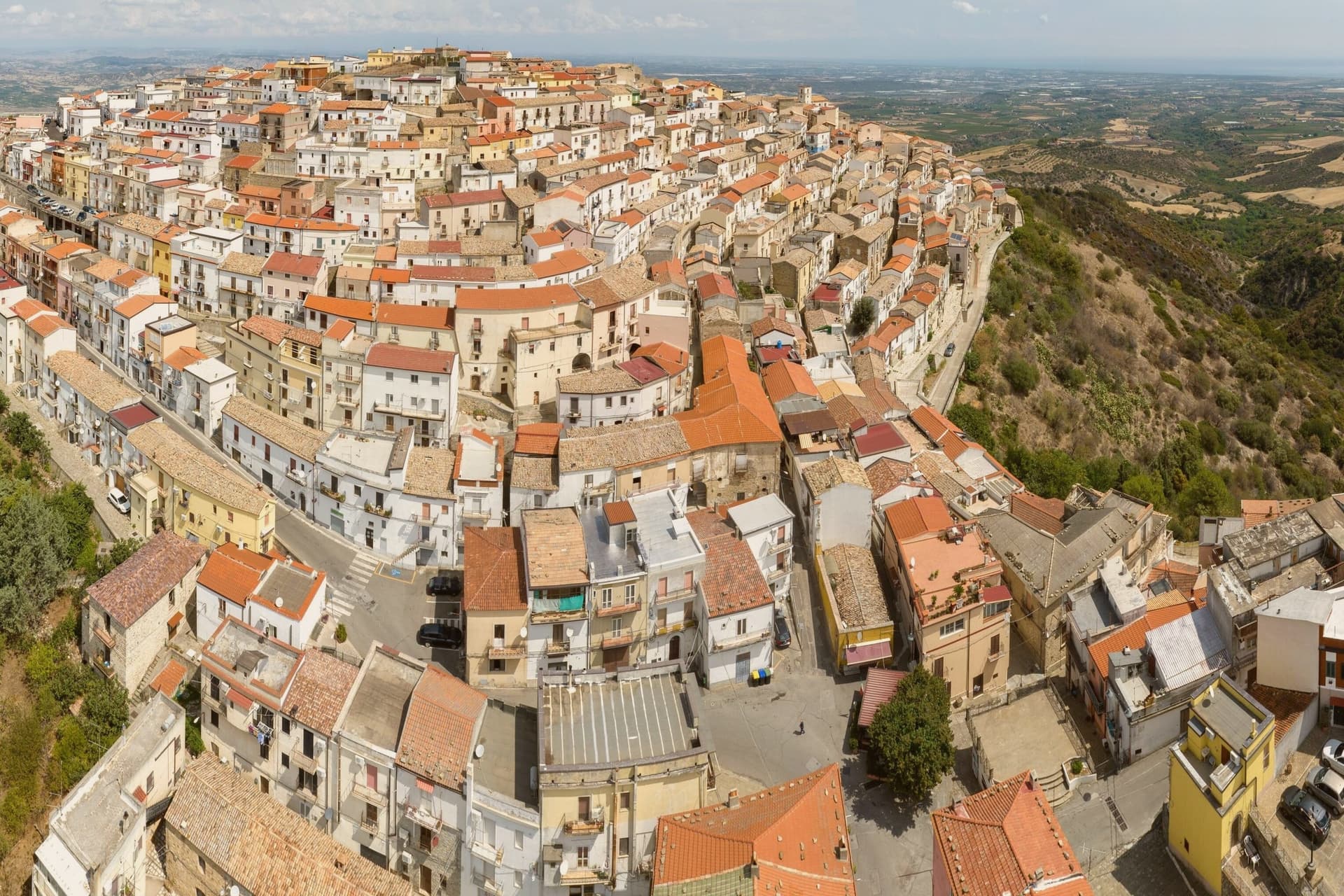
Rotondella
Province: Matera · 576 m
A 2,400-resident Lucanian borgo on a 576m hilltop, its medieval streets ringed concentrically around the summit above the Metapontino plain.
Sant'Angelo Le Fratte
Province: Potenza · 560 m
A village of 1,295 in the Melandro valley whose house fronts are painted with trompe l'oeil murals, so that a real balcony sits beside a painted one and a woman in old Lucanian dress leans out of a wall.
Aliano
Province: Matera · 555 m
The clay-hill village at 555 meters above the Agri valley where Carlo Levi served his 1935 exile and is buried in the cemetery.
Irsina
Province: Matera · 548 m
A 548-meter Bradano-valley hill town, called Montepeloso until 1895, whose cathedral holds a Renaissance rarity.
San Mauro Forte
Province: Matera · 540 m
A 540-meter Lucanian hill town built around a surviving Norman tower, where the Sagra dei Campanacci on 16 January wakes the village with cowbells.
Melfi
Province: Potenza · 530 m
At 530 meters on volcanic slopes, first Norman capital of the south and seat of a landmark 1231 legal code issued from its castle.
Grottole
Province: Matera · 481 m
A hilltop borgo at 481 meters between the Bradano and Basento, where six hundred empty houses outnumber residents in the centro storico.
Rivello
Province: Potenza · 479 m
A 479-meter ridge above the Noce valley where Lombards and Byzantines lived side by side, holding Latin and Greek rites until the seventeenth century.
Miglionico
Province: Matera · 461 m
A hilltop borgo at 461 meters above the Bradano, the seven-tower castle that gave the 1485 Conspiracy of the Barons its hall.
Venosa
Province: Potenza · 415 m
Founded as Roman Venusia in 291 BC, birthplace of Horace, with an unfinished abbey built from amphitheater stones and a 1470 Aragonese castle.
Matera
Province: Matera · 401 m
Cave dwellings carved into limestone since the Paleolithic, called the shame of Italy in the 1950s and made European Capital of Culture in 2019.
Craco
Province: Matera · 391 m
A medieval ghost town on a clay cliff, emptied by landslide and earthquake, now walked only on a guided path.
Pisticci
Province: Matera · 364 m
A hill town on eroded clay above the Ionian, rebuilt in three hundred identical white houses after survivors refused to leave the ground the landslide had passed over.
Valsinni
Province: Matera · 250 m
A 1,344-resident Lucanian borgo on a hilltop above the Sinni river, where a 16th-century Renaissance poet was murdered by her brothers in 1545, marked today by a Touring Club Bandiera Arancione and a place inside the Pollino park.
The slow-trip planner
Plan a slow trip across the towns travelers skip.
Answer five questions. We will shape a geographically coherent slow trip from the 1,000 Italian towns most travelers skip. Yours to save and share.
From elsewhere in Italy
Five more towns to discover
Visso
Province: Macerata
The northern Sibillini gate at 607 meters where the Nera meets the Ussita, holding one of two surviving manuscripts of Leopardi's L'Infinito.
Goriano Sicoli
Province: L'Aquila
At 720 meters in the Subequana valley, a medieval village drawn by M.C. Escher in 1929 keeps a May ritual folklorists trace to Demeter.
Ugento
Province: Lecce
A Messapian-Roman town five kilometers from the Ionian, where a Baroque castle sits on the walls of the ancient city of Ozan.
Fontanellato
Province: Parma
A Parma-plain town built around the Rocca Sanvitale, the moated fortress at its center.
Pescina
Province: L'Aquila
A Marsica town at 735 meters, on the rim of the drained Fucino basin, that lost five thousand of six thousand people in a single morning in 1915.