
The best coastal towns within two hours of Udine
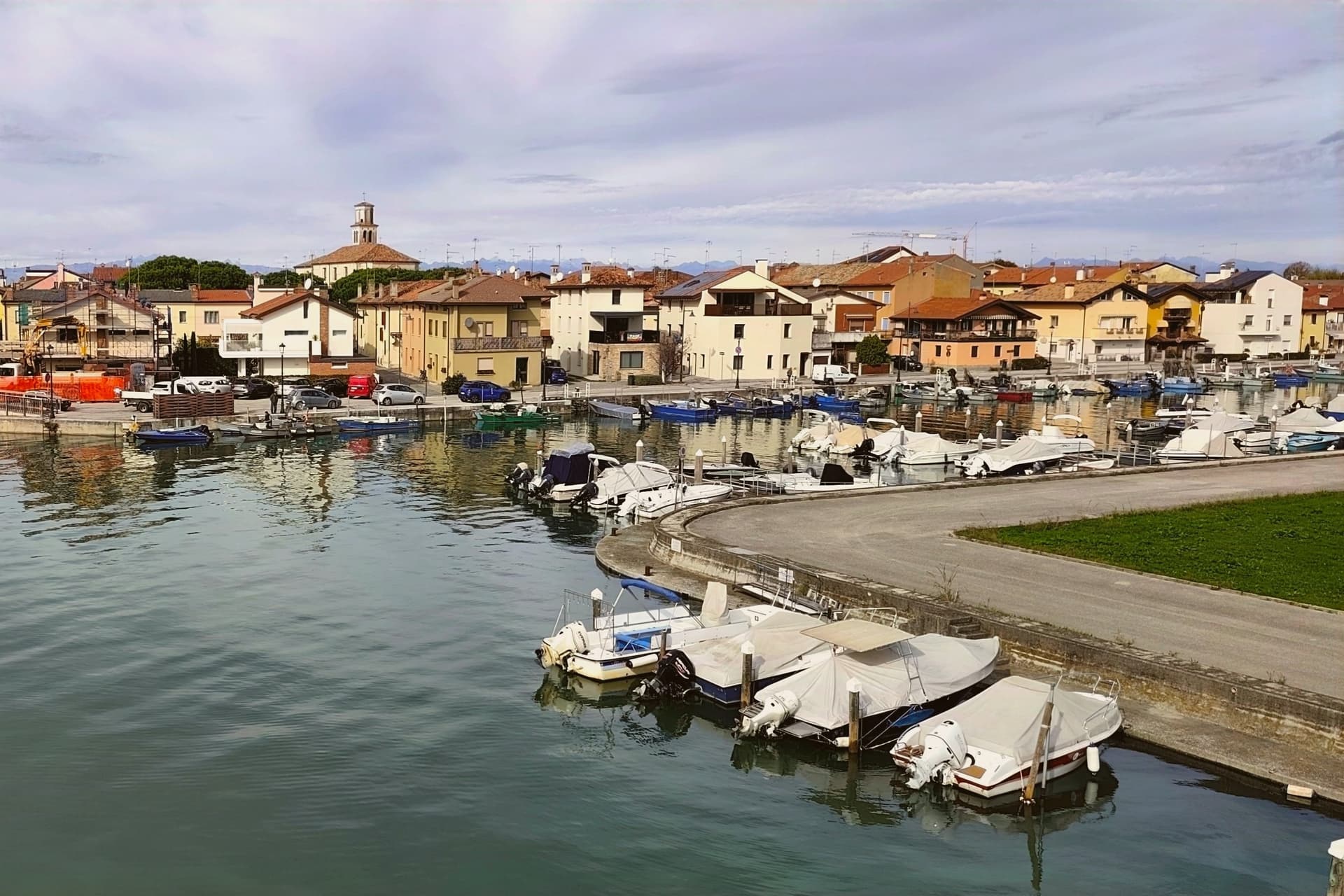
The Adriatic north of Venice does not look like the rest of Italy's coast. Here the sea flattens into lagoon, cut by channels marked with wooden bricole, edged by reedbeds and salt flats where herons stand in the shallows. The fishing towns are built low, in plaster washed ochre and pink, with boats tied at the end of the street rather than in a marina, and the kitchens run on sardoni, canoce, eel and brodetto. Autumn is the season worth planning for, when the light goes long over the water, the bora begins to clear the air and the seafood tables stop needing a booking a week ahead.
Most people arriving from Udine head straight for Lignano Sabbiadoro, which has the long sand, the pine woods and the full summer machinery of umbrellas, hotels and traffic queues on the approach road. It works, and in July and August it works for a very large number of people at once. Those who want the historic version go the other way, into Venice, and join the crowds on the vaporetti. Both are legitimate. Neither tells you much about what this coastline actually is.
The same lagoon continues east and west past the resorts, and it keeps its fishing fleets, its Roman ruins, its Habsburg cafés and its Istrian border cooking. There are towns here where the catch is auctioned in the morning and eaten at lunch, where a basilica floor of fourth-century mosaic sits inland of the water, and where the coast turns rocky and starts speaking Slovene as much as Italian. Fewer travellers stop in them, which mostly means shorter waits and cheaper rooms. All of them are reachable from Udine inside a morning's drive.
Of the 42 communes we have mapped in a 120-minute drive of Udine, 6 qualify as coastal towns: each is on the sea. The smallest, Marano Lagunare, has 1,713 residents.
Elsewhere in the catalogue: The best coastal towns within two hours of Venice and The best coastal towns within two hours of Padua.
Marano Lagunare
Why visit Marano Lagunare
Marano Lagunare sits on a single fingertip of land at the mouth of the Stella river, surrounded by the Laguna di Marano and Grado: the largest lagoon in Friuli-Venezia Giulia. The town was a Roman port, Maranum, mentioned by Pliny, then a fishing town under the Patriarchate of Aquileia, then a fortified Venetian outpost from 1420 until the fall of the Republic in 1797.
Each layer left its mark on the same small footprint: the Roman-era estuary settlement, the Aquileian fishing economy that still runs the harbour, and the Venetian grid of houses and watchtower around the piazza. The fleet and the lagoon are the same fact seen from two sides.
The moeche harvest, the schie shrimp, and the daily catch move directly from boat to osteria, and the dialect spoken in the streets is a pocket of Venetian speech that outlasted the Republic itself, holding on in a region that speaks Friulian. The town's whole history reads as a single settlement repeatedly absorbed by larger powers, Roman, Aquileian, Venetian, without ever losing the lagoon that defines its geography and its economy alike.
What to see in Marano Lagunare
- Porto e centro storico. Pastel-coloured fishermen's houses in a tight grid around a single piazza, with the watchtower anchoring the harbour where the fleet still ties up.
- Laguna di Marano. Moeche soft-shell crab harvest runs spring and autumn, alongside daily fishing. Small-boat tours reach the casoni, traditional thatched fishermen's huts on the lagoon islands.
- Riserva Naturale Foci dello Stella. Natura 2000 wetland at the Stella river estuary, reachable by short boat hop from the harbour. Reedbeds, birding hides, herons and migratory waterfowl.
How to get to Marano Lagunare
Udine is roughly 44 minutes away by road.
Our tip
April through October is the prime season — calm lagoon, working fleet daily, and the osterie at full menu. May and September are the moeche soft-shell-crab seasons; the local boats land them at dawn and the osterie serve them within hours. June bears the highest summer light over the lagoon; July-August are hot and busy with regional tourism but the lagoon stays workable. Fasolari in Festa falls in August.
Aquileia
Why visit Aquileia
Aquileia sits at five meters above sea level on the Friuli plain, ten kilometers inland from the Adriatic at the head of the Grado lagoon. Rome founded it as a military colony in 181 BC.
By the second century AD it held close to 100,000 people, was the capital of Augustus's Regio X, and ranked among the nine great cities of the empire. Attila's Huns sacked it in 452, the population scattered to the lagoon islands, and the surface town never recovered.
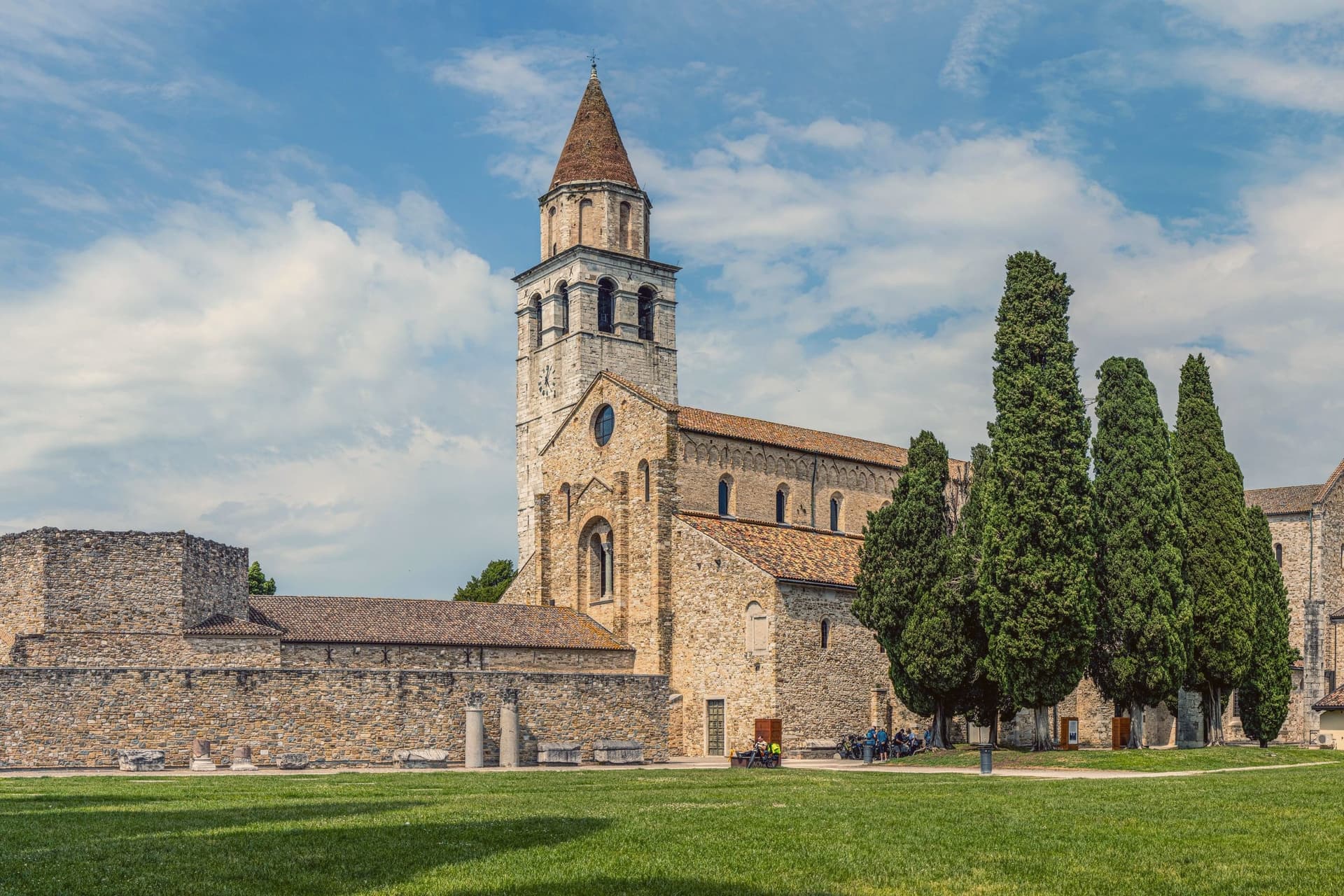
The Roman city below is largely unexcavated, which makes Aquileia, in UNESCO's words, the most complete example of an Early Roman city in the Mediterranean. Above it, Patriarch Poppo rebuilt the basilica in 1031 over a fourth-century church.
Its floor is the largest paleochristian mosaic in the Western world, 760 square meters of fish, birds, jonah and the whale, uncovered by archaeologists in 1909. The 73-meter campanile uses stone quarried from the Roman amphitheater.
The Patriarchate of Aquileia survived until 1751.
What to see in Aquileia
- Basilica di Santa Maria Assunta. Patriarch Poppo's eleventh-century basilica over a fourth-century church, with a 760-square-meter paleochristian mosaic floor uncovered in 1909.
- Campanile di Poppo. Free-standing 73-meter bell tower built in the eleventh century with stone quarried from the Roman amphitheater, raised again in the fourteenth.
- Foro Romano. Excavated section of the Roman forum along the Via Sacra, with the bases of columns and reused capitals from the second century AD.
How to get to Aquileia
There is a railway station in the town, so you can arrive without a car and never need one while you are here. Udine is roughly 43 minutes away by road.
Our tip
May through September is the working season for Aquileia. The basilica is open daily, the archaeological park stays light until late, and the lagoon at Grado five kilometers south is swimmable. July and August are hot and humid on the plain, often pushing above thirty-two degrees, and the mosaic floor is the coolest room in town. Festa dell'Unità falls in July.
Grado
Why visit Grado
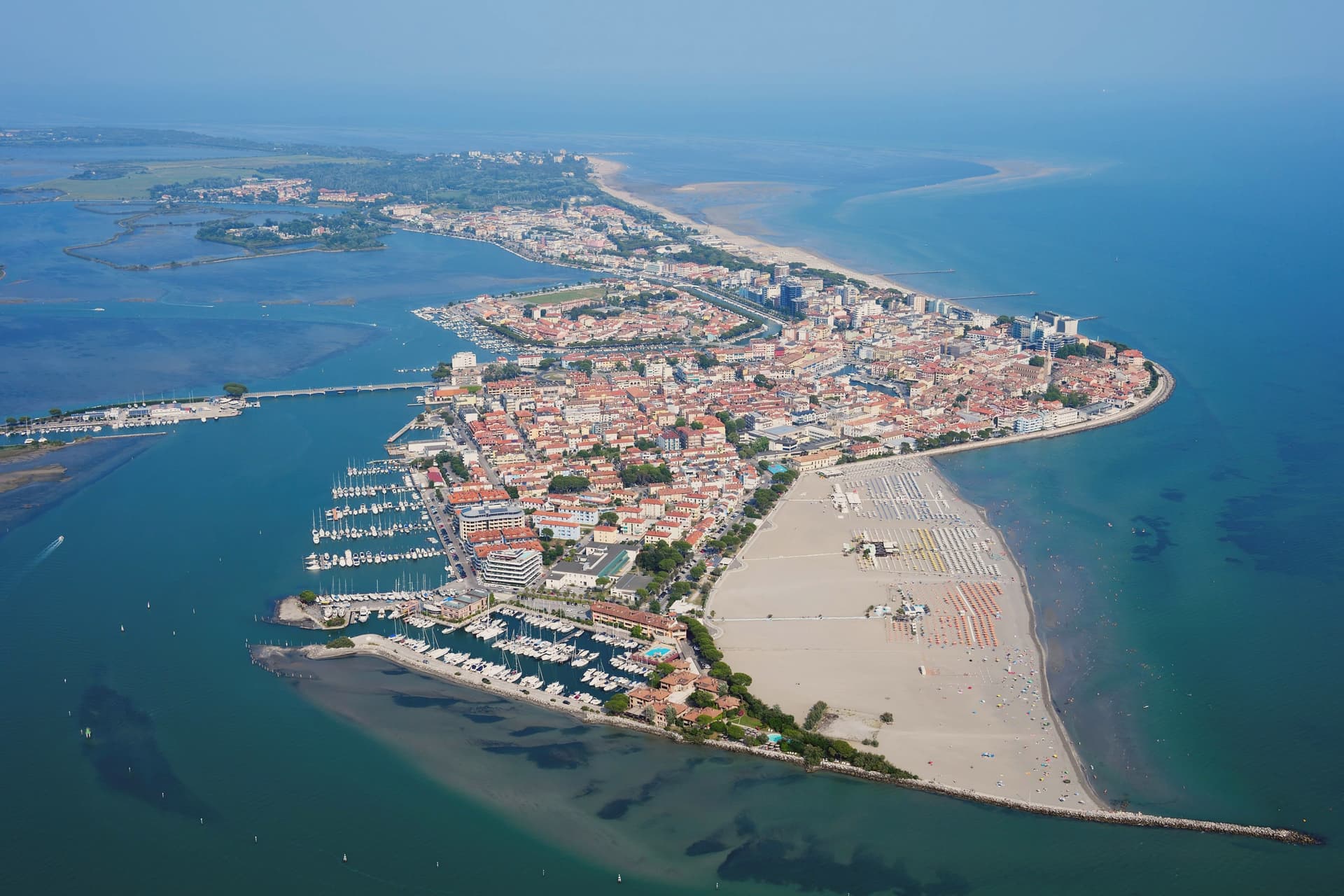
Grado is an island town in the Marano-Grado Lagoon, between Venice and Trieste, on a 90-square-kilometer mosaic of shallow water, sandbanks, and reedbeds. When the Lombards took Aquileia in 568, the metropolitan fled here; the Aquileian see was transferred to Grado in 579 and the town became known as New Aquileia.
Bishop Elia consecrated the Basilica of Sant'Eufemia on November 3, 579, on the patriarchal square. The patriarchate moved to Venice in 1105 and was formally suppressed in 1451, but Grado kept the basilica, the sixth-century baptistery, and the lapidarium.
The town became Italian seaside in the Habsburg sense in the nineteenth century, when Empress Sissi's circle gave it the imperial bathing certification; the long sandy beaches and lagoon climate did the rest. Today it carries the Bandiera Blu and is the only Italian Adriatic resort that opens directly south, with full-day sun.
The casoni, thatched fishermen's huts on the lagoon islets, are still in use.
The beach here holds the national bathing award, which a comune has to win back every year on water quality, beach management and safety.
What to see in Grado
- Basilica di Sant'Eufemia. Sixth-century basilica consecrated in 579 by Patriarch Elia, with original mosaic floor, lapidarium, and the suppressed patriarchal cathedra of Grado.
- Battistero di Sant'Eufemia. Hexagonal sixth-century baptistery next to the basilica, with octagonal immersion font and the oldest preserved liturgical architecture in the lagoon.
- Basilica di Santa Maria delle Grazie. Fifth- to sixth-century three-nave basilica on the patriarchal square, with original mosaic flooring and remains of the earlier early-Christian structure.
How to get to Grado
Udine is roughly 46 minutes away by road.
Our tip
May through September is the season the town was rebuilt for. Beach umbrellas line the southern shore, lagoon boats run scheduled trips out to the casoni and the Valle Cavanata, restaurant tables spread out along the riva. July and August fill with Austrian, German, and Italian families on full bathing weeks; book ahead and expect price surcharges.
Muggia
Why visit Muggia
Muggia sits at 13 meters on the eastern flank of the Gulf of Trieste, the only Italian port town on the Istrian peninsula and the last commune before the Slovenian border. The bones go back to a prehistoric castelliere, eighth or seventh century BC, which the Romans turned into Castrum Muglae in 178 BC.
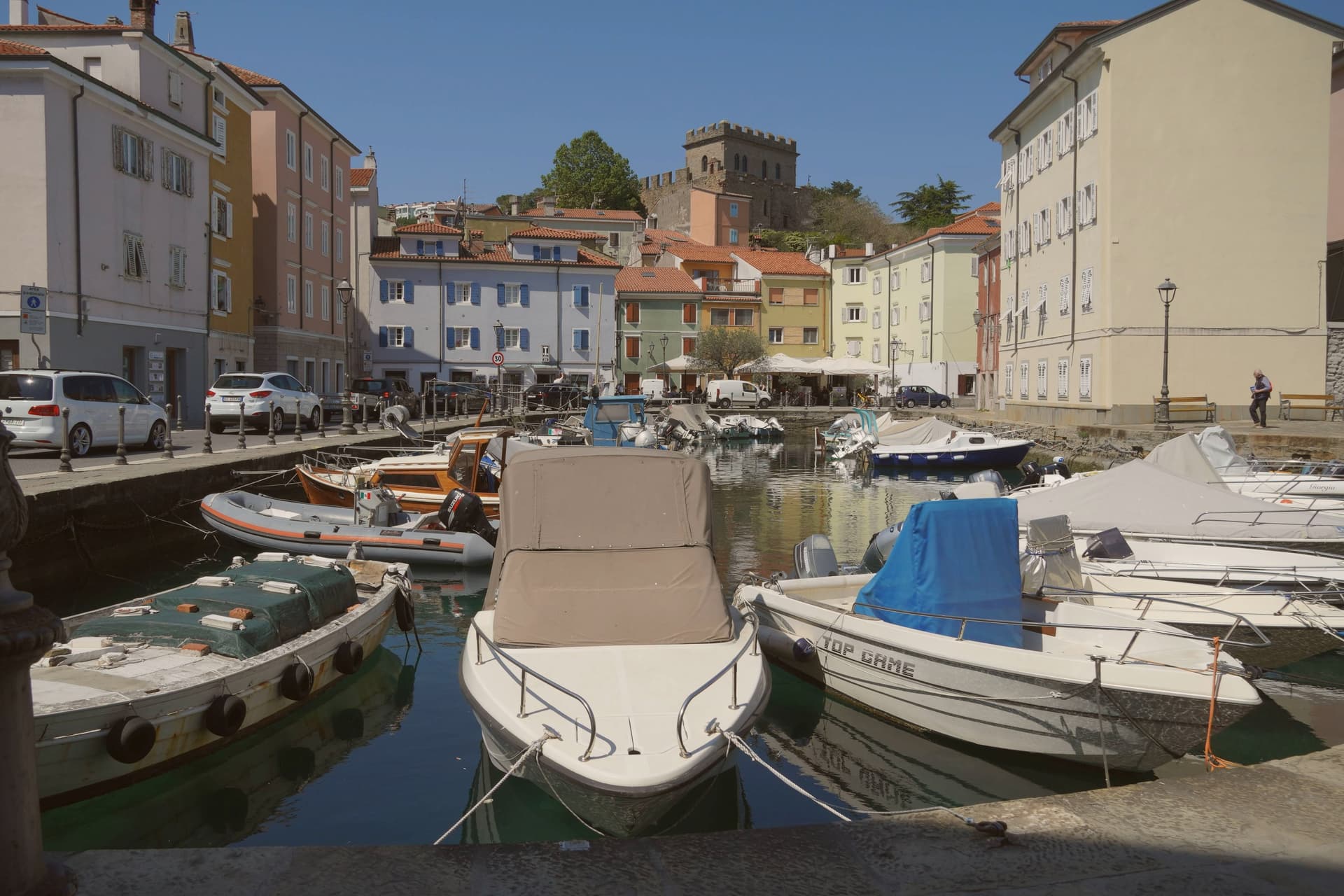
After Venice took it in 1420 the town acquired the architecture it still wears: tri-lobed Gothic facades, narrow calli, a mandracchio harbor ringed by pastel houses. The Duomo of Santi Giovanni e Paolo was consecrated in 1263 and faced with Aurisina limestone in 1467 in Venetian Renaissance Gothic.
After Venice fell in 1797, Muggia entered the Austrian Empire and grew on naval shipbuilding through World War II. The town joined Italy in 1918.
The Carnevale, ten parading companies in custom costumes, runs as the oldest in Friuli-Venezia Giulia.
What to see in Muggia
- Duomo dei Santi Giovanni e Paolo. Cathedral consecrated in 1263, refaced in 1467 with Aurisina limestone and a tri-lobed Venetian Renaissance Gothic façade, the visual symbol of the town.
- Castello di Muggia Vecchia. Hilltop fortress above the town on the site of the prehistoric castelliere, rebuilt by Romans, the Patriarchate of Aquileia, and Venice, then abandoned.
- Mandracchio. Sheltered small-boat harbor at the center of the town, pastel houses lining the water, ranked among the fifteen most beautiful small ports in Italy.
How to get to Muggia
There is a railway station in the town, so you can arrive without a car and never need one while you are here. Trieste is roughly 22 minutes away by road.
Our tip
May through September is the open season on the gulf. The mandracchio fills with boats, tables spread along the water, evening temperatures stay in the low twenties. July and August bring crowds out of Trieste; the harborfront restaurants book up. Carnevale Estivo di Muggia falls in August.
Chioggia
Why visit Chioggia
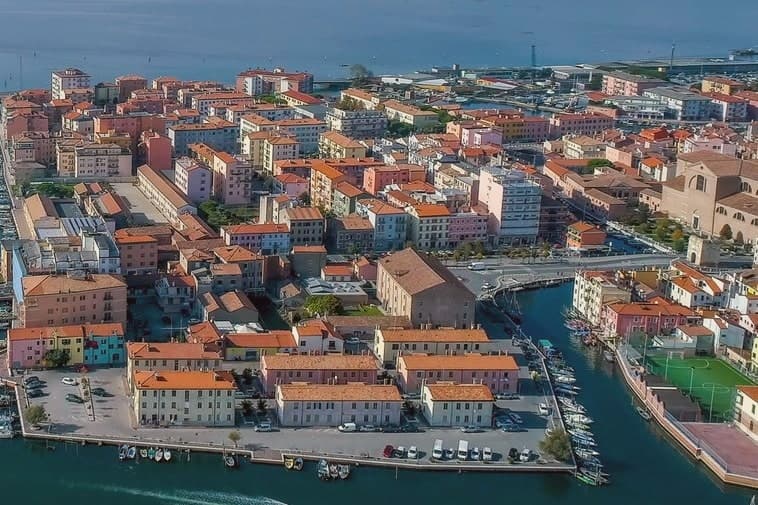
Chioggia sits at 2 meters on a small island at the southern entrance to the Venetian Lagoon, twenty-five kilometers south of Venice and connected to the mainland and to its frazione Sottomarina by causeways. The Romans knew it as Clodia.
By the eleventh and twelfth centuries it had grown into a salt-producing port and became a free commune in 1110. The naval war that carries the town's name ran through 1378-81 and ended Genoese rivalry with Venice, leaving Chioggia under the Serenissima for the next four centuries.
The defeat reduced the town to fishing, salt and limited Adriatic trade. The fleet never left.
The street plan is a herringbone of calli running off the town's single straight spine, with three canals threading between them and the bridges that gave the town its Little Venice nickname. Inland lies the historic island itself; across the causeway sits Sottomarina, the beach frazione facing the open Adriatic where the lagoon town has none.
What Chioggia lost at sea it kept at the dock: a working port still built around the same trade that outlasted the war which was supposed to end it.
The beach here holds the national bathing award, which a comune has to win back every year on water quality, beach management and safety.
What to see in Chioggia
- Cattedrale di Santa Maria Assunta. Cathedral founded in the eleventh century, raised to episcopal seat in 1110, rebuilt from 1623 to designs by Baldassare Longhena.
- Canale Vena. Main canal of the centro storico, lined with fishing boats and crossed by nine bridges including the seventeenth-century Ponte Vigo.
- Mercato del Pesce. Wholesale fish market on the canal, open before dawn six days a week, the operating center of the Adriatic fleet.
How to get to Chioggia
There is a railway station in the town, so you can arrive without a car and never need one while you are here. Venezia is roughly 46 minutes away by road.
Our tip
May through September is the working season. June and early July bring warm Adriatic water and the long Sottomarina beach to capacity on weekends; mid-August fills it past comfort. The Sagra del Pesce on the third weekend of July puts the whole fleet on display along Canale Vena.
Trieste
Why visit Trieste
Trieste sits at the head of its gulf, on a narrow strip of Italian land between the Adriatic and Slovenia. Rome made it a colony under Julius Caesar; Augustus built the harbor and walls around 33 BC.
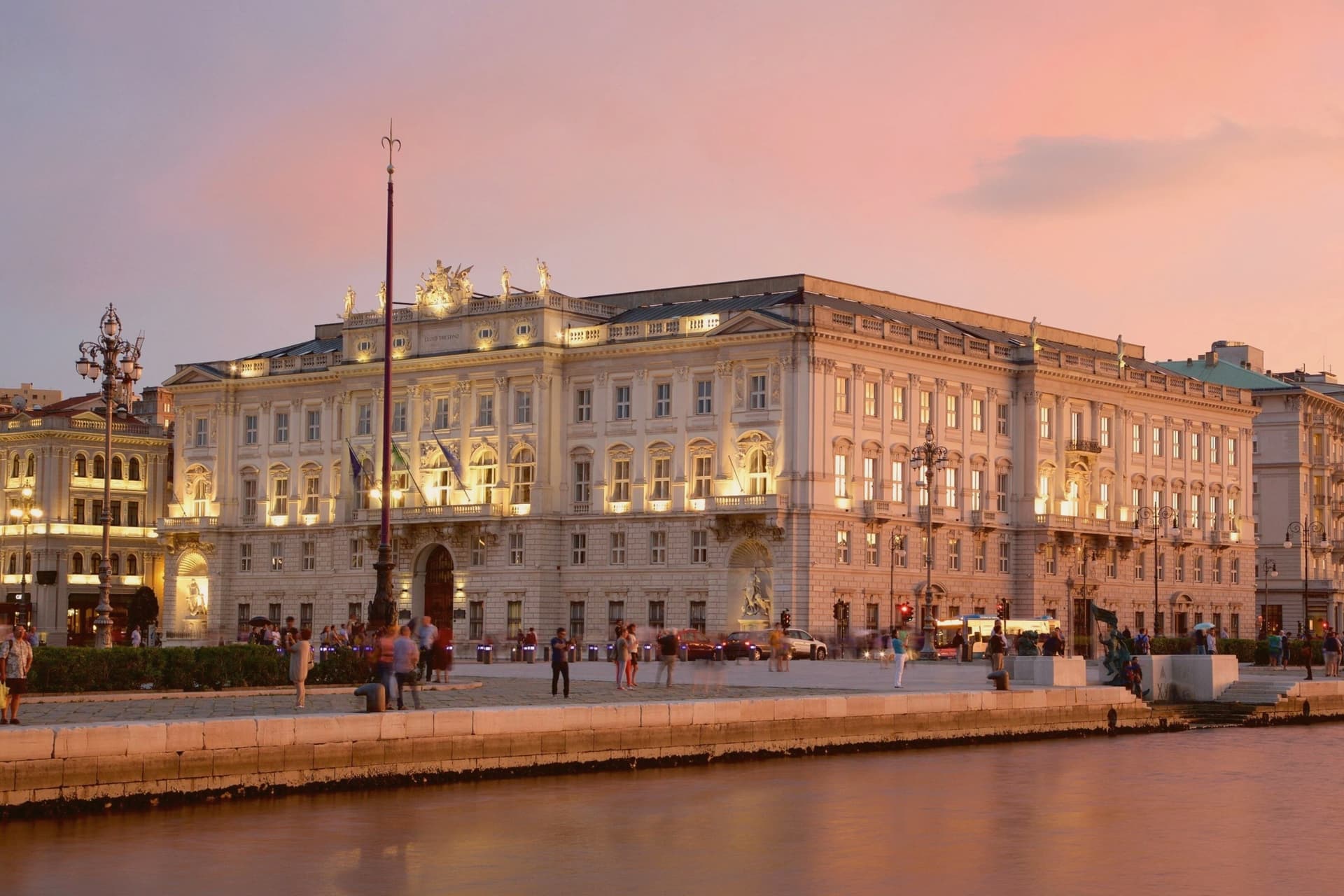
The Habsburgs held the city from 1382 until 1918 and ran it as their empire's free port, the access route to the sea for Vienna: that arrangement set the shape of the modern city, laying out the Borgo Teresiano and the Canal Grande that cuts into it, and opening the great sea-facing square onto the water where the old town meets the Habsburg extension. The castle on the cliffs north of town was built by Archduke Maximilian, who left it for Mexico in 1864 and was executed three years later.
The former rice-husking plant used as the only Nazi camp on Italian soil with a crematorium sits in the southern industrial belt, apart from the imperial center. A city built as an empire's outlet to the sea, then handed over at the end of that empire, carries both the harbor it was built for and the border it was built against.
What to see in Trieste
- Piazza Unità d'Italia. The largest sea-facing square in Europe, framed by Habsburg-era municipal and Austrian Lloyd buildings opening directly onto the Adriatic.
- Castello di Miramare. White castle on the cliffs north of the city, set in a park of acclimatized Mediterranean and exotic species.
- Cattedrale di San Giusto. Romanesque cathedral on the San Giusto hill, formed from the eleventh-century fusion of two adjoining basilicas, with fifth-century mosaics and a fourteenth-century rose window.
How to get to Trieste
There is a railway station in the town, so you can arrive without a car and never need one while you are here. Trieste is roughly 10 minutes away by road.
Our tip
May through September is the open season on the gulf. The bora, the dry northeast wind that defines Trieste weather, drops off, the cafés put tables on Piazza Unità, and the Barcola sea promenade fills with swimmers. July and August are warm but moderated by the sea, less heavy than the Friulian plain. Sagra di San Marco falls in April.
More from Anywhere Italy
- The best coastal towns within two hours of Venice
- The best coastal towns within two hours of Padua
- The best towns that eat well within 75 minutes of Trieste
- The best towns you can reach by train within an hour of Trieste
 The best hidden towns you can reach by train in Friuli-Venezia Giulia
 The best towns with a food festival in Friuli-Venezia Giulia