
Piedmont · Alessandria
Cella Monte
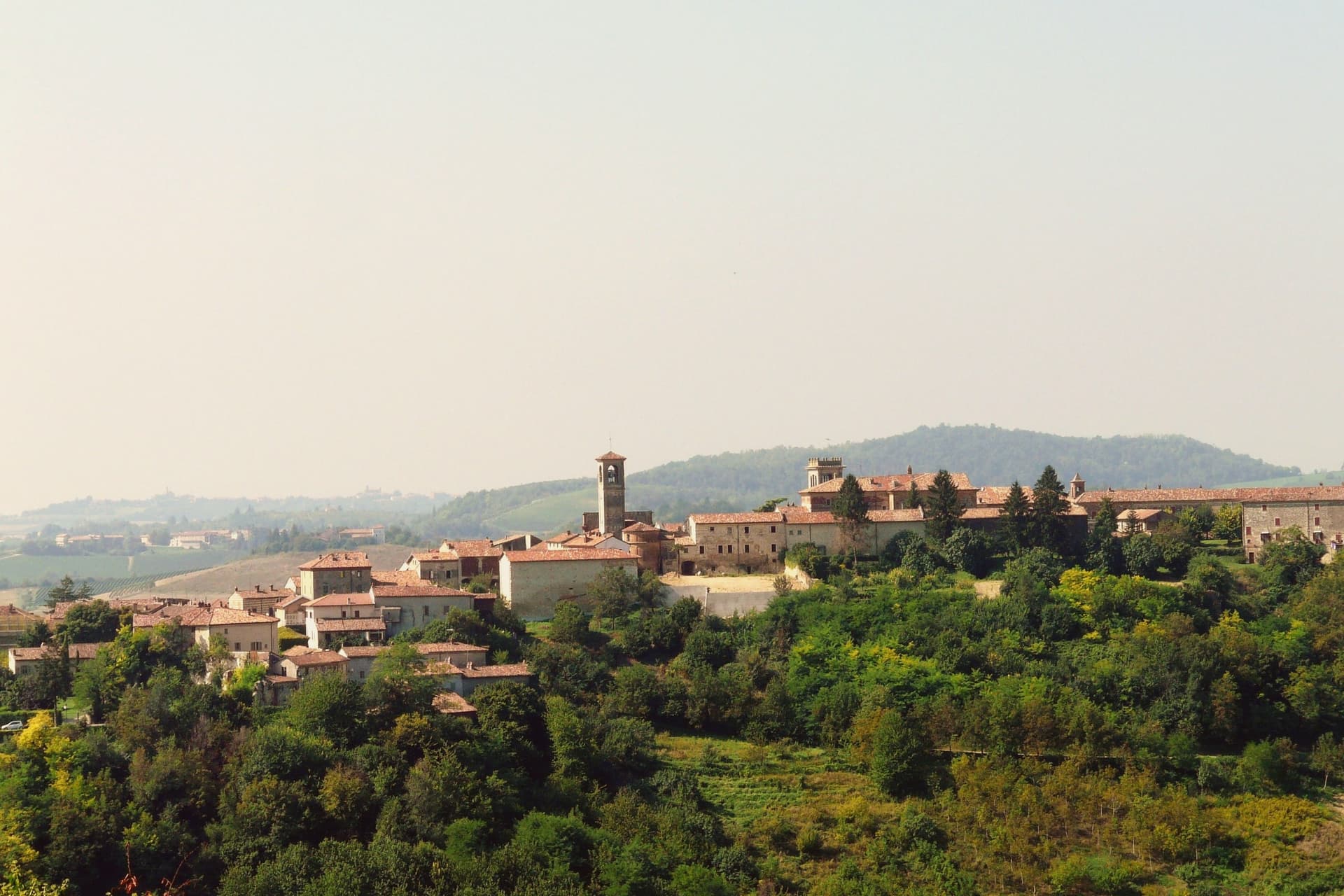
A 465-person Monferrato Casalese borgo, built entirely from a sandstone found only here, riddled underneath with cellars carved into the same stone.
- Best time
- Apr–Oct
- By car
- 1 h 27 min from Turin
- Population
- 465
Known for
INFERNOT
Underground sandstone cells dug between 1830 and 1860 for storing wine; component of the UNESCO Vineyard Landscape of Piedmont.
PIETRA DA CANTONI
Local marine sandstone, 20-million-year-old, used as the construction stone for the entire village and its underground cellars.
ECOMUSEO
Ecomuseum of the pietra da cantoni inside Palazzo Volta, the village interpretive centre for stone, infernot and rural architecture.
DOCG ZONES
The commune lies inside the Barbera d'Asti and Barbera del Monferrato Superiore DOCG production zones.
When to visit
Best · Apr–Oct
- J7°
- F12°
- M14°
- A18°
- M22°
- J27°
- J30°
- A30°
- S24°
- O19°
- N12°
- D7°
- Best
- Hot or crowded
- Quiet
- Mostly closed
Daytime averages, 2020–2024. Weather data by Open-Meteo.com.
The festa: Quirico e Giulitta, 16 June
Why come
Cella Monte sits in the Monferrato Casalese hills, ten kilometers south-west of Casale Monferrato. The commune holds 465 people. The defining material is pietra da cantoni, a soft sandstone formed when the Padana sea retreated more than 20 million years ago, found only in this stretch of hill country.
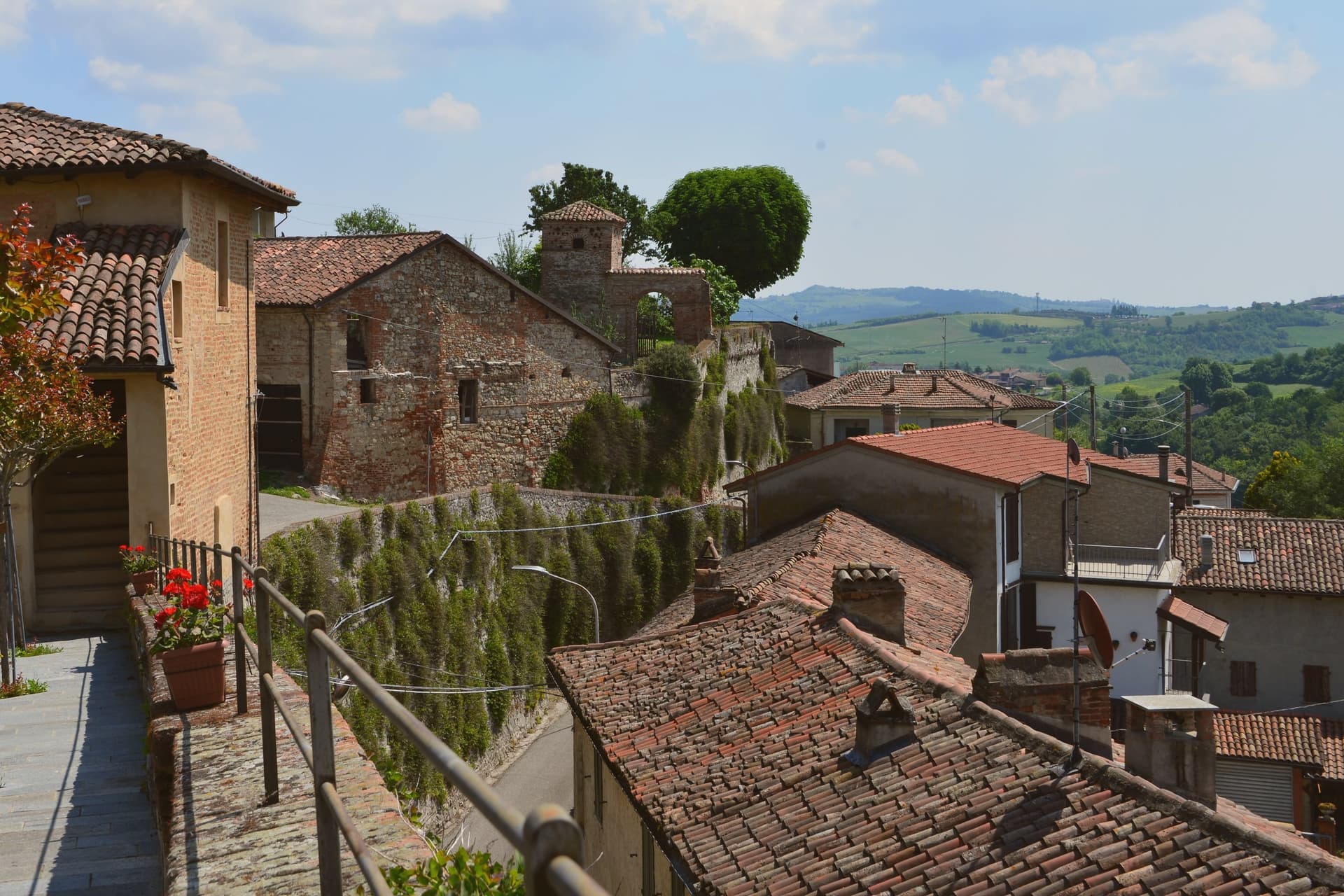
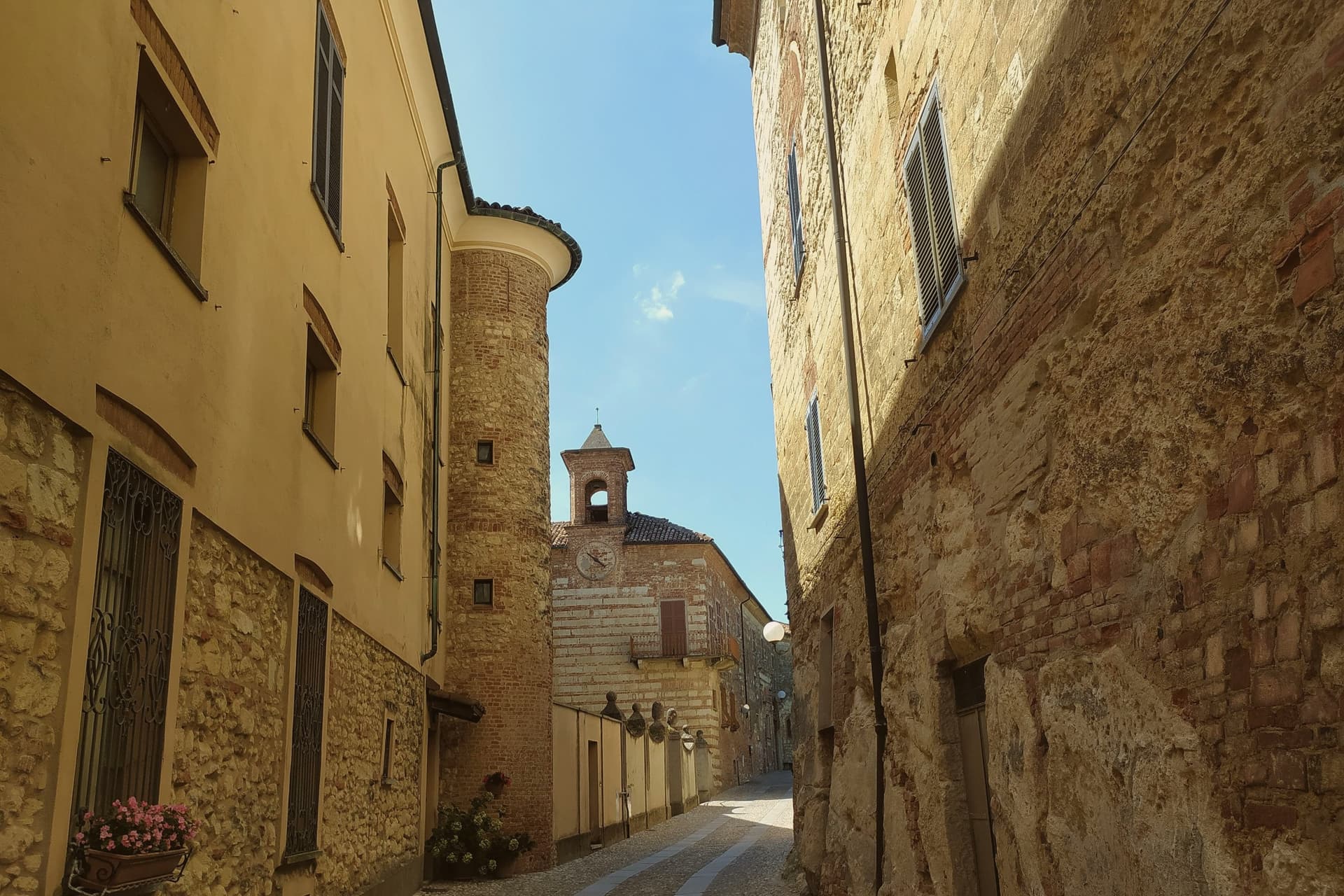
The village is built out of nothing else: walls, arches, courtyards and retaining structures all in the same yellow-grey block, so that the church, the palazzo and the ordinary houses of the centro storico read as one continuous fabric rather than separate buildings in a shared style. Underneath that surface the same stone was hollowed out again. Each infernot sits off a family wine cellar, cut into the sandstone itself, and the cold, dark, still air below ground did what the rooms above could not: keep the best bottles at constant temperature, undisturbed by light, draught or noise.
The village above is stone assembled; the village below is stone removed. Cella Monte is best understood as that pairing, a single sandstone worked in two opposite directions, one raising the borgo and the other hollowing out beneath it.
The Sunday letter
Cella Monte is on our list. Its letter is still to come.
We are writing about all 1,000 of these towns, one at a time, in a free letter every Sunday: the photo, the food, the festa. That is our mission. Sign up and you will be there when Cella Monte comes up. By Peter & Sophia, from Pietrasanta.
Read on
Cella Monte in our articles
 The 6 best hill towns in the province of Alessandria6 towns, Cella Monte among them.
 The prettiest villages within 90 minutes of Novara6 towns, Cella Monte among them.
 The best hill towns within 90 minutes of Novara9 towns, Cella Monte among them.
 10 comuni under 1,000 people within an hour of a major city10 towns, Cella Monte among them.
How to get there
From Turin (TRN), about 1h 27m by car.
Genoa (GOA) is about 1h 31m away.
By car from the centre of Milan 1h 31m.
Coming by train into Torino Porta Susa? Cella Monte is about 1h 24m away by road.
What to see
Infernot di Cella Monte
Small cells reached from the family wine cellar, dark, windless and at constant temperature, built to hold the household's best bottles rather than the everyday stock.
Ecomuseo della Pietra da Cantoni
Museum of stone and infernot construction, laid out across rooms whose restoration exposed the palazzo's older fabric beneath later plaster and masonry.
Palazzo Volta
Restored noble palazzo in the centro storico, home of the Ecomuseo, with a fifteenth-century loggia recovered under later masonry.
Chiesa di San Quirico
Parish church of the village, standing among the same yellow-grey blocks that make up the borgo's houses and courtyards.
Centro storico
A compact hill settlement where street, wall and courtyard read as a single material, and where the underground cellars sit beneath the surface streets.
The slow-trip planner
Building a trip? Find where Cella Monte fits in a slow Italy circuit.
Answer five questions. We will shape a geographically coherent slow trip from the 1,000 Italian towns most travelers skip. Yours to save and share.
Living here
- Population 465
- Commuter belti
- Pharmacy in town
- High school within a 30-minute drive
- Nearest airport Turin, 1 h 27 min drive
- Regional capital Torino, 1 h 27 min drive
Common questions
- What is Cella Monte known for?
- Cella Monte is a 465-person Monferrato Casalese borgo at 268 meters, built entirely from a sandstone found only here, riddled underneath with cellars carved into the same stone.
- Where is Cella Monte?
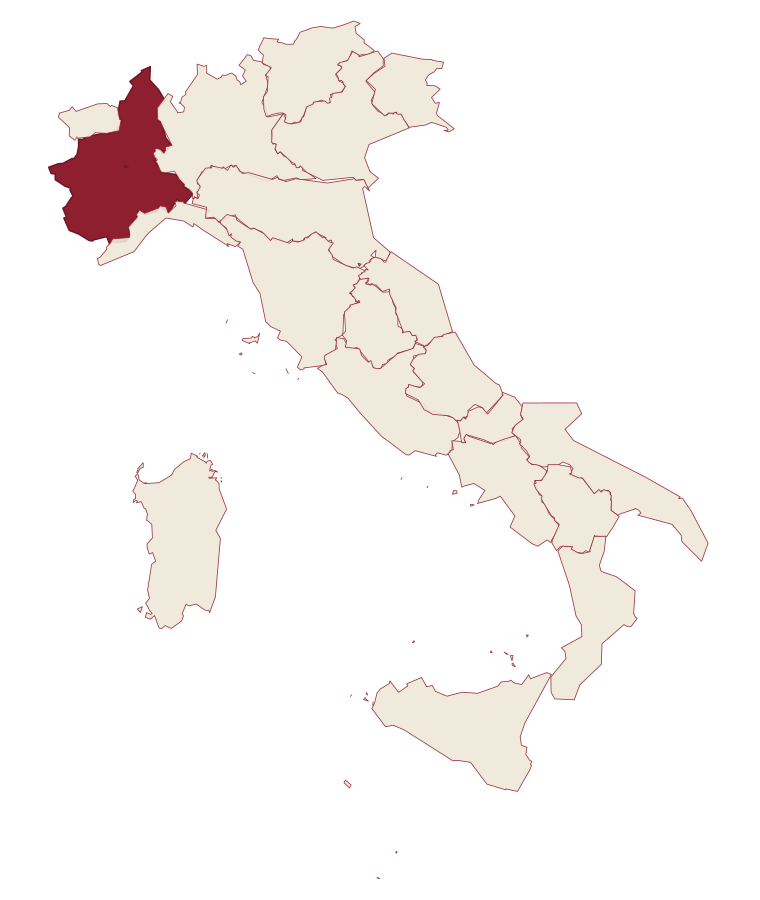
- Cella Monte is a comune in the province of Alessandria, in Piedmont.
- What is the nearest airport to Cella Monte?
- Turin (TRN), about 1h 27m by car.
- How long is the drive from Milan to Cella Monte?
- About 1h 31m by car.
- When is the best time to visit Cella Monte?
- Best in Apr–Oct. July is the warmest month, averaging 30 degrees, and May the wettest, with about 15 rain days.
- Is there a sagra or a festival in Cella Monte?
- The town keeps its patron saint's day: Quirico e Giulitta, 16 June.
- Which other towns are like Cella Monte?
- Serralunga di Crea, Barolo and Verduno.
- How many people live in Cella Monte?
- 465 at the 2023 count.
Tags & datadesignations · numbers · sources
Recognised as
The numbers
- Elevation: 268 m
- Population: 465
- Surface area: 5.55 km²
These figures were compiled from public directories: ISTAT, OpenStreetMap and Wikidata, and from the official listings of the guides named on this page. Town details change; verify with official sources before you travel.
Similar
Towns like Cella Monte
Serralunga di Crea
Province: Alessandria
both inland, away from the coast · both under 1,000 people
Barolo
Province: Cuneo
both inland, away from the coast · both under 1,000 people
Verduno
Province: Cuneo
both inland, away from the coast · both under 1,000 people
Serralunga d'Alba
Province: Cuneo
both inland, away from the coast · both under 1,000 people
Scheggino
Province: Perugia
both inland, away from the coast · both under 1,000 people
Moresco
Province: Fermo
both inland, away from the coast · both under 1,000 people
🎨 Borghi più belli d'Italia
More Borghi più belli d'Italia towns in Piedmont
Barolo
Province: Cuneo
A Langhe borgo at 301 meters whose Castello Falletti gave its name to the wine the Marchesi turned dry in the 1830s with Cavour's help.
Biella
Province: Biella
A wool city at 417 meters in the Alpine foothills, where the medieval Piazzo sits above the modern Piano, connected by a funicular since 1885.
Candelo
Province: Biella
A Biellese commune at 350 meters whose Ricetto, a 13th-century fortified shelter of two hundred stone cellule, is the best-preserved in Piedmont.
Castagnole delle Lanze
Province: Asti
An Asti hill town at 298 meters between Langhe and Monferrato, with two Baroque churches and a nineteenth-century astronomical tower.
Cocconato
Province: Asti
A Monferrato ridge town at 491 meters with a microclimate mild enough to grow palms and olives this far north.