
The best towns you can reach by train in the province of Teramo
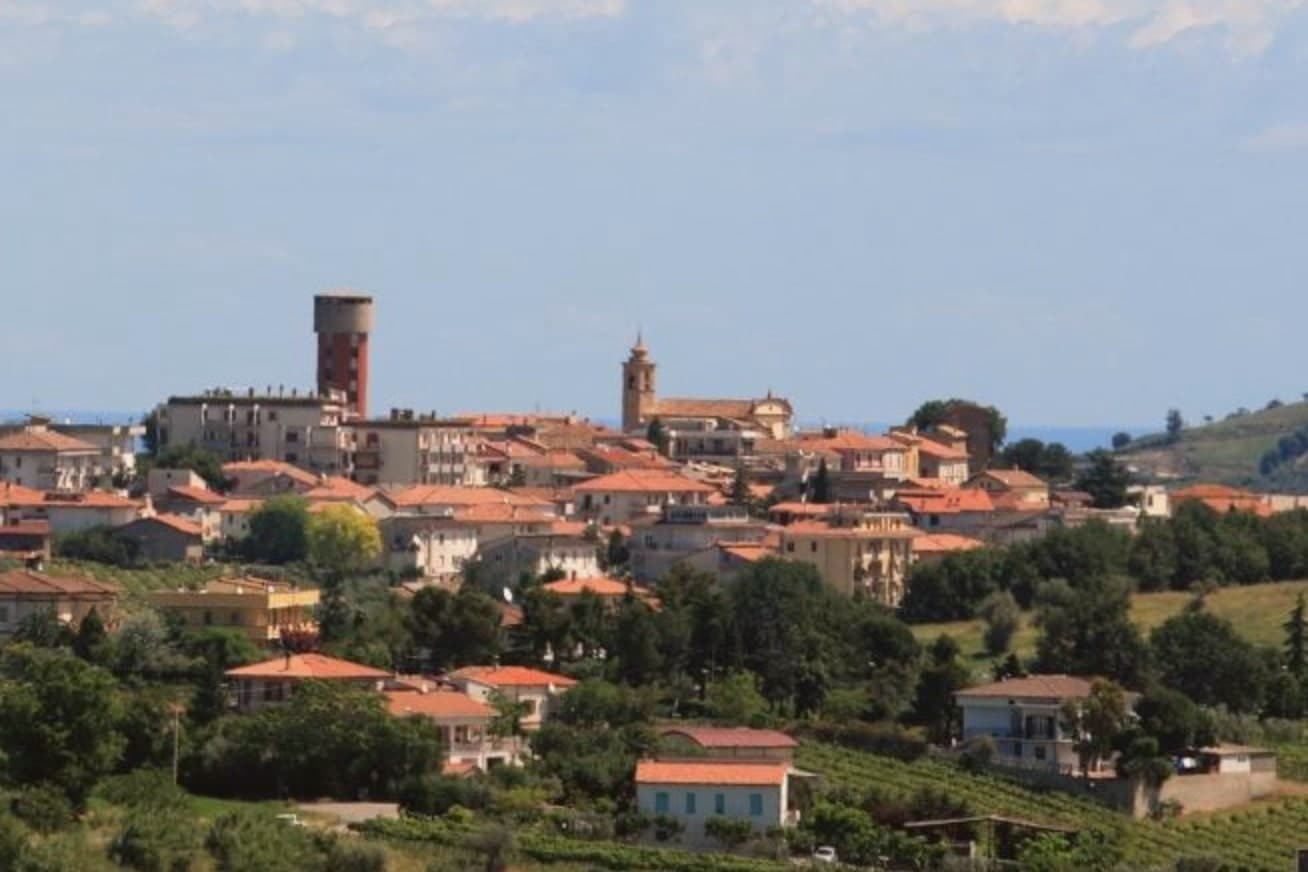
The Teramo coast is flat, sandy and long, backed by pinewoods and by hills that rise quickly towards the snow line of the Gran Sasso. The railway sits almost on the beach for much of it, so a station platform and the sea are often within sight of each other. Houses run to brick, render and pale stone, sometimes with the wrought iron balconies of the Liberty seaside years, and older centres sit up on ridges above their modern marinas. Summer is loud with beach umbrellas and evening passeggiata; spring and September are quieter, when the fish is still good, the Montepulciano and Pecorino from the inland vineyards are pouring, and the brodetto of the Abruzzo coast tastes right again.
Most people arriving in Abruzzo without a car head straight for Pescara, the regional capital just to the south, where the trains are frequent, the beach is enormous and the shopping streets fill up from June onwards. It is the practical choice and the crowded one, and in August the sand there is measured in rows rather than in metres. Others go inland to the Gran Sasso and Campo Imperatore, which is spectacular and which almost nobody manages without a hire car. Between the two, the coastal province gets read as a corridor rather than a destination.
The same coast keeps going north of Pescara, and so does the line. Every stop past the city is another town with a beach, a fish market and a hill village behind it, and some of them have hills of vines close enough to walk into. These are the towns in the province of Teramo we have confirmed you can reach without a car, which makes them worth a detour for anyone travelling by train.
Of the 11 communes we have mapped in the province of Teramo, 6 qualify as towns you can reach by train: we have confirmed each is reachable without a car. The smallest, Controguerra, has 2,192 residents.
Two more lists worth reading alongside this one: The best beach towns in Abruzzo and The best coastal towns in Abruzzo.
Controguerra
Why visit Controguerra
The village sits fifteen kilometers from the Adriatic, at the northern edge of Abruzzo, where the valley bends toward the river and the sea. The wine zone that carries the town's name reaches beyond it, spread across five communes sharing the same elbow of land between river and coast.
The reds run at least sixty percent Montepulciano, with Merlot, Cabernet Franc and Cabernet Sauvignon allowed up to fifteen percent; the whites are sixty percent Trebbiano with at least fifteen percent Passerina; the spumante sets Trebbiano against Chardonnay, Verdicchio and Pecorino. The old center holds to its ridge above the valley while the vines and olive groves that support both the wine and oil designations spread on the slopes below, the same ground doing double duty.
The place works because the name on the bottle and the name on the map are the same thing, a small hilltop settlement whose slow-food charter governs an area small enough that vineyard and piazza are never far apart.
We confirmed you can reach this one by train.
What to see in Controguerra
- Centro storico. Small hilltop medieval centre on a ridge above the valley, with brick palazzi and the parish church on the central piazza.
- Chiesa di San Salvatore. Parish church on the main piazza, the religious anchor of the medieval ridge village, with a rebuilt eighteenth-century interior.
- Cantine del Controguerra DOC. Family cellars open by appointment, pouring Montepulciano-based reds, Trebbiano-Passerina whites and Pecorino spumante from the same slopes the town gives its name to.
How to get to Controguerra
There is a railway station in the town, so you can arrive without a car and never need one while you are here. Pescara is roughly 56 minutes away by road.
Our tip
April through October is the working season for vineyards and oil. May and September are the best months for cellar visits, with mild light and the vineyards in full leaf. July and August can climb into the mid-thirties and the centro empties through the hot afternoon. Controguerra in festa falls in July.
Alba Adriatica
Why visit Alba Adriatica
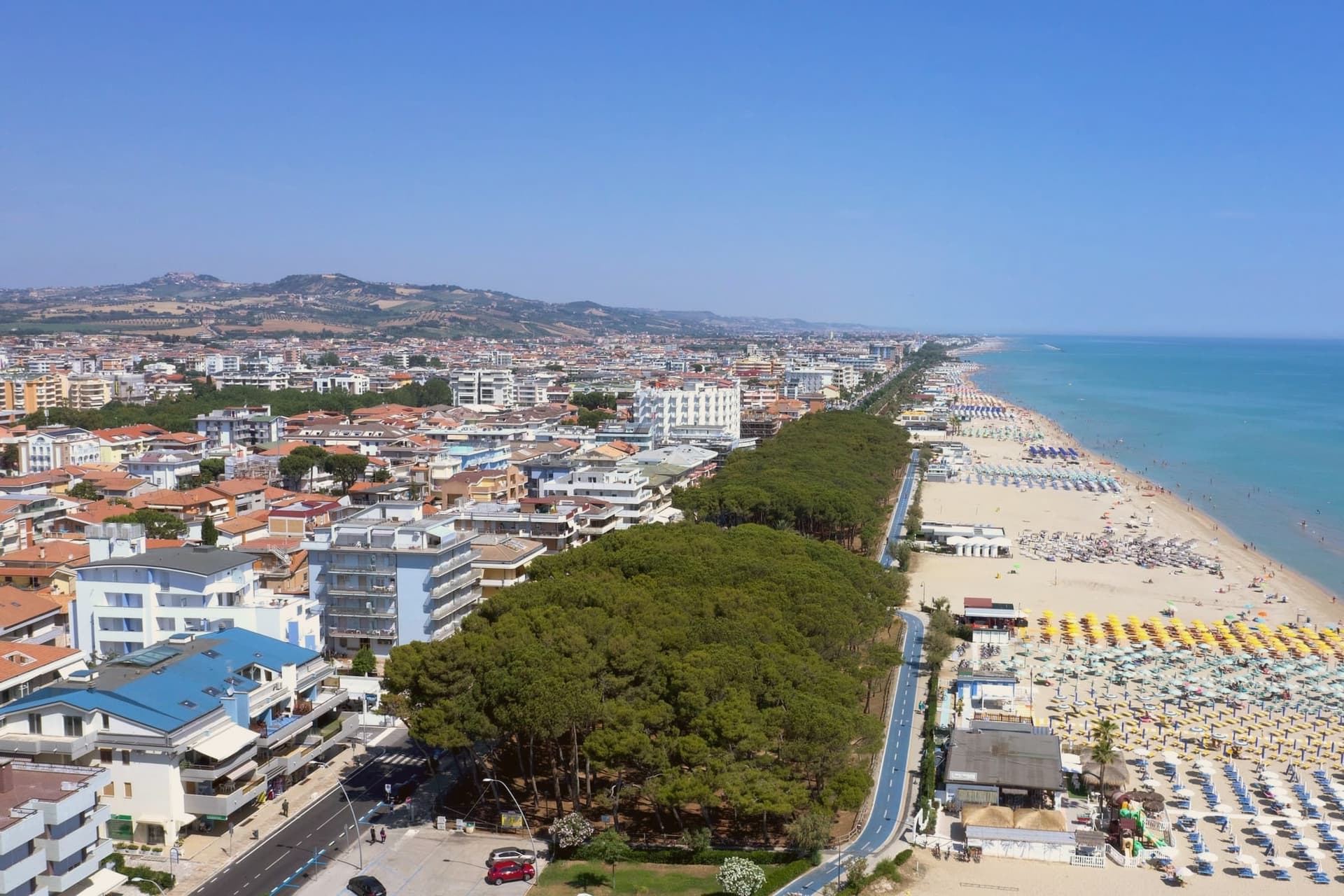
Alba Adriatica is the northernmost of the seven coastal communes of the province of Teramo, the chain of resort towns known collectively as the seven sisters. The commune did not exist before 1956: it was created by referendum that year when the coastal residents of Tortoreto voted for administrative autonomy.
The town's identity is its sand. The three-kilometer beach is called the Spiaggia d'Argento, the silver beach, for the fineness of its grains.
The Blue Flag flew here continuously from 2000 to 2013 and again in recent years. The lungomare runs the whole length of the commune, palm-lined and largely flat, joining the towns on either side without a clear visual break.
Inland from the beach, the town is laid out on a 20th-century grid, with no centro storico to speak of: the historic centers belong to the older inland communes. Alba Adriatica was built to be a beach.
We confirmed you can reach this one by train.
What to see in Alba Adriatica
- Spiaggia d'Argento. The three-kilometer fine-sand beach, gently sloped, Blue-Flag-rated for water quality continuously from 2000 to 2013 and after.
- Lungomare Marconi. Palm-lined promenade running the length of the commune, joining Tortoreto Lido to the north and Giulianova to the south.
- Chiesa Sant'Eufemia. Parish church set on the inland grid, a modest 20th-century construction reflecting the town's recent 1956 foundation date.
How to get to Alba Adriatica
There is a railway station in the town, so you can arrive without a car and never need one while you are here. Pescara is roughly 51 minutes away by road.
Our tip
May through September is the season. June and early September are the temperate weeks before and after the August crowds. July and August fill the beach and the boardwalks: temperatures sit in the low thirties, the water is warm by mid-July, and the lungomare runs late.
Pineto
Why visit Pineto
Pineto sits at sea level, one of the Sette Sorelle, the seven Adriatic resorts of the Teramo coast. The town was planned in the 1920s by Luigi Filiani as a beach resort under pine forest, and renamed Pineto in 1925 after Gabriele D'Annunzio's poem La Pioggia nel Pineto.
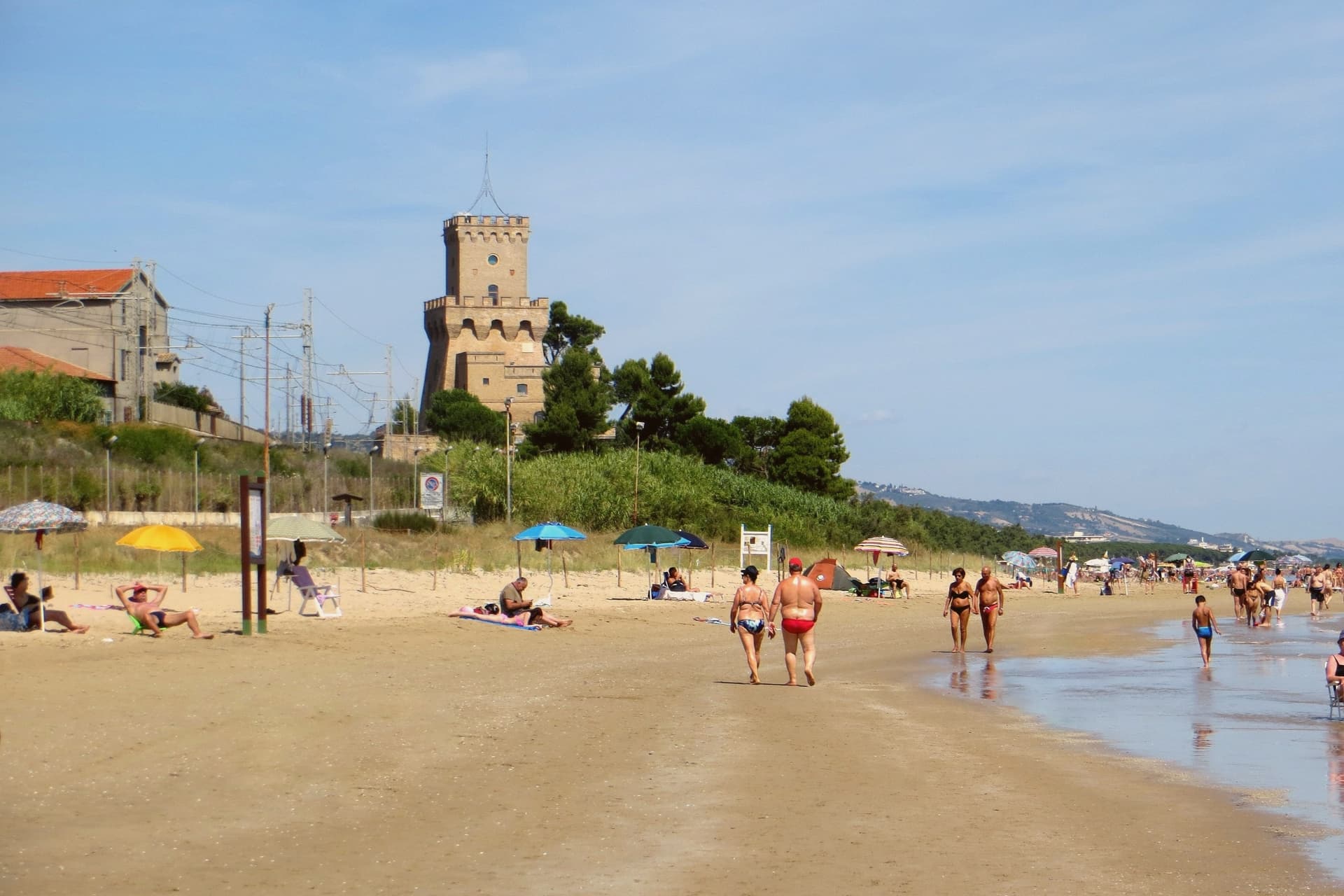
In 1929 it replaced Mutignano, the older hill village above, as the capoluogo of the comune. Two kilometers south of the centre stands the Torre del Cerrano, built around 1568 by Charles V as a watchtower against Ottoman raiders.
In 2010 the tower and the stretch of sea in front of it became Abruzzo's first marine protected area, 3,431 hectares of coast and shallow water. The beach has held a Blue Flag in most years since 2007.
The pine canopy, planted to hold the dunes, still shades the seafront promenade as far north as the Vibrata river.
We confirmed you can reach this one by train.
What to see in Pineto
- Torre del Cerrano. Sixteenth-century watchtower built around 1568 under Charles V against Ottoman raids, now the gateway to Abruzzo's first marine reserve.
- Area Marina Protetta Torre del Cerrano. 3,431 hectares of protected coast and shallow Adriatic water established in 2010, the first marine reserve in the region.
- Pineta Catucci. Coastal pine forest planted in the early twentieth century to hold the dunes, shading the seafront promenade and the bike path.
How to get to Pineto
There is a railway station in the town, so you can arrive without a car and never need one while you are here. Pescara is roughly 26 minutes away by road.
Our tip
May through September is the season. June and September are the best beach months, warm but not hot, with the marine reserve open for guided snorkelling and the bike path along the pineta in full use. July and August bring Italian summer crowds, especially from Pescara, and the seafront fills.
Silvi
Why visit Silvi
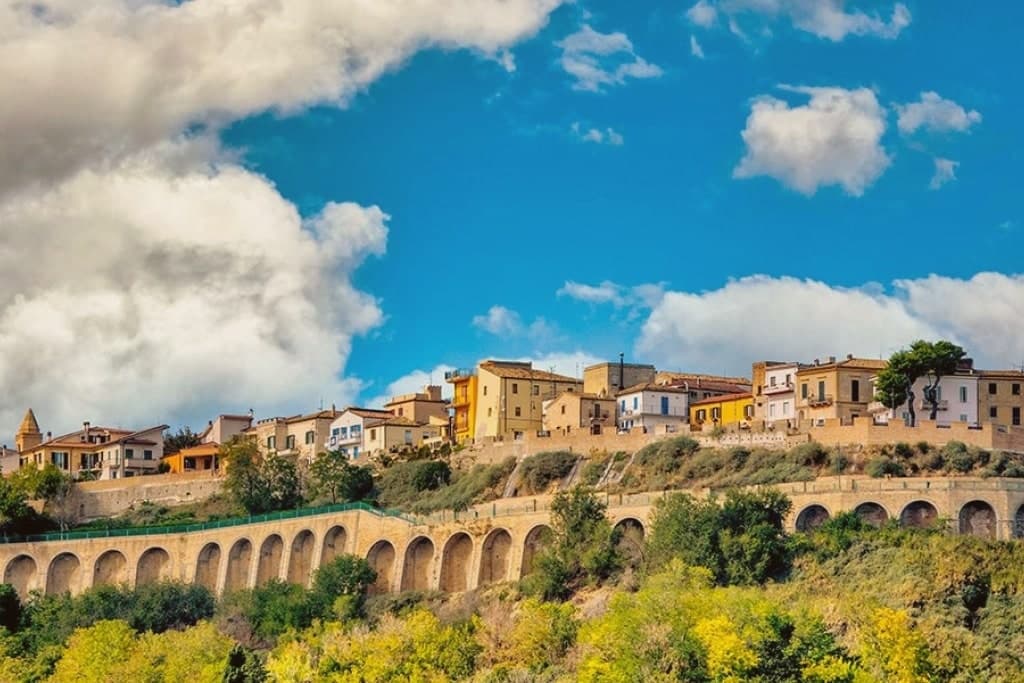
Silvi is two places held together by a hill. The upper town sits at 242 meters on a ridge above the water, known as Castrum Silvi in the Middle Ages and as Matrinum in earlier times.
The lower town, a fishing strip until 1931, took over as municipal seat that year and turned the coast into a summer resort, so the newer half now outranks the older one administratively even as the older half keeps the name's origin. The two halves run on industries that have nothing to do with each other and never did: one bottled its economy in licorice from a converted theater in the 1930s, the other guards a stretch of protected sea and dune around a sixteenth-century watchtower.
Pescara is fifteen kilometers south. What holds the town together is not a shared trade but the hill itself, the thing that separates the medieval ridge from the resort strip below and forces the place to be read as two settlements rather than one.
We confirmed you can reach this one by train.
What to see in Silvi
- Silvi Paese. Stone alleys along a ridge, the old Castrum Silvi, with the coastline visible the length of the walk.
- Torre del Cerrano. The watchtower stands alone on the sand between the two towns, squat and stone, with the reserve's dune scrub pressing up against its base.
- Area Marina Protetta Torre del Cerrano. The first marine protected area in Abruzzo, established in 2010, covering a seven-kilometer stretch of coastline with intact dunes.
How to get to Silvi
There is a railway station in the town, so you can arrive without a car and never need one while you are here. Pescara is roughly 27 minutes away by road.
Our tip
May through September is when Silvi Marina fills, the lidos open, and the nine-kilometer beach works as advertised. July and August bring heat, Italian school holidays, and the maximum crowd density between Pescara and Teramo. June and September are the better months: the sea warms enough to swim, the lidos still run, and the inland breeze keeps the evenings tolerable.
Giulianova
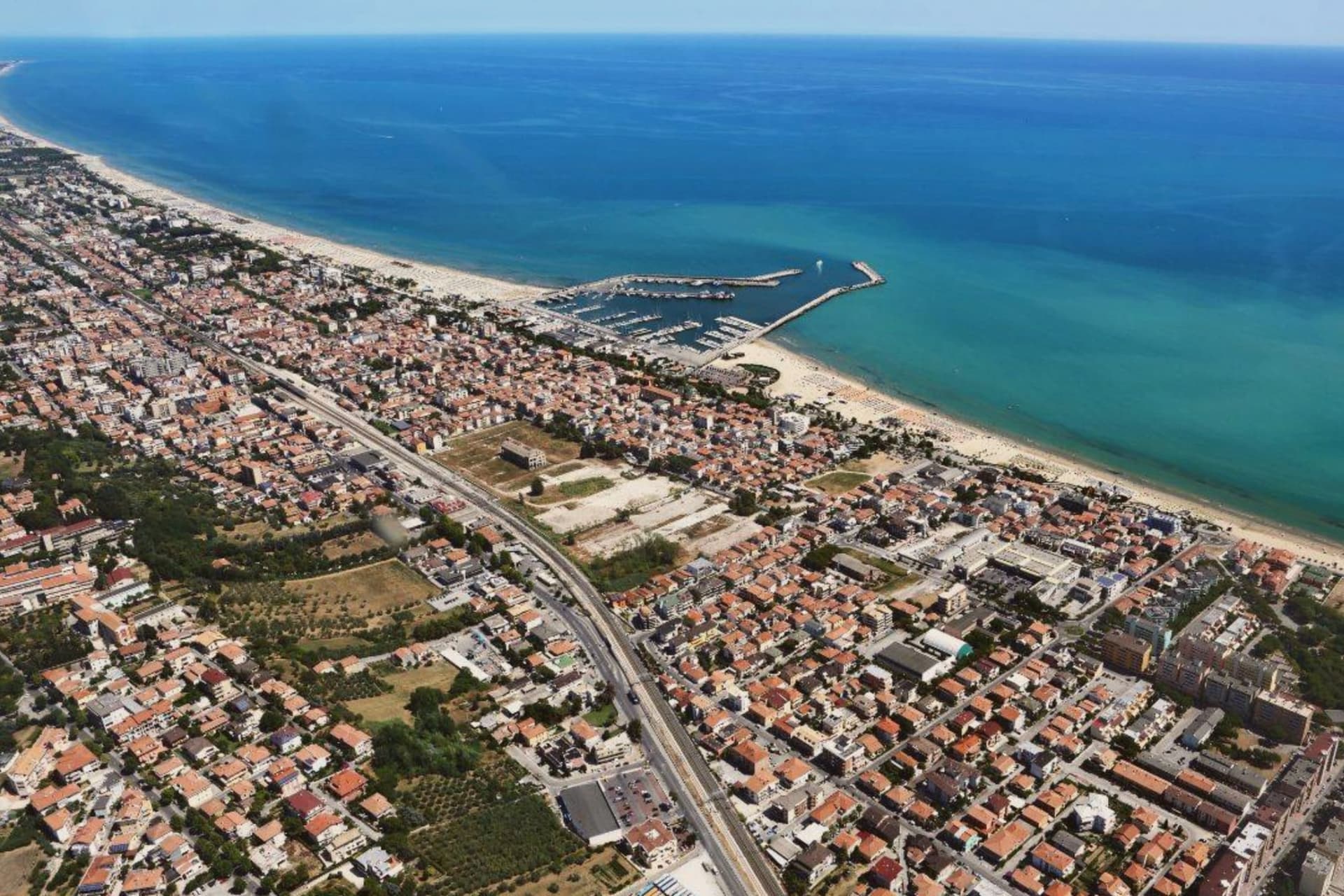
Why visit Giulianova
The town sits at the mouth of the Tordino river, where colonists from Praetutii territory established Castrum Novum in the 3rd century BC. A medieval settlement, Castrum divi Flaviani, later stood on the same hill until it was destroyed in the Battle of the Tordino in 1460.
What rose after covers the upper part of the town today: a walled, planned town on the hill, 68 meters above the water. The Lido came later and by a different route, growing from the 19th century around the railway rather than around any single founding decision.
It is now one of Abruzzo's main fishing ports, and the fish stew served along its promenade, brodetto alla giuliese, is the local counterpart to the better-known Vastese version from further south. The sanctuary on the road between the two halves of town marks the physical and historical hinge between them: hill above, coast below.
In August the Sant'Andrea feast carries the saint by boat along the water, a rite that belongs to the Lido's fishing life rather than to the hill's planned streets. The town, in effect, holds two founding stories side by side, one Renaissance and deliberate, one maritime and gradual, and neither has absorbed the other.
We confirmed you can reach this one by train.
What to see in Giulianova
- Duomo di San Flaviano. Cathedral in the hilltop Paese, its dome visible above the Renaissance street plan. Holds the relics of the saint after whom the medieval settlement was named.
- Paese. The hilltop town, walled and centered on a single piazza, its street plan unchanged since Giulio Antonio Acquaviva laid it out over the ruins of the settlement destroyed in 1460.
- Lido. The coastal town with promenade, fishing port and Blue-Flag beach, developed from the 19th-century railway era.
How to get to Giulianova
There is a railway station in the town, so you can arrive without a car and never need one while you are here. Pescara is roughly 46 minutes away by road.
Our tip
May through September is the beach season. June and September are the calm weeks, July and August the busy ones. The Lido fills with Italian families on holiday and the lungomare runs late.
Roseto degli Abruzzi
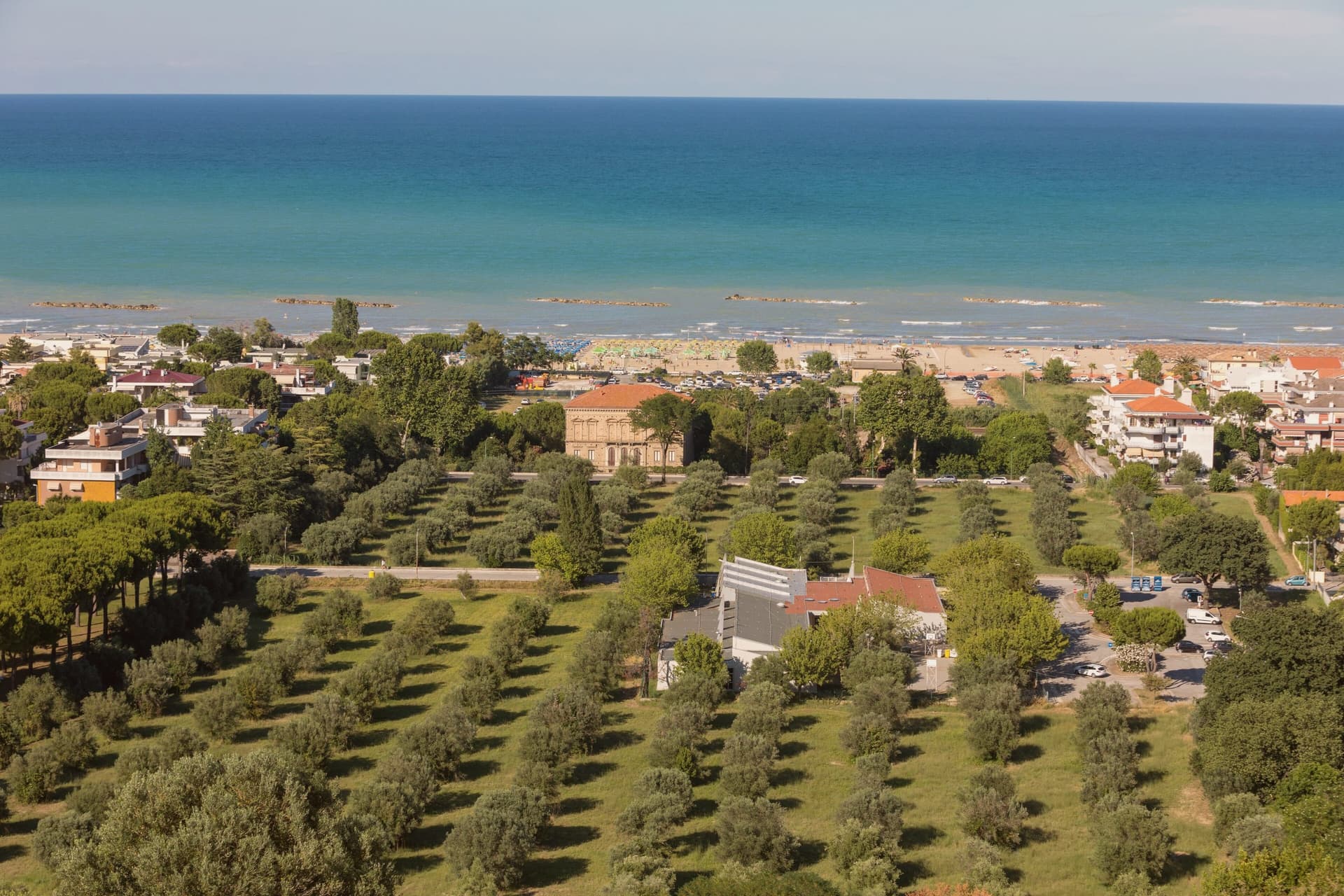
Why visit Roseto degli Abruzzi
Roseto degli Abruzzi sits on the Adriatic between Giulianova and Pineto, with a flat lower town at sea level and the older nucleus of Montepagano on a hill 285 meters above. Ten kilometers of sand run continuously from the Tordino river south to the Vomano, divided into the historic lidos and the Cologna stretch.
The town carried the name Rosburgo until 1927, when it was changed because the Austrian-sounding form had become unpopular after the First World War. Rosburgo had been the local rebranding of the medieval Montepagano settlement that descended to the coast in the nineteenth century, taking its new name from the rose and oleander hedges that lined the new streets.
Roseto has held a Bandiera Blu Blue Flag every year since 1995 and is a Borgo Autentico d'Italia. The Riserva Naturale del Borsacchio, at the northern edge of town, protects the last dunes and Mediterranean scrub on this stretch of coast.
We confirmed you can reach this one by train.
What to see in Roseto degli Abruzzi
- Lungomare and lidos. Ten kilometers of low-rise sand from the Tordino to the Vomano, with the Lido delle Rose, Cologna, and free-beach sections.
- Montepagano. Original medieval village on a hill 285 meters above the coast, with walls, stone houses, and a panoramic terrace over the sea.
- Riserva Naturale del Borsacchio. Coastal nature reserve at the north end of town, protecting dunes, Mediterranean scrub, and the nesting site of the Kentish plover.
How to get to Roseto degli Abruzzi
There is a railway station in the town, so you can arrive without a car and never need one while you are here. Pescara is roughly 37 minutes away by road.
Our tip
May through September is the beach season. June and September are the best balance of warm sea and lower crowds. July and August fill the lidos, especially the weekends of Ferragosto in mid-August.
More from Anywhere Italy
 The best beach towns in Abruzzo
 The best coastal towns in Abruzzo
- The best olive oil towns within 90 minutes of Ancona
 The best towns with a serious restaurant that you can reach by train within 90 minutes of Pescara
- The best coastal towns that eat well within 90 minutes of Pescara
 The best hidden towns you can reach by train that have a serious restaurant in Abruzzo