
The best small towns you can reach by train in Calabria
Calabria is a region where the train still does the useful work. The lines along the Ionian and Tyrrhenian coasts hug the shingle for hours at a stretch, past dry riverbeds, prickly pear, olive terraces and villages built from local sandstone on ridges above the sea. Summer here is long and hard-lit, and the eating is red onion from Tropea, swordfish, chilli, ricotta salata, pasta with breadcrumbs rather than cheese, bergamot in the far south. Autumn brings mushrooms and chestnuts down from the Sila, where the air changes completely and the beech woods hold the cold.
Most visitors arriving without a car head for Tropea, and it earns the attention: the old town sits on a rock above white sand, with the Santa Maria dell'Isola church on its outcrop and Stromboli visible on a clear evening. The result is a station platform crowded in July and August, a beach measured out in parasols, and restaurant prices set by the season rather than the kitchen. It is a fine place to spend a day. It is not the whole coast.
The same railway keeps going. North along the Ionian shore there are towns where a Norman castle stands directly over the beach and lemon groves run to the sand, and inland the Sila plateau begins where the pine forest does. The towns below are the smaller stops on those lines, places with a station or a reliable connection from one, and we have confirmed each can be reached without a car.
Of the 45 communes we have mapped in Calabria, 19 qualify as towns you can reach by train: we have confirmed each is reachable without a car. This list is the small ones, 8 in all, ordered smallest first. The smallest, Albidona, has 1,142 residents.
Two more lists worth reading alongside this one: The best hidden towns you can reach by train in the province of Cosenza and The best small coastal towns in Calabria.
Albidona
Why visit Albidona
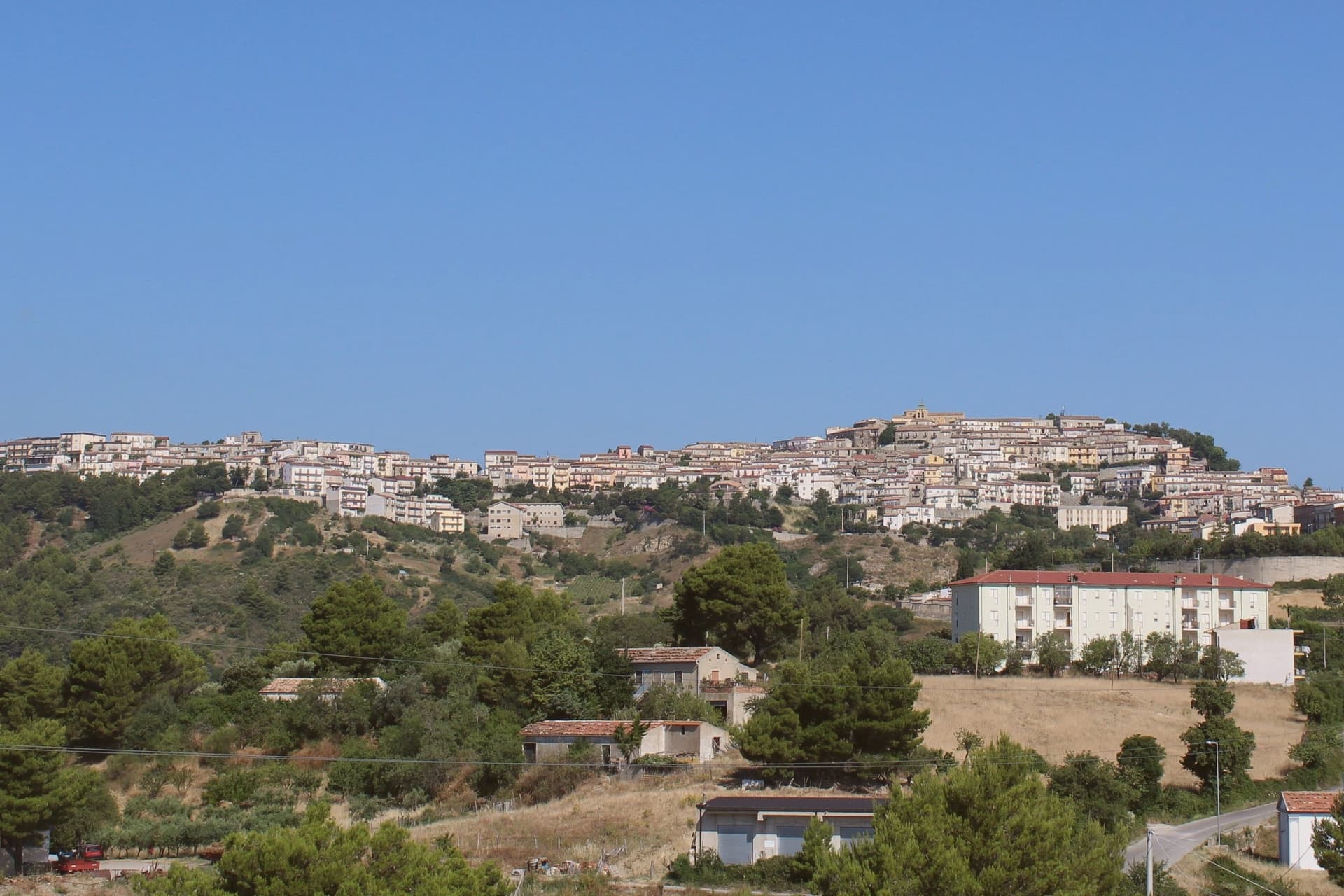
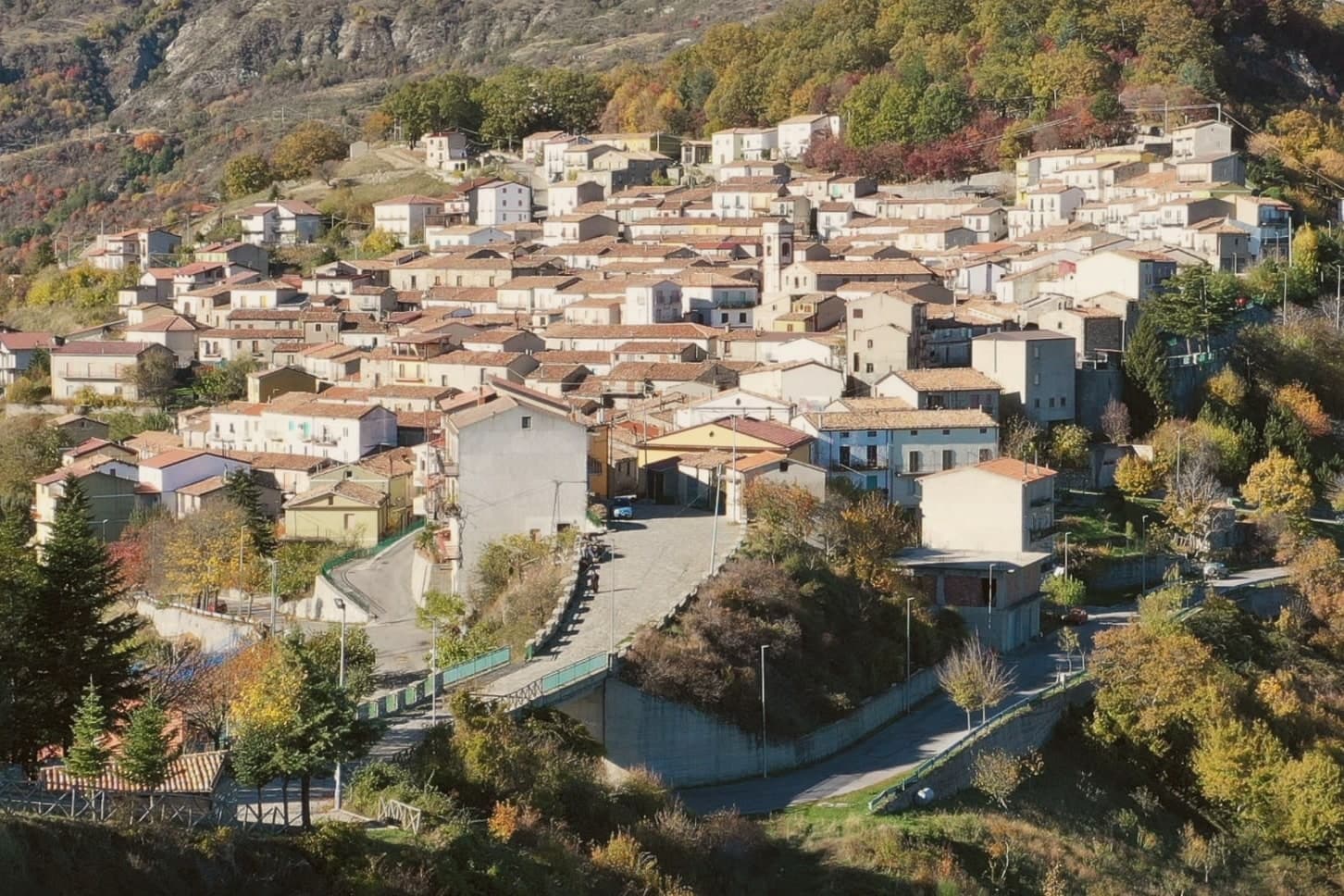
Albidona sits at 810 meters on a ridge between the Pollino mountains and the Ionian coast, eleven kilometers from the sea and eighteen from the high mountain. The ancient writers Lycophron and Strabo identify it with Leutarnia, the Magna Graecia town founded by the seer Calchas on his return from the Trojan War.
Whatever the legend, the first reliable historical record dates from around the year 1000. The territory drops from the village ridge down to the Ionian, where Don Pedro Álvarez de Toledo built a watchtower in the sixteenth century to defend the coastline from Saracen raids; in the 1600s the monks took possession and the structure is still called the Torre dei Monaci.
Five churches anchor the centro storico, including the Chiesa di San Michele Arcangelo at the highest point. The commune is part of Borghi Autentici d'Italia.
We confirmed you can reach this one by train.
What to see in Albidona
- Torre dei Monaci. Sixteenth-century coastal watchtower built by Don Pedro Álvarez de Toledo against Saracen raids, later owned by monks who gave it its current name.
- Chiesa di San Michele Arcangelo. Mother church on the highest point of the village, named for the patron archangel of Albidona.
- Chiesa della Madonna del Cafaro. Sanctuary in the countryside below the village, traditional site of pilgrimage in the surrounding farmland.
How to get to Albidona
There is a railway station in the town, so you can arrive without a car and never need one while you are here. Taranto is roughly 120 minutes away by road.
Our tip
May through October is the working window for Albidona. The 810-meter ridge stays cooler than the coast even in August, and the village fills slightly with returning emigrants and second-home families through the summer feast season. July and August can still push thirty degrees; the morning and evening light, with the sea on one side and the Pollino on the other, is the better time of day.
Parghelia
Why visit Parghelia
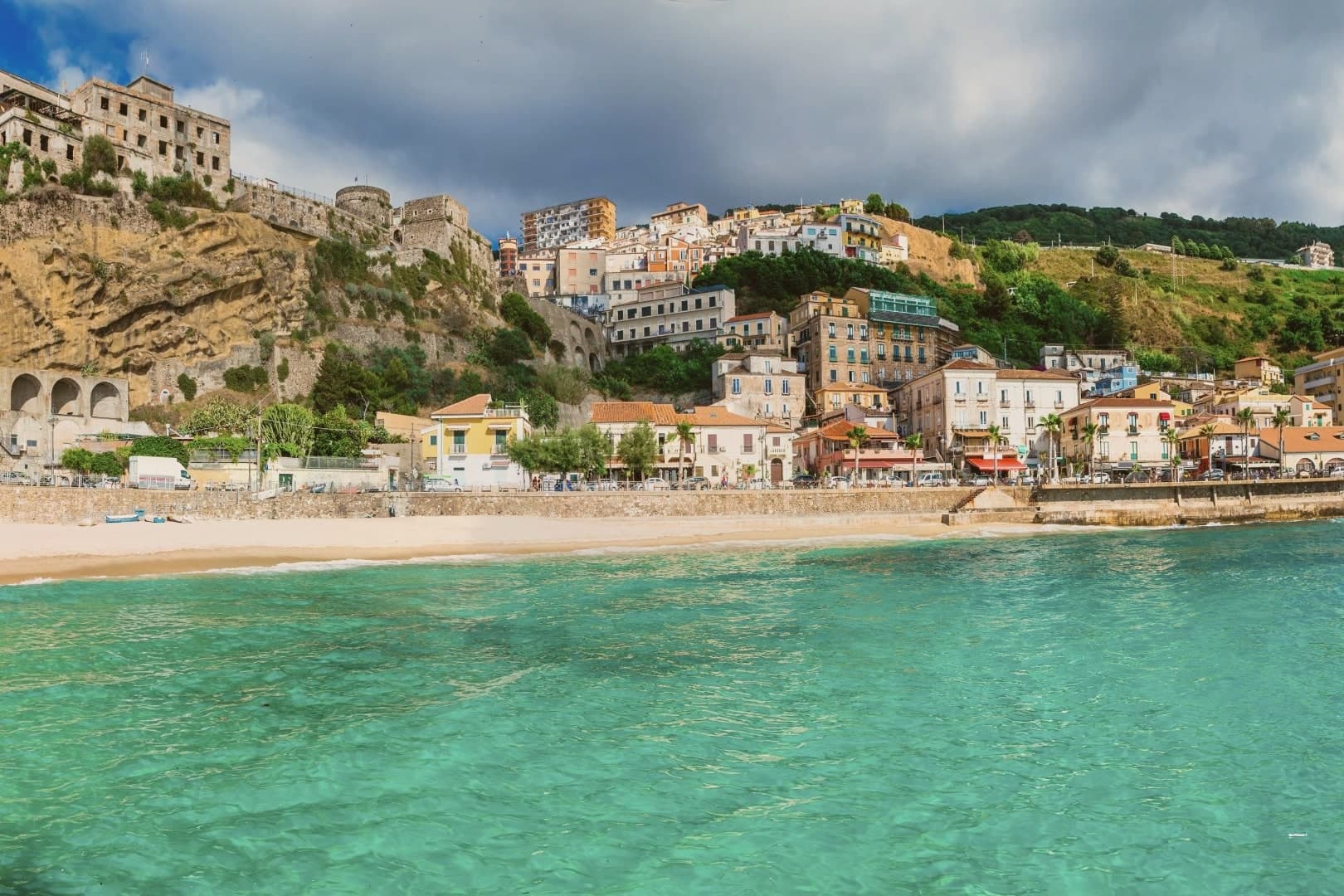
Parghelia sits on a low Tyrrhenian cliff at about 70 meters, on the stretch of coast tourism boards call the Costa degli Dei, four kilometers north of Tropea and fifteen west of Vibo Valentia. The commune is small (under 1,300 residents) and easy to overlook from the highway, which is part of why it has kept a residential pulse that Tropea has largely traded for tourism.
The beaches sit below the village, reached on foot through cuts in the sandstone: Michelino, with its dark cliffs, and the smaller coves toward Zambrone. The frazione of Fitili holds the older houses inland.
Bandiera Blu status has tracked the water quality for several seasons, and the coastal panorama opens north to the Gulf of Sant'Eufemia and south to the Capo Vaticano promontory. Most visitors who stay here do so to use Tropea without paying Tropea's prices.
We confirmed you can reach this one by train.
What to see in Parghelia
- Spiaggia di Michelino. Curved beach below the village reached by stairs through the cliff, with dark sandstone walls and Bandiera Blu water.
- Centro storico. Compact village core on the headland, with the parish church of the Annunziata at its centre.
- Fitili. Inland frazione of Parghelia with older stone houses and the small church of San Nicola di Bari.
How to get to Parghelia
There is a railway station in the town, so you can arrive without a car and never need one while you are here. Reggio Calabria is roughly 96 minutes away by road.
Our tip
May through September is when Parghelia functions as a coastal village. Water is swimmable from late May, beach clubs run from June, and the parking constraints that plague Tropea are easier here. July and August are hot and busy, but the cliff-foot beaches stay calmer than the Tropea sand. Sagra del Pesce falls in August.
Montegiordano
Why visit Montegiordano
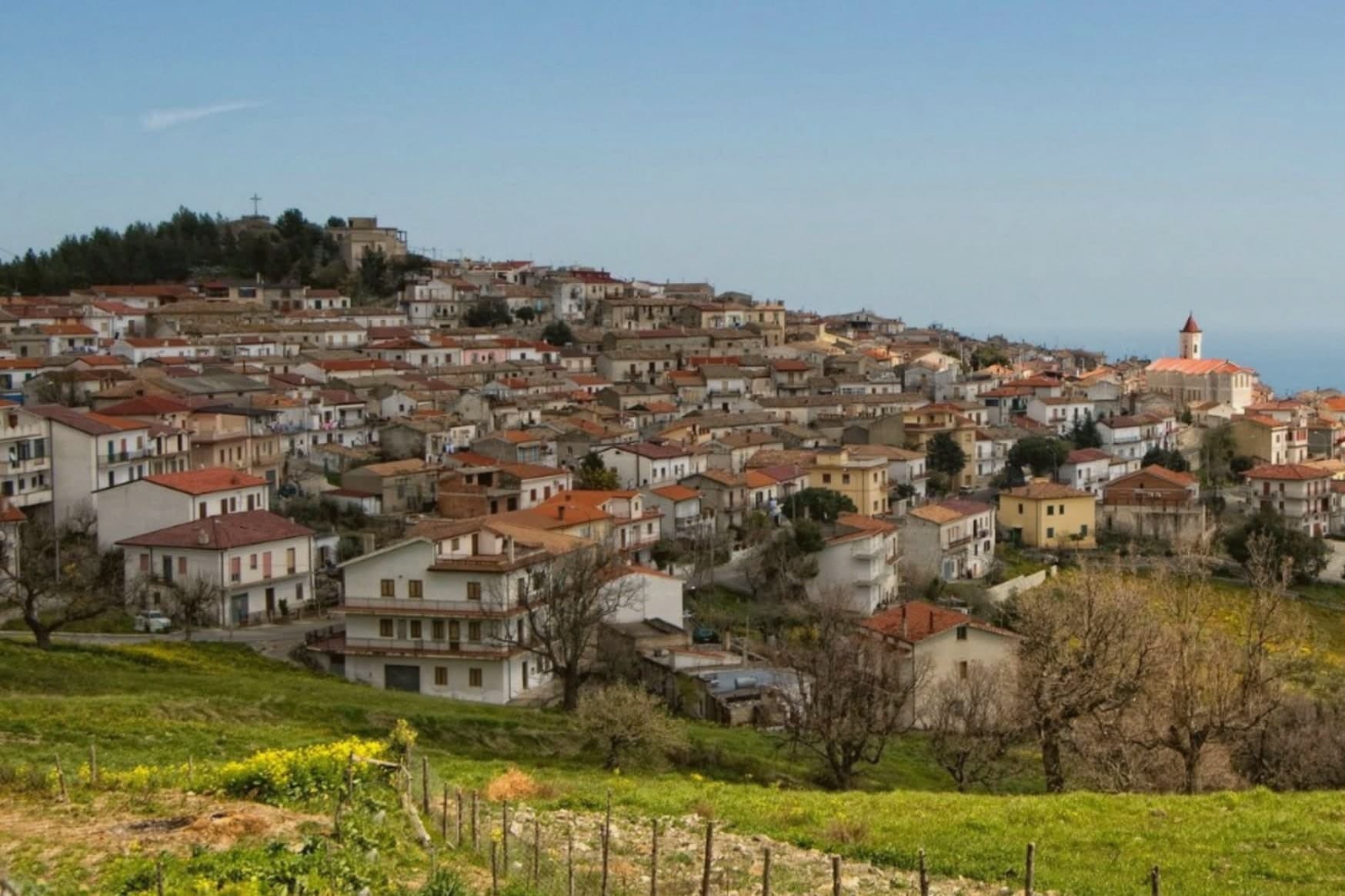
The commune sits on a ridge above the Ionian in the Alto Jonio Cosentino, with the Pollino massif behind it. It has two centres, the hill town at 619 meters and the marina on the coast below, joined by the road that passes the small chapel on the plain.
Records of settlement here go back to the fourth century BC. The castle stands in the Piano delle Rose locality, built by the Pignone del Carretto as a winter residence and hunting lodge; the de Martino family later ruled the feudo from 1748 until the abolition of feudalism in 1806.
The commune carries the designations Borgo Autentico, Spiga Verde and Città del Vino. What holds the two centres and the centuries together is the sense of a working village rather than a preserved one: a hill town still occupied and repainted, a castle still standing over its own courtyard, a marina still adding beach length, and a plain between them still crossed on the old route from residence to coast.
We confirmed you can reach this one by train.
What to see in Montegiordano
- Castello Pignone del Carretto. Four kilometers from the marina, built as a winter residence by the Neapolitan Pignone del Carretto family who held the feudo from the seventeenth century.
- Centro storico dei murales. The hilltop old town itself, its walls and lanes given over entirely to the mural project, each one telling a piece of the village story rather than standing as decoration alone.
- Cappella Madonna del Carmine. Small chapel on the plain near the castle, a few hundred meters from the Pignone residence, on the road between hill and marina.
How to get to Montegiordano
There is a railway station in the town, so you can arrive without a car and never need one while you are here. Taranto is roughly 88 minutes away by road.
Our tip
April through June and September into October are the right months to walk Montegiordano's mural-painted alleys and look from the 619-meter ridge over the Ionian. July and August are hot on the coast but the hill stays at workable temperatures and catches the sea breeze in the evening. November through March is quiet: most of the marina lidi close, the castle keeps limited hours, and the cantine work but visit by appointment.
Riace
Why visit Riace
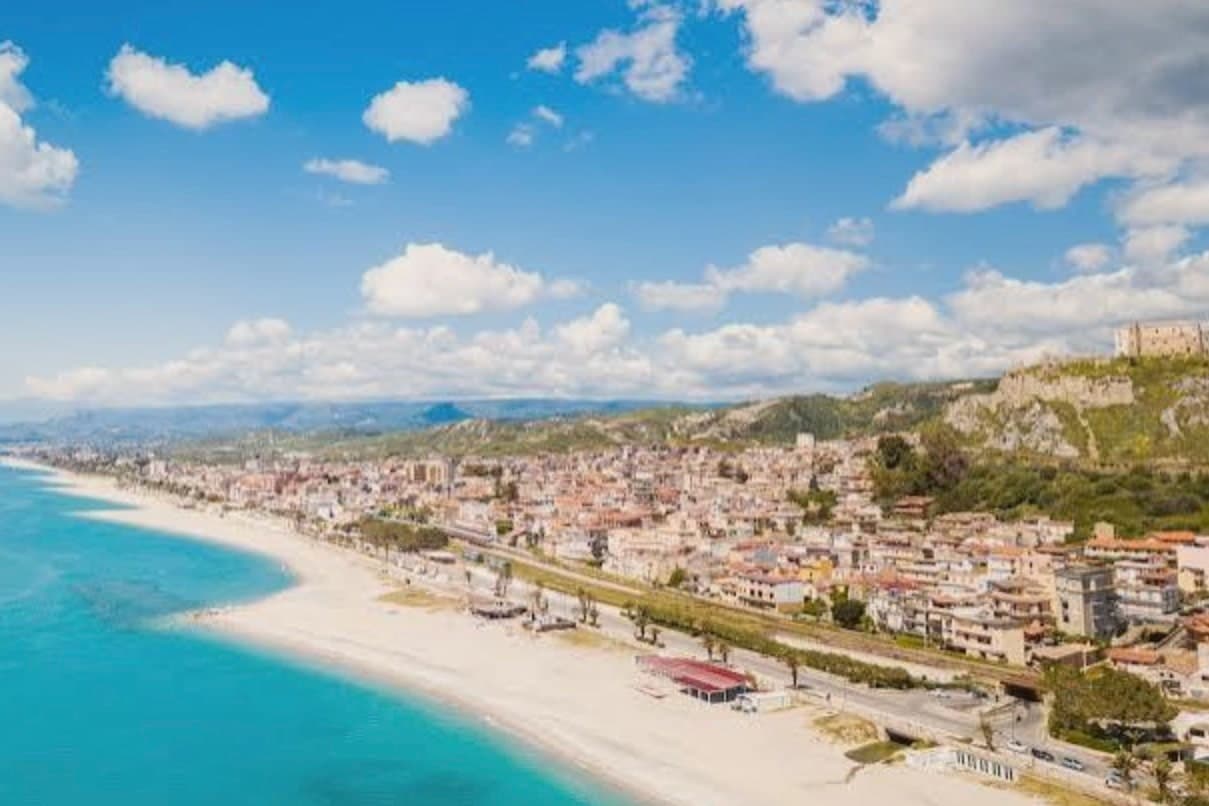
Riace sits at 300 meters on the Serre foothills above the Ionian, in the Metropolitan City of Reggio Calabria, with the small frazione of Riace Marina at sea level two kilometers below. Two stories collide here.
In August 1972, a snorkeller off Riace Marina found two life-size Greek warriors lying on the seabed at eight meters depth: the Bronzi di Riace, two of the finest surviving Greek bronzes, now in the Museo Nazionale della Magna Grecia in Reggio Calabria. Three decades later, under mayor Domenico Lucano, Riace became the centre of one of Europe's most-studied refugee resettlement experiments: by 2011 around 450 refugees from twenty countries were living among 1,800 residents, the village school reopened, and abandoned houses were converted to host families.
The project was prosecuted, then partially vindicated; Lucano was re-elected mayor and elected to the European Parliament in 2024.
We confirmed you can reach this one by train.
What to see in Riace
- Borgo Superiore. Hilltop historic centre at 300 meters, the older settlement among the Serre hills, with stone houses and the Lucano-era refugee project still visible in the alleys.
- Riace Marina. Coastal frazione two kilometers downhill at sea level, near the spot where the Bronzi were found in 1972.
- Santuario dei Santi Cosma e Damiano. Sanctuary dedicated to the patron healers, focus of the September pilgrimage that has run for centuries in the Locride.
How to get to Riace
There is a railway station in the town, so you can arrive without a car and never need one while you are here. Reggio Calabria is roughly 102 minutes away by road.
Our tip
April through October works at 300 meters in the Locride. Spring is green and the hills smell of broom; September brings the Santi Cosma e Damiano pilgrimage and milder afternoons; October closes the season with olive harvest. July and August are hot, with temperatures pushing into the mid-thirties, and the upper borgo empties between two and six in the afternoon.
Roseto Capo Spulico
Why visit Roseto Capo Spulico
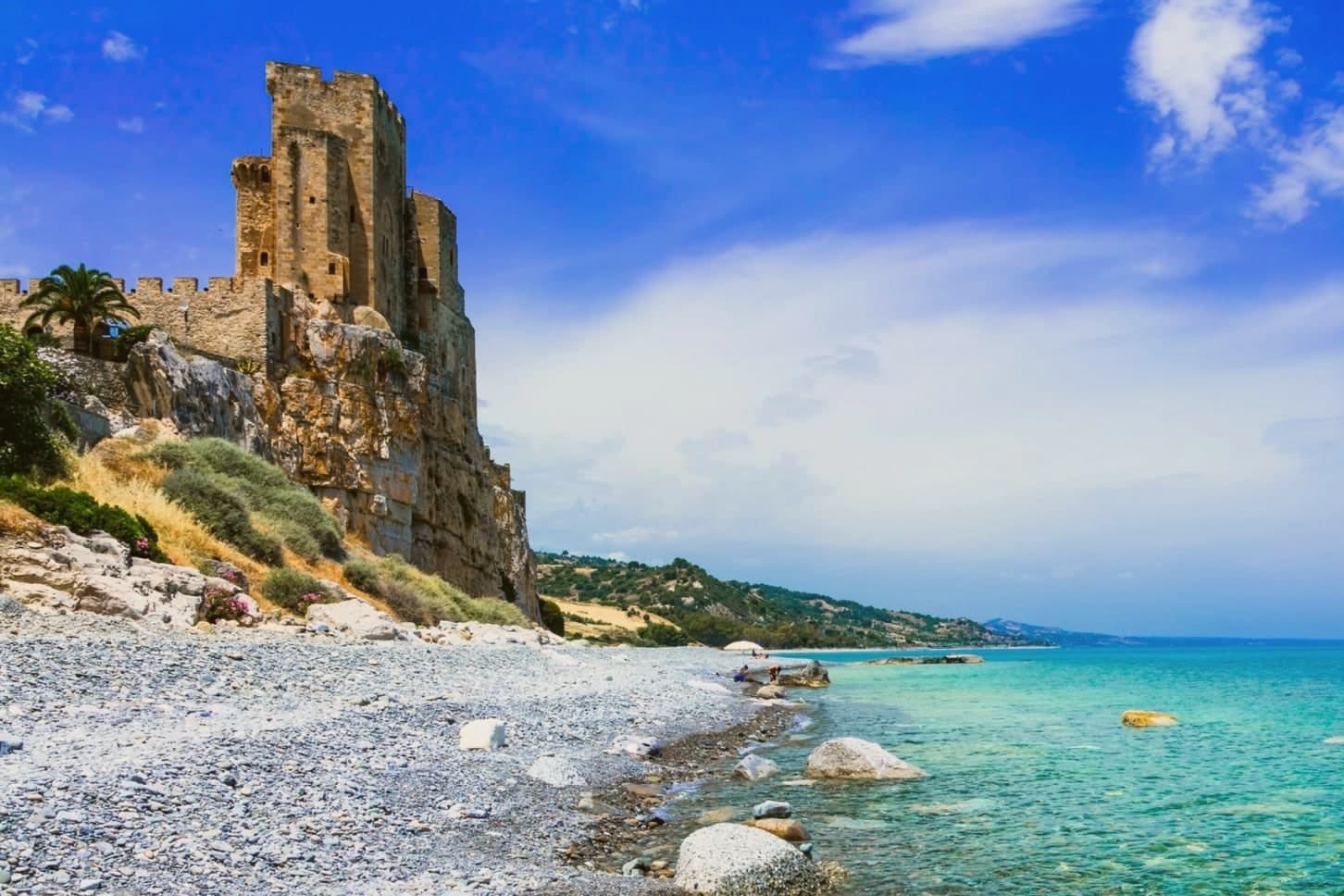
Roseto Capo Spulico sits at the northern edge of Calabria's Ionian coast, the last commune before the Basilicata border, with the Pollino massif rising behind it. The village began as a Magna Graecia satellite of Sybaris, its name tied to the roses once cultivated to fill the mattresses of the Sybarite elite.
The castle above the water was requisitioned from the Templars in 1229 after their conduct during the Sixth Crusade, an episode that also carries a Shroud legend. The old town sits on the ridge above the marina, its stone houses and lanes looking down over the castle rock and the sea beyond it, while the beach runs along the shore directly below.
Inland, vineyards climb toward the Pollino slopes, and the commune holds recognition as a Borgo Autentico d'Italia and a Spiga Verde. The village reads as a settlement built in layers, from Sybarite outpost to fortress town to a place whose seafront, hilltop and inland farmland still sit visibly stacked, one above the other, along the same short stretch of coast.
We confirmed you can reach this one by train.
What to see in Roseto Capo Spulico
- Castello Federiciano di Roseto Capo Spulico. Trapezoidal fortress with three towers, one taller and crenellated, standing directly on the sea. Built under Robert Guiscard and rebuilt by Frederick II after he took it from the Templars.
- Spiaggia del Castello. Pebbled Bandiera Blu beach directly below the castle rock, with clear water and small coves along the Costa degli Achei.
- Chiesa di Santa Maria delle Grazie. Sixteenth-century mother church in the centro storico, rebuilt after earthquake damage and dedicated to the patron of the village.
How to get to Roseto Capo Spulico
There is a railway station in the town, so you can arrive without a car and never need one while you are here. Taranto is roughly 93 minutes away by road.
Our tip
May through September are the months the Ionian beach is open and the castle promontory fills with day-trippers from Sibari and Basilicata. July and August push past thirty-five degrees and the marina rentals fully book; the centro storico on the ridge above stays quieter and cooler. April and October are dry and mild, the right time to walk the castle path and the Pollino foothills inland without sweat.
Badolato
Why visit Badolato
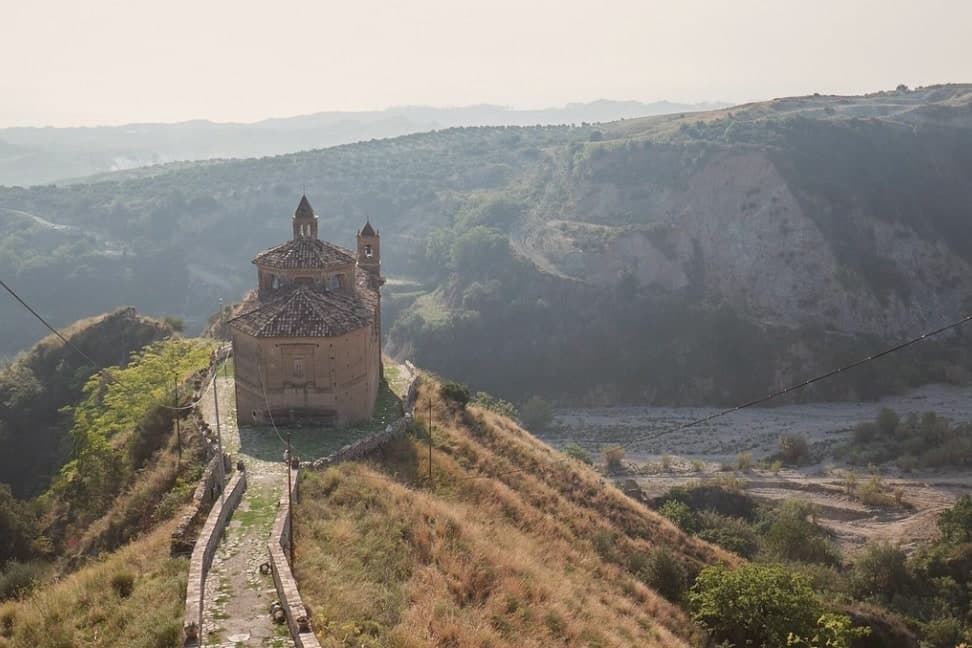
Badolato sits at 240 meters on a hill above the Ionian coast in the southern Catanzaro province, ringed by two deep valleys that drop toward the sea. The fief was granted around 1080 to the Norman knight Roberto il Guiscardo; in 1254 Filippo de Badulato was named lord, and the village stayed in his hands until 1272 when Pietro Ruffo, Count of Catanzaro, removed him.
The medieval grid was laid out in the shape of a Latin cross, with thirteen churches inside the centro storico, most of them now closed; only the Chiesa Matrice, dedicated to the Santissimo Salvatore, holds regular services. In 1997 the village, severely depopulated by emigration, took in 350 Kurdish refugees from a ship that ran aground on the coast.
The episode turned Badolato into a model for resettlement and started a slow rebirth of the historic center, with houses bought and restored by foreign and Italian returnees. Olive oil and wine are the main agricultural products.
We confirmed you can reach this one by train.
What to see in Badolato
- Chiesa Matrice del Santissimo Salvatore. Mother church of Badolato, the only one of the thirteen historic churches still in regular use.
- Chiesa di Santa Caterina d'Alessandria. Medieval church preserved with a fresco that village women blocked from being moved for restoration, in a famous local protest.
- Convento di Santa Maria degli Angeli. Former Franciscan monastery on a hill outside the village, now home to a Mondo X recovery community founded by Padre Eligio.
How to get to Badolato
There is a railway station in the town, so you can arrive without a car and never need one while you are here. Reggio Calabria is roughly 111 minutes away by road.
Our tip
April through June and September into October are the working months. The hill at 240 meters catches a sea breeze from the Ionian, and the centro storico holds the morning cool until ten or eleven. July and August are hot, often above thirty-five degrees, and the borgo empties between two and five each afternoon while the Marina fills with bathers.
Rocca Imperiale
Why visit Rocca Imperiale
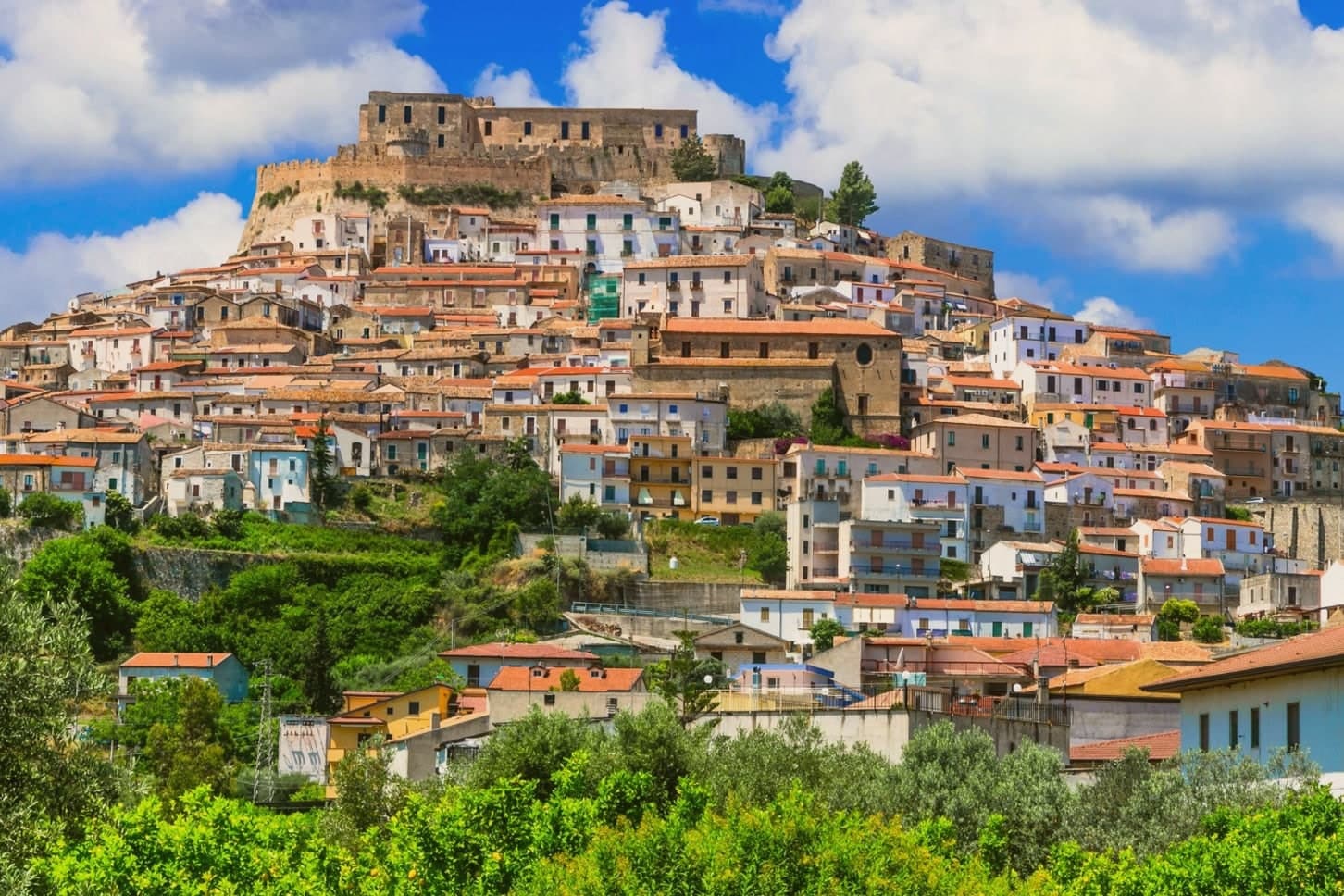
Rocca Imperiale is the northernmost commune of Calabria, pressed against the Basilicata border on the Ionian coast. The hilltop borgo sits a kilometre inland from the long sandy Marina, the two connected by the slope the town has always used to move between fortress and shore.
The castle stands on a defensible hill chosen to command the coastal route between Taranto and Reggio Calabria, and the borgo grew downhill from it in tight medieval grids of whitewashed houses and narrow vicoli, with the Chiesa Madre dell'Assunta, a 15th-century church with a Madonna by Pietro Bernini, father of Gian Lorenzo, anchoring the central piazza. Inland and upland frame the town on the other side: the Pollino park lies 30 km west and the Sila highlands further south, making Rocca a base for both while the coastal frazione below handles the beach trade.
The food is north-Calabrian-meets-Lucanian: peperoni cruschi, pasta with lardo and chilli, pesce azzurro from the Ionian, and the lemon grown only in the surrounding belt, used in liqueurs and the local pasta al limone. The Festa del Limone in early August is the year's main event.
The town works because its geography does the sorting: fortress and church hold the hill, the lemon groves hold the middle slope, and the marina holds the shore, each part visible from the others across the same short drop to the sea.
We confirmed you can reach this one by train.
What to see in Rocca Imperiale
- Castello Federiciano (1225). Frederick II Hohenstaufen's square fortress with four corner towers (two cylindrical) commanding the Ionian coastal route. Open as a cultural centre.
- Centro storico (Borghi più belli). Whitewashed houses in tight medieval vicoli cascading downhill from the castle. The Chiesa Madre dell'Assunta has a Pietro Bernini Madonna.
- Rocca Imperiale Marina (Bandiera Blu). Long sandy Ionian beach 1 km below the borgo, holding the Bandiera Blu every recent year for water clarity and beach management.
How to get to Rocca Imperiale
There is a railway station in the town, so you can arrive without a car and never need one while you are here. Taranto is roughly 81 minutes away by road.
Our tip
Rocca Imperiale is best May–June and September–October — the borgo cool in the morning, the Marina swimmable, the lemon orchards in flower or harvest. July–August fills the Marina with Italian families and the Festa del Limone (early August) is the biggest event. The borgo stays atmospheric in winter but most amenities at the Marina close November–March.
Spezzano della Sila
Why visit Spezzano della Sila
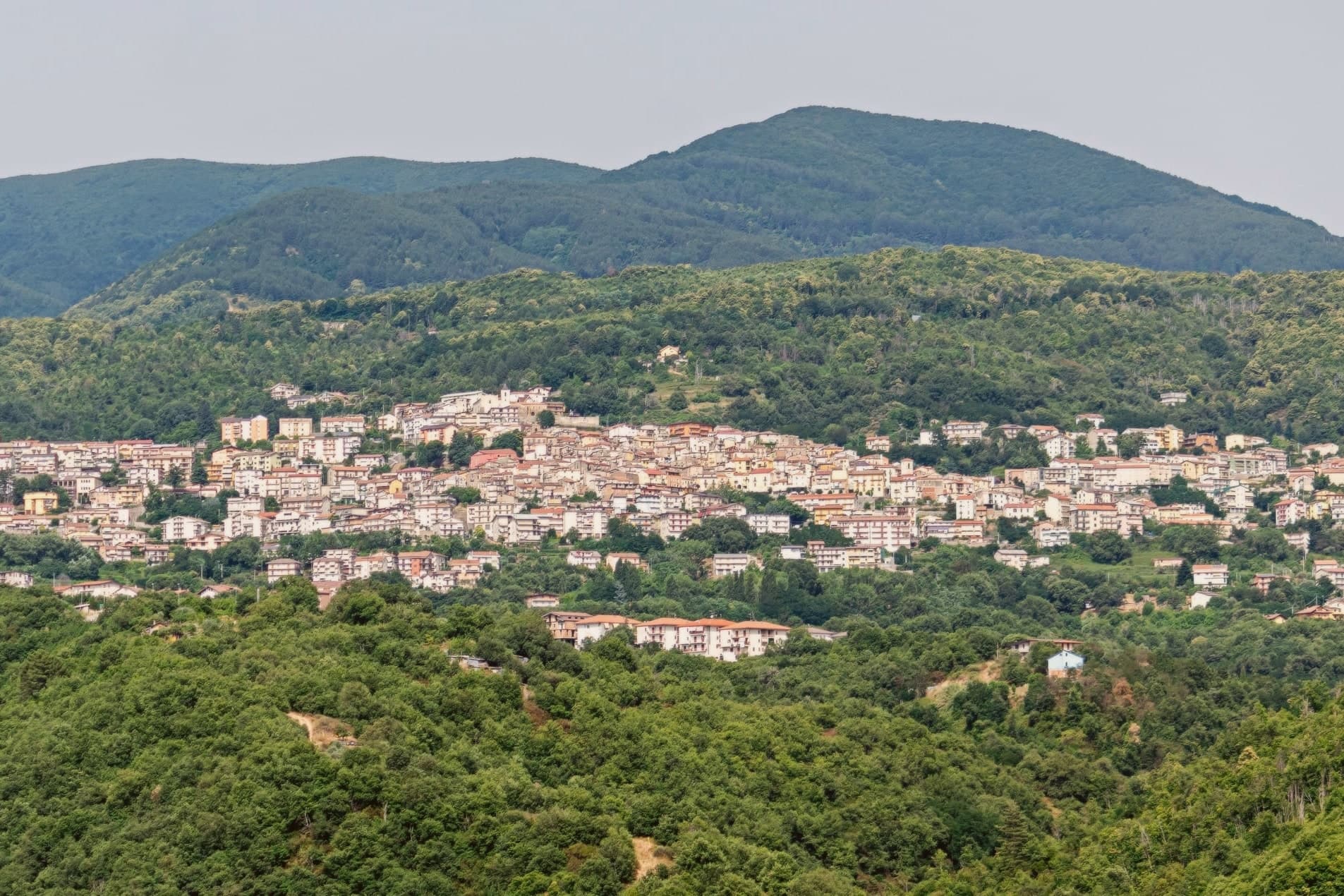
The town sits on the Presila Cosentina, twenty kilometers east of Cosenza and on the western edge of the Sila plateau. The borough likely formed at the end of the tenth century, after the Arab raids on Cosenza pushed settlement inland toward higher ground.
The commune's territory reaches well beyond the historic centre. The mountain hamlets of Croce di Magara and Moccone fall inside its boundary alongside the resort frazione, and with them a share of the national park itself: its visitor centre and wildlife enclosures, its stand of centuries-old pines, and part of the largest lake in Calabria.
Snow closes the high pastures in winter; in summer the same ground turns to hiking, mushroom-gathering and grazing country. The old village below and the high plateau above are administratively one place, even though little of daily life in one resembles the other.
We confirmed you can reach this one by train.
What to see in Spezzano della Sila
- Santuario di San Francesco da Paola. Convent with attached cloister at the head of the historic centre, the building around which the old town still gathers.
- Chiesa di San Pietro. Parish church in the old village, the main religious anchor of the Spezzano centro storico.
- Chiesa di San Biagio. Smaller historic church dedicated to the town's patron, part of the network of religious buildings inside the borgo.
How to get to Spezzano della Sila
There is a railway station in the town, so you can arrive without a car and never need one while you are here. Reggio Calabria is roughly 170 minutes away by road.
Our tip
May through October is the long Sila season: the lifts on Monte Curcio stop, the plateau opens up to hikers, and Lake Cecita fills with anglers and picnickers. July and August are the busiest months because the cool air pulls Cosenza and Catanzaro residents up the hill to escape the coast. September and October bring porcini and chestnuts. Sagra della Cucuzza falls in July.
More from Anywhere Italy
- The best hidden towns you can reach by train in the province of Cosenza
- The best small coastal towns in Calabria
- The best hidden beach towns in Calabria
 The 10 best hidden mountain towns in Calabria
- The best hidden beach towns you can reach by train in the province of Cosenza
- The best high-altitude villages in Calabria