
Without a car
Lazio by train
29 towns
Towns in this region where we confirmed an active station. Check the timetable before you go: a station on the map is not the same as a useful service.
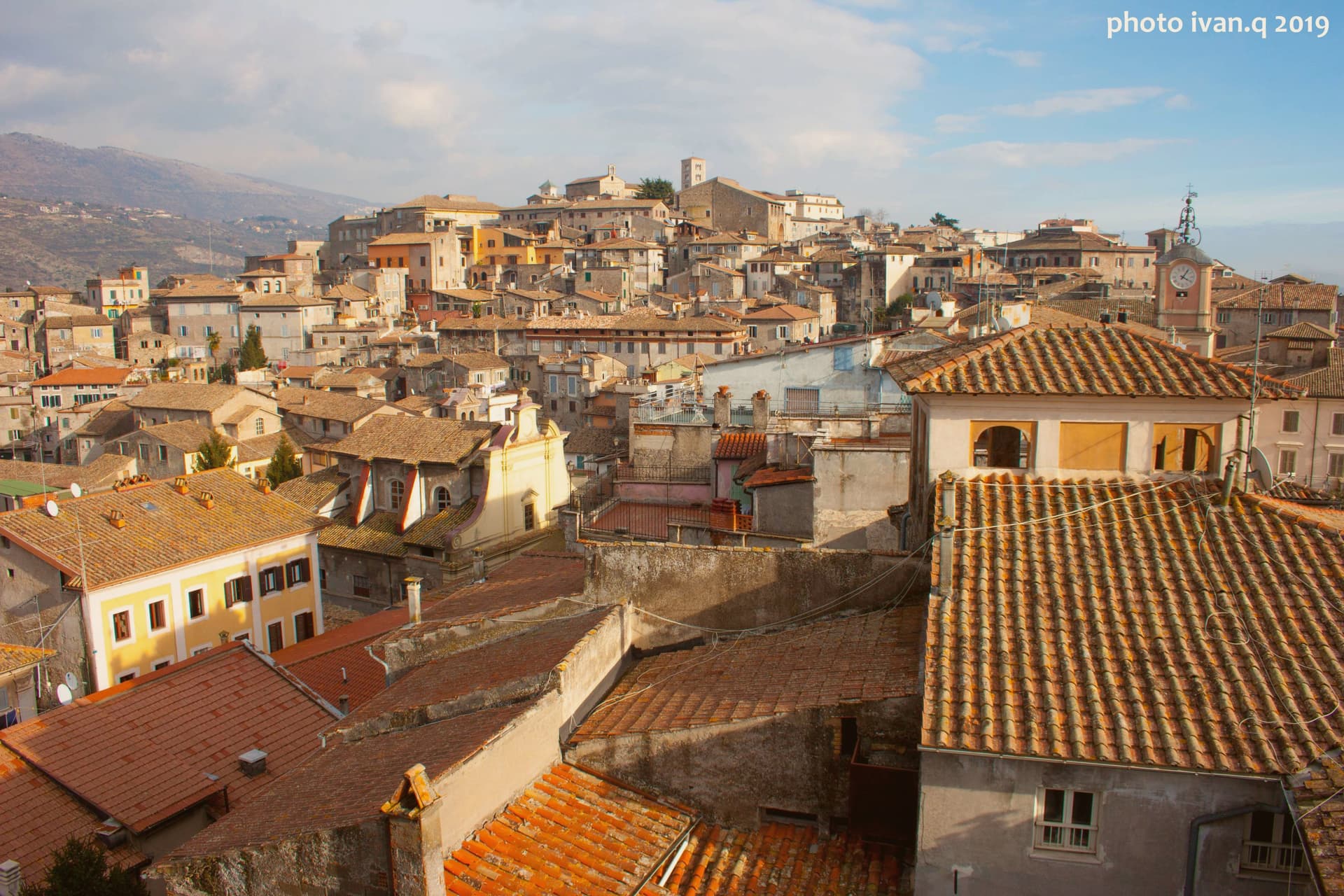
Anagni
Province: Frosinone · 424 m
The hill town in Ciociaria where a September 1303 assault on a reigning pope inside his own palace ended the medieval claim to papal supremacy.
Anguillara Sabazia
Province: Roma · 195 m
A medieval cape town jutting into Lake Bracciano, twenty-five kilometers from Rome, built above a 5700 BC Neolithic lakeshore village.
Ariccia
Province: Roma · 412 m
The Castelli Romani town where a single Baroque architect's ensemble sits on a volcanic crater rim above Rome, and Saturday lunch means porchetta.
Arpino
Province: Frosinone · 450 m
The Volscian-Roman hill town in the Liri valley that produced Marius and Cicero, with a pre-Roman acropolis above the modern center.
Bomarzo
Province: Viterbo · 263 m
The Tuscia village below a garden built by a grieving condottiero for his dead wife, all stone monsters and no apology for it.
Bracciano
Province: Roma · 280 m
The Lazio lake town with the eighth-largest lake in Italy below it and one of the best-preserved Renaissance castles in the country above it.
- ✷ We've been
Capranica
Province: Viterbo · 370 m
A medieval hill town on the old Via Cassia, taken by the Anguillara family in 1305 and remembered as the place Petrarch stayed in 1337.
Castel Gandolfo
Province: Roma · 426 m
A papal town on the rim of Lake Albano's volcanic crater, summer residence of the popes since 1626.
Castelnuovo di Porto
Province: Roma · 250 m
A tufa-ridge borgo twenty-five kilometers north of Rome inside the Parco di Veio, dominated by a Renaissance fortress above the Tiber valley.
Castro dei Volsci
Province: Frosinone · 385 m
A Ciociaria hilltop borgo at 385 meters in the Sacco valley, named for the pre-Roman Volsci.
Cerveteri
Province: Roma · 81 m
An Etruscan capital seven kilometers inland from the Tyrrhenian coast, with the Banditaccia necropolis holding 1,000 tombs in the largest ancient cemetery in the Mediterranean.
Fondi
Province: Latina · 9 m
The plain town between the Ausoni and Aurunci mountains where the Caetani built a castle in the middle of farmland instead of on a hill.
Gaeta
Province: Latina · 2 m
The promontory port where a Bourbon kingdom fell in February 1861 and the south of Italy stopped existing as a state.
Greccio
Province: Rieti · 705 m
A 705-meter borgo on a ridge above the Rieti valley, built around the cave of the first living nativity scene.
Isola del Liri
Province: Frosinone · 217 m
The Ciociaria town with a 27-meter waterfall in its centro storico and a paper-mill past once called the Manchester of Italy.
Magliano Sabina
Province: Rieti · 222 m
A 222-meter Sabine town on a Tiber terrace, cathedral seat of the Sabina diocese on the Lazio-Umbria border.
Minturno
Province: Latina · 140 m
A coastal comune at the mouth of the Garigliano, built on the Roman colony of Minturnae.
Montefiascone
Province: Viterbo · 590 m
A 590-meter hill town on the highest hill of the Volsini, source of Est! Est!! Est!!!.
Nettuno
Province: Roma · 11 m
A Tyrrhenian town 60 km south of Rome, with a walled medieval borgo above the sea, a Borgia fortress and the 1944 landing beaches.
Oriolo Romano
Province: Viterbo · 420 m
A planned sixteenth-century village in the Sabatini hills, laid out in 1560 by a Santacroce nobleman on land cleared from an ancient beech wood.
Rieti
Province: Rieti · 405 m
The Sabine capital on the Velino, claimed as the center of Italy, under Monte Terminillo and the Franciscan sanctuaries of the Valle Santa.
- ✷ We've been
Ronciglione
Province: Viterbo · 441 m
A tufa-brick borgo above Lake Vico, fortified by the Prefects of Vico and crowned Borgo dei Borghi in 2023.
Sermoneta
Province: Latina · 257 m
A walled medieval town on a Lepini spur above the Pontine Plain, seat of the Caetani since a 1297 purchase and still ruled from a 42-meter tower.
Subiaco
Province: Roma · 408 m
The Aniene valley town where Benedict spent three years in a cliff cave, and where Italy's first printed book appeared in 1465.
Tarquinia
Province: Viterbo · 133 m
An Etruscan capital on a Maremma ridge whose 6,000 rock-cut tombs at Monterozzi hold the largest body of pre-Roman painting in the Mediterranean.
Tivoli
Province: Roma · 235 m
A travertine town on the Aniene falls twenty-five kilometers east of Rome, holding two separate UNESCO sites: Hadrian's villa below and the Villa d'Este above.
Velletri
Province: Roma · 332 m
The Castelli Romani town where Augustus grew up, now the largest wine commune of its hills.
Viterbo
Province: Viterbo · 326 m
The medieval capital of the Tuscia, papal seat for five popes between 1257 and 1281 and home to the longest conclave in Church history.
Vitorchiano
Province: Viterbo · 285 m
A peperino borgo built on a single volcanic boulder near Viterbo.
The slow-trip planner
Plan a slow trip across the towns travelers skip.
Answer five questions. We will shape a geographically coherent slow trip from the 1,000 Italian towns most travelers skip. Yours to save and share.
From elsewhere in Italy
Five more towns to discover
Visso
Province: Macerata
The northern Sibillini gate at 607 meters where the Nera meets the Ussita, holding one of two surviving manuscripts of Leopardi's L'Infinito.
Goriano Sicoli
Province: L'Aquila
At 720 meters in the Subequana valley, a medieval village drawn by M.C. Escher in 1929 keeps a May ritual folklorists trace to Demeter.
Ugento
Province: Lecce
A Messapian-Roman town five kilometers from the Ionian, where a Baroque castle sits on the walls of the ancient city of Ozan.
Fontanellato
Province: Parma
A Parma-plain town built around the Rocca Sanvitale, the moated fortress at its center.
Pescina
Province: L'Aquila
A Marsica town at 735 meters, on the rim of the drained Fucino basin, that lost five thousand of six thousand people in a single morning in 1915.