
For foodies
Where to eat well in Basilicata
11 towns
Towns holding at least one place a guide put its name to. The ones several guides agree on come first.
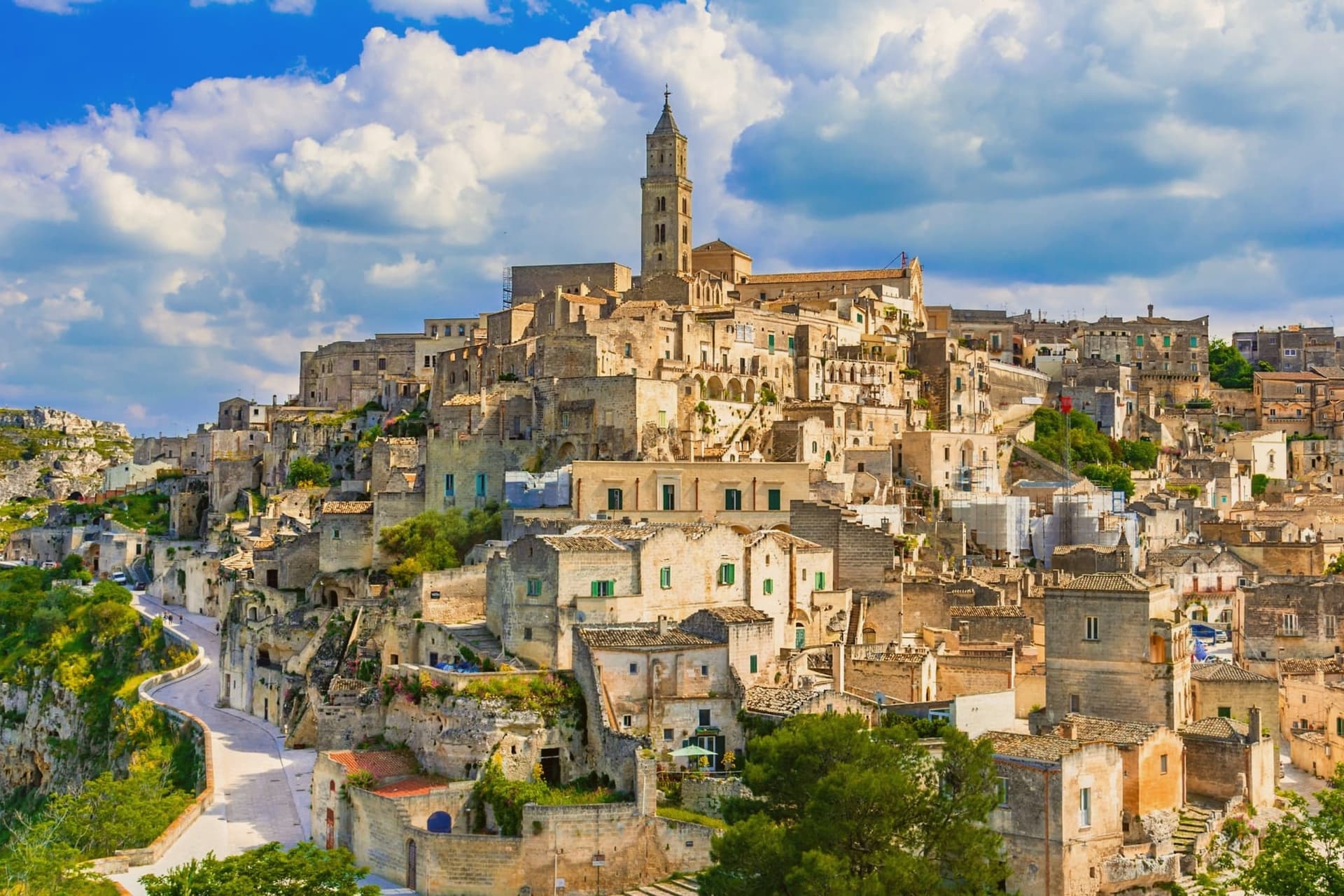
Matera
Province: Matera · 401 m
Cave dwellings carved into limestone since the Paleolithic, called the shame of Italy in the 1950s and made European Capital of Culture in 2019.
Maratea
Province: Potenza · 300 m
Basilicata's only commune on the Tyrrhenian, thirty-two kilometers of rocky coast overlooked by a marble Christ raised inland in 1965.
Castelmezzano
Province: Potenza · 750 m
A medieval village wedged into sandstone teeth at 750 meters, linked to Pietrapertosa by a 1,452-meter zipline since 2007.
Melfi
Province: Potenza · 530 m
At 530 meters on volcanic slopes, first Norman capital of the south and seat of a landmark 1231 legal code issued from its castle.
Rotonda
Province: Potenza · 626 m
The Pollino park's Lucanian gateway: a 3,171-resident borgo at 626m on the Basilicata/Calabria border, headquarters for the Parco Nazionale del Pollino, Italy's largest national park, with the Loricato pine forests immediately above town.
Terranova di Pollino
Province: Potenza · 926 m
At 926 meters on the Lucanian side of the Pollino, the gateway into Italy's largest national park, home of the Sarmento red potato.
Acerenza
Province: Potenza · 833 m
A walled ridge town at 833 meters in the north Lucanian hills, archbishopric since 1068 under a Romanesque cathedral begun in 1080.
Irsina
Province: Matera · 548 m
A 548-meter Bradano-valley hill town, called Montepeloso until 1895, whose cathedral holds a Renaissance rarity.
Latronico
Province: Potenza · 888 m
A mountain town at 888 meters on the northern edge of the Pollino, with two prehistoric thermal springs at the Calda hamlet below.
Venosa
Province: Potenza · 415 m
Founded as Roman Venusia in 291 BC, birthplace of Horace, with an unfinished abbey built from amphitheater stones and a 1470 Aragonese castle.
Viggiano
Province: Potenza · 975 m
A 975-meter Val d'Agri ridge town, home of the Black Madonna of Lucania and the Italian folk harp, on Europe's largest onshore oil field.
The slow-trip planner
Plan a slow trip across the towns travelers skip.
Answer five questions. We will shape a geographically coherent slow trip from the 1,000 Italian towns most travelers skip. Yours to save and share.
From elsewhere in Italy
Five more towns to discover
Visso
Province: Macerata
The northern Sibillini gate at 607 meters where the Nera meets the Ussita, holding one of two surviving manuscripts of Leopardi's L'Infinito.
Goriano Sicoli
Province: L'Aquila
At 720 meters in the Subequana valley, a medieval village drawn by M.C. Escher in 1929 keeps a May ritual folklorists trace to Demeter.
Ugento
Province: Lecce
A Messapian-Roman town five kilometers from the Ionian, where a Baroque castle sits on the walls of the ancient city of Ozan.
Fontanellato
Province: Parma
A Parma-plain town built around the Rocca Sanvitale, the moated fortress at its center.
Pescina
Province: L'Aquila
A Marsica town at 735 meters, on the rim of the drained Fucino basin, that lost five thousand of six thousand people in a single morning in 1915.