
The best towns with a World Heritage site in the province of Siena
Southern Siena province is built from the stone under it. Travertine and warm brick in the Val d'Orcia towns, tufa on the volcanic slopes towards Radicofani, and behind the walls a food culture of pecorino di Pienza, hand-rolled pici, wild boar and the Brunello and Rosso vineyards that climb the Montalcino hill. The listed landscape here is agricultural rather than architectural, which means the view from the ramparts is part of the protected thing: wheat, clay crete, cypress avenues, sheep. Late spring turns the fields green and the roadsides yellow with broom; October brings grape harvest, olive pressing and the first cold evenings in stone kitchens.
Most visitors arrive in Siena, and with reason. The Campo, the Duomo with its striped marble and inlaid floor, the Palio in July and August, the medieval street plan intact enough to be inscribed as a World Heritage site in its own right. On summer weekends the Via di Città moves at a shuffle, the trattorie near the Campo run two sittings, and the hill towns beyond appear only as a coach excursion sold by the hour.
The listing does not stop at the city walls. The same protected countryside continues south through the Val d'Orcia and out towards Monte Amiata, and it takes in whole small towns: a papal ideal city, a fortress ridge above the Via Francigena, wine villages where the cellar door is on the main street. Fewer people go, particularly outside the middle of the day, and these are the towns where the World Heritage designation is something you walk through rather than queue for.
Of the 20 communes we have mapped in the province of Siena, 6 qualify as towns with a World Heritage site: each holds or sits inside a UNESCO World Heritage site. The smallest, Radicofani, has 1,060 residents.
Elsewhere in the catalogue: The best towns with a medieval festival that hold a World Heritage site in Toscana and The best hidden towns with a medieval festival in the province of Siena.
Radicofani
Why visit Radicofani
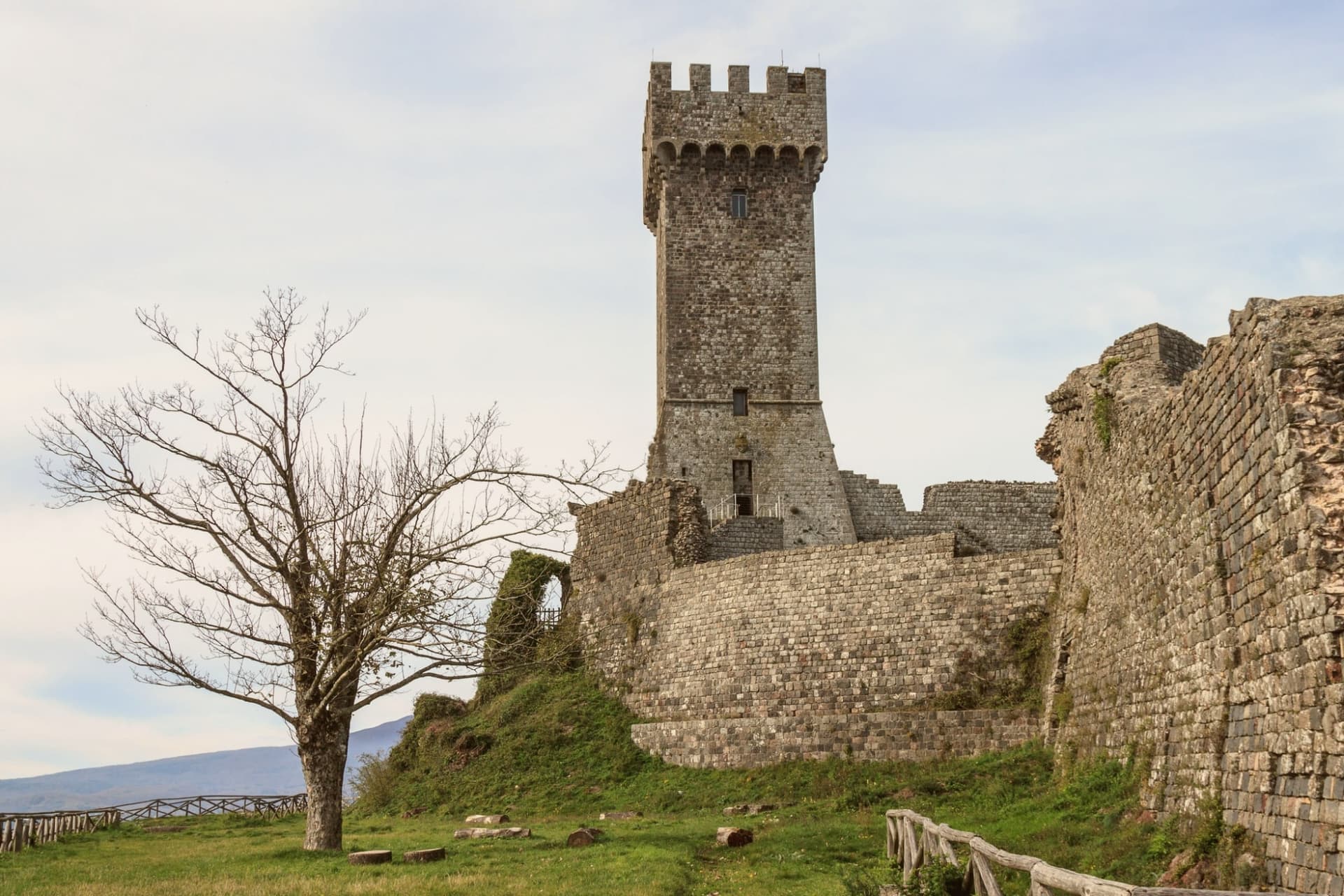
Radicofani sits where the rolling clay hills of the Val d'Orcia give way, abruptly, to a volcanic cone: the town rises straight off the plain rather than sitting among gentler slopes, which is why the rock is visible from Pienza, Montalcino, the Cassia road and points as far off as Lago Trasimeno, 60 km away, and why it reads as a landmark rather than a village from any distance. The medieval centro climbs in the same volcanic-basalt stone as the rock beneath it, narrowing as it rises, so that the streets themselves seem to funnel a visitor upward toward the fortress that caps the summit.
That fortress began under the Aldobrandeschi in the 12th century, was expanded by the outlaw and Ghibelline noble who made the rock his raiding base from 1297 to 1303, robbing pilgrims and churchmen on the road below and returning the richest captives to Pope Boniface VIII with gallows-humour notes attached, a story Dante folds into Purgatorio VI and Boccaccio into the Decameron's tenth day. The Sienese extended it again in the 14th century, the Medici in the 16th after Cosimo I bought the territory in 1556, and a powder-magazine explosion in 1735 took off the upper levels, leaving the restored lower fortress and its terrace standing today.
Below the village, at its foot rather than within its walls, sits the old stagecoach inn, a separate register of the town's history: not the fortress and its outlaw but the machinery of travel and hospitality that grew up beneath it to serve the pilgrim road running from Canterbury to Rome, hosting Montaigne, Dickens and Grand Tour travellers moving between Florence and Rome from 1500 to 1850. The town's church, the Romanesque Pieve di San Pietro, and its companion the Chiesa di Sant'Agata, with its Della Robbia altarpiece, belong to the centro itself rather than to the rock above it.
Surroundings widen the picture: Pienza, also UNESCO-listed, lies 30 km north, Montalcino 35 km northwest, and the extinct volcano immediately west offers a cooler, wooded counterpoint of chestnut and beech forest to the bare rock the town is built on, with thermal baths built around a pool 20 km north. The food follows the same Val d'Orcia line as its neighbors: pici with hare ragù, pecorino di Pienza, lardo di Colonnata and finocchiona, with Brunello di Montalcino and Vino Nobile di Montepulciano within easy reach.
The Festa Medievale in mid-July recreates the outlaw court that once ruled the summit, and the Festa del Fagiolo in early August celebrates the local cannellini bean. Like other Val d'Orcia hilltop villages, the population has fallen hard, from 2,800 in 1951 to 1,060 today.
The three marks the town carries together, UNESCO, Bandiera Arancione and the pilgrim route, are not separate honors so much as three ways of naming the same fact: a place built for defense and passage that has outlasted both purposes and now stands mostly for itself.
What to see in Radicofani
- Rocca di Radicofani. 12th-c Aldobrandeschi origin, expanded by the Sienese in the 14th century and by the Medici in the 16th, after Cosimo I bought the territory in 1556. A 1735 powder-magazine explosion destroyed the upper levels. The restored lower fortress and its panoramic terrace give the most expansive single view in southern Tuscany.
- Via Francigena + Posta Medicea. The inn stands at the foot of the village, on the pilgrim road from Canterbury to Rome, where it once put up travellers moving between Florence and Rome for three and a half centuries, among them Montaigne and Dickens.
- UNESCO Val d'Orcia centro. An intact medieval centro climbing in volcanic-basalt stone toward the fortress above it. The Pieve di San Pietro is Romanesque; the Chiesa di Sant'Agata holds a Della Robbia altarpiece.
How to get to Radicofani
Perugia is roughly 91 minutes away by road.
Our tip
Radicofani is best May–September. The Festa Medievale mid-July (Ghino di Tacco pageant) + Festa del Fagiolo early August are the year's headline events. Summer is hot in the Val d'Orcia but the 814m altitude keeps Radicofani 5-7°C cooler than the lower valleys. Festa degli antichi mestieri a Radicofani falls in June.
Pienza
Why visit Pienza
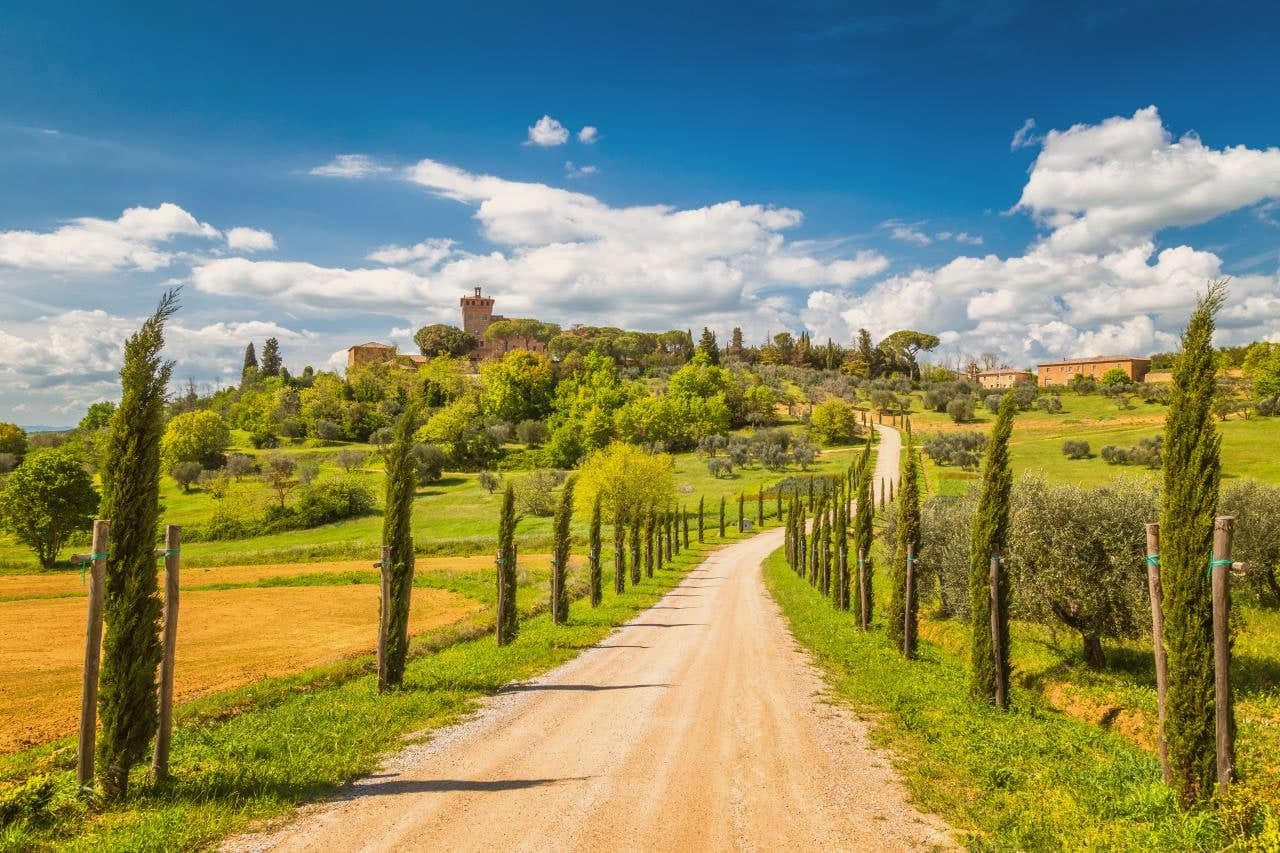
Pienza sits at 491 meters on a long ridge in the Val d'Orcia, an hour and a half south of Siena. The village was called Corsignano until 1462.
Enea Silvio Piccolomini was born here in 1405 and became Pope Pius II in 1458; the following year he ordered the Florentine architect Bernardo Rossellino to rebuild his birthplace as a Renaissance ideal city. The work took three years.
The square at the center, the cathedral on the cliff side, the palace built for the pope's family, the cardinal's palace facing it, and the town hall opposite the cathedral were all designed and built as a single composition rather than assembled piece by piece over time. Pius consecrated the cathedral on 29 August 1462, two years before his death, and the whole arrangement has survived almost unchanged since.
What stands in Pienza today is less a collection of monuments than the physical record of one commission carried out in one stretch of years.
What to see in Pienza
- Piazza Pio II. Trapezoidal Renaissance square laid out by Bernardo Rossellino, with the Duomo, Palazzo Piccolomini, Palazzo Borgia and Palazzo Comunale facing each other.
- Duomo di Pienza. Latin-cross cathedral with three apsidal chapels, built on the cliff edge, its Renaissance façade also by Rossellino.
- Palazzo Piccolomini. Renaissance palace for the pope's family, begun 1459, with an internal courtyard and a hanging garden overlooking the Val d'Orcia.
How to get to Pienza
Perugia is roughly 98 minutes away by road.
Our tip
April through June and September into October are the months when the Val d'Orcia sits at its best, green or gold depending on the wheat cycle, and the Piazza Pio II is open for photographs without the day-tripper buses. July and August push past thirty-three degrees and the Corso Rossellino fills with tour groups between ten and four. The Fiera del Cacio, the cheese festival, takes the first Sunday in September, when the streets fill with stalls of pecorino producers from the Pienza ridge. Festa del Cacio di Pienza falls in September.
Castiglione d'Orcia
Why visit Castiglione d'Orcia
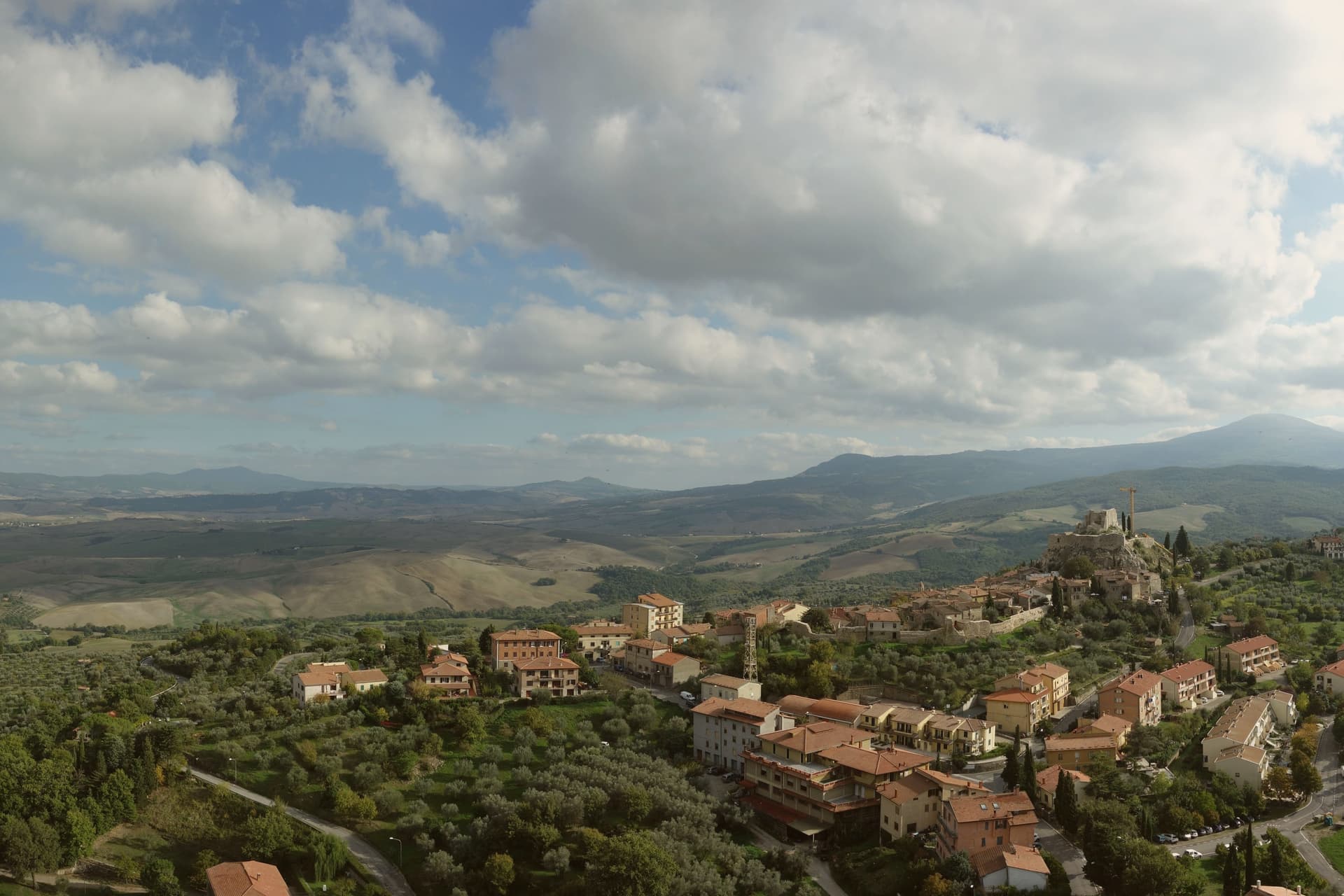
The village stands on a ridge where the land drops toward the Val d'Orcia, the agricultural landscape shaped by Sienese painters and Renaissance estate managers that stretches between Siena and the mountain to the south. First documented in 714, the settlement was then held by the Aldobrandeschi, who built the fortress above the village to hold the medieval road running between the mountain and the Via Francigena, the pilgrim route below.
Siena took the town in 1251 and passed control to the Salimbeni and later the Piccolomini, a shift that put a Sienese family in charge of the second fortress on the neighboring outcrop in the frazione of Rocca d'Orcia. The village center and its outlying frazione form two working parts of one settlement: the walled hill town with its civic square and parish church, and the fortified outcrop a short distance off that once policed the valley approach on its own.
The territory is one of three communes sharing the UNESCO inscription, a status that recognizes the whole valley rather than any single settlement within it. What the record shows, across all of it, is a place whose function was always defensive and administrative before it was scenic: two fortresses set to watch one road, a town divided between them, and a landscape that outgrew its original purpose to become the reason people look at it now.
What to see in Castiglione d'Orcia
- Rocca Aldobrandesca. Aldobrandeschi fortress above the village, documented from the eighth century, walls and keep open as an archaeological site.
- Rocca a Tentennano. Stronghold on a basalt outcrop in the frazione of Rocca d'Orcia, reached by a climb that still shows the defensive logic of the site, controlling the approach along the valley.
- Piazza Vecchietta. Small triangular civic square in the centro storico, the space that carries the painter's adopted name through the village center he left behind.
How to get to Castiglione d'Orcia
Perugia is roughly 152 minutes away by road.
Our tip
April through June and September into October are the months the Val d'Orcia photographers come for, the green hills and the gold stubble depending on the half. The borgo at 540 meters stays cool when the valley floor heats up. July and August push the lower fields into the mid thirties; afternoons thin out the centro storico but the ridge keeps a breeze.
San Quirico d'Orcia
Why visit San Quirico d'Orcia
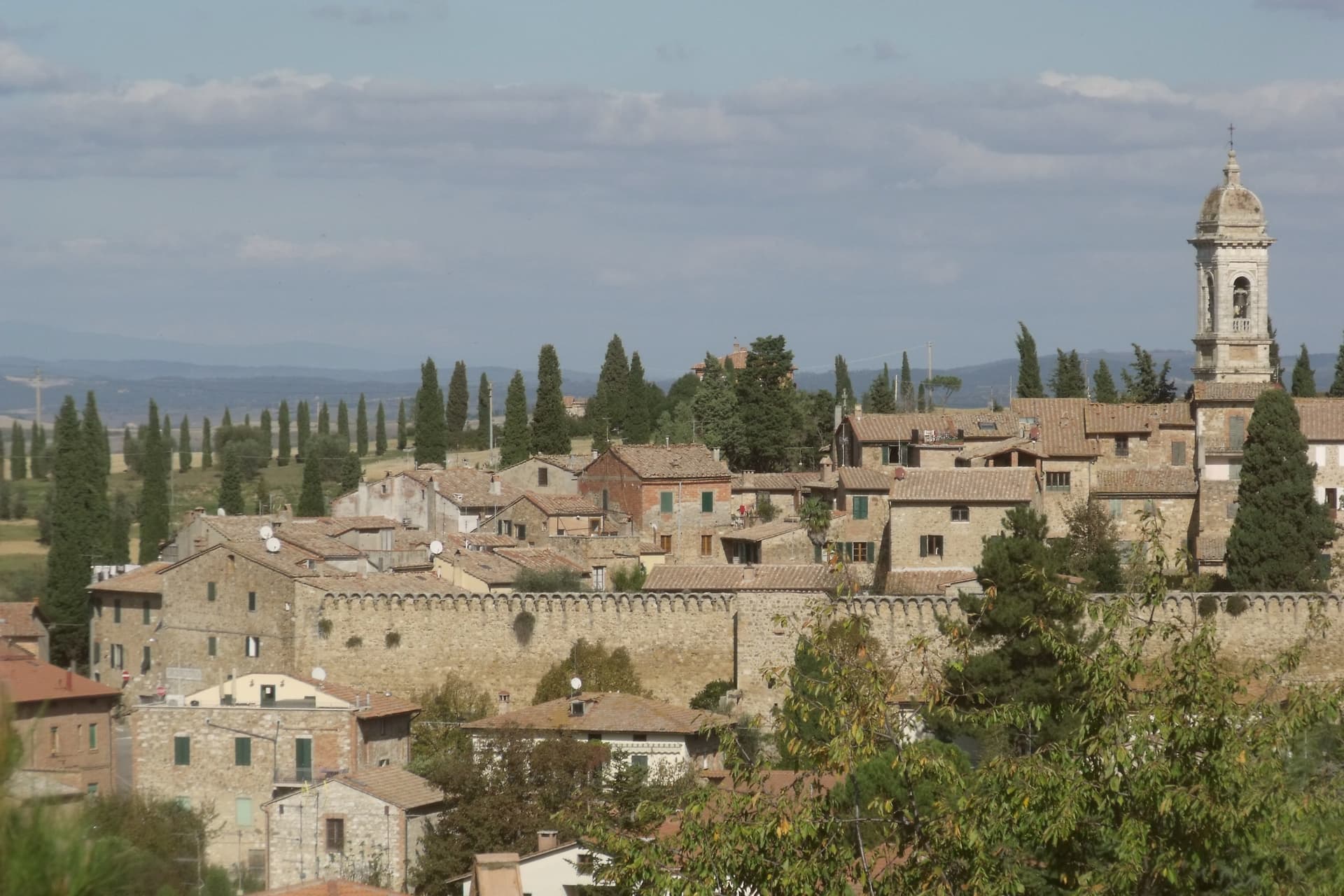
San Quirico d'Orcia sits at 409 meters on a low rise in the Val d'Orcia, the rolling clay-and-tufa landscape inscribed by UNESCO in 2004 as a cultural landscape shaped by fourteenth and fifteenth-century Sienese governance. The town was a stage on Sigeric the Serious's tenth-century Via Francigena from Canterbury to Rome and has remained a working stop on the route ever since.
The Collegiata dei Santi Quirico e Giulitta was built at the end of the twelfth century over an eighth-century baptistery; the lateral portal added in 1288 is attributed to Giovanni Pisano, then working on the Siena cathedral. The Horti Leonini, the geometric boxwood garden laid out by Diomede Leoni around 1580 inside the town walls, hosts the Forme nel Verde sculpture exhibition every summer since 1971.
Bagno Vignoni, the frazione five kilometers down the road, has a thermal pool at the center of its piazza, used since Etruscan times. Few comuni this small carry UNESCO, thermal and Francigena signals at once.
What to see in San Quirico d'Orcia
- Collegiata dei Santi Quirico e Giulitta. Romanesque parish church built late twelfth century over an eighth-century baptistery, with the 1288 lateral portal attributed to Giovanni Pisano.
- Horti Leonini. Italianate boxwood garden laid out by Diomede Leoni around 1580 inside the town walls, hosting the Forme nel Verde sculpture exhibition since 1971.
- Bagno Vignoni. Frazione five kilometers south, with a sixteenth-century thermal pool at the center of its piazza, fed by springs used since Etruscan times.
How to get to San Quirico d'Orcia
Perugia is roughly 96 minutes away by road.
✷ We have written about San Quirico d'Orcia
“When the film industry needed a picture of heaven, of the fields a dead hero walks home to, they came and shot it here, and that is the truest thing anyone has ever said about the Val d'Orcia. It is not a place. It is the afterlife as imagined by people who lived in cities. It is how the country looks to men who never spent an hour in it, dreamed up by Florentine bankers five hundred years ago and maintained, beautifully, ever since.”
Read our piece on San Quirico d'Orcia →Val d'Orcia | The Postcard Is Constructed
Our tip
April through June and September into October are the gold months in the Val d'Orcia: green wheat in spring, ochre stubble by autumn, low light that defines the cypress ridges. The Festa del Barbarossa runs the third Sunday of June with archery, jousts and crossbow contests between the town quarters. July and August are hot and busy; the centro storico fills with day-trippers from Pienza and Montalcino. Festa del Barbarossa a San Quirico d'Orcia falls in June.
Montalcino
Why visit Montalcino
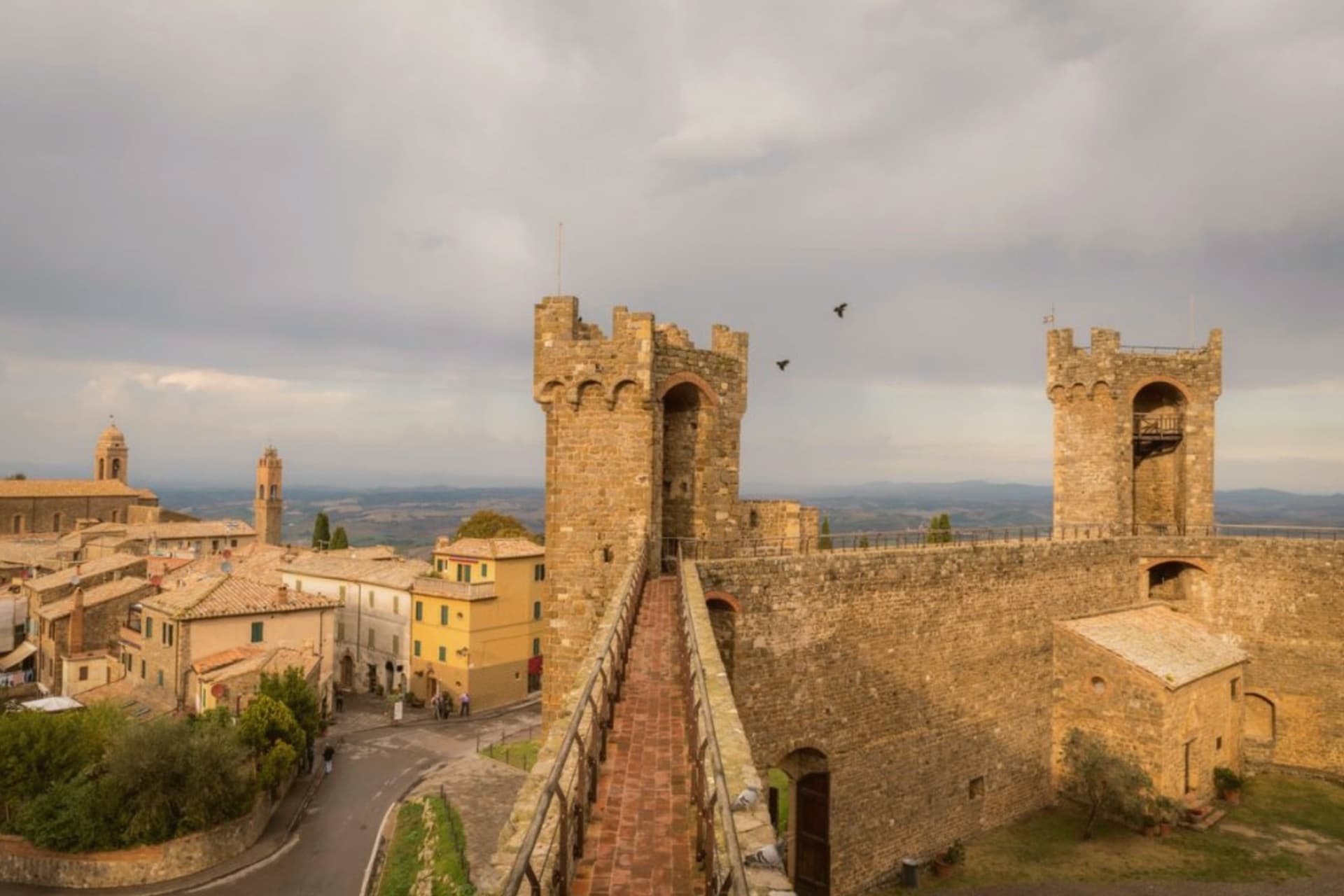
Montalcino sits at 564 meters on a hill south of Siena, the centro storico ringed by walls and crowned by a pentagonal fortress built in 1361. When Florence took Siena in 1555, the Sienese exiles regrouped here and held out for almost four years; the Rocca itself never fell.
That date matters less to most visitors than 1980, when Brunello di Montalcino was named one of the first four Italian wines to receive DOCG status. The vineyards run from the town at 600 meters down to plots at 200, on stony galestro soils that ripen Sangiovese Grosso into a wine that ages for decades.
The Abbey of Sant'Antimo, ten kilometers south, is a Romanesque church first documented in 814 and tied by local legend to a vow by Charlemagne. The town also produces miele, olio, and the white truffles of the surrounding woods.
It carries seven institutional signals at once, more than any other commune in this batch.
What to see in Montalcino
- Rocca di Montalcino. Pentagonal fortress built in 1361 by Sienese architects Mino Foresi and Domenico di Feo, refuge of the Sienese Republic after 1555.
- Abbazia di Sant'Antimo. Romanesque abbey ten kilometers south, first documented in 814, set among olive groves below the town with Gregorian chant still sung.
- Palazzo dei Priori. Thirteenth-century town hall on Piazza del Popolo, slender tower attached, civic seat of the medieval commune.
How to get to Montalcino
There is a railway station in the town, so you can arrive without a car and never need one while you are here. Perugia is roughly 105 minutes away by road.
Our tip
April through June and September into October are the months locals prefer. The hills are green or gold depending on the half, and the vineyards run their full work cycle. The Sagra del Tordo, a medieval archery contest between the four quarters of the town, takes place the last Sunday of October. Sagra del Cinghiale di Montalcino falls in the season.
San Gimignano
Why visit San Gimignano
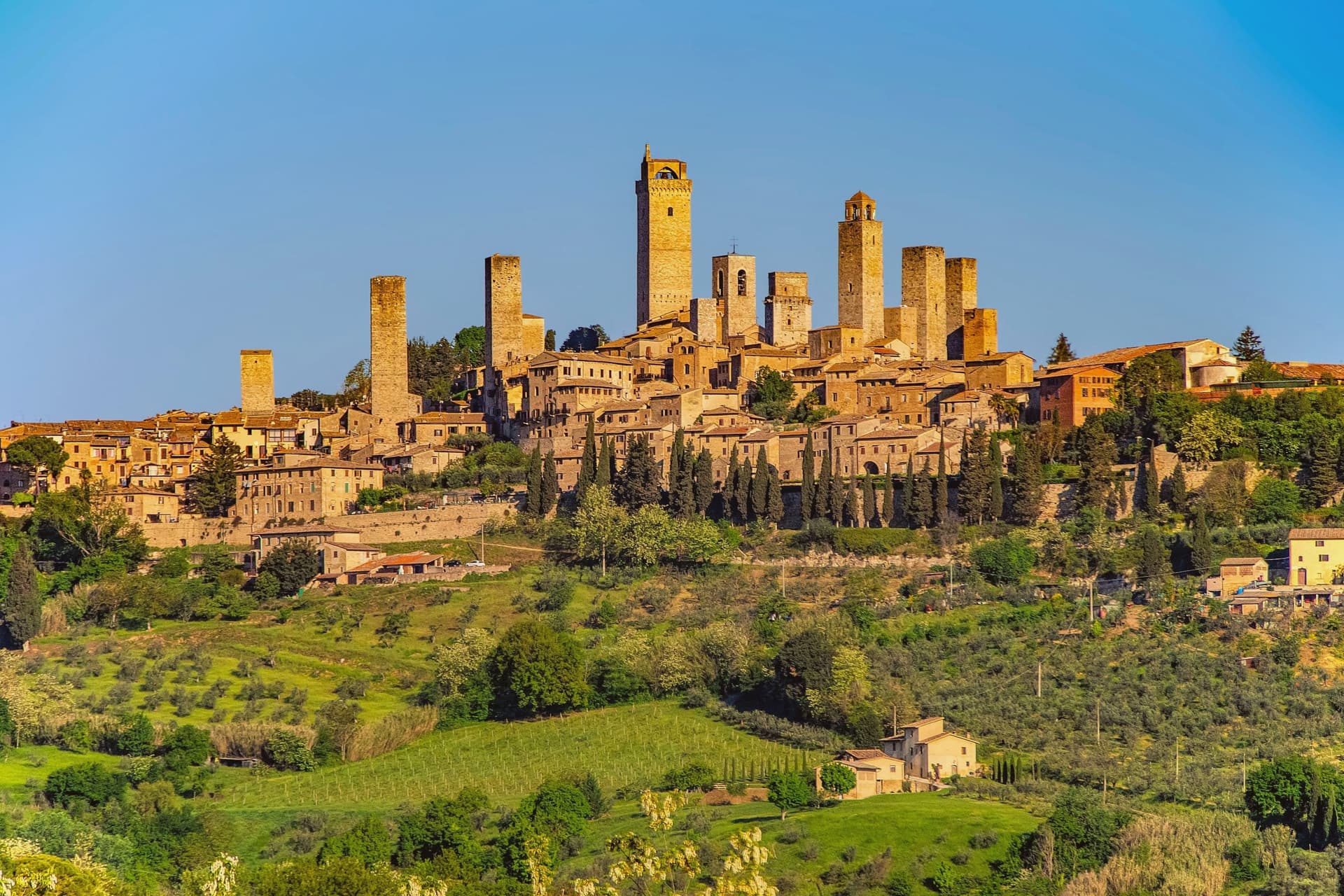
San Gimignano sits at 334 meters in the Val d'Elsa, halfway between Firenze and Siena on the medieval pilgrim road to Rome. Patrician families built 72 tower-houses in the twelfth and thirteenth centuries as proofs of wealth and platforms for vendettas; 14 still stand, the tallest being the Torre Grossa at 54 meters.
The town declared independence from the bishops of Volterra in 1199 and grew rich on saffron and Vernaccia, the white wine grown on the surrounding hills and praised since Dante. The Black Death of 1348 broke the boom; San Gimignano lost more than half its population and submitted to Florence.
That collapse is the reason the medieval skyline survived. UNESCO listed the historic centre in 1990 as a complete record of feudal architecture.
Roughly three million visitors come each year, more than 400 times the resident population, and the centro storico empties into the surrounding olive groves once the day-trippers leave.
What to see in San Gimignano
- Torre Grossa. Fifty-four meter civic tower attached to the Palazzo Comunale, the tallest of the surviving 14, open for the climb to the panoramic terrace.
- Piazza della Cisterna. Triangular medieval square paved in brick around an octagonal well of 1287, lined by tower houses and Romanesque palaces.
- Collegiata di Santa Maria Assunta. Romanesque parish church on Piazza Duomo, walls covered by Bartolo di Fredi and Lippo Memmi frescoes of Old and New Testament scenes.
How to get to San Gimignano
Firenze is roughly 61 minutes away by road.
✷ We have written about San Gimignano
“We arrived in the afternoon, into the second half of the day’s crowd. Off-season meant it was groups and guides rather than a flood, but the shops were open and doing their worst, the same garbage souvenirs, the same pasta no one local would eat, and we walked through it the way you walk through a thing you have decided not to let ruin your evening. The towers stood over all of it, indifferent, which is their whole talent.”
Read our piece on San Gimignano →San Gimignano | The Town After Seven
Our tip
April through June and September into October are the months the town is worth a full day rather than three hours. The buses still come, but late afternoon empties the piazzas and lets the towers take their light. July and August push temperatures past thirty and the centro storico becomes uncomfortable between two and six, when the stone radiates heat. Fiere delle Messi di San Gimignano falls in June.
More from Anywhere Italy
 The best towns with a medieval festival that hold a World Heritage site in Toscana
 The best hidden towns with a medieval festival in the province of Siena
- The best towns on a walking route in the province of Siena
 The best towns with a World Heritage site within two hours of Perugia
 The 9 best hidden hill towns on a walking route in Toscana
 The 10 best small hill towns in the province of Siena