
The best wine towns within 75 minutes of Rimini
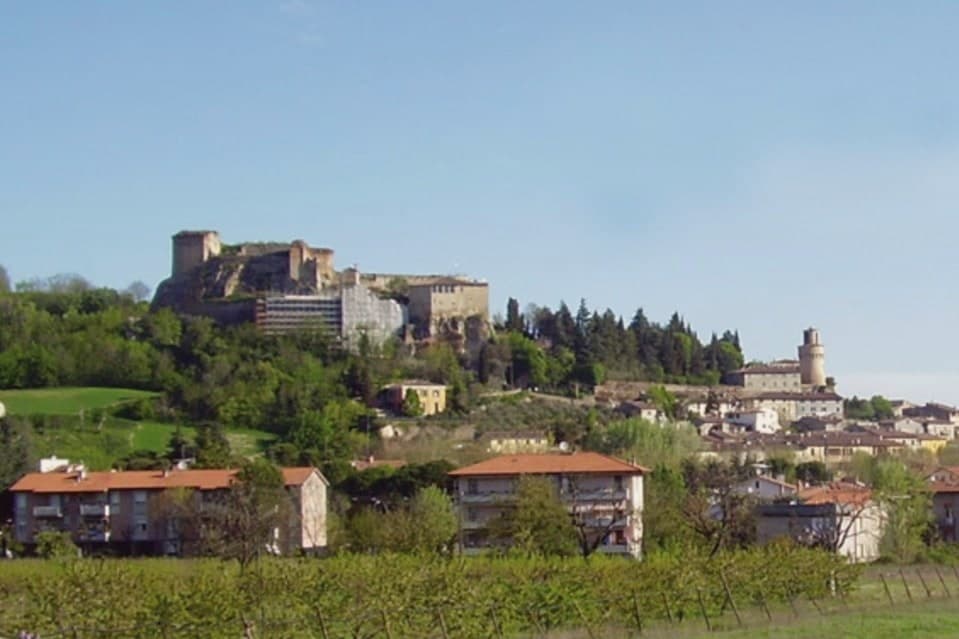
Behind the Adriatic beaches the land tilts up quickly, and within half an hour the sand gives way to clay ridges planted with Sangiovese, Trebbiano and the golden Albana grape that made Romagna the first Italian white to win protected status. The towns here are built of brick and pale local sandstone, with arcaded streets, hilltop bell towers and cellars dug back into the slope where the wine stays cool through August. Autumn is the season that rewards a detour: grape harvest in September, then chestnuts, wild boar ragù and truffle from the Apennine foothills through November. Piadina is everywhere, split and filled with squacquerone cheese, and it is the correct thing to eat with a young glass of red poured at room temperature.
Most people arriving in this corner of Emilia-Romagna go to Rimini for the beach, or push on to Bologna for the tortellini and the porticoes, and both fill up accordingly. The Riviera hotels are booked solid from June, and Bologna's food streets around the Quadrilatero are a slow shuffle of tour groups by lunchtime. It is understandable. Bologna does eat superbly, and Rimini's beach clubs are a genuine institution.
The vineyards, though, do not stop where the guidebooks do. The same Sangiovese hills run west along the ancient Via Emilia and south into the Apennine valleys, past thermal spas, painted village walls and towns where the wine cooperative is the biggest building in sight. Fewer visitors go, the tables are easier to get, and the drive from Rimini is short enough to do on a whim. These are the towns on that stretch.
Of the 33 communes we have mapped in a 75-minute drive of Rimini, 7 qualify as wine towns: each sits inside the production zone of a protected wine. The smallest, Castrocaro Terme e Terra del Sole, has 6,352 residents.
Elsewhere in the catalogue: The best towns known for what they grow within an hour of Rimini and The best towns known for what they grow within two hours of Florence.
Castrocaro Terme e Terra del Sole
Why visit Castrocaro Terme e Terra del Sole
The commune sits at 68 meters on the Montone river, ten kilometers southwest of Forlì in the Apennine foothills, and is the union of two distinct towns rather than one that simply grew. Castrocaro occupies the hill, its castle controlling the valley from above.
The fortress town on the plain below it was built in one campaign to project the authority of the Grand Duchy of Tuscany into Romagna, rather than accumulated over centuries like its neighbor. The Medici governed it until 1923, when the provincial border finally moved and the arrangement ended.
The two halves of the commune read like two different centuries standing next to each other: one shaped by defense over generations, the other stamped out whole by a single ducal decision in 1564. What the pairing adds up to is a rare chance to see, in the space of one small commune, both how a medieval hill fortress evolved and what a Renaissance planner intended a fortress town to look like when built from nothing, a place called Terra del Sole.
Essentia have been named by a guide.
What to see in Castrocaro Terme e Terra del Sole
- Rocca di Castrocaro. One of the oldest castles in Italy, standing on the hill above the centro with three concentric defensive rings, built to command the valley below.
- Terra del Sole. Two squares, four gates, and bastioned walls still standing, laid out with the geometric symmetry of a town designed on paper rather than grown over time.
- Palazzo dei Commissari e del Pretorio. On the central square, the residence of the Medici governors of Romagna Fiorentina until 1772, its facade facing the town's planned axis.
How to get to Castrocaro Terme e Terra del Sole
Forlì is roughly 19 minutes away by road.
Our tip
Castrocaro Terme runs all twelve months because the thermal water does. The Terme stay open year-round, with the lowest tariffs from November to March and the most space in spa hotels through mid-week stays in winter. April through June brings green on the Apennine slopes and the gardens around Terra del Sole.
Dozza
Why visit Dozza
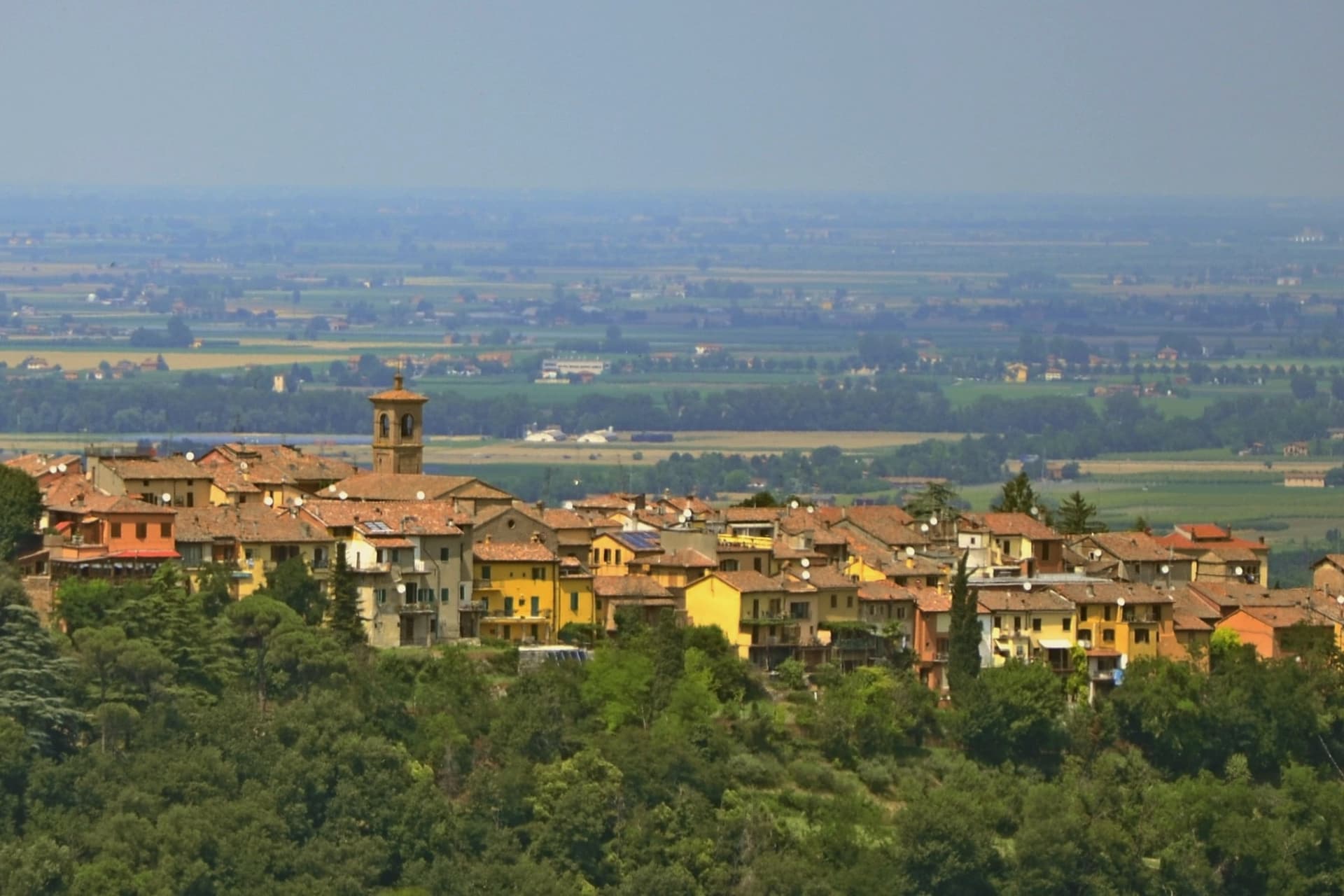
Dozza sits on a low ridge at 190 meters above the Sellustra valley, six kilometers from Imola and twenty-five southeast of Bologna. The medieval village runs along a single curved spine of stone houses, with the Rocca Sforzesca closing the upper end.
Caterina Sforza rebuilt the fortress at the end of the fifteenth century on the remains of earlier Bolognese defences; the Malvezzi-Campeggi family turned it into a palazzo in the late sixteenth century, and the cellars now hold the Enoteca Regionale dell'Emilia-Romagna, which curates the wines of the whole region. The Biennale del Muro Dipinto began in 1960, when the opening of the Rocca to the public was paired with a contemporary-painting competition that worked directly on the village walls.
Over sixty years later, more than 100 murals cover the borgo, repainted and added to every other year by invited Italian and international artists. The municipality holds Borghi più belli and Bandiera Arancione recognition.
Population 6,582.
What to see in Dozza
- Rocca Sforzesca. Late fifteenth-century fortress rebuilt by Caterina Sforza, transformed into a palazzo by the Malvezzi-Campeggi family at the end of the 1500s.
- Muro Dipinto. Over 100 murals on the house walls of the medieval village, repainted and added to every two years since the first Biennale in 1960.
- Enoteca Regionale dell'Emilia-Romagna. Regional wine cellar inside the Rocca's underground levels, curating about 800 labels from across the region's DOC and DOCG zones.
How to get to Dozza
Bologna is roughly 37 minutes away by road.
Our tip
April through June and September through October are the working months in Dozza. The murals look best in oblique morning or late-afternoon light, and the Sellustra valley below stays green into early summer. The Biennale del Muro Dipinto runs in September of odd-numbered years and is when the borgo is fullest, with painters working on scaffolding through the whole month.
Longiano
Why visit Longiano
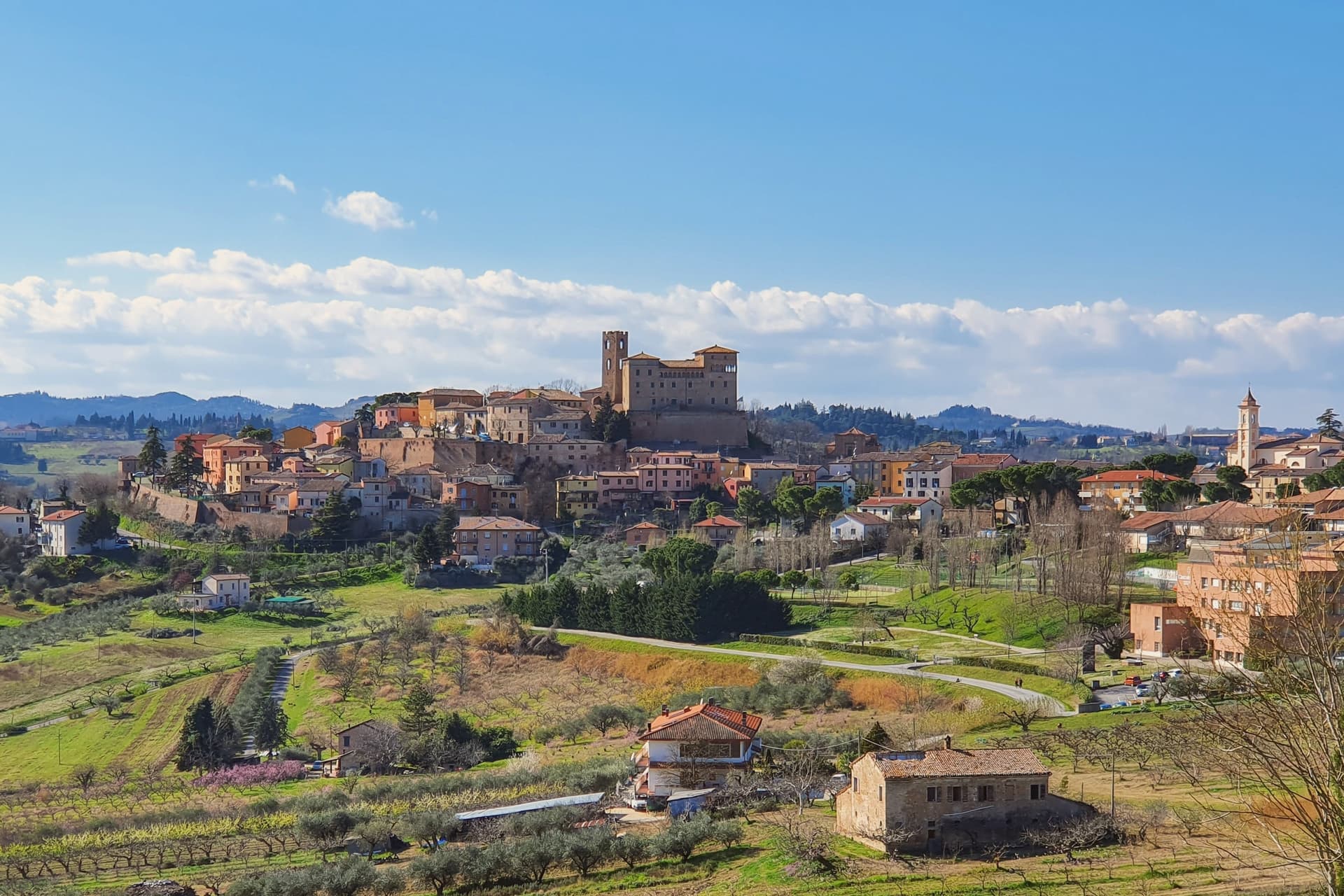
Longiano sits at 179 meters on the first hill line between Cesena and Rimini, eleven kilometers inland from Cesenatico and within sight of the Adriatic. The town shifted from the plain to the hill in the seventh and eighth centuries, when the local population moved up to escape Lombard raids, and the settlement that resulted is the hilltop borgo still walled today, with the castle at its center and the theater just below it.
Longiano passed to the Church in 1581 and stayed under papal rule until unification, before the castle came to the commune in 1989. The sanctuary stands apart from this hilltop cluster, built around its painted crucifix and held by Franciscan presence for over seven centuries, a separate thread of the town's history running alongside the Malatesta line and the civic one.
What ties the parts together is the hill itself: a defensive move made in the seventh and eighth centuries left Longiano with a compact center where a former ruling family's fortress, a nineteenth-century theater and a walled medieval borgo all sit within reach of each other, while the sanctuary's much older devotional history runs on its own separate track nearby.
Magnolia, Dei Cantoni, Terre Alte have been named by a guide.
What to see in Longiano
- Castello Malatestiano. Fortified hilltop seat of the Malatesta of Rimini, later passing to the Church and then the commune. Its rooms now hold the Fondazione Tito Balestra, so the walls that once housed a ruling family now hold paintings, drawings and sculpture.
- Teatro Petrella. Sits just below the castle. Restored in 1986, it is known today for its acoustics inside the horseshoe-shaped hall.
- Santuario del Santissimo Crocifisso. Franciscan sanctuary built around a thirteenth-century painted crucifix on oak panel, with continuous Franciscan presence for over seven centuries.
How to get to Longiano
There is a railway station in the town, so you can arrive without a car and never need one while you are here. Rimini is roughly 30 minutes away by road.
Our tip
April through June and September through October are the months for Longiano. The hilltop catches a breeze the coastal plain below does not, and the views run from the Apennines to the Adriatic on clear days. July and August touch the low thirties and the centro storico empties between two and five; many visitors come up from Cesenatico and Cervia in the late afternoon for the cooler air and the castle. Crocetta 30 in Festa falls in August.
Bertinoro
Why visit Bertinoro
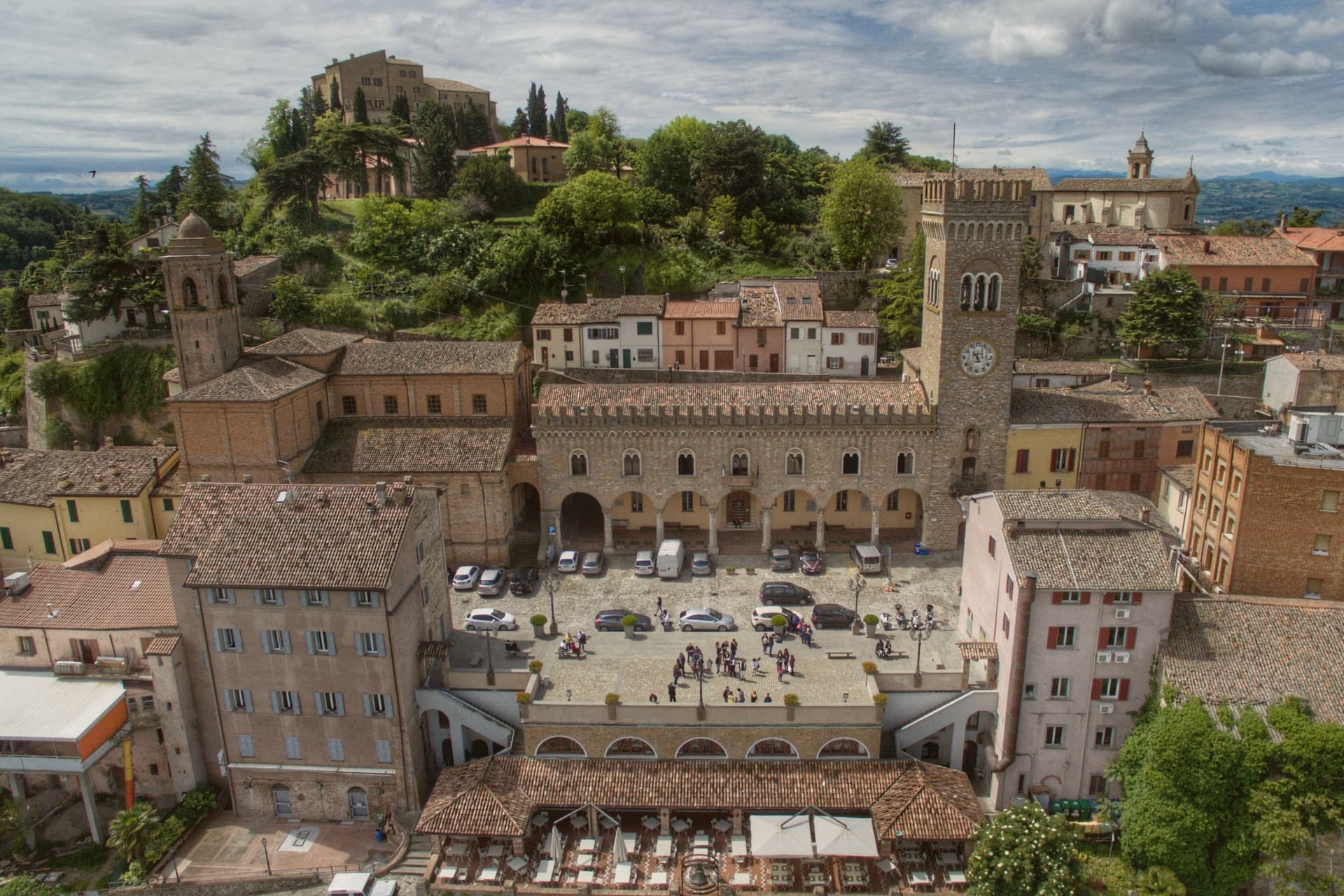
Bertinoro sits at 254 meters on Mount Cesubeo, a few kilometers south of the Via Emilia between Forlì and Cesena, the Romagna hills rolling toward the Adriatic on a clear day visible from the panoramic balcony locals call the Belvedere. The town's signature object is the Colonna delle Anella in Piazza della Libertà, a white-stone column with twelve iron rings, erected in 1300 by the noble families of the borgo so visitors arriving from the Via Emilia could tie their horse to a ring and be hosted by the family it belonged to.
The Albana grape grown on the surrounding slopes became, in 1987, the first Italian white wine to receive DOCG status; the artist Guerrino Bardeggia's Campana dell'Albana still rings to mark the opening of the harvest. Bertinoro joined the Borghi più belli d'Italia network in 2025.
The municipality holds two institutional signals: Borghi più belli, Città del Vino. Population 11,026.
What to see in Bertinoro
- Colonna delle Anella. White-stone column with twelve iron rings, erected 1300 in Piazza della Libertà so visitors could tie their horse to the ring of the family who would host them.
- Rocca Vescovile. Tenth-century fortress on the summit of Mount Cesubeo, expanded by the Ordelaffi and Malatesta and used as the bishop's residence from the sixteenth century.
- Cattedrale di Santa Caterina. Sixteenth-century cathedral on the upper part of the borgo, rebuilt over an earlier Pieve dedicated to Saint Catherine of Alexandria.
How to get to Bertinoro
Forlì is roughly 20 minutes away by road.
Our tip
April through June brings green hills, mild evenings, and the first events in Piazza della Libertà. September and October are the strongest months: the Albana harvest runs through late September, and the Festa dell'Ospitalità on the first Sunday of September re-enacts the old ring ritual, drawing visitors paired by lottery to twelve host families. July and August touch thirty-two degrees but the 254-meter elevation cools the borgo earlier than the plain below.
Castel San Pietro Terme
Why visit Castel San Pietro Terme
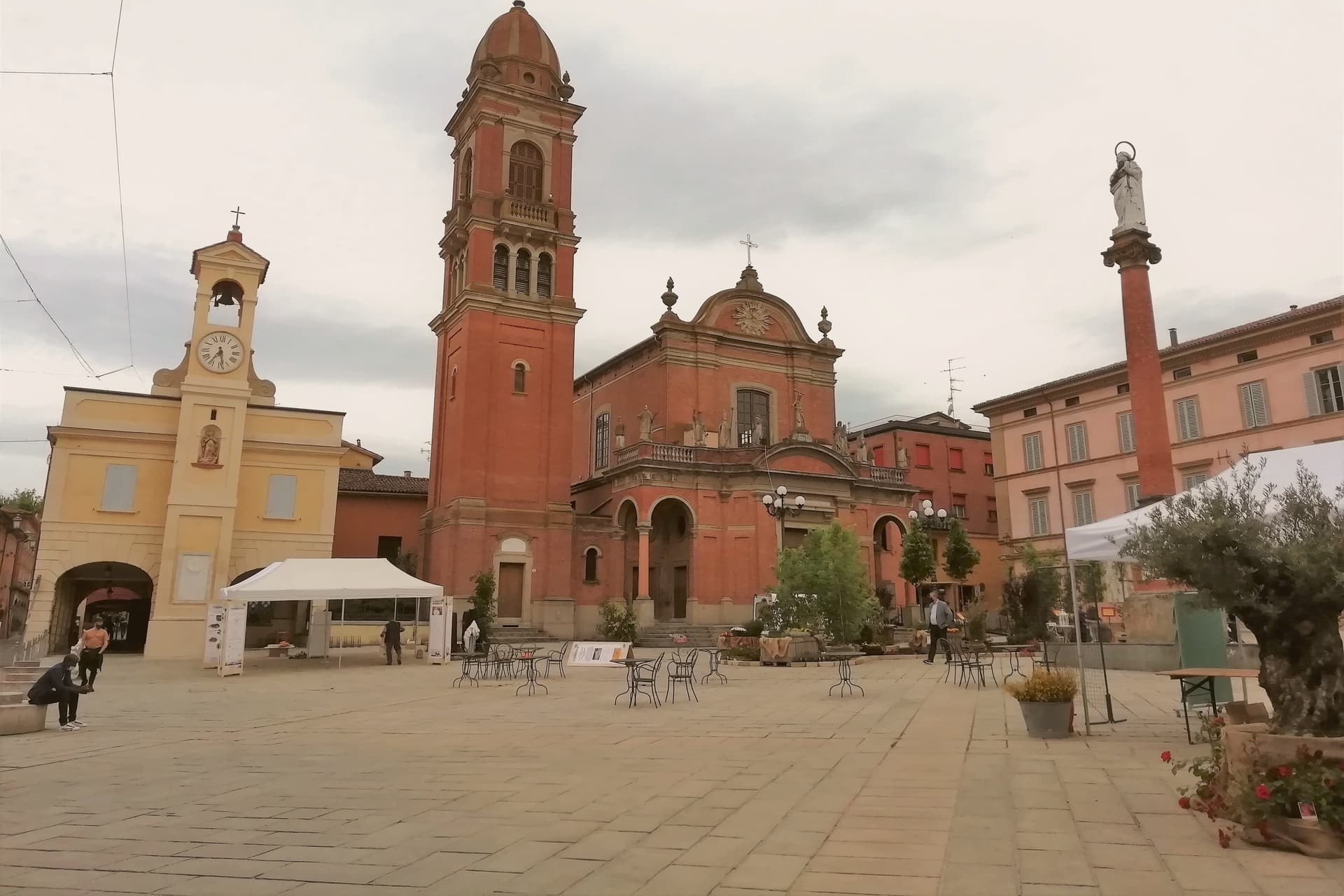
The town sits on the Sillaro river, which marks the historic border between Emilia and Romagna, twenty kilometers east of Bologna on the Via Emilia. It was founded as a Bolognese castrum in 1200, and the walled core still follows that original plan, with the river bridge on one edge and the road toward Imola leading out past the walls to the pilgrimage shrine beyond.
Castel San Pietro also joined the Città dell'Olio network for its hillside olive cultivation, a rural counterpart to the spa and civic life inside the walls. The Conservatorio Santa Caterina, founded in 1741, is one of the older female educational institutions still active in the region, sitting inside the same historic core as the gateway and the town hall.
The town reads as two things held together: a walled medieval seat on a border river, and a spa destination whose waters predate the walls by decades. Both draw on what was already there long before either was built up for visitors.
Il Grifone, Osteria La Civichella, Gastarea have been named by a guide.
What to see in Castel San Pietro Terme
- Cassero. The gateway stands at the southern edge of the old walls, its stone face marking what was once the main entry into the castrum. Inside, the civic theater now occupies the space, so the structure that once controlled access to the town now hosts its audiences.
- Terme di Castel San Pietro. The complex draws on sulphurous, ferruginous and salt-bromine-iodide springs, with the first establishment opened in 1870. The waters run year-round from the same sources used centuries before the modern building existed.
- Santuario del Crocifisso del Piratello. Pilgrimage shrine on the Via Emilia toward Imola, built around a fifteenth-century crucifix and decorated by Innocenzo da Imola. It drew pilgrim traffic from across northern Emilia, standing apart from the walled town on the road out toward Romagna.
How to get to Castel San Pietro Terme
There is a railway station in the town, so you can arrive without a car and never need one while you are here. Bologna is roughly 39 minutes away by road.
Our tip
Castel San Pietro Terme runs all twelve months because the thermal water does. Spring and autumn are the easier months for walking the centro storico and the Sillaro valley, with mild light and the olive groves on the hill above town green or harvest-coloured. June through August touches the low thirties and humid, but the spa runs longer hours in summer and the riverside frazione of Osteria Grande stays cool.
Faenza
Why visit Faenza
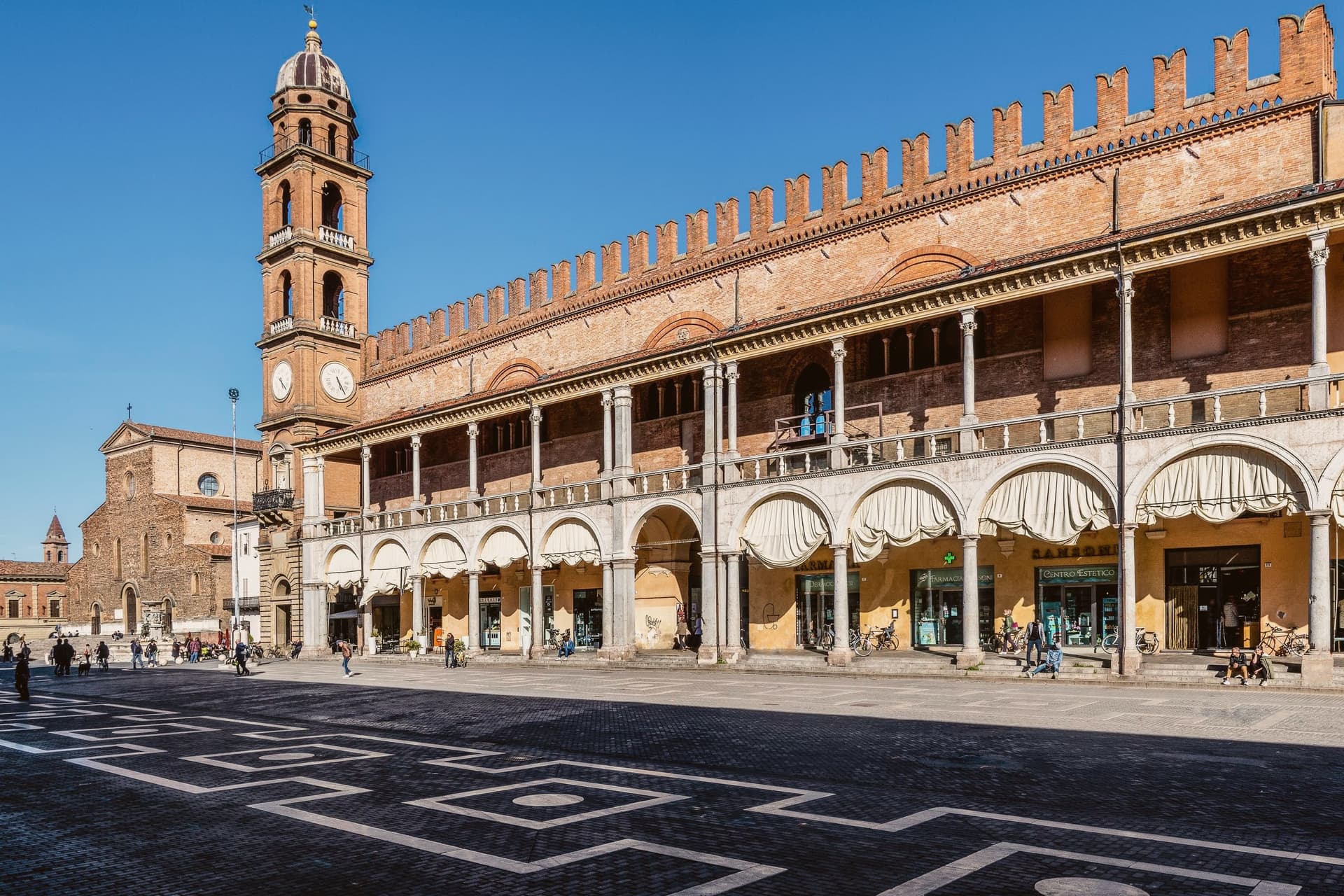
Faenza sits at 34 meters on the Via Emilia between Bologna and Rimini, on the Lamone river fifty kilometers southeast of Bologna. The city gave its name to faïence: tin-glazed earthenware that emerged here in the late fourteenth century and reached its peak in the early sixteenth, when the bianchi di Faenza, white-on-white ceramics exported across Europe, set the standard for Renaissance maiolica.
The Museo Internazionale delle Ceramiche, founded in 1908 by Gaetano Ballardini, holds 15,000 square meters of collections from 4000 BC to the present, with rooms dedicated to Picasso, Matisse, Chagall, Léger, Dalí, Burri, and Fontana. UNESCO named it a Monument Witness to a Culture of Peace in 2000.
The Cattedrale di San Pietro Apostolo, begun by Giuliano da Maiano in 1474, dominates Piazza della Libertà; Piazza del Popolo next door holds the medieval Palazzo del Podestà and the municipal palace. The Palio del Niballo, an equestrian competition between the five city rioni, runs every June.
La Baita, Manueli have been named by a guide.
What to see in Faenza
- Museo Internazionale delle Ceramiche. Founded in 1908 by Gaetano Ballardini, 15,000 square meters spanning 4000 BC to contemporary work by Picasso, Matisse, Chagall, and Fontana.
- Cattedrale di San Pietro Apostolo. Renaissance cathedral begun by Giuliano da Maiano in 1474, completed by 1515, with sculptures by Benedetto da Maiano in the nave.
- Piazza del Popolo. Twin medieval square to Piazza della Libertà, framed by the Palazzo del Podestà and the porticos of the municipal palace.
How to get to Faenza
There is a railway station in the town, so you can arrive without a car and never need one while you are here. Forlì is roughly 26 minutes away by road.
Our tip
April through June and September through October are the working months on the Romagna plain. Spring brings the Palio del Niballo at the end of June and clear water in the Lamone; autumn dries the fields gold and brings the ceramics fairs back to the centro. July and August touch thirty-six degrees with high humidity, and Piazza del Popolo empties between two and five.
Imola
Why visit Imola
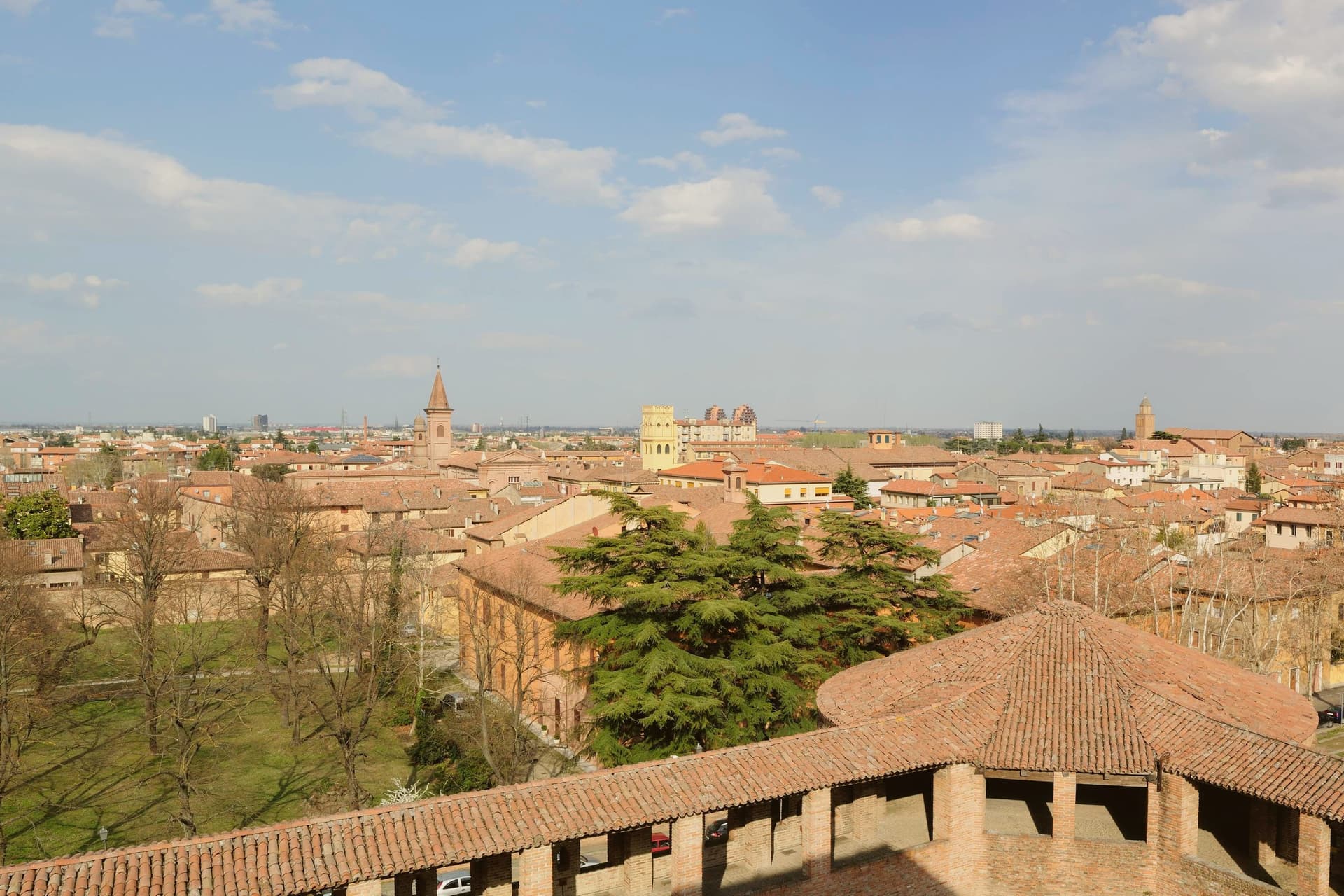
Imola is two cities sharing a name. The medieval one is a quietly handsome Romagna brick town 35 km southeast of Bologna along the Via Emilia, with the Rocca Sforzesca (rebuilt by Caterina Sforza in 1473–1499 — the Tigress of Forlì, who held this fortress through the Borgia siege of 1500) anchoring the centro.
The Palazzo Tozzoni museum, the 11th-century Cattedrale di San Cassiano with its crypt of the city's patron, the Palazzo Sersanti on the central piazza, and the medieval grid of porticoed brick streets all read as a smaller-scale Bologna. The OTHER Imola is the Autodromo Enzo e Dino Ferrari — the 4.9-km F1 circuit on the south bank of the Santerno, built 1953 and named for Enzo Ferrari and his son Dino after Dino's death.
It hosted the San Marino Grand Prix every May from 1981 to 2006 (and again 2020–present), and is the circuit where Ayrton Senna died in 1994 at the Tamburello corner — a memorial still stands there. The Emilia Romagna Grand Prix in April–May is the city's biggest tourist event of the year.
Outside race weekends the circuit is a public park; locals jog the track. The food is Romagna: piadina romagnola (the city is Città dell'Olio, and the local Brisighella Nostrana di Brisighella DOP olive oil is what dresses it), passatelli in brodo, cappelletti, Sangiovese di Romagna from the surrounding hills, and the local nocino walnut liqueur made by every grandmother in the foothills.
San Domenico, Semplice have been named by a guide.
What to see in Imola
- Rocca Sforzesca. Caterina Sforza's 1499 four-towered brick fortress at the centro's edge — the Tigress of Forlì held it against Cesare Borgia in 1500. Museum of arms and ceramics inside.
- Autodromo Enzo e Dino Ferrari. The 4.9-km F1 circuit on the Santerno. Senna memorial at Tamburello. Open as a public park outside race weekends — locals jog the track.
- Cattedrale di San Cassiano + crypt. 11th-c cathedral with the city patron's crypt; the Madonna del Piratello pilgrimage church just outside the walls is a major regional sanctuary.
How to get to Imola
There is a railway station in the town, so you can arrive without a car and never need one while you are here. Forlì is roughly 34 minutes away by road.
Our tip
Imola is best April–June and September–October. The Emilia Romagna Grand Prix (last weekend April / first weekend May) fills every hotel for 80 km — wonderful if you're going, brutal if you're not. Summer is hot and sticky. Baccanale Imola falls in October.
More from Anywhere Italy
- The best towns known for what they grow within an hour of Rimini
- The best towns known for what they grow within two hours of Florence
 The best hot-spring towns within two hours of Rimini
 The best wine towns within two hours of Ancona
 The best cheese towns within two hours of Bologna
 The best hot spring towns in Emilia-Romagna