
The best wine towns in Sicily
90 towns visited, 910 to go. Follow along, free: Subscribe on Substack
Sicilian wine changes character every time the ground under it changes. On the north flank of Etna the soil is black volcanic sand, the vines are old and low, and the reds made from nerello mascalese come out pale, sharp and mineral, closer to a mountain wine than an island one. West of Palermo the light goes flat and white, the houses are cut from tuff, and the grapes are grillo and catarratto and zibibbo, grown for wines that taste of salt and dried apricot. Autumn is the season: the harvest runs late, the roadside stalls sell prickly pears and almonds, and lunch is caponata, raw prawns, tuna cured in salt, bread rubbed with oil that still tastes green.
Most wine visitors to Sicilia go up Etna and stay in Taormina, which makes sense. The cellars on the volcano's slopes are the ones the international press writes about, the terrace views over the Ionian are worth the drive, and the road up from Giardini Naxos fills with hire cars from spring onwards. Cruise passengers arrive in Messina and Catania and are bussed the same way. The tastings are good, the crowds are real, and in August the town is close to unwalkable.
The vines carry on well past the part everyone photographs. They run round to the quieter side of the volcano, out into the Belice valley where the hill towns look down on lakes and wheat, along the salt pans of the west coast, and out to a windy island nearer Africa than Palermo where zibibbo grows in stone hollows dug against the wind. These are the towns in this list, all of them members of the national association of wine-producing towns, and fewer people go to them.
Of the 61 communes we have mapped in Sicilia, 6 qualify as wine towns: each belongs to the national association of wine-producing towns. The smallest, Sant'Alfio, has 1,509 residents.
Two more lists worth reading alongside this one: The best hidden coastal towns that eat well in Sicily and The best olive oil towns in Sicily.
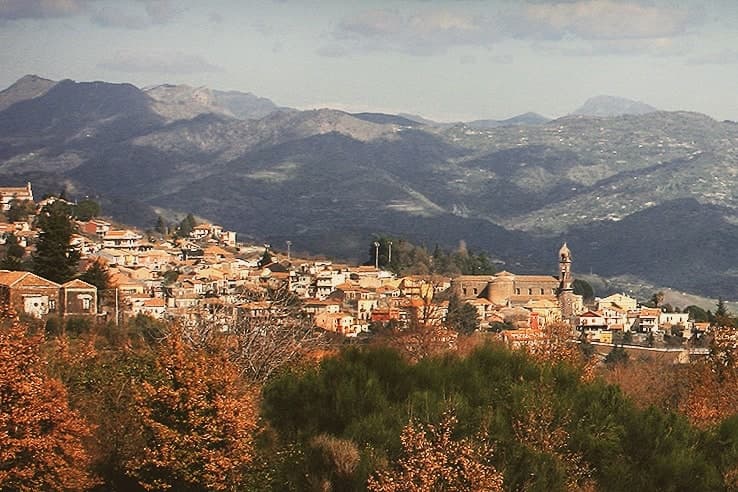
Why visit Sant'Alfio
Sant'Alfio sits at 537 meters on the eastern slope of Etna, eight kilometers from the active crater. The village grew around a seventeenth-century sanctuary dedicated to the brothers Alfio, Filadelfo and Cirino, three Christian martyrs deported from the Greek Aegean to Sicily under Decius and venerated as the town's patrons.
The real draw is older. The Castagno dei Cento Cavalli, on the Linguaglossa road just outside the centro, is the largest and oldest sweet chestnut in the world, between 2,000 and 4,000 years old, listed by Guinness for a recorded girth of 57.9 meters in 1780.
The trunk has since split into separate stems sharing one root system. The legend gives the tree its name: Queen Joanna of Aragon and her hundred mounted retainers are said to have sheltered beneath it during a storm.
The slopes around the village produce Etna Rosso DOC from Nerello Mascalese and cherries that fill the late-June sagra.
The comune belongs to the national association of wine-producing towns.
What to see in Sant'Alfio
- Castagno dei Cento Cavalli. Sweet chestnut between 2,000 and 4,000 years old on the Linguaglossa road, recorded by Guinness for a girth of 57.9 meters.
- Santuario dei Santi Martiri Alfio, Filadelfo e Cirino. Seventeenth-century parish sanctuary dedicated to the three brother martyrs, raised on a staircase of black Etna lava stone.
- Versante orientale dell'Etna. Lava fields and chestnut and oak woods on the volcano's east flank, crossed by trails from the village toward the summit craters.
How to get to Sant'Alfio
Catania is about 44 min away by road.
Our tip
April through June and September through November are the working months on the east slope of Etna. The chestnut woods leaf out in May, the Sagra della Ciliegia fills the last weekend of June, and the grape harvest runs from late September into October. July and August stay cooler than the Catania plain because of the 537-meter elevation, but the sun is hard and many visitors come for the volcano rather than the village.
Why visit Castiglione di Sicilia
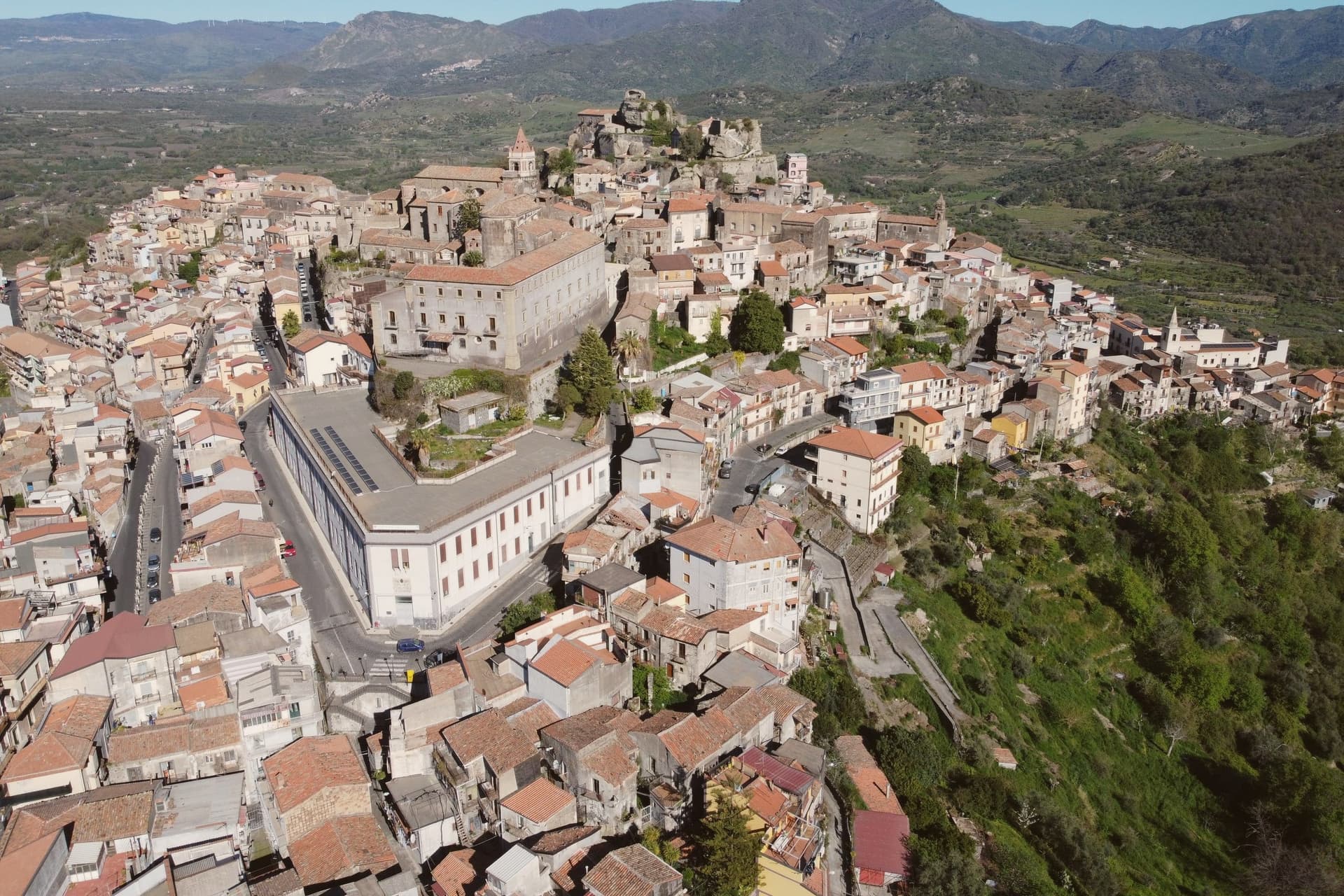
The town looks down the Alcantara river valley between Randazzo and Taormina, its position fixed by Norman count Roger I, who documented it in 1092 as Castrileonis, the great castle. That name still fits the territory more than the town itself: the commune's boundary runs uphill from the historic center all the way to the summit of Etna, taking in the north-east crater, so the same municipality holds a huddle of streets at 621 meters and a stretch of active volcano above it.
The hills below the center are the heart of the Etna DOC. Nerello Mascalese and Nerello Cappuccio grow on the volcanic soils around the village, with Carricante carrying the whites, and bottles from Cottanera, Passopisciaro, Tenuta delle Terre Nere and the Alcantara producers all ship from here.
Twenty minutes downhill the Alcantara has cut its gorges through the same lava that feeds those vineyards, basalt walls shaped by water where the fields above are shaped by the grape. Town, castle, vineyard and gorge read as one continuous volcanic system, worked over centuries into a fortress, a wine region and a river cut.
The comune belongs to the national association of wine-producing towns.
What to see in Castiglione di Sicilia
- Castello di Lauria. The fortress stands on its basalt outcrop above the town, its walls carrying the weight of two rebuildings by Ruggero di Lauria's crews. The rooms now hold the Enoteca Regionale for eastern Sicily, so the same stone that once watched for approach up the valley now stores the bottles made from the vines below it.
- Cuba Bizantina di Santa Domenica. Small Byzantine cube-shaped church, seventh to ninth century, in the rural outskirts of the commune, one of the oldest surviving structures in the Etna area.
- Gole dell'Alcantara. Basalt gorges carved by the Alcantara river through prismatic lava columns, around twenty minutes downhill from the centro storico.
How to get to Castiglione di Sicilia
It has its own railway station. Catania is about 49 min away by road.
Our tip
May through October are the working months on Etna nord. Vineyard tours start in June, harvest runs late September through mid-October on the higher contrade, and the slopes turn red and gold into early November. July and August on Etna are bearable at 621 meters: nights drop to seventeen degrees, far cooler than Catania.
Why visit Sambuca di Sicilia
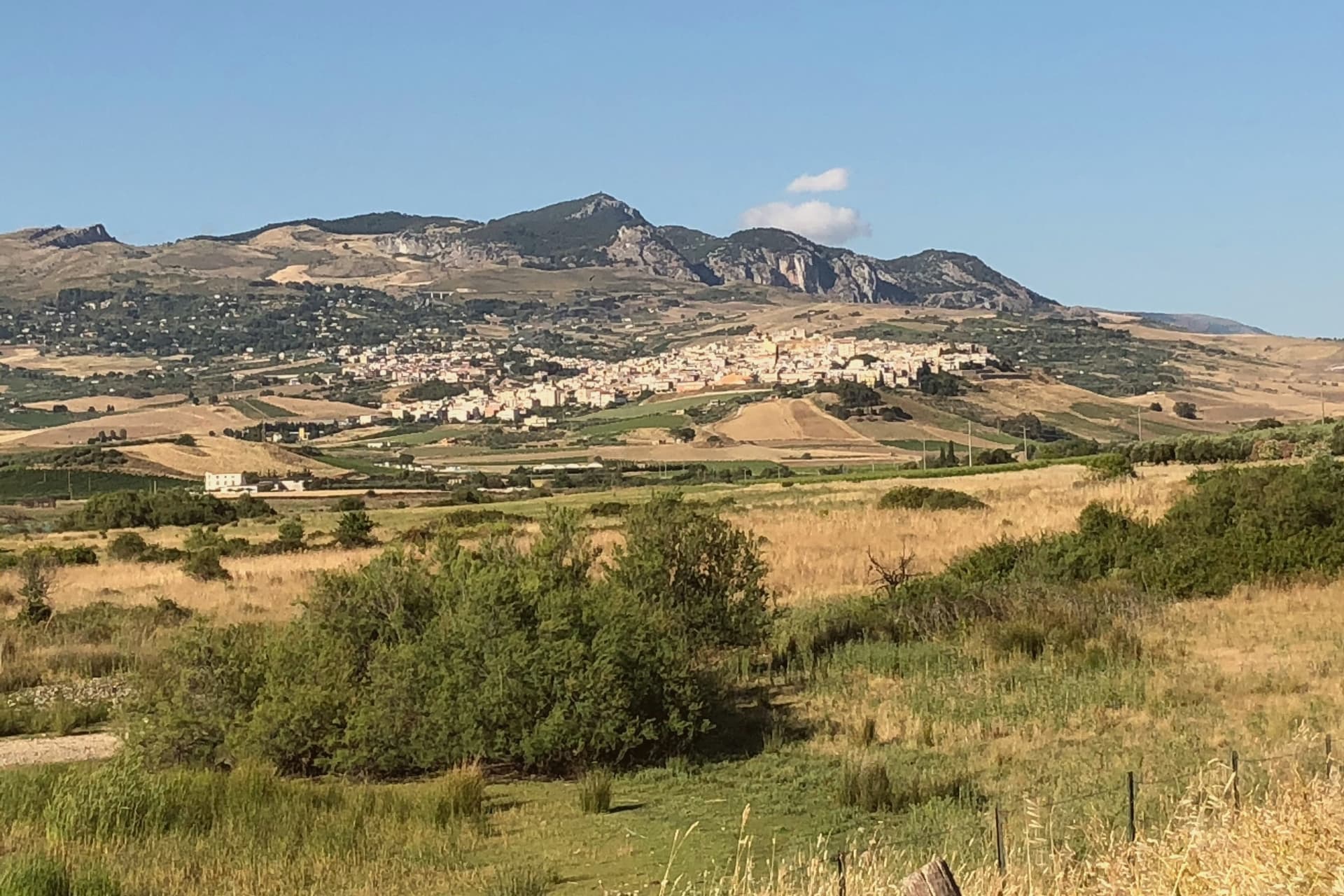
The town sits at 350 meters on a hill above the Belice valley, sixty-eight kilometers southwest of Palermo, overlooking the Sicani hills and the reservoir below. Frederick II conquered the town, then still called Zabut, in the thirteenth century, and it carried that Arab name as Sambuca Zabut until 1923, when the suffix was officially dropped.
The upper town holds the old Arab core, its stone houses and courtyards laid along the alleys founded by the emir, while the lower ground toward the reservoir carries the fortress that once took his name and now stands part underwater, and the vineyards that supply the Menfi DOC. Earthquake damage in 1968 reached the upper town and required rebuilding the mother church on the central piazza.
The name, the water, and the stone all trace back to the same ninth-century founding: a town that took an Arab ruler's name, kept it for over a thousand years, and only shed it in the twentieth century, while the fortress he built still marks the water's edge below.
The comune belongs to the national association of wine-producing towns.
What to see in Sambuca di Sicilia
- Li Setti Vaneddi. Narrow stone lanes opening into inner courtyards at the core of the Arab quarter, still recognizable underfoot as the same grid laid out by the emir.
- Castello di Mazzallakkar. Square fortress with four corner towers, standing half-submerged at the southern edge of Lake Arancio since the reservoir was filled.
- Lago Arancio. Reservoir fed by the Carboj river, formed in 1952 and used today for sport fishing and irrigation of the surrounding vineyards.
How to get to Sambuca di Sicilia
Palermo is about 1 h 21 min away by road. The full route from Palermo.
Our tip
April through June and September through November are the right windows for Sambuca. The inland Sicani hills hold dry heat in summer, regularly past thirty-five degrees in July and August, and the centro storico shuts itself down between two and five in the afternoon. October is harvest in the surrounding vineyards and the air clears enough to see Monte Adranone from the upper piazza.
Why visit Pantelleria
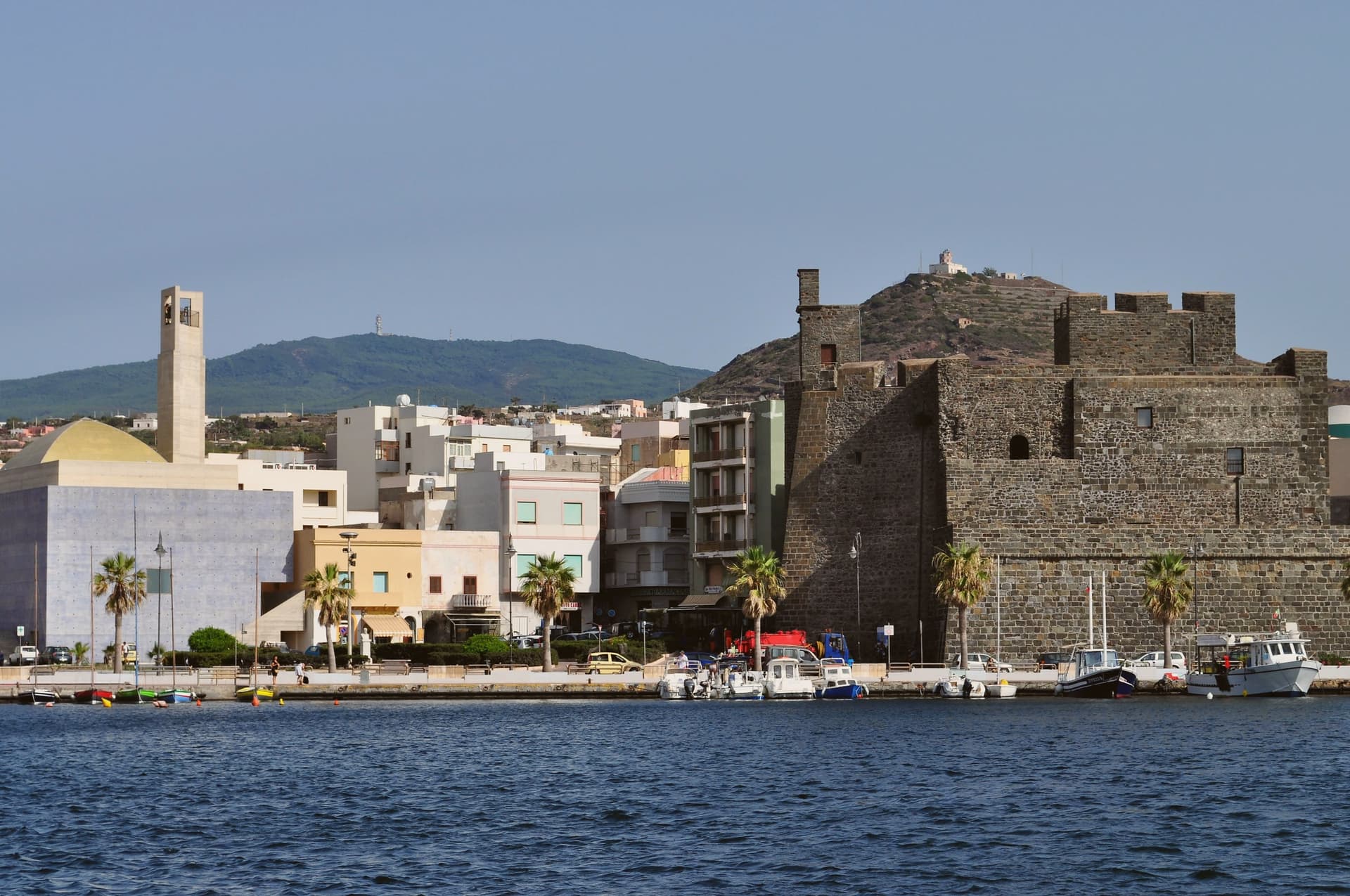
Pantelleria lies 110 kilometers southwest of Sicily and 70 east of Tunisia, a fifteen-kilometer island that is the emergent summit of a largely submarine volcano. Montagna Grande rises to 836 meters; the coast is black basalt cliff with almost no sand.
The dammusi, square dry-stone houses with thick walls and white-painted domed roofs, were built from local volcanic rock, the technique dating to around the tenth century when the island was part of the Zirid emirate. The vineyards are planted in the alberello pantesco, vines trained low in shallow pits dug into the volcanic soil to catch wind and dew, the only agricultural practice on the UNESCO Intangible Cultural Heritage list.
The Zibibbo grape, also called Moscato di Alessandria, arrived with the Phoenicians and produces Passito di Pantelleria DOC, made from sun-dried bunches. The Specchio di Venere, a thermal lake fed by springs at 35 to 58 degrees, sits in an elliptical crater in the north of the island.
The comune belongs to the national association of wine-producing towns.
What to see in Pantelleria
- Arco dell'Elefante. Basalt sea arch on the east coast resembling an elephant lowering its trunk into the water, between Cala Levante and Cala Tramontana.
- Specchio di Venere. Thermal volcanic lake in a 450 by 350 meter elliptical crater, fed by three springs running between 35 and 58 degrees.
- Montagna Grande. Island's highest point at 836 meters, an extinct volcanic cone with hiking paths and steam vents inside the Parco Nazionale Isola di Pantelleria.
Our tip
May, June, September and October are the workable months on Pantelleria. The scirocco from the Sahara pushes August temperatures past thirty-five degrees and the wind drops dust over everything. Late September is the Zibibbo harvest, the bunches laid out on stenditoi to dry under the sun for Passito.
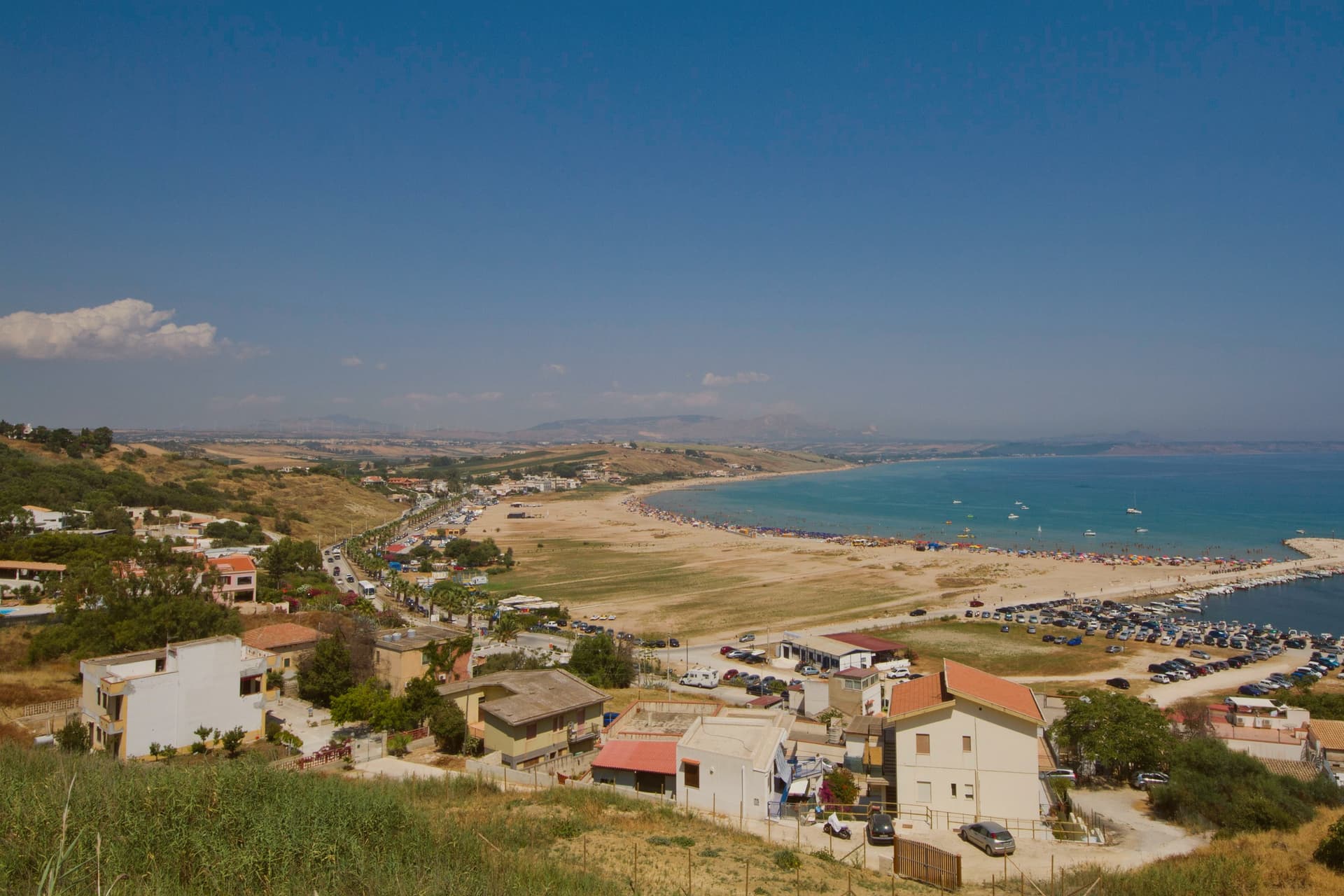
Why visit Menfi
Menfi is an 11,814-resident town on the western Agrigento coast, and its geography frames everything else about it. The town sits at 119 meters on a low limestone ridge between the Belice and Carboj rivers, four kilometers inland from the coast, where a nine-kilometre arc of fine sandy beach runs at Porto Palo di Menfi, backed by a protected dune system of 1,100 hectares, the most important loggerhead turtle nesting site on the southern Sicilian coast.
That gap between ridge and shore is the shape of the whole place: the historic centro on the high ground, the beach and reserve down below, the vineyard and olive plateaux spreading out behind and above the town. The town itself was founded in 1638 by the Tagliavia d'Aragona Pignatelli family on the site of an earlier castello belonging to Federico II.
Nothing from that medieval phase survived the re-foundation except a single surviving tower, the only structure left from before the seventeenth-century rebuilding. Above the town, the plateaux produce the two products that give Menfi the rest of its quality-mark trifecta alongside the beach: a cooperative cellar founded in 1958 that draws on 2,000 grower-members farming 6,000 hectares to produce 50 million bottles a year, the volume that makes it one of Sicily's largest wine cooperatives, and an olive oil, Valle del Belice DOP, pressed from the Nocellara del Belice, the same olive sold whole as the Castelvetrano table olive.
That range of production is what earns the town its Città del Vino status alongside its oil and its beach. Beyond the town, Selinunte's Greek temple site lies 25 km west and the Scala dei Turchi limestone cliff sits 50 km east toward Agrigento, the two standard day trips.
The food is Sicilian-coastal: pasta con le sarde, busiate with Trapani-style pesto, bluefin tuna from one of the last traditional fisheries on the island, couscous showing the same Trapani influence reaching this far along the coast, cassata and cannoli, and the local Grillo or Nero d'Avola poured alongside all of it. What holds the place together is that ridge-to-shore, town-to-plateau layout: a working wine and olive town that happens to sit a short drive from its own protected beach, rather than a beach resort with agriculture as an afterthought.
The comune belongs to the national association of wine-producing towns.
What to see in Menfi
- Porto Palo di Menfi (Bandiera Blu). Fine sandy beach below the town, backed by dune wetland where loggerhead turtles nest. The sand runs long enough that the crowd thins fast once you walk past the first stretch.
- Cantine Settesoli + Mandrarossa. Visits and tastings at the cooperative cellar in town: Nero d'Avola, Grillo, Inzolia, Syrah poured where they are made rather than at a distributor's counter.
- Valle del Belice DOP olive oil. The local olive oil, pressed from the Nocellara del Belice, the olive also sold whole as the Castelvetrano table olive. Several small frantoi in town offer tastings, worth setting alongside the wine visit rather than instead of it.
How to get to Menfi
Palermo is about 1 h 23 min away by road.
Our tip
Menfi is best May–June and September–October: the beach is swimmable May–October, summer crowds peak August. The Inycon Wine & Jazz festival in late June is the year's headline event. October is harvest at Cantine Settesoli and the surrounding cellars.
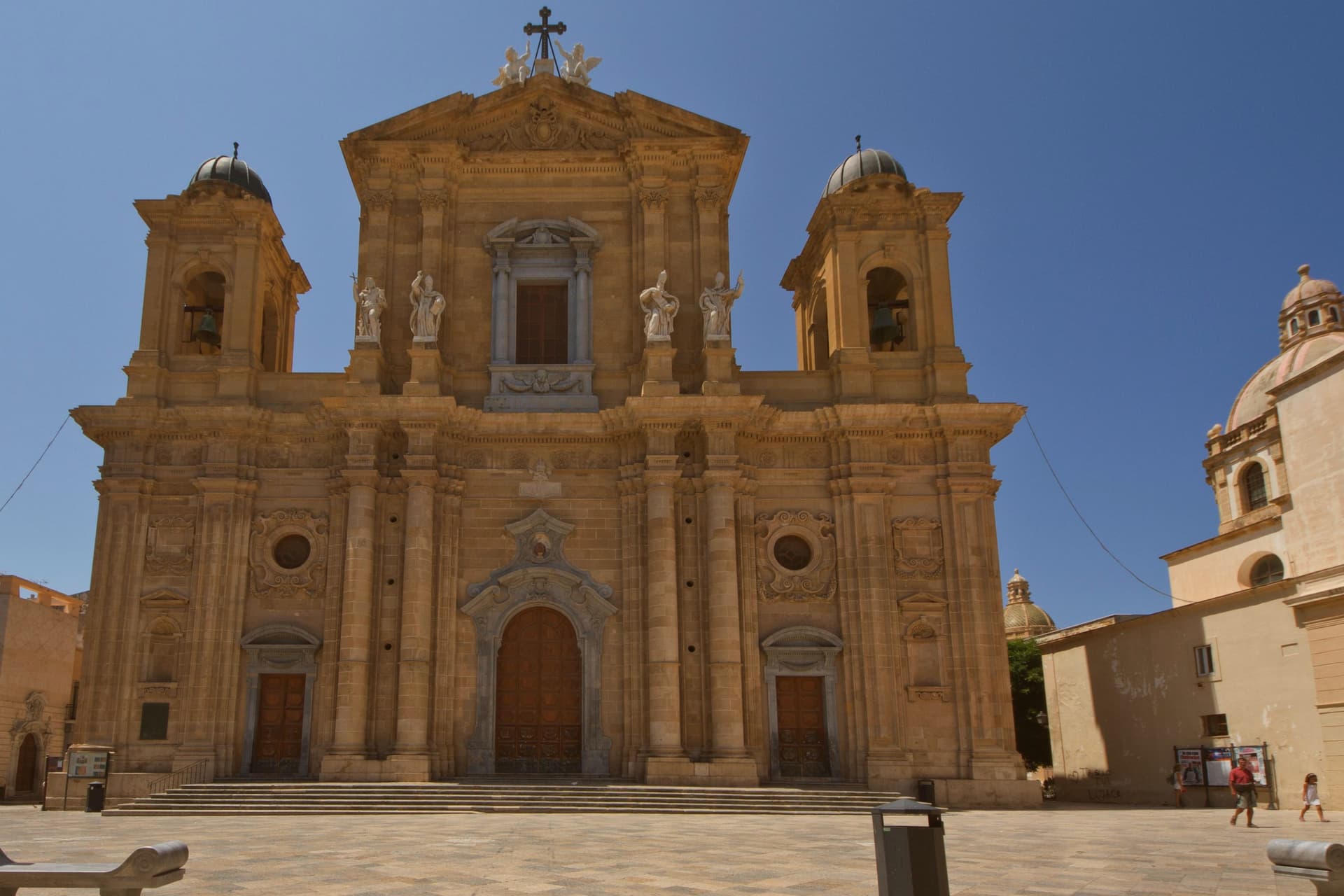
Why visit Marsala
Marsala sits on the westernmost point of Sicily, at sea level on the strait facing Tunisia. The Phoenicians of Mozia, on the small island just off the Stagnone lagoon to the north, founded Lilibeo on the mainland after Dionysius of Syracuse razed Mozia in 397 BC; the modern city sits on that ground.
The Arabs renamed it Marsa Ali or Marsa Allah, the harbor of God, in the ninth century. On 11 May 1860 Giuseppe Garibaldi landed at the port with the Mille and began the campaign that ended the Bourbon kingdom.
Large-scale wine production began in 1773 when the English trader John Woodhouse added grape spirit to local wines to keep them through the sea voyage to England, and the fortified Marsala became a global product. The historic cellars (Florio, Pellegrino, Rallo, Donnafugata) still operate in the city.
The Saline della Laguna and the Stagnone, with Mozia at its center, lie a few kilometers north along a low coastal road of windmills and salt mounds.
The comune belongs to the national association of wine-producing towns.
What to see in Marsala
- Parco archeologico di Lilibeo. Phoenician-Punic and Roman site at Capo Boeo on the western tip of the city, with the Baglio Anselmi museum and the third-century BC Punic warship.
- Riserva dello Stagnone e Mozia. Two-thousand-hectare coastal lagoon with the island of Mozia at its center, holding the Phoenician walls and the Kothon harbor basin.
- Saline della Laguna. Working salt pans along the Stagnone with Dutch-style windmills and pyramidal salt mounds, in production since Phoenician times.
How to get to Marsala
It has its own railway station. Palermo is about 1 h 51 min away by road. The full route from Palermo.
Our tip
May, June, September and October are the months for the Stagnone and the salt pans. July and August are hot and busy at Mozia, and the salt-pan reflections that give the lagoon its color are best caught at sunset, when the temperature drops. November is the new wine on the Marsala cellars' floors.
Read a sample letter
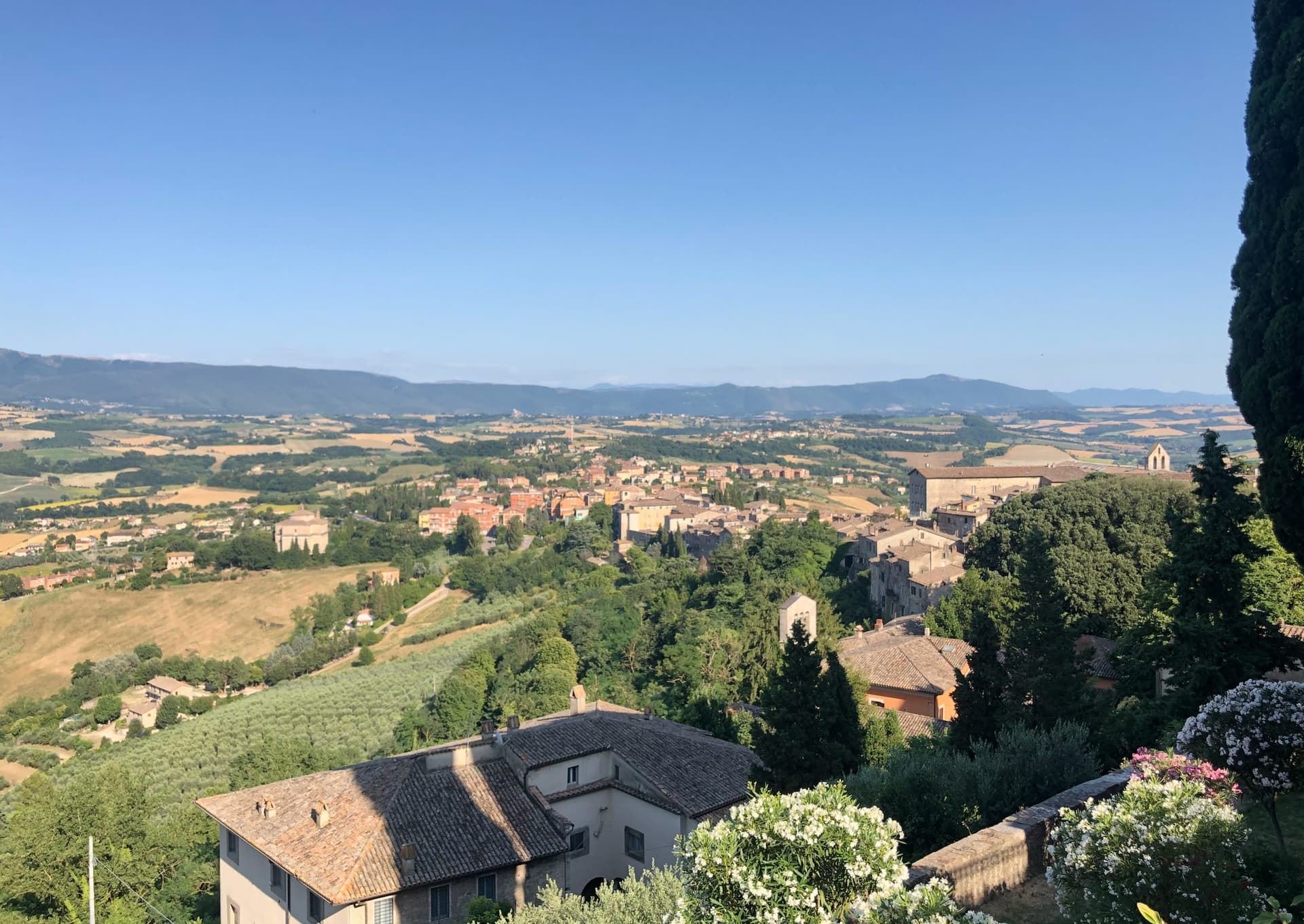
Todi | The Beverly Hills of Umbria
An unusually global town on a clay hill
Letters from the towns we visit. Free.
The button takes you to the letter's own page on Substack, where you leave your email. About the letter
More from Anywhere Italy
- The best hidden coastal towns that eat well in SicilySicilycoastaleats wellhidden8 towns · smallest 4,525 residents
- The best olive oil towns in SicilySicilyolive oil9 towns · smallest 1,729 residents
- The best small towns inside a nature park in SicilySicilyinside a parksmall7 towns · smallest 1,509 residents
- The prettiest villages inside a nature park in SicilySicilyinside a parkprettiest villages7 towns · smallest 1,702 residents
- The best towns that eat well within two hours of PalermoNear Palermowithin 2 hourseats well7 towns · smallest 1,778 residents · closest 44 min away
- The best coastal towns you can reach by train in SicilySicilycoastalby train9 towns · smallest 10,471 residents