
The best coastal towns you can reach by train in Sicilia
The Sicilian coast changes material as you move around it. On the Ionian side the beaches are black, ground down from Etna's lava, and the houses are built from the same dark stone with pale limestone at the corners. West of Palermo the rock turns soft and golden, the sea goes shallow and green over sand, and the harvest is salt, tuna and grillo grapes. The eating follows the geology: pistachio and almond and granita with brioche in the shadow of the volcano, couscous and marzipan and fortified wine near the salt pans. Spring and late autumn are the good months, when the light is long and the sea is still warm enough.
Most people arrive in high summer and go to Palermo, then out to the Aeolian Islands on the hydrofoil, and the queues form at both ends. It is a reasonable plan, because Palermo is one of the great street-food cities of the Mediterranean and the islands are volcanic and dramatic. But the ferries fill, the parking near the ports is grim, and July on Vulcano is a slow shuffle of people who all read the same page.
The railway, though, runs almost the whole way round the island, mostly within sight of the water, and it keeps going long past the places everyone photographs. Small stations open onto fishing harbours, lava-rock swimming platforms, baroque streets and salt flats, and the trains are slow in a way that suits the coast. These are the towns on that line where the sea is at the end of the platform and fewer people get off.
Of the 61 communes we have mapped in Sicilia, 10 qualify as coastal towns you can reach by train: each sits directly on the sea, and we have confirmed each is reachable without a car. The smallest, Savoca, has 1,724 residents.
Elsewhere in the catalogue: The best coastal towns within an hour of Catania and The 7 best towns you can reach by train that are worth a night in Sicilia.
Savoca
Why visit Savoca
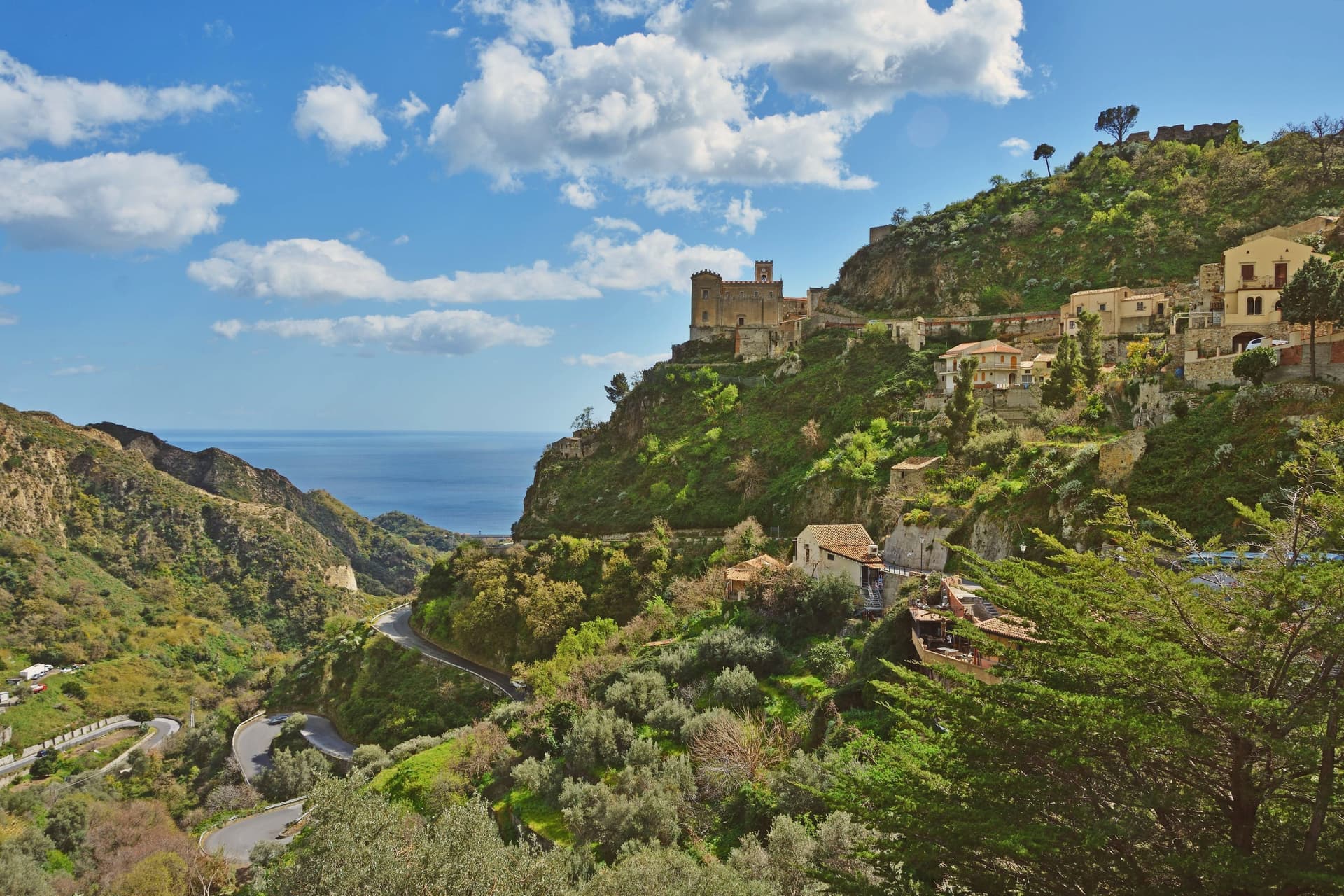
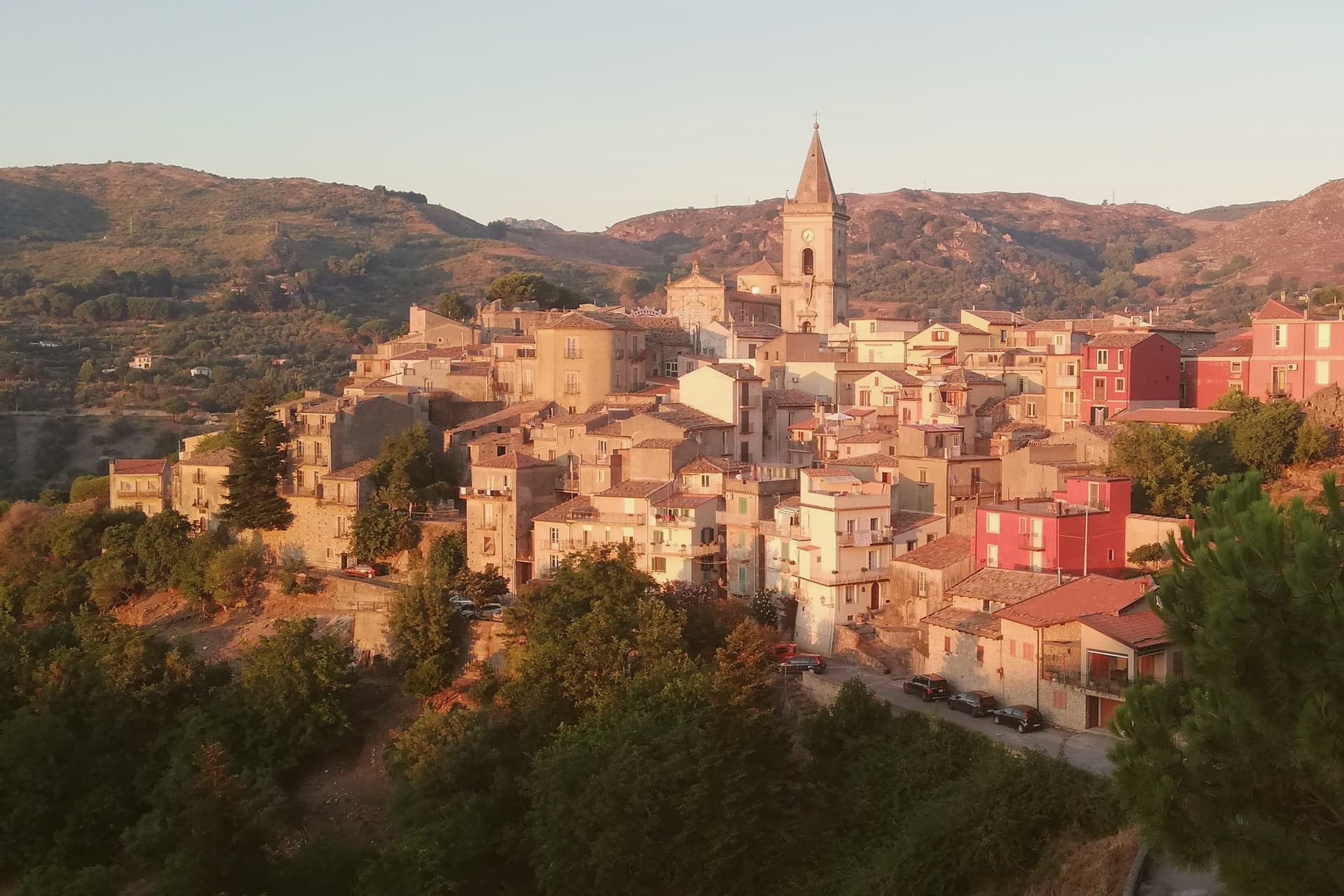
Savoca sits fifteen kilometers north of Taormina, on a hill above the Ionian coast. The centro storico runs along the ridge in stepped lanes and balconied stone houses, with the Capuchin convent below it at the lower edge of the village and the castle ruin above at the highest point, the two anchoring the village from bottom to top.
The convent's crypt holds thirty-seven mummified bodies of notables from the eighteenth and nineteenth centuries, preserved in a colatoio that desiccated the corpses with vinegar and salt. In the summer of 1971, Francis Ford Coppola and Mario Puzo arrived to film the Sicilian scenes of The Godfather here, after the original Corleone in Palermo province was judged too modern for the camera.
The village's shape, a compact ridge with a church at one end and a bar in the lower piazza, gave the film both its wedding location and its courtship scene without need for another set. What draws people now is largely what drew Coppola then: a village small enough to read in a single walk, old enough to need no dressing.
We confirmed you can reach this one by train.
What to see in Savoca
- Chiesa di San Nicolò. Thirteenth-century church suspended on a rock promontory at the top of the village. The Godfather's wedding scene between Michael and Apollonia was filmed here.
- Bar Vitelli. Eighteenth-century palazzo and family bar in the lower piazza, still operating as it did when it stood in for Apollonia's father's bar in The Godfather.
- Cripta dei Frati Cappuccini. Crypt of the Capuchin convent below the centro storico, its ventilated chamber holding the mummified bodies of local notables.
How to get to Savoca
There is a railway station in the town, so you can arrive without a car and never need one while you are here. Messina is roughly 39 minutes away by road.
Our tip
May through October are the months Savoca is busy. The Godfather pilgrims arrive year-round, but the village photographs best in spring and autumn, when the Ionian below is clear and the hill stays cool. July and August are warm; the centro storico is shaded in late afternoon, and the climb up to Pentefur is best at dawn.
Taormina
Why visit Taormina
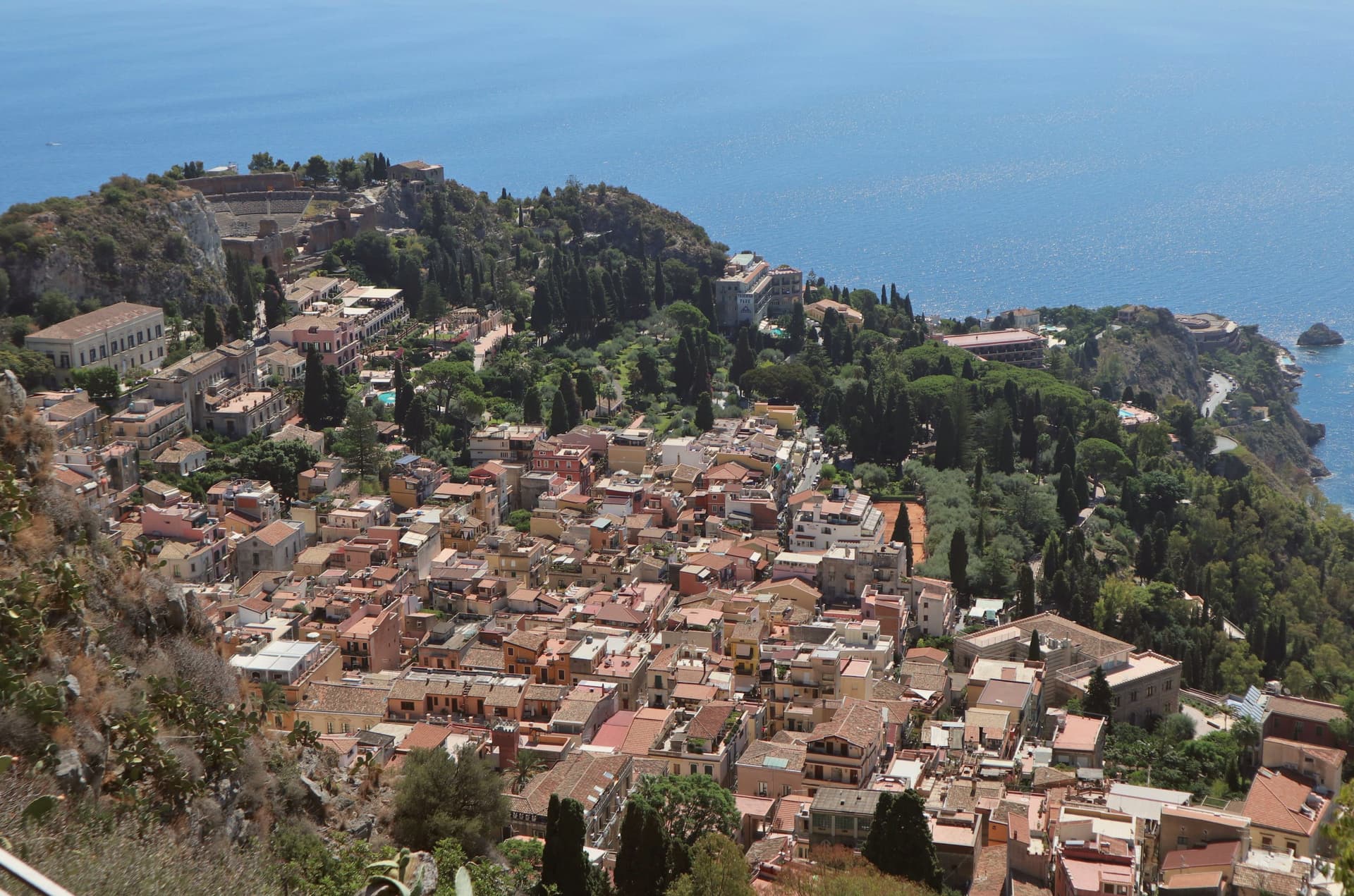
The town sits at 204 meters on the rock above the coast, on the Ionian shore halfway between Messina and Catania. The Siculi welcomed the survivors of the Greek colony of Naxos in 358 BC after Dionysius of Syracuse destroyed it, and Andromachus refounded them as Tauromenium on the height above.
Augustus later made it a Roman colony, deporting much of the population and resettling it with Roman families. The centro sits below the fortress and above the sea: the Arab-Norman stronghold occupies the rock at 397 meters, while further up the hillside the frazione of Castelmola hangs at 884, both looking down on the same stretch of coast the theatre faces.
The small island reserve lies at the opposite end of that vertical arrangement, at sea level below the cliff, reached by cable car or path from the town above. A place built in tiers, from the beach at the base to the fortress on the rock to the village above that, all of it oriented toward the same view of the volcano and the water that made a nineteenth-century travel writer's description enough to start a tourist route still followed today.
We confirmed you can reach this one by train.
What to see in Taormina
- Teatro Antico. The stone rows face south, so the audience looks past the stage wall to Etna rather than toward it. 109 meters in diameter, the remodelling under Roman rule widened the space for spectacle beyond Greek drama.
- Palazzo Corvaja. Fourteenth-century Sicilian-Gothic palace at the entrance to Corso Umberto, on the site of the Roman forum and the Arab cube of the citadel.
- Castello di Monte Tauro. Arab-Norman fortress at 397 meters on the rock above the centro, reached on foot from Via Circonvallazione.
How to get to Taormina
There is a railway station in the town, so you can arrive without a car and never need one while you are here. Catania is roughly 45 minutes away by road.
Our tip
May, June, September and October are the working months in Taormina. Late spring keeps the air clear over Etna and the cruise season has not yet peaked. Taormina Arte runs concerts and opera at the Teatro Antico from June through August; the same weeks bring the highest crowds on Corso Umberto.
Cefalù
Why visit Cefalù
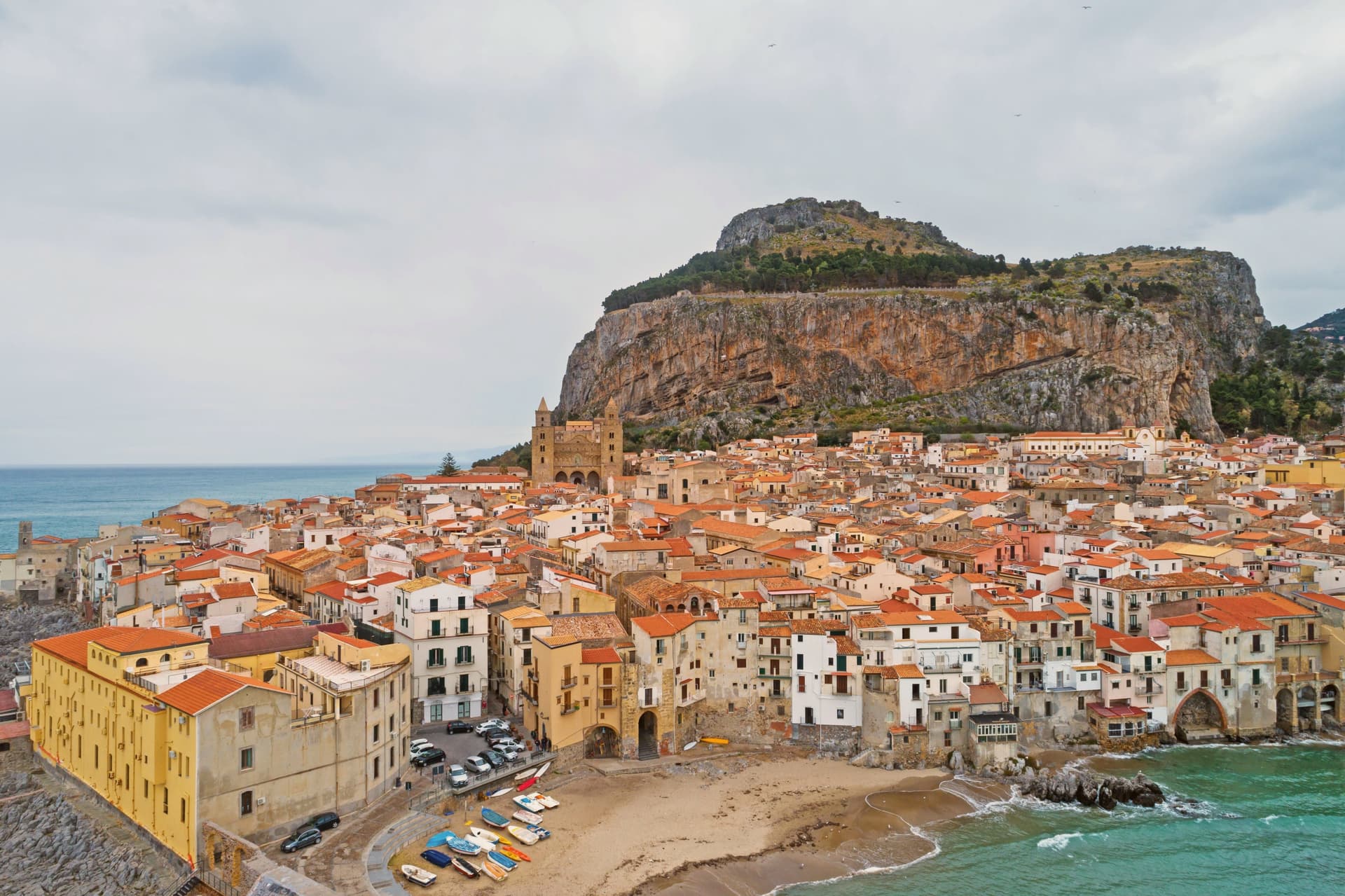
Cefalù sits 70 kilometers east of Palermo where the Madonie meet the Tyrrhenian, the old town built on a strip of land between the sea and the headland that gave the place its name. The Greeks called it Kephaloidion in the fourth century BC.
Roger II refounded the town at the foot of the rock in 1131 and began the cathedral the same year; tradition holds he vowed to build it after surviving a storm offshore. Its mosaics were executed by masters he brought from Constantinople.
The old town keeps the cathedral, the museum, and the working port within the same short walk, the stone lanes running straight down from the Duomo's square to the sea and the lavatoio fed by its own spring along the way. The beach runs below on one side, the rock rises behind on the other, and the harbor still works at the foot of it.
A small coastal town, built once by the Greeks and refounded by a Norman king against the same rock, still reads as one place rather than several eras stacked on top of each other.
We confirmed you can reach this one by train.
What to see in Cefalù
- Duomo di Cefalù. Twin-towered cathedral built by Roger II, its west front facing a narrow square hemmed by the old town. Inside, the mosaic apse is reached down a nave still laid out to Norman proportions, the Arab-Norman UNESCO listing covering both the fabric and the decoration.
- La Rocca. The trail switchbacks up bare limestone above the roofs, past the megalithic sanctuary walls before reaching the castle ruins, where the town, the harbor, and the coastline in both directions open out below.
- Museo Mandralisca. Private nineteenth-century collection in an eighteenth-century palazzo, holding the Portrait of an Unknown Sailor and Greek vases from Lipari.
How to get to Cefalù
There is a railway station in the town, so you can arrive without a car and never need one while you are here. Palermo is roughly 63 minutes away by road.
Our tip
May, June, September and October are the windows for Cefalù. The Tyrrhenian is warm enough to swim from mid-May, the cathedral and the climb up La Rocca are bearable in the morning, and the town isn't yet at full crowd. July and August fill the beach and the lungomare past capacity, with Palermo and northern European holidaymakers; the cathedral keeps its mosaics behind a steady queue. Festa SS. Salvatore a Cefalù falls in August.
Riposto
Why visit Riposto
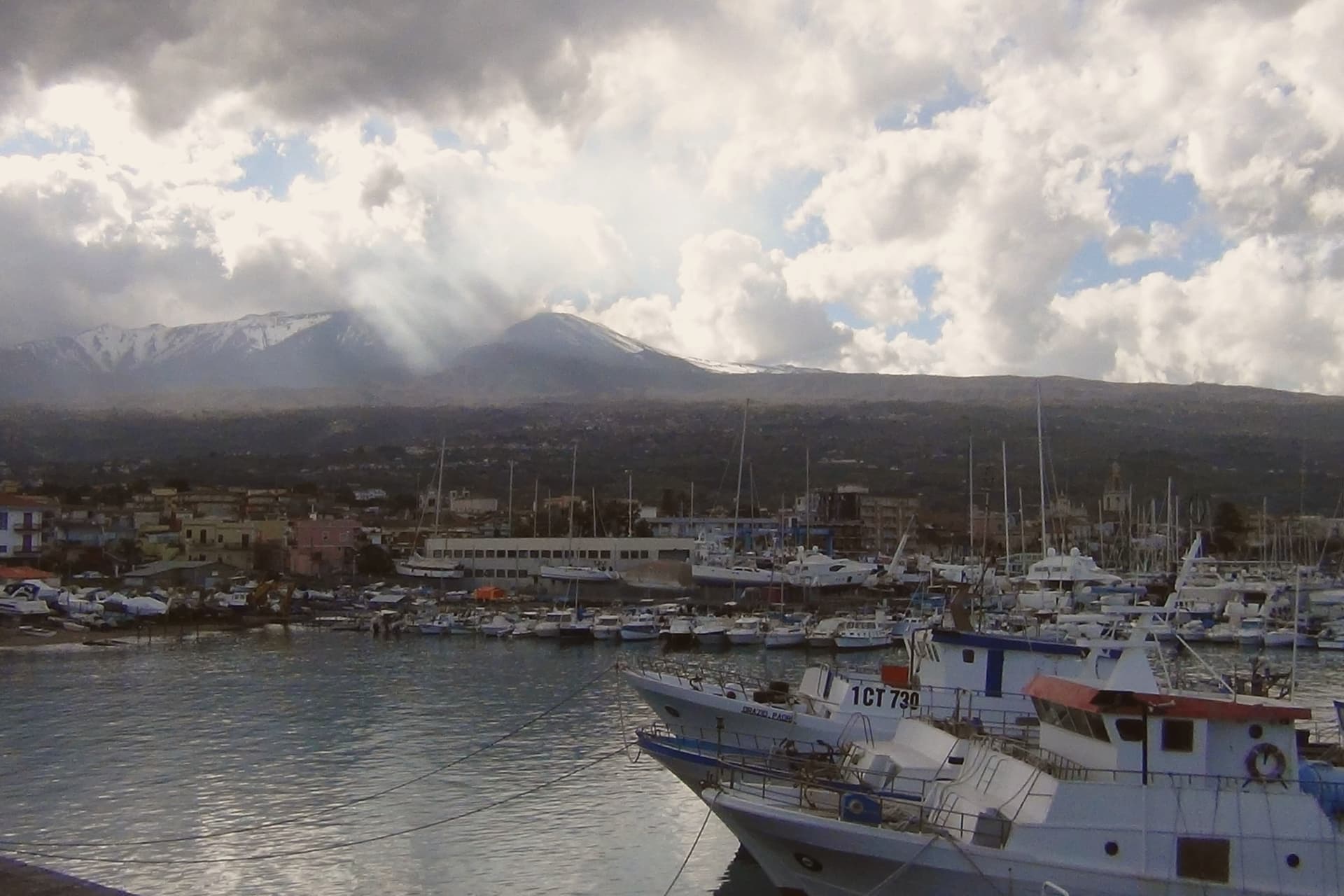
Riposto sits on the Ionian coast twenty-five kilometres north of Catania, at the eastern foot of Etna and the southern edge of the Giarre-Riposto conurbation. The name is commercial: u ripostu in Sicilian, the cellar, because the wine produced in the surrounding county of Mascali was stored here before being loaded onto ships.
The town was the commercial port of Mascali from the sixteenth century onwards, won full administrative autonomy in the eighteenth, and was merged with neighbouring Giarre under the name Jonia from 1939 until 1945, when the two split again. Today the Porto dell'Etna, also called Marina di Riposto, runs as a combined tourist marina, fishing port and small commercial harbour.
Locals still call the town the port of the volcano. Etna fills the western skyline, the railway runs to Catania along the coast, and the historic centre threads between churches built when the wine trade still paid for them.
We confirmed you can reach this one by train.
What to see in Riposto
- Porto dell'Etna. The combined tourist marina, fishing and commercial port, the largest pleasure harbour between Catania and Messina.
- Chiesa Madre San Pietro. The mother church on the main square, rebuilt in the eighteenth century when Riposto's wine trade financed new construction.
- Centro storico. Grid of streets parallel to the seafront, with palazzi and warehouses built during the eighteenth and nineteenth century wine boom.
How to get to Riposto
There is a railway station in the town, so you can arrive without a car and never need one while you are here. Catania is roughly 29 minutes away by road.
Our tip
May, June, September and October are the dry, clear months when the Ionian is warm enough to swim and Etna stays visible from the seafront. July and August are hot and crowded: the marina fills with sailing traffic and the lungomare runs at full capacity until late. November through March is quiet.
Aci Castello
Why visit Aci Castello
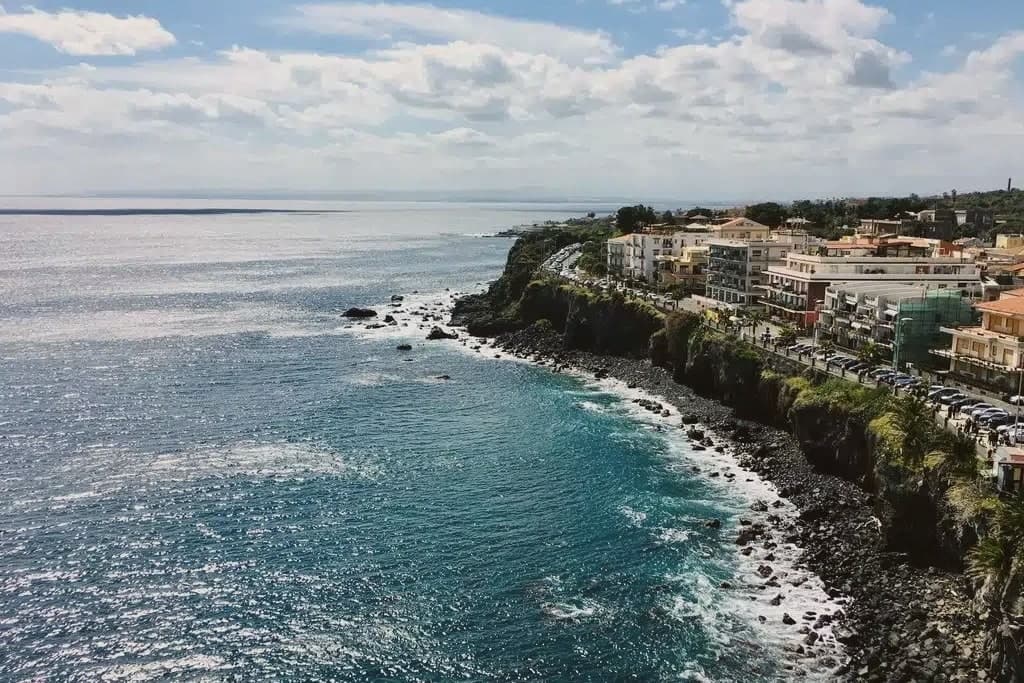
Aci Castello sits ten kilometres north of Catania on the Riviera dei Ciclopi, where the lava-black basalt coast meets the Ionian Sea. The town's anchor is the Castello Normanno (Castello d'Aci), built in 1076 by Roger I of Sicily on a basalt sea-stack thrown up by an underwater Etna eruption around 25,000 BC; the Aragonese expanded it in the 14th century and it now houses the Civic Museum of Aci Castello.
Just offshore stand the Isole dei Ciclopi — the seven basalt sea-stacks that Homer identified as the rocks Polyphemus the Cyclops hurled at Odysseus's ship in Book IX of the Odyssey, and which are now a protected marine reserve. The frazione of Aci Trezza (the larger fishing village south of the castle) is where Giovanni Verga set I Malavoglia (The House by the Medlar Tree, 1881), the founding novel of Italian verismo.
The coastline between Castello and Trezza is a single black-pebble swimming front, with the dramatic profile of Etna rising behind.
We confirmed you can reach this one by train.
What to see in Aci Castello
- Castello Normanno di Aci. 1076 Norman castle on a basalt sea-stack thrown up by an underwater Etna eruption c. 25,000 BC. Aragonese expansion 14th c. Houses the Civic Museum with the stratigraphic and natural-history collections.
- Isole dei Ciclopi. Seven basalt sea-stacks offshore — Homer's Cyclopean rocks from Odyssey Book IX. Now a protected marine reserve (AMP Isole Ciclopi), with snorkelling tours from Aci Trezza.
- Aci Trezza — terra di Verga. Fishing-village frazione where Giovanni Verga set I Malavoglia (1881), the founding novel of Italian verismo. The old harbour and Casa del Nespolo museum trace the literary setting.
How to get to Aci Castello
There is a railway station in the town, so you can arrive without a car and never need one while you are here. Catania is roughly 12 minutes away by road.
Our tip
April through October is the season on the Ionian coast. May and September are the best months: warm Mediterranean sea, lava-rock swimming comfortable, the castle museum at full hours. June brings the patronal feast of San Mauro. Arancino Festival falls in September.
Giarre
Why visit Giarre
Giarre sits on the lower eastern slope of Etna at eighty metres, thirty kilometres north of Catania and three from the sea at Riposto. From the late sixteenth century until 1815 it was a village of the county of Mascali; it separated after the abolition of feudalism and built itself a town centre in the decades that followed.
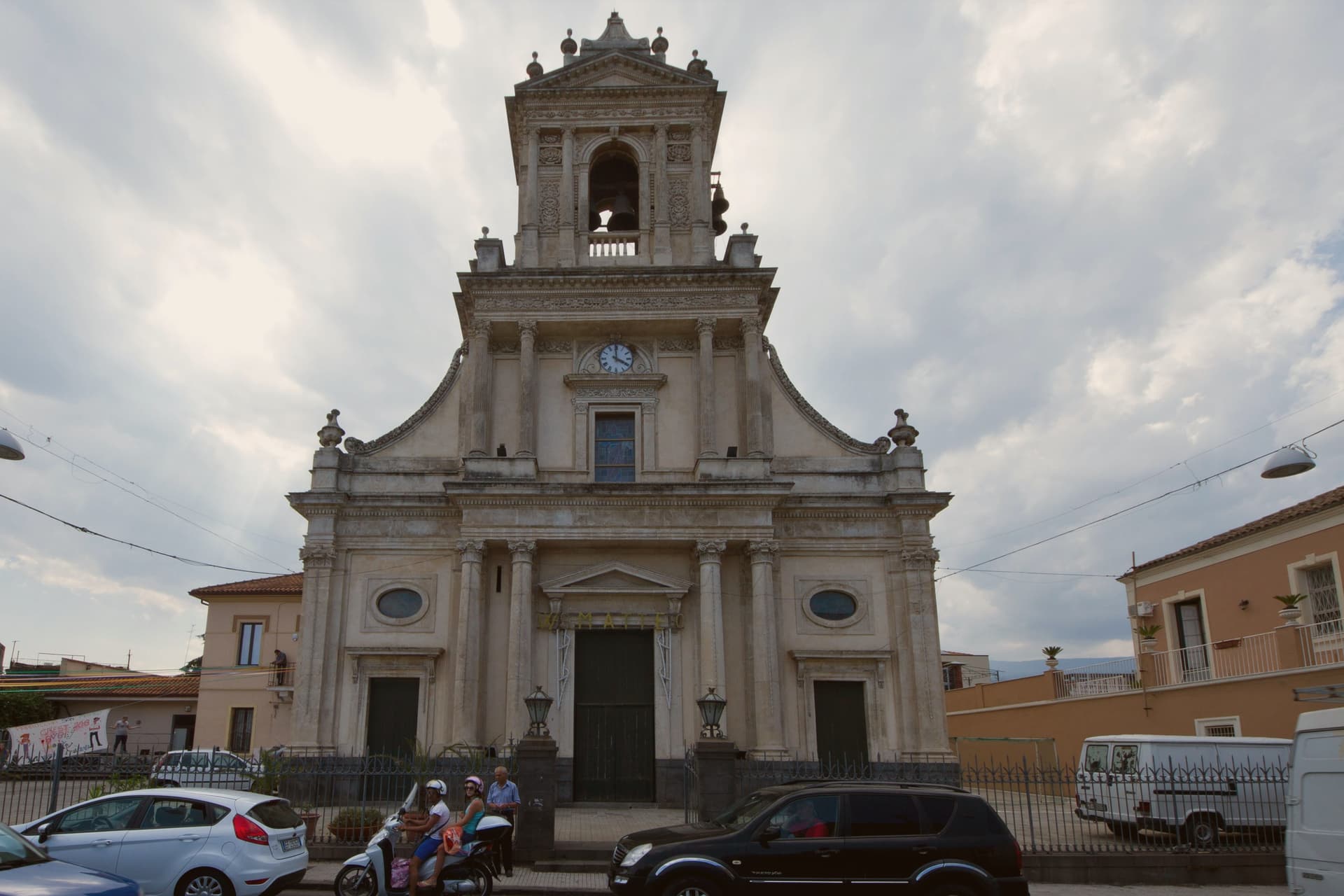
The Duomo di Sant'Isidoro Agricola, begun in 1794 and opened for worship in 1818, is the result: a neoclassical mother church in white stone, with a large central nave, two lateral naves, a transept, and a dome with lantern. The two bell towers, designed by the Neapolitan architect Pietro Valente, were begun in 1859 and finished only in 1890.
Inside, the church holds one of the most substantial collections of sacred silverware in eastern Sicily. From 1939 to 1945 Giarre was merged with Riposto under the fascist name Jonia.
The two towns still form a single conurbation along the coast.
We confirmed you can reach this one by train.
What to see in Giarre
- Duomo di Sant'Isidoro Agricola. Neoclassical mother church begun in 1794, two bell towers by Pietro Valente, and one of eastern Sicily's largest collections of sacred silverware.
- Piazza Duomo. The main square at the centre of the historic grid, with the duomo facing the foothill of Etna to the west.
- Corso Italia. The principal axis of the town, running between the duomo and the open country towards Riposto and the sea.
How to get to Giarre
There is a railway station in the town, so you can arrive without a car and never need one while you are here. Catania is roughly 26 minutes away by road.
Our tip
April through June, then September and October, are when Giarre is at its best: clear views of Etna from the duomo square, citrus blossom on the slopes above town, and the coast at Riposto still calm. July and August are hot and crowded along the seafront, though the upper town keeps cooler at eighty metres. November through March is the quiet season, with rain off the Ionian and snow on the volcano. Festival Etneo del Porcino falls in September.
Castelvetrano
Why visit Castelvetrano
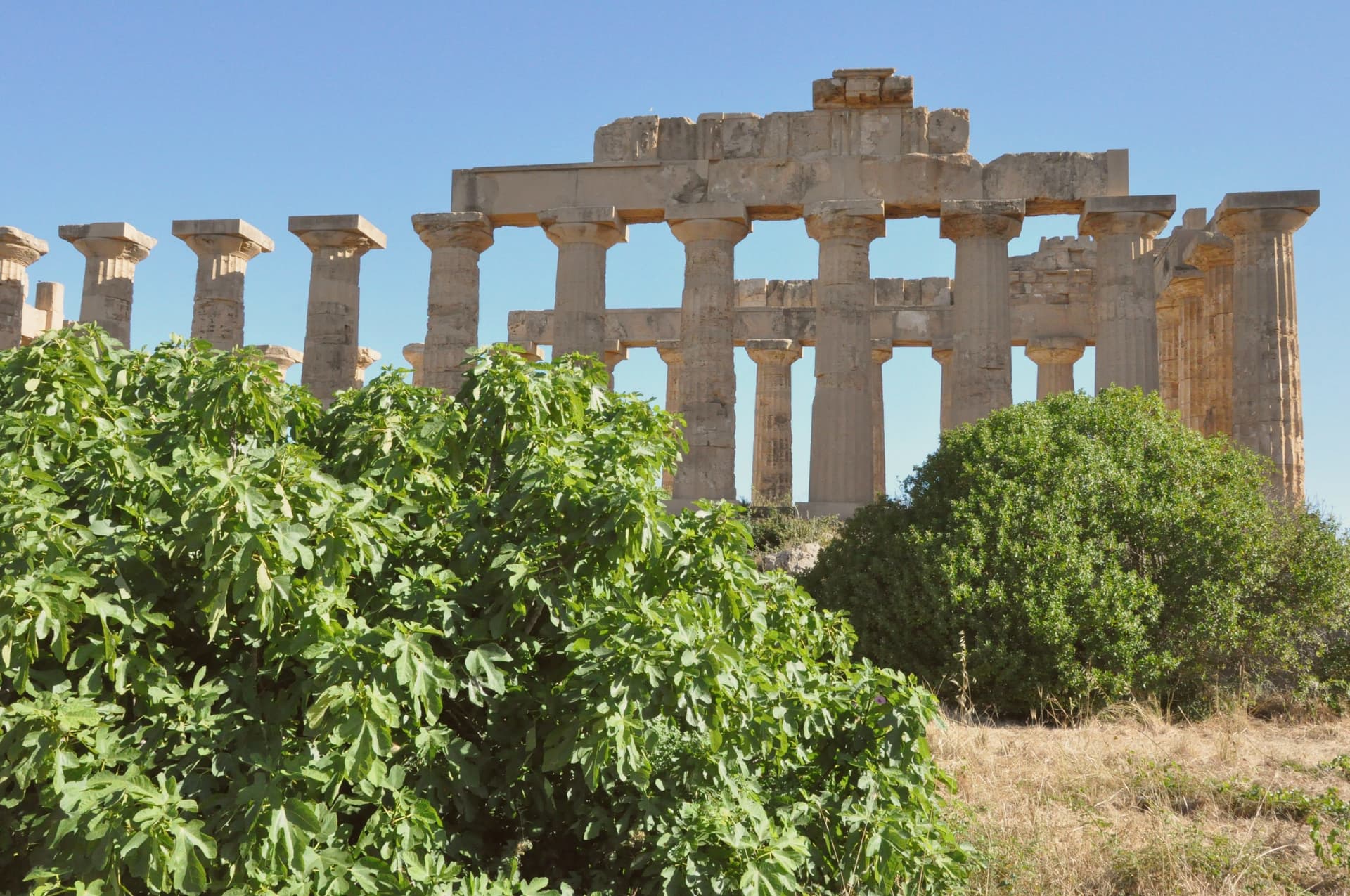
Castelvetrano sits at 187 meters in the Belice valley, fifteen kilometers from the south coast of Trapani province. Within its municipal territory lies Selinunte, founded in the seventh century BC by Greek settlers from Megara Hyblea, named for the wild parsley that still grows on the site, and now the largest archaeological park in Europe at 337 hectares of Doric temples, walls and necropoleis.
The town itself developed in the twelfth and thirteenth centuries; its centro is built around the Sistema delle Piazze, three linked squares (Garibaldi, Umberto I and Cavour) framed by the sixteenth-century Chiesa Madre with stucco work by Antonio Ferraro and Gaspare Serpotta. The Civic Museum holds the Efebo di Selinunte, an 85-centimeter bronze cast around 470 BC, one of the rare authentic Greek originals in Sicily.
Castelvetrano produces Nocellara del Belice DOP table olives and the pane nero, baked from autochthonous tumminia and rusulidda grains in wood-fired ovens, grain found in noble tombs at Selinunte.
We confirmed you can reach this one by train.
What to see in Castelvetrano
- Parco Archeologico di Selinunte. Largest archaeological park in Europe at 337 hectares, with Doric temples E, F and G along the Marinella plain between the Belice and Modione rivers.
- Sistema delle Piazze. Three linked squares (Garibaldi, Umberto I, Cavour) at the heart of the centro storico, framed by the Chiesa Madre and Palazzo dei Principi.
- Chiesa Madre. Sixteenth-century mother church with tufaceous neo-Romanesque façade, three naves under wooden ceilings, and stucco decoration by Antonio Ferraro and Gaspare Serpotta.
How to get to Castelvetrano
There is a railway station in the town, so you can arrive without a car and never need one while you are here. Palermo is roughly 92 minutes away by road.
Our tip
May, June, September and October are the working months at Selinunte. The site has almost no shade, July and August push past thirty-five degrees, and the long path between the eastern and western hills becomes punishing. April brings the asphodels and wild parsley that gave Selinunte its name. Sagra del Pane Nero falls in October.
Marsala
Why visit Marsala
Marsala sits on the westernmost point of Sicily, at sea level on the strait facing Tunisia. The Phoenicians of Mozia, on the small island just off the Stagnone lagoon to the north, founded Lilibeo on the mainland after Dionysius of Syracuse razed Mozia in 397 BC; the modern city sits on that ground.
The Arabs renamed it Marsa Ali or Marsa Allah, the harbor of God, in the ninth century. On 11 May 1860 Giuseppe Garibaldi landed at the port with the Mille and began the campaign that ended the Bourbon kingdom.
Large-scale wine production began in 1773 when the English trader John Woodhouse added grape spirit to local wines to keep them through the sea voyage to England, and the fortified Marsala became a global product. The historic cellars (Florio, Pellegrino, Rallo, Donnafugata) still operate in the city.
The Saline della Laguna and the Stagnone, with Mozia at its center, lie a few kilometers north along a low coastal road of windmills and salt mounds.
We confirmed you can reach this one by train.
What to see in Marsala
- Parco archeologico di Lilibeo. Phoenician-Punic and Roman site at Capo Boeo on the western tip of the city, with the Baglio Anselmi museum and the third-century BC Punic warship.
- Riserva dello Stagnone e Mozia. Two-thousand-hectare coastal lagoon with the island of Mozia at its center, holding the Phoenician walls and the Kothon harbor basin.
- Saline della Laguna. Working salt pans along the Stagnone with Dutch-style windmills and pyramidal salt mounds, in production since Phoenician times.
How to get to Marsala
There is a railway station in the town, so you can arrive without a car and never need one while you are here. Palermo is roughly 111 minutes away by road.
Our tip
May, June, September and October are the months for the Stagnone and the salt pans. July and August are hot and busy at Mozia, and the salt-pan reflections that give the lagoon its colour are best caught at sunset, when the temperature drops. November is the new wine on the Marsala cellars' floors. A Fera di Strasatti a Marsala falls in August.
Siracusa
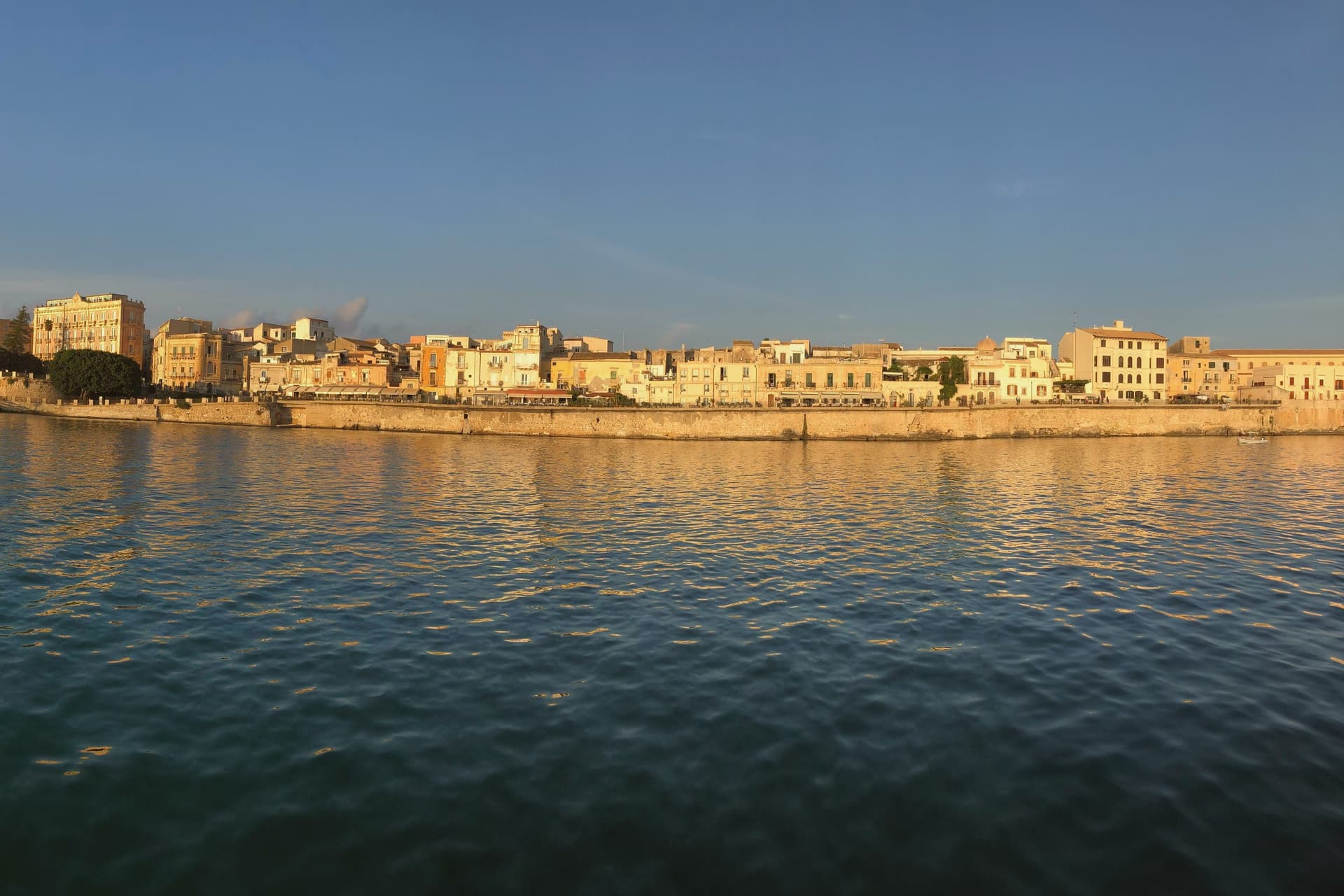
Why visit Siracusa
The city was founded in 734 BC by Corinthian Greeks and became the most populous Greek city in the Mediterranean under the tyrant Dionysius I in the 4th century BC. The historic centre sits on Ortigia, the small island linked to the mainland by three bridges, where the Cathedral of Santa Maria delle Colonne, the freshwater spring, and the Piazza Duomo's late-Baroque palazzi, rebuilt after 1693, all stand on the same ground the Greeks first built on.
Across on the mainland, the Parco Archeologico della Neapolis preserves the theatre, the limestone cave, a Roman amphitheatre, and the Ara di Ierone sacrificial altar, so the ancient city reads as two halves: an island core wrapped by the sea and a mainland quarry and theatre district set into the hillside behind it. The Necropolis of Pantalica lies inland from both, joined to the city on the same UNESCO listing, and the city was later named a candidate for European Capital of Culture in 2019.
What Cicero praised as the greatest and most beautiful of Greek cities was in effect two settlements working as one, the island for living and worship, the mainland for spectacle and quarrying, a division still legible in how the ruins are separated by water and distance today.
We confirmed you can reach this one by train.
What to see in Siracusa
- Ortigia + Duomo (Tempio di Atena). Island historic centre with the cathedral built directly into a 5th-c. BC Doric temple of Athena, the original columns visible in the walls. Honey-coloured Baroque palazzi on Greek foundations.
- Teatro Greco (Parco della Neapolis). 5th-century BC Greek theatre carved into the limestone hillside, still in use every summer for the INDA classical drama festival. The largest surviving Greek theatre in Sicily.
- Fonte Aretusa. Freshwater spring at the western tip of Ortigia, the mythological setting of Arethusa's transformation. Pools at the seafront with papyrus growing, the only papyrus colony on European soil.
How to get to Siracusa
There is a railway station in the town, so you can arrive without a car and never need one while you are here. Siracusa is roughly 0 minutes away by road.
Our tip
Siracusa is year-round but with two clear peaks. The INDA classical drama festival runs from mid-May to early July at the Greek theatre — the city's biggest cultural event, book performances and accommodation months ahead. Spring (April-May) and autumn (September-October) are the best months for the archaeological sites and Ortigia: warm Mediterranean light, manageable crowds, sea swimming starts in May and runs into October.
Catania
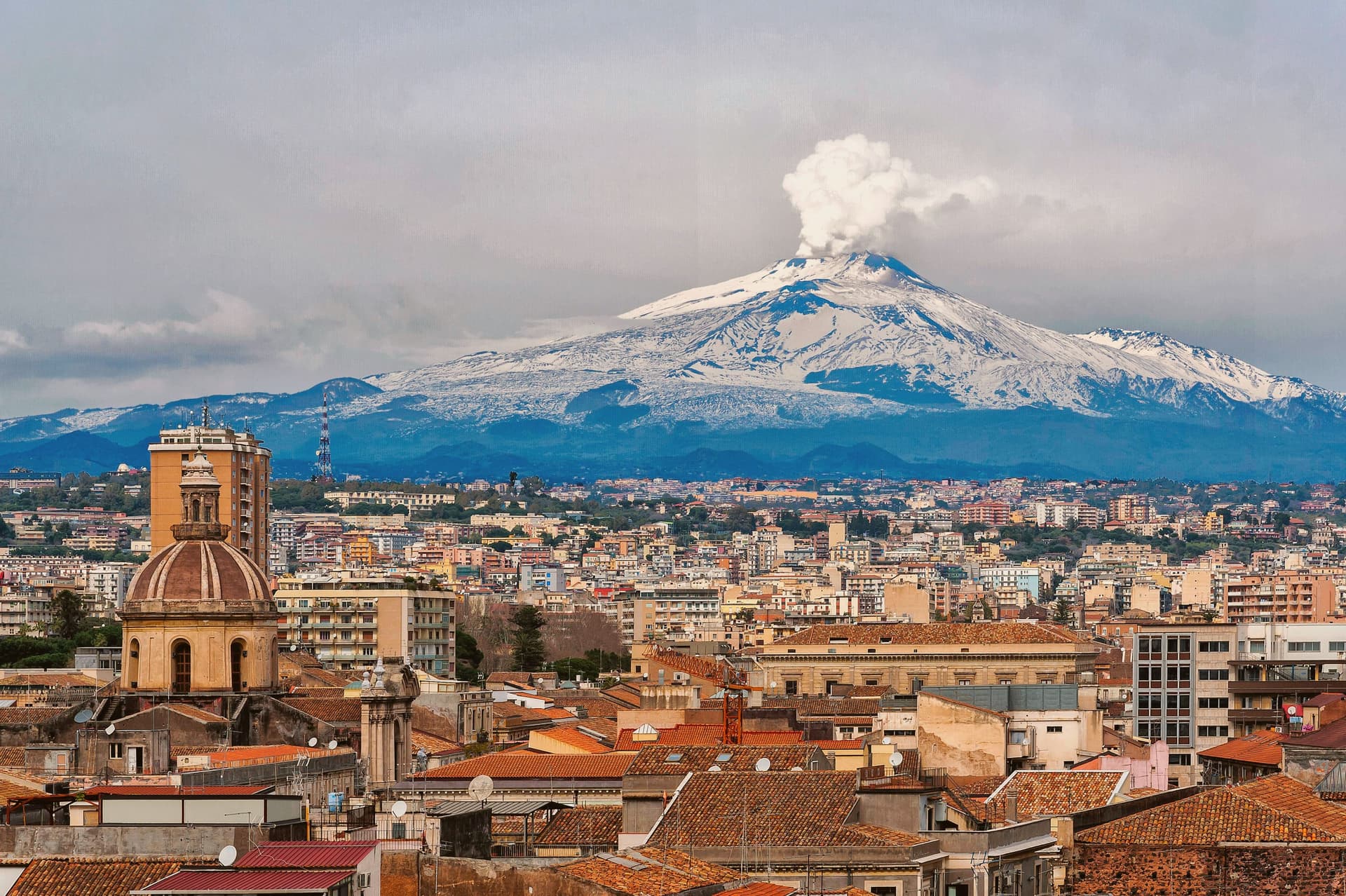
Why visit Catania
Catania is Sicily's second-largest city and the capital of the Ionian coast: 300,000 residents at the foot of Etna, with the volcano visible from every street that opens north. The current city is the third built on the same site — Greek Katánē (729 BC), Roman Catina, and the medieval town all in turn — and the version visible today was built almost entirely in the half-century after the 1693 Val di Noto earthquake destroyed 75% of the buildings and killed two-thirds of the population.
The reconstruction was led by Giovanni Battista Vaccarini, who gave Catania its distinctive late-Baroque profile: wide regular streets paved with lava basalt, palazzi faced in the same black stone with white limestone trim, and the Piazza del Duomo at the centre with Vaccarini's 1735 elephant fountain (U Liotru, a Roman-era basalt elephant supporting an Egyptian obelisk) as the city's symbol. The historic centre was inscribed on the UNESCO World Heritage list in 2002 as one of the Late Baroque Towns of the Val di Noto.
Beyond the Baroque: Bellini was born here, the Roman amphitheatre is the second-largest in Sicily, the Pescheria fish market runs every weekday morning, and the Etna cable car from Rifugio Sapienza is reachable in an hour for the high-altitude lava fields.
We confirmed you can reach this one by train.
What to see in Catania
- Piazza del Duomo + U Liotru. Vaccarini's 1735 elephant fountain in the central square — a Roman basalt elephant supporting an Egyptian obelisk. The cathedral of Sant'Agata anchors the south side. Both rebuilt post-1693 in lava-and-limestone Baroque.
- Via dei Crociferi. Pedestrian Baroque street with four churches in 200 metres — the densest stretch of post-1693 reconstruction. UNESCO World Heritage protected.
- Etna. Europe's largest active volcano (3,357 m), an hour from the city by cable car + jeep from Rifugio Sapienza. UNESCO World Heritage in its own right since 2013.
How to get to Catania
There is a railway station in the town, so you can arrive without a car and never need one while you are here. Catania is roughly 14 minutes away by road.
Our tip
Catania is year-round. October through April is the value season — warm Mediterranean light, the centro storico navigable, the Pescheria at full output, Etna often snow-capped and stunning above the Baroque rooftops. May and June are the best months for the volcano and the coast — long warm days, Etna fully accessible, sea swimming starts. Il Mercatino di Borgo Natura falls in the season.
More from Anywhere Italy
- The best coastal towns within an hour of Catania
- The 7 best towns you can reach by train that are worth a night in Sicilia
 The best towns you can reach by train in the province of Catania
- The best towns you can reach by train that eat well within 90 minutes of Catania
 The best hidden coastal towns that eat well in Sicilia
 The best towns with a food festival in Sicilia