
The 7 best towns you can reach by train that have a serious restaurant within 90 minutes of Torino
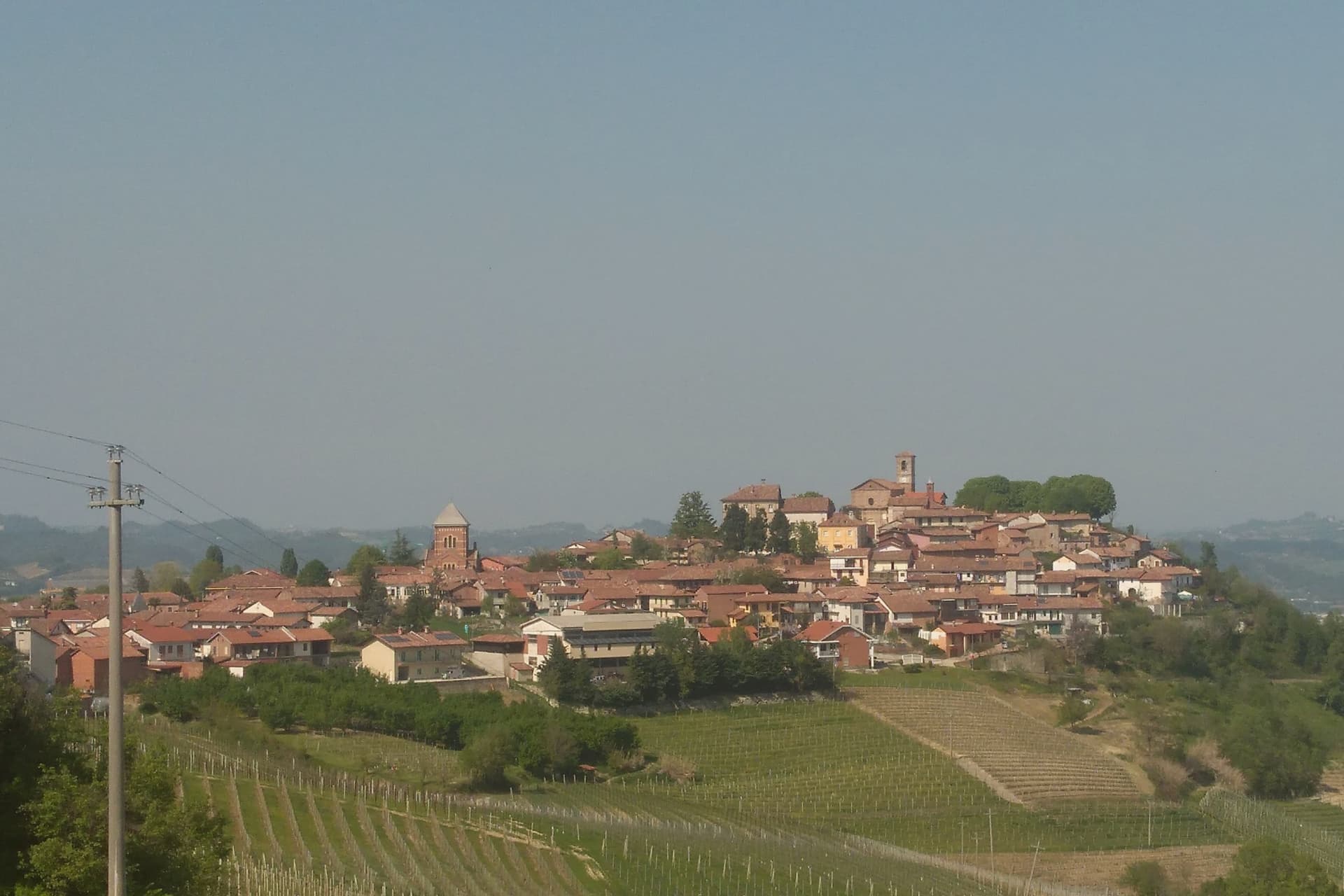
Piedmont eats better than almost anywhere in Italy, and it does it in small places. The hills south and east of Torino are planted in Nebbiolo, Barbera and Moscato, with hazelnut groves on the cooler slopes and truffle woods along the river valleys. Autumn is the season everyone means: white truffle shaved over tajarin, raw veal dressed with oil and lemon, agnolotti del plin the size of a thumbnail, bagna cauda arriving in a terracotta pot once the fog settles in November. The towns themselves are built of brick and pale stucco, with arcaded squares, brick bell towers and cellars dug into the tufa beneath the main street.
Most visitors give Piedmont a day from Torino, and the day tends to be spent in the city itself: the arcades of Via Roma, the Egyptian Museum, an evening vermouth under the porticoes of Piazza San Carlo. Those who do get out of town head for Barolo, which is small, famous and, through the harvest and truffle weeks, parked solid. The wine road that links the best-known cellars carries coaches as well as cars, and the tasting rooms book out months ahead. It is good, and it is busy, and it more or less requires a car.
The same hills, the same growers and the same kitchens carry on past the celebrated names, and much of it sits on a railway line. Regional services from Torino reach the market towns of the Langhe, the Roero and the Monferrato in well under two hours, and several of them put you within a few streets of a dining room the most demanding of the guides has bothered to list. The towns here were chosen on both counts: reachable without a car, and worth the trip for lunch alone.
Of the 34 communes we have mapped within 90 minutes of Torino, 7 qualify as towns you can reach by train with a serious restaurant: we have confirmed each is reachable without a car, and each holds a restaurant listed by the most demanding of the guides. The smallest, Verduno, has 567 residents.
Elsewhere in the catalogue: The best hidden hill towns you can reach by train within 90 minutes of Torino and The 6 best hidden towns you can reach by train that eat well within 90 minutes of Torino.
Verduno
Why visit Verduno
Verduno sits fifty kilometers south of Torino on a Langhe ridge above the Tanaro, its vineyards the only ones among the eleven Barolo communes to lean partly toward the river plain rather than folding back into the hills. That position, facing the water and the Alps beyond it, sets the village apart from the rest of the DOCG even before the wine is considered.
The other thing that sets it apart is Pelaverga Piccolo, a native black grape cultivated commercially in only three Langhe communes: Verduno, La Morra and Roddi. It yields a light ruby red with strawberry, rose and a distinct white-pepper finish, and the first single-variety Pelaverga vineyard on these slopes was planted in 1972.
Between the castle on the ridge and the vine on the plain-facing slope, Verduno holds two things most of its neighbors do not: a wine that is Barolo's own, structurally, and a wine that belongs to almost nowhere else.
La Sbornia a Verduno, Real Castello have been named by a guide.
What to see in Verduno
- Castello di Verduno. The castle stands on the Langhe ridge and passed to the Burlotto family in 1909, who still work it as a winery producing Barolo and Pelaverga.
- Centro storico. Small hilltop village arranged around the castle and the parish church, with views across the Tanaro and the northern Barolo vineyards.
- Vigneti di Pelaverga. Indigenous Pelaverga Piccolo plantings on the Verduno slopes, including the first single-variety Pelaverga vineyard planted in 1972.
How to get to Verduno
There is a railway station in the town, so you can arrive without a car and never need one while you are here. Torino is roughly 60 minutes away by road.
Our tip
April through June is the green window in the Langhe, hillsides striped between Nebbiolo and Pelaverga vines, mild evenings on the Verduno ridge. September and October are the harvest months: Pelaverga first, Nebbiolo last, with the surrounding cantine open for tastings and walking through the rows possible without crowds. July and August touch the low thirties on the hills; the centro storico thins after lunch and the cellar tastings move under stone vaults to stay cool.
Cherasco
Why visit Cherasco
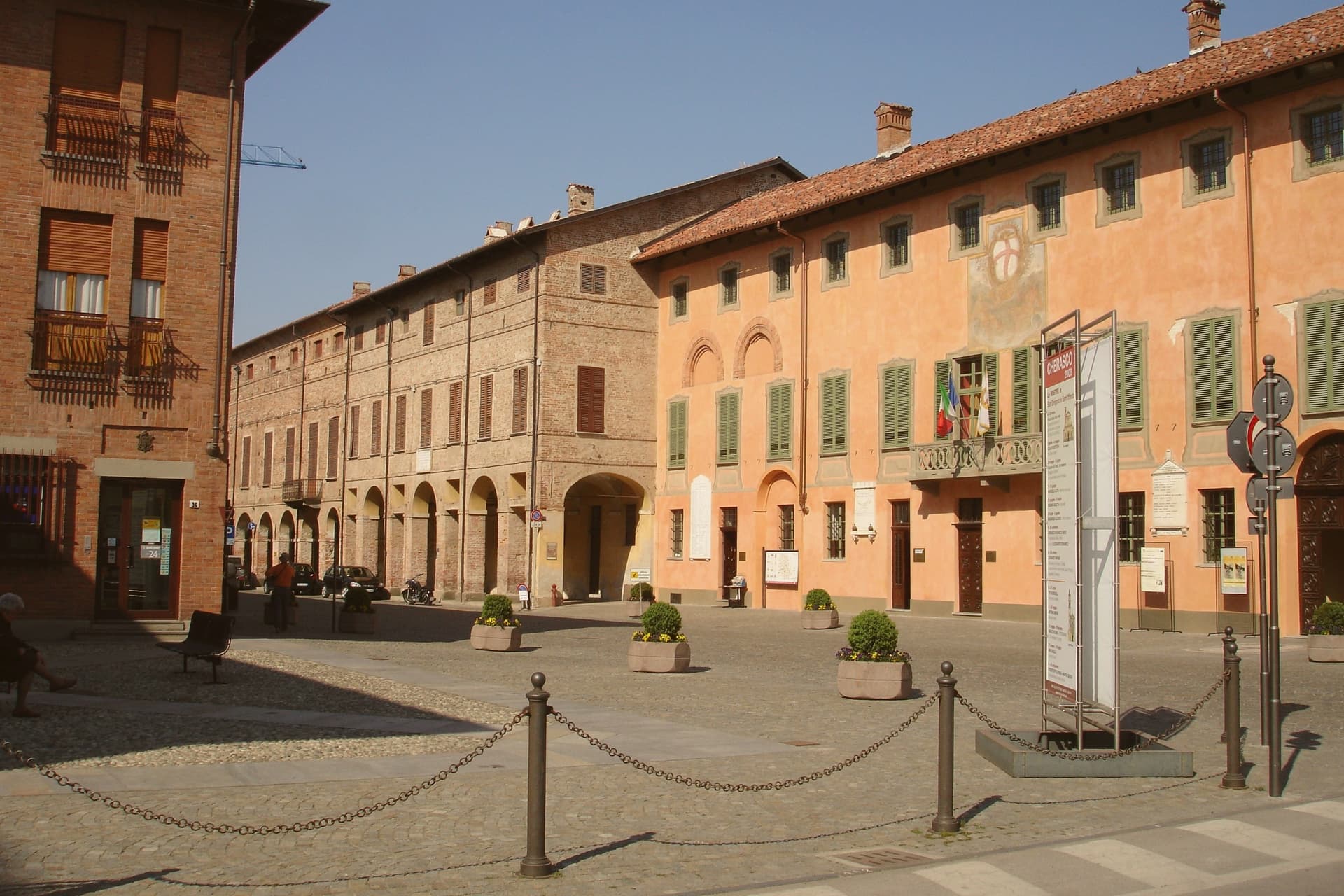
Cherasco sits fifty kilometers southeast of Torino, on the terrace where the Stura di Demonte joins the Tanaro. The site put the town on the frontier between the Piedmontese plain and the Langhe hills, and the 1243 planners answered it with a grid: wide streets, arcades, and walls, laid out in a single act rather than grown over centuries.
The castle anchors one end of that plan, the sanctuary another, and the palace where two treaties were signed sits within the same walkable core, so a visitor moving from arch to palace to church is retracing the town's history in the space of a few streets rather than reading it in sequence. That compactness is the point.
A town this size produced a fortress, two treaties of continental consequence, a baroque sanctuary, and a modern research institute, all within the same walled grid on the same river terrace. The snails came last and stayed longest: what began as an institute in 1973 is now the thing Cherasco is best known for, outlasting even the armistice in the town's daily life.
Pasticceria Barbero, La Torre, Autentico and 1 more have been named by a guide.
What to see in Cherasco
- Castello Visconteo. Well preserved on the side facing the town, a museum since restoration. Begun by Luchino Visconti, it still dominates the skyline from the terrace below.
- Palazzo Salmatoris. Civic palace where the 1631 peace of Cherasco and the 1796 Napoleonic armistice were signed, now an exhibition venue.
- Santuario della Madonna del Popolo. Baroque sanctuary designed by Sebastiano Taricco, its facade and interior forming one of the architectural anchors of the centro storico.
How to get to Cherasco
There is a railway station in the town, so you can arrive without a car and never need one while you are here. Torino is roughly 65 minutes away by road.
Our tip
April through June is the green season on the Tanaro terrace, with mild days, vineyards in leaf, and the snail farms beginning their cycle. September and October bring the harvest, the Fiera del Tartufo, and the biannual Lumache di Cherasco fair in even years. July and August reach the mid-thirties on the river plain; the arcades that line Via Vittorio Emanuele are practical, not decorative, in that heat. Mercatino dell'antiquariato di Cherasco falls in September.
Canelli
Why visit Canelli
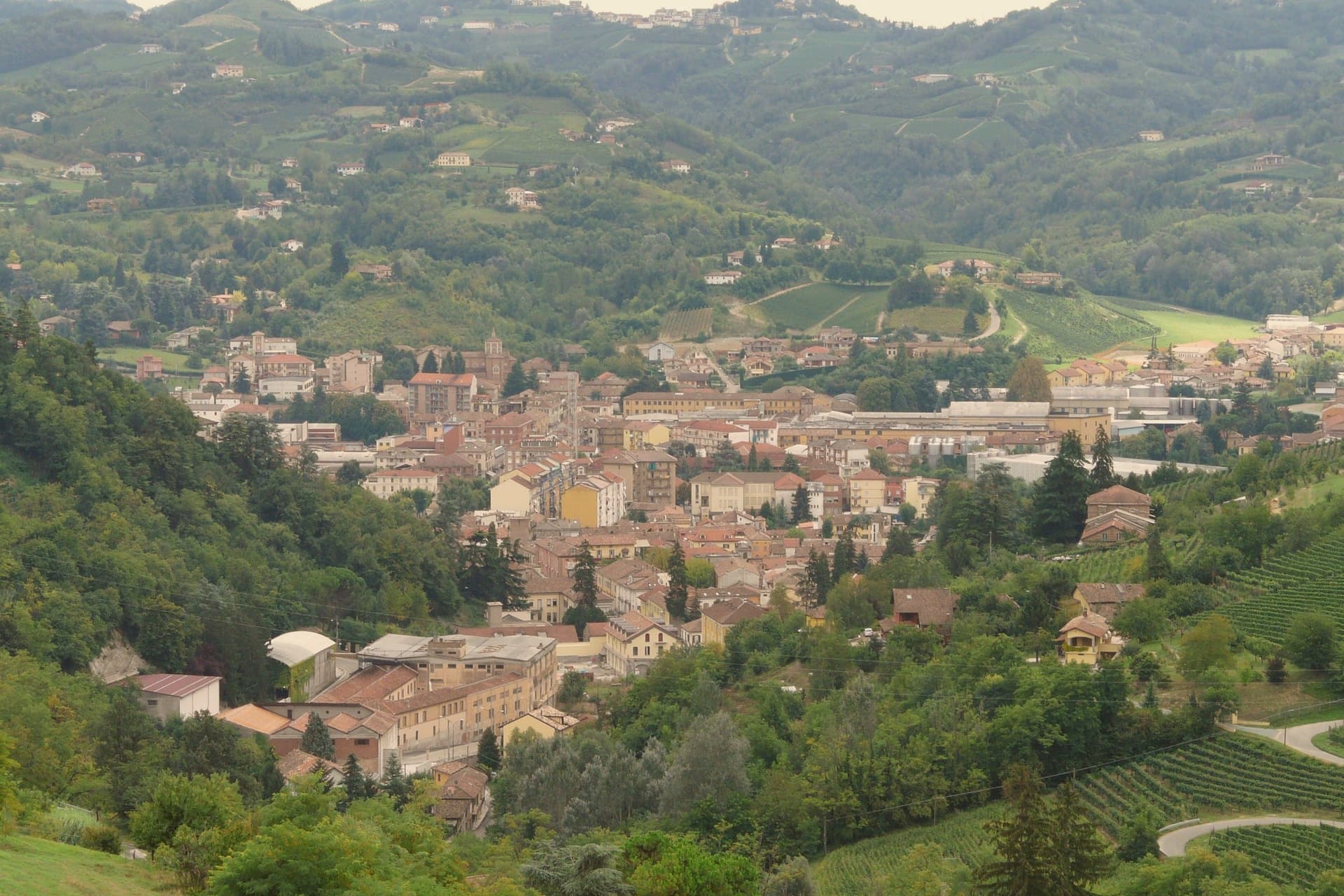
Canelli sits at 157 meters on the Belbo, in the south-east corner of the Asti hills where the Langhe and Monferrato meet. The town is the birthplace of Italian sparkling wine: Carlo Gancia produced the first Asti Spumante here in 1865, on the model of Champagne.
Underneath the centro storico runs a network of cellars cut into the tuff by pickaxe and chisel from the sixteenth to the nineteenth century, descending as deep as 32 meters and extending about 20 kilometers through the hill below town. They are called the Cattedrali Sotterranee, and they were inscribed in the UNESCO Vineyard Landscape of Piedmont in 2014.
Above ground, the Sternia, a steep stone street, climbs from the Borgo Villanuova past the Torre dei Contini at 371 meters to the Castello Gancia, a medieval fortress transformed into a noble residence by the Scarampi in the early 1600s and still occupied by the Gancia family. The Belbo grows Moscato Bianco, Barbera and hazelnut.
San Marco, Enoteca di Canelli - Casa Crippa, Civico 15 have been named by a guide.
What to see in Canelli
- Cattedrali Sotterranee. Network of tuff-cut cellars under the centro storico, 20 km of tunnels descending to 32 meters, part of the UNESCO Vineyard Landscape since 2014.
- Castello Gancia. Medieval castle on the Sternia hill above town, transformed into a Scarampi residence in the 1600s and now home of the Gancia family.
- La Sternia. Historic stone-paved street climbing through Borgo Villanuova to the castle, the original access road to the hilltop fortress.
How to get to Canelli
There is a railway station in the town, so you can arrive without a car and never need one while you are here. Torino is roughly 82 minutes away by road.
Our tip
April through June and September into October are the months the Belbo hills work best. The vines leaf and harvest in those windows, the cellars stay 12 to 14 degrees year-round, and the climb up the Sternia to the castle is in shade most of the day. July and August get hot in the valley; the Cattedrali Sotterranee are the coolest space in town and double as a refuge between two and five in the afternoon. National Truffle Fair and San Martin Fair falls in November.
Nizza Monferrato
Why visit Nizza Monferrato
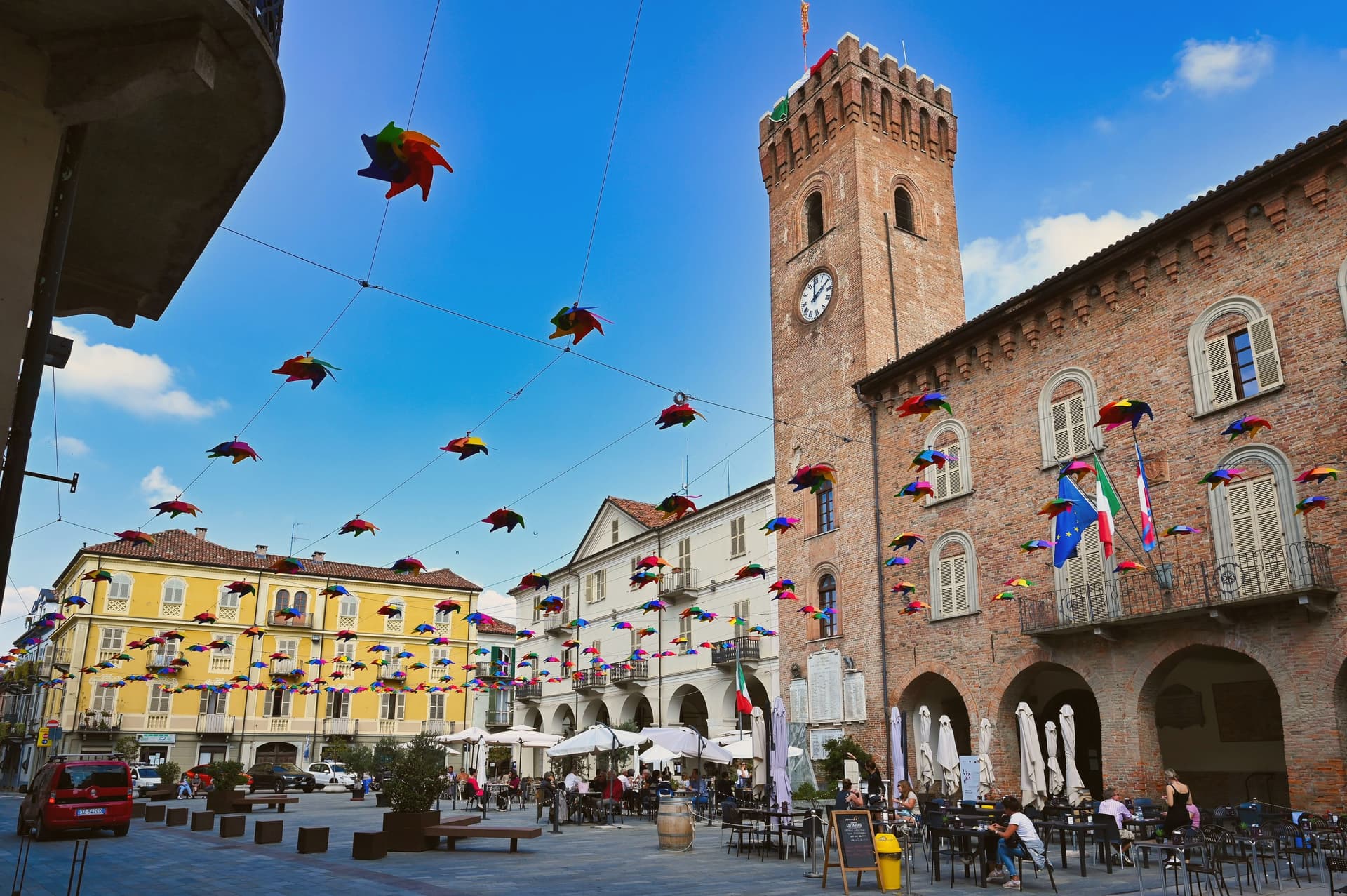
Nizza Monferrato sits at 267 meters in the south of the Asti province, thirty kilometers from Asti city. It was founded in 1225 by inhabitants displaced from castles in the Alessandria area, joined the Marquisate of Monferrato in 1264, and grew through the 19th century as the commercial center of the Barbera-growing hills around it.
The medieval grid from that 1225 founding still holds the centro storico together, with Renaissance and 18th-century palazzi lining Via Pio Corsi and Via Carlo Alberto, while the vineyards that made the town's fortune spread out beyond it at 200 to 400 meters. That agricultural hinterland and the market town at its center still explain each other: the Foro Boario, the old cattle market on Piazza Garibaldi, is the physical record of a town that existed to move what the hills produced, and it still does that job as a multipurpose hall for the antiques market and for the November weekend known as Nizza è Bagna Cauda.
At that gathering, long communal tables fill with the Cardo Gobbo, a hunchbacked cardoon grown only here and protected by a Slow Food presidium, alongside Barbera raised to DOCG status in 2014. A town built to trade a hillside's produce has ended up defined by two of that produce's most particular forms.
Le Due Lanterne, I Cugini di Torino have been named by a guide.
What to see in Nizza Monferrato
- Piazza Garibaldi and Foro Boario. Main square with the old covered cattle market, now a multipurpose hall used for antiques fairs and the November bagna cauda weekend.
- Chiesa di San Giovanni in Lanero. Baroque parish church on the centro storico, with a tall bell tower visible across the surrounding vineyards.
- Museo Bersano delle Contadinerie. Wine-and-farming museum in a former cellar, with one of the largest collections of historic Piemonte viticulture tools.
How to get to Nizza Monferrato
There is a railway station in the town, so you can arrive without a car and never need one while you are here. Torino is roughly 78 minutes away by road.
Our tip
April through June and September into October are the months the Monferrato hills work best. October is harvest, with the Barbera coming in late and the cellars open for visits. November is the Cardo Gobbo and bagna cauda weekend, the largest event of the year, when the Foro Boario fills with communal tables and the Cantina di Nizza pours through the night. Mercatino dell'antiquariato nicese falls in August.
Bra
Why visit Bra
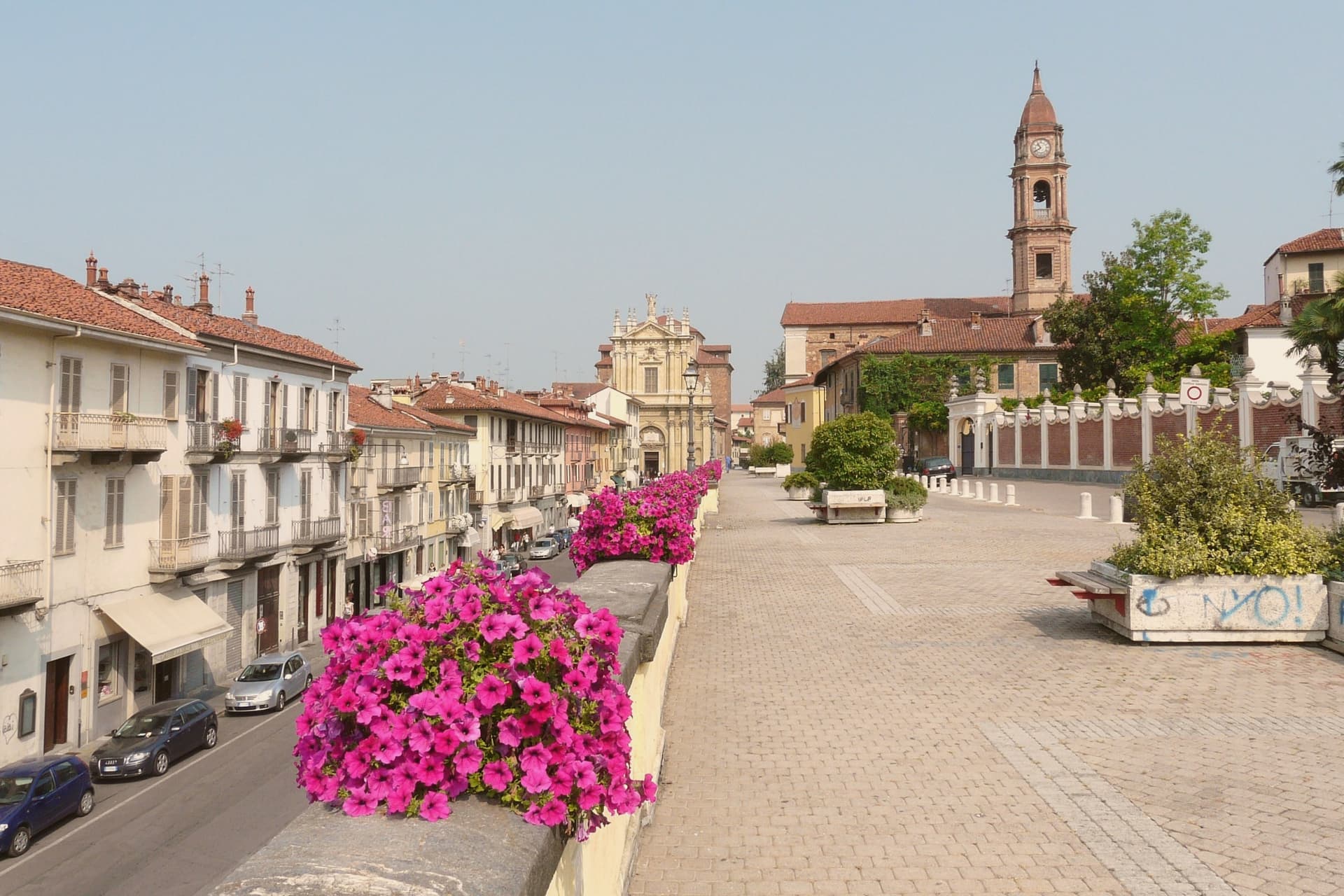
Bra sits at 290 meters in the Roero hills, fifty kilometers southeast of Torino, on the north edge of the Langhe-Roero-Monferrato UNESCO wine landscape. The old center, with its porticoed Corso Garibaldi and Via Cavour, is the working core of town; above it a nineteenth-century pavilion looks out over the surrounding hills, and below, on the Tanaro, a frazione occupies the site of a Roman colony inside a former Savoy royal estate.
Carlo Petrini founded Slow Food here in 1986 in response to a McDonald's planned next to the Spanish Steps in Rome, and the movement's headquarters has stayed in town since. In 1999 Bra was one of the four founding cities of Cittaslow, the small-town quality-of-life network.
The biennial Cheese fair, the largest event in the world for raw-milk cheeses, fills the old center in odd-numbered Septembers, alongside the town's own DOP cheese and its ground veal sausage, eaten raw by local custom. A town this size holding a global food movement, a gastronomic university, and a Roman site within its own borders is not an accident of promotion: it reflects a place that has treated eating and its history as civic matters worth building institutions around.
Caffè Pasticceria Converso, Battaglino, Osteria La Pimpinella and 3 more have been named by a guide.
What to see in Bra
- La Zizzola. Octagonal pavilion on the hill above town, reached as the best panoramic point over the Langhe and Roero.
- Palazzo Mathis. Fourteenth-century palazzo on the central piazza with frescoed main floor and eighteenth-century oil-painted door covers, now used for exhibitions.
- Palazzo Traversa. Fifteenth-century building housing the Museo di Archeologia, Storia e Arte, with finds from the Roman colony of Pollentia.
How to get to Bra
There is a railway station in the town, so you can arrive without a car and never need one while you are here. Torino is roughly 54 minutes away by road.
Our tip
April through June and September into October are the months Bra runs cleanest. The Roero hills colour up around the town, the cellars hold tastings, and the Cheese fair takes the centro storico in September of odd years. July and August get hot in the Tanaro plain below, and the porticoes on Corso Garibaldi become the cool part of town between four and seven in the afternoon. Bra's - Bra falls in September.
Alba
Why visit Alba
Alba sits at 172 meters on the right bank of the Tanaro, the regional capital of the Langhe and the centre of one of Italy's most concentrated wine and food economies. The Roman city of Alba Pompeia stood on the same site, and the Piazza Risorgimento, locally called Piazza Duomo, is laid out on the line of the old Roman forum.
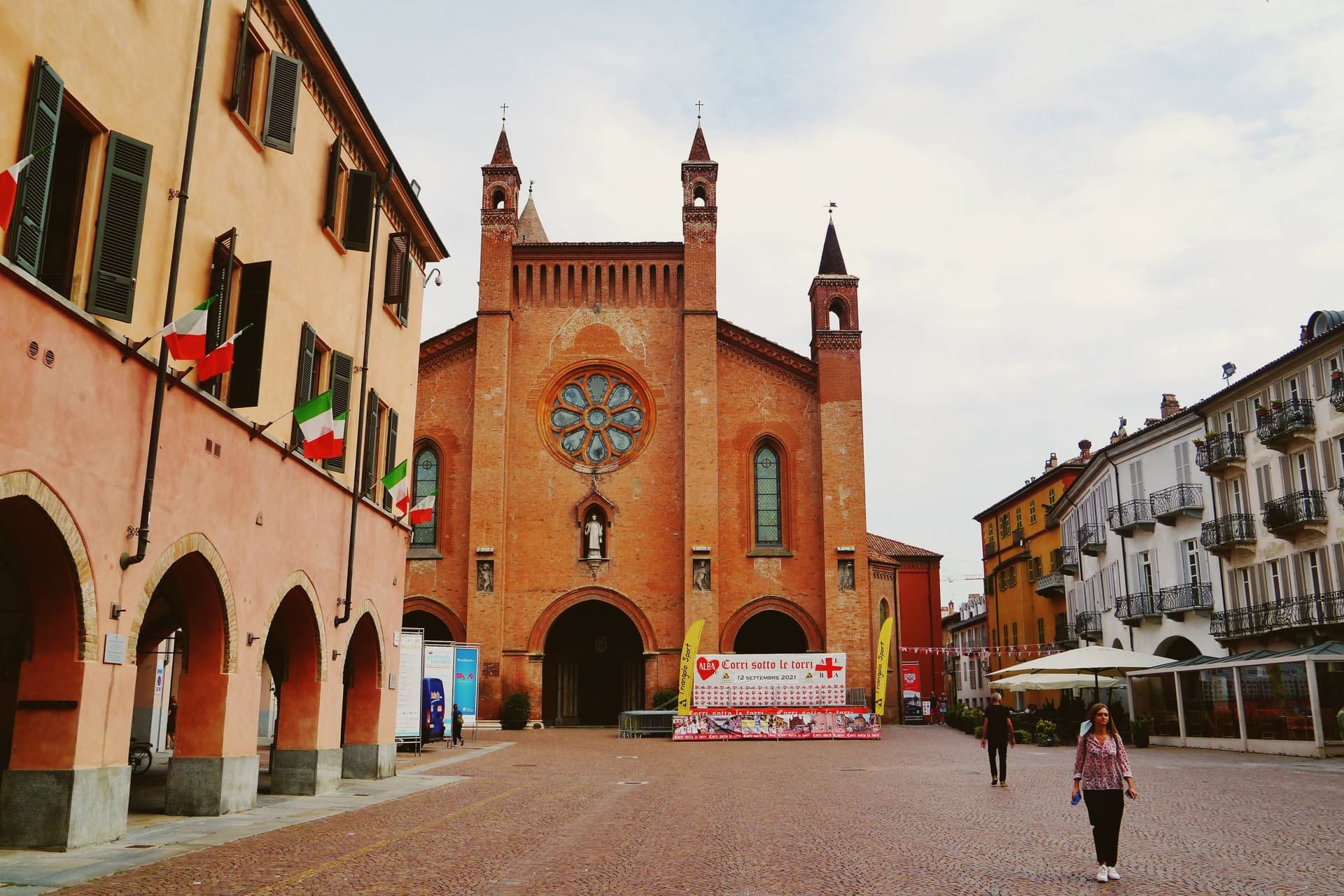
The Duomo di San Lorenzo dates to the twelfth century and carries a late Gothic red-brick façade and a vaulted nave. In the medieval centuries the town was known as the city of a hundred towers; a few dozen survive, the tallest along Via Cavour.
The Fiera Internazionale del Tartufo Bianco runs across October and November, the oldest white truffle fair in the country. The Palio degli Asini on the first Sunday of October recalls a 1275 dispute with Asti.
The town is the headquarters of Ferrero, the family company that invented Nutella, and the home of Beppe Fenoglio, whose Partisan novels are set in these same hills.
Piazza Duomo, Locanda del Pilone, Ventuno.1 and 10 more have been named by a guide.
What to see in Alba
- Duomo di San Lorenzo. Twelfth-century cathedral with a late Gothic red-brick façade, vaulted nave and 16th-century inlaid wooden choir, on the line of the Roman forum.
- Piazza Risorgimento. Central square on the site of the Roman forum, framed by the Duomo, the Palazzo Comunale and the surviving medieval brick towers.
- Torri medievali. Roughly forty of the original hundred or more brick towers still rise above the rooftops, most clustered along Via Cavour and Via Vittorio Emanuele.
How to get to Alba
There is a railway station in the town, so you can arrive without a car and never need one while you are here. Torino is roughly 58 minutes away by road.
Our tip
April through June are the green months in the Langhe hills, with mild evenings and vineyards in full leaf. July and August touch the mid-thirties; the centro storico empties between two and five in the afternoon. September and October are the heart of the year: harvest in the surrounding cantine, the Palio degli Asini on the first Sunday of October, and the opening weekends of the white truffle fair. Festa Patronale Madonna della Moretta falls in September.
Venaria Reale
Why visit Venaria Reale
Venaria Reale sits at 269 meters fifteen kilometers northwest of Torino, on the lowland that ran into the Savoy hunting forests of the Mandria. The modern name comes from the Latin ars venatoria, hunting.
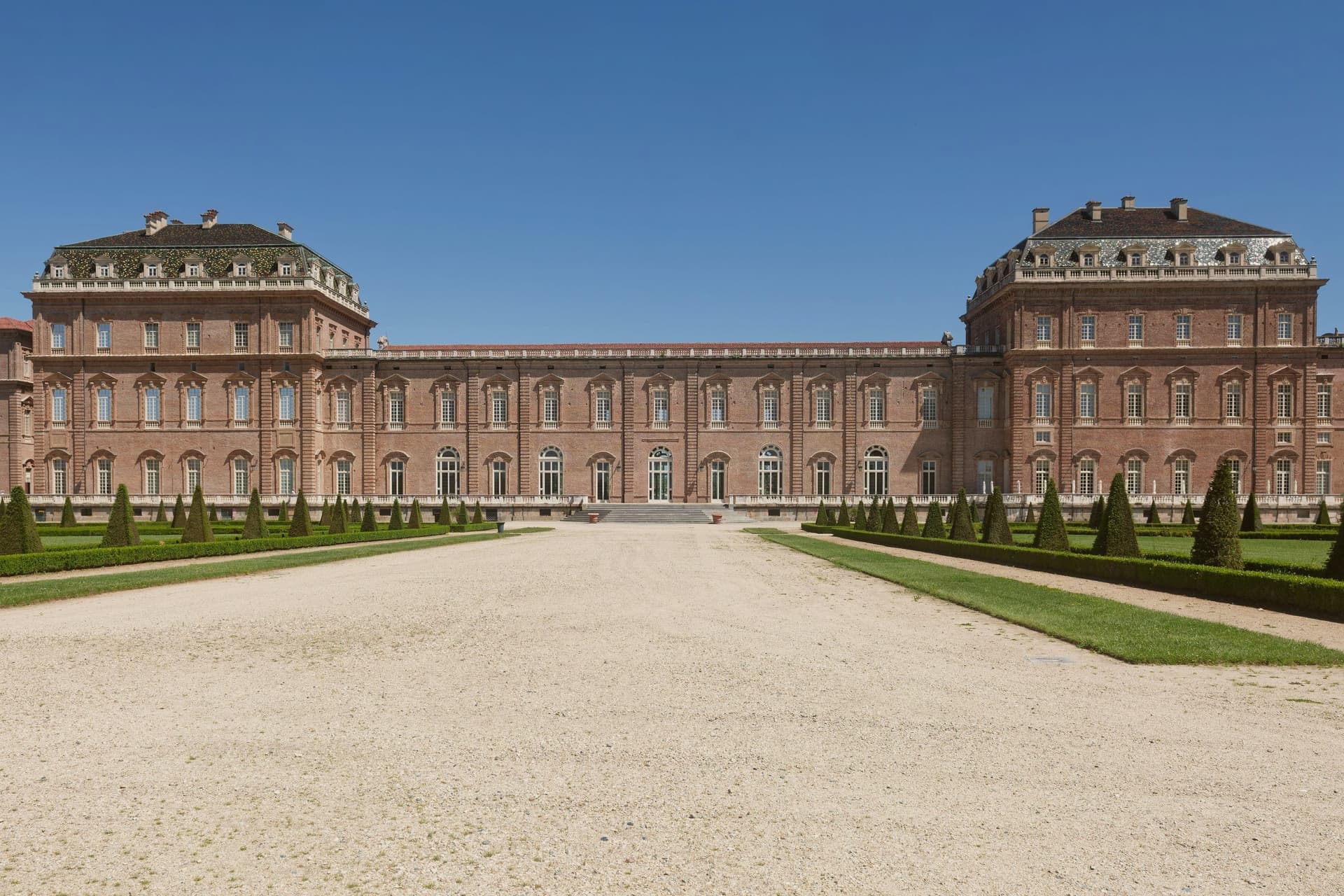
In 1658 Duke Carlo Emanuele II commissioned court architect Amedeo di Castellamonte to build a residence for hunting parties and court leisure, with a coordinated plan for palace, park, hunting wood and adjoining village. In 1716 Filippo Juvarra enlarged the complex with the Galleria Grande, the Cappella di Sant'Uberto, the Citroniera and the Scuderia, lifting the Reggia to one of the major baroque set pieces of Europe.
The Savoy Residences entered the UNESCO list in 1997. After two centuries as a military barracks the palace was restored across eight years from 1999 to 2007, in the largest cultural restoration project in European Union history, with 1,800 operators on site.
The Reggia now opens eighty thousand square meters of floor surface and sixty hectares of gardens, with the three thousand fenced hectares of the Parco della Mandria beyond.
Dolce Stil Novo alla Reggia, Il Convito della Venaria have been named by a guide.
What to see in Venaria Reale
- Reggia di Venaria. UNESCO baroque palace begun in 1658 by Amedeo di Castellamonte for Duke Carlo Emanuele II, with 80,000 m² of floors and 60 hectares of gardens.
- Galleria Grande. Filippo Juvarra's barrel-vaulted gallery of 1716, one of the longest enfilades of baroque court architecture in Europe.
- Cappella di Sant'Uberto. Royal chapel designed by Juvarra inside the palace, completed in the second decade of the eighteenth century for the hunting court.
How to get to Venaria Reale
There is a railway station in the town, so you can arrive without a car and never need one while you are here. Torino is roughly 28 minutes away by road.
Our tip
April through June is the best window for the gardens of the Reggia and the long walks through the Parco della Mandria, with parterres in full bloom and the hunting park green. September and October bring cooler air over the gardens and the start of the autumn exhibition season inside the Galleria Grande. July and August touch the mid-thirties on the Torino plain; the palace interiors stay cool, the Citroniera and the chapel hold the heat at bay, but the gardens flatten in midday glare.
More from Anywhere Italy
 The best hidden hill towns you can reach by train within 90 minutes of Torino
- The 6 best hidden towns you can reach by train that eat well within 90 minutes of Torino
- The 7 best wine towns you can reach by train within 90 minutes of Torino
- The 8 best towns you can reach by train in the province of Cuneo
- The best towns you can reach by train within an hour of Turin
- The best hill towns within an hour of Turin