
The best towns with a serious restaurant in the province of La Spezia
The province of La Spezia sits where Liguria runs out of room, the Apennines dropping into the sea in terraces of dry-stone wall, vines and lemon trees. The kitchens work with what that geography gives them: anchovies salted in Monterosso, mussels and clams from the Gulf of Poets, testaroli cooked on hot terracotta and dressed with pesto, chickpea flour turned into farinata, Vermentino and Albarola from the Colli di Luni. Inland, in the Val di Vara and around Sarzana, the register shifts to lamb, mushrooms, chestnut flour and cattle raised on high pasture. Spring and early autumn are the useful seasons, when the terraces are green, the sea is still warm enough to swim and the dining rooms are not booked out weeks ahead. The houses here are tall and narrow, built of river stone and rendered in ochre, pink and faded green.
The obvious move is Portovenere, with its church on the point, its row of coloured houses along the quay and its boats out to Palmaria. It is beautiful and it is on every coach itinerary and every ferry timetable between Easter and late September, which means the quayside tables turn over fast and the menus are written to be understood in several languages at once. Portofino, further up the coast, does the same thing at higher prices. None of this is a scandal, it is simply what happens to a small harbour that a great many people want to photograph.
The good news is that the same coast, the same terraces and the same suppliers carry on either side of the crowds. The gulf continues round to Lerici, the Cinque Terre railway keeps stopping at smaller stations further west, and the Magra valley behind Sarzana is farm country with a market town at the centre of it. In these towns the serious kitchens are cooking for people who live nearby as much as for visitors, which shows in the wine lists and in the hours they keep. Each of the towns below holds a restaurant listed by the most demanding of the dining guides, and most of them are small enough to walk across before lunch.
Of the 13 communes we have mapped in the province of La Spezia, 7 qualify as towns with a serious restaurant: each holds a restaurant listed by the most demanding of the dining guides. The smallest, Framura, has 577 residents.
If you are still choosing, we have also written The best hidden coastal towns in the province of La Spezia and The best small coastal towns with a serious restaurant in Liguria.
Framura
Why visit Framura
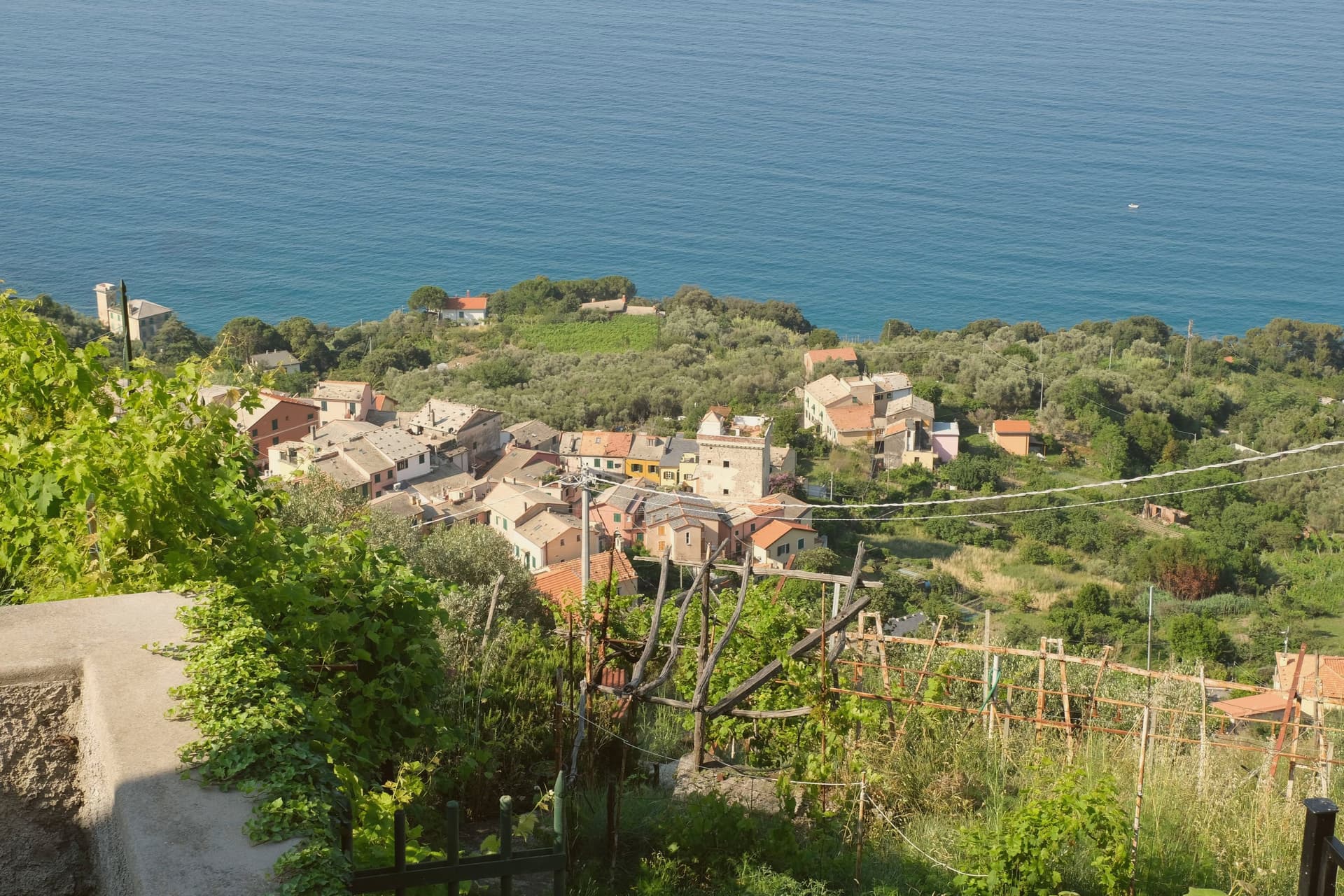
Framura is not one village but five: Anzo on the water, Setta and Ravecca on the slope, Costa above them, and Castagnola at roughly 300 meters with views back down to the coast. The commune spans from the rocky shoreline to 845 meters inland on the ridge that separates the Cinque Terre coast from the Vara valley.
Byzantine settlers built the original circular watchtowers here against Saracen raids, three of them still standing on the coast and inland. The hamlets remained agricultural until the Genova-La Spezia railway tunneled through in the late nineteenth century, opening the commune to summer visitors.
The seafront below Anzo, reached by a converted railway tunnel turned cycle path, carries the Bandiera Blu, and the same path runs north toward Bonassola and Levanto. Framura is the quiet outlier on this coast: the closest Borghi più belli village to Monterosso al Mare without being in the Cinque Terre national park.
L'Agave have been named by a guide.
What to see in Framura
- Torri bizantine. Three surviving Byzantine watchtowers on the coast and ridge, built to defend the village from Saracen incursions.
- Castagnola. Highest of the five hamlets at around 300 meters, with views over the lower frazioni and the Riviera di Levante.
- Anzo waterfront. Coastal hamlet at sea level with the Bandiera Blu beach access, the lowest of Framura's five settlements.
How to get to Framura
There is a railway station in the town, so you can arrive without a car and never need one while you are here. Genova is roughly 59 minutes away by road.
Our tip
April through October fits Framura, with the cycle path open and the coast walkable in any direction. May, June and September are the best for combining sea and hiking; mid-summer brings the strongest beach traffic but the upper hamlets stay calm. The Bandiera Blu beachfront below Anzo is small and fills early on August weekends.
Levanto
Why visit Levanto
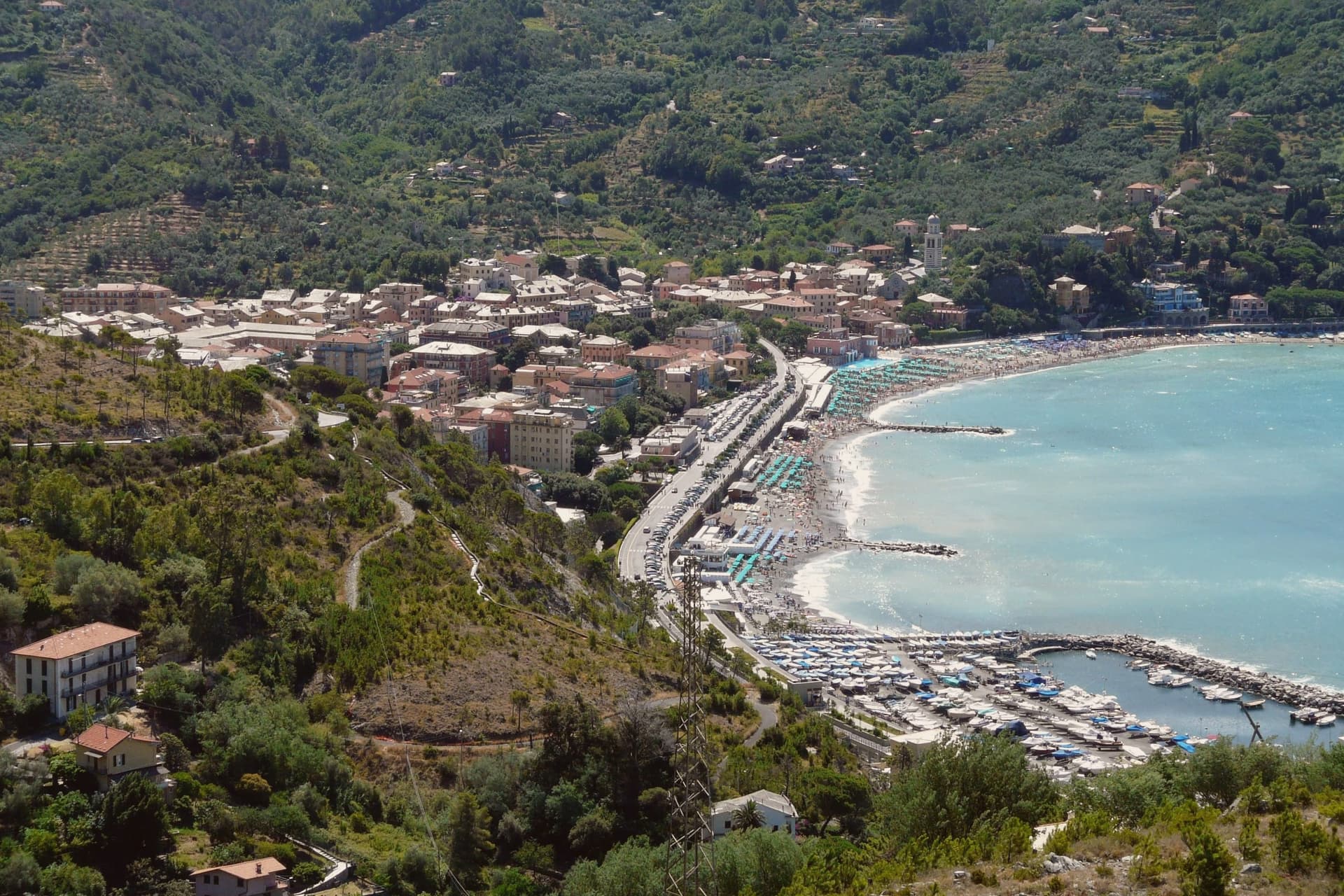
Levanto sits at sea level on the Ligurian coast, twenty kilometers northwest of La Spezia and just outside the Cinque Terre National Park. The Cinque Terre Express train stops here every half hour on its way to the five villages, but Levanto has the things they do not: a long sand-and-gravel beach with Bandiera Blu status, a flat centro storico, and a surf break that local guides classify as one of the few big-wave spots in Italy.
The Chiesa di Sant'Andrea, built in 1222, fronts the old town with horizontal bands of black and white marble and a large rose window. The thirteenth-century Loggia Comunale, on the same piazza, was awarded a UNESCO peace and culture title in 2007.
Casa Restani, on Via Grillo, is a surviving medieval merchant house with the ground floor where goods from the harbor were stored. Levanto holds Cittaslow, Bandiera Blu, Parco Nazionale, and Città dell'Olio at once.
La Sosta di Ottone III have been named by a guide.
What to see in Levanto
- Chiesa di Sant'Andrea. Parish church built in 1222 in Ligurian Gothic style, with horizontal bands of black and white marble and a large rose window over the main door.
- Castello di Levanto. Thirteenth-century defensive castle on the hillside, still intact but privately owned and closed to the public.
- Loggia Comunale. Thirteenth-century arcaded loggia on the main piazza, awarded a UNESCO title in 2007 as a monument of culture and peace.
How to get to Levanto
There is a railway station in the town, so you can arrive without a car and never need one while you are here. Genova is roughly 72 minutes away by road.
Our tip
April through June and September into October are the dry months. The sea warms enough for swimming by late May. The surf builds in autumn and winter when Atlantic systems push swell into the gulf.
Riomaggiore
Why visit Riomaggiore
The village sits at the eastern end of the coastal line running out of La Spezia, first among the five reached along that route. It is documented from 1251, when the Carpena district swore allegiance to Genoa.
The castle went up first, begun in 1260 against pirate raids; the church followed in 1340 under Bishop Antonio Fieschi, its neo-Gothic front a much later addition from 1870, with a Maragliano crucifix still inside. The terraces above the rooftops are older than either building in continuous use, cut into the slope and worked without interruption long enough that the wine they produce carries the name of the method itself.
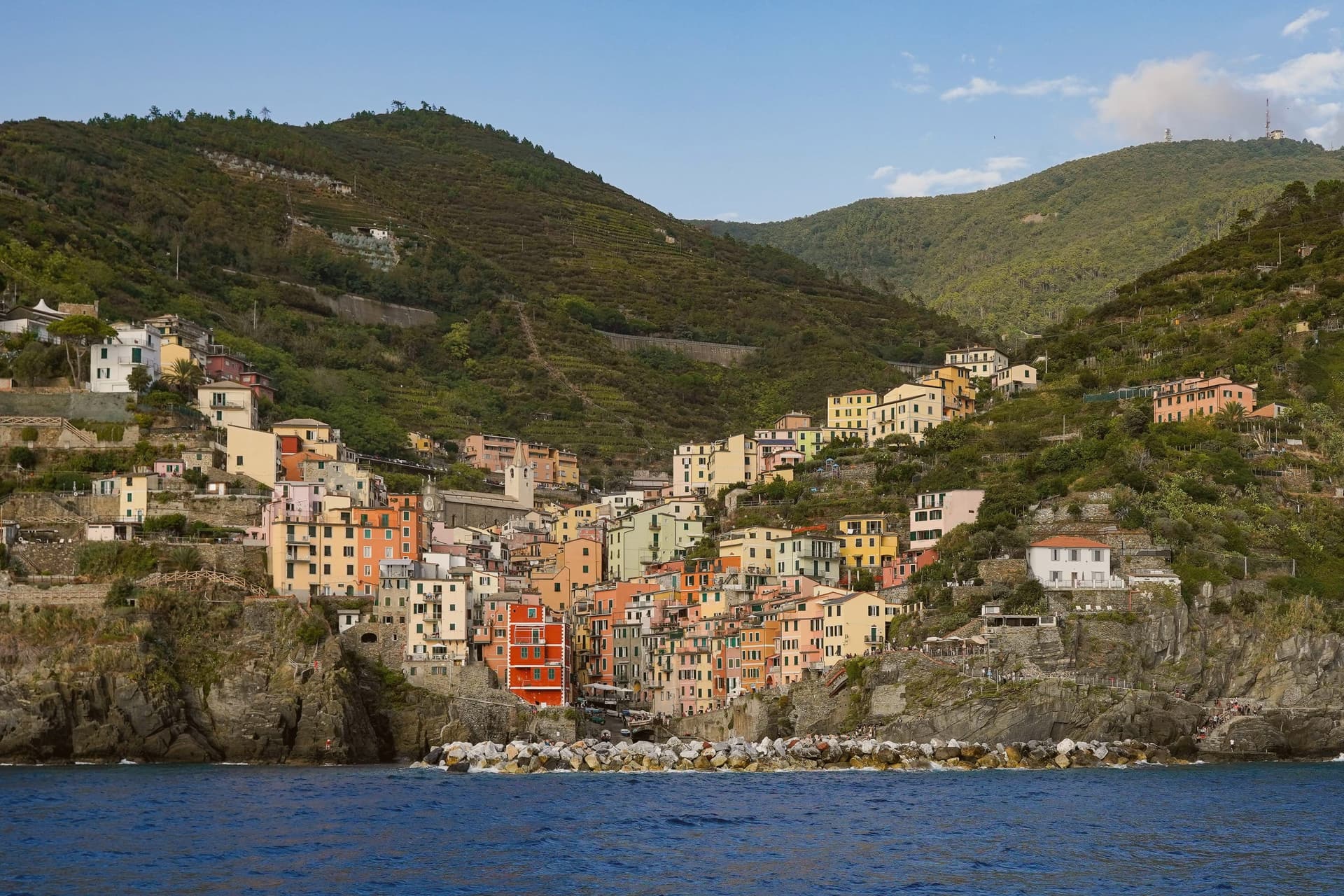
The built village is compact: castle and church above, the narrow harbour below at the water's edge, boats hauled onto the slipway between the breakwaters. Pixar set Luca here in 2021, lightly disguised as Portorosso.
Roughly 2.5 million annual visitors now reach a commune of 1,326 residents, a ratio that says as much about the place as any single monument: a fishing settlement of one street and one slipway, built to hold far fewer people than now pass through it, sized against a public many times its own population.
Rio Bistrot, Fuori Rotta have been named by a guide.
What to see in Riomaggiore
- Chiesa di San Giovanni Battista. Built in 1340 under Bishop Antonio Fieschi, rebuilt with a neo-Gothic façade in 1870, holds a wooden crucifix by Anton Maria Maragliano.
- Castello di Riomaggiore. Begun in 1260 by the Marchesi Turcotti against pirate raids, completed by Genoa two centuries later, twin cylindrical towers above the village.
- Via dell'Amore. The path clings to the cliff face between two villages, the sea directly below and the rock wall pressing close on the other side.
How to get to Riomaggiore
Pisa is roughly 134 minutes away by road.
Our tip
April through June brings the green window before the crowds: terraces in flower, train arrivals manageable, the Sentiero Azzurro walkable end to end. September and October are the dry months, harvest on the slopes above the village. July and August are hard.
Monterosso al Mare
Why visit Monterosso al Mare
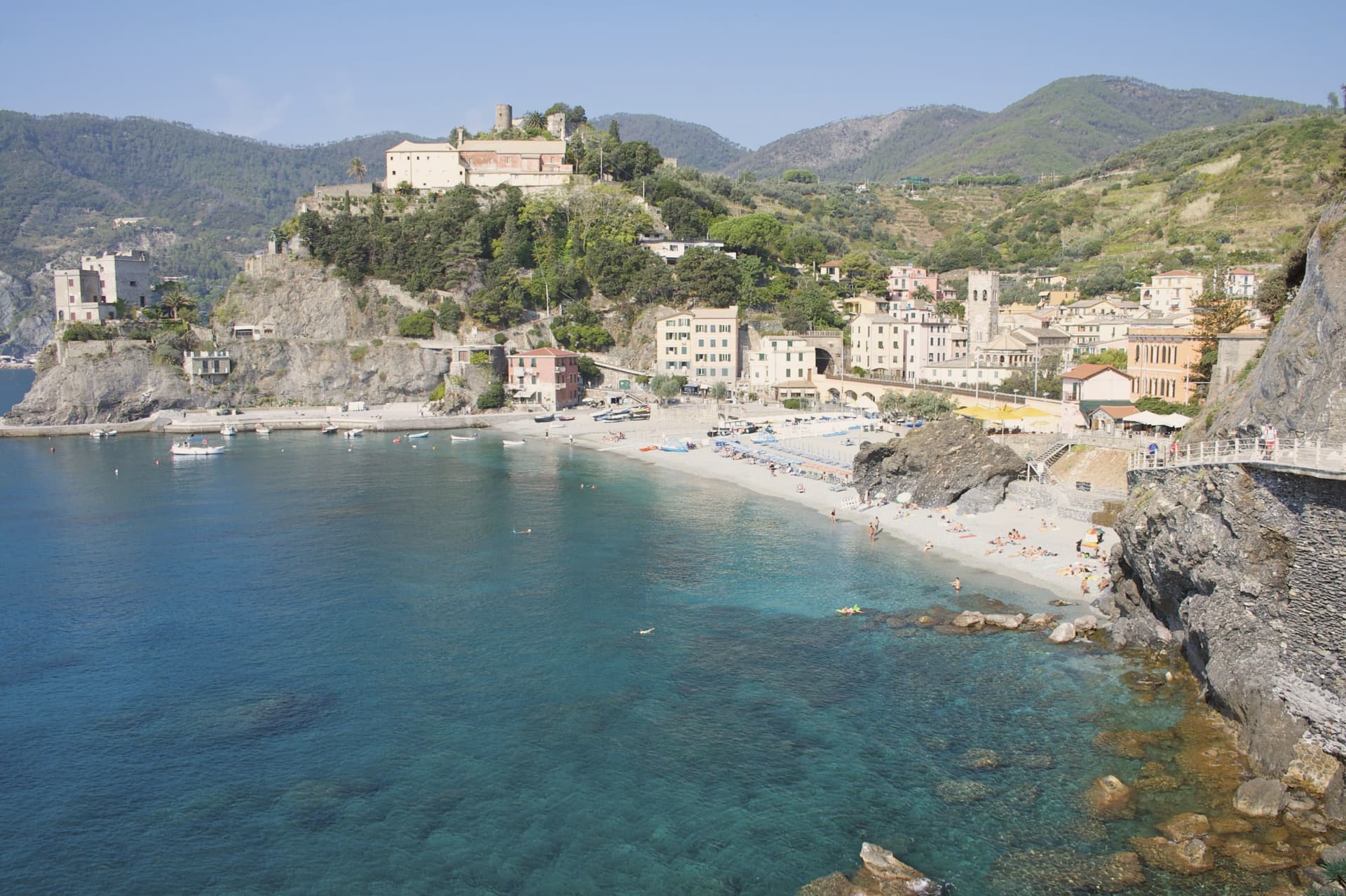
The village splits into two halves on either side of a headland: the older centro storico and, on the other side, the Fegina seafront where the railway runs behind the sand. The Capuchin convent looks out over both sides from that same headland, the hinge on which the whole layout turns.
Above the rooftops, at 464 meters, a hilltop sanctuary has stood on the same ground since 740, older than the village below it and the oldest Marian site in Liguria. The parish church down in the old town, banded in black and white marble, was built centuries later, so the two put a long stretch of the coast's religious history on display within sight of each other.
Montale's villa stood in Fegina, and the rocks and cliffs he carried into Ossi di seppia are the same ones visible from either half of the village. The geography here is the story: a headland dividing old from new, and a hillside holding the older of the two by several centuries.
Da Miky, L'Ancora della Tortuga, Buranco have been named by a guide.
What to see in Monterosso al Mare
- Chiesa di San Giovanni Battista. Parish church built 1282-1307 with a black-and-white-banded marble façade and a fresco of the baptism of Christ over the main portal.
- Santuario di Nostra Signora di Soviore. Hilltop sanctuary at 464 meters above the village, occupied by a church since 740, the oldest Marian site in Liguria.
- Convento dei Cappuccini. Seventeenth-century Capuchin convent on the San Cristoforo headland, separating the centro storico from Fegina.
How to get to Monterosso al Mare
There is a railway station in the town, so you can arrive without a car and never need one while you are here. Genova is roughly 78 minutes away by road.
✷ We have written about Monterosso al Mare
“The Cinque Terre are five towns with a national park around them and a marketing name that adds up to five. The copies without the name are a few miles away in either direction, and the experience they sell is the same experience, with the crowd divided by a hundred.”
Read our piece on Monterosso al Mare →Cinque Terre | How To Do It Right
Our tip
April through June and September through October are the workable months. The Sentiero Azzurro is open, the sea warms from late May, and the village still moves at a manageable pace. July and August are difficult: the Cinque Terre regional system caps walking-path tickets but the centro storico still saturates, and trains arrive standing-room from La Spezia. Festa del Limone falls in May.
Ameglia
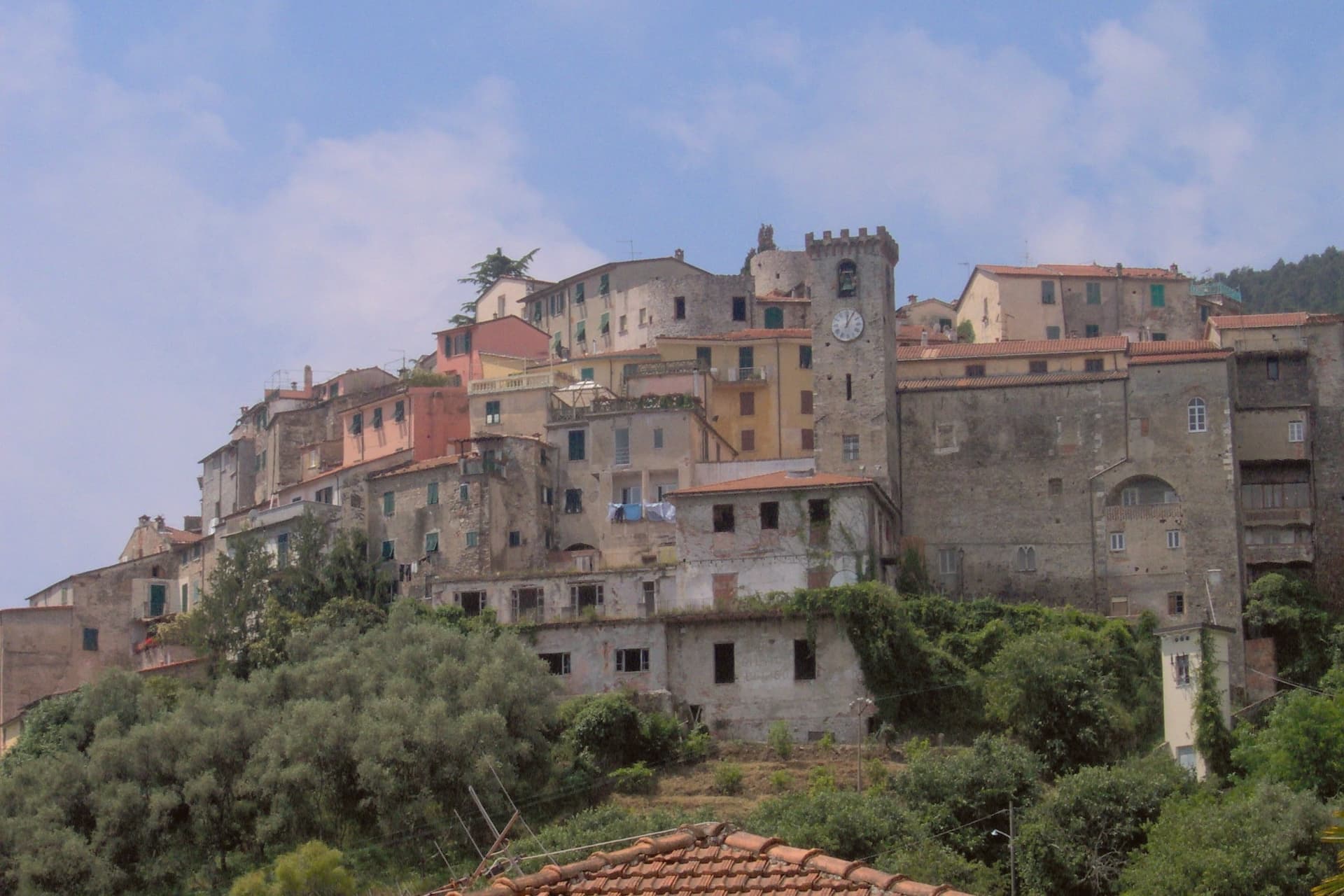
Why visit Ameglia
The Magra was the Roman Macra, the eastern boundary of Liguria, and the hill at Ameglia stands on the border between Lunigiana and the Riviera where that river reaches the sea. Genoa bought part of the fief in 1141, the bishops took it back by 1284, and Castruccio Castracani of Lucca conquered it in 1321: a small fortress passed between larger powers for three and a half centuries before it settled into the shape it now has.
The marina at the river mouth is a separate world from the hill town above it. Where the castle and its concentric streets sit on the summit, the frazione at the water is a former fishing village, flat, tied to the tide and to summer moorings rather than to the bishops who once held the heights.
The two headlands south of that marina are reachable only by boat or steep footpath, cut off from the estuary settlement by their own geography rather than by distance. The town, in effect, is two places joined by the same river: a fortified height that answered to Luni and Genoa, and a working shoreline that answered to the sea.
Pescarino-Sapori di Terra e di Mare, LUV Ristorante have been named by a guide.
What to see in Ameglia
- Castello di Ameglia. Rebuilt in 1174 on a tenth-century footprint, episcopal fortress of the bishops of Luni, cylindrical keep above the Magra estuary.
- Centro storico di Ameglia. Concentric medieval streets around the castle, twelfth and thirteenth-century houses with stone arches and external staircases.
- Bocca di Magra. Old fishing village and marina at the river mouth, summer mooring for small craft, departure point for Punta Corvo by sea.
How to get to Ameglia
Pisa is roughly 60 minutes away by road.
✷ We have written about Ameglia
“It has the best panorama in Liguria, full stop, and I do not think it is close. The reasons are two. The first is the obvious one. You are 266 meters up, the cliff is high enough that there is no rocky beach below to draw a crowd, the sea on one side is the Gulf of La Spezia with Portovenere across the water and the Cinque Terre fading north, and the view on the other side is the Magra running into its delta with the white Apuane behind it and Tuscany beyond.”
Read our piece on Ameglia →Magra Delta Roadtrip | A Tagine, a Lighthouse, and a Dead Roman City
Our tip
April through June and September to October bring the river's best months: clear estuary water, the headland walks down to Punta Corvo manageable, marinas at Bocca di Magra not yet at summer capacity. July and August fill the river mouth with summer boats from across the Gulf of Poets, and the road down from the borgo backs up on weekends. The Sagra del Pesce in mid-August draws thousands. Mercato Settimanale Di Ameglia falls in August.
Lerici
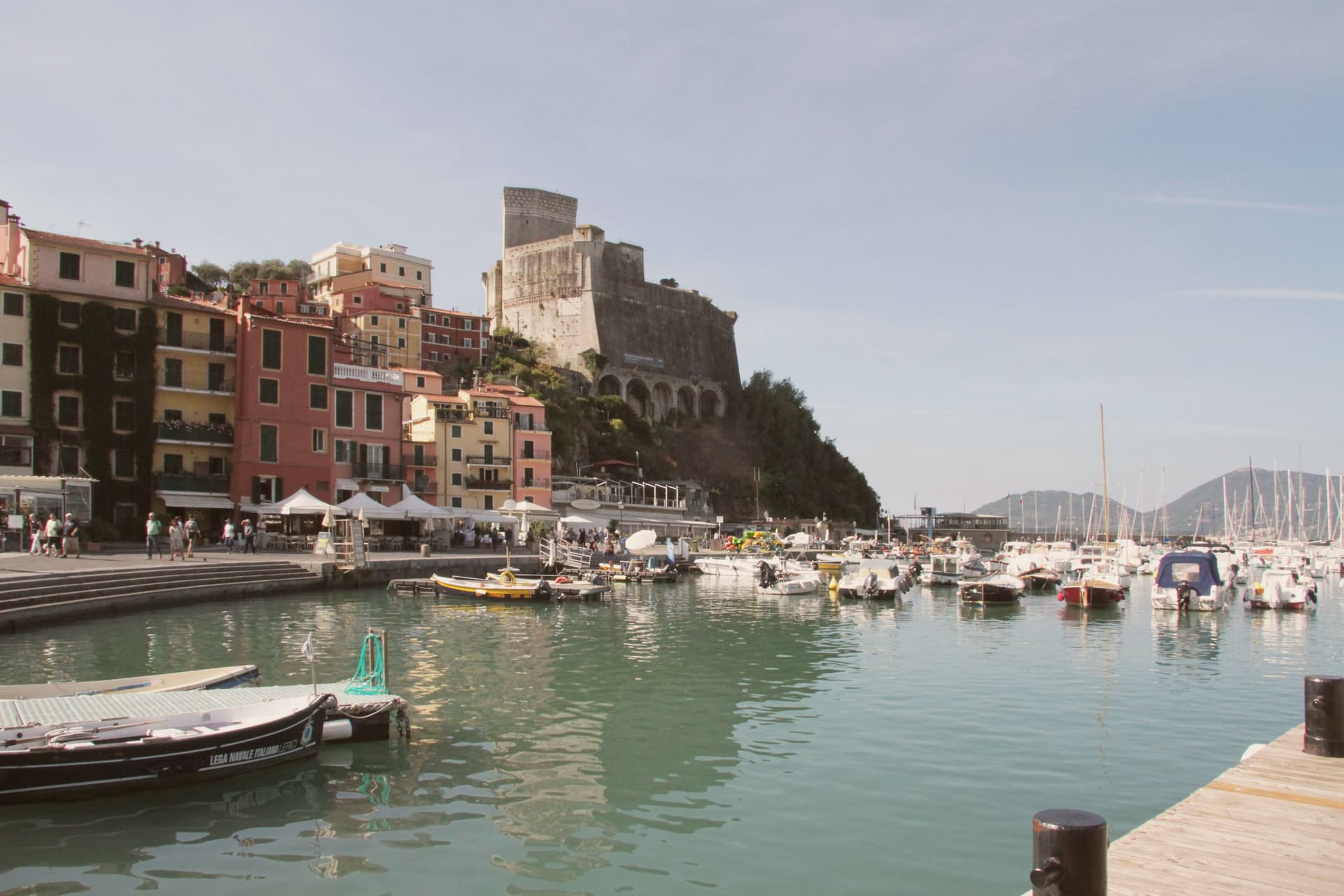
Why visit Lerici
The Gulf of La Spezia takes its eastern shore here, and English Romantics renamed that shore the Bay of Poets after Byron and Shelley made it their address in the early 19th century. The fortress that defines the harbour was begun by the Pisans in 1152 to control the gulf, captured by the Genoese in 1256, and rebuilt in its present pentagonal form through the 14th and 15th centuries; it now holds a paleontology museum with Jurassic dinosaur tracks recovered from the local sandstone.
Shelley lived at a house in nearby San Terenzo in 1822, he drowned that summer sailing from Livorno, and Byron swam across the bay from Portovenere on his way to visit him. Beyond the historic harbour the commune stretches south past a colourful frazione perched on a rocky promontory above the sea, a member of the Borghi più belli d'Italia network in its own right; a coastal trail links the two through olive terraces and pine woods.
The town beach holds a Bandiera Blu and the harbour fills with sailing dinghies all summer. Upper fortress and lower water, working harbour and outlying fishing hamlet: the whole gulf edge here reads as one address that two poets happened to share, and the parts of the commune as its castle, its beach, and its outpost on the rocks.
Il Fico trentacareghe, La Barca have been named by a guide.
What to see in Lerici
- Castello di Lerici. Begun by the Pisans in 1152, captured by Genoa in 1256, rebuilt in its present form in the 14th-15th centuries. The pentagonal walls still hold the harbour under them, and the paleontology museum inside keeps the Jurassic tracks pulled from the local sandstone.
- Bay of Poets / Casa Magni. The Casa Magni at San Terenzo, a Lerici frazione, was Shelley's residence in 1822, the year he drowned in the bay. The house still stands on the shore that gave the Bay of Poets its name.
- Tellaro. Pastel-coloured fishing frazione clinging to a rocky promontory at the southern edge of the bay. Linked to Lerici by the coastal Castelnuovo trail.
How to get to Lerici
Pisa is roughly 61 minutes away by road.
✷ We have written about Lerici
“We know the steep streets above the castle by heart. We know which restaurant is for the view and which is for the dinner. We know that the gelato in San Terenzo, made at a place called La Rana Golosa, is worth the half-hour walk along the sea to find. We know the underpass that takes you to the small free beach under the castle, the rocks at the back of it, and the bench halfway along the promenade to San Terenzo where, on a good day, the wind off the Gulf has the precise temperature of being alive.”
Read our piece on Lerici →Lerici | An Old Friend on the Gulf of Poets
Our tip
April through October is the open season in the Bay of Poets — warm coastal days, calm seas from late spring, and the sailing fleet active all summer. June and September are the best months: warm sea, longer light, fewer crowds than July-August. The castle is open year-round (paleontology museum included) and Tellaro is best in October-November when the colours go warm. Mytiliade a Lerici falls in September.
Sarzana
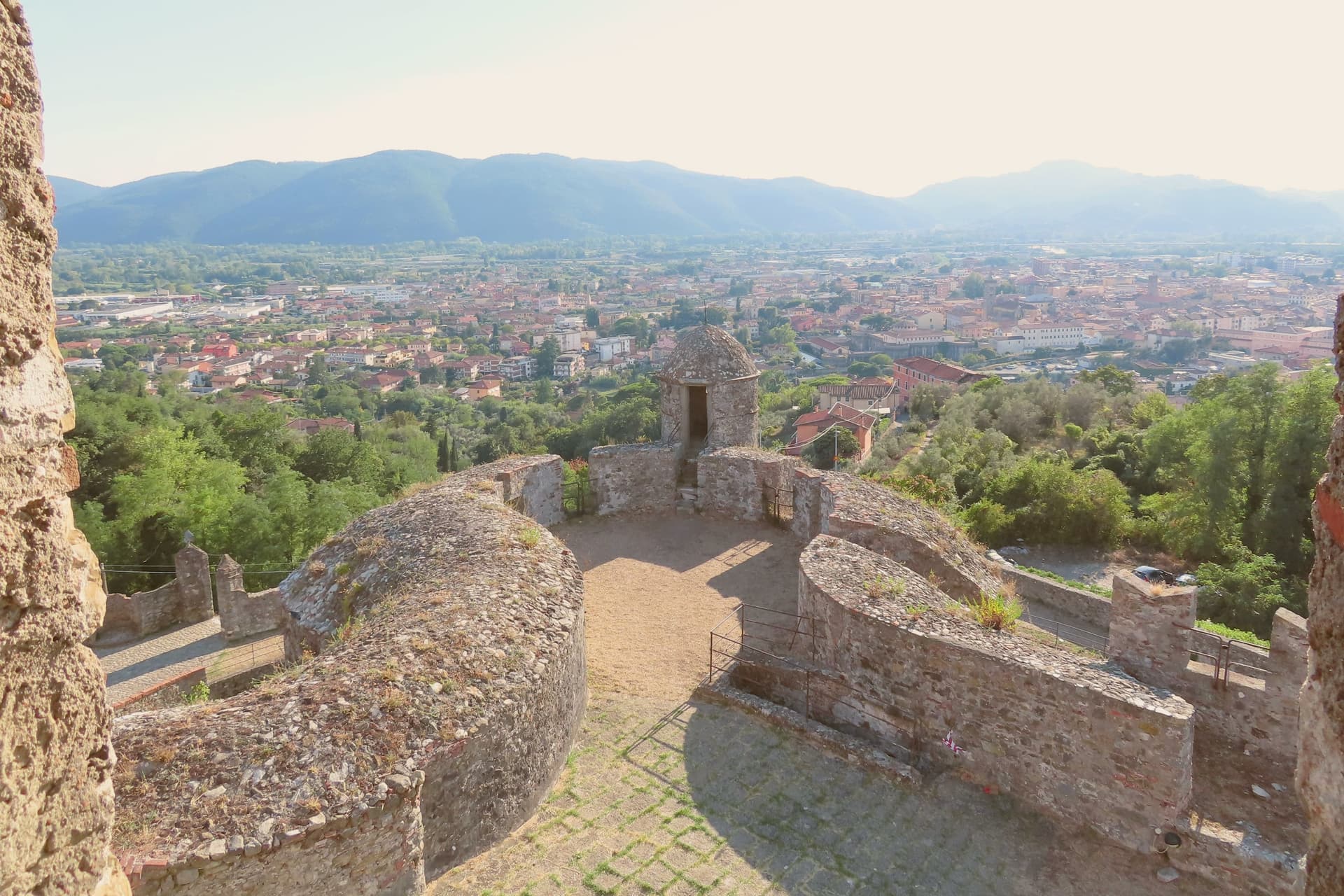
Why visit Sarzana
Sarzana sits on the Magra plain at the Liguria-Tuscany border, eighty kilometers from Parma and thirteen from the sea at Portovenere. The town inherited the episcopal seat of Luni in 1204, when Pope Innocent III moved it here away from the malarial plain, and the cathedral built for that new seat still anchors the centro storico.
The walled center keeps its grid plan, with Via Mazzini and the cathedral square running through it and the Palazzo Roderio still doing duty as the town hall. Above the town, on a ridge, a second fortress with a triangular plan looks down on the plain and the older one below.
A future pope was born here in 1397. Between the hill fortress from the fourteenth century, the Renaissance rebuilding of the lower cittadella, and a cathedral that changed hands with a diocese, the town's layout reads as a record of who controlled the Magra plain and when.
Pasticceria Gemmi il Loggiato, Il Cardinale Vino e Cucina, Piccolo Ristorante and 1 more have been named by a guide.
What to see in Sarzana
- Fortezza Firmafede. The fortress replaced a medieval cittadella on the same ground. Giuliano da Sangallo's plan survives largely intact, with the bulk and angles of the walls still readable from the approach into town.
- Cattedrale di Santa Maria Assunta. Late Gothic Tuscan cathedral, elevated to minor basilica in 1947. A cardinal born in the town, half-brother to a native-born pope, left his mark on the later additions.
- Croce di Mastro Guglielmo. The cross hangs inside the cathedral it has occupied since the seat moved here. Signed by its maker, it is the object the town's Romanesque reputation rests on.
How to get to Sarzana
There is a railway station in the town, so you can arrive without a car and never need one while you are here. Pisa is roughly 54 minutes away by road.
Our tip
April through June and September into October are the strongest months for the centro storico, with the Festival della Mente filling the squares at the end of August. July and August are hot on the Magra plain, often 32 to 35 degrees; the Fortezza Firmafede holds courtyard concerts in the evenings. The town stays open year-round because it is a working provincial center of 21,650 residents, with daily markets and trains to La Spezia, Pisa, and Parma. Marinella Fish Festival falls in August.
More from Anywhere Italy
- The best hidden coastal towns in the province of La Spezia
- The best small coastal towns with a serious restaurant in Liguria
- The 6 best towns you can reach by train in the province of La Spezia
- The prettiest villages with a serious restaurant in Liguria
 The best towns inside a nature park that have a serious restaurant in Liguria
 The 10 best towns with a food festival that have a serious restaurant in Liguria