
The best towns that eat well within an hour of Bologna
Emilia-Romagna eats in a way that shows up in the buildings: low brick porticoes, farm courtyards with drying rooms, cellars cut into the clay under the plain. The register changes as you move. Up in the Apennine folds south of the city there is chestnut flour, tortelloni with ricotta and wild herbs, pork cured through a cold damp winter. Down on the flat, towards the Po, it turns to pumpkin, eel from the valli, salama da sugo, spaghetti with clams from the Adriatic edge. Autumn is the season the whole thing points at, when the must comes off the Lambrusco and the balsamic lofts smell of cooked grape.
Most people eat all of this in Bologna. There are good reasons for that, and the trattorie under the porticoes of the Quadrilatero deserve their names, but the queues in via Pescherie Vecchie now start before the kitchens open and a table at the well-known addresses wants booking weeks out. The city has become the single fixed point on a food map that was never centralised in the first place.
The Via Emilia keeps going in both directions, and so do the hills. The towns here sit within about an hour of Bologna by train or car, in the Mugello, along the Modenese wine road, in the Apennine river valleys and out across the Ferrarese plain, and each holds at least one table a guide has put its name to. Fewer people make the trip. The cooking is the reason to.
Of the 11 communes we have mapped in a one-hour drive of Bologna, 7 qualify as towns that eat well: each holds a table a guide put its name to. The smallest, Barberino di Mugello, has 10,920 residents.
Elsewhere in the catalogue: The best towns you can reach by train within 45 minutes of Bologna and The best hill towns within 75 minutes of Bologna.
Barberino di Mugello
Why visit Barberino di Mugello
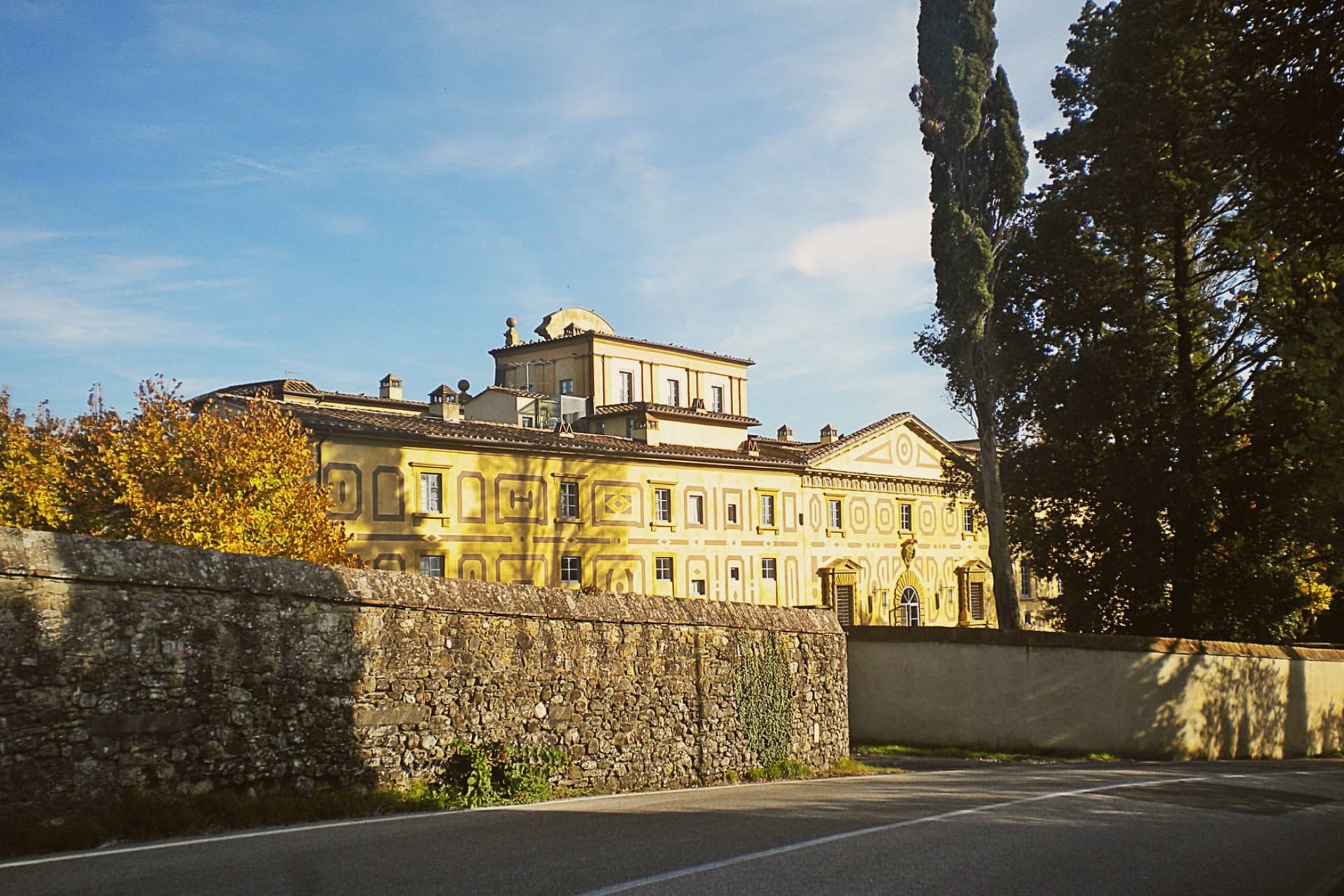
Barberino di Mugello sits at 272 meters in the upper Sieve valley, twenty-five kilometers north of Florence, the road and rail gateway from the city to the Mugello and onward to Bologna across the Apennines. The Medici family had its roots in this territory: Cosimo the Elder commissioned Michelozzo around 1451 to transform the medieval castle at Cafaggiolo into a country villa, the first in the Medici building campaign that would later run through Poggio a Caiano and Cerreto Guidi.
In 2013 Villa di Cafaggiolo and the nearby Villa del Trebbio joined eleven other Medici properties on the UNESCO list. Michelozzo's hand also shows on the fourteenth-century loggia in the main piazza of Barberino.
South of the town lies the Lago di Bilancino, an artificial reservoir completed in 1999, the largest in Tuscany at five square kilometers, built to feed the water supply of Florence, Prato and Pistoia, and now used for sailing, windsurfing and birdwatching.
Da Alberto have been named by a guide.
What to see in Barberino di Mugello
- Villa Medicea di Cafaggiolo. Medieval castle transformed into a country villa by Michelozzo around 1451 for Cosimo the Elder, UNESCO World Heritage since 2013.
- Villa Medicea del Trebbio. Smaller medieval Medici castle on a wooded hilltop near San Piero a Sieve, also inscribed on the UNESCO list of Medici Villas in 2013.
- Lago di Bilancino. Artificial reservoir completed in 1999, five square kilometers, the largest in Tuscany, built to supply Florence, Prato and Pistoia.
How to get to Barberino di Mugello
Prato is roughly 33 minutes away by road.
Our tip
April through June brings the Mugello hills into clear green and the lake of Bilancino into its season for windsurfing and small-boat sailing. September and October are dry and gold, the harvest in the upper Sieve and the chestnut woods on the higher ridges. July and August are hot enough in the valley to drive most weekenders to the lake; the two Medici villas are cool inside year-round.
Castelvetro di Modena
Why visit Castelvetro di Modena
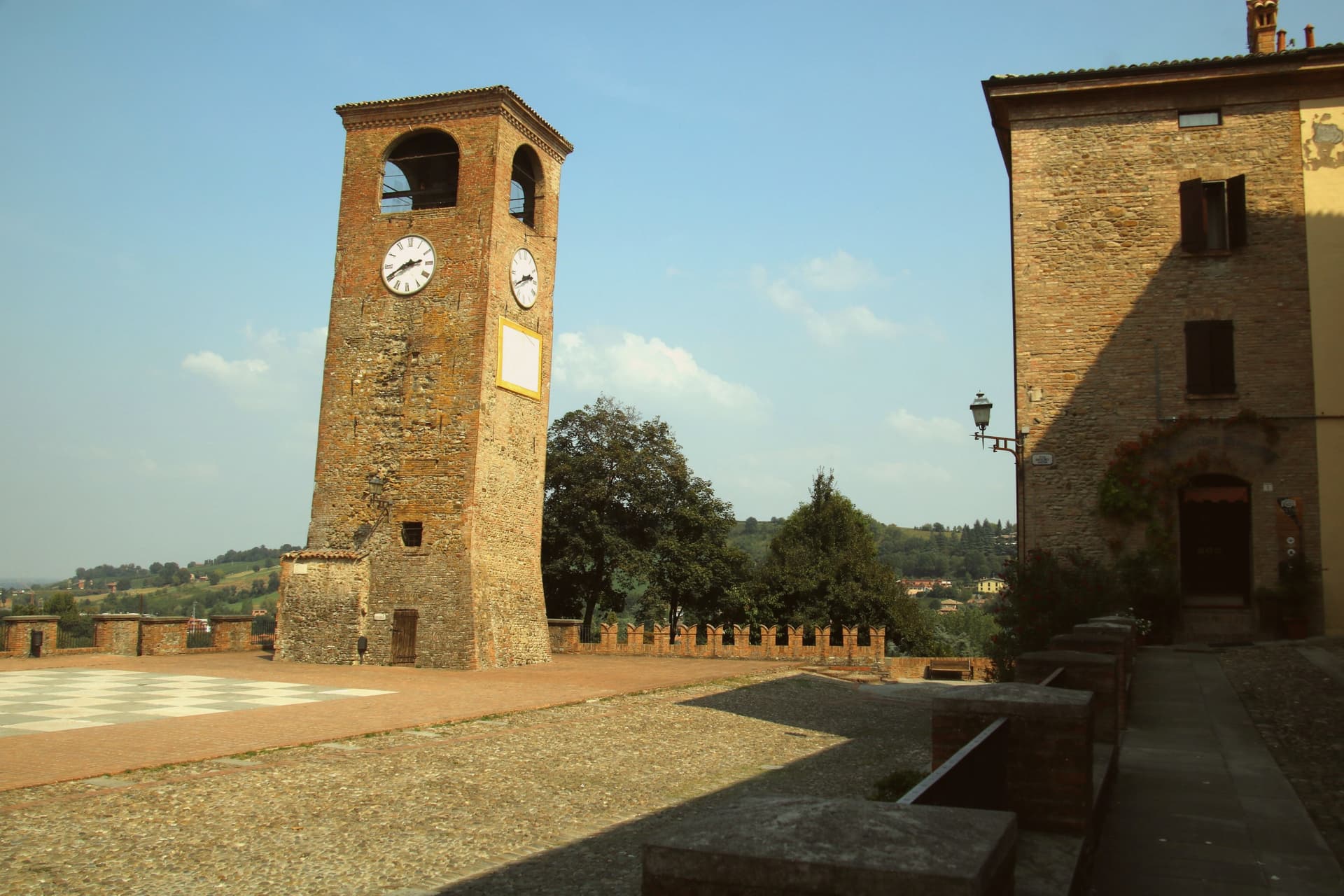
Castelvetro di Modena sits on a hill at 152 meters, eighteen kilometers southeast of Modena and at the northern edge of the Apennine foothills. The medieval centro storico rises around the Piazza Roma, paved in alternating white and black stones that earned it the name Piazza della Dama, the checkerboard piazza, framed by the four surviving towers of the old castle.
The Grasparossa grape grows on the clay slopes around the town, the sandy soil and the south-facing aspect producing the deepest, most tannic of the three main Lambruschi; Lambrusco Grasparossa di Castelvetro received DOC status in 1970. Above the piazza, the Palazzo Rinaldi houses the Museo del Vino and the Museo dell'Aceto Balsamico, the second tracing the same Modenese tradition that nearby Spilamberto codifies.
The municipality holds three institutional signals: Borghi più belli, Bandiera Arancione, Città del Vino. The Sagra dell'Uva e del Lambrusco runs the last weekend of September, when the streets fill with the chess players from the surrounding Lambrusco towns dressed as living pieces on the piazza.
Locanda del Feudo, Opera|02 have been named by a guide.
What to see in Castelvetro di Modena
- Piazza Roma. Checkerboard piazza paved in alternating white and black stones, framed by the four surviving towers of the medieval castle.
- Castello di Levizzano Rangone. Tenth-century fortified frazione four kilometers north, with a tower built in the 990s and a fully preserved medieval village.
- Museo del Vino. Wine museum inside the Palazzo Rinaldi, tracing the Grasparossa production cycle and the DOC zone established in 1970.
How to get to Castelvetro di Modena
There is a railway station in the town, so you can arrive without a car and never need one while you are here. Modena is roughly 28 minutes away by road.
Our tip
April through June and September through October are the Castelvetro months. The hills around the borgo turn green in spring and red in autumn when the Grasparossa vines colour up before the harvest. July and August are hot, thirty-five degrees in the valley, less in the hills above, and the cantine slow down. Sagra dell'Uva e del Lambrusco Grasparossa di Castelvetro falls in September.
Sasso Marconi
Why visit Sasso Marconi
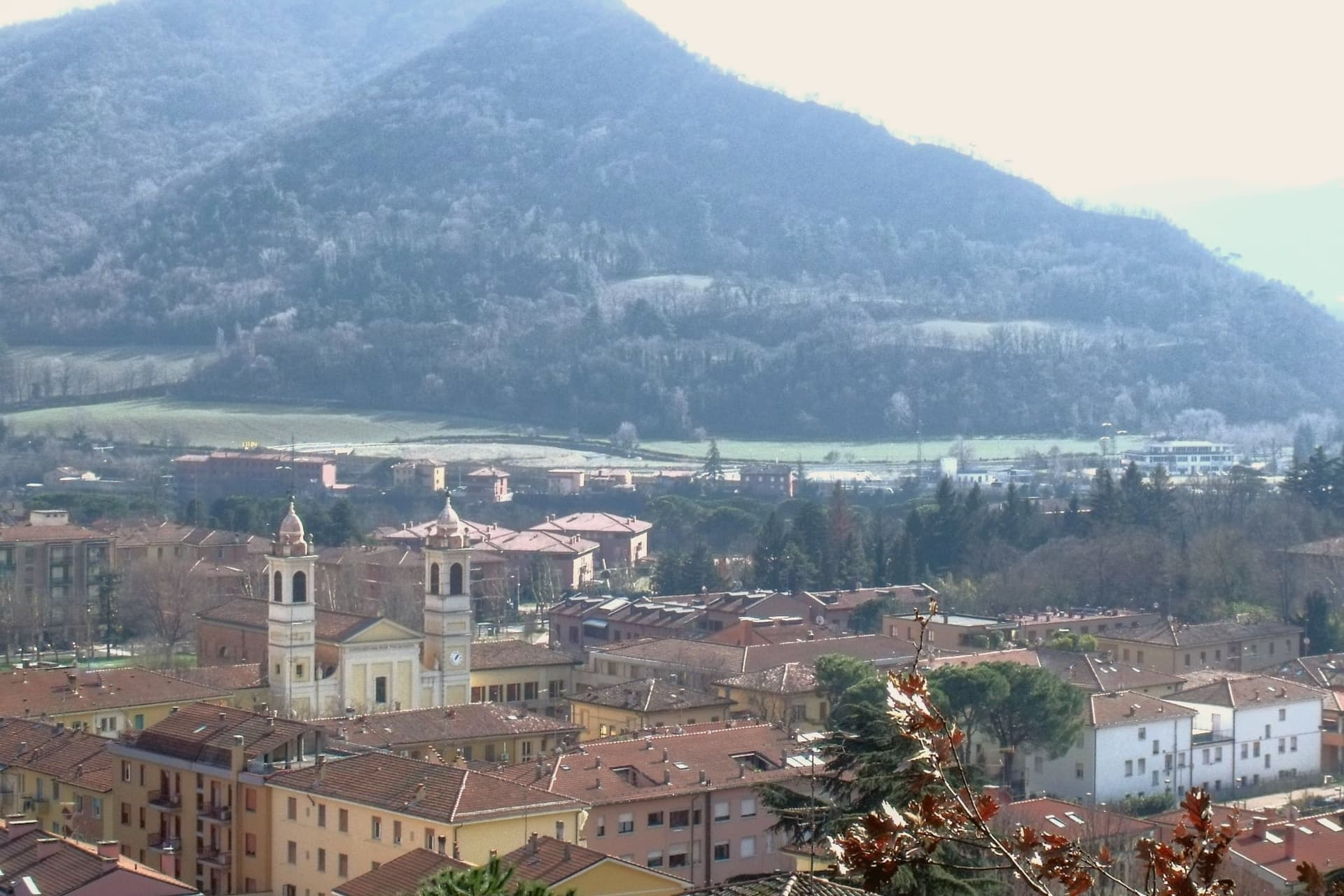
The Setta and Reno rivers meet below the rock that gives the town its name, at the point where the pre-Apennine hills begin their climb south of Bologna. The Sasso della Glosina dominates the bend, a Pliocene formation old enough to have shaped how the crossing below it was used long before the valley took its modern name.
The town itself was called Sasso Bolognese until 1938, when it was renamed for the family whose estate lies in the frazione of Pontecchio, on the valley floor rather than on the rock itself. The territory reaches from that river confluence up into the Apennine slopes, and the change in elevation shows in what the land produces: white truffle from the valley floor near the Reno, and vineyards on the hills around Pieve del Pino and Mongardino, recognition earned on two different registers of the same ground.
The lower town, built around the rivers and the old road to Pistoia, and the upper slopes, given to woods and terraced vines, read as one territory doing two different kinds of work.
Casa Mazzucchelli, Antica Trattoria la Grotta dal 1918 have been named by a guide.
What to see in Sasso Marconi
- Villa Griffone - Museo Marconi. Marconi family villa in the frazione of Pontecchio. The mausoleum sits alongside the attic laboratory, and the museum holds working reproductions of his early apparatus.
- Sasso della Glosina. The rock rises directly over the river bend, its bulk visible from the crossing below and from much of the surrounding valley.
- Confluenza Setta-Reno. Meeting of the two valleys at the foot of the rock, with the historic crossing of the Via Porrettana toward Pistoia.
How to get to Sasso Marconi
There is a railway station in the town, so you can arrive without a car and never need one while you are here. Bologna is roughly 26 minutes away by road.
Our tip
April through October is the working season in Sasso Marconi. Spring and early autumn are best on the Reno valley trails and at Villa Griffone, with mild temperatures and the Apennine foothills green or autumn-coloured. July and August can touch thirty-five degrees in the valley, though the higher frazioni stay cooler; many visitors come up from Bologna for a day on a weekend. Fira di Sdaz di Sasso Marconi falls in September.
Castel San Pietro Terme
Why visit Castel San Pietro Terme
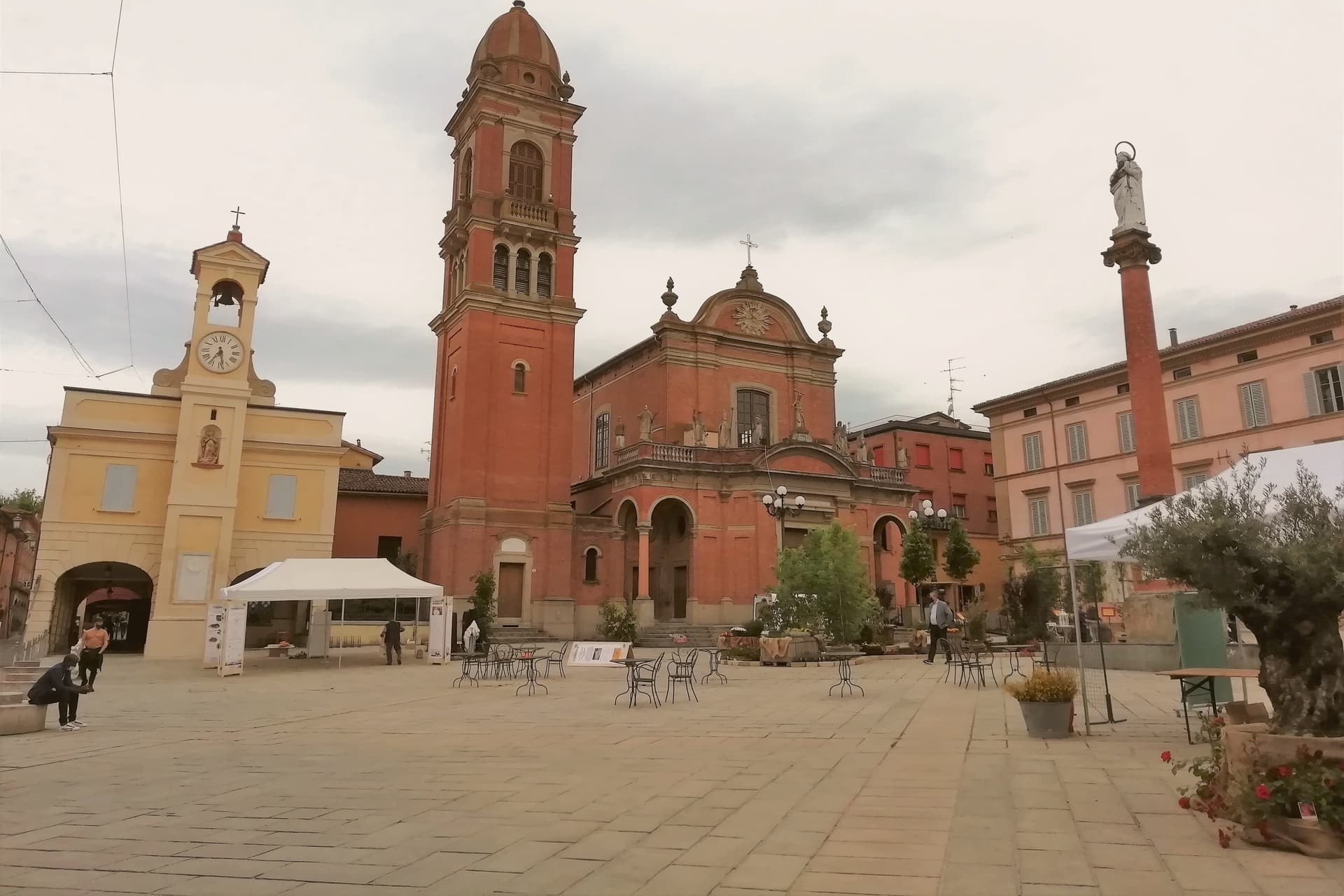
The town sits on the Sillaro river, which marks the historic border between Emilia and Romagna, twenty kilometers east of Bologna on the Via Emilia. It was founded as a Bolognese castrum in 1200, and the walled core still follows that original plan, with the river bridge on one edge and the road toward Imola leading out past the walls to the pilgrimage shrine beyond.
Castel San Pietro also joined the Città dell'Olio network for its hillside olive cultivation, a rural counterpart to the spa and civic life inside the walls. The Conservatorio Santa Caterina, founded in 1741, is one of the older female educational institutions still active in the region, sitting inside the same historic core as the gateway and the town hall.
The town reads as two things held together: a walled medieval seat on a border river, and a spa destination whose waters predate the walls by decades. Both draw on what was already there long before either was built up for visitors.
Il Grifone, Osteria La Civichella, Gastarea have been named by a guide.
What to see in Castel San Pietro Terme
- Cassero. The gateway stands at the southern edge of the old walls, its stone face marking what was once the main entry into the castrum. Inside, the civic theater now occupies the space, so the structure that once controlled access to the town now hosts its audiences.
- Terme di Castel San Pietro. The complex draws on sulphurous, ferruginous and salt-bromine-iodide springs, with the first establishment opened in 1870. The waters run year-round from the same sources used centuries before the modern building existed.
- Santuario del Crocifisso del Piratello. Pilgrimage shrine on the Via Emilia toward Imola, built around a fifteenth-century crucifix and decorated by Innocenzo da Imola. It drew pilgrim traffic from across northern Emilia, standing apart from the walled town on the road out toward Romagna.
How to get to Castel San Pietro Terme
There is a railway station in the town, so you can arrive without a car and never need one while you are here. Bologna is roughly 39 minutes away by road.
Our tip
Castel San Pietro Terme runs all twelve months because the thermal water does. Spring and autumn are the easier months for walking the centro storico and the Sillaro valley, with mild light and the olive groves on the hill above town green or harvest-coloured. June through August touches the low thirties and humid, but the spa runs longer hours in summer and the riverside frazione of Osteria Grande stays cool.
Faenza
Why visit Faenza
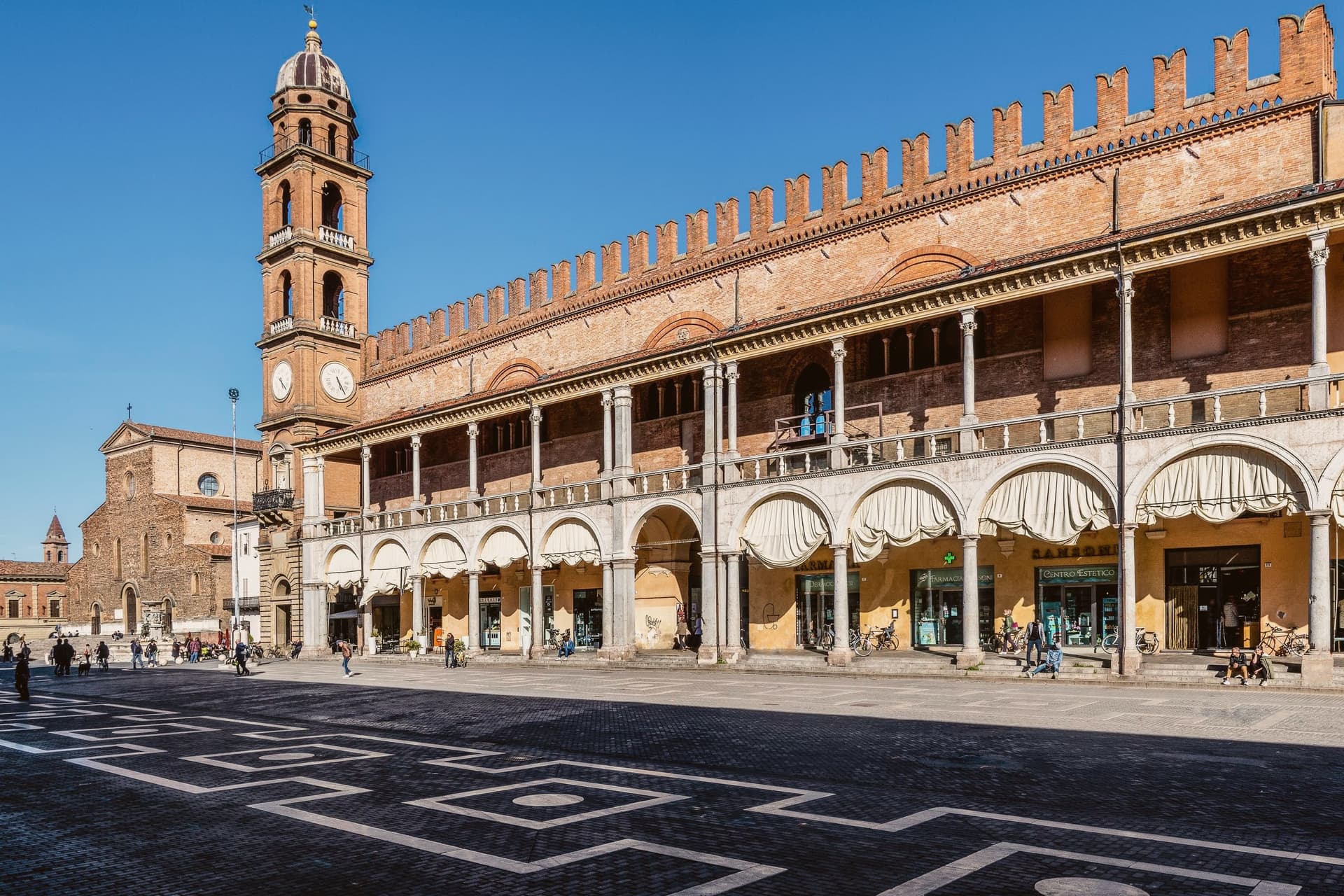
Faenza sits at 34 meters on the Via Emilia between Bologna and Rimini, on the Lamone river fifty kilometers southeast of Bologna. The city gave its name to faïence: tin-glazed earthenware that emerged here in the late fourteenth century and reached its peak in the early sixteenth, when the bianchi di Faenza, white-on-white ceramics exported across Europe, set the standard for Renaissance maiolica.
The Museo Internazionale delle Ceramiche, founded in 1908 by Gaetano Ballardini, holds 15,000 square meters of collections from 4000 BC to the present, with rooms dedicated to Picasso, Matisse, Chagall, Léger, Dalí, Burri, and Fontana. UNESCO named it a Monument Witness to a Culture of Peace in 2000.
The Cattedrale di San Pietro Apostolo, begun by Giuliano da Maiano in 1474, dominates Piazza della Libertà; Piazza del Popolo next door holds the medieval Palazzo del Podestà and the municipal palace. The Palio del Niballo, an equestrian competition between the five city rioni, runs every June.
La Baita, Manueli have been named by a guide.
What to see in Faenza
- Museo Internazionale delle Ceramiche. Founded in 1908 by Gaetano Ballardini, 15,000 square meters spanning 4000 BC to contemporary work by Picasso, Matisse, Chagall, and Fontana.
- Cattedrale di San Pietro Apostolo. Renaissance cathedral begun by Giuliano da Maiano in 1474, completed by 1515, with sculptures by Benedetto da Maiano in the nave.
- Piazza del Popolo. Twin medieval square to Piazza della Libertà, framed by the Palazzo del Podestà and the porticos of the municipal palace.
How to get to Faenza
There is a railway station in the town, so you can arrive without a car and never need one while you are here. Forlì is roughly 26 minutes away by road.
Our tip
April through June and September through October are the working months on the Romagna plain. Spring brings the Palio del Niballo at the end of June and clear water in the Lamone; autumn dries the fields gold and brings the ceramics fairs back to the centro. July and August touch thirty-six degrees with high humidity, and Piazza del Popolo empties between two and five.
Imola
Why visit Imola
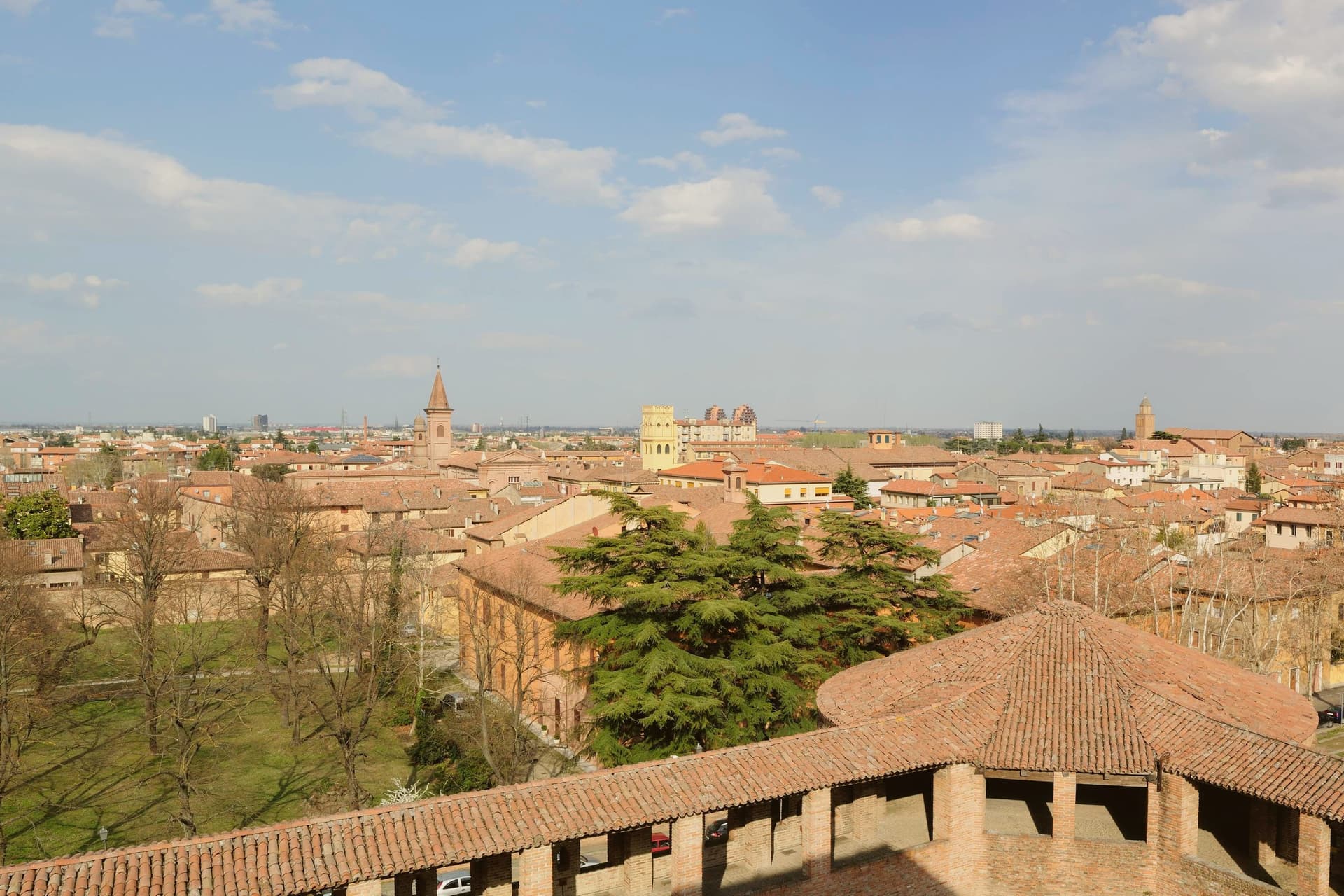
Imola is two cities sharing a name. The medieval one is a quietly handsome Romagna brick town 35 km southeast of Bologna along the Via Emilia, with the Rocca Sforzesca (rebuilt by Caterina Sforza in 1473–1499 — the Tigress of Forlì, who held this fortress through the Borgia siege of 1500) anchoring the centro.
The Palazzo Tozzoni museum, the 11th-century Cattedrale di San Cassiano with its crypt of the city's patron, the Palazzo Sersanti on the central piazza, and the medieval grid of porticoed brick streets all read as a smaller-scale Bologna. The OTHER Imola is the Autodromo Enzo e Dino Ferrari — the 4.9-km F1 circuit on the south bank of the Santerno, built 1953 and named for Enzo Ferrari and his son Dino after Dino's death.
It hosted the San Marino Grand Prix every May from 1981 to 2006 (and again 2020–present), and is the circuit where Ayrton Senna died in 1994 at the Tamburello corner — a memorial still stands there. The Emilia Romagna Grand Prix in April–May is the city's biggest tourist event of the year.
Outside race weekends the circuit is a public park; locals jog the track. The food is Romagna: piadina romagnola (the city is Città dell'Olio, and the local Brisighella Nostrana di Brisighella DOP olive oil is what dresses it), passatelli in brodo, cappelletti, Sangiovese di Romagna from the surrounding hills, and the local nocino walnut liqueur made by every grandmother in the foothills.
San Domenico, Semplice have been named by a guide.
What to see in Imola
- Rocca Sforzesca. Caterina Sforza's 1499 four-towered brick fortress at the centro's edge — the Tigress of Forlì held it against Cesare Borgia in 1500. Museum of arms and ceramics inside.
- Autodromo Enzo e Dino Ferrari. The 4.9-km F1 circuit on the Santerno. Senna memorial at Tamburello. Open as a public park outside race weekends — locals jog the track.
- Cattedrale di San Cassiano + crypt. 11th-c cathedral with the city patron's crypt; the Madonna del Piratello pilgrimage church just outside the walls is a major regional sanctuary.
How to get to Imola
There is a railway station in the town, so you can arrive without a car and never need one while you are here. Forlì is roughly 34 minutes away by road.
Our tip
Imola is best April–June and September–October. The Emilia Romagna Grand Prix (last weekend April / first weekend May) fills every hotel for 80 km — wonderful if you're going, brutal if you're not. Summer is hot and sticky. Baccanale Imola falls in October.
Ferrara
Why visit Ferrara
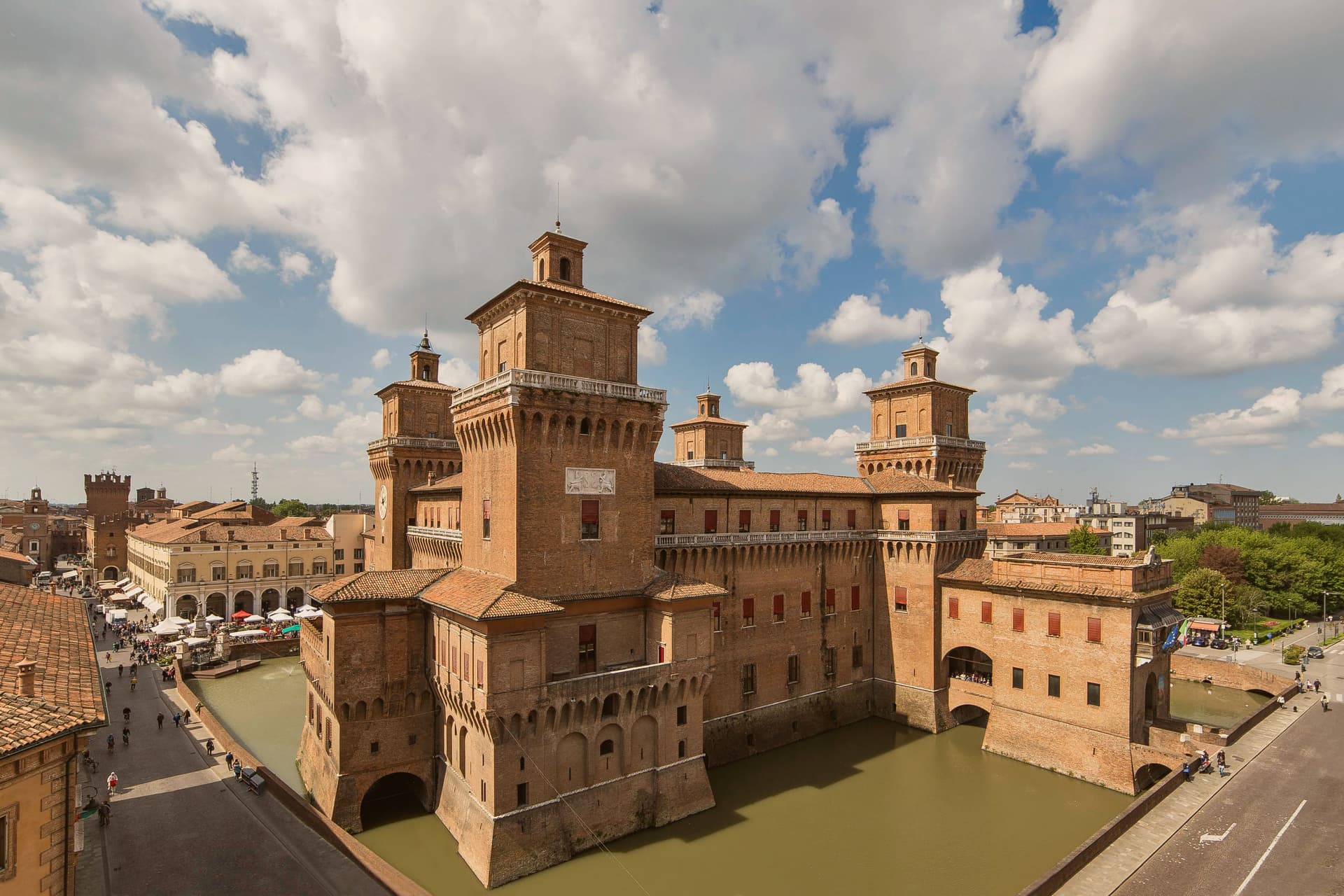
Ferrara is the city the Este family built and that the Po built around. For two centuries, from 1264 to 1598, the Este dukes ran their court from a moated brick fortress at the centre of town: Ariosto wrote the Orlando Furioso here, and the Ferrara school of painting flowered under Cosmè Tura.
In 1492, Duke Ercole I commissioned Biagio Rossetti to lay out a new quarter on a rational grid, with engineered perspectives and zoned districts, grafted onto the older medieval core rather than replacing it. That layering is still legible on the ground.
The old quarter, narrow and irregular, sits against Rossetti's planned extension, wide and gridded, and the two are stitched together inside a single ring of walls nine kilometres around. The scale is small enough that the whole centro can be crossed by bicycle in twenty minutes, and locals do: Ferrara has close to one bike per resident, and the medieval streets are narrow enough to keep cars mostly out.
The food carries its own local character apart from any of this: cappellacci di zucca, salama da sugo, pampepato at Christmas, and a Trebbiano-based wine grown on coastal sand dunes to the east. The Comacchio lagoons and the eel-fishing villages of the Po Delta are an easy half-day from the city, which served as the gateway to that whole territory.
What the plan and the walls add up to is a city that grew twice, once organically and once by design, and kept both versions intact side by side rather than letting one erase the other.
Osteria Enoteca Al Brindisi, Trattoria Lanzagallo, Ca' d'Frara and 8 more have been named by a guide.
What to see in Ferrara
- Castello Estense. 1385 moated brick fortress at the very centre, the Este dukes' palace. The moat is still water-filled and the four corner towers are still walkable.
- Palazzo dei Diamanti. Rossetti's 1493 anchor of the new quarter, faced with 8,500 white-marble pyramid blocks. Now hosts major art exhibitions.
- 9 km of intact brick walls. The Renaissance ramparts ring the entire centro, and the top is a continuous cycling path with views over the moat and the Po valley.
How to get to Ferrara
There is a railway station in the town, so you can arrive without a car and never need one while you are here. Ferrara is roughly 6 minutes away by road.
Our tip
Ferrara is brilliant in April–June and September–October. The Po valley gets hot and sticky July–August and the brick city radiates heat. October has the Buskers Festival (Europe's largest street-musician festival, late August now). Sagra Di San Lorenzo A Baura falls in July.
More from Anywhere Italy
- The best towns you can reach by train within 45 minutes of Bologna
 The best hill towns within 75 minutes of Bologna
 The best towns known for what they grow within 45 minutes of Bologna
 The best towns known for what they grow within two hours of Florence
 The best hill towns that eat well in Emilia-Romagna
 The best towns that eat well within 75 minutes of Parma