
The best towns that eat well within 75 minutes of Parma
This is flat, foggy, extremely serious eating country, and the fog is part of the recipe. Culatello wants the damp air of the Po lowlands to age properly; Parmigiano wants the hay of the hills behind. In autumn the menus turn to pumpkin, to boiled meats with mostarda, to tortelli closed by hand and dressed with nothing but butter and cheese. The building materials tell you where you are, brick and terracotta on the plain, stone and rougher plaster once the road starts to climb towards Bologna.
Most people eat their way through this region from Bologna, or from Modena, where the tasting menu at Osteria Francescana books out months ahead and the porticoes fill with people queueing for tagliatelle. The reputation is deserved and the crowding is the price of it. Prices in the centre have risen accordingly, and the tables that matter are the ones you cannot walk into.
The same larder continues in every direction past the city limits. Salumi cellars, Lambrusco vineyards on the Modenese hills, river towns with a single trattoria that has been cooking eel and pumpkin for generations. The towns below sit within about an hour and a quarter of Parma, and each one holds a table a guide thought worth naming. Fewer people make the drive.
Of the 20 communes we have mapped in a 75-minute drive of Parma, 7 qualify as towns that eat well: each holds a table a guide put its name to. The smallest, Castell'Arquato, has 4,617 residents.
Two more lists worth reading alongside this one: The best towns you can reach by train within 75 minutes of Parma and The best hill towns that eat well in Emilia-Romagna.
Castell'Arquato
Why visit Castell'Arquato
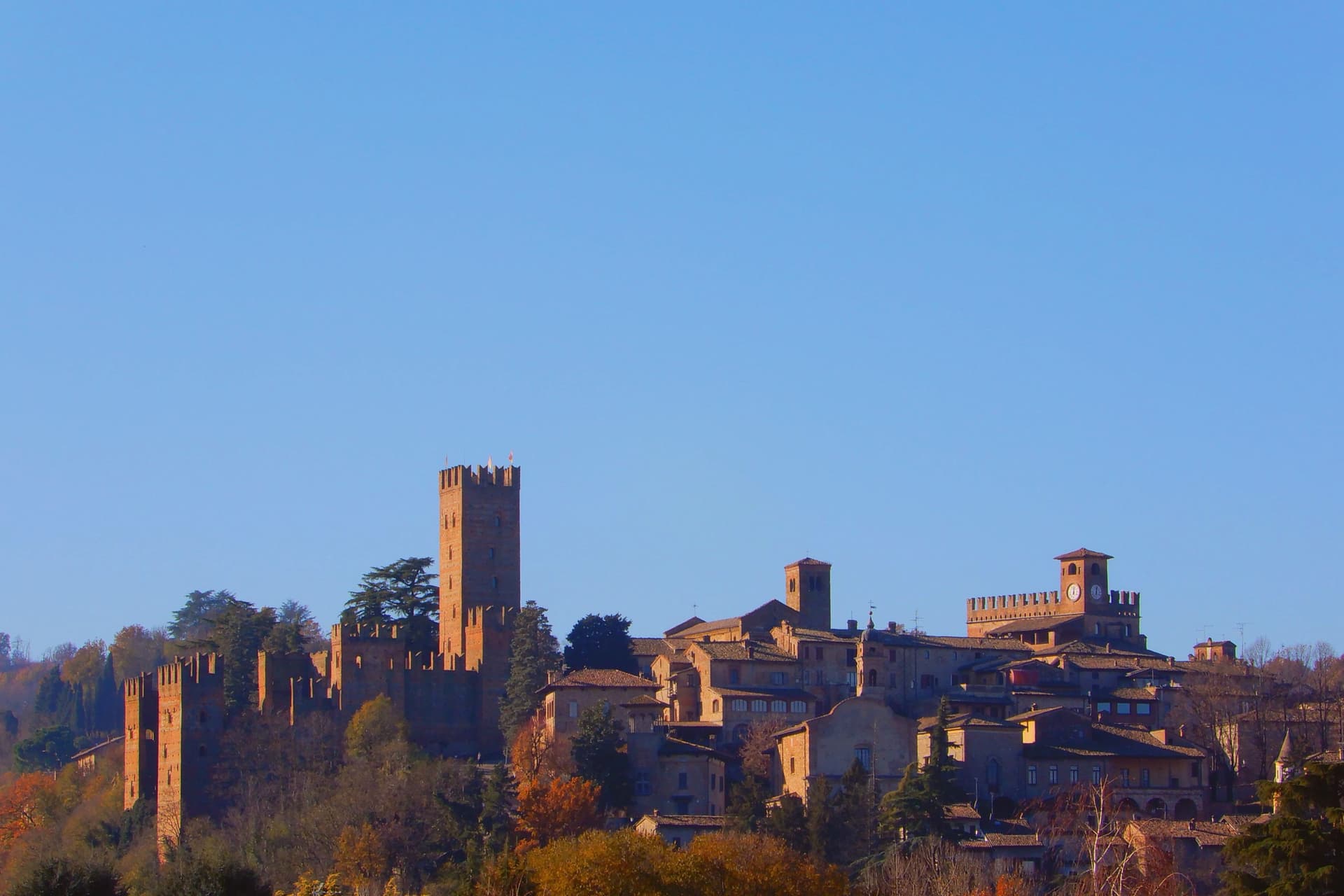
Castell'Arquato sits on the first hills of the Val d'Arda at 224 meters, thirty kilometers from Piacenza, the medieval borgo arranged in tight concentric levels around the old rock. The Collegiata di Santa Maria, founded by the noble Magnus in the eighth century, was rebuilt in 1122 after the 1117 earthquake destroyed the earlier church and is one of the finest Romanesque buildings in the Piacentino.
The Rocca Viscontea, with its thirty-five-meter tower, was begun in 1342 by Luchino Visconti, lord of Milan, to lock down the valley for Piacenza. The Palazzo del Podestà next door dates from 1292 and still anchors the Piazza Monumentale.
Luigi Illica, the librettist of Tosca, Madama Butterfly, La bohème and Andrea Chénier, was born in town in 1857; the museum dedicated to him sits in the house next to his birthplace. The Val d'Arda hills around the town produce the white wines that earned Castell'Arquato Città del Vino status.
Da Faccini have been named by a guide.
What to see in Castell'Arquato
- Rocca Viscontea. Fortress begun in 1342 by Luchino Visconti for the municipality of Piacenza, with a thirty-five-meter tower at the highest point of the borgo.
- Collegiata di Santa Maria Assunta. Romanesque collegiate church, founded in the eighth century and rebuilt in 1122 after the 1117 earthquake destroyed the earlier structure.
- Palazzo del Podestà. Civic palace from 1292 facing the Collegiata, with the original ghibelline merlons and a fourteenth-century loggia along its lower level.
How to get to Castell'Arquato
Piacenza is roughly 38 minutes away by road.
Our tip
April through June is the best season for the Val d'Arda hills: the vineyards on the slopes below the borgo are green and the air clear enough to see across to the Appennino Piacentino. September and October bring the white-wine harvest and the chestnut weeks. July and August touch thirty-three degrees and the unshaded Piazza Monumentale becomes uncomfortable between noon and four.
Pizzighettone
Why visit Pizzighettone
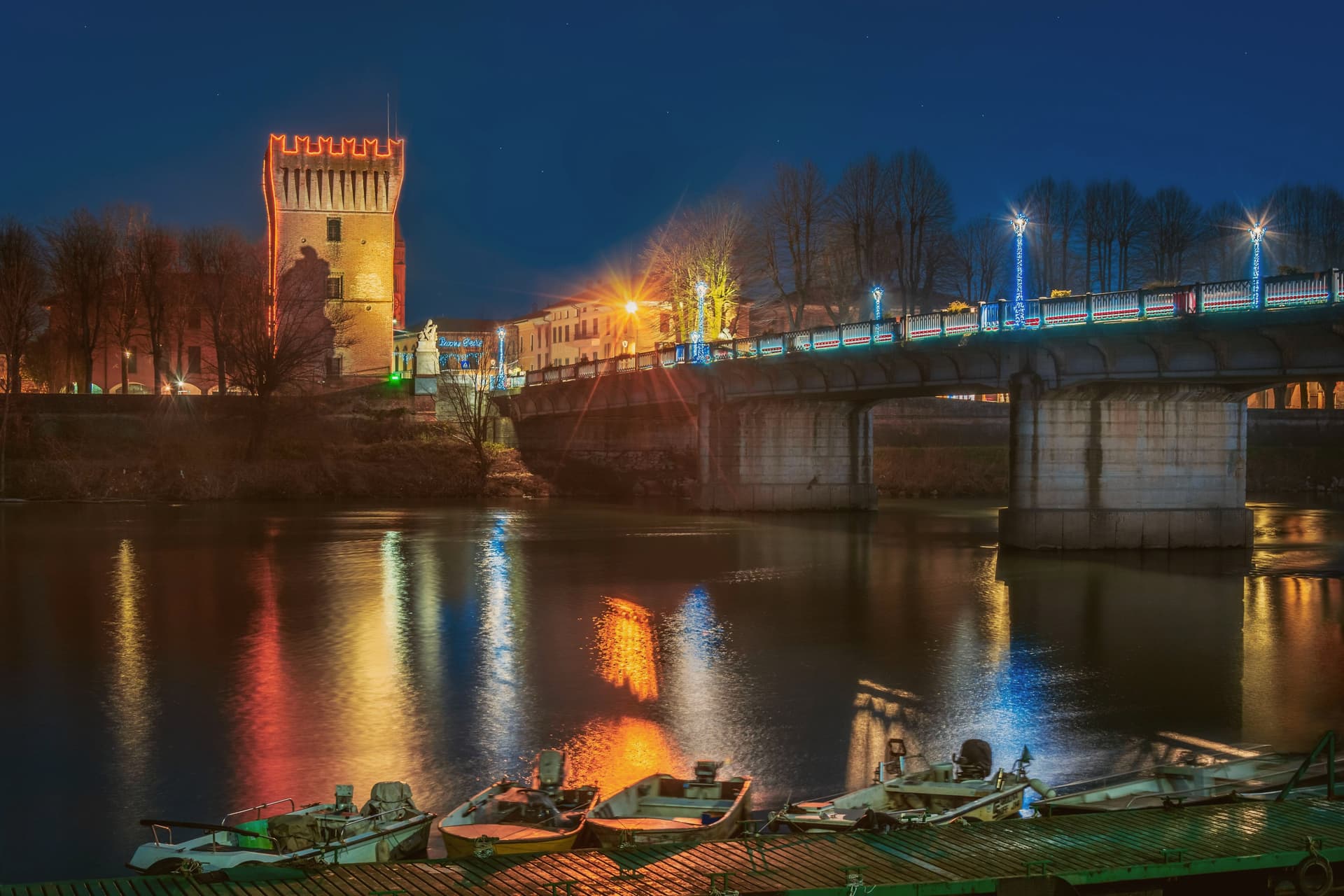
Pizzighettone sits on the river Adda in the Po valley at 46 metres above sea level, half an hour west of Cremona and an hour southeast of Milan. The Adda cuts the town in two: Pizzighettone proper on the east bank, the smaller Gera on the west, joined by a single bridge.
The 16th-century walls run two kilometres around the historic centre, twelve metres tall and three and a half thick, and they hold a network of guardhouses called Casematte that visitors can walk through with a guide. The Torre del Guado, part of the older Rocca fortress, held the captured King Francis I of France for roughly fifty days in 1525 after his defeat at Pavia, before the Spanish transferred him to Madrid.
Most of the medieval Rocca was demolished after Italian unification; the tower is one of two that survived. The Bandiera Arancione recognises the walls and the colourful interior of the Chiesa di San Bassiano in Gera.
Da Giacomo have been named by a guide.
What to see in Pizzighettone
- Mura e Casematte. 16th-century walls, two km long, twelve m tall, with a network of vaulted Casematte guardhouses open to visits.
- Torre del Guado. Surviving tower of the Rocca, where Francis I of France was imprisoned in 1525 after his capture at the Battle of Pavia.
- Chiesa di San Bassiano. Parish church in the Gera quarter, known for its richly painted interior, claimed locally as the most colourful church in Italy.
How to get to Pizzighettone
There is a railway station in the town, so you can arrive without a car and never need one while you are here. Piacenza is roughly 30 minutes away by road.
Our tip
Pizzighettone runs on the Po valley calendar. April through June and again in September and October are the working months, when the walls dry out, the Casematte tours run regularly, and the Adda lowers from its winter levels. July and August are heavy: humidity sits in the valley, the river attracts mosquitoes, and afternoon temperatures push past thirty-five. Fasulìn de l'öc cun le cùdeghe falls in October.
Busseto
Why visit Busseto
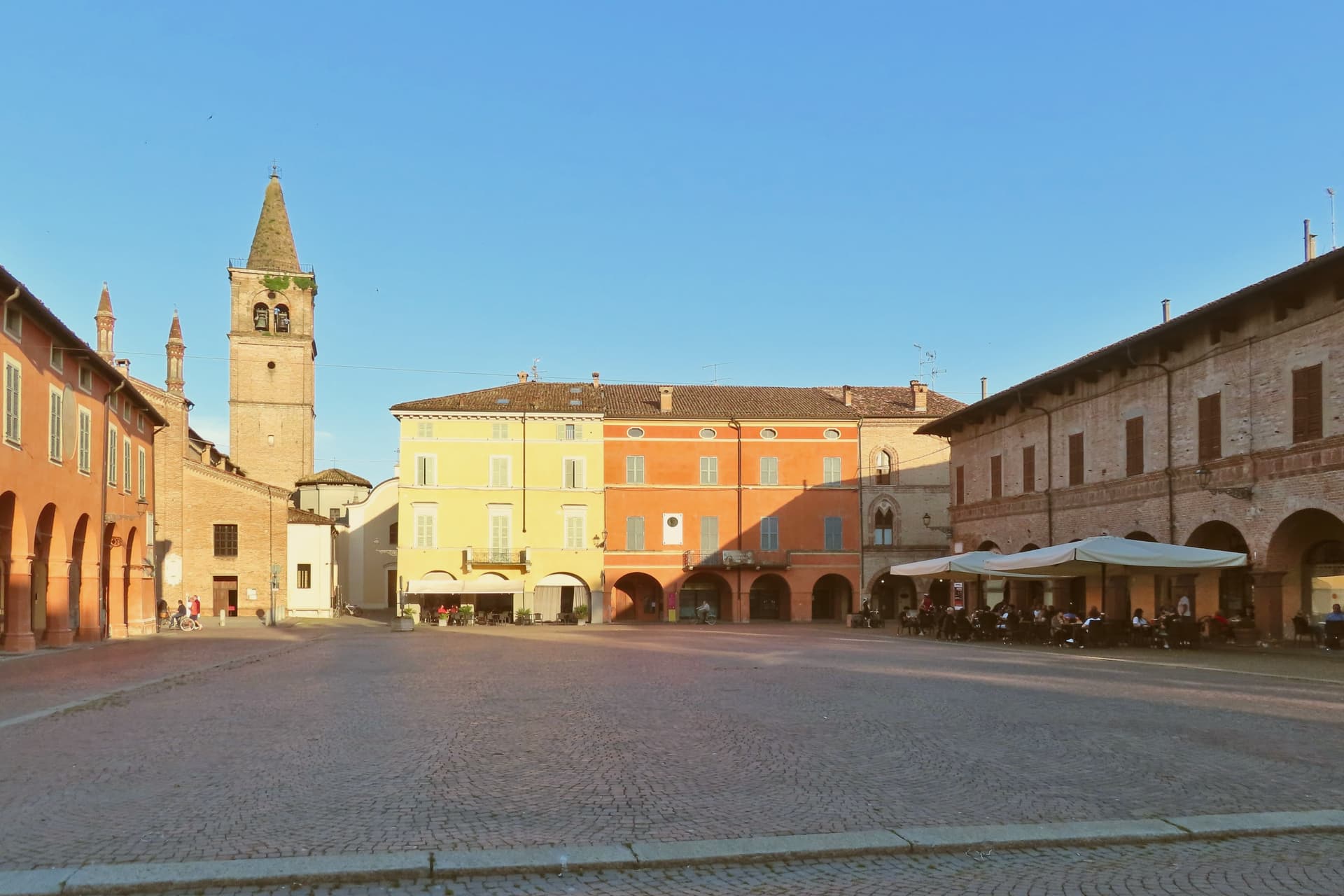
The town sits twenty-five kilometers northwest of Parma, in the flat farming country of the Bassa Parmense between the Po and the Apennine foothills. It was the capital of the Stato Pallavicino for almost five hundred years before the territory was absorbed into the Duchy of Parma, and the fortress built for that state still anchors the main piazza today.
Roncole, the frazione where Verdi was born, lies three kilometers east; he moved into Busseto proper as a boy in 1824, and Villa Sant'Agata, the house he later bought and kept until his death, lies five kilometers north of the center. The three places trace a line outward from the town: birth to the east, boyhood at the center, and the household of his adult life to the north.
The Bassa around the town is also farming country in a more literal sense, producing the Culatello di Zibello and the Parmigiano Reggiano that the local consortium has aged here since the nineteenth century. A small provincial capital, in other words, whose built center was shaped by one family's rule and whose long afterlife has been shaped by one composer's, with the surrounding plain supplying the food economy underneath both.
Campanini have been named by a guide.
What to see in Busseto
- Teatro Giuseppe Verdi. The stage sits inside the fortress walls, reached through the courtyard rather than a freestanding facade. The empty box he kept is still pointed out.
- Rocca dei Pallavicino. Fifteenth-century fortress on the main piazza, seat of the Stato Pallavicino for centuries. It now holds the theatre in one wing and the town hall in another.
- Casa Natale di Verdi. A modest house at Roncole, three kilometers east, kept much as it would have been, with the rooms where a child grew up rather than the trappings of later fame.
How to get to Busseto
There is a railway station in the town, so you can arrive without a car and never need one while you are here. Parma is roughly 38 minutes away by road.
Our tip
April through June and September through October are the working months in the Bassa. The Po Valley sky clears and the cured-meat acetaie reopen their tasting rooms after winter. July and August are heavy.
Castelvetro di Modena
Why visit Castelvetro di Modena
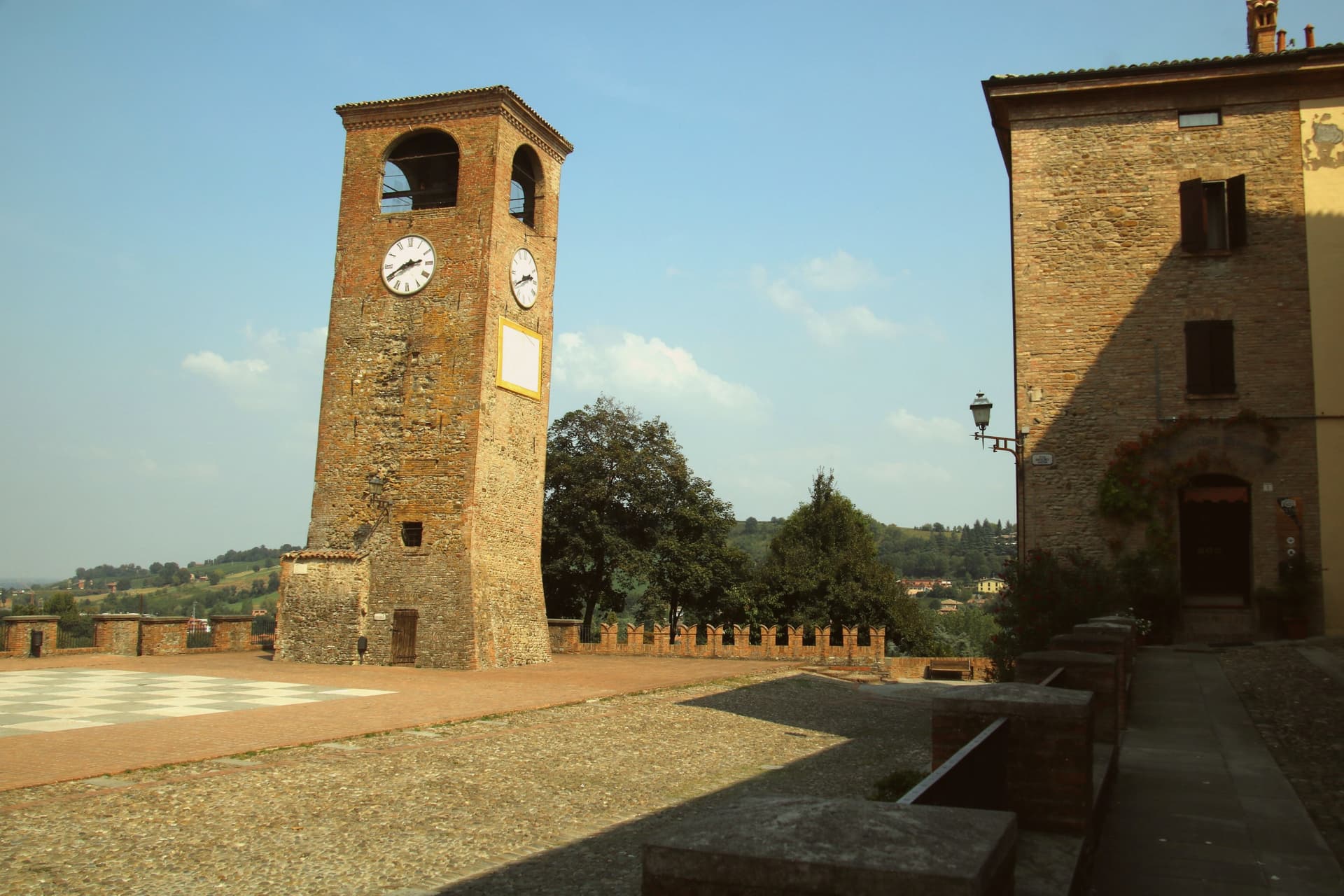
Castelvetro di Modena sits on a hill at 152 meters, eighteen kilometers southeast of Modena and at the northern edge of the Apennine foothills. The medieval centro storico rises around the Piazza Roma, paved in alternating white and black stones that earned it the name Piazza della Dama, the checkerboard piazza, framed by the four surviving towers of the old castle.
The Grasparossa grape grows on the clay slopes around the town, the sandy soil and the south-facing aspect producing the deepest, most tannic of the three main Lambruschi; Lambrusco Grasparossa di Castelvetro received DOC status in 1970. Above the piazza, the Palazzo Rinaldi houses the Museo del Vino and the Museo dell'Aceto Balsamico, the second tracing the same Modenese tradition that nearby Spilamberto codifies.
The municipality holds three institutional signals: Borghi più belli, Bandiera Arancione, Città del Vino. The Sagra dell'Uva e del Lambrusco runs the last weekend of September, when the streets fill with the chess players from the surrounding Lambrusco towns dressed as living pieces on the piazza.
Locanda del Feudo, Opera|02 have been named by a guide.
What to see in Castelvetro di Modena
- Piazza Roma. Checkerboard piazza paved in alternating white and black stones, framed by the four surviving towers of the medieval castle.
- Castello di Levizzano Rangone. Tenth-century fortified frazione four kilometers north, with a tower built in the 990s and a fully preserved medieval village.
- Museo del Vino. Wine museum inside the Palazzo Rinaldi, tracing the Grasparossa production cycle and the DOC zone established in 1970.
How to get to Castelvetro di Modena
There is a railway station in the town, so you can arrive without a car and never need one while you are here. Modena is roughly 28 minutes away by road.
Our tip
April through June and September through October are the Castelvetro months. The hills around the borgo turn green in spring and red in autumn when the Grasparossa vines colour up before the harvest. July and August are hot, thirty-five degrees in the valley, less in the hills above, and the cantine slow down. Sagra dell'Uva e del Lambrusco Grasparossa di Castelvetro falls in September.
Curtatone
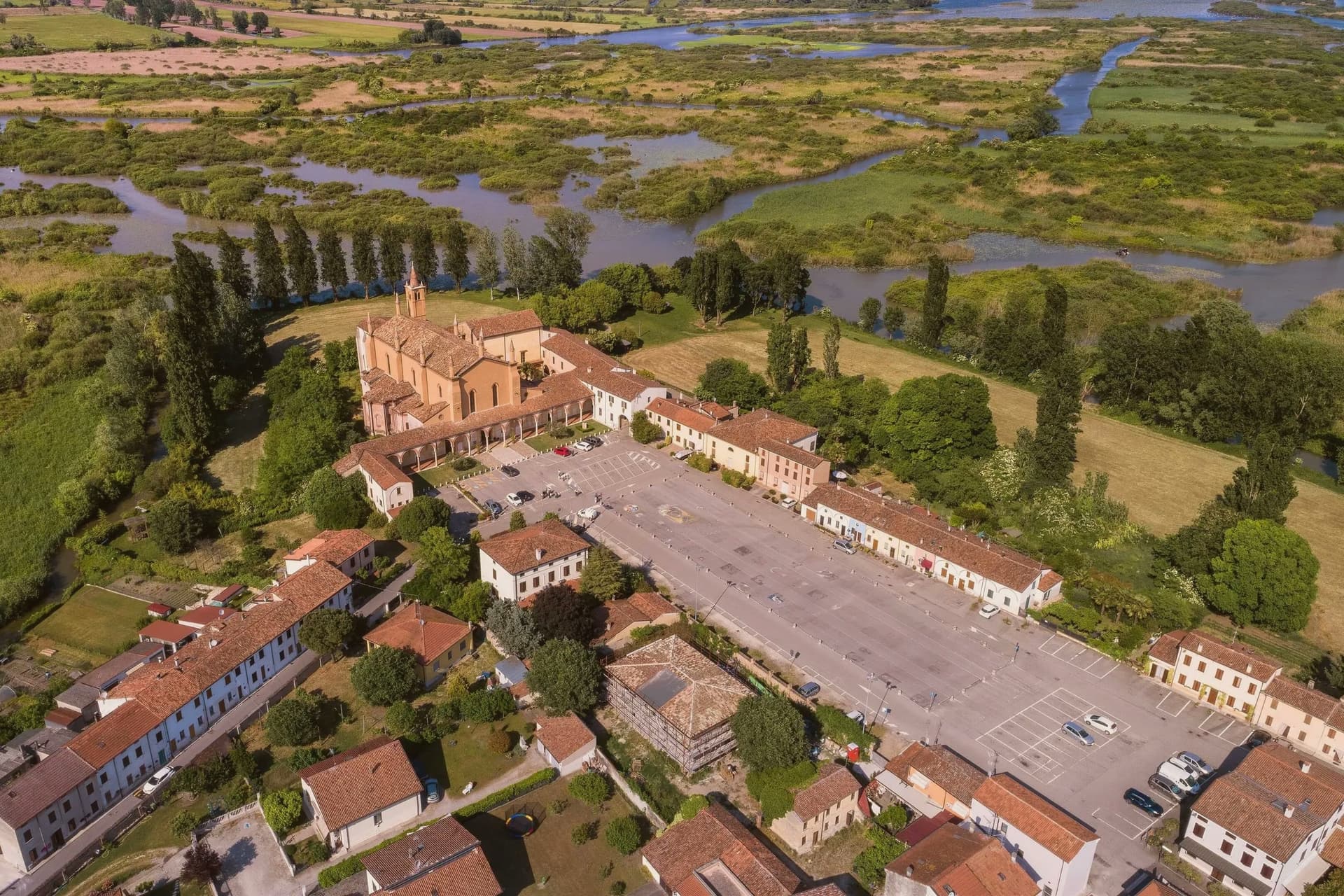
Why visit Curtatone
Curtatone is a Mantova commune of eight frazioni in the Parco del Mincio, with its seat at Montanara and its most visited fraction at Grazie. The Santuario della Beata Vergine delle Grazie was commissioned in 1406 by Francesco I Gonzaga and stands on the edge of the Mincio's lower bend, surrounded by lotus flowers that bloom across the river in July and August.
On 29 May 1848, Tuscan and Neapolitan volunteers held this stretch of ground against Austrian forces under Radetzky long enough for the Piedmontese army to reorganize at Goito the following day. The battle is remembered nationally as Curtatone e Montanara.
Every year around Ferragosto the Antichissima Fiera delle Grazie fills the square in front of the sanctuary; since 1973 the fair has hosted the Incontro Nazionale dei Madonnari, with over a hundred chalk artists working through the night on the pavement around the church.
Locanda delle Grazie, La Locanda delle Grazie have been named by a guide.
What to see in Curtatone
- Santuario della Beata Vergine delle Grazie. 1406 Gonzaga sanctuary on the Mincio bend, with a unique wooden ex-voto wall lining the nave, and the burial of Baldassarre Castiglione.
- Parco del Mincio. Riverine nature reserve around Grazie, with lotus flower expanses that bloom mid-July through August on the lower Mincio.
- Monument to the Battle of Curtatone and Montanara. Memorial to the 1848 stand by Tuscan and Neapolitan volunteers against Austrian forces under Radetzky on 29 May.
How to get to Curtatone
Verona is roughly 48 minutes away by road.
Our tip
April through June and September into October are the months Po-valley humidity stays bearable. April brings the Mincio in full water and the wetland birds along the parco. The lotus flowers around Grazie bloom from mid-July into August, a brief overlap with the heaviest summer heat, when temperatures climb past thirty-three degrees and the air thickens.
Sasso Marconi
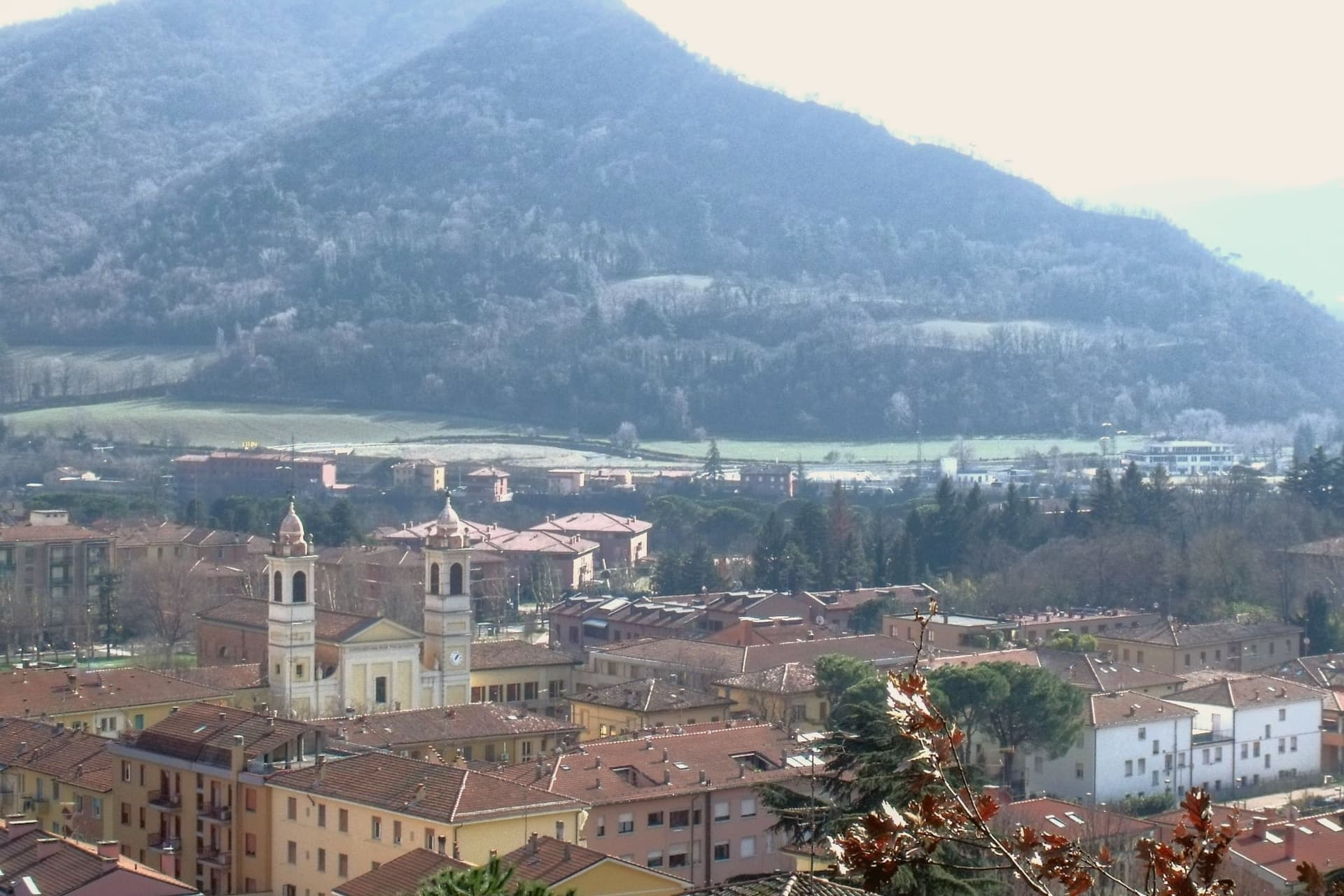
Why visit Sasso Marconi
The Setta and Reno rivers meet below the rock that gives the town its name, at the point where the pre-Apennine hills begin their climb south of Bologna. The Sasso della Glosina dominates the bend, a Pliocene formation old enough to have shaped how the crossing below it was used long before the valley took its modern name.
The town itself was called Sasso Bolognese until 1938, when it was renamed for the family whose estate lies in the frazione of Pontecchio, on the valley floor rather than on the rock itself. The territory reaches from that river confluence up into the Apennine slopes, and the change in elevation shows in what the land produces: white truffle from the valley floor near the Reno, and vineyards on the hills around Pieve del Pino and Mongardino, recognition earned on two different registers of the same ground.
The lower town, built around the rivers and the old road to Pistoia, and the upper slopes, given to woods and terraced vines, read as one territory doing two different kinds of work.
Casa Mazzucchelli, Antica Trattoria la Grotta dal 1918 have been named by a guide.
What to see in Sasso Marconi
- Villa Griffone - Museo Marconi. Marconi family villa in the frazione of Pontecchio. The mausoleum sits alongside the attic laboratory, and the museum holds working reproductions of his early apparatus.
- Sasso della Glosina. The rock rises directly over the river bend, its bulk visible from the crossing below and from much of the surrounding valley.
- Confluenza Setta-Reno. Meeting of the two valleys at the foot of the rock, with the historic crossing of the Via Porrettana toward Pistoia.
How to get to Sasso Marconi
There is a railway station in the town, so you can arrive without a car and never need one while you are here. Bologna is roughly 26 minutes away by road.
Our tip
April through October is the working season in Sasso Marconi. Spring and early autumn are best on the Reno valley trails and at Villa Griffone, with mild temperatures and the Apennine foothills green or autumn-coloured. July and August can touch thirty-five degrees in the valley, though the higher frazioni stay cooler; many visitors come up from Bologna for a day on a weekend. Fira di Sdaz di Sasso Marconi falls in September.
Parma
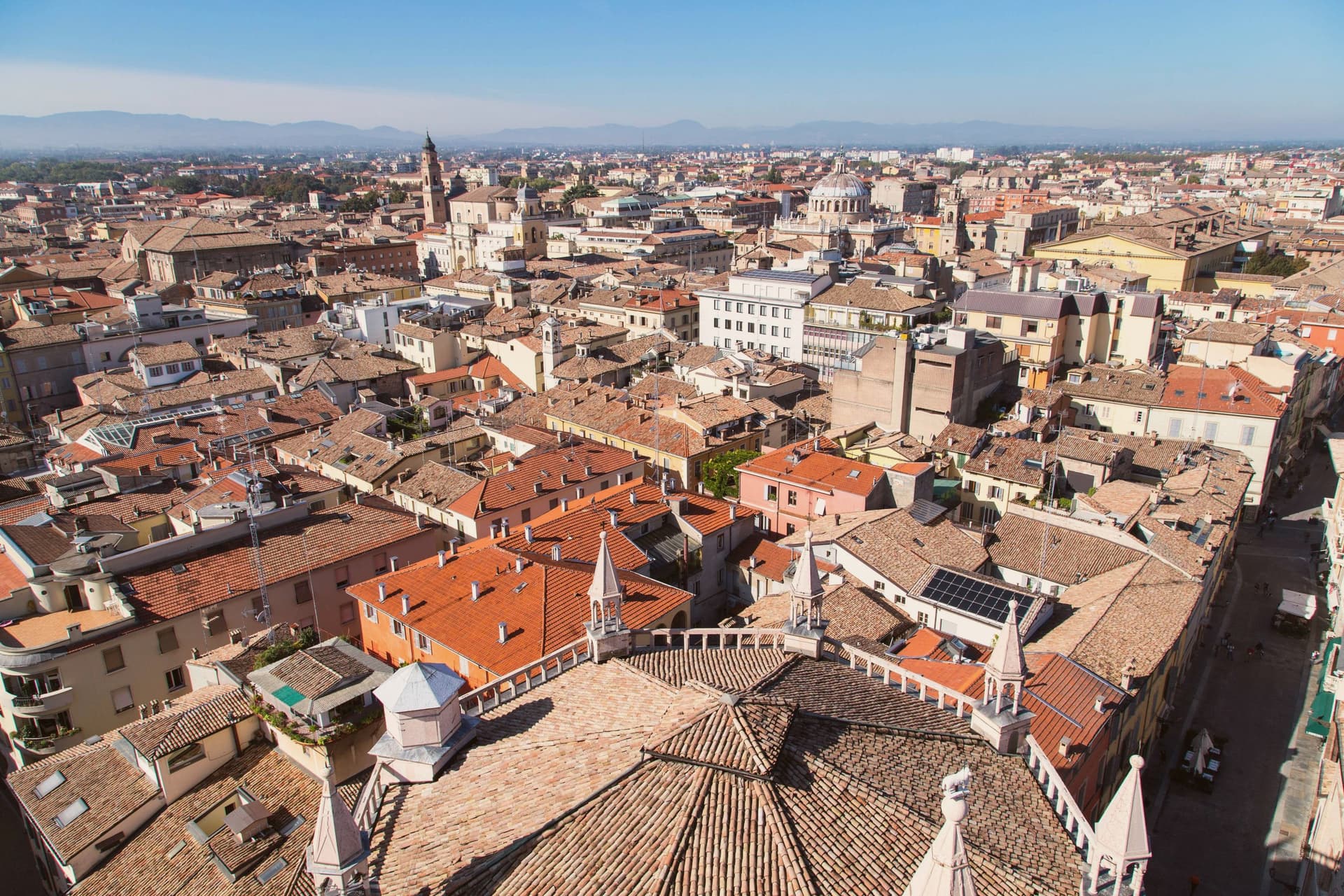
Why visit Parma
Parma sits on the Via Emilia at 57 meters, halfway between Bologna and Piacenza, the Po Valley reaching north and the Apennine foothills closing in fifteen kilometers south. Under the Farnese in the sixteenth century and Marie Louise of Habsburg in the nineteenth, the city ran its own duchy and built the institutions that still define it: the Palazzo della Pilotta, the Teatro Farnese, the Teatro Regio of 1829.
The Cathedral of Santa Maria Assunta, consecrated in 1106, holds Correggio's Assumption fresco in the dome, painted between 1526 and 1530 with a vortex of figures that read as a single rotating body. The Battistero, octagonal in pink Veronese marble, was designed and carved by Benedetto Antelami from 1196.
Arturo Toscanini was born here in 1867; the Teatro Regio still treats his recordings as house standard. The city's two food appellations, Parmigiano Reggiano and Prosciutto di Parma, carry European protected status; UNESCO named the city a Creative City of Gastronomy in 2015.
The population is 196,764.
Inkiostro, Trattoria Antichi Sapori, I Tri Siochètt and 15 more have been named by a guide.
What to see in Parma
- Duomo di Parma. Cathedral consecrated 1106, holding Correggio's Assumption fresco in the dome, painted 1526 to 1530 as a single rotating vortex of figures.
- Battistero. Octagonal baptistery in pink Veronese marble, 35 meters tall, designed and sculpted by Benedetto Antelami from 1196, completed in 1270.
- Palazzo della Pilotta. Sixteenth-century Farnese palace housing the National Gallery, the Archaeological Museum and the wooden Teatro Farnese of 1618.
How to get to Parma
There is a railway station in the town, so you can arrive without a car and never need one while you are here. Parma is roughly 4 minutes away by road.
Our tip
April through June and September through October are the working months in Parma. The Po Valley clears, the colonnaded streets behind the Pilotta hold their light, and the food calendar lines up: asparagus in May, prosciutto festivals in June, Parmigiano openings into the autumn. July and August bring thirty-five degrees and the humidity that comes with the plain; the city empties in the second half of August. Palio di Parma falls in September.
More from Anywhere Italy
 The best towns you can reach by train within 75 minutes of Parma
 The best hill towns that eat well in Emilia-Romagna
 The best towns inside a nature park that eat well in Emilia-Romagna
 The best hill towns within 75 minutes of Parma
 The prettiest villages that eat well in Emilia-Romagna
 The best towns that eat well within an hour of Bologna