
The best towns with a World Heritage site within 90 minutes of Bologna
The Emilian plain flattens out north of Bologna into a country of poplars, embankments and long red-brick facades, and it holds an unusual density of listed heritage: gold-ground mosaics, frescoed chapels, Renaissance street plans drawn with a ruler, Medici villas on the Tuscan side of the Apennines. Trains run out of Bologna Centrale in every direction, so a morning in an archive city and an afternoon back under the porticoes is ordinary rather than ambitious. Food shifts with the ground. Eel and pumpkin tortelli towards the Po, chestnut flour and pecorino in the mountain communes, Sangiovese and Trebbiano on the hills where the vines start. Autumn is the season for it, when the mist comes off the river and the piazzas empty out.
Most visitors treat this stretch of Italy as the corridor between Florence and Venice, and both take the strain. Florence in particular absorbs the great majority of anyone travelling with a heritage list in hand, which means queues at the Uffizi, timed entry at the Accademia and a centre that has priced out most of the people who used to live in it. It is worth going. It is not worth going twice in the same week, and it is certainly not the only listed thing within a short ride of Bologna.
The same alluvial plain, the same Apennine crossings and the same brick keep going past the famous stops. There are towns here where the listed site is a working part of the town rather than a ticketed enclosure: a cathedral still used for mass, a hill of vineyards, a chapel whose frescoes changed European painting, a reservoir in the Mugello with a Medici estate above it. Fewer people go, and the ones who do tend to eat better and pay less. These are the places on that list.
Of the 36 communes we have mapped in a 90-minute drive of Bologna, 6 qualify as towns with a World Heritage site: each holds a site UNESCO has listed. The smallest, Barberino di Mugello, has 10,920 residents.
If you are still choosing, we have also written The best towns with a World Heritage site within two hours of Parma and The best towns with a World Heritage site within 75 minutes of Padua.
Barberino di Mugello
Why visit Barberino di Mugello
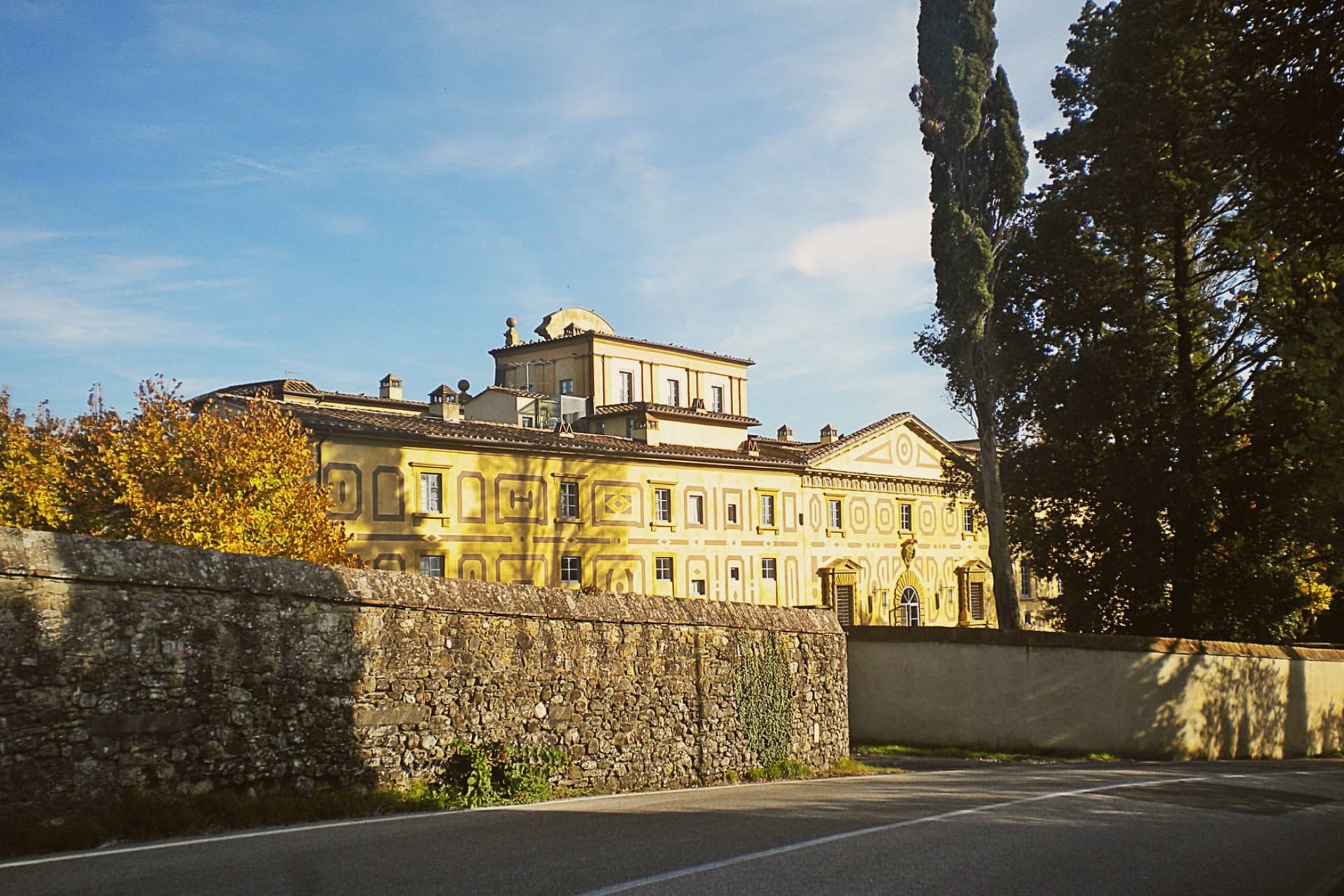
Barberino di Mugello sits at 272 meters in the upper Sieve valley, twenty-five kilometers north of Florence, the road and rail gateway from the city to the Mugello and onward to Bologna across the Apennines. The Medici family had its roots in this territory: Cosimo the Elder commissioned Michelozzo around 1451 to transform the medieval castle at Cafaggiolo into a country villa, the first in the Medici building campaign that would later run through Poggio a Caiano and Cerreto Guidi.
In 2013 Villa di Cafaggiolo and the nearby Villa del Trebbio joined eleven other Medici properties on the UNESCO list. Michelozzo's hand also shows on the fourteenth-century loggia in the main piazza of Barberino.
South of the town lies the Lago di Bilancino, an artificial reservoir completed in 1999, the largest in Tuscany at five square kilometers, built to feed the water supply of Florence, Prato and Pistoia, and now used for sailing, windsurfing and birdwatching.
What to see in Barberino di Mugello
- Villa Medicea di Cafaggiolo. Medieval castle transformed into a country villa by Michelozzo around 1451 for Cosimo the Elder, UNESCO World Heritage since 2013.
- Villa Medicea del Trebbio. Smaller medieval Medici castle on a wooded hilltop near San Piero a Sieve, also inscribed on the UNESCO list of Medici Villas in 2013.
- Lago di Bilancino. Artificial reservoir completed in 1999, five square kilometers, the largest in Tuscany, built to supply Florence, Prato and Pistoia.
How to get to Barberino di Mugello
Prato is roughly 33 minutes away by road.
Our tip
April through June brings the Mugello hills into clear green and the lake of Bilancino into its season for windsurfing and small-boat sailing. September and October are dry and gold, the harvest in the upper Sieve and the chestnut woods on the higher ridges. July and August are hot enough in the valley to drive most weekenders to the lake; the two Medici villas are cool inside year-round.
Carmignano
Why visit Carmignano
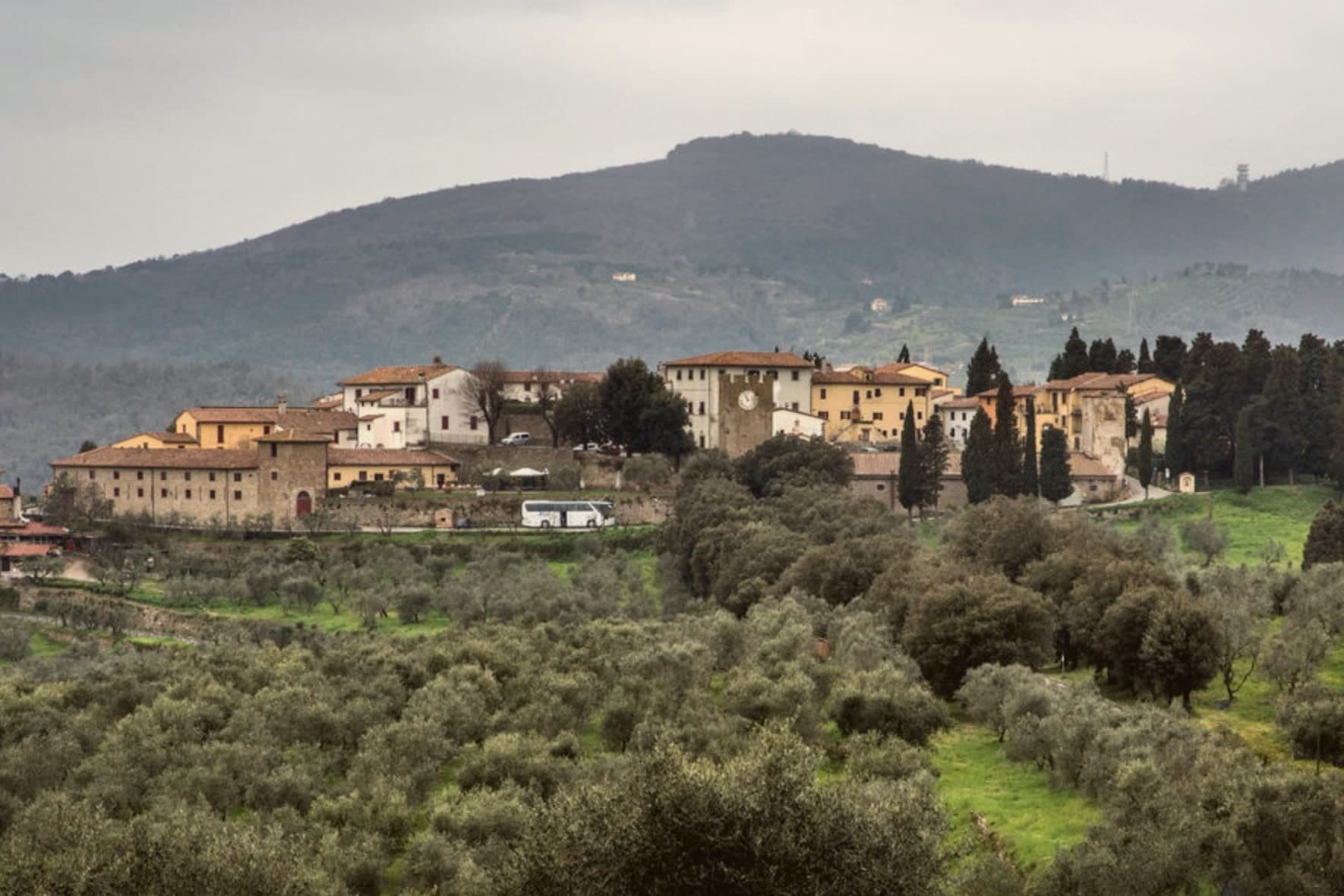
Carmignano sits at 189 meters on the Montalbano hills, twenty kilometers west of Florence and ten southwest of Prato. The commune is built from separate frazioni rather than a single center: Artimino occupies the ridge above, Comeana lies apart with its own tombs, and the town itself holds the parish church at the lower elevation.
This layout puts a Renaissance villa, a pair of seventh-century BC tombs and a working wine appellation within the same small commune without any of them sitting next to each other. The vines of the Carmignano DOCG cover the same Montalbano slopes that were occupied first by the people who built the tombs at Comeana and later by the Medici, so the landscape reads as continuous use of one hillside across the centuries rather than as separate attractions laid on top of it.
Few communes this size hold a Medici villa, a seventh-century BC necropolis and a wine appellation across three distinct frazioni, each still doing what it was built or planted for.
What to see in Carmignano
- Visitazione di Pontormo. Painted for the Pinadori family and still in place in the parish church of San Michele e San Francesco, the panel hangs where it was installed, a late Mannerist work seen in the setting it was made for rather than in a museum.
- Villa Medicea La Ferdinanda. The villa sits on the ridge above Artimino, its roofline broken by the chimneys that give it its nickname, looking out over the same slopes planted with vines below.
- Tumulo di Montefortini. Monumental Etruscan tomb at Comeana from the seventh century BC, 11 meters high and 60 in diameter, with two intact chambers visited through a corridor.
How to get to Carmignano
Prato is roughly 25 minutes away by road.
Our tip
April through June and September into October are the working months on the Montalbano: vine work in the surrounding hills, mild days, evening light over the Arno plain. Harvest runs from mid-September through October. July and August push into the low thirties and Florence twenty kilometers east bakes harder than the ridges here. Festa di San Michele a Carmignano falls in September.
Mantova
Why visit Mantova
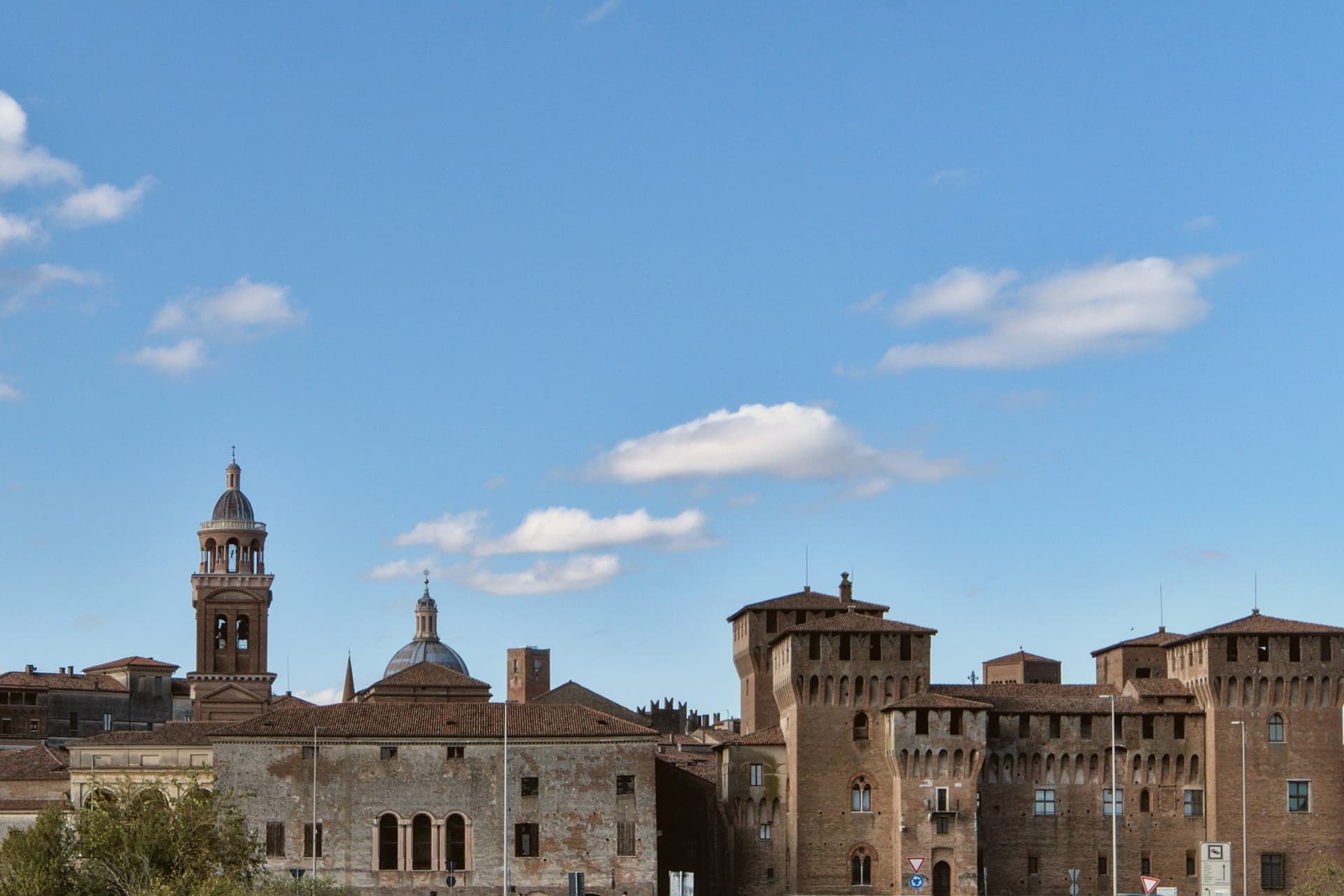
Mantova sits at 19 meters on a peninsula in the Mincio, halfway between Milan and Venice. In the twelfth century the river was dammed into three artificial lakes, Superiore, di Mezzo and Inferiore, which still ring the city on three sides and worked as its defence for six centuries.
From 1328 to 1707 it was the seat of the Gonzaga. The Palazzo Ducale they assembled across that span covers 34,000 square meters between Piazza Sordello and Lago di Mezzo, with over a thousand rooms; the Camera degli Sposi, frescoed by Andrea Mantegna between 1465 and 1474, is the heart of that complex.
Outside the walls, Federico II Gonzaga commissioned Giulio Romano to build Palazzo Te between 1525 and 1535: a pleasure villa with the Sala dei Giganti, whose painted Olympus collapses on the viewer from every wall. Mantua and Sabbioneta were jointly inscribed by UNESCO in 2008.
The city was Italian Capital of Culture in 2016.
What to see in Mantova
- Palazzo Ducale. Gonzaga ducal complex of 34,000 square meters between Piazza Sordello and Lago di Mezzo, with over a thousand rooms across four centuries of additions.
- Camera degli Sposi. Frescoed chamber by Andrea Mantegna inside the Palazzo Ducale, painted between 1465 and 1474, with an illusionistic oculus on the ceiling.
- Palazzo Te. Suburban pleasure villa built between 1525 and 1535 by Giulio Romano for Federico II Gonzaga, with the Sala dei Giganti and Sala di Amore e Psiche.
How to get to Mantova
There is a railway station in the town, so you can arrive without a car and never need one while you are here. Verona is roughly 39 minutes away by road.
Our tip
April through June and September into October are the months Mantova works best. The lakes hold light all day, the Palazzo Ducale is walkable without summer queues, and the surrounding bike paths to Peschiera del Garda run sixty kilometers along the Mincio. July and August get humid and still on the plain, with mosquitoes off the lakes and afternoons that empty the centro storico. Festival della sbrisolona e dei dolci italiani falls in October.
Ferrara
Why visit Ferrara
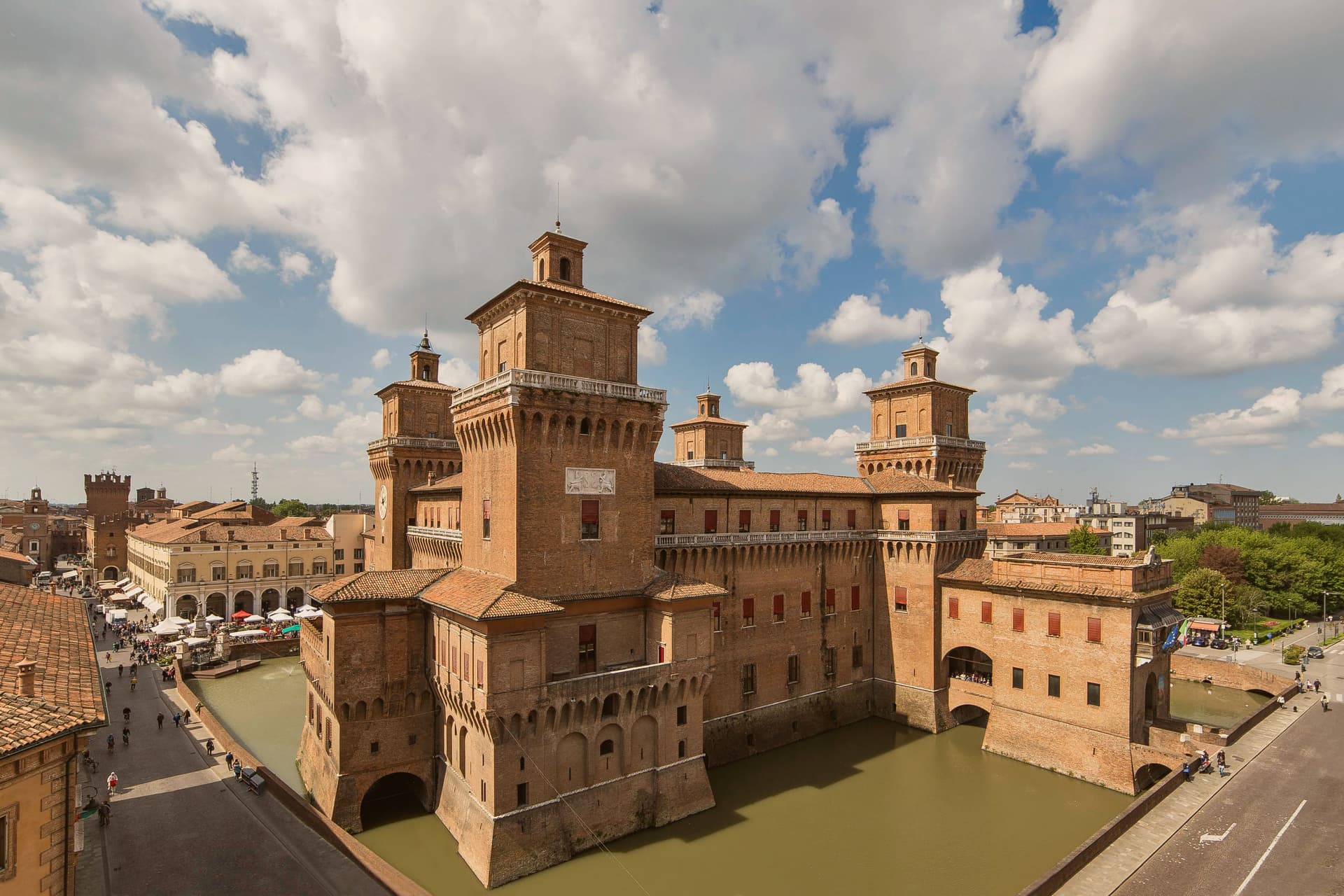
Ferrara is the city the Este family built and that the Po built around. For two centuries, from 1264 to 1598, the Este dukes ran their court from a moated brick fortress at the centre of town: Ariosto wrote the Orlando Furioso here, and the Ferrara school of painting flowered under Cosmè Tura.
In 1492, Duke Ercole I commissioned Biagio Rossetti to lay out a new quarter on a rational grid, with engineered perspectives and zoned districts, grafted onto the older medieval core rather than replacing it. That layering is still legible on the ground.
The old quarter, narrow and irregular, sits against Rossetti's planned extension, wide and gridded, and the two are stitched together inside a single ring of walls nine kilometres around. The scale is small enough that the whole centro can be crossed by bicycle in twenty minutes, and locals do: Ferrara has close to one bike per resident, and the medieval streets are narrow enough to keep cars mostly out.
The food carries its own local character apart from any of this: cappellacci di zucca, salama da sugo, pampepato at Christmas, and a Trebbiano-based wine grown on coastal sand dunes to the east. The Comacchio lagoons and the eel-fishing villages of the Po Delta are an easy half-day from the city, which served as the gateway to that whole territory.
What the plan and the walls add up to is a city that grew twice, once organically and once by design, and kept both versions intact side by side rather than letting one erase the other.
What to see in Ferrara
- Castello Estense. 1385 moated brick fortress at the very centre, the Este dukes' palace. The moat is still water-filled and the four corner towers are still walkable.
- Palazzo dei Diamanti. Rossetti's 1493 anchor of the new quarter, faced with 8,500 white-marble pyramid blocks. Now hosts major art exhibitions.
- 9 km of intact brick walls. The Renaissance ramparts ring the entire centro, and the top is a continuous cycling path with views over the moat and the Po valley.
How to get to Ferrara
There is a railway station in the town, so you can arrive without a car and never need one while you are here. Ferrara is roughly 6 minutes away by road.
Our tip
Ferrara is brilliant in April–June and September–October. The Po valley gets hot and sticky July–August and the brick city radiates heat. October has the Buskers Festival (Europe's largest street-musician festival, late August now). Sagra Di San Lorenzo A Baura falls in July.
Ravenna
Why visit Ravenna
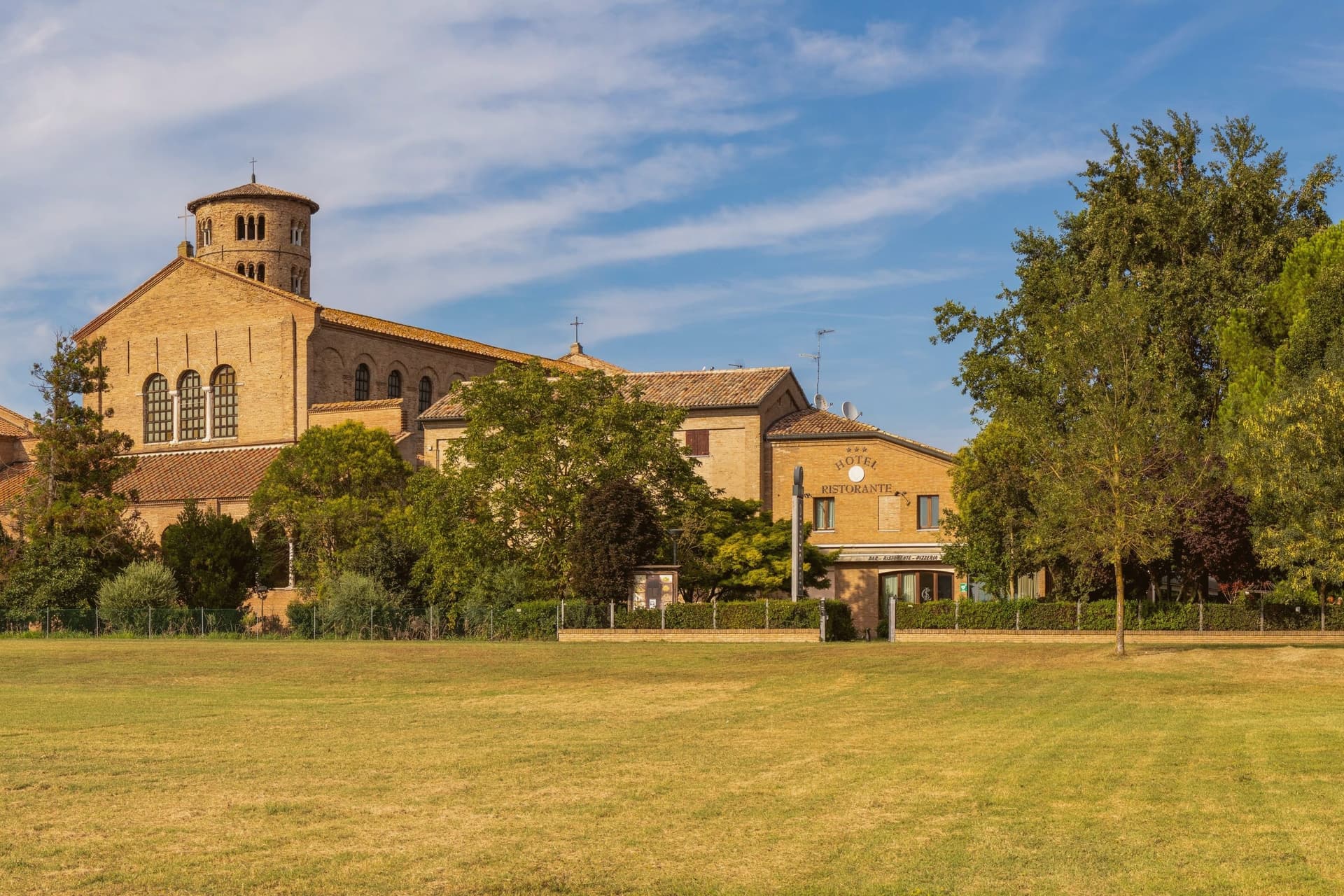
Ravenna sits four meters above sea level on the Adriatic coastal plain, ten kilometers from the sea and 105 kilometers east of Modena. Its position, low, flat, and close to the coast but not on it, made it defensible in a way landlocked cities were not: the surrounding marsh and lagoon kept armies at a distance while boats could still reach it.
That is why Honorius moved the Western Roman capital here in 402, why Theoderic kept it as his Ostrogothic seat, and why the Byzantine Exarchate held it for Constantinople until 751 as the last piece of imperial territory in northern Italy. Each of the three regimes built churches and paid for mosaic to decorate them, which is why the city's monuments read as a sequence rather than a single style: Roman, Gothic and Byzantine hands working in the same medium across a century and a half.
The municipality itself is split between this historic center and a stretch reaching the Adriatic, where Marina di Ravenna and Punta Marina hold Bandiera Blu beaches, so the same town that holds the fifth-century mausoleums also runs a public coastline. Population is 155,751.
What the churches add up to is less a city of monuments than a record of power changing hands, with each occupant leaving its faith in glass and gold on the walls rather than tearing down what came before.
What to see in Ravenna
- Basilica di San Vitale. Octagonal basilica holding the imperial mosaics of Justinian and Theodora in the presbytery and apse, the throne room of the sequence in gold and purple.
- Mausoleo di Galla Placidia. Small mausoleum next to the basilica, vaulted in a starry blue mosaic sky with gold cross and the symbols of the Evangelists, dim enough that the gold seems to generate its own light.
- Basilica di Sant'Apollinare Nuovo. Built by Theoderic as his palace chapel, the nave walls lined with continuous mosaic processions of saints and martyrs facing each other the full length of the church.
How to get to Ravenna
There is a railway station in the town, so you can arrive without a car and never need one while you are here. Ravenna is roughly 3 minutes away by road.
Our tip
May through September is the working window for Ravenna. The Adriatic warms enough for the beaches at Marina di Ravenna and Punta Marina to fill from late May through August, and the centro storico stays open for the Ravenna Festival in June and July. The mosaics need no weather, but July and August touch thirty-three degrees and the basilica interiors hold their heat. Antica Sagra del Monticino falls in September.
Padova
Why visit Padova
The Università degli Studi di Padova was founded in 1222 by scholars who had left Bologna in search of academic freedom, and for half a millennium it supplied the Veneto with its doctors and lawyers. Galileo lectured on physics here between 1592 and 1610.
Copernicus studied here. Elena Cornaro Piscopia became, in 1678, the first woman anywhere to receive a university doctorate.
The teaching happened in the same rooms tourists now walk through, which is part of what makes the university feel less like a monument and more like a machine that has never stopped running. The city's older story predates the university by centuries in spirit if not in stone: in 1303 Enrico Scrovegni commissioned a fresco cycle for his family chapel, an act of atonement for his father's usury, and the result changed what painting could do.
Separately, and for entirely different reasons, the city's botanical garden preserves a walled circular plan laid down in the sixteenth century, the layout that made it the template for every university garden that followed. Away from these two, the Basilica di Sant'Antonio draws pilgrims to a reliquary and a bronze outside its doors, the Palazzo della Ragione holds an astrological fresco hall and a two-hundred-year-old wooden horse, and a historic caffè has served coffee since 1831 in a neoclassical room that once served as Risorgimento headquarters.
The kitchen runs to bigoli with duck ragù, baccalà mantecato, risi e bisi in spring, and white asparagus from the Piazza delle Erbe market in May. What holds the city together is the university's habit of making its past into working infrastructure: a lecture hall still gives lectures, a dissection theatre still stands where it was built, a garden still grows on its original beds.
What to see in Padova
- Cappella degli Scrovegni (Giotto, 1303–1305). 38 scenes from the life of Christ and Mary, painted directly onto the plaster of a single chapel. The air-handling required to keep the pigment stable is why entry is capped at 15 minutes and 25 people at a time.
- Orto Botanico (1545, UNESCO). A walled circular garden, laid out on its founding plan and unchanged in shape since. Goethe stood among its beds. A modern biodiversity greenhouse has been added alongside the historic plot.
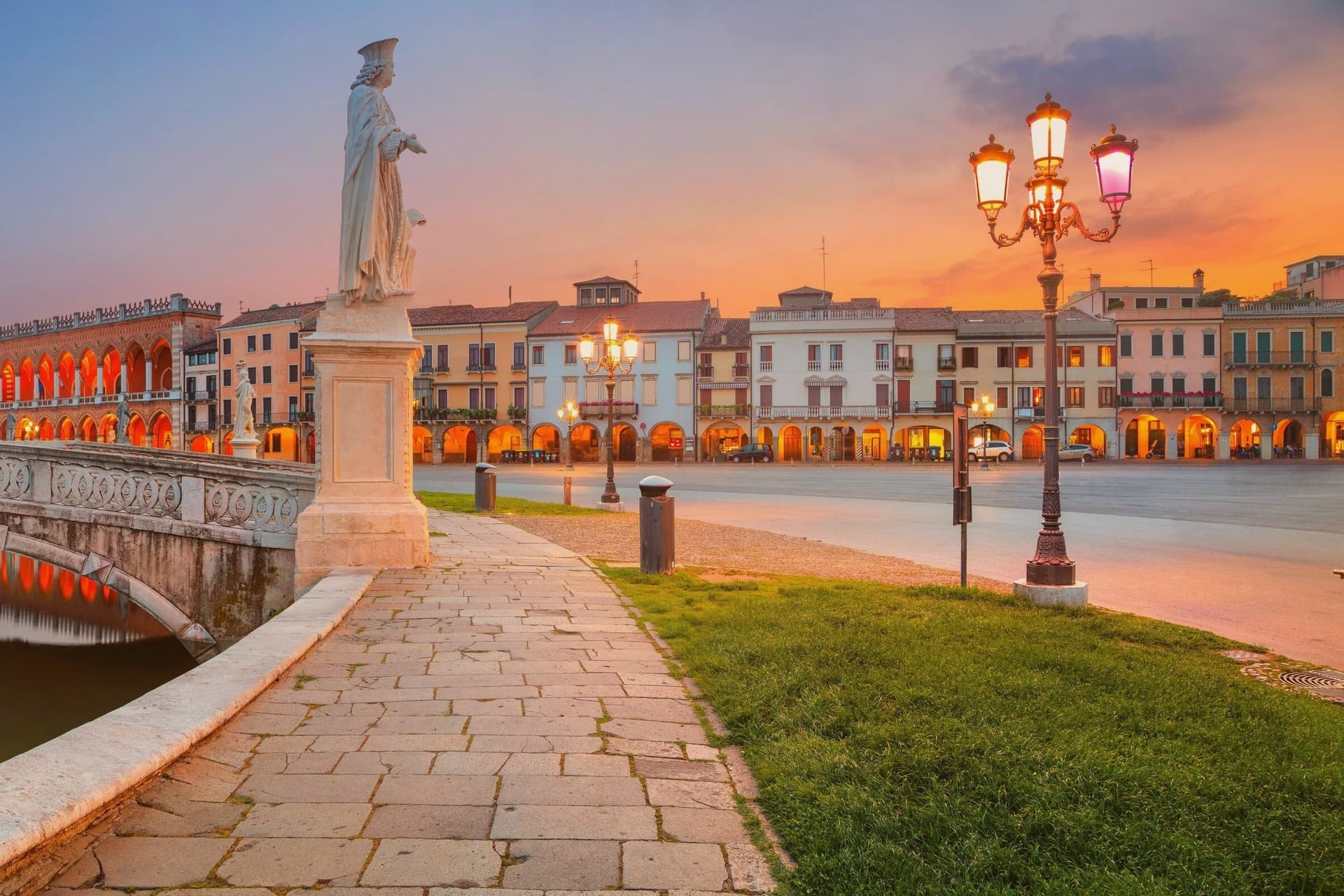
- Prato della Valle. An elliptical canal ringed by 78 statues of Padovan worthies, enclosing a central island and facing the Basilica of Santa Giustina. At 88,000 square metres it is the largest piazza in Italy.
How to get to Padova
There is a railway station in the town, so you can arrive without a car and never need one while you are here. Padova is roughly 3 minutes away by road.
Our tip
Padova is best April–June and September–October. May is the Padovan asparago bianco IGP at the Piazza delle Erbe market and the gardens at the Orto Botanico in full bloom. June 13 is the feast of Sant'Antonio — a quarter-million pilgrims, hotels full for 50 km.
More from Anywhere Italy
 The best towns with a World Heritage site within two hours of Parma
 The best towns with a World Heritage site within 75 minutes of Padua
- The best towns with a World Heritage site within 90 minutes of Verona
 The best towns with a World Heritage site within two hours of Trento
 The best towns with a World Heritage site within 90 minutes of Florence
- The best towns with a World Heritage site within 90 minutes of Pisa