
The best small hill towns in the province of Pesaro e Urbino
Inland Pesaro e Urbino is a province of river valleys climbing towards the Apennine ridge, and its towns sit where the ground gave them no choice, on spurs and saddles above the Metauro, the Candigliano and the Foglia. The houses are built of local sandstone and brick, roofs low and pinkish, with kitchen gardens dropping away behind them into oak and hornbeam. Autumn is the season the region is known for inland: white truffle from the beech and oak woods, sold in shops that smell of it from the street, alongside casciotta cheese, crescia baked on a hot stone and passatelli in broth. Winter brings snow to the higher villages near Monte Catria and Monte Nerone, and cold, clear light off the limestone.
This is Raphael's province, and almost everyone who comes inland comes for Urbino. The ducal palace and the steep brick streets deserve the reputation, and in summer and on festival weekends the buses fill the car parks below the walls and the queue for the Galleria Nazionale runs down the courtyard. Most visitors then drive back to the Adriatic beaches at Pesaro or Fano, treating the whole interior as a single day out from the coast.
The hills do not stop at Urbino. The same valleys keep going west and south towards the Umbrian and Tuscan borders, past Renaissance fortresses, Roman bridges, sulphur baths and truffle markets, through towns too steep and too small to have been rebuilt outwards. Fewer people go, which mostly means quieter piazzas, cheaper rooms and restaurants where the truffle is weighed at the table rather than priced for a coach party. These are the towns on that road.
Of the 17 communes we have mapped in the province of Pesaro e Urbino, 12 qualify as hill towns: each is an inland hill settlement built on ground too steep to spread. This list is the small ones, 7 in all, ordered smallest first. The smallest, Monte Grimano Terme, has 1,094 residents.
Two more lists worth reading alongside this one: The 8 prettiest villages in the province of Pesaro e Urbino and The best small hill towns within 90 minutes of Rimini.
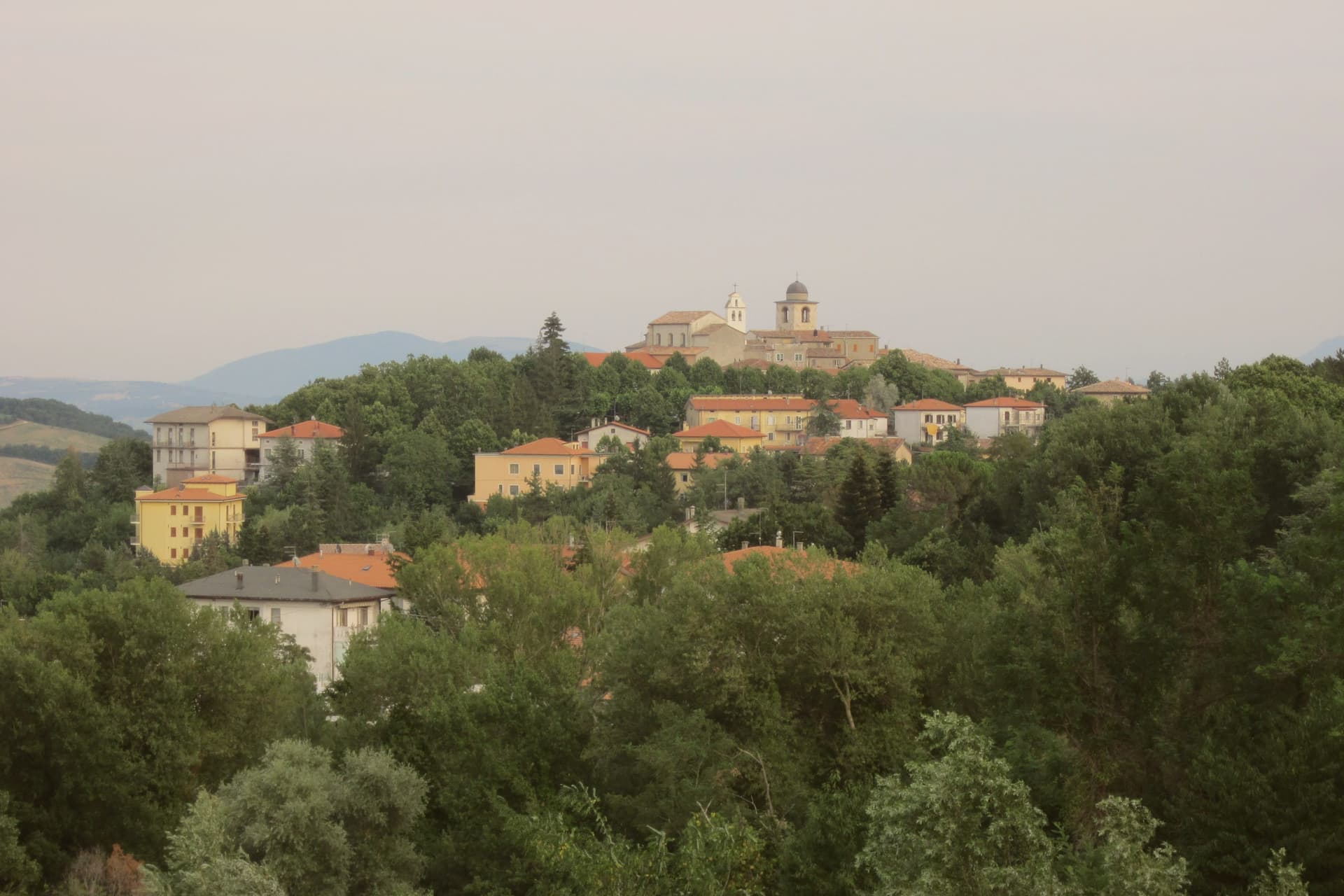
Monte Grimano Terme
Why visit Monte Grimano Terme
Monte Grimano Terme sits at 536 meters on a rocky spur in the Montefeltro hills, on the border between Marche and Romagna, ninety kilometers northwest of Ancona. The Romans knew the springs that surface below the borgo, though the first written record of their properties came only in 1571, in De Thermis, the early modern catalogue of Italian thermal waters.
The waters are alkaline and sulphurous. The town divides cleanly between the medieval upper settlement, ringed by the remains of its walls on the spur, and the spa below drawing on the same water source.
From the belvedere at the edge of the old town the ground drops toward the Conca valley, with the Carpegna ridge on one side and, on clear days, the Adriatic visible near Cattolica. Between them lies San Marino, part of the same Montefeltro setting that shaped the borgo's inclusion among the Borghi più belli d'Italia.
The Comuni Virtuosi membership adds a modern layer, an environmental program run by the same small commune whose waters were first written down centuries earlier. What holds the place together is that continuity: a mountain village and its springs, still working the same ground.
What to see in Monte Grimano Terme
- Centro storico. Medieval upper town on the rocky spur, with the remains of the walls, the Chiesa di San Silvestro and stone lanes around the central piazza.
- Terme di Monte Grimano. Modern spa complex below the upper town, running on the same springs Andrea Bacci catalogued, used today for respiratory, dermatological and digestive cures.
- Chiesa di San Silvestro. Parish church on the central piazza of the borgo, with later interventions on a medieval core, dedicated to the patron San Silvestro.
How to get to Monte Grimano Terme
Rimini is roughly 56 minutes away by road.
Our tip
April through October is the main window for Monte Grimano Terme. The Montefeltro hills turn green from April, the spa runs through the warm months for cure cycles, and the borgo stays cool at 536 meters when the lowland valleys touch the high twenties in July and August. June and September give the clearest air for the belvedere view across to the Carpegna ridge and the San Marino tower.
Mercatello sul Metauro
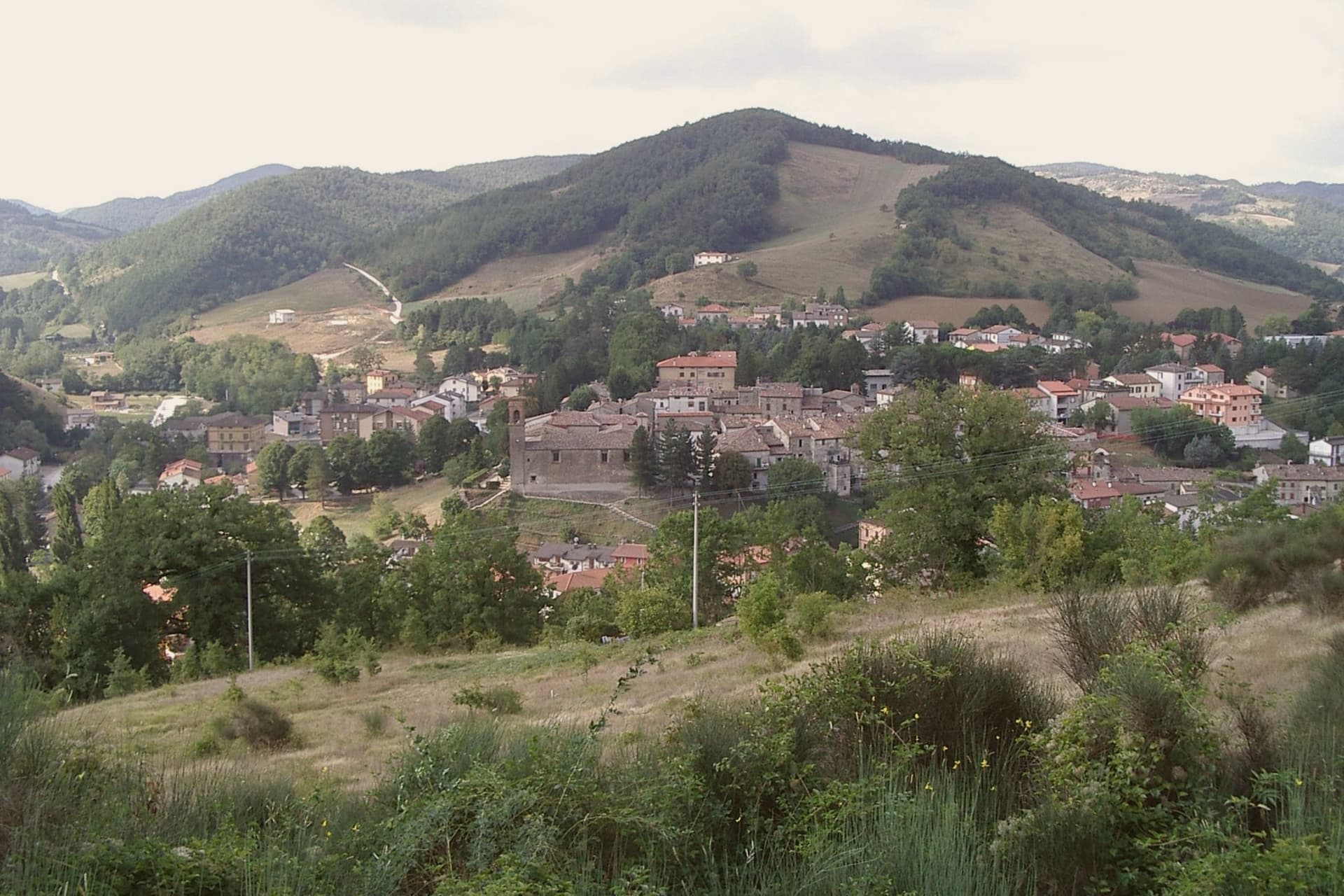
Why visit Mercatello sul Metauro
The upper Metauro valley here sits within the Massa Trabaria, the medieval district that supplied beams for Roman and papal building, and the site itself has older layers still. Etruscans and then Romans held the ground, where it stood between the municipia of Tiferno Metaurense and Tiferno Tiberino under the name Pieve d'Ico.
The town became an autonomous commune in 1235 under a bull of Pope Gregory IX, and within fifty years walls had risen around it and the name had changed to Mercatello sul Metauro. The pieve, exempt from any bishop since 1180 and answering only to the Holy See, sits on the square along with the town hall, forming the axis around which the walled center still reads as a single composition.
That square and its buildings earned the borgo its place among the Borghi più belli d'Italia in 2018. What the valley setting, the papal bull, the walls and the exempt pieve add up to is a town whose shape and status were fixed almost in a single generation, tied to a jurisdiction and a building material trade that both reached well beyond its own small perimeter, and have changed little since.
What to see in Mercatello sul Metauro
- Pieve Collegiata dei Santi Pietro e Paolo. Romanesque church whose facade was rebuilt in 1927 on the 1363 plan. Under Holy See dependence its jurisdiction reached forty-seven churches and chapels scattered through the surrounding valley.
- Piazza Garibaldi. Main square of the medieval borgo, faced by the pieve, the town hall and the seventeenth-century Palazzo Gasparini.
- Mura medievali. Thirteenth-century walls built within fifty years of the 1235 charter, still defining the perimeter of the centro storico.
How to get to Mercatello sul Metauro
Rimini is roughly 119 minutes away by road.
Our tip
April through October is the working season for Mercatello sul Metauro. The upper Metauro valley turns green from April, the walls and the pieve open every day, and the woodland trails of the surrounding Massa Trabaria forests open for slow walks. June through August touches the low thirties in the valley but the 429-meter elevation keeps the borgo a few degrees cooler than the lowland.
Macerata Feltria
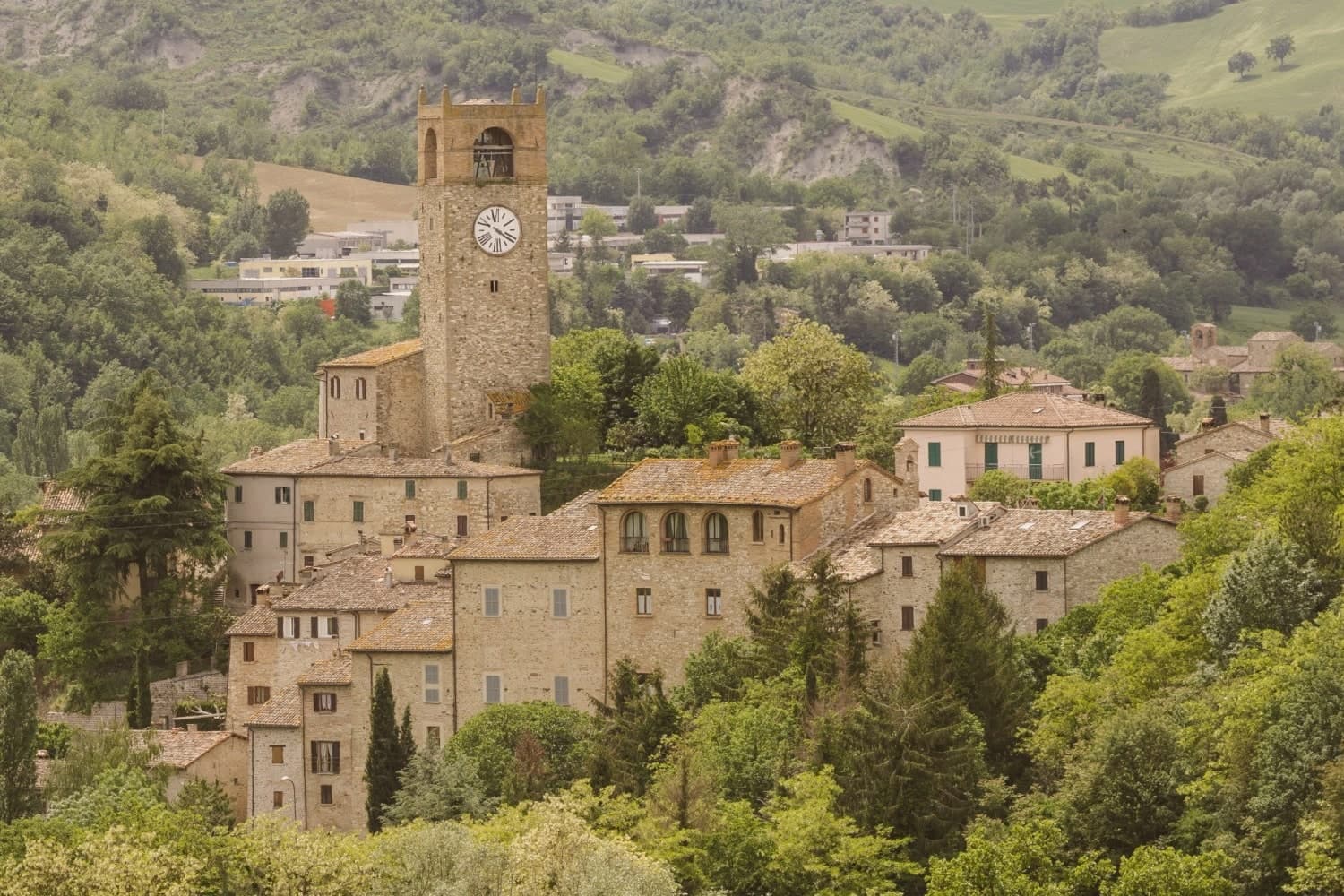
Why visit Macerata Feltria
Macerata Feltria sits in the Montefeltro, the borderland shared by the Marche, Emilia-Romagna and the Republic of San Marino, on the Pesaro side of that territory. The name Pitinum Pisaurense points to its origin as a stop on the Roman road between Pisaurum, now Pesaro, and the upper Tiber, which explains why the excavated forum and baths sit at the edge of today's centro rather than beneath it: the Roman town and the modern one occupy adjoining ground, not the same footprint.
After the 8th century the site was rebuilt as a feud under the Montefeltro family, the line that produced Federico da Montefeltro, Duke of Urbino, whose profile in Piero della Francesca's portrait is the standard image of the Renaissance prince. That period left the fortifications in town and the outlying Castello di Pietrarubbia 5 km north, and it was in this same span that the parish church was raised over an earlier basilica, so the building itself is a second layer built on a first.
The 19th century added a third: the Roman thermal springs were put back into use, leading to the 1898 spa building, still running on the same sulphurous water. The Montefeltro setting also places the town among better-known neighbours: San Leo 15 km north, Urbino 30 km south, San Marino 25 km east.
Food follows the same regional line, passatelli in brodo, tagliatelle al ragù di lepre, crescia sfogliata, Bianchello del Metauro and Montefeltro Pecorino, with the Festa del Patrono San Cassiano on 13 August as the year's fixed point. Three eras, Roman, Montefeltro and the modern spa town, sit on the same small plot of ground, each one building over rather than replacing the last.
What to see in Macerata Feltria
- Parco Archeologico di Pitinum Pisaurense. The forum, amphitheatre and bath foundations sit on the edge of the modern centro, low walls in open ground rather than a reconstructed ruin. A small site museum stands next to the free excavated area.
- Pieve di San Cassiano. Stone and brick exterior largely original, with 14th-c frescoes restored inside. The building stands over an earlier Christian basilica, so the floor plan carries two churches at once.
- Terme di Macerata Feltria. A modest single building rather than a resort complex, drawing on mineral water that has been in use since Roman times. Treatment is still limited to digestive and skin conditions.
How to get to Macerata Feltria
Rimini is roughly 63 minutes away by road.
Our tip
Macerata Feltria is best April–June and September–October — the Montefeltro borderland gets hot in summer but the 321m altitude offers some relief. The Festa di San Cassiano (13 August) is the year's main civic event. The Terme are open year-round.
Cantiano
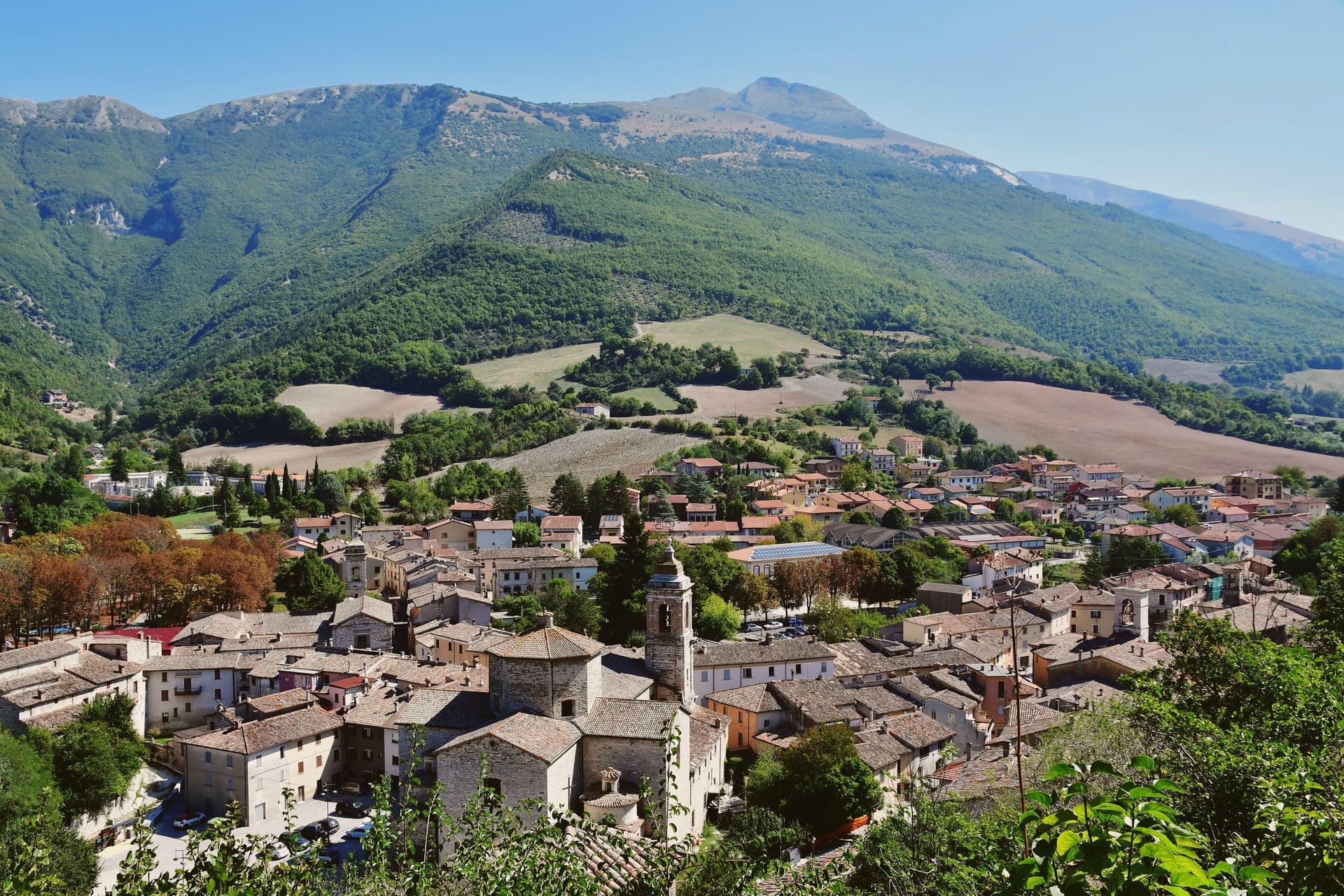
Why visit Cantiano
Cantiano sits on the southern slope of Monte Catria, at the point where the Marche meets Umbria along the old consular road. The town has held Bandiera Arancione status for two decades and carries the Comuni Virtuosi mark for its waste-reduction policies, alongside the bakery designation noted above.
Monte Catria itself has been an eremitic site since 980, with a monastery on its western flank where Dante is said to have stayed, a link between the mountain wilderness above the town and the literary record below it. The centro storico, walled and built along the route, sits under that same peak, so the town reads as a hinge point: a border crossing, a mountain approach, and a settlement whose bread, wine, and Passion play all draw on what the hills around it produce and what the road brings through it.
What to see in Cantiano
- La Turba di Cantiano. Costumed actors in mid-thirteenth-century dress move through the centro storico tracing the Passion route, the same streets the brotherhoods who founded the rite would have walked.
- Monte Catria. At 1,702 meters, the highest peak of the northern Apennines on this stretch, with eremitic sites used since the tenth century on its western flank.
- Collegiata di San Giovanni Battista. Main parish church of the centro storico, built in the seventeenth century over an earlier medieval foundation, with eighteenth-century paintings inside.
How to get to Cantiano
Perugia is roughly 70 minutes away by road.
Our tip
April through June and September into October are the best months for Cantiano. The Catria slopes turn green by mid-April, the visciola cherries ripen in June, and the surrounding chestnut woods color through October. The Good Friday Turba pulls thousands of visitors into the centro storico, the biggest single day of the year.
Mondavio
Why visit Mondavio
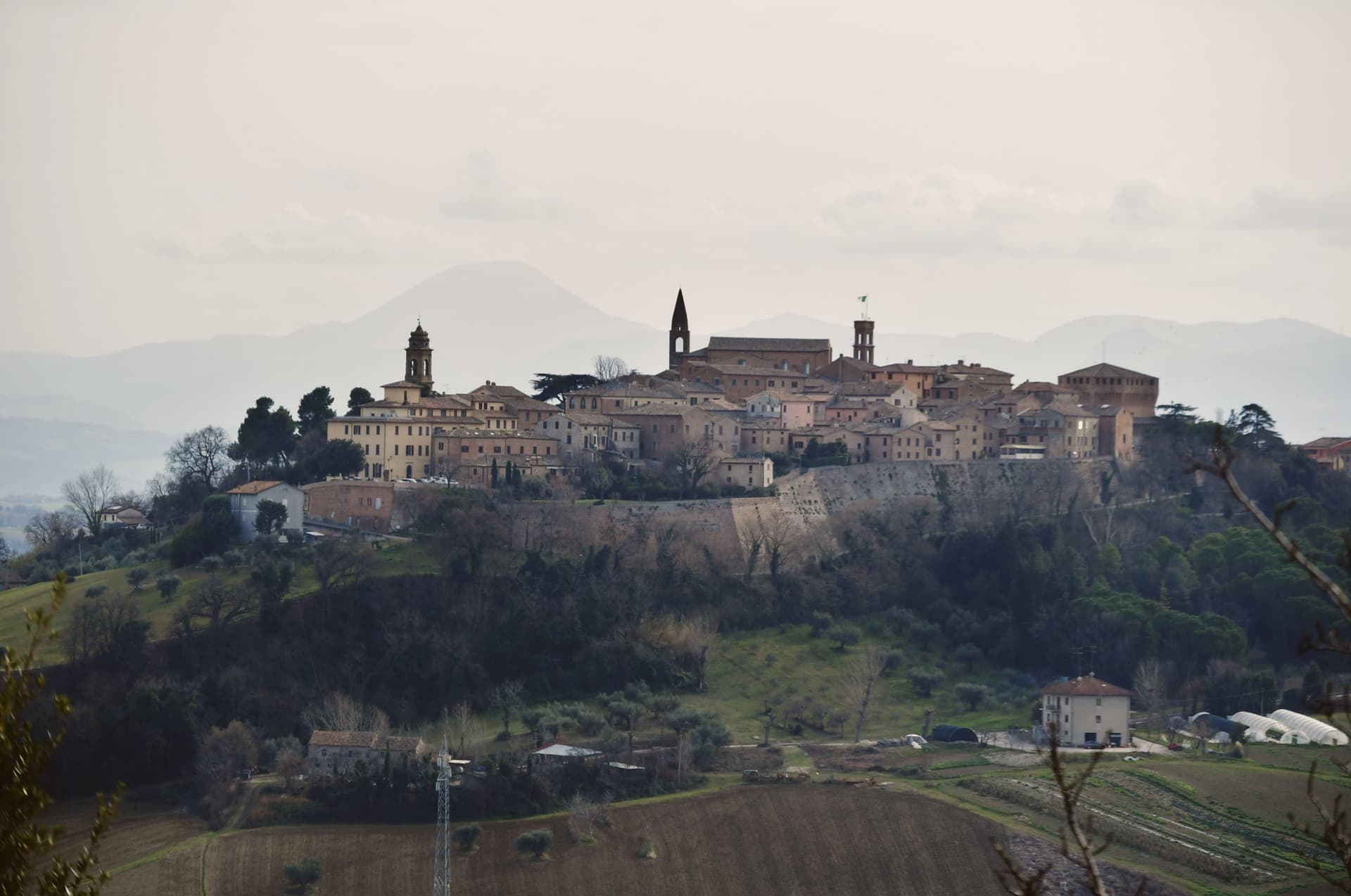
Mondavio sits at 280 meters on a hill between the Cesano and the Metauro rivers, twenty kilometers inland from Senigallia. The fortress at its center was built over an earlier medieval structure, and its patron used the commission to test a new kind of defensive geometry: an octagonal keep on a wide base of trapezoidal walls that incline outward in a helical line, with sightlines arranged so attackers could not aim straight at the walls.
The fortress was never attacked. Both the patron and the architect died in 1501, and the building remained slightly short of the original plan.
The town's walled core still gathers around that fortress, entered through two surviving gates and threaded with stone lanes that open onto the central piazza and the Palazzo Comunale. The Festa del Duca in August fills those same streets with costumed jousting and crossbow trials, a fair echo of the military purpose the walls were built for.
What the geometry was designed to prevent, an attack that never came, is now what the town preserves and re-enacts each summer.
What to see in Mondavio
- Rocca Roveresca. Commissioned by Giovanni della Rovere from Francesco di Giorgio Martini, built 1482-1492, octagonal keep on inclined trapezoidal walls designed to deflect cannon fire.
- Museo di Rievocazione Storica. Inside the Rocca, presents life in a Renaissance fortress with reconstructed armory, kitchen, prison and ballista chamber.
- Teatro Apollo. Eighteenth-century theatre at the heart of the borgo, all wood, with a horseshoe plan and four orders of boxes.
How to get to Mondavio
Ancona is roughly 61 minutes away by road.
Our tip
April through October is the working window for Mondavio. The hills between the Cesano and the Metauro turn green from April, the Rocca and the Teatro Apollo are open every day, and the surrounding olive and grain country opens for slow walks. The Festa del Duca in mid-August fills the streets with costumed jousting and crossbow trials.
Sant'Angelo in Vado
Why visit Sant'Angelo in Vado
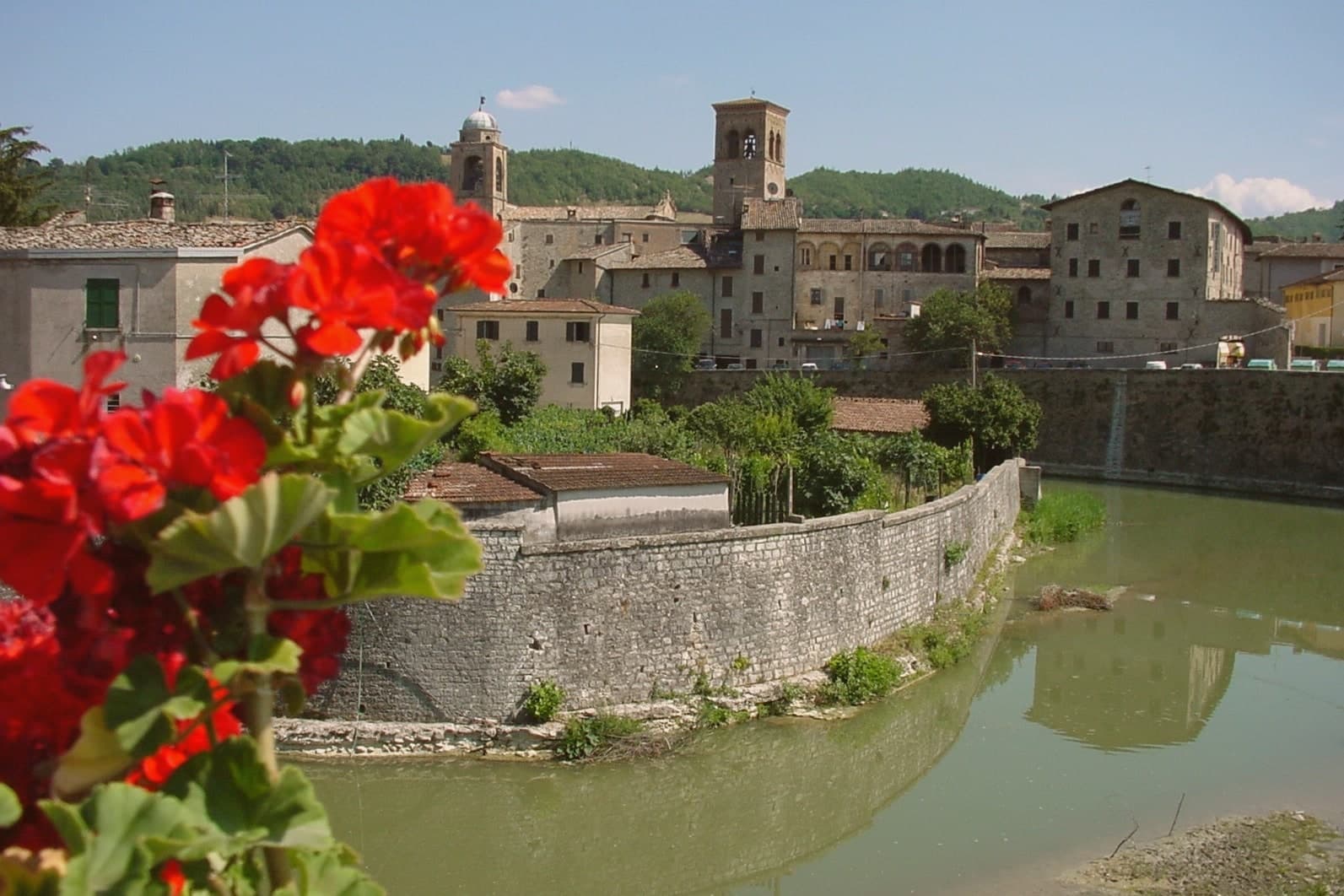
Sant'Angelo in Vado sits at 359 meters on a river terrace on the right bank of the upper Metauro, sixty kilometers from Perugia and twenty from Urbino. The Roman city of Tifernum Mataurense lies underneath the modern town: a municipium from the first century BC, built on a grid with the cardo maximus running past the public baths to a forum under the former convent of Santa Caterina.
Excavations from 2003 onward uncovered the Domus del Mito, a 1,000-square-meter noble house from the late first century AD with 27 rooms and a sequence of polychrome figurative mosaics of Neptune and Amphitrite, Dionysus and Medusa that survive almost intact. The white truffle fair began in 1963, the oldest in Italy after Alba, and runs across the weekends of October and the first half of November in Palazzo Mercuri and the streets around it.
The Centro Sperimentale di Tartuficoltura, the national research center for truffle cultivation, has been based here since the 1980s.
What to see in Sant'Angelo in Vado
- Domus del Mito. Roman noble house from the late first century AD, 1,000 square meters across 27 rooms, with intact polychrome mosaics of Neptune, Amphitrite, Dionysus and Medusa.
- Palazzo Mercuri. Liberty-style palace with frescoed rooms, used as the central venue of the Mostra Nazionale del Tartufo Bianco each October and November.
- Mostra Nazionale del Tartufo Bianco. Italy's oldest white truffle fair after Alba, founded 1963, running across the weekends of October and the first half of November.
How to get to Sant'Angelo in Vado
Rimini is roughly 86 minutes away by road.
Our tip
April through June and September into November are the working months for Sant'Angelo in Vado. The Metauro valley turns green from April, the Domus del Mito and the archaeological park run guided visits through the warm months, and the white truffle fair fills the centro storico across the October and November weekends. July and August touch the high twenties at 359 meters; the terrace position above the river keeps the evenings cooler than the lower Metauro plain.
Acqualagna
Why visit Acqualagna
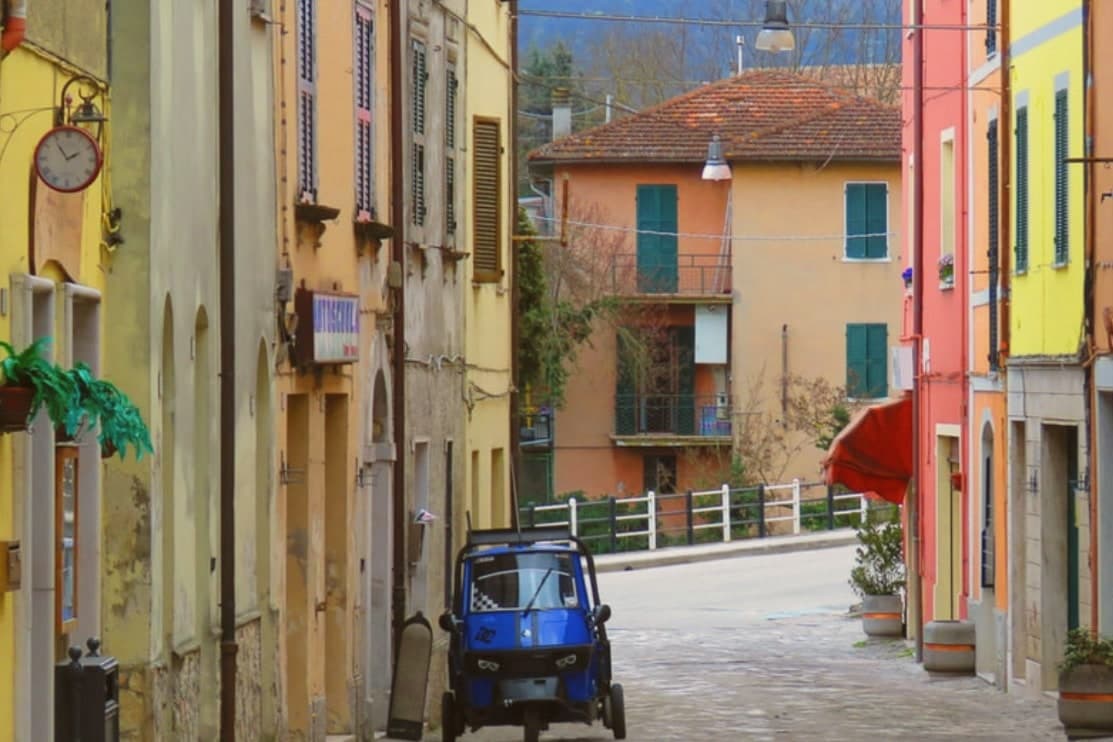
Acqualagna sits at 204 meters in the Metauro valley, twelve kilometers from Urbino, on the plain just downstream from the gorge cut by the Candigliano river. The Roman city of Pitinum Mergens stood nearby until Alaric's Goths destroyed it; the survivors founded Montefalcone, the castle from which today's village grew.
The name Acqualagna comes from Aqua Lanea, water of slaughter, after the sixth-century battle fought on that same plain. Three fairs anchor the year: black truffle on the last Sunday of February, summer black on the last Sunday of July, white truffle across the last weekend of October and the two that follow.
The town below and the gorge above read as one unit, a river valley that has carried Roman road traffic, monastic settlement and truffle trade in turn, each leaving its mark on the ground without erasing what came before.
What to see in Acqualagna
- Gola del Furlo. The gorge narrows between Monte Paganuccio (977 m) and Monte Pietralata (888 m); the 38-meter Roman tunnel, cut in 76 AD, is still driven through by the Via Flaminia today.
- Abbazia di San Vincenzo al Furlo. Medieval Benedictine monastery set into the slopes above the gorge, counted among the oldest religious foundations in the Metauro valley.
- Riserva Naturale Statale Gola del Furlo. Nature reserve established in 2001, covering 3,600 hectares of woodland, grazing land and ridgeline above the river.
How to get to Acqualagna
There is a railway station in the town, so you can arrive without a car and never need one while you are here. Rimini is roughly 81 minutes away by road.
Our tip
April through June and September into October are the months for Acqualagna. The Metauro hills hold their green, the woods around Monte Paganuccio are open for walking, and summer truffle season turns the piazzas over to tasting tables in late July. July and August touch the high twenties; the gorge stays cooler than the valley floor. Fiera Regionale del Tartufo d'Estate falls in August.
More from Anywhere Italy
- The 8 prettiest villages in the province of Pesaro e Urbino
 The best small hill towns within 90 minutes of Rimini
 The 6 best small hill towns that eat well in Marche
 The best small towns that eat well in Marche
- The prettiest small villages within 90 minutes of Rimini
- The best towns with a serious restaurant in the province of Pesaro e Urbino