
The 8 prettiest villages in the province of Pesaro e Urbino
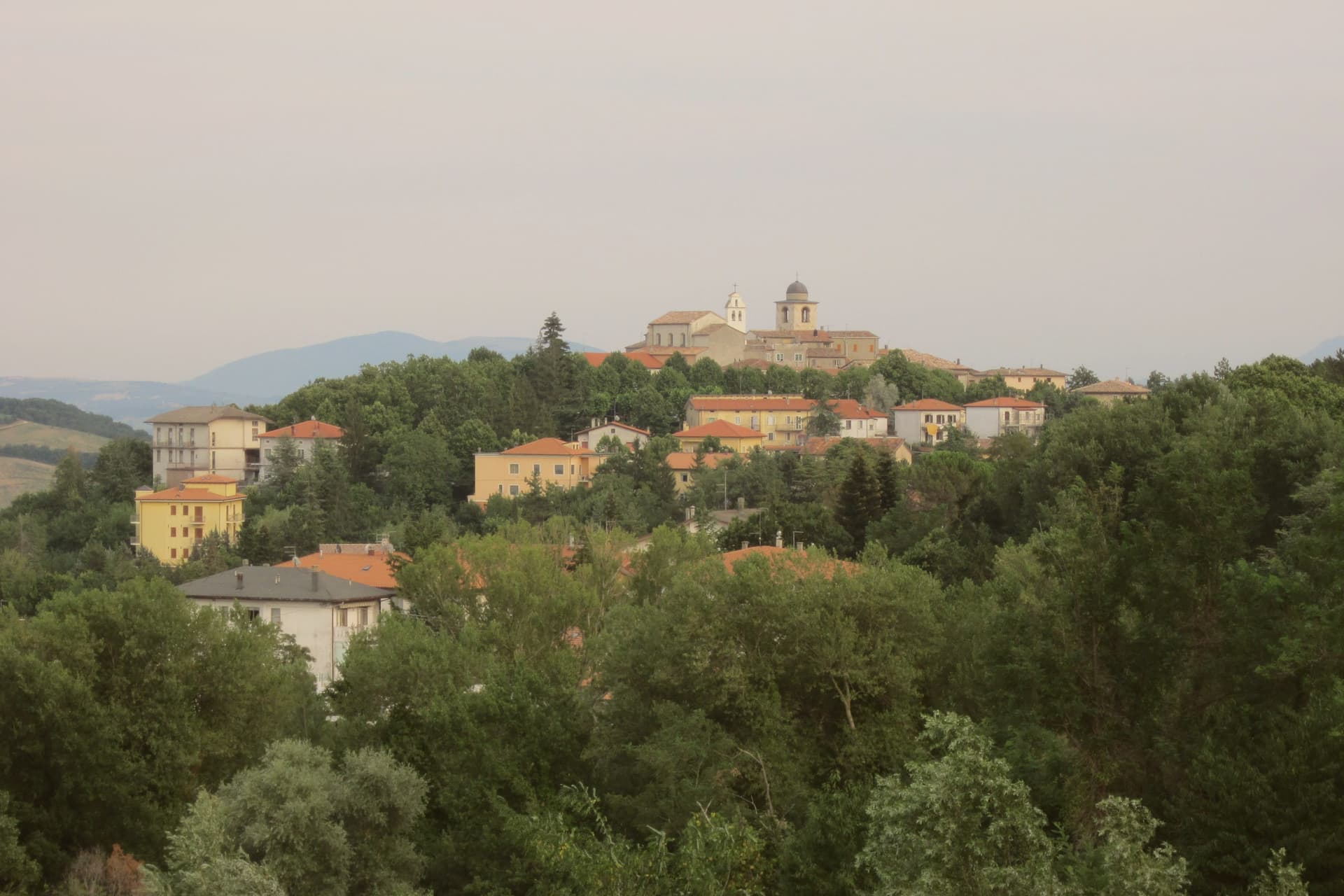
The Marche behind the beach is a country of ridges. Villages sit on the crest with their backs to the Apennines, built of local sandstone and warm brick, ringed by walls that were serious defences when the Montefeltro and the Malatesta were arguing over every hill. Autumn brings white truffles out of the oak woods around the Metauro and the Foglia, and the trattorie put them over tagliatelle and passatelli without ceremony. In summer the same lanes fill with evening festivals, grilled meat, Bianchello del Metauro poured cold.
Almost everyone who comes inland here comes for Urbino, and with good reason: the Palazzo Ducale, Raphael's birthplace, the steep student streets, a UNESCO listing that pulls coach parties up the hill from the coast at Pesaro all season. It is one of the great small cities of the Renaissance and it is busy accordingly, particularly in the middle of the day between spring and September. Most visitors treat it as a single stop, then drive back down to the sea.
The hills do not stop at the city limits. The same walls, the same brick, the same truffle woods and river valleys carry on north into the Montefeltro and south towards the Cesano, and that is where these villages are, fewer people on their ramparts and rather more room at the table.
Of the 17 communes we have mapped in the province of Pesaro e Urbino, 8 qualify as prettiest villages: each has passed the assessment of the national association of Italy's most beautiful villages. The smallest, Monte Grimano Terme, has 1,094 residents.
Elsewhere in the catalogue: The best small hill towns in the province of Pesaro e Urbino and The 9 prettiest villages within 90 minutes of Rimini.
Monte Grimano Terme
Why visit Monte Grimano Terme
Monte Grimano Terme sits at 536 meters on a rocky spur in the Montefeltro hills, on the border between Marche and Romagna, ninety kilometers northwest of Ancona. The Romans knew the springs that surface below the borgo, though the first written record of their properties came only in 1571, in De Thermis, the early modern catalogue of Italian thermal waters.
The waters are alkaline and sulphurous. The town divides cleanly between the medieval upper settlement, ringed by the remains of its walls on the spur, and the spa below drawing on the same water source.
From the belvedere at the edge of the old town the ground drops toward the Conca valley, with the Carpegna ridge on one side and, on clear days, the Adriatic visible near Cattolica. Between them lies San Marino, part of the same Montefeltro setting that shaped the borgo's inclusion among the Borghi più belli d'Italia.
The Comuni Virtuosi membership adds a modern layer, an environmental program run by the same small commune whose waters were first written down centuries earlier. What holds the place together is that continuity: a mountain village and its springs, still working the same ground.
What to see in Monte Grimano Terme
- Centro storico. Medieval upper town on the rocky spur, with the remains of the walls, the Chiesa di San Silvestro and stone lanes around the central piazza.
- Terme di Monte Grimano. Modern spa complex below the upper town, running on the same springs Andrea Bacci catalogued, used today for respiratory, dermatological and digestive cures.
- Chiesa di San Silvestro. Parish church on the central piazza of the borgo, with later interventions on a medieval core, dedicated to the patron San Silvestro.
How to get to Monte Grimano Terme
Rimini is roughly 56 minutes away by road.
Our tip
April through October is the main window for Monte Grimano Terme. The Montefeltro hills turn green from April, the spa runs through the warm months for cure cycles, and the borgo stays cool at 536 meters when the lowland valleys touch the high twenties in July and August. June and September give the clearest air for the belvedere view across to the Carpegna ridge and the San Marino tower.
Mercatello sul Metauro
Why visit Mercatello sul Metauro
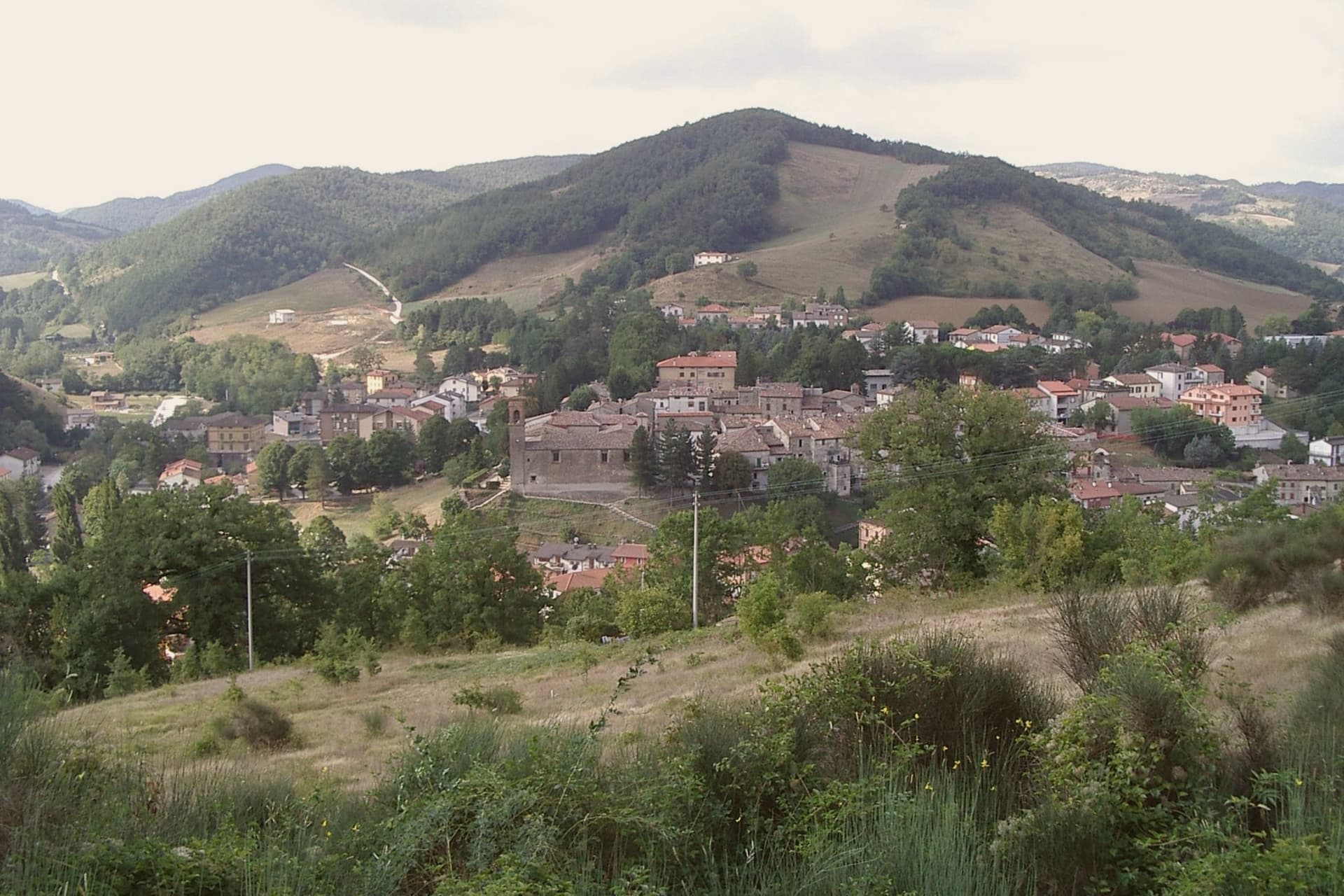
The upper Metauro valley here sits within the Massa Trabaria, the medieval district that supplied beams for Roman and papal building, and the site itself has older layers still. Etruscans and then Romans held the ground, where it stood between the municipia of Tiferno Metaurense and Tiferno Tiberino under the name Pieve d'Ico.
The town became an autonomous commune in 1235 under a bull of Pope Gregory IX, and within fifty years walls had risen around it and the name had changed to Mercatello sul Metauro. The pieve, exempt from any bishop since 1180 and answering only to the Holy See, sits on the square along with the town hall, forming the axis around which the walled center still reads as a single composition.
That square and its buildings earned the borgo its place among the Borghi più belli d'Italia in 2018. What the valley setting, the papal bull, the walls and the exempt pieve add up to is a town whose shape and status were fixed almost in a single generation, tied to a jurisdiction and a building material trade that both reached well beyond its own small perimeter, and have changed little since.
What to see in Mercatello sul Metauro
- Pieve Collegiata dei Santi Pietro e Paolo. Romanesque church whose facade was rebuilt in 1927 on the 1363 plan. Under Holy See dependence its jurisdiction reached forty-seven churches and chapels scattered through the surrounding valley.
- Piazza Garibaldi. Main square of the medieval borgo, faced by the pieve, the town hall and the seventeenth-century Palazzo Gasparini.
- Mura medievali. Thirteenth-century walls built within fifty years of the 1235 charter, still defining the perimeter of the centro storico.
How to get to Mercatello sul Metauro
Rimini is roughly 119 minutes away by road.
Our tip
April through October is the working season for Mercatello sul Metauro. The upper Metauro valley turns green from April, the walls and the pieve open every day, and the woodland trails of the surrounding Massa Trabaria forests open for slow walks. June through August touches the low thirties in the valley but the 429-meter elevation keeps the borgo a few degrees cooler than the lowland.
Macerata Feltria
Why visit Macerata Feltria
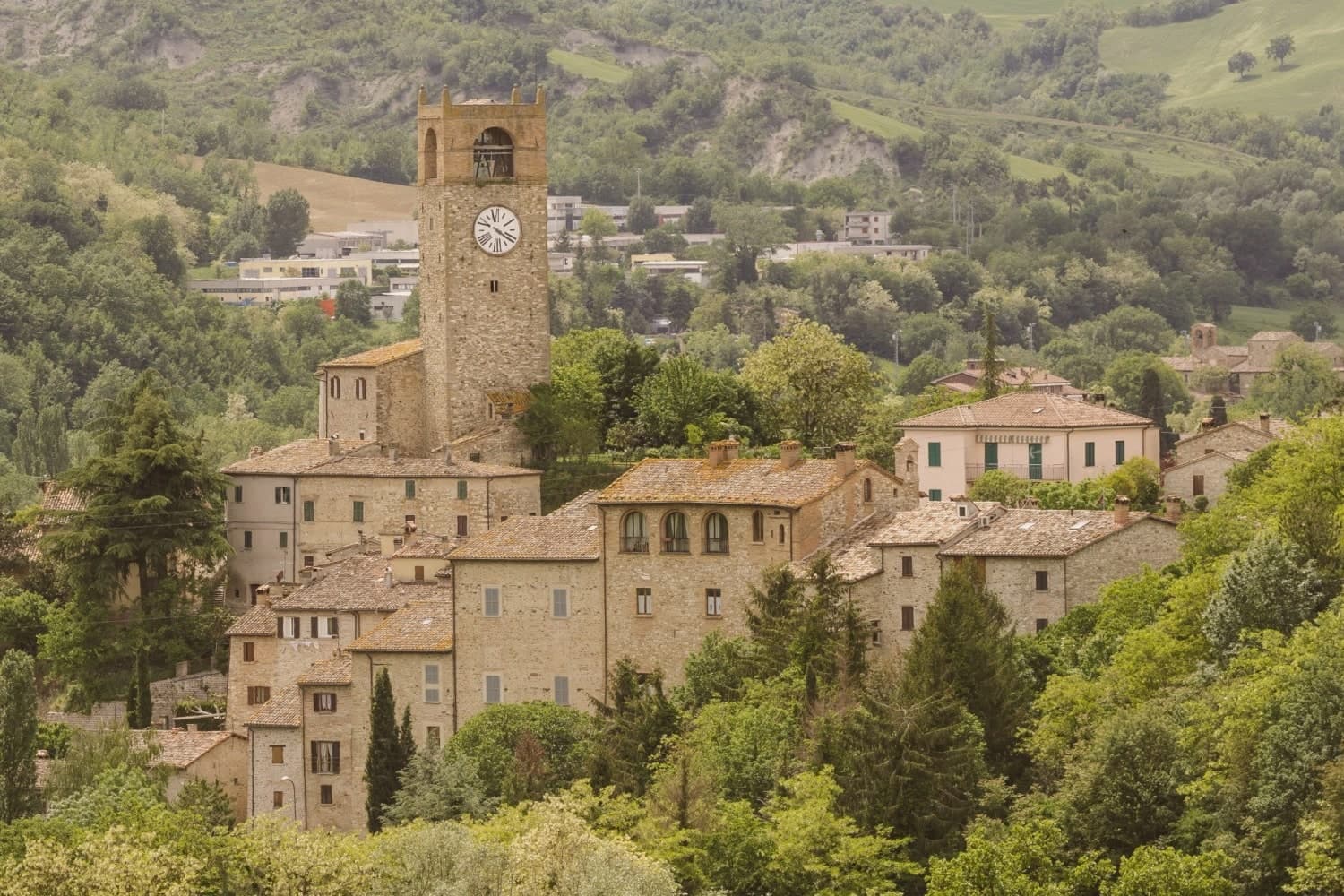
Macerata Feltria sits in the Montefeltro, the borderland shared by the Marche, Emilia-Romagna and the Republic of San Marino, on the Pesaro side of that territory. The name Pitinum Pisaurense points to its origin as a stop on the Roman road between Pisaurum, now Pesaro, and the upper Tiber, which explains why the excavated forum and baths sit at the edge of today's centro rather than beneath it: the Roman town and the modern one occupy adjoining ground, not the same footprint.
After the 8th century the site was rebuilt as a feud under the Montefeltro family, the line that produced Federico da Montefeltro, Duke of Urbino, whose profile in Piero della Francesca's portrait is the standard image of the Renaissance prince. That period left the fortifications in town and the outlying Castello di Pietrarubbia 5 km north, and it was in this same span that the parish church was raised over an earlier basilica, so the building itself is a second layer built on a first.
The 19th century added a third: the Roman thermal springs were put back into use, leading to the 1898 spa building, still running on the same sulphurous water. The Montefeltro setting also places the town among better-known neighbours: San Leo 15 km north, Urbino 30 km south, San Marino 25 km east.
Food follows the same regional line, passatelli in brodo, tagliatelle al ragù di lepre, crescia sfogliata, Bianchello del Metauro and Montefeltro Pecorino, with the Festa del Patrono San Cassiano on 13 August as the year's fixed point. Three eras, Roman, Montefeltro and the modern spa town, sit on the same small plot of ground, each one building over rather than replacing the last.
What to see in Macerata Feltria
- Parco Archeologico di Pitinum Pisaurense. The forum, amphitheatre and bath foundations sit on the edge of the modern centro, low walls in open ground rather than a reconstructed ruin. A small site museum stands next to the free excavated area.
- Pieve di San Cassiano. Stone and brick exterior largely original, with 14th-c frescoes restored inside. The building stands over an earlier Christian basilica, so the floor plan carries two churches at once.
- Terme di Macerata Feltria. A modest single building rather than a resort complex, drawing on mineral water that has been in use since Roman times. Treatment is still limited to digestive and skin conditions.
How to get to Macerata Feltria
Rimini is roughly 63 minutes away by road.
Our tip
Macerata Feltria is best April–June and September–October — the Montefeltro borderland gets hot in summer but the 321m altitude offers some relief. The Festa di San Cassiano (13 August) is the year's main civic event. The Terme are open year-round.
Mondavio
Why visit Mondavio
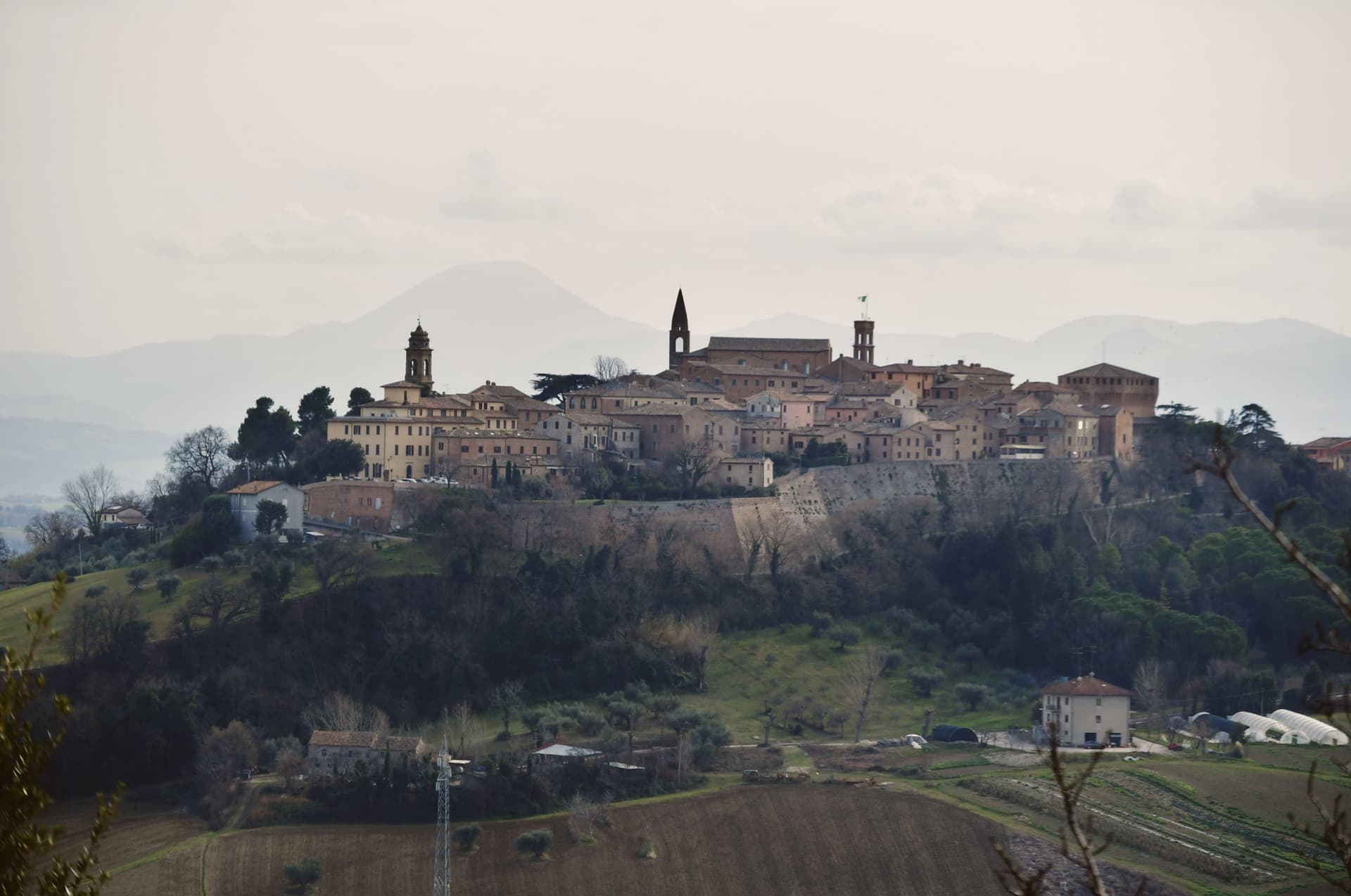
Mondavio sits at 280 meters on a hill between the Cesano and the Metauro rivers, twenty kilometers inland from Senigallia. The fortress at its center was built over an earlier medieval structure, and its patron used the commission to test a new kind of defensive geometry: an octagonal keep on a wide base of trapezoidal walls that incline outward in a helical line, with sightlines arranged so attackers could not aim straight at the walls.
The fortress was never attacked. Both the patron and the architect died in 1501, and the building remained slightly short of the original plan.
The town's walled core still gathers around that fortress, entered through two surviving gates and threaded with stone lanes that open onto the central piazza and the Palazzo Comunale. The Festa del Duca in August fills those same streets with costumed jousting and crossbow trials, a fair echo of the military purpose the walls were built for.
What the geometry was designed to prevent, an attack that never came, is now what the town preserves and re-enacts each summer.
What to see in Mondavio
- Rocca Roveresca. Commissioned by Giovanni della Rovere from Francesco di Giorgio Martini, built 1482-1492, octagonal keep on inclined trapezoidal walls designed to deflect cannon fire.
- Museo di Rievocazione Storica. Inside the Rocca, presents life in a Renaissance fortress with reconstructed armory, kitchen, prison and ballista chamber.
- Teatro Apollo. Eighteenth-century theatre at the heart of the borgo, all wood, with a horseshoe plan and four orders of boxes.
How to get to Mondavio
Ancona is roughly 61 minutes away by road.
Our tip
April through October is the working window for Mondavio. The hills between the Cesano and the Metauro turn green from April, the Rocca and the Teatro Apollo are open every day, and the surrounding olive and grain country opens for slow walks. The Festa del Duca in mid-August fills the streets with costumed jousting and crossbow trials.
Gradara
Why visit Gradara
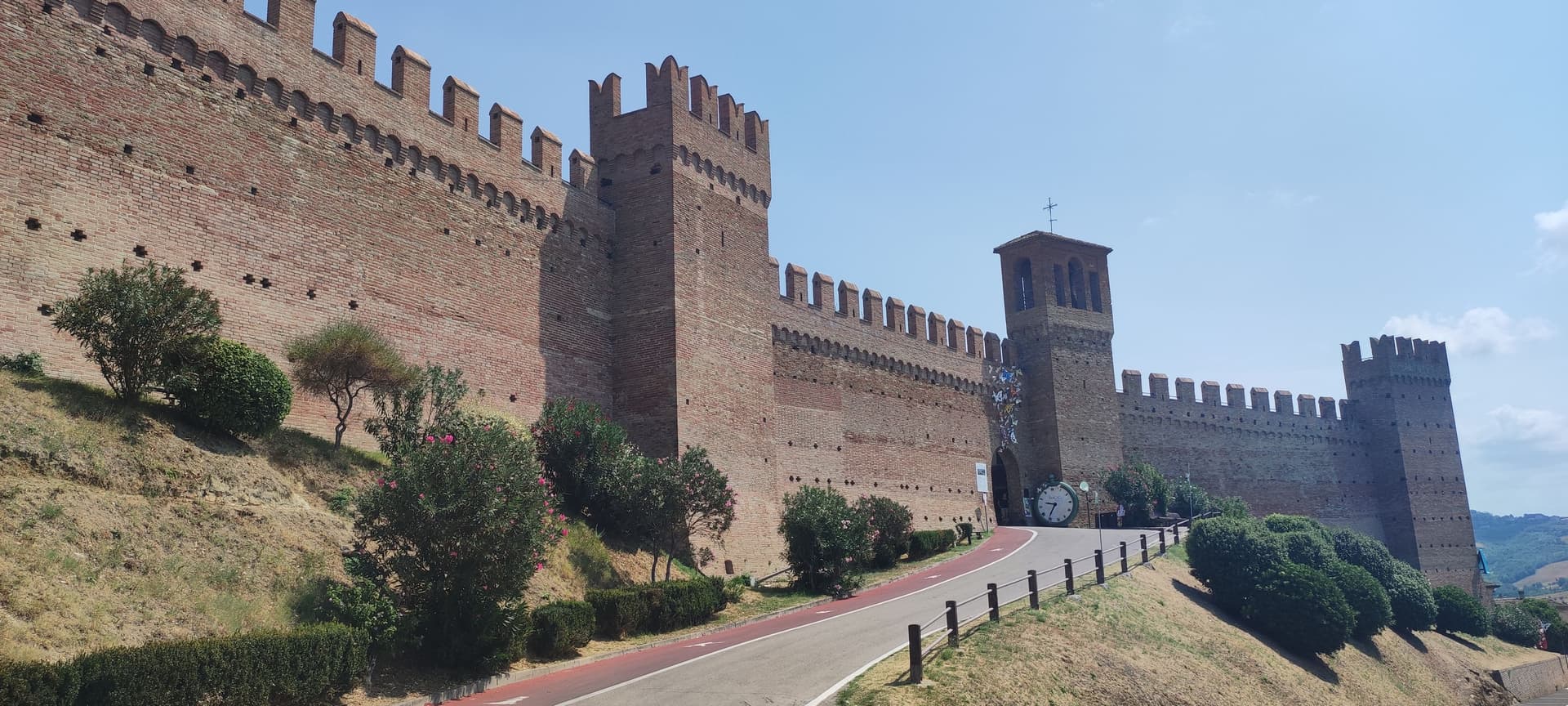
Gradara sits at 142 meters on a hill three kilometers from the Adriatic, at the northern border of the Marche with Romagna. The castle was begun in the twelfth century by Pietro and Ridolfo del Grifo and completed in the fifteenth, when the Malatesta extended the double ring of walls that still runs almost 800 meters around the borgo.
In the fifth canto of the Inferno, Dante placed Paolo and Francesca here: around 1275 Guido da Polenta of Ravenna married his daughter Francesca to Giovanni Malatesta and sent his younger brother Paolo as proxy. The two fell in love.
Gianciotto Malatesta caught them and killed both. Whether the killing happened at Gradara, Pesaro or Rimini is disputed among scholars; tradition keeps it here.
The borgo was voted Borgo dei Borghi by RAI viewers in 2018. The Castello and the Camerino di Lucrezia draw most visitors.
Olive groves around the walls supply the Cartoceto DOP oil.
What to see in Gradara
- Castello di Gradara. Twelfth-century rocca completed by the Malatesta in the fifteenth century, one of the best-preserved medieval fortresses in Italy, with the Camerino di Lucrezia frescoed cycle.
- Mura medievali. Double ring of fourteenth and fifteenth-century walls running almost 800 meters around the borgo, walkable along the camminamento.
- Camera di Paolo e Francesca. Frescoed chamber inside the castle, traditionally identified as the room where Dante set the killing of the two lovers.
How to get to Gradara
Rimini is roughly 30 minutes away by road.
Our tip
May through September is the working season for Gradara. The hill is dry from late April, the castle and walls are open every day, and the literary park below the rocca turns green into June. July and August bring the heaviest crowds: the proximity to Cattolica and Gabicce Mare puts seaside families on the castle road and the borgo's narrow streets fill from mid-morning. Giovedì al Castello - Rievocazione storica falls in August.
Pergola
Why visit Pergola
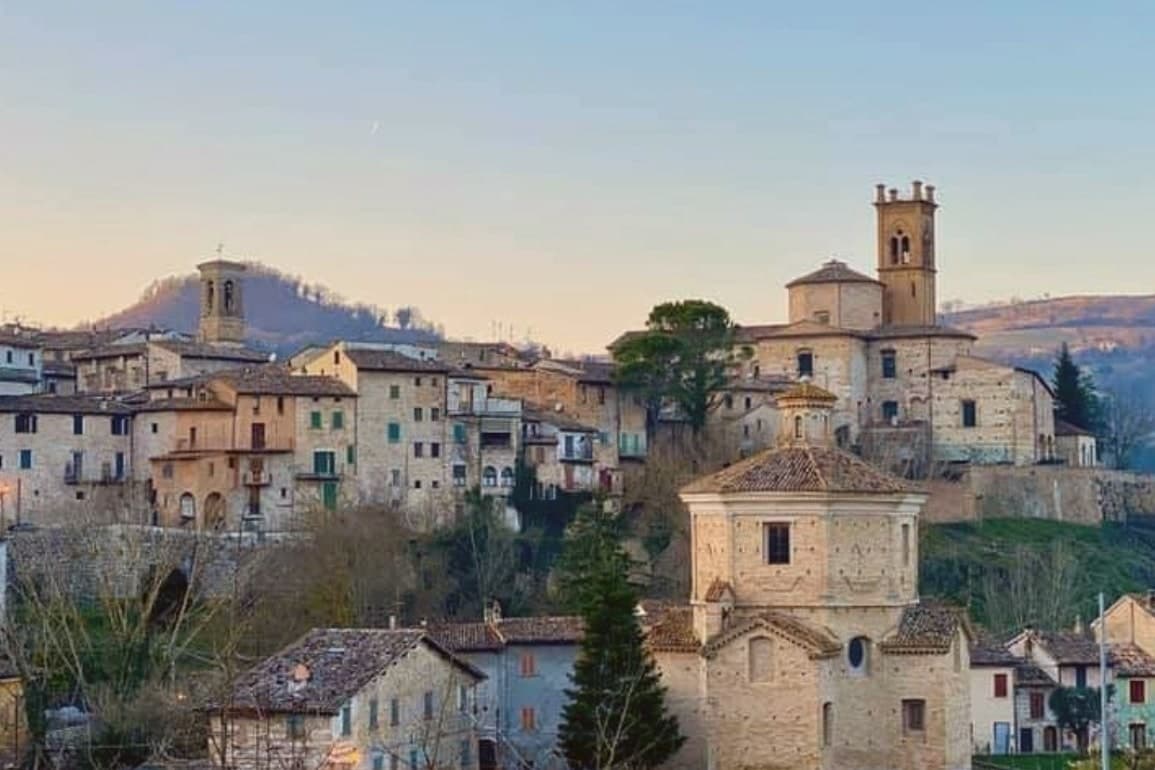
Pergola sits at 265 meters on a terrace at the confluence of the Cesano and the Cinisco, fifty-five kilometers from Ancona in the inland Apennines. The town was founded in 1234 by the people of Gubbio with inhabitants of the surrounding castles, raised on older Roman ground along the Via Flaminia.
The defining find is the Bronzi Dorati da Cartoceto: hundreds of gilded bronze fragments unearthed in June and July 1946 at Santa Lucia di Calamello, in the frazione of Cartoceto, the only surviving group of Roman gilded bronze statues from antiquity. Reassembled into two standing women, two riders and two horses, the group dates to the late Republican period between 50 and 30 BC and is held in the Museo dei Bronzi Dorati, opened on 9 October 1999 in the fourteenth-century convent of San Giacomo.
Pergola is also a Città del Tartufo, with the Mostra Mercato del Tartufo Bianco Pregiato running across three weekends in October.
What to see in Pergola
- Museo dei Bronzi Dorati e della Città di Pergola. Opened 9 October 1999 in the fourteenth-century former convent of San Giacomo, holding the only surviving group of Roman gilded bronze statues, found at Cartoceto in 1946.
- Bronzi Dorati da Cartoceto di Pergola. Two standing women, two riders and two horses in gilded bronze from the late Republican period, 50 to 30 BC, the only surviving group of its kind in the world.
- Cattedrale di San Secondo. Pergola was a co-cathedral diocese until 1986; the cathedral on the central piazza holds works tied to the medieval and renaissance town.
How to get to Pergola
Ancona is roughly 75 minutes away by road.
Our tip
April through June and September into October are the best months for Pergola. The Cesano valley turns green in spring, the white truffle woods open from late September, and the inland Apennine air stays clearer than the coast on summer days. July and August touch the high twenties at 265 meters, with the centro storico quietest through midday. Sagra delle Tagliatella falls in August.
Mondolfo
Why visit Mondolfo
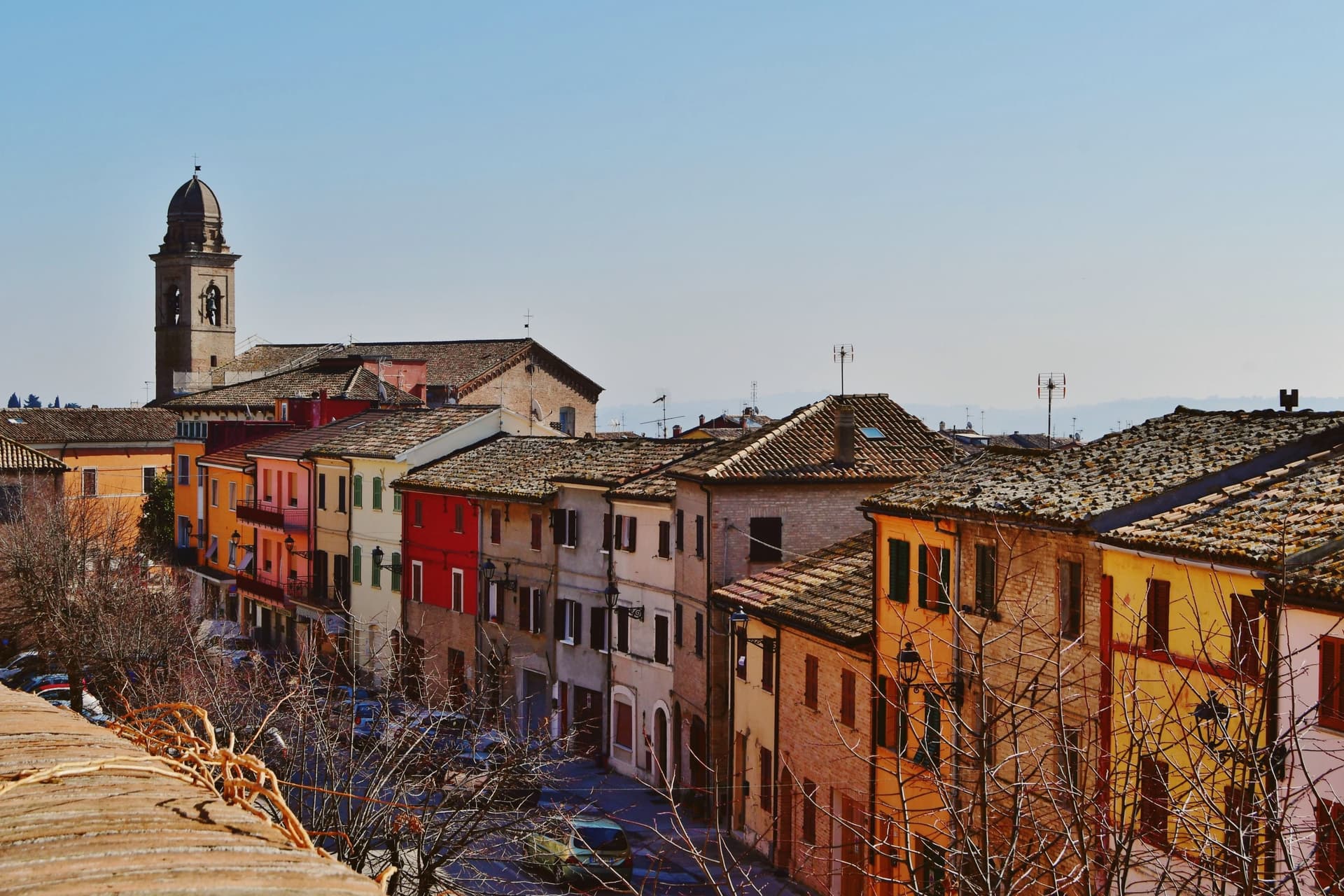
Mondolfo sits at 144 meters on a ridge above the Adriatic between Pesaro and Senigallia, with the coastal frazione on the beach four kilometers below. A Byzantine castle stood here in the sixth and seventh centuries, and the present settlement formed around it in the early eleventh, when the Montoffo feudal family gave the town its name.
The Malatesta took the castle in the fourteenth century, then Sigismondo Pandolfo Malatesta lost it to Pope Pius II in 1463, at which point the walls and bastion that still anchor the southwest corner were rebuilt. The friary and church at the heart of the old town were rebuilt twice, first by Antonio di Pietro da Vercelli in 1466 and again under Domenico da Como in 1593.
Mondolfo joined the Borghi più belli d'Italia and holds recognitions for both its coast and its farmland. The town is a single history in two elevations: the ridge held the castle and later the fortified center, while the shore below, reached across the four kilometers of farmland now recognized for its management, grew into the seafront community that carries the coastal recognitions today.
What began as a Byzantine strongpoint and passed through Malatesta and papal hands still reads as a hill town looking down at its own beach.
What to see in Mondolfo
- Mura Roveresche. Roughly 600 meters of fifteenth-century walls and the south-west bastion, redesigned by the Della Rovere for early artillery defense after 1463.
- Complesso Monumentale di Sant'Agostino. Augustinian friary and church from the late thirteenth century, rebuilt in 1466 and again in 1593, now home to the civic museum and the Sant'Agostino complex.
- Centro storico. Walled hill borgo with narrow streets, the Palazzo del Comune and the Chiesa di Santa Giustina at the heart of the perimeter.
How to get to Mondolfo
There is a railway station in the town, so you can arrive without a car and never need one while you are here. Ancona is roughly 44 minutes away by road.
Our tip
May through September is the main window for Mondolfo. The Marotta seafront opens from late spring, the Bandiera Blu lido water clears from June, and the hill borgo above stays a few degrees cooler than the beach. July and August fill the lungomare with the worst of the coast traffic; the walled borgo above keeps quieter. Festa del Mare falls in August.
Vallefoglia
Why visit Vallefoglia
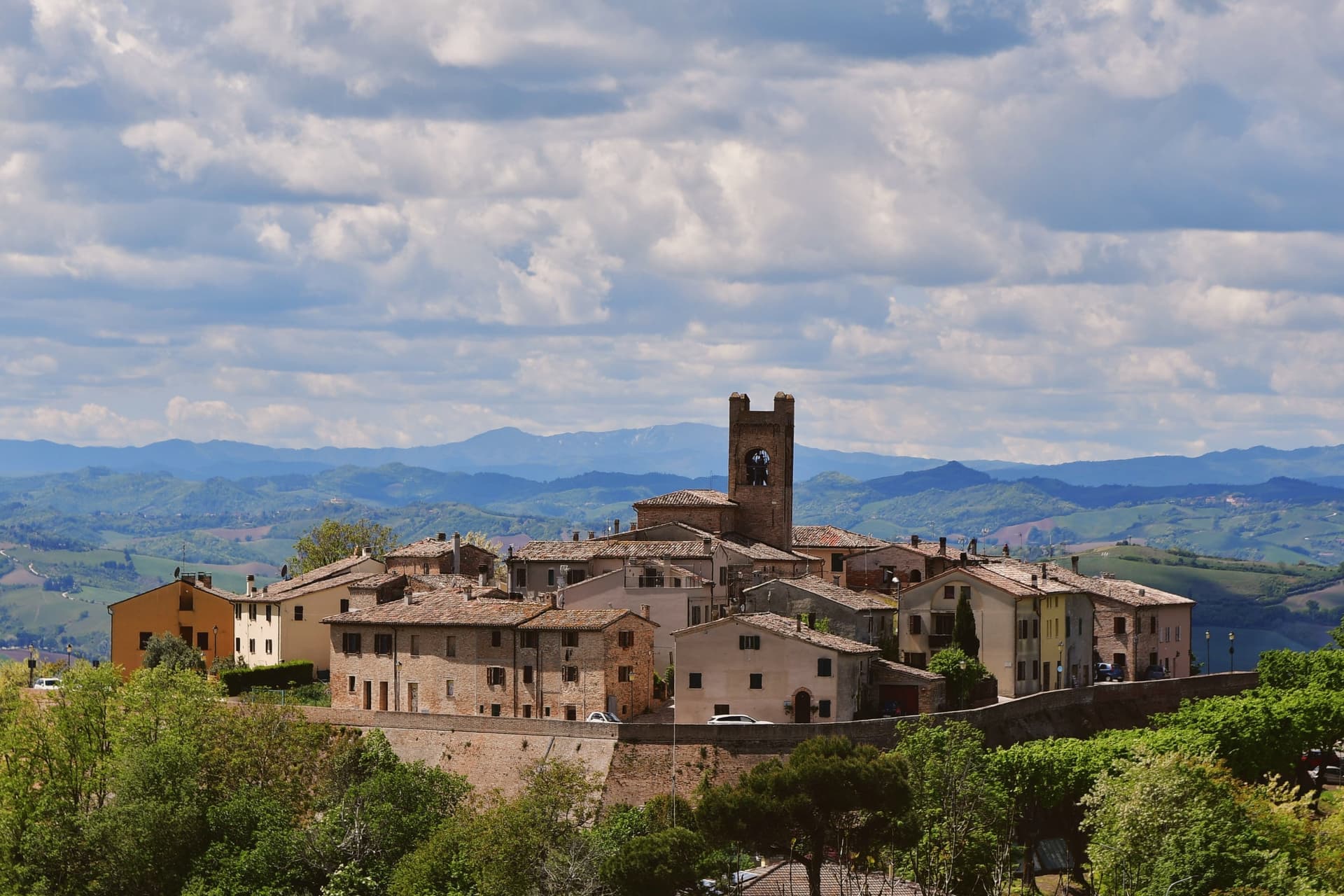
Vallefoglia was created in 2014 by referendum, when 76.3% of voters approved the merger of Colbordolo and Sant'Angelo in Lizzola, two adjacent communes in the Foglia valley between Pesaro and Urbino. The new commune sits at 295 meters and runs along the river that gives it its name, on the route between the Adriatic coast and the Montefeltro hills.
Colbordolo's castle is documented from 1213 in a bull of Pope Innocent III, and in 1446 Sigismondo Pandolfo Malatesta took it from the Montefeltro after a long siege and burned it. Giovanni Santi, the painter who fathered Raffaello, was born in Colbordolo around 1440 and ran the workshop in Urbino where his son trained.
Sant'Angelo in Lizzola produced the engineer Giovanni Branca (1571-1645) and the Risorgimento statesman Terenzio Mamiani (1799-1885); the circle of Giulio Perticari and his wife Costanza Monti drew Leopardi and Rossini in the nineteenth century. Olive oil from the valley slopes carries the Città dell'Olio signal.
What to see in Vallefoglia
- Castello di Colbordolo. Medieval castle documented from 1213, contested between the Malatesta and the Montefeltro, burned by Sigismondo Pandolfo Malatesta in 1446 and rebuilt at lower scale.
- Palazzo Mamiani-Della Rovere. Sixteenth-century palace in Sant'Angelo in Lizzola, family seat of the Mamiani della Rovere, who produced Risorgimento statesman Terenzio Mamiani.
- Centro storico di Sant'Angelo in Lizzola. Hilltop nucleus on the right bank of the Foglia, with the Piazza della Repubblica, the Chiesa di Sant'Apollinare and views to the Montefeltro ridges.
How to get to Vallefoglia
Rimini is roughly 44 minutes away by road.
Our tip
April through June and September into October are the best months for Vallefoglia. The Foglia valley turns green in spring, the olive groves run silver across the slopes through summer, and the harvest weeks in October fill the small frantoi. July and August touch the low thirties on the valley floor; the higher frazioni at 295 meters and above catch evening breezes from the Montefeltro.
More from Anywhere Italy
- The best small hill towns in the province of Pesaro e Urbino
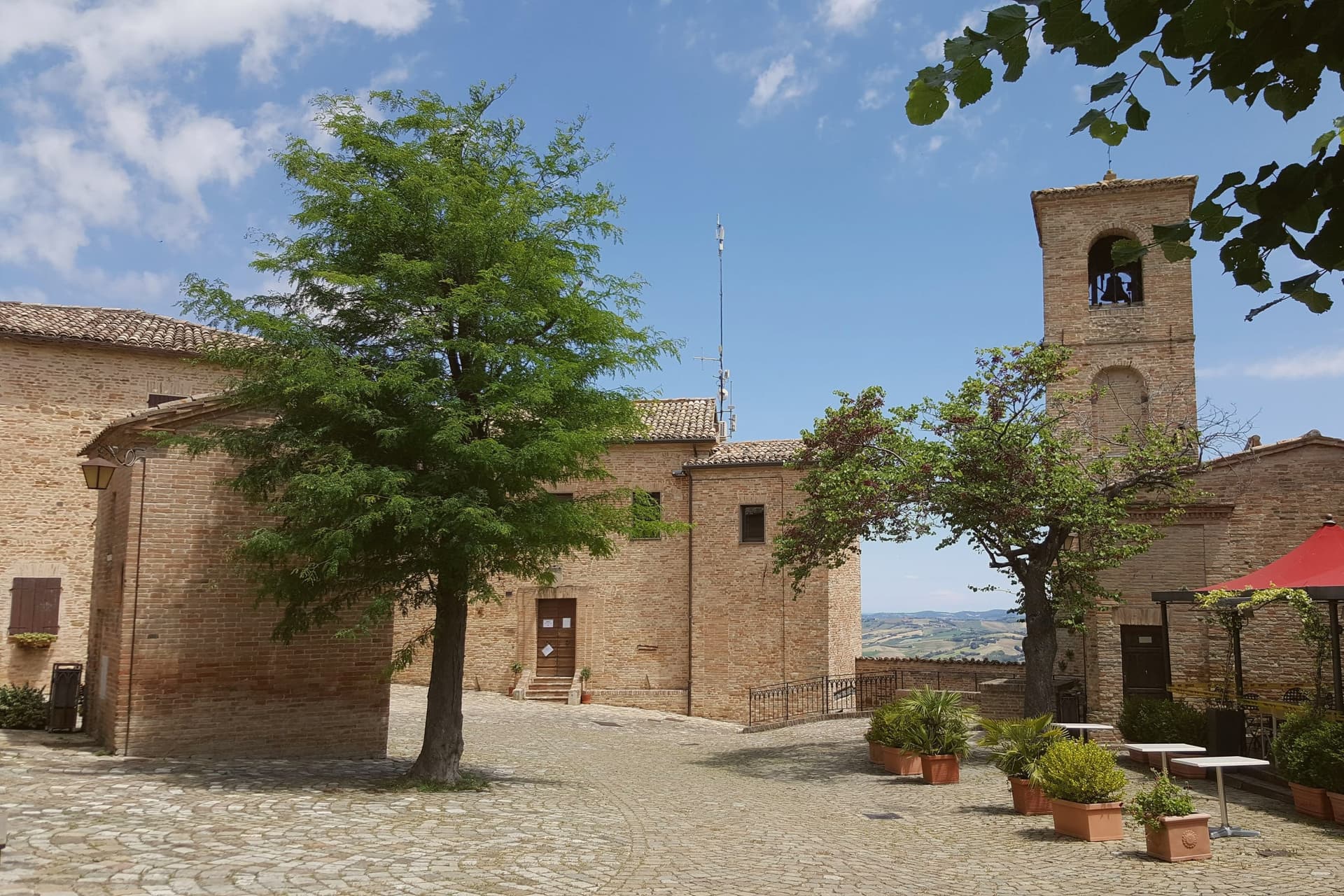 The 9 prettiest villages within 90 minutes of Rimini
- The prettiest small villages within 90 minutes of Rimini
- The 8 prettiest villages that eat well in Marche
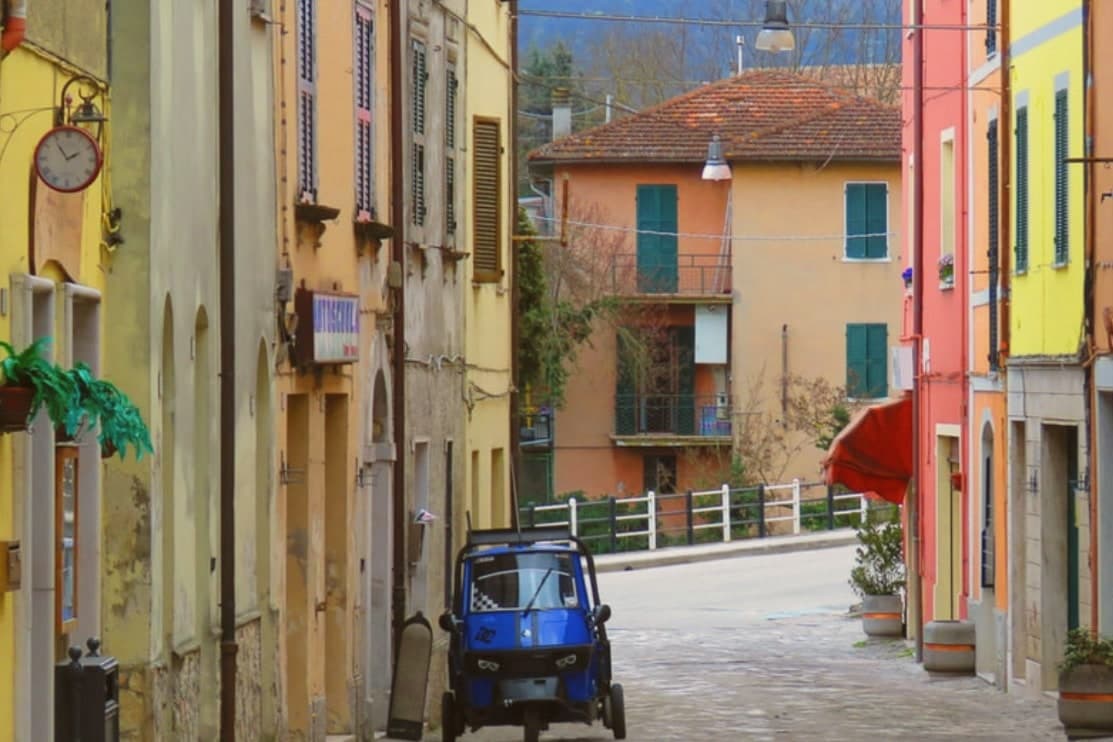 The best towns with a serious restaurant in the province of Pesaro e Urbino
- The best coastal towns within two hours of Bologna