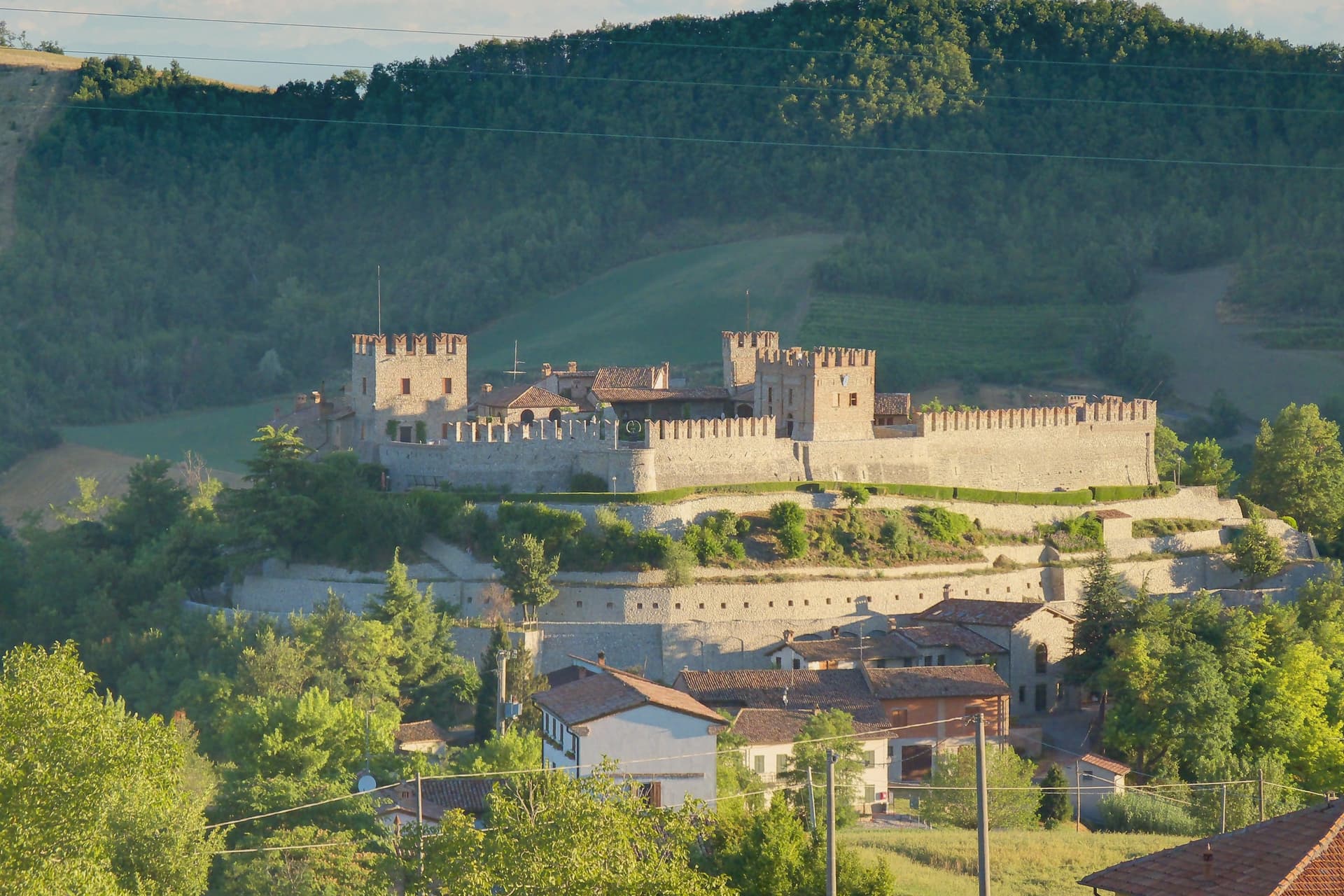
The best hill towns within 75 minutes of Brescia
The country around Brescia flattens into rice fields and industry to the south, then lifts abruptly where the glaciers left their debris. On those moraine hills sit towns of grey limestone and warm brick, with a castle wall or a bell tower marking the highest point and olives and vines running down the slopes below. Autumn is the season that suits them best, when the Valpolicella harvest is in and the local kitchens turn to casoncelli, spiedo bresciano, freshwater fish from the lake and Franciacorta poured cold. Spring brings the wisteria on the old walls and the cherry blossom on the ridges above Garda.
Almost everyone heading this way goes to Sirmione, out on its peninsula with the Scaliger castle and the Roman ruins at the far end. The setting deserves the reputation, but the bridge into the old town is a queue for much of the year, and the lakefront streets are given over to gelato and souvenirs by midsummer. Verona absorbs the rest of the traffic, and between the two the Garda shore can feel like one continuous car park in August.
The same hills carry on inland and northward, and that is where these towns are. Fortified villages on the moraine, wine villages on the Valpolicella terraces, market towns on ridges with the Alps visible on a clear morning. All of them are within a short drive or train ride of Brescia, and fewer people go.
Of the 36 communes we have mapped in a 75-minute drive of Brescia, 6 qualify as hill towns: each stands on high ground rather than on the plain. The smallest, Castellaro Lagusello, has 250 residents.
If you are still choosing, we have also written The best hill towns within 75 minutes of Verona and The best hidden hill towns in Lombardia.
Castellaro Lagusello
Why visit Castellaro Lagusello
Castellaro Lagusello is a frazione of Monzambano on the morainic hills south of Lake Garda, and one of the smallest entries in the Borghi più belli d'Italia network. The village sits inside a tight ring of 13th-century stone walls built by the Scaligeri of Verona, and the single arched gate opens onto the central piazza in front of the parish church of San Nicola.
The defining feature is the small heart-shaped lake below — the laghetto di Castellaro Lagusello, a natural glacial pond formed at the end of the last ice age — which the village overlooks from its low promontory and which has shaped the village's name (Lagusello = "little lake") for centuries. The lakeside path is a marshland reserve protected by the WWF, with birdwatching hides and a constant population of herons and kingfishers.
Villa Tacoli on the south side of the village is privately held but visible from the promenade. The whole place takes less than an hour to walk and is best paired with the morning produce market in Monzambano or an afternoon at the Lago di Garda south shore, twenty minutes away.
What to see in Castellaro Lagusello
- Mura medievali e porta d'ingresso. 13th-century walled ring built by the Scaligeri of Verona, with a single arched gate opening into the village's central piazza.
- Laghetto di Castellaro Lagusello. Small heart-shaped glacial lake below the village, a WWF-protected marshland reserve with birdwatching hides and a circular footpath.
- Chiesa di San Nicola. Parish church on the central piazza, with a 16th-century facade and a single nave looking onto the village's only square.
How to get to Castellaro Lagusello
Verona is roughly 38 minutes away by road.
Our tip
April through October is the open season for the morainic hills south of Lake Garda. May and June bring the wildflowers around the heart-lake and the warmest birdwatching activity. July and August are warmer but the village stays small and uncrowded compared to the Garda shore fifteen kilometers north.
Polpenazze del Garda
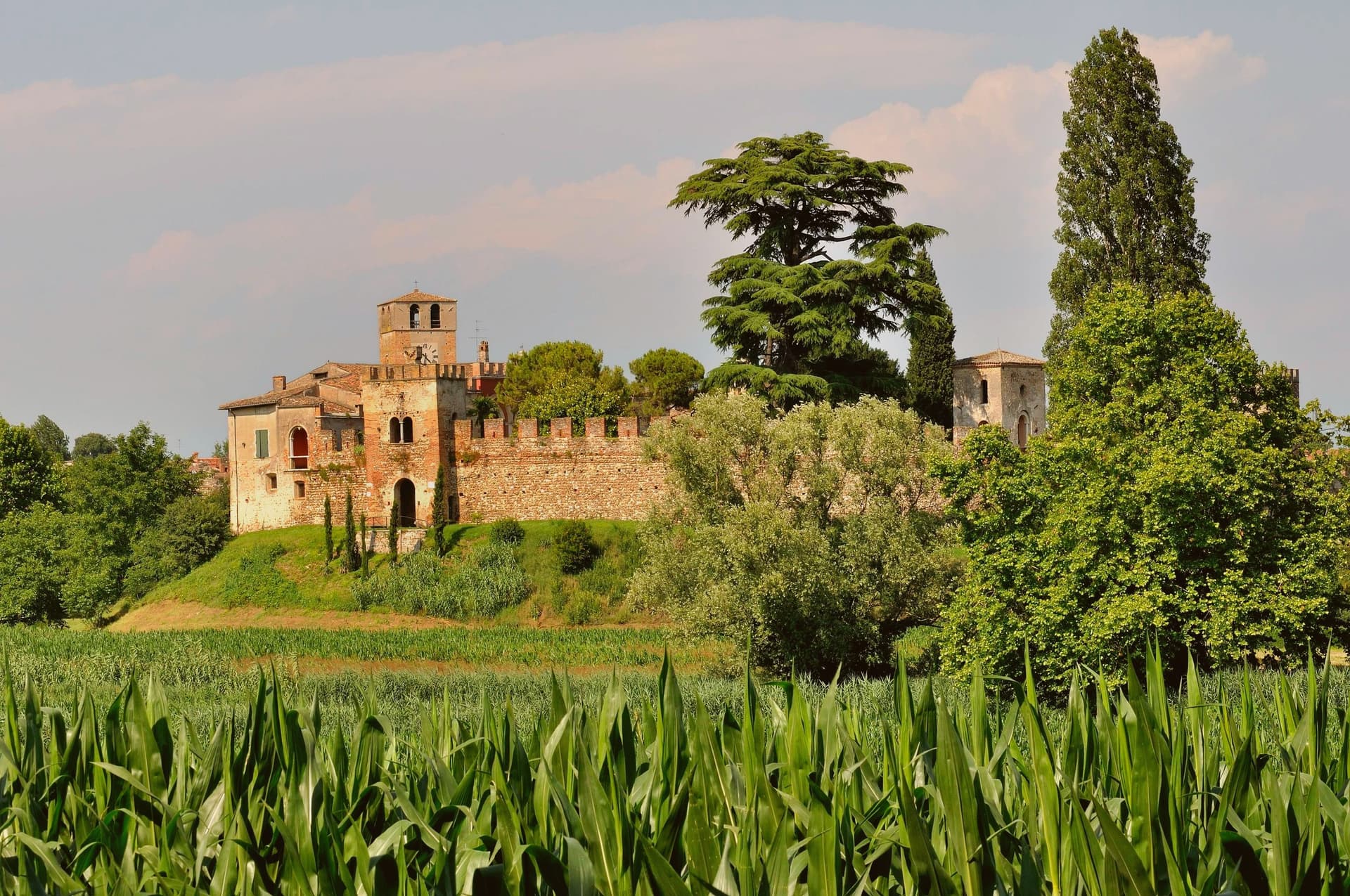
Why visit Polpenazze del Garda
Polpenazze sits on a Valtenesi hill 207 meters above sea level, six kilometers inland from Lake Garda's western shore. The lower ground below the village was once Lake Lucone, a small basin between the hills of Cassaga, Brassina and San Pietro, progressively drained between the fifteenth and eighteenth centuries to recover farmland.
The village itself reads as a set of layers around that basin: the castle and its parish church occupy the high point, the Romanesque pieve stands on the hill facing the drained lake, and the vineyards and olive groves spread across the slopes between. The wine fair in the central piazza draws on the same Valtenesi ground that produces the Chiaretto and Garda Classico rosso poured there each May.
What holds the place together is the drained basin itself: land reclaimed from water now carries vines and olives, while the water's former bed preserved, in its clay, the traces of the people who lived on its edge millennia earlier.
What to see in Polpenazze del Garda
- Castello di Polpenazze. Medieval hilltop castle with the parish church inside its walls, the visible center of the village.
- Pieve di San Pietro in Lucone. Romanesque parish church on the hill above the basin, with twelfth-century frescoes.
- Sito palafitticolo del Lucone. The pile-dwelling site sits in the drained basin sediments, with on-site interpretation panels explaining the wooden tools, vases and fabrics preserved by the wet clay.
How to get to Polpenazze del Garda
Brescia is roughly 34 minutes away by road.
Our tip
April through October is when Polpenazze functions. The wine fair on the last weekend of May is the largest event of the year and fills the village with producers from the Valtenesi and Garda hills. June through August the Lucone path is open and the vineyards work the harvest run-up.
Castell'Arquato
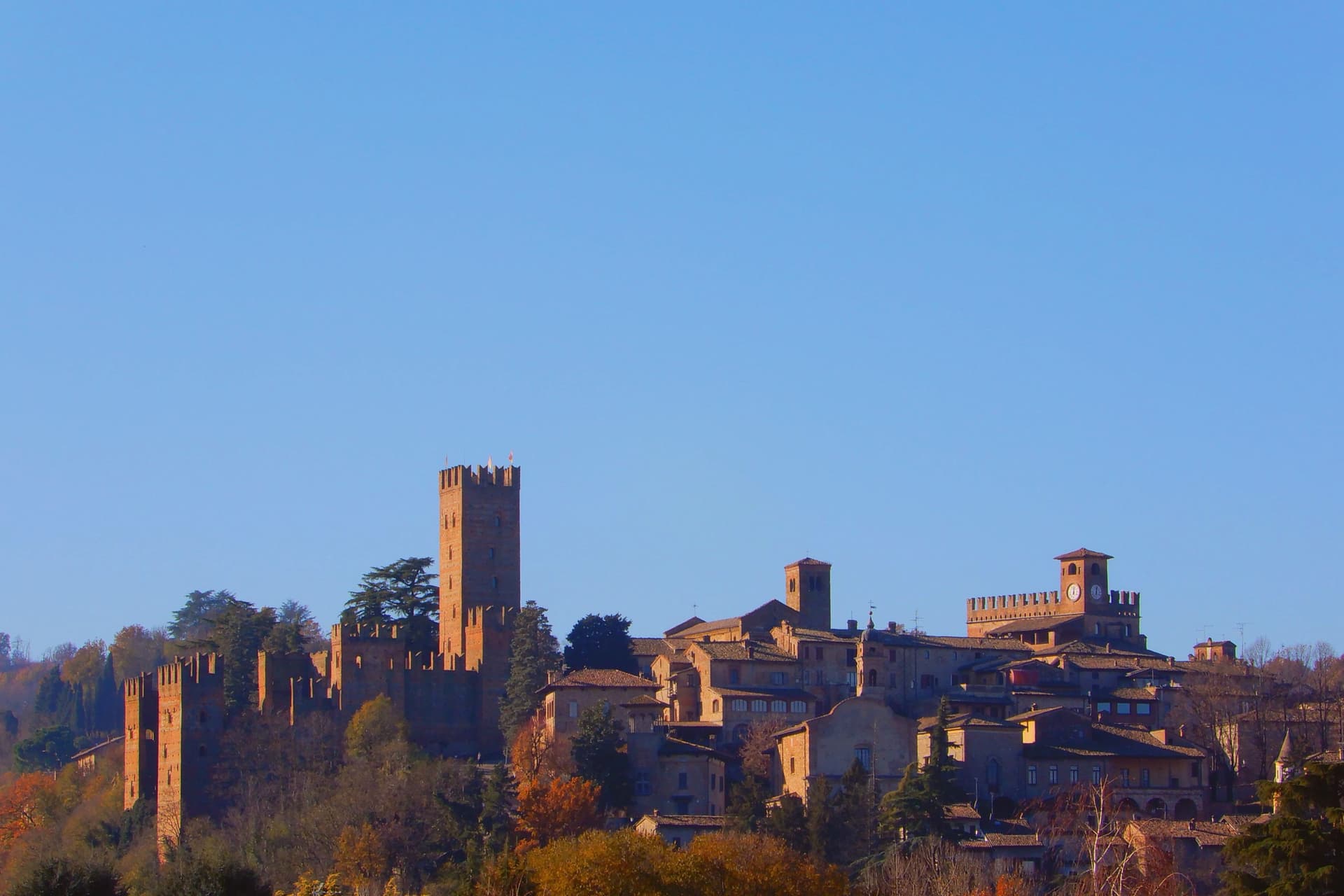
Why visit Castell'Arquato
Castell'Arquato sits on the first hills of the Val d'Arda at 224 meters, thirty kilometers from Piacenza, the medieval borgo arranged in tight concentric levels around the old rock. The Collegiata di Santa Maria, founded by the noble Magnus in the eighth century, was rebuilt in 1122 after the 1117 earthquake destroyed the earlier church and is one of the finest Romanesque buildings in the Piacentino.
The Rocca Viscontea, with its thirty-five-meter tower, was begun in 1342 by Luchino Visconti, lord of Milan, to lock down the valley for Piacenza. The Palazzo del Podestà next door dates from 1292 and still anchors the Piazza Monumentale.
Luigi Illica, the librettist of Tosca, Madama Butterfly, La bohème and Andrea Chénier, was born in town in 1857; the museum dedicated to him sits in the house next to his birthplace. The Val d'Arda hills around the town produce the white wines that earned Castell'Arquato Città del Vino status.
What to see in Castell'Arquato
- Rocca Viscontea. Fortress begun in 1342 by Luchino Visconti for the municipality of Piacenza, with a thirty-five-meter tower at the highest point of the borgo.
- Collegiata di Santa Maria Assunta. Romanesque collegiate church, founded in the eighth century and rebuilt in 1122 after the 1117 earthquake destroyed the earlier structure.
- Palazzo del Podestà. Civic palace from 1292 facing the Collegiata, with the original ghibelline merlons and a fourteenth-century loggia along its lower level.
How to get to Castell'Arquato
Piacenza is roughly 38 minutes away by road.
Our tip
April through June is the best season for the Val d'Arda hills: the vineyards on the slopes below the borgo are green and the air clear enough to see across to the Appennino Piacentino. September and October bring the white-wine harvest and the chestnut weeks. July and August touch thirty-three degrees and the unshaded Piazza Monumentale becomes uncomfortable between noon and four.
Monzambano
Why visit Monzambano
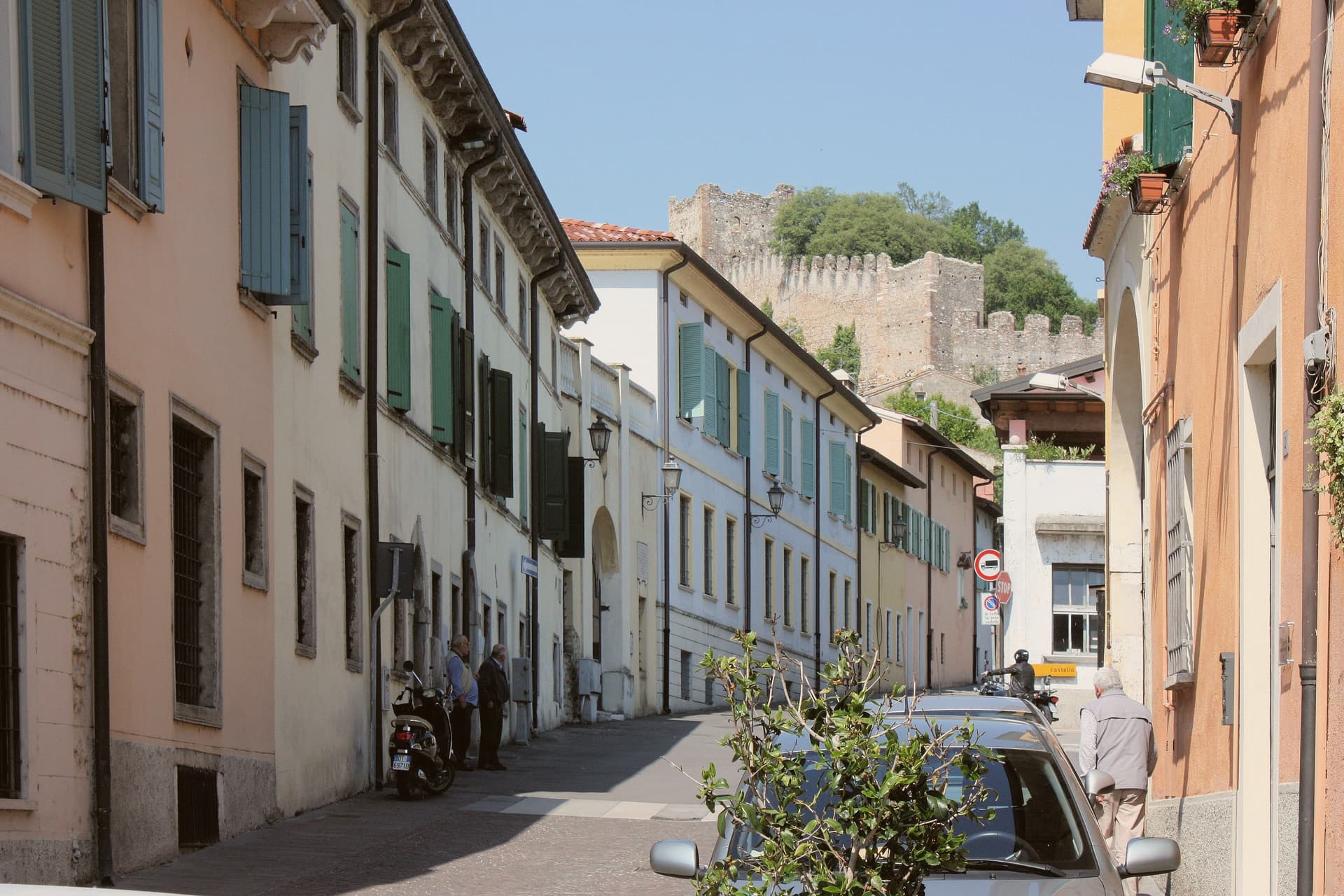
Monzambano sits at 88 meters on the right bank of the Mincio, in the moraine hills the last Alpine glacier pushed up south of Lake Garda. The commune covers 4,800 people across several frazioni, but the one travelers come for is Castellaro Lagusello, a fortified medieval village built around a small heart-shaped lake.
Pope Eugenio III's document of 1145 lists its parish among those of the Diocese of Verona. The castle and walls date to the eleventh and twelfth centuries.
The Gonzaga of Mantua tried and failed to hold it through the Quattrocento, and it passed to Venice, then to Napoleon, who in 1803 annexed it to Monzambano. Pile-dwelling settlements under the lake belong to the Prehistoric Pile Dwellings around the Alps UNESCO site.
The commune holds five institutional signals at once: Borghi più belli, Bandiera Arancione, Borgo dei Borghi finalist, Città del Vino, Città dell'Olio. The wines are Lugana and Garda Colli Mantovani; the oil is Garda DOP.
What to see in Monzambano
- Castellaro Lagusello. Fortified medieval frazione inside crenellated walls and ten towers, set above a heart-shaped lake on a moraine hill.
- Castello di Castellaro. Eleventh- to twelfth-century castle on the hill above the lake, long contested between Mantua and Venice.
- Prehistoric pile dwellings. Submerged Bronze Age stilt-house settlement in the lake, part of the UNESCO Prehistoric Pile Dwellings around the Alps.
How to get to Monzambano
Verona is roughly 39 minutes away by road.
Our tip
April through June and September into October are the months the moraine hills work best. The vines are leafing or harvested, the lake reflects the walls, and the small reserve around Castellaro is open to walkers. July and August get humid and still; Lake Garda is fifteen kilometers away and pulls the day-trippers off the back roads. Sagra di San Bartolomeo falls in August.
Sant'Ambrogio di Valpolicella
Why visit Sant'Ambrogio di Valpolicella
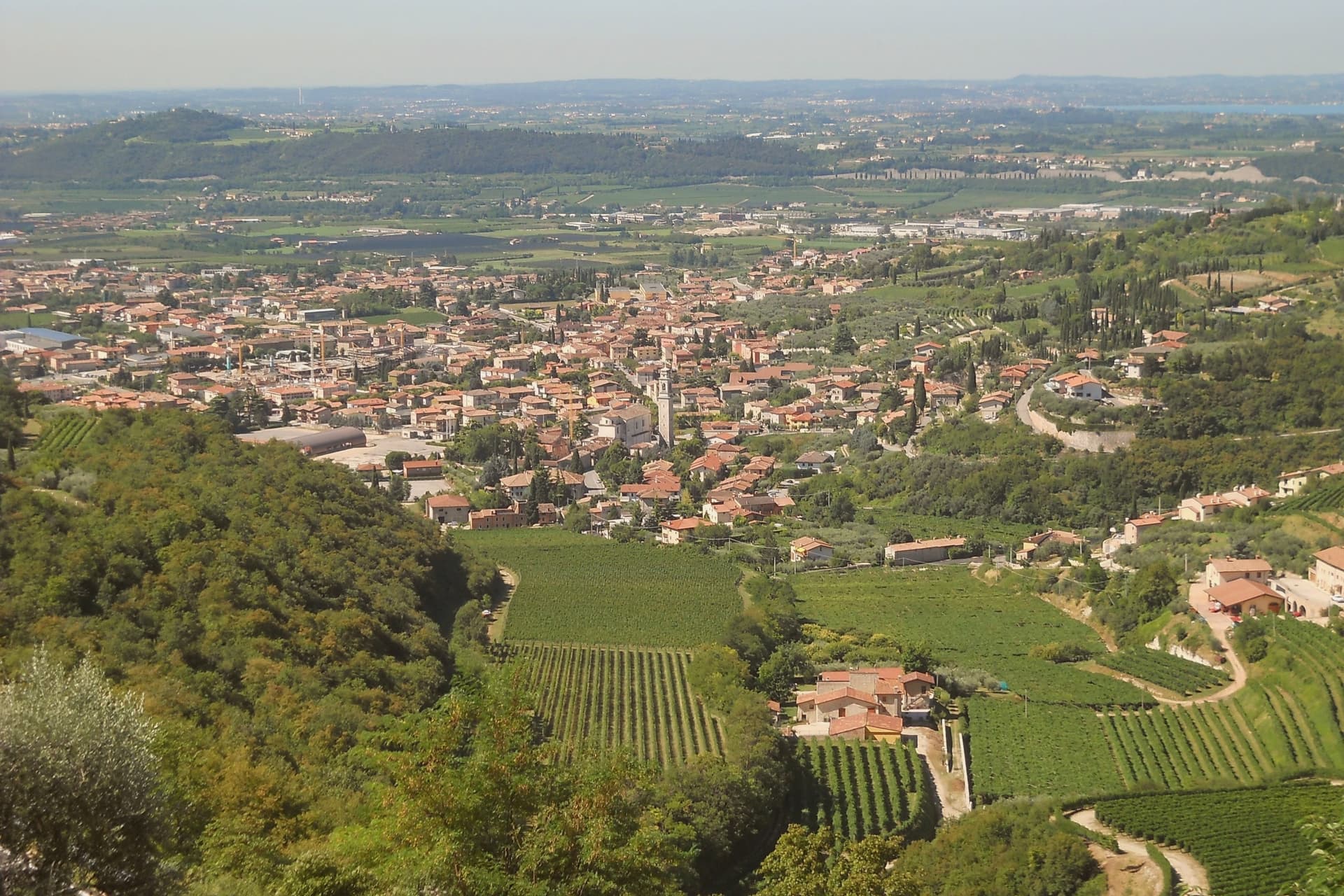
Sant'Ambrogio di Valpolicella sits at 174 meters in the heart of the Valpolicella DOC, fifteen kilometers northwest of Verona, on the rolling hills that close the eastern shore of Lake Garda. The commune groups five frazioni around the main village: Domegliara, Gargagnago, Monte, Ponton and the ridge settlement above them.
Gargagnago sits at the foot of the hills, its cellars closest to the valley floor; the ridge frazione occupies the higher limestone ground, reached by a climb steep enough to have earned the church its nickname. Between them the Serego Alighieri estate has worked the same parcels since Pietro Alighieri, son of Dante the poet who had followed his father into exile in Verona, bought the property in 1353, and the family still grows Corvina, Rondinella and Molinara there, with the Vaio Armaron Amarone counted among the appellation's cru benchmarks.
The pattern of the commune is one of a valley economy and a hill economy sharing a single administrative roof: wine pressed and aged below, an older, stiller settlement kept above it, with the quarries that once supplied Verona still worked on the slopes that join the two.
What to see in Sant'Ambrogio di Valpolicella
- Pieve di San Giorgio Ingannapoltron. Romanesque parish church whose ciborium columns carry an inscription naming the master builder Orso and his disciples Juventino and Juviano.
- San Giorgio di Valpolicella. Frazione on the limestone ridge above the valley, in the Borghi più belli d'Italia network, nicknamed Ingannapoltron for the steep climb up to it.
- Villa Serego Alighieri. Estate still owned by the Alighieri descendants; produces Vaio Armaron Amarone from Corvina, Rondinella and Molinara grown on the same parcels the family has worked.
How to get to Sant'Ambrogio di Valpolicella
There is a railway station in the town, so you can arrive without a car and never need one while you are here. Verona is roughly 34 minutes away by road.
Our tip
April through June and September through October are the months for Valpolicella. The vineyards green up in spring, harvest runs from mid-September into October, and the appassimento drying begins in the cellars while the leaves turn. July and August push past thirty degrees in the valley and the village empties between two and six in the afternoon; cellar visits move to morning slots.
Bergamo
Why visit Bergamo
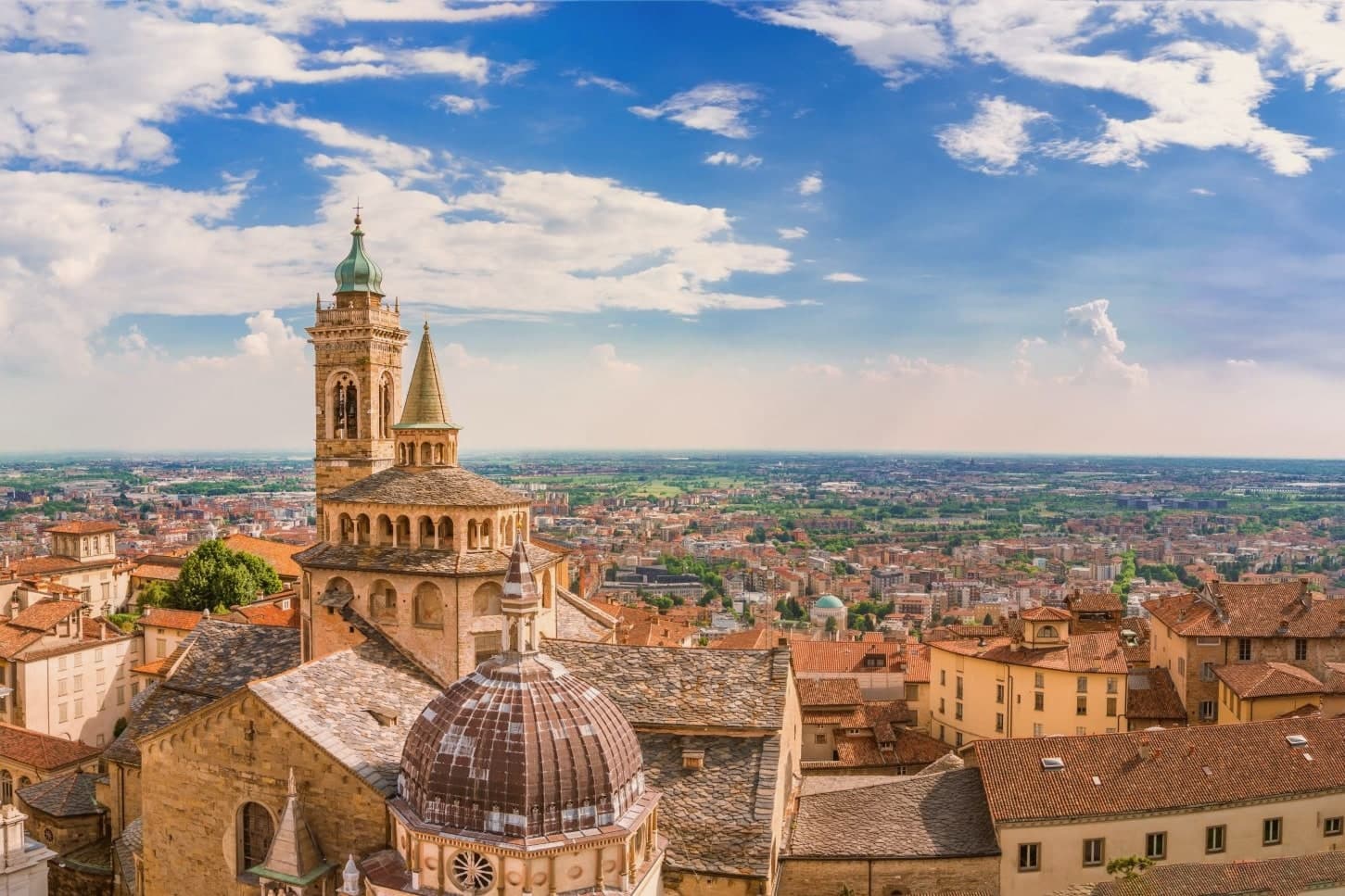
Bergamo's upper town occupies a spur of the Bergamasque foothills, and the lower town spreads onto the plain that runs southwest toward Milan. The walls that ring the hilltop cost the old town more than 250 buildings, including the original cathedral of Sant'Alessandro, demolished to clear ground for the defenses.
The circuit was built as part of a much larger Venetian project, inscribed together with the fortifications at Peschiera, Palmanova and sites on the Dalmatian coast: one defensive system spread across the Republic's frontier, of which this hilltop was the western anchor. The two halves of the city keep their own centuries.
The walled hilltop holds its medieval and Renaissance fabric inside the fortifications, reached by a funicular that has run the same route since the nineteenth century. The lower city is the newer half, built up through the nineteenth and twentieth centuries on the flat ground below.
Bergamo works as a place because that separation stayed intact instead of being built over: a fortified hill town and a modern city sharing one name but occupying two distinct centuries.
What to see in Bergamo
- Mura Venete. Eight bastions and four gates carry the circuit around the ridge of Città Alta, the walkway open along most of its length with views down over the lower town and the plain.
- Piazza Vecchia. Ringed by the Palazzo della Ragione, the Campanone tower, the Contarini fountain and the Biblioteca Mai, this is the square at the top of the funicular climb, the meeting point of Città Alta's streets.
- Basilica di Santa Maria Maggiore. The Romanesque exterior gives no hint of the Baroque interior inside, gilded and heavy with stucco, where the composer's tomb sits among the furnishings.
How to get to Bergamo
There is a railway station in the town, so you can arrive without a car and never need one while you are here. Bergamo is roughly 3 minutes away by road.
Our tip
April through June and September into October are the months Bergamo works best. Città Alta is walkable, the walls open at dawn, and the Accademia Carrara is uncrowded on weekday mornings. July and August are hot on the plain and full on the hill; the funicular waits stretch on weekends.