
The best olive oil towns in Marche
The olive country of Marche sits on the slow slope between the Apennines and the Adriatic, where limestone hills hold the heat and the trees run in ordered rows below towns built of pale brick and travertine. Harvest comes in late autumn, when the fruit is still half green and the mills work into the night, and the new oil pours out cloudy, grassy, with a pepper burn at the back of the throat. It goes on bruschetta, on farro soup, on boiled chard with nothing else, and in Ascoli it goes into the fryer around a stuffed green olive the size of a plum. Local varieties like Raggia, Coroncina and the enormous Ascolana Tenera give oils that taste of artichoke and almond rather than the softer stuff from further south. Every one of these towns belongs to the national association of olive-oil towns, which is the plainest evidence that the oil matters here beyond a souvenir bottle.
Most people who come to this part of Italy for food go to Tuscany instead, where the oil has a century of marketing behind it and the roads through Chianti fill up from spring onwards. The mills there run tasting rooms with fixed opening hours, the agriturismi book out months ahead, and the price of a half litre reflects the postcode as much as the pressing. It is good oil and the landscape earns its reputation. It is also busy, expensive, and photographed to the point of familiarity.
The same hills and the same trees carry on east across the Apennine watershed into Marche, and the oil culture carries on with them, minus the queue. The towns here still press for their own tables, sell from the frantoio rather than the boutique, and put the year's oil on the menu in November without ceremony. Some sit high on ridges above the Esino and the Tronto, others look straight at the Adriatic. Fewer travellers go, which is the only real difference.
Of the 63 communes we have mapped in Marche, 8 qualify as olive oil towns: each belongs to the national association of olive-oil towns. The smallest, Serra San Quirico, has 2,540 residents.
If you are still choosing, we have also written The best towns with a food festival that eat well in Marche and The 9 best towns inside a nature park in Marche.
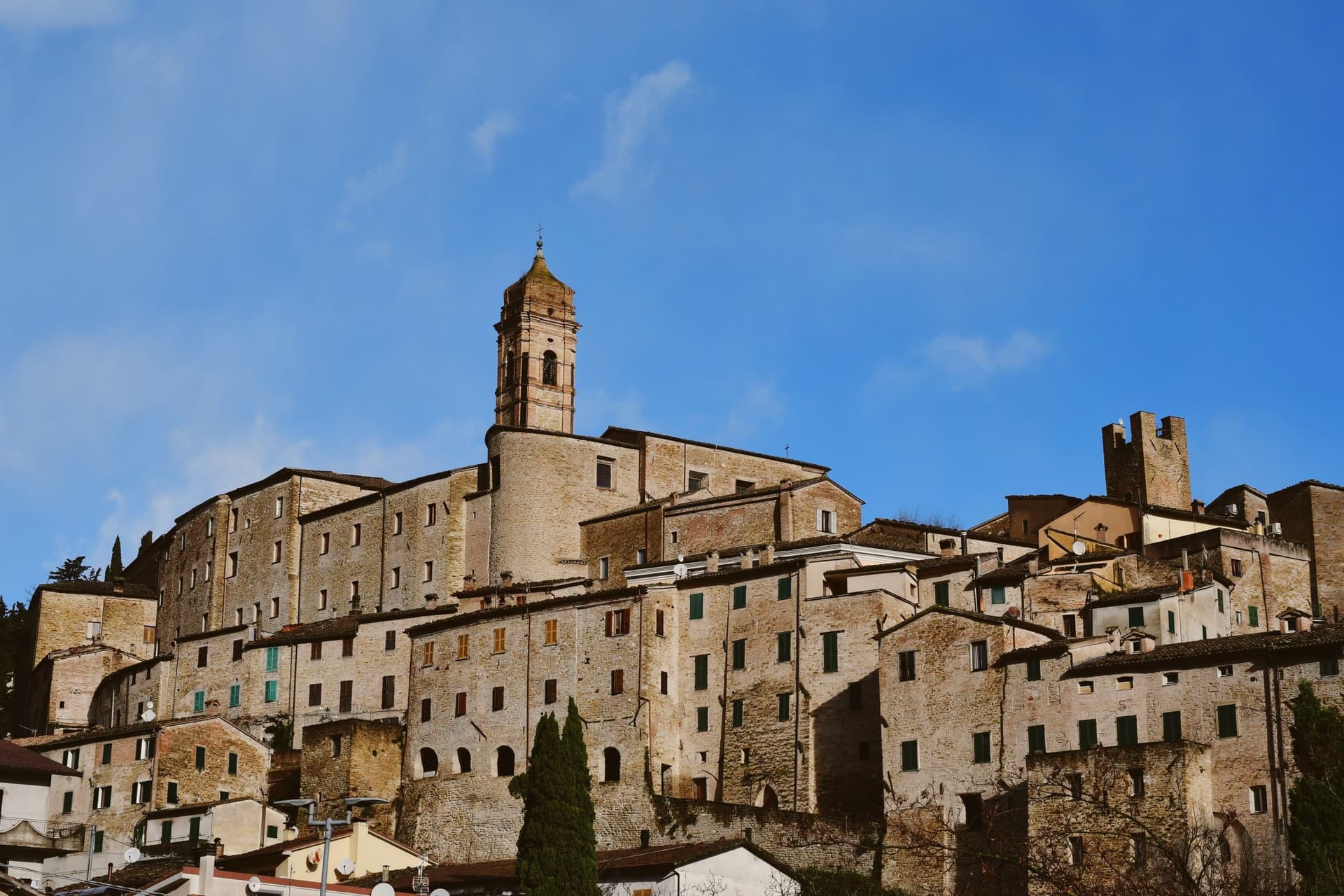
Serra San Quirico
Why visit Serra San Quirico
Serra San Quirico sits at 409 meters on the left bank of the Esino river, at the foot of Monte Murano and the entrance to the Gola della Rossa, forty-five kilometers from Ancona. Etruscan, Picene and Roman remains have been found in the area; the Romans established a military garrison that grew into the original village.
The medieval town is built almost entirely in stone and rock, ringed by walls dating to around 1300. Above those walls run the Copertelle, covered passageways that line the outer circuit, the true visual signature of the borgo.
The Santa Lucia complex, the former monastery in the centro storico, houses the headquarters of the Parco Naturale Regionale della Gola della Rossa e di Frasassi, the 9,167-hectare regional park that runs from Serra south to the Frasassi caves. The Chiesa di Santa Lucia, baroque inside with marble decoration and gold-leaf stucco, sits next door.
The Festa del Centro Storico in late July fills the stone lanes with theatrical reenactments.
What to see in Serra San Quirico
- Le Copertelle. Covered passageways running above the medieval outer walls from around 1300, the true visual signature of the stone borgo.
- Chiesa di Santa Lucia. Baroque church in the centro storico, with marble decoration, gold-leaf stucco and a Pasqualino Rossi seventeenth-century altarpiece.
- Parco Naturale Gola della Rossa e di Frasassi. 9,167-hectare regional park with headquarters at the Santa Lucia complex in the centro storico, running south to the Frasassi caves.
How to get to Serra San Quirico
There is a railway station in the town, so you can arrive without a car and never need one while you are here. Ancona is roughly 49 minutes away by road.
Our tip
April through June and September into October are the best months for Serra San Quirico. The Esino valley turns green from April, the Gola della Rossa runs cool through the limestone walls, and the autumn light brings out the stone of the Copertelle along the outer ring. July and August touch the high twenties at 409 meters; the gorge stays cooler than the valley floor and the centro storico catches afternoon breezes off the ridge. Sagra del Coniglio in Porchetta falls in July.
Ripatransone
Why visit Ripatransone
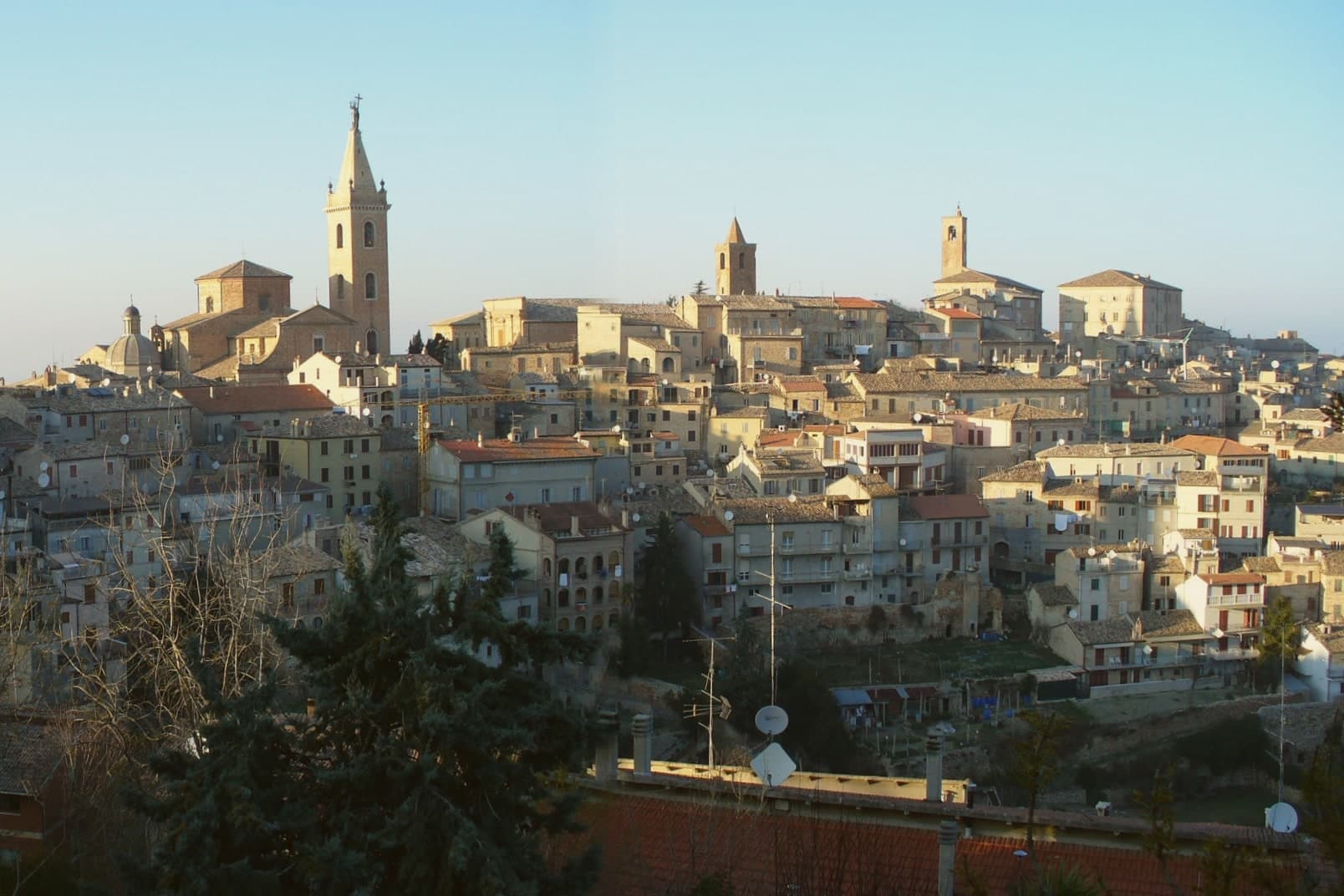
Ripatransone sits at 494 meters on a ridge between the Tesino and Menocchia valleys, twenty kilometers from Ascoli Piceno and seven from the Adriatic, with views from the Sibillini and Gran Sasso to the coast that earned it the nickname Belvedere del Piceno. The hill has been inhabited since prehistory and was settled by the Umbri and then the Piceni; after centuries of Roman quiet a medieval town grew here from a circle of castles unified in 1096.
Pope Pius V raised it to City and diocesan see in 1571. The name combines ripa, cliff, with Transone, the first feudal lord.
The Vicolo più stretto d'Italia, the narrowest alley in Italy at 43 centimeters and 32 at its tightest point, runs between two stone houses near Via Margherita: shoulders go sideways. The Cavallo di Fuoco, a wooden horse covered in fireworks that gallops across the main piazza on the Sunday after Easter, has run since 1682.
Iervasciò, Trattoria da Rita have been named by a guide.
What to see in Ripatransone
- Vicolo più stretto d'Italia. The narrowest alley in Italy, 43 centimeters wide and 32 at its tightest point, between two stone houses near Via Margherita.
- Piazza XX Settembre. The main square of the centro storico, with the Palazzo del Podestà, the Cathedral of San Gregorio Magno and the medieval Torre Civica.
- Cattedrale di San Gregorio Magno. Cathedral built between the seventeenth and eighteenth centuries on the site of an earlier church, raised to cathedral status by Pope Pius V in 1571.
How to get to Ripatransone
Pescara is roughly 70 minutes away by road.
Our tip
April through June and September into October are the working months for Ripatransone. The Tesino and Menocchia valleys turn green from April, the Cavallo di Fuoco runs on the Sunday after Easter, and the autumn light brings the clearest views from the ridge across to the Sibillini and the sea. July and August touch the low thirties; the ridge breeze keeps the centro storico cooler than the coastal plain seven kilometers below. Festival Frittella di Zia Maria falls in September.
Gradara
Why visit Gradara
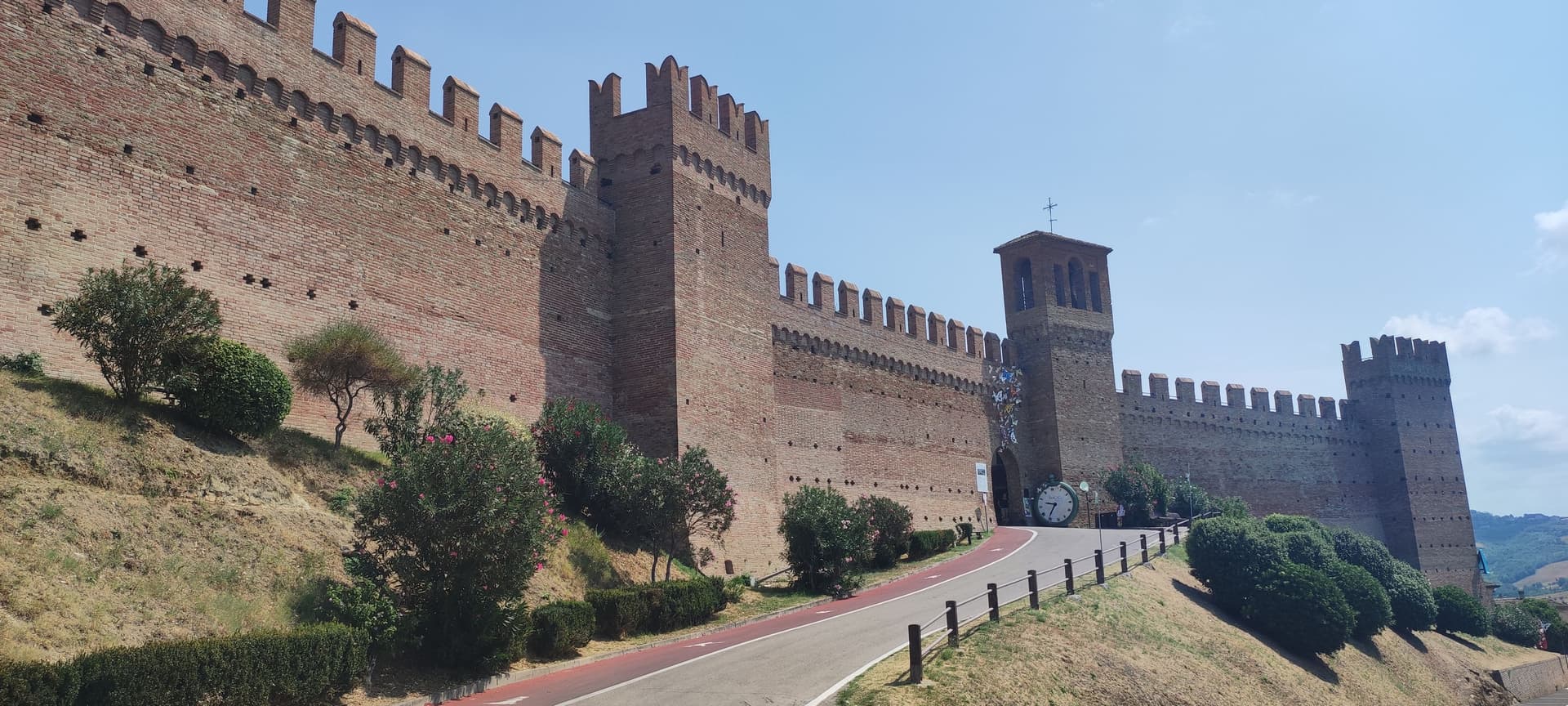
Gradara sits at 142 meters on a hill three kilometers from the Adriatic, at the northern border of the Marche with Romagna. The castle was begun in the twelfth century by Pietro and Ridolfo del Grifo and completed in the fifteenth, when the Malatesta extended the double ring of walls that still runs almost 800 meters around the borgo.
In the fifth canto of the Inferno, Dante placed Paolo and Francesca here: around 1275 Guido da Polenta of Ravenna married his daughter Francesca to Giovanni Malatesta and sent his younger brother Paolo as proxy. The two fell in love.
Gianciotto Malatesta caught them and killed both. Whether the killing happened at Gradara, Pesaro or Rimini is disputed among scholars; tradition keeps it here.
The borgo was voted Borgo dei Borghi by RAI viewers in 2018. The Castello and the Camerino di Lucrezia draw most visitors.
Olive groves around the walls supply the Cartoceto DOP oil.
What to see in Gradara
- Castello di Gradara. Twelfth-century rocca completed by the Malatesta in the fifteenth century, one of the best-preserved medieval fortresses in Italy, with the Camerino di Lucrezia frescoed cycle.
- Mura medievali. Double ring of fourteenth and fifteenth-century walls running almost 800 meters around the borgo, walkable along the camminamento.
- Camera di Paolo e Francesca. Frescoed chamber inside the castle, traditionally identified as the room where Dante set the killing of the two lovers.
How to get to Gradara
Rimini is roughly 30 minutes away by road.
Our tip
May through September is the working season for Gradara. The hill is dry from late April, the castle and walls are open every day, and the literary park below the rocca turns green into June. July and August bring the heaviest crowds: the proximity to Cattolica and Gabicce Mare puts seaside families on the castle road and the borgo's narrow streets fill from mid-morning. Giovedì al Castello - Rievocazione storica falls in August.
Cingoli
Why visit Cingoli
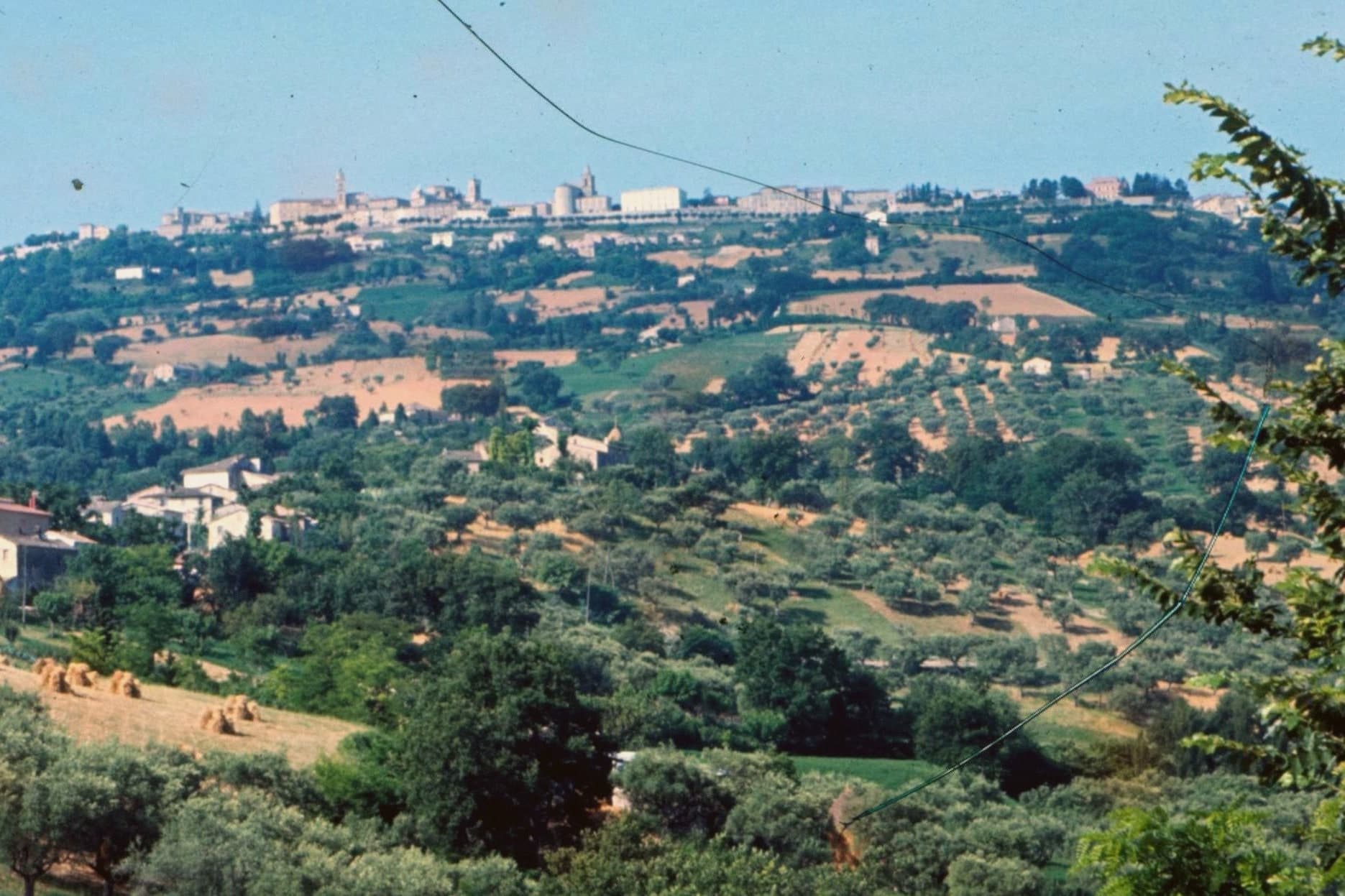
Cingoli sits at 631 meters on a hill above the Macerata province, thirty-five kilometers from Ancona and twenty-seven from Macerata. The town is known as the Balcone delle Marche for the belvedere that on a clear day takes in the Sibillini, the entire region, and the Croatian coast across the Adriatic.
The site is older than its medieval walls: ancient Cingulum was founded and fortified in 63 BC by Titus Labienus, Julius Caesar's lieutenant, at his own expense, on the bones of an earlier Picene settlement. The town held municipium status under Rome and became important again during the civil wars.
Cingoli is the birthplace of Pope Pius VIII, Francesco Saverio Castiglione, born here in 1761. Lorenzo Lotto painted the Madonna del Rosario altarpiece for the Dominican church here between 1537 and 1539, the work that still anchors the town's art holdings.
What to see in Cingoli
- Belvedere di Cingoli. The viewpoint that gives the town its Balcone delle Marche nickname, with views over the Macerata hills, the Sibillini and on clear days the Croatian coast.
- Madonna del Rosario di Lorenzo Lotto. Altarpiece painted by Lorenzo Lotto between 1537 and 1539 for the Dominican church of San Domenico, the town's defining work of art.
- Cattedrale di Santa Maria Assunta. Eighteenth-century cathedral rebuilt for Pope Pius VIII, the local-born pope whose pontificate ran 1829 to 1830.
How to get to Cingoli
Ancona is roughly 52 minutes away by road.
Our tip
April through June and September into October are the months for Cingoli. The hilltop catches the Adriatic breeze, the clear days for the belvedere fall most often in spring and early autumn, and the olive harvest below town runs through October. July and August are warm at 631 meters but cooler than the coastal towns, and Lago di Castreccioni below the village fills with weekend visitors from Ancona and Macerata. Festa del Paese falls in August.
Vallefoglia
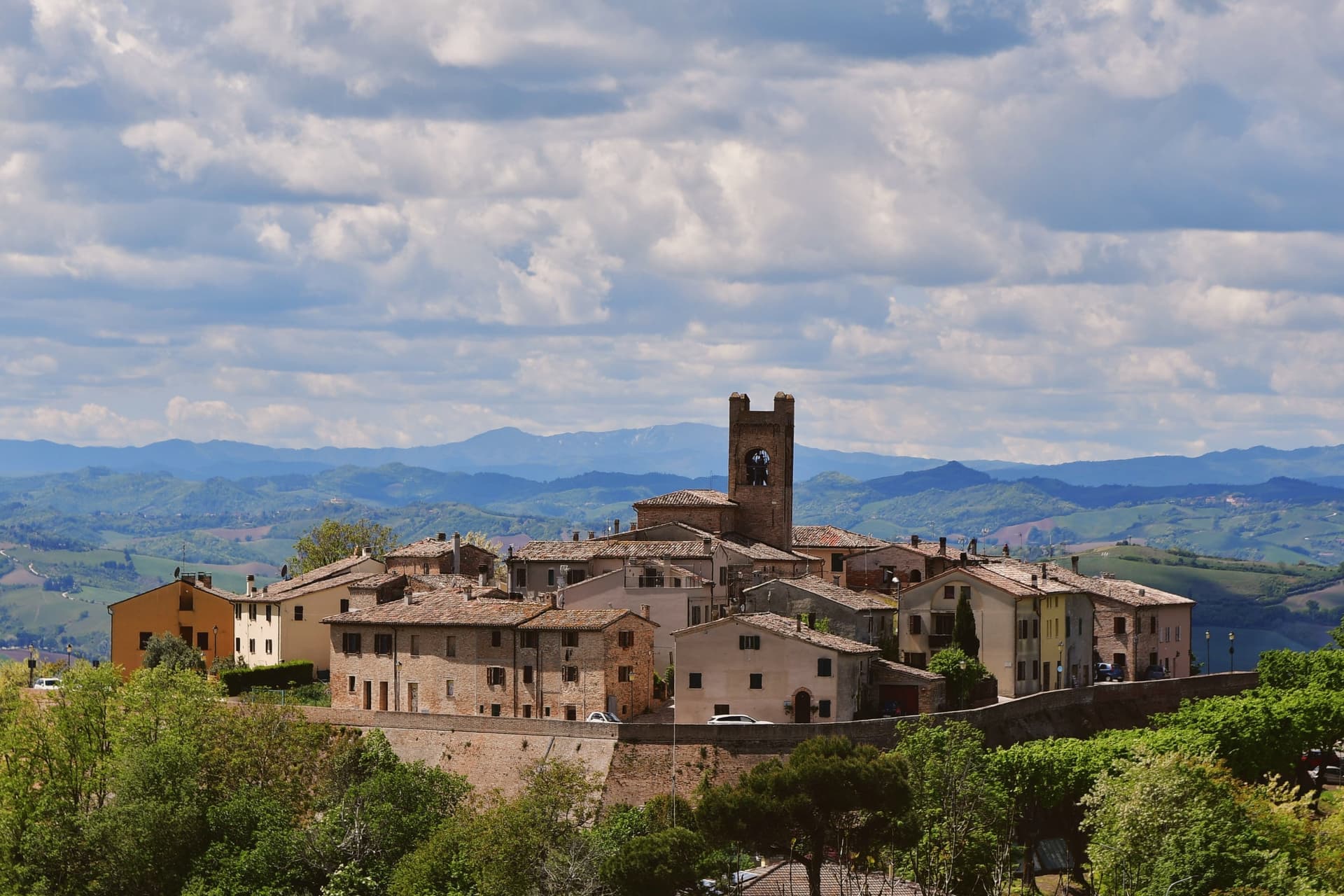
Why visit Vallefoglia
Vallefoglia was created in 2014 by referendum, when 76.3% of voters approved the merger of Colbordolo and Sant'Angelo in Lizzola, two adjacent communes in the Foglia valley between Pesaro and Urbino. The new commune sits at 295 meters and runs along the river that gives it its name, on the route between the Adriatic coast and the Montefeltro hills.
Colbordolo's castle is documented from 1213 in a bull of Pope Innocent III, and in 1446 Sigismondo Pandolfo Malatesta took it from the Montefeltro after a long siege and burned it. Giovanni Santi, the painter who fathered Raffaello, was born in Colbordolo around 1440 and ran the workshop in Urbino where his son trained.
Sant'Angelo in Lizzola produced the engineer Giovanni Branca (1571-1645) and the Risorgimento statesman Terenzio Mamiani (1799-1885); the circle of Giulio Perticari and his wife Costanza Monti drew Leopardi and Rossini in the nineteenth century. Olive oil from the valley slopes carries the Città dell'Olio signal.
What to see in Vallefoglia
- Castello di Colbordolo. Medieval castle documented from 1213, contested between the Malatesta and the Montefeltro, burned by Sigismondo Pandolfo Malatesta in 1446 and rebuilt at lower scale.
- Palazzo Mamiani-Della Rovere. Sixteenth-century palace in Sant'Angelo in Lizzola, family seat of the Mamiani della Rovere, who produced Risorgimento statesman Terenzio Mamiani.
- Centro storico di Sant'Angelo in Lizzola. Hilltop nucleus on the right bank of the Foglia, with the Piazza della Repubblica, the Chiesa di Sant'Apollinare and views to the Montefeltro ridges.
How to get to Vallefoglia
Rimini is roughly 44 minutes away by road.
Our tip
April through June and September into October are the best months for Vallefoglia. The Foglia valley turns green in spring, the olive groves run silver across the slopes through summer, and the harvest weeks in October fill the small frantoi. July and August touch the low thirties on the valley floor; the higher frazioni at 295 meters and above catch evening breezes from the Montefeltro.
Senigallia
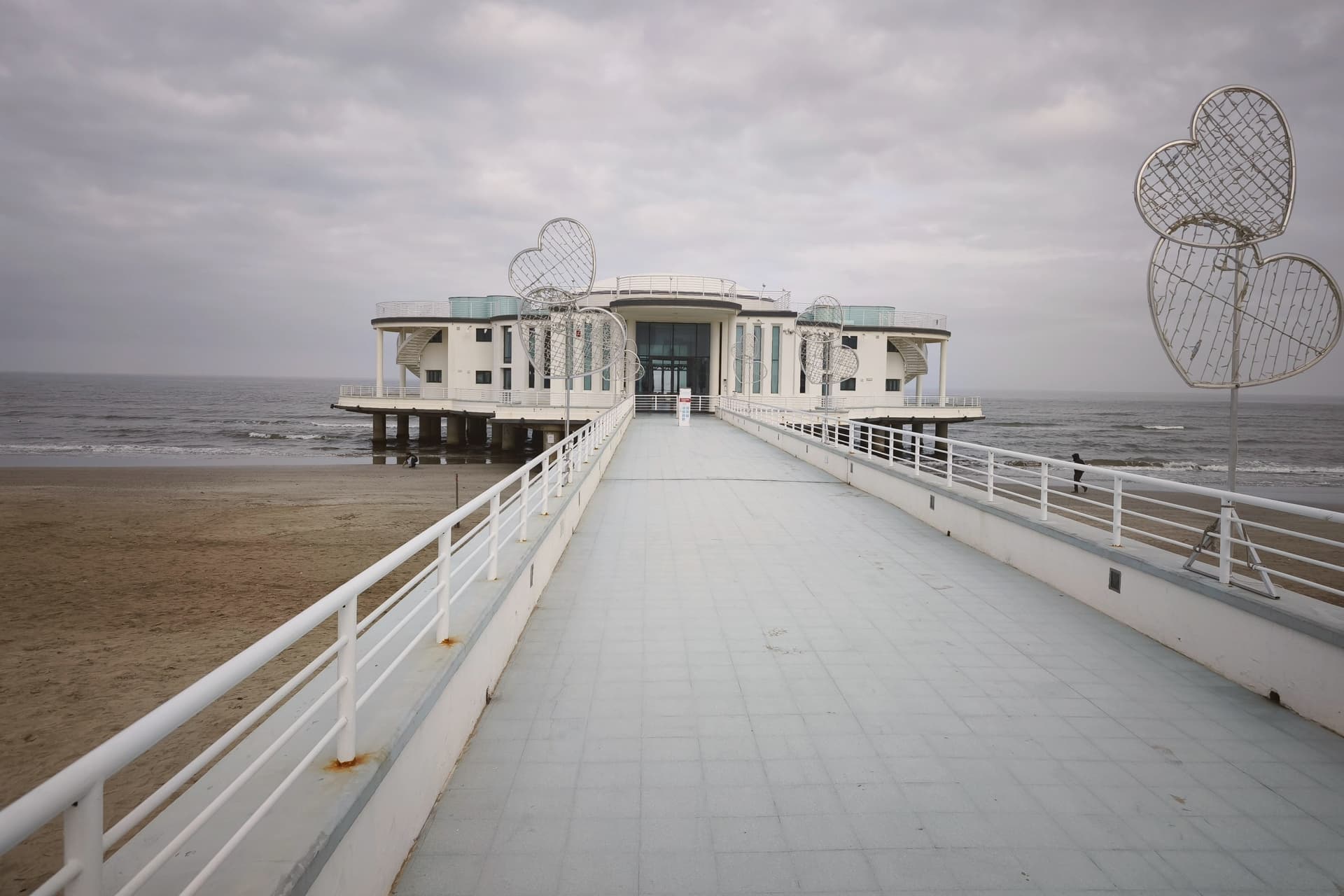
Why visit Senigallia
Senigallia sits at the mouth of the Misa river on the Adriatic, twenty-five kilometers north of Ancona. The centro storico gathers along the river's right bank, where the arcades face the water, while the fortress stands apart as the town's layered military record, built up over two centuries by successive rulers rather than in one campaign.
The beach runs south from this old core as a separate register of the town entirely, thirteen kilometers of it, with the pier pavilion marking the center of that beachfront and the restaurant anchoring its southern end. The photographer worked in the town all his life, and the permanent section of his prints sits inland in the Palazzo del Duca rather than anywhere near the coast he might have photographed.
The market arcade, built in the nineteenth century, still does the ordinary work of feeding the town between the historic river frontage and the modern beach economy. Senigallia reads, then, as three towns joined at the river mouth: a fortified old center, a nineteenth-century civic one, and a twentieth-century coastline, each still doing the job it was built for.
Uliassi, Madonnina del Pescatore, Cuoco di Bordo and 4 more have been named by a guide.
What to see in Senigallia
- Spiaggia di Velluto. The Bandiera Blu beach, working spine of the town's summer, its sand fine enough underfoot to explain the name.
- Rocca Roveresca. Layered fortress combining Albornoz's fourteenth-century Rocchetta, the 1450 Malatesta keep and the Della Rovere completion by Laurana and Pontelli.
- Rotonda a Mare. Art-deco pier pavilion completed 1933, set on iron piles above the water at the center of the beachfront, restored and used for exhibitions and weddings.
How to get to Senigallia
There is a railway station in the town, so you can arrive without a car and never need one while you are here. Ancona is roughly 41 minutes away by road.
Our tip
May through September is the Senigallia window: the beach bagni open from late May, the Caterraduno radio festival fills late June, the Summer Jamboree rockabilly week runs through early August, and the September sea stays warm through the start of school. July and August touch the high twenties with humid Adriatic evenings; the Velvet Beach and the Rotonda a Mare passeggiata pull the largest crowds of the year. April, May and October are quieter, cooler months for the Rocca Roveresca tours and the Giacomelli rooms at Palazzo del Duca. Festa Castellana falls in August.
Ascoli Piceno
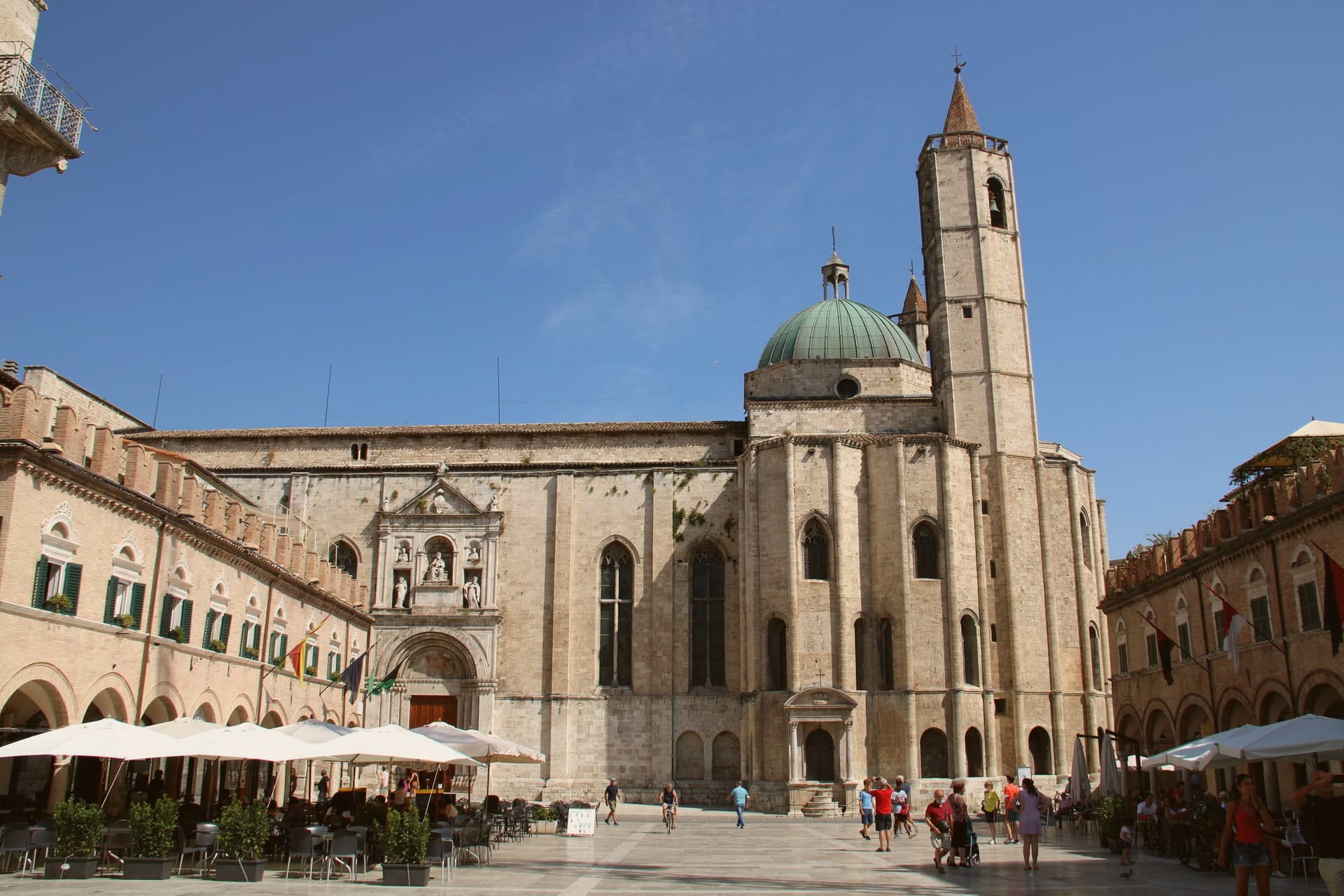
Why visit Ascoli Piceno
Ascoli Piceno sits at 154 meters at the confluence of the Tronto and the Castellano, the historic capital of the Piceni who held this part of the Marche before Rome. The town is built almost entirely from local travertine, which gives the centro storico its luminous pale surface and its mirror behavior under rain: Piazza del Popolo, paved in polished travertine slabs, is one of the most photographed squares in Italy.
In 91 BC the Ascolani killed the Roman delegation in their forum and triggered the Social War; the city was razed and rebuilt by Rome and the present grid still follows the Roman layout. The Quintana, run in costume in July and August, is a joust between the six sestieri, the city districts, the knight on horseback charging an effigy of an Arab warrior.
Anisetta Meletti, the local aniseed liqueur invented in 1907, is poured at the Caffè Meletti on the piazza.
Caffè Meletti, Tetsu have been named by a guide.
What to see in Ascoli Piceno
- Piazza del Popolo. Paved in polished travertine slabs and lined by Renaissance porticoes, the Palazzo dei Capitani and the Loggia dei Mercanti, one of the most photographed squares in Italy.
- Chiesa di San Francesco. Gothic basilica begun in the thirteenth century, three travertine portals, two bell-towers, the largest Marchigiana example of the Franciscan order's architecture.
- Cattedrale di Sant'Emidio. Cathedral on Piazza Arringo, with a fifth-century crypt holding the relics of Sant'Emidio, patron saint invoked against earthquakes.
How to get to Ascoli Piceno
There is a railway station in the town, so you can arrive without a car and never need one while you are here. Pescara is roughly 72 minutes away by road.
Our tip
April through June and September into October are the best months for Ascoli Piceno. The travertine is dry, the surrounding olive groves turn through the Ascolana tenera harvest from October, and the Tronto and Castellano walks along the city's south edge are open every day. July and August touch the mid-thirties; the centro storico empties between three and six in the afternoon but the Quintana weekends fill it again. Ascoliva Festival falls in August.
Pesaro
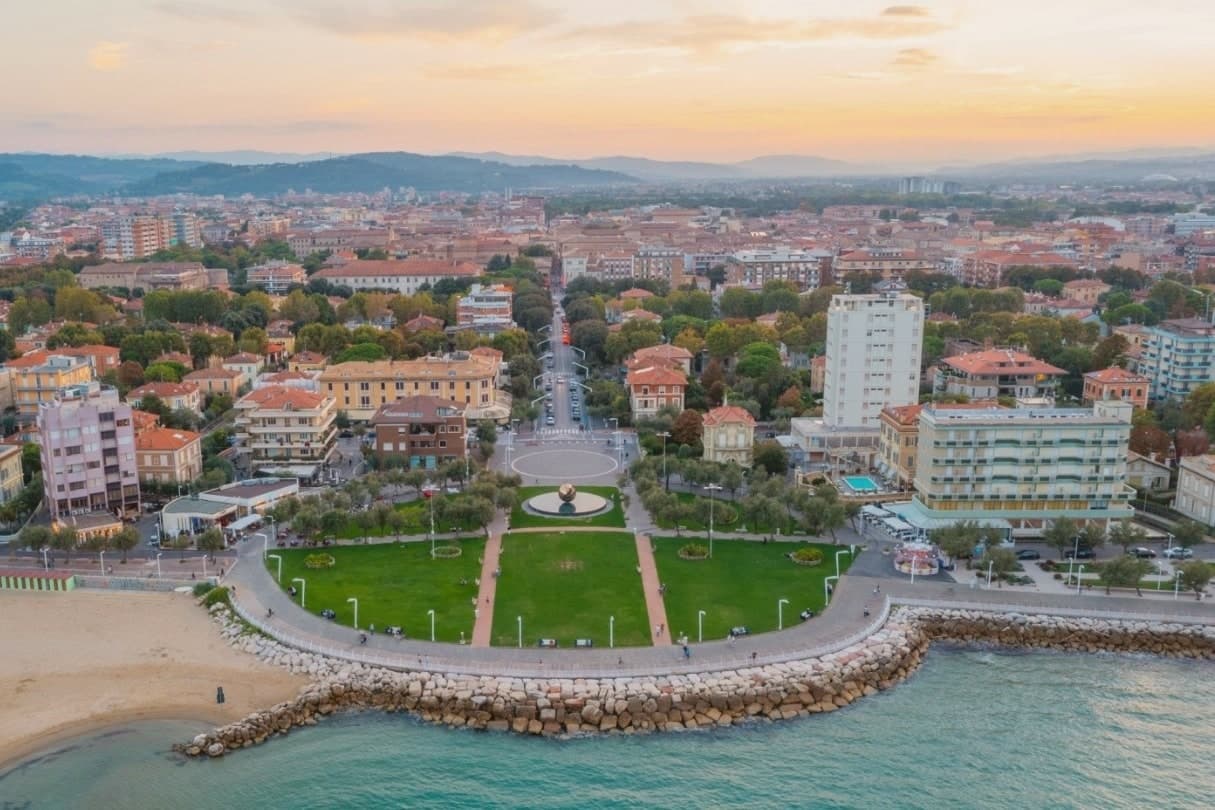
Why visit Pesaro
Pesaro sits at the mouth of the Foglia river on the Adriatic, founded as the Roman colony of Pisaurum in 184 BC on the Via Flaminia and held in turn by Montefeltro, Sforza and Della Rovere lords through the Renaissance. The city was Italian Capital of Culture in 2024.
The centro storico is bookended by two poles: the Rocca Costanza holds one end, a fortress built to defend the town, while the beach runs north from the port along the other, the source of the city's working summer economy rather than its history. Inland and above, on the Monte San Bartolo hills, the Della Rovere and Sforza built their summer villa away from the density of the port town below, a separation of ruling residence from civic center that still marks the geography.
The Palazzo Mosca, in the center, gathers what the town has made and collected: paintings, a modern audio amphitheater, and the maiolica that gave Pesaro its recognition as a city of ceramics. Together the fortress, the villa, the beach and the palazzo describe a town shaped by defense, hillside retreat, coastal work and civic collection, each occupying a different piece of ground rather than competing for the same one.
Nostrano, Gibas, Lo Scudiero and 4 more have been named by a guide.
What to see in Pesaro
- Rocca Costanza. Renaissance fortress commissioned by Costanzo Sforza in the 1470s, four corner bastions and a moat, anchoring the eastern edge of the centro storico.
- Musei Civici di Palazzo Mosca. Civic museum in the former Mosca residence, holding paintings, the Pesaro maiolica collection and the Sonosfera audio amphitheater by David Monacchi.
- Teatro Rossini. Nineteenth-century opera house restored after the 1873 reconstruction, filled for two weeks each August when the Rossini Opera Festival takes over, alongside the Vitrifrigo Arena, for the run of performances.
How to get to Pesaro
There is a railway station in the town, so you can arrive without a car and never need one while you are here. Rimini is roughly 40 minutes away by road.
Our tip
May through September is the Pesaro window: the Velvet Beach opens its bagni from late May, the Rossini Opera Festival fills the second half of August, and the September sea stays warm through the start of school. July and August touch the low thirties with humid Adriatic evenings; the festival nights and the seafront passeggiata draw the largest crowds of the year. April, May and October are cooler, calmer months for the Villa Imperiale guided tours and the museum circuit through Palazzo Mosca. Fiera di San Nicola falls in September.
More from Anywhere Italy
 The best towns with a food festival that eat well in Marche
 The 9 best towns inside a nature park in Marche
- The 7 best towns with a medieval festival in Marche
 The best coastal towns you can reach by train in Marche
 The best small olive oil towns within 90 minutes of Pescara
- The best coastal towns within two hours of Bologna