
The best hot spring towns you can reach by train in Tuscany
90 towns visited, 910 to go. Follow along, free: Subscribe on Substack
Tuscan thermal water smells of sulphur before you see it, and it runs warm through winter, when the vines are bare and the hills go the color of wet stone. The bathing towns are built around that fact: travertine terraces near Siena, cast-iron and stucco pump rooms on the plain around Pistoia, plain concrete tanks behind a farmhouse further south. Autumn and early spring are the good months, when the air is cold enough to make steam and the restaurants have gone back to ribollita, wild boar, chestnut flour cakes and new oil poured thick over toasted bread. Much of it sits within walking distance of a station, which matters more than it sounds, because a soak and a bottle of Chianti do not combine well with a hire car.
people generally drive to Saturnia, park along the verge above the Cascate del Mulino and climb down to the free pools below the mill, where the water falls through a staircase of limestone basins. It is a fine place and the photographs do not lie, but the road is the only way in, the parking fills by mid-morning at weekends and the basins hold a fixed number of bodies. The nearest railway is a long taxi ride away. In high season the queue for the terraces starts before the light does.
The same volcanic and karst geology runs on well past that one waterfall, north into the Sienese clay hills, west to the coast below Pisa and Livorno, and up onto the Apennine edge. Rapolano's travertine quarries and Montecatini's grand bathhouses are on the line; so are thermal sources near Grosseto, Orbetello and the Apuan foothills. Fewer people come to these, partly because they are not the photograph. Each town in this list has natural thermal water, and we have confirmed each can be reached without a car.
Of the 84 communes we have mapped in Toscana, 8 qualify as hot spring towns you can reach by train: each has natural thermal water, and we have confirmed each is reachable without a car. The smallest, Rapolano Terme, has 5,072 residents.
Elsewhere in the catalogue: The best hot spring towns with a serious restaurant in Tuscany and The best hot-spring towns within 90 minutes of Florence.
Why visit Rapolano Terme
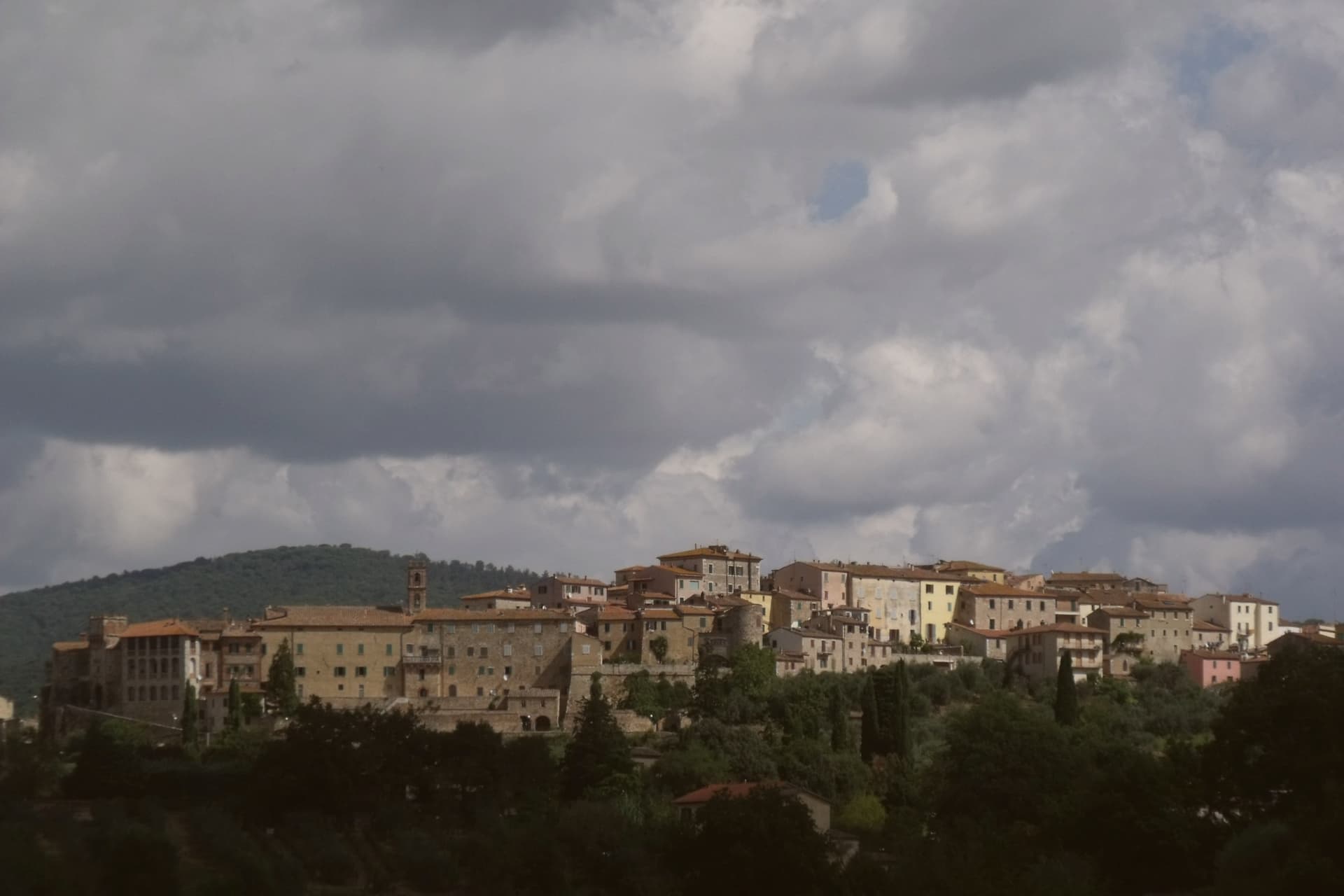
The comune sits at 334 meters on the eastern edge of the clay hills, twenty kilometers east of Siena. It was called simply Rapolano until 1949, when the spa industry pushed the name change, a shift that marks how thoroughly the waters came to define the place.
The thermal facilities and the quarry sit at some distance from each other within the comune: the springs rise near the centro and to its south, while the travertine beds lie in the Serre frazione three kilometers further out, a separate settlement built around the stone rather than the water. The medieval centro storico, meanwhile, holds no thermal or mineral history at all: a fortified perimeter, a Sienese-period castello on the highest point, and a parish church founded in the eleventh century, all predating the spa industry by centuries.
The clay-hill landscape spreads north and west of the comune, and draws most visitors past the spa itself. What emerges is a town built on two extractive industries, water and stone, wrapped around an older walled settlement that has little to do with either.
What to see in Rapolano Terme
- Terme Antica Querciolaia. Six outdoor pools at 38 degrees, the older of the two facilities and the one tied to a general's convalescence.
- Terme San Giovanni. Thermal complex south of the centro among the clay hills of the Crete Senesi, with outdoor pools facing vineyards and olive groves.
- Cave di travertino di Serre. Active quarries in the Serre di Rapolano frazione three kilometers south, the source of the stone behind the Pienza Duomo's façade.
How to get to Rapolano Terme
It has its own railway station. Perugia is about 1 h 3 min away by road. The full route from Florence.
Our tip
Thermal towns work year-round and Rapolano is the rare Sienese commune where winter is a season. The pools at Antica Querciolaia and San Giovanni stay open through the cold months and the steam off the 38-degree water against the December clay hills is the postcard the spa industry sells. April through June and September into October are the wider best months, with the Crete Senesi at full color and the surrounding wine and olive harvests pulling traffic through the centro.
Why visit Campiglia Marittima
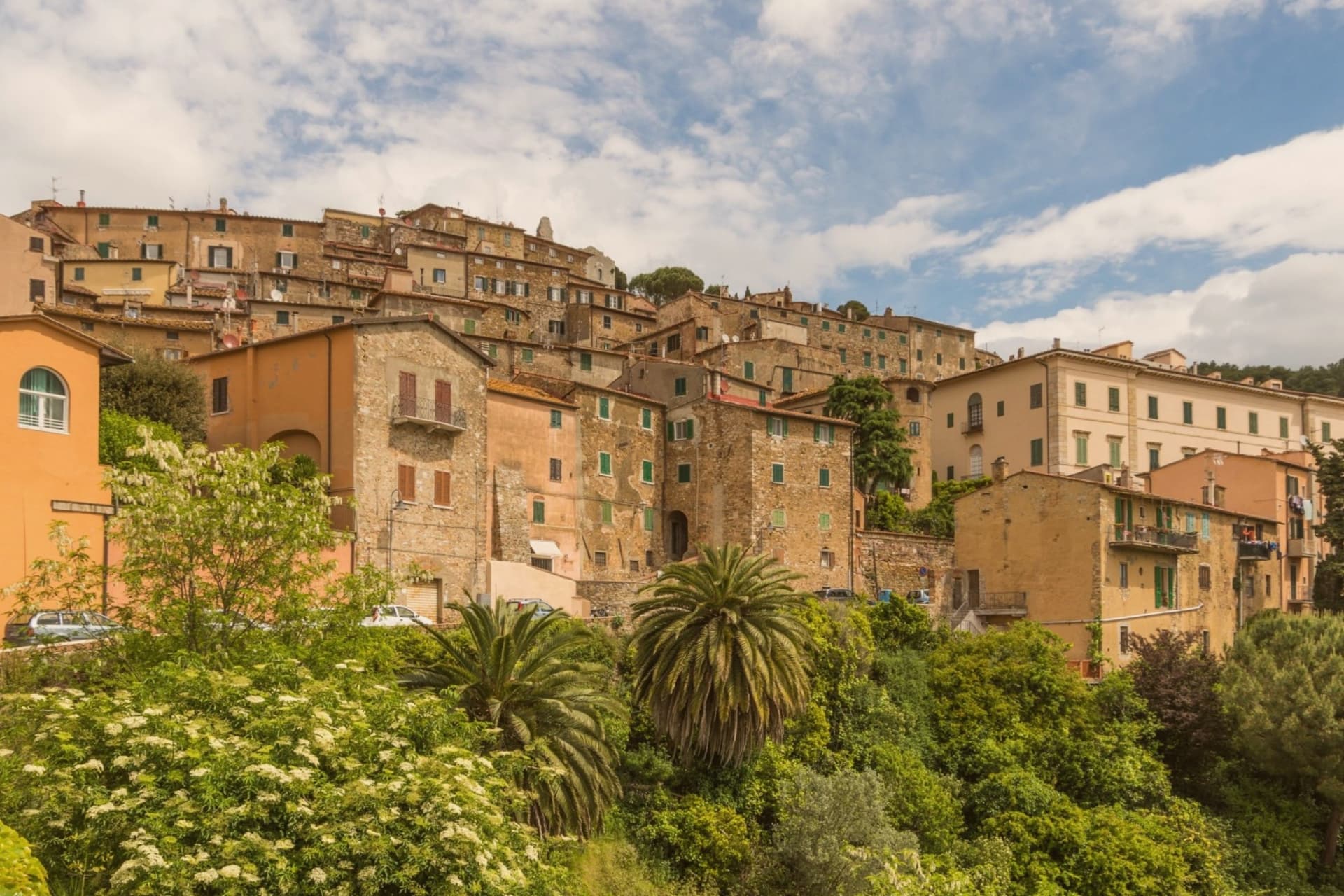
Campiglia Marittima sits at 231 meters on the last slopes of the Colline Metallifere above the Val di Cornia, eight kilometers inland from the Tyrrhenian coast and 60 kilometers southeast of Livorno. The Rocca occupies the highest point at 281 meters, a fortified semicircle whose 14th-century tower and town walls trace the medieval defensive line.
The territory has been mined since the Etruscans: copper, silver, lead and tin from the hills behind town, worked continuously until the last galleries closed in 1976. The Parco Archeominerario di San Silvestro, opened in 1996 on 450 hectares behind the town, centers on Rocca San Silvestro, a tenth and eleventh-century miners' village abandoned in the fourteenth century and excavated since 1984.
Visitors enter through restored galleries on a small electric train. Down on the plain the DOC Val di Cornia produces Sangiovese and Cabernet, and the thermal springs at Venturina, the frazione south of town, have flowed since Roman use as Aquae Populoniae.
What to see in Campiglia Marittima
- Rocca di Campiglia. Fortified semicircle at 281 meters with the 14th-century tower, walls and the Pieve di San Giovanni, the highest point of the town.
- Parco Archeominerario di San Silvestro. 450-hectare park behind town, opened 1996, with restored mining galleries, a small electric train, and the abandoned medieval miners' village of Rocca San Silvestro.
- Centro storico. Walled hilltop borgo of stone houses, with Piazza della Repubblica at its center, the medieval gates Porta a Mare and Porta Fiorentina still intact.
How to get to Campiglia Marittima
It has its own railway station. Livorno is about 1 h 7 min away by road. The full route from Pisa.
Our tip
May through September is the season on the Val di Cornia: warm days, sea breezes that climb the hill, harvest of Sangiovese and Vermentino from late August. The beaches at San Vincenzo and Baratti are eight to fifteen kilometers away and pull the day-traffic. July and August are hot and busy on the coast; the borgo on the hill stays a few degrees cooler.
Why visit Montepulciano
The ridge runs between the Val di Chiana and the Val d'Orcia, 70 kilometers southeast of Siena, and the town follows its spine uphill: streets climb from the gates toward the high point, where the main square sits ringed by the buildings that define the skyline from below. The origin predates the Renaissance fabric by centuries.
Etruscan tombs survive in the surrounding hills, though almost nothing of that period shows in the centro storico itself, which was rebuilt wholesale in the fifteenth and sixteenth centuries over whatever came before. The wine and the festival both use the climb as their setting rather than their subject: the cellars are cut into the rock beneath the palazzi, keeping a constant temperature for aging, and the barrel race each August sends two men from each of the eight contrade hauling an eighty-kilogram cask up the same gradient that every visitor covers on foot, only slower.
The steepness that shaped the defensive site nine centuries ago is still what a person feels first, in the legs, before the buildings register at all.
What to see in Montepulciano
- Tempio di San Biagio. A 13-meter dome and travertine façade standing alone outside the walls, the ground falling away below it so the building reads as a single volume against the hillside.
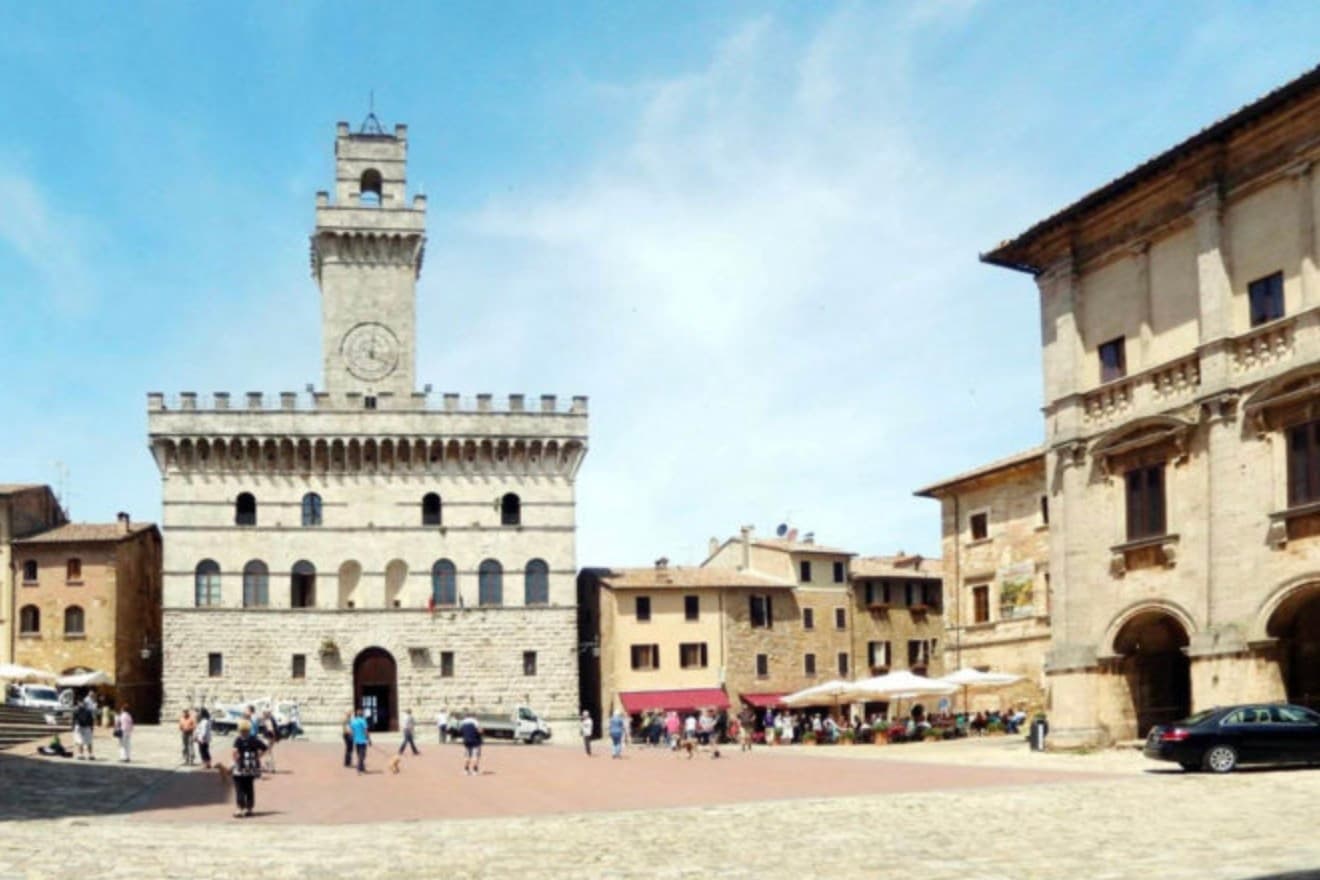
- Piazza Grande. The high piazza at the top of the ridge, ringed by the Duomo, the Palazzo Comunale and the Palazzo Tarugi, all rebuilt in the fifteenth and sixteenth centuries.
- Palazzo Comunale. Town hall designed by Michelozzo in the fifteenth century, its tower offering a view over the Val di Chiana and Val d'Orcia.
How to get to Montepulciano
It has its own railway station. Perugia is about 57 min away by road. The full route from Florence.
Our tip
April through June and September into October are the working months on the ridge: vine work in the surrounding hills, mild days, evening light that lingers over the Val d'Orcia. July and August push into the low thirties and the climb to Piazza Grande slows even the residents. The Bravìo delle Botti runs the last Sunday of August and fills the town.
Why visit Orbetello
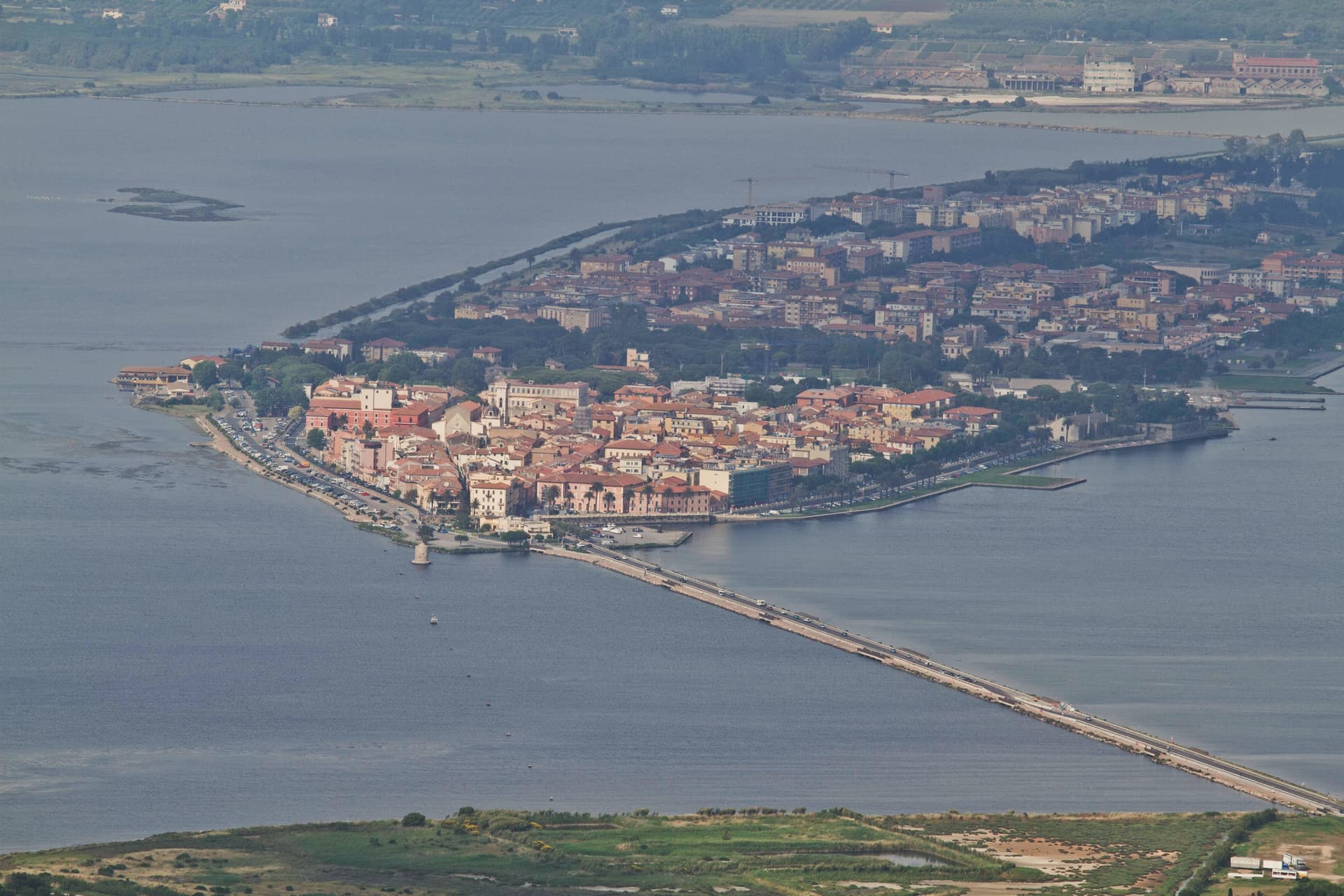
The isthmus runs out into the lagoon and splits it into two basins, Ponente and Levante. Two sand tombolos close the shape from either side: Giannella to the north, Feniglia to the south, both reaching toward the Monte Argentario promontory and meeting it at either end.
The Etruscans settled the site first, the Romans followed with their colony of Cosa nearby, and centuries later the Spanish took the isthmus as the seat of their coastal enclave, leaving the Governor's Palace on the main square where it still stands. Of the nine Sienese windmills once built out in the water, one remains in place, the only Italian water-and-wind mill of its type still fixed where it was built.
The lagoon that once carried Balbo's flying boats out toward Rio and Chicago now carries a WWF reserve and the nets of a bottarga and eel cooperative working the same waters since 1965. A town built on the water it is named for, held between two arms of sand and one mountain it never quite touches.
What to see in Orbetello
- Duomo di Santa Maria Assunta. Fourteenth-century cathedral with a Gothic travertine façade, rebuilt over an earlier Etruscan-Roman temple foundation.
- Fortificazioni Spagnole. The bastions and the Polveriera Guzman magazine, still standing along the edges of the historic center.
- Laguna di Orbetello. The brackish water splits into two basins and is now a WWF reserve and Ramsar wetland.
How to get to Orbetello
It has its own railway station. Roma is about 2 h 4 min away by road. The full route from Rome.
✷ We have written about Orbetello
“Everyone driving from Florence down to Rome crosses the Maremma without noticing, because there is nothing on that stretch to make them slow down. The hills give out. The cypresses stop. What opens up instead is flat open country, wheat and grass running off to a few low rises, the least Tuscan-looking part of Tuscany, a landscape you would call dull if you were being honest and which most guidebooks solve by leaving out.”
Read our piece on Orbetello →Maremma | The Last Cowboys of Tuscany
Our tip
May through September is when the lagoon and the Feniglia and Giannella beaches do their work. June brings the migratory bird count back up: flamingos, herons, avocets. July and August push temperatures over thirty degrees and the tombolos fill with Roman day-trippers, so the lagoon path on the Ponente side stays the quieter option.
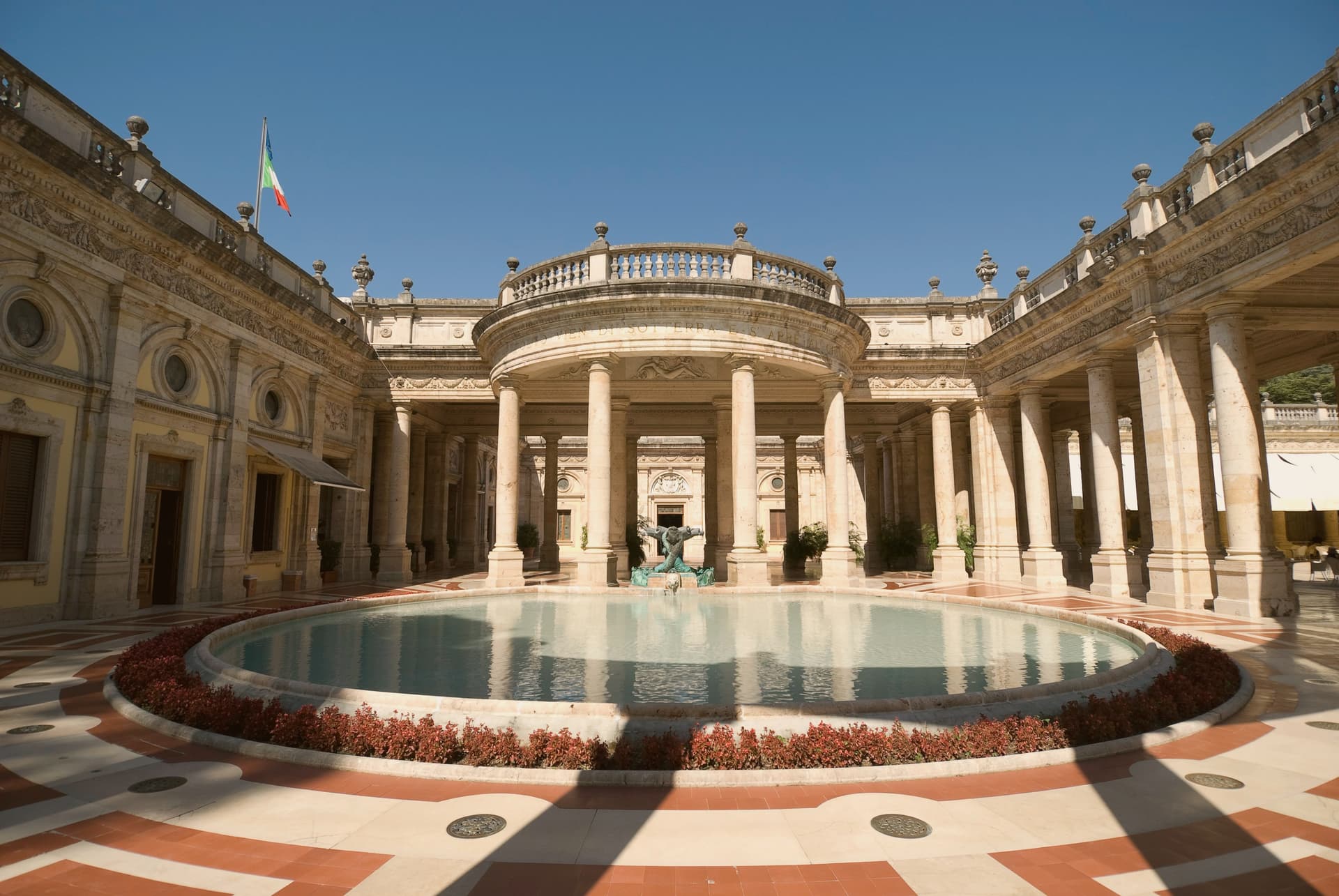
Why visit Montecatini-Terme
The spa town sits at 27 meters in the Valdinievole, forty kilometers west of Florence, at the foot of the hills that hold its older twin on the height above. That older settlement predates the town below it: the springs were exploited later, and the modern spa grew up on the flat ground beneath the hill village rather than around it.
The two remain connected by the red funicular, so a visitor moves between them in minutes rather than by road. Each of the four named waters treats a different complaint, drawn from the same eleven springs but separated by mineral content once they reach the surface.
The Thermal Park gathers the pavilions that were built to house this water cure, Liberty and neo-Renaissance architecture arranged as a single walled enclave rather than scattered through the town. In 2021 the UNESCO listing grouped the town with other spa towns built for the same purpose, Bath, Vichy, Baden-Baden and Karlovy Vary among them, recognition of a model of spa town that produced this particular layout: springs, park, pavilions, and a hill town kept deliberately apart from the cure below.
What to see in Montecatini-Terme
- Terme Tettuccio. The most famous of the thermal establishments, designed by Ugo Giovannozzi, with Liberty interiors built on the concept of the Roman baths.
- Parco Termale. Walled thermal park holding the major spa pavilions, laid out around the eleven springs that surface in the lower town.
- Funicolare di Montecatini. The two red cars carry passengers up the hill on rails laid in 1898, the ride lasting eight and a half minutes.
How to get to Montecatini-Terme
It has its own railway station. Prato is about 31 min away by road. The full route from Florence.
✷ We have written about Montecatini-Terme
“I grew up around water that smells. In Budapest, you do not think of this as a flaw. The thermal water comes up out of the ground carrying its minerals with it, iron and sulfur, and whatever else the limestone has been holding for ten thousand years, and it announces itself before you see it.”
Read our piece on Montecatini-Terme →Montecatini Terme | The Bath Without People
Our tip
The thermal park works as a year-round destination, but the seasons feel different. April through June and September through October are the comfortable months: pavilions open, hotels staffed, walking the park or the funicular pleasant. July and August are hot in the Valdinievole and busy with package tourism.
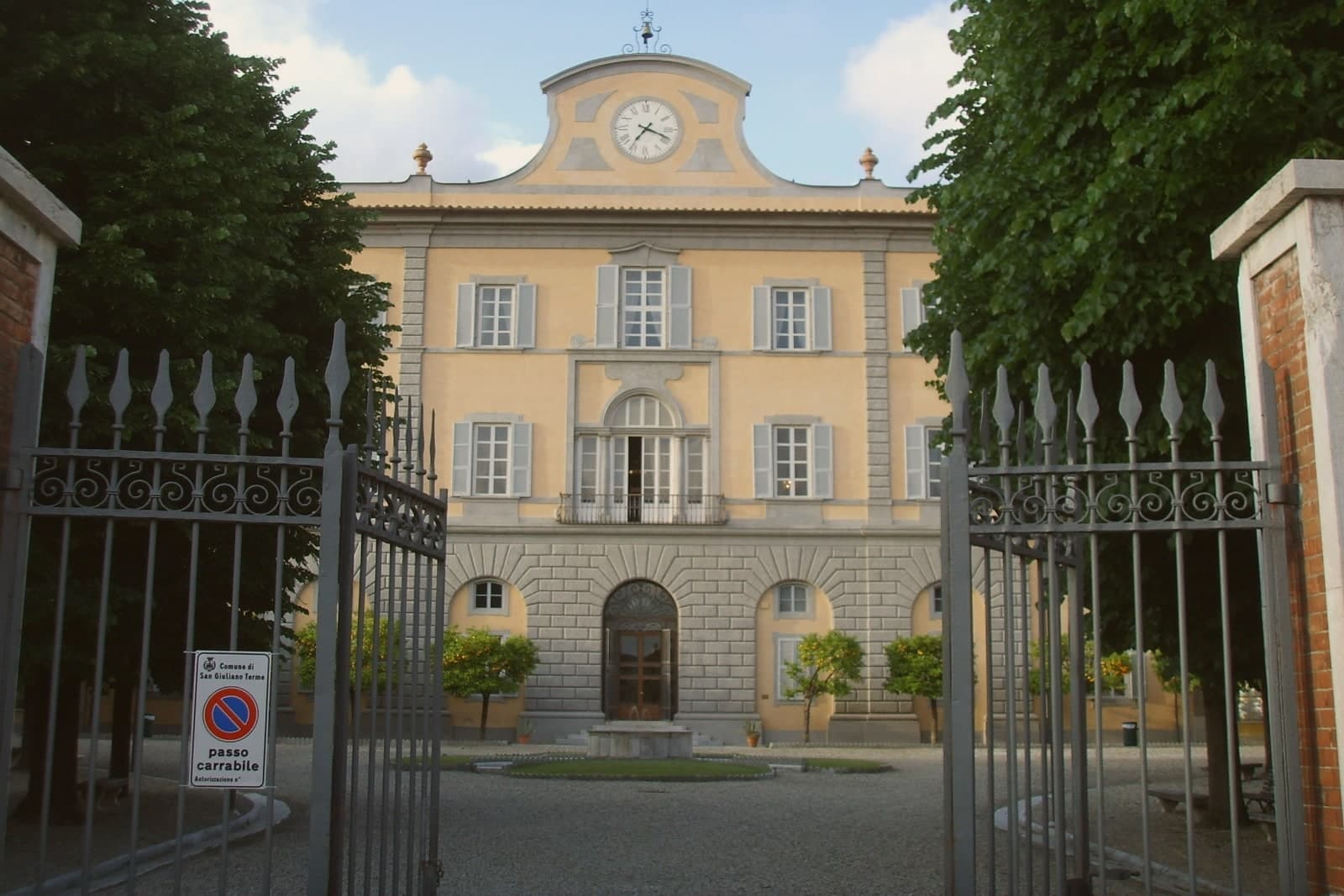
Why visit San Giuliano Terme
San Giuliano Terme sits at 10 meters at the southern foot of Monte Pisano, ten kilometers north of Pisa. The name Aquae Pisanae was the ancient one for the springs that rise here, and the town's own name records the later dedication to San Giuliano rather than to Pisa, though the waters remain tied to the city below by the aqueduct that still carries them there.
The frazioni climb the slope of Monte Pisano itself, olive groves stepping up the lower ground while the plain beneath opens into the pine forests and dunes of the Parco di Migliarino-San Rossore-Massaciuccoli, so the comune runs in one line from mountain ridge to coastal flat with the spa town fixed at the hinge between them. What holds the place together is water moving downhill: from the spring, through the baths where the waters were taken, along the arches to Pisa, and out across the plain toward the sea.
What to see in San Giuliano Terme
- Bagni di Pisa. The restored complex occupies the eighteenth-century Lorena baths, its rooms the ones where Byron, Shelley and Leopardi lodged while taking the waters.
- Acquedotto Mediceo. The line of arches runs from the springs of Asciano down to Pisa, parallel to the modern road, still legible as a single continuous structure across the plain.
- Monte Pisano. The granite ridge above the town, with olive groves on the lower slopes and trails leading to Rocca della Verruca.
How to get to San Giuliano Terme
It has its own railway station. The full route from Pisa.
✷ We have written about San Giuliano Terme
“By the sea, cold hits differently. When that flat grey sky arrives, it means two things in our house: a big pot of bollito, and a thermal bath. The problem is finding one, the whole apparatus, multiple pools, the salt pool, sauna, steam room, mud, the entire game. For us, that means San Giuliano Terme, at the foot of Monte Pisano, and the Bagni di Pisa.”
Read our piece on San Giuliano Terme →Bagni di Pisa | The Tuesday Cure
Our tip
The thermal town runs year-round. Winter is the original spa season, with the warm pools welcome against the cold air off the Monte Pisano. April through June and September into October are the dry mild months for combining a spa stay with walks on Monte Pisano and the Parco di San Rossore.
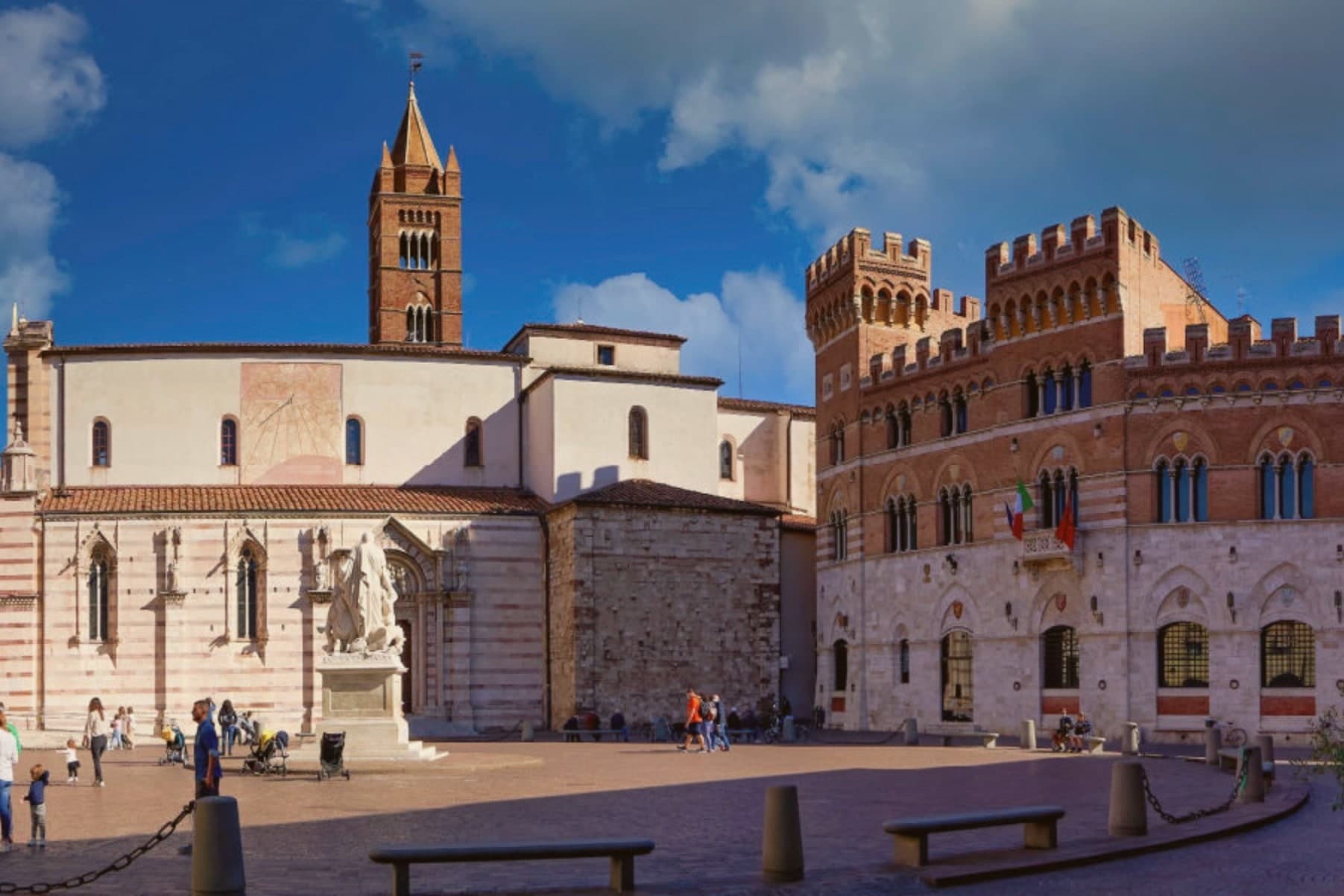
Why visit Grosseto
Grosseto sits on the right bank of the Ombrone, ten meters above sea level and twelve kilometers inland from the Tyrrhenian. The Roman city of Roselle was destroyed in 935 by Saracen pirates; refugees regrouped on the plain below and Grosseto inherited the bishopric.
From 1336 it was Sienese; in 1559 it passed to the Medici after the battle of Montalcino. Cosimo I commissioned Baldassarre Lanci to replace the medieval walls with a hexagonal bastioned circuit, begun in 1565 and finished a decade later.
The walls are intact. Six bastions, two main gates, a continuous earthwork four kilometers around, now planted and used as the city's promenade.
Inside, the Duomo di San Lorenzo holds a Romanesque-Gothic façade in alternating white and pink marble. The Cassero Senese, the Sienese fortress of 1345 swallowed into the later Medici walls, anchors the southeast corner.
Grosseto is the largest city of southern Toscana and the working capital of the Maremma.
What to see in Grosseto
- Mura Medicee. Hexagonal bastioned circuit commissioned by Cosimo I in 1564, designed by Baldassarre Lanci, intact and walkable for the full four kilometers.
- Duomo di San Lorenzo. Thirteenth-century cathedral with a façade in alternating white and pink marble, Latin-cross plan, semicircular apse over the nave.
- Cassero Senese. Travertine-clad Sienese fortress completed in 1345, incorporated into the southeast corner of the Medici walls, now used for exhibitions.
How to get to Grosseto
It has its own railway station. Livorno is about 1 h 50 min away by road. The full route from Pisa.
Our tip
May, September and October are the Maremma months. The walls and the Parco Regionale are open without the heat, the umbrella pines hold their shade, and the wild horses are visible at dawn near the Ombrone mouth. July and August push past thirty-five degrees and the city empties between one and six in the afternoon.
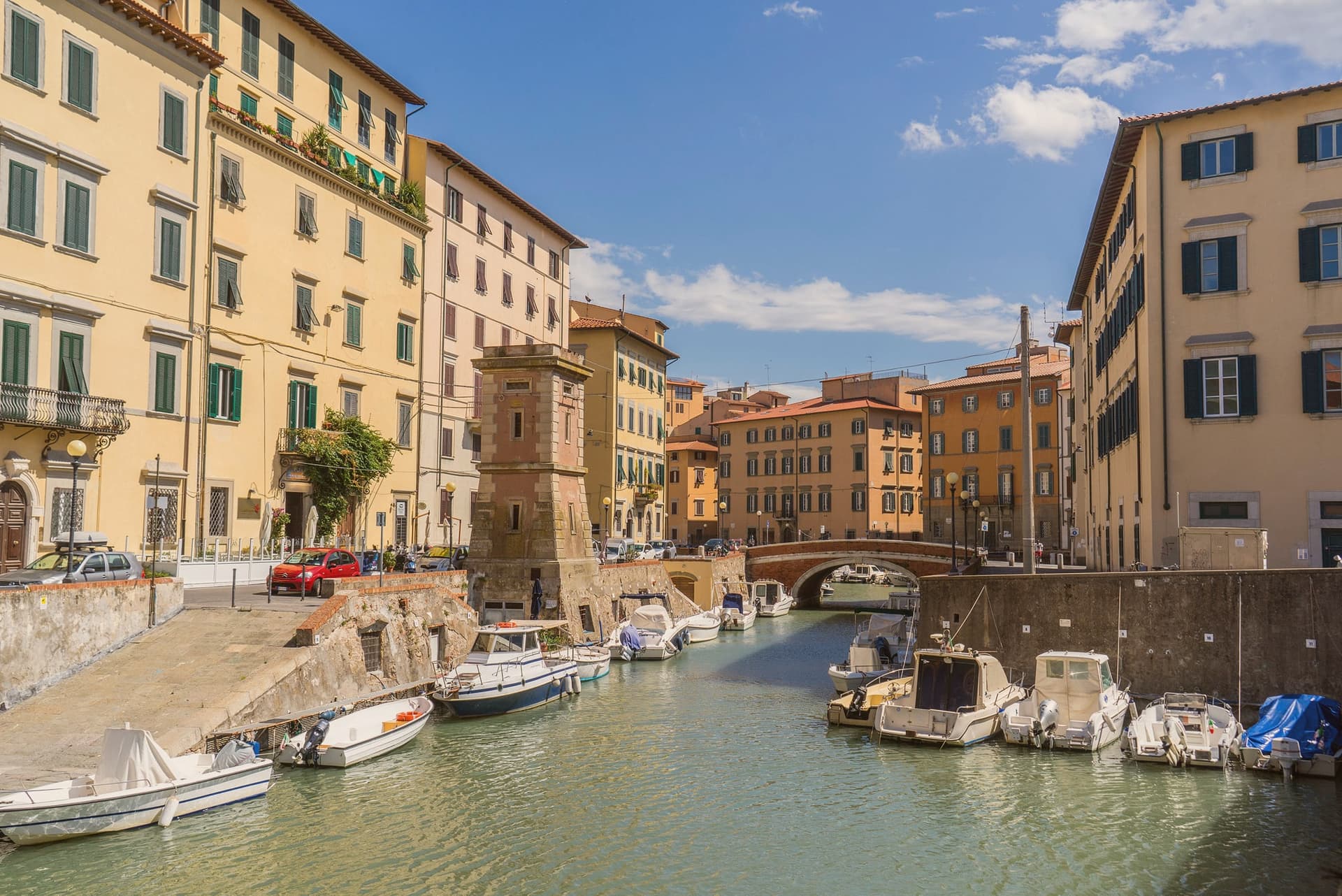
Why visit Livorno
Livorno is the Tuscan coast you don't expect: Medici-founded in 1577 as Nova Civitas, planned from scratch by Bernardo Buontalenti as a free port to rival Genoa and Venice, and unique among Tuscan cities for being entirely a Renaissance-era invention rather than a medieval inheritance. The original pentagonal city walls enclosed a Venetian-style quarter (Venezia Nuova) laced with navigable canals where merchant warehouses opened directly to the water.
Jews, Greeks, Armenians, English, Dutch and North Africans were all invited to settle under the 1591–1593 'Livornine' laws granting freedom of worship and trade, making Livorno the most cosmopolitan port on the Mediterranean for two centuries. What you see today: Fortezza Vecchia (1521) and Fortezza Nuova (1590) guarding the inner harbor; the four bronze Moors (1626) chained to the base of Ferdinando I's monument facing the port; the Terrazza Mascagni (a 1925 Art Deco chequerboard promenade with 4,100 black-and-white tiles facing the Tyrrhenian); the Cattedrale rebuilt after 1944 bombing; the Pentagono di Buontalenti street grid still visible from above.
The Macchiaioli painters' movement was born here in the 1860s (Fattori, Lega, Signorini all lived and painted the local light). Modigliani was born in Livorno in 1884.
And the food: cacciucco (a 5-fish stew with toasted bread and red wine, the city's totemic dish) plus ponce alla livornese (rum-spiked coffee) at the Caffè Civili. The Tuscan archipelago (Capraia, Gorgona, Elba) ferries out from the port within view of the promenade.
What to see in Livorno
- Terrazza Mascagni. A 1925 Art Deco seafront promenade with 4,100 black-and-white tiles facing the open Tyrrhenian. Locals call it the world's most beautiful balcony, especially at sunset.
- Venezia Nuova quarter. The Medici-planned canal district from 1629. Walkable bridges, warehouse-doors-on-water, and the Effetto Venezia summer festival turn it into Tuscany's Venice.
- Quattro Mori (Monumento dei Quattro Mori). Pietro Tacca's four bronze Moors (1626) chained to the base of Grand Duke Ferdinando I's statue facing the port. Livorno's civic icon.
How to get to Livorno
It has its own railway station. The full route from Pisa.
✷ We have written about Livorno
“I lived in Naples for weeks once, and those days remain among the best I have had, and the people there are among the finest I have met anywhere in this country, and I love the place without reservation. Naples is the same love story as Livorno.”
Read our piece on Livorno →Livorno | The City With No Time For You
Our tip
Livorno is a true year-round port city, but the sweet spot is April–June and September–October. May and June have the warm Tyrrhenian light, the Effetto Venezia festival (last week of July) brings the canal quarter alive at night, and September is still beach-warm without the crowds. July and August get hot and the port traffic peaks.
More from Anywhere Italy
- The best hot spring towns with a serious restaurant in TuscanyTuscanyhot springsserious restaurant10 towns · smallest 1,500 residents
- The best hot-spring towns within 90 minutes of FlorenceNear Florencehot springswithin 90 min7 towns · smallest 3,492 residents · closest 46 min away
- The best hot-spring towns within 75 minutes of PisaNear Pisahot springswithin 75 min6 towns · smallest 3,492 residents · closest 8 min away
- The best hidden hot spring towns that eat well in TuscanyTuscanyhot springseats wellhidden8 towns · smallest 1,500 residents
- The best hot spring towns worth staying overnight in TuscanyTuscanyhot springsworth staying overnight7 towns · smallest 1,500 residents
- The best hot-spring towns within 75 minutes of SienaNear Sienahot springswithin 75 min6 towns · smallest 2,572 residents · closest 24 min away