
The best hidden hill towns you can reach by train in Campania
Campania away from the water is built on tuff, the soft yellow volcanic stone that cuts like cheese and hardens in the air, and it shows in the houses, the church facades and the cellars dug straight down beneath them. The land rises quickly behind the coast into the Matese, the Irpinian ridges and the Tanagro valley, where chestnut woods give way to vineyards of Greco, Fiano and Aglianico. Food here is mountain food rather than seaside food: pork, beans, hard sheep's cheese, mozzarella di bufala made a valley or two over on the Volturno plain. Autumn is the season, when the grapes come in and the chestnut festivals fill the squares, though spring on these hills is greener than most people expect of the south.
In practice almost everyone who lands in Naples goes the same way, out along the bay to Pompeii, then Sorrento and the Amalfi Coast, and in summer the Circumvesuviana carries more people than it comfortably can. The ruins and the cliff road are worth the crowds they draw, but the pressure on them is real, and hotel prices inland are a fraction of what they are in Positano. The famous stretch is also narrow. Step a short way behind it and the buses stop.
The same hills continue north and east, and the railway continues with them. Regional trains from Naples, Caserta, Benevento and Salerno still serve small inland stations, which means these towns can be reached without hiring a car and without driving hairpins. Fewer people go, so the wine is poured in the village bar rather than a tasting room, and the medieval castle on the ridge is usually open with nobody queueing. These are the smaller places on those lines, chosen because the train gets you there.
Of the 67 communes we have mapped in Campania, 11 qualify as hill towns you can reach by train: each is an inland hill settlement, and we have confirmed each is reachable without a car. This list is the hidden ones, 7 in all, ordered smallest first. The smallest, Tufo, has 772 residents.
Elsewhere in the catalogue: The best hill towns you can reach by train in Campania and The best hidden hill towns within 90 minutes of Napoli.
Tufo
Why visit Tufo
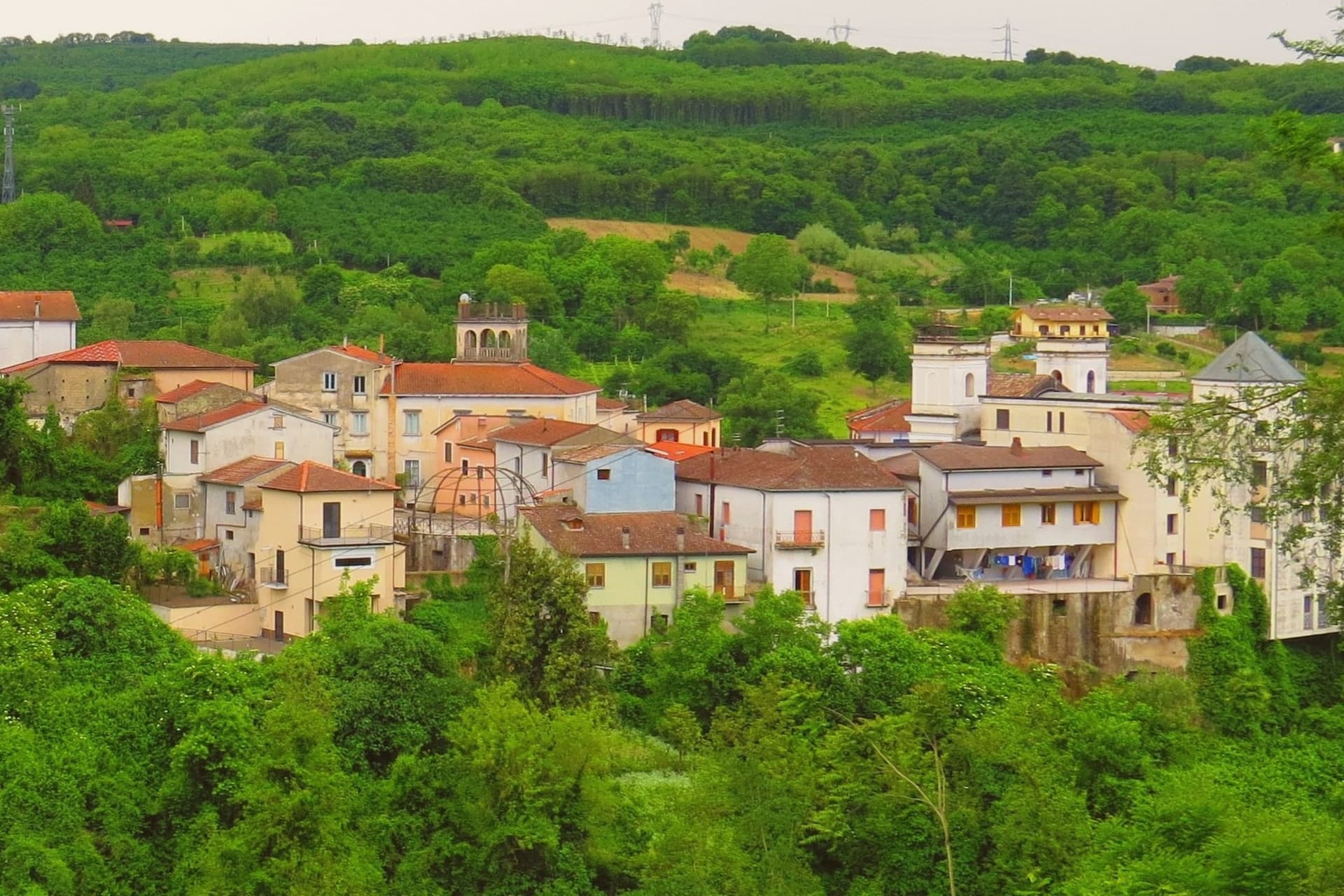
The name Tufo comes from the volcanic tuff stone the hill is built on, the same stone that runs through the slopes below and gives the local wine its mineral edge. The village sits on top of that stone at 250 meters, with the cellars at its foot and the vineyards spreading out around both.
Sulfur was mined in shafts cut into the cliffs beneath the village, work that shaped the local economy for over a century before it stopped. Most visitors are wine buyers, not tourists.
They drive in for a tasting, walk the steep main street to the medieval castle on top, and leave by dinner. The village stays quiet after they go.
What the stone gave the place economically it also gave it physically: a hill town built from the same rock that flavors what it grows, mined until the ground itself ran out of use.
We confirmed you can reach this one by train.
What to see in Tufo
- Castello di Tufo. Medieval fortress on the top of the hill, rebuilt after the 1732 and 1980 earthquakes that damaged the village below.
- Cantine di Marzo. The cellars sit at the foot of the village, where Greco di Tufo has been produced commercially since the family took up winemaking here.
- Ex Miniere di Zolfo. Abandoned mines in the cliffs below the village, their shafts left the rock marked with rust-colored scars after closure.
How to get to Tufo
There is a railway station in the town, so you can arrive without a car and never need one while you are here. Salerno is roughly 55 minutes away by road.
Our tip
April through June covers the green months in Irpinia: vine leaves unfurling on the slopes, mild evenings on the main street. September through early October is harvest, when the cellars open more often than usual and the village smells of crushed Greco. July and August get hot in the valley, though 250 meters keeps the worst of it off.
Auletta
Why visit Auletta
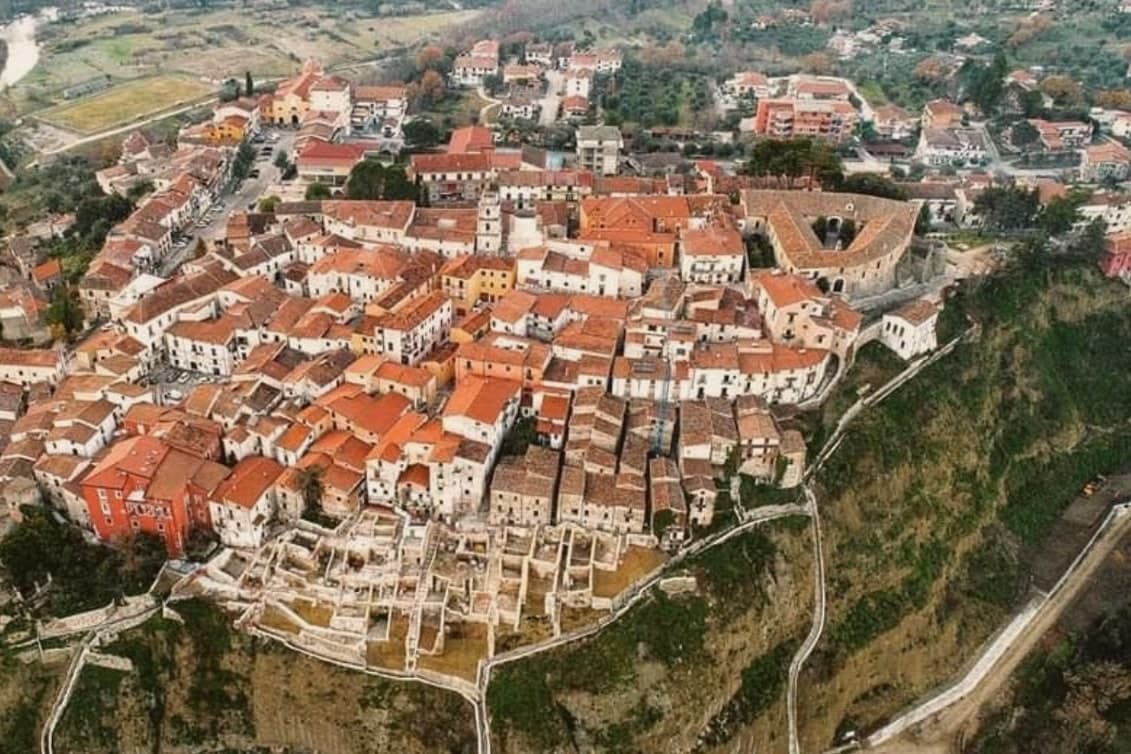
Auletta sits at 280 meters on a hill on the right bank of the Tanagro river, at the northern edge of the Vallo di Diano, inside the Cilento, Vallo di Diano and Alburni National Park. The town was fortified by the year 1000 and is mentioned as Olibola in 1095, possibly from olea, Latin for oil.
The medieval core is reached through three gates, Porta Castello, Porta del Fiume and Porta Rivellino. The Castello Marchesale, twelfth century in origin, took its current shape in the fifteenth, when defensive systems were added; it is privately owned by the Maioli Castriota Scanderbech family.
The 1857 Great Neapolitan earthquake destroyed much of the town and was documented by the Irish seismologist Robert Mallet, in the first systematic post-earthquake survey ever attempted. In 1861, immediately after Unification, locals rose against the Piedmontese army and 45 were killed in what is remembered as the Auletta Massacre.
The town is now a Città delle Grotte for its proximity to the Pertosa-Auletta caves.
We confirmed you can reach this one by train.
What to see in Auletta
- Castello Marchesale. Twelfth-century fortress in the highest part of the centro storico, reshaped in the fifteenth century with defensive walls and now privately held.
- Chiesa di San Nicola di Mira. Parish church inside the medieval walls, holds a relic of San Donato di Ripacandida, the town's patron saint.
- Borgo dei Mestieri. Restored part of the centro storico turned into a living museum of traditional Cilento crafts, with workshops on stone, iron and clay.
How to get to Auletta
There is a railway station in the town, so you can arrive without a car and never need one while you are here. Salerno is roughly 49 minutes away by road.
Our tip
April through October is the open season in the Tanagro valley: clear days, mild nights and the National Park trails dry enough to walk. July and August push past thirty-three degrees in the valley; the centro storico on the hill catches a slight breeze. April, May and early June are the right weeks for the Alburni hikes and the Pertosa-Auletta caves, which run at fifty degrees year-round and feel cold off a hot afternoon.
Calitri
Why visit Calitri
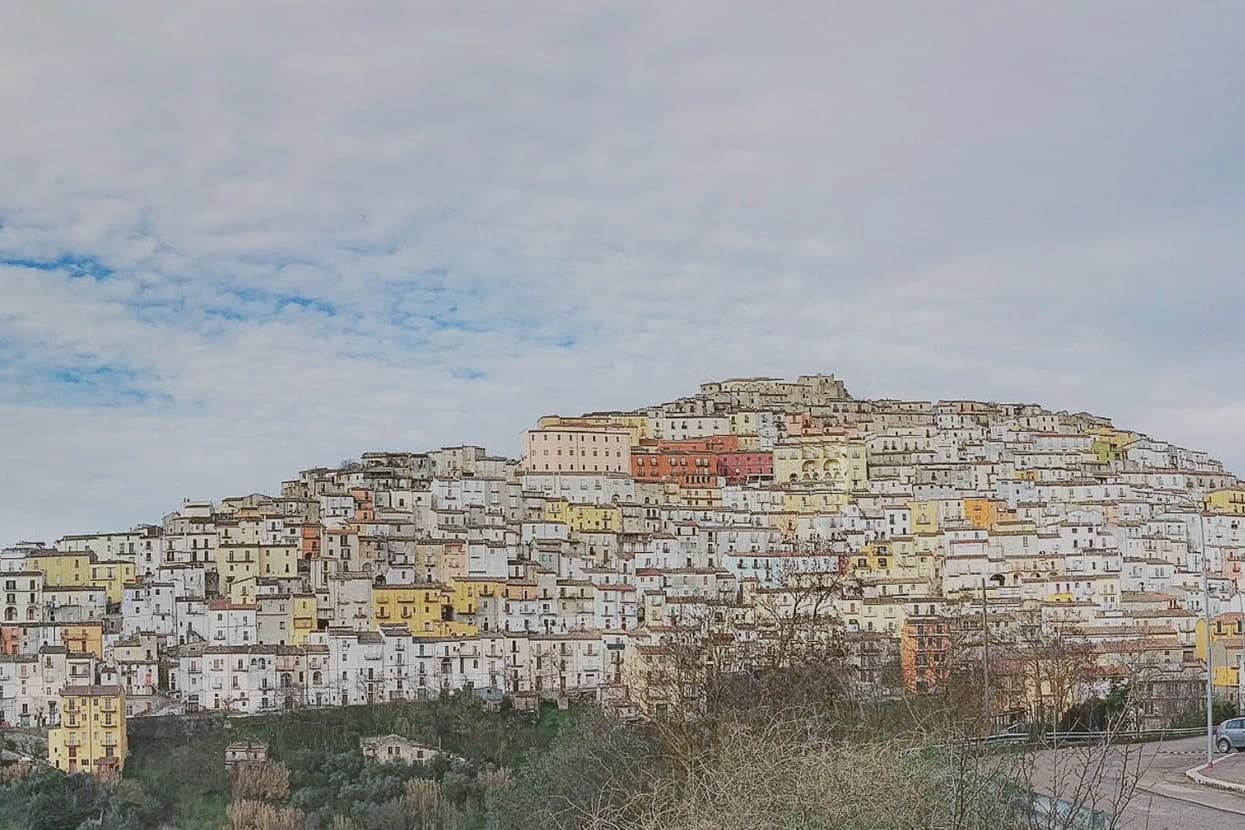
Calitri sits on a mountain above the upper Ofanto valley, sixty-five kilometers inland from Salerno. The town stacks down the slope in a sheet of pastel houses that has earned it the nickname positano dell'entroterra: an old settlement folded into a hillside rather than a coastline.
The clay underneath those houses gave the town its old craft. Streets are still named for the potter's wheel and for the Faenza artisans who arrived in the 1600s, a trade that runs from that century straight through to the workshops active today.
The 1980 earthquake cuts through that continuity. It killed two residents, triggered landslides, and left a large part of the centro storico uninhabitable for years; many houses were never reoccupied and stand today alongside the rebuilt blocks, upper village and lower streets sharing one slope but two different histories of repair.
What holds the place together now is deliberate: a festival built specifically to give these depopulated lands their footing back, run every August since 2013. A hillside town, in other words, that turned its own damage and its own craft into the same civic project.
We confirmed you can reach this one by train.
What to see in Calitri
- Borgo Castello. Medieval upper village built from the stones of the destroyed feudal castle, partly abandoned after the 1980 earthquake, now hosting the ceramics museum and the Sponz Fest.
- Museo della Ceramica. Ceramics museum inside the Borgo Castello, open since 2008, with Calitrian pieces from the fourth century BC to the modern revival workshops.
- Chiesa di Santa Lucia. Hilltop church above the centro storico, the high point of the town with views across the Ofanto valley and the Alta Irpinia ridges.
How to get to Calitri
There is a railway station in the town, so you can arrive without a car and never need one while you are here. Foggia is roughly 90 minutes away by road.
Our tip
April through June and September into October are the working months for Calitri. The 530-meter altitude keeps the summer breeze, and the upper alleys are walkable. July and August are hot, though Sponz Fest in late August pulls thousands of visitors for three days regardless.
Caiazzo
Why visit Caiazzo
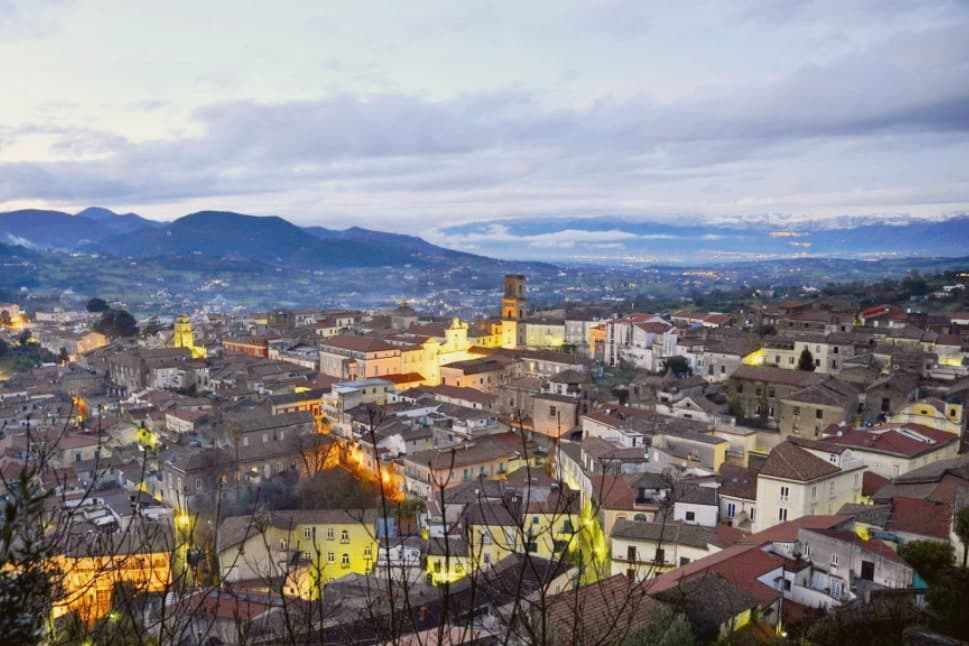
Caiazzo sits at 200 meters on a small hill above the Volturno, forty kilometres north of Naples, between the Matese foothills and the Caserta plain. The town is older than the surrounding province: Caiatia was already a Samnite then Roman centre, and the medieval cathedral preserves a Lombard crypt under its eleventh-century floor.
What pulls visitors today is not the cathedral but a pizzeria. In 2012 Franco Pepe, third-generation baker, opened Pepe in Grani in an eighteenth-century palazzo on Vico San Giovanni Battista, working long-fermented doughs with local Pallagrello flour, Conciato Romano cheese and Caiazzo olive oil.
Tre spicchi from Gambero Rosso for ten straight years and a Michelin world-best ranking in 2018 turned the centro storico into a destination that handles 800 pizzas a day. Caiazzo is a Cittaslow, a Città del Vino for Pallagrello and Casavecchia, and a Città dell'Olio.
We confirmed you can reach this one by train.
What to see in Caiazzo
- Cattedrale di Santa Maria Assunta. Eleventh-century cathedral with a Lombard crypt beneath the floor, baroque interior and the relics of San Stefano Minicillo, patron of Caiazzo.
- Castello di Caiazzo. Medieval castle of Lombard origin on the highest point of the centro storico, remodelled under the Normans and later princes of Caiazzo.
- Pepe in Grani. Franco Pepe's pizzeria in an eighteenth-century palazzo on Vico San Giovanni Battista, ranked best in the world by Michelin in 2018.
How to get to Caiazzo
There is a railway station in the town, so you can arrive without a car and never need one while you are here. Napoli is roughly 53 minutes away by road.
Our tip
April through June and September into October are the cleanest months in Caiazzo, when the Volturno valley is green and the Pepe in Grani tables are easier to book at lunch. July and August push the Caserta plain past thirty-five degrees and the centro storico empties between two and six in the afternoon. Harvest runs September and October for Pallagrello and Casavecchia and pulls weekend wine visitors.
Vairano Patenora
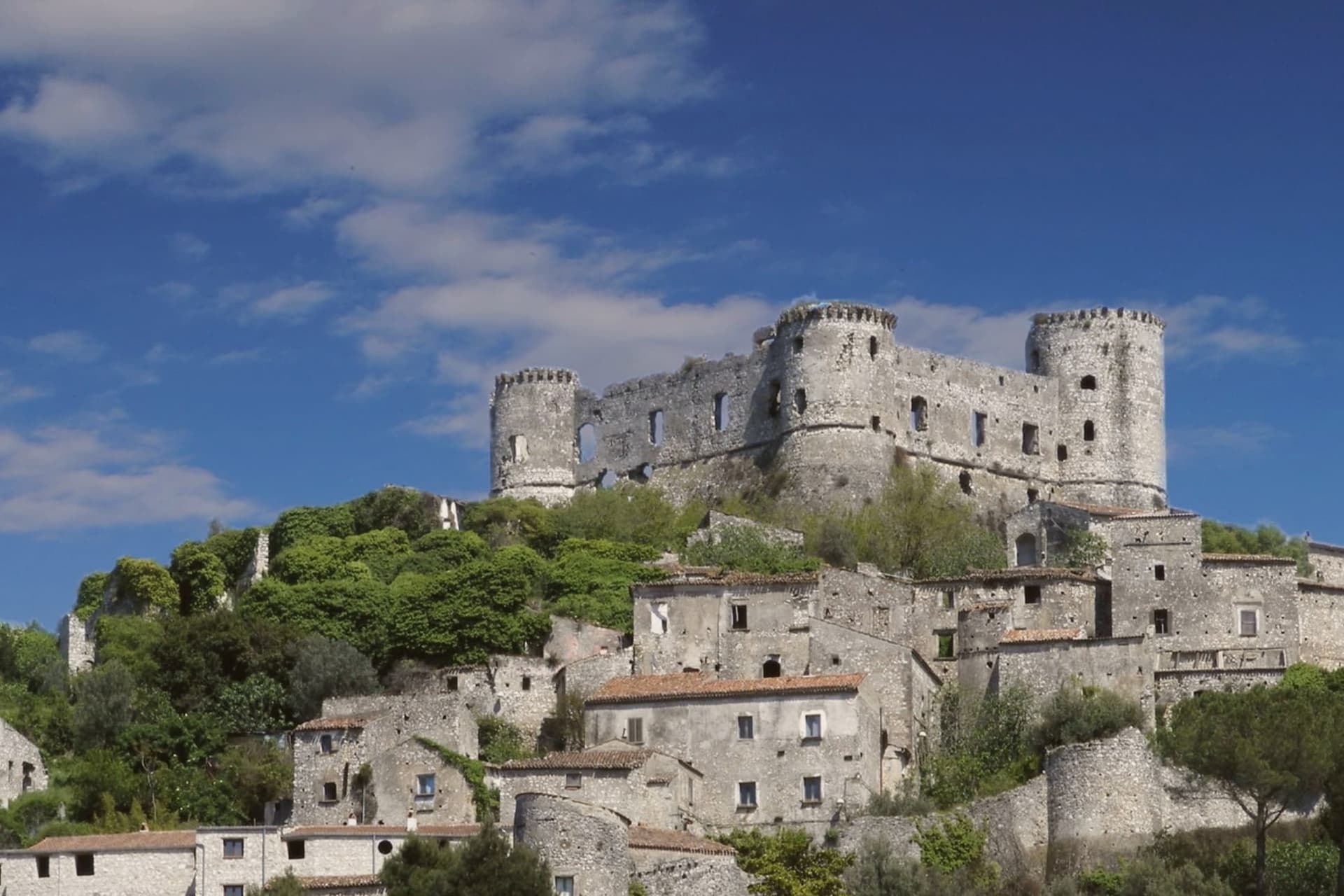
Why visit Vairano Patenora
The castle is a shell and that is the point of coming. Innico II d'Avalos built it between 1491 and 1503 on the footings of the Norman one, four round towers with the largest at the south-east corner, and the inside has fallen in: you can still read the floor levels off the walls, the kitchens, the prisons, the old cistern.
Below it the medieval borgo runs downhill in grey stone, and its wall once carried fourteen cylindrical towers and three gates. People have been passing through here for a very long time.
The Samnites held the hills, the Romans took them in 290 BC, the Normans put up the first castle, and Frederick II, Charles II of Anjou and Pope Gregory X all stayed in it. Two miles out, the Abbazia della Ferrara was built by a Cistercian monk between 1171 and 1179 and keeps a thirteenth-century fresco of a funeral.
The town below sits in flat, farmed country between the Matese and the Roccamonfina park, with a small volcanic lake on the Presenzano boundary.
We confirmed you can reach this one by train.
What to see in Vairano Patenora
- Castello aragonese. Built 1491 to 1503 by Innico II d'Avalos on the Norman and Swabian footings. Four round towers; the interior is ruined, but the floor divisions, kitchens, prisons and cistern are still legible.
- The borgo walls. The medieval circuit once ran to fourteen cylindrical towers on battered bases, opened by three gates: porta Oliva, porta di Mezzo and porta Castello.
- Abbazia della Ferrara. A Cistercian abbey of 1171 to 1179 that housed Frederick II and the future Pope Celestine V, holding a thirteenth-century fresco of the funeral of Malgerio Sorel.
How to get to Vairano Patenora
There is a railway station in the town, so you can arrive without a car and never need one while you are here. Napoli is roughly 59 minutes away by road.
Our tip
April to October is the season down here at 168 metres, and July and August are hot in the valley in a way the hill towns further east are not. Spring is the best of it, when the scrub on Catreola and Montauro is green and the castle can be walked around without the heat. The feast of San Bartolomeo falls on 24 August.
Alife
Why visit Alife
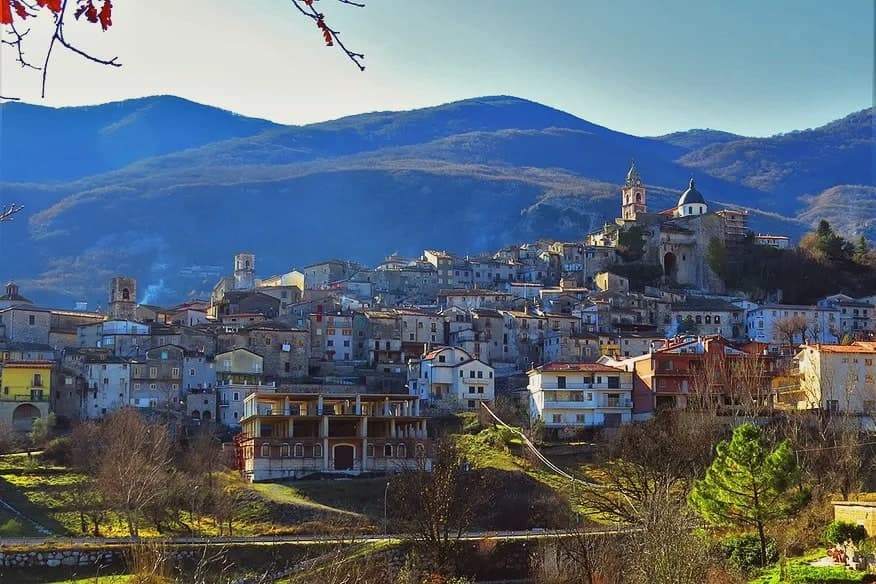
Alife sits at 110 meters at the southern foot of the Matese, the rectangular Roman walls still tracing the original plan of the 326 BC Latin colony founded after the Samnite Wars. The circuit runs 1.9 kilometres, with towers every 39 meters and four monumental gates on the cardo and decumano.
Inside the walls lies the largely buried Roman amphitheatre, 48 by 38 meters, the fourth largest in Italy after Rome, Pompeii and Capua. The Cryptoporticum, a 100-meter underground gallery, has been kept legible by recent excavation.
The town gives its name to the Cipolla di Alife, a heirloom red onion documented locally since Roman times and still cultivated on the irrigated plain along the Volturno. Modern Alife sits inside the Parco Regionale del Matese and along the Via Francigena del Sud, with extra-virgin olive oil and Pallagrello and Casavecchia wines on the surrounding slopes.
We confirmed you can reach this one by train.
What to see in Alife
- Mura romane di Alife. Rectangular Roman walls running 1.9 kilometres, with towers every 39 meters and four monumental gates on the original cardo and decumano of the 326 BC colony.
- Anfiteatro Romano. Largely buried amphitheatre of 48 by 38 meters, the fourth largest in Italy after Rome, Pompeii and Capua, dating to the early imperial period.
- Criptoportico Romano. Underground gallery more than 100 meters long, well preserved beneath the centro storico, kept open after recent archaeological excavation.
How to get to Alife
There is a railway station in the town, so you can arrive without a car and never need one while you are here. Napoli is roughly 76 minutes away by road.
Our tip
April through June and September into October are the open months along the Matese foothills, when the Volturno plain is green and the Roman walls walk at a reasonable temperature. July and August push the inland Caserta past thirty-five degrees and the amphitheatre site closes mid-afternoon to protect visitors and stone. The Sagra della Cipolla di Alife happens in mid-September and pulls weekend visitors from Naples and Caserta. Sagra della pannocchia e dell'agricoltura alifana falls in September.
Montesarchio
Why visit Montesarchio
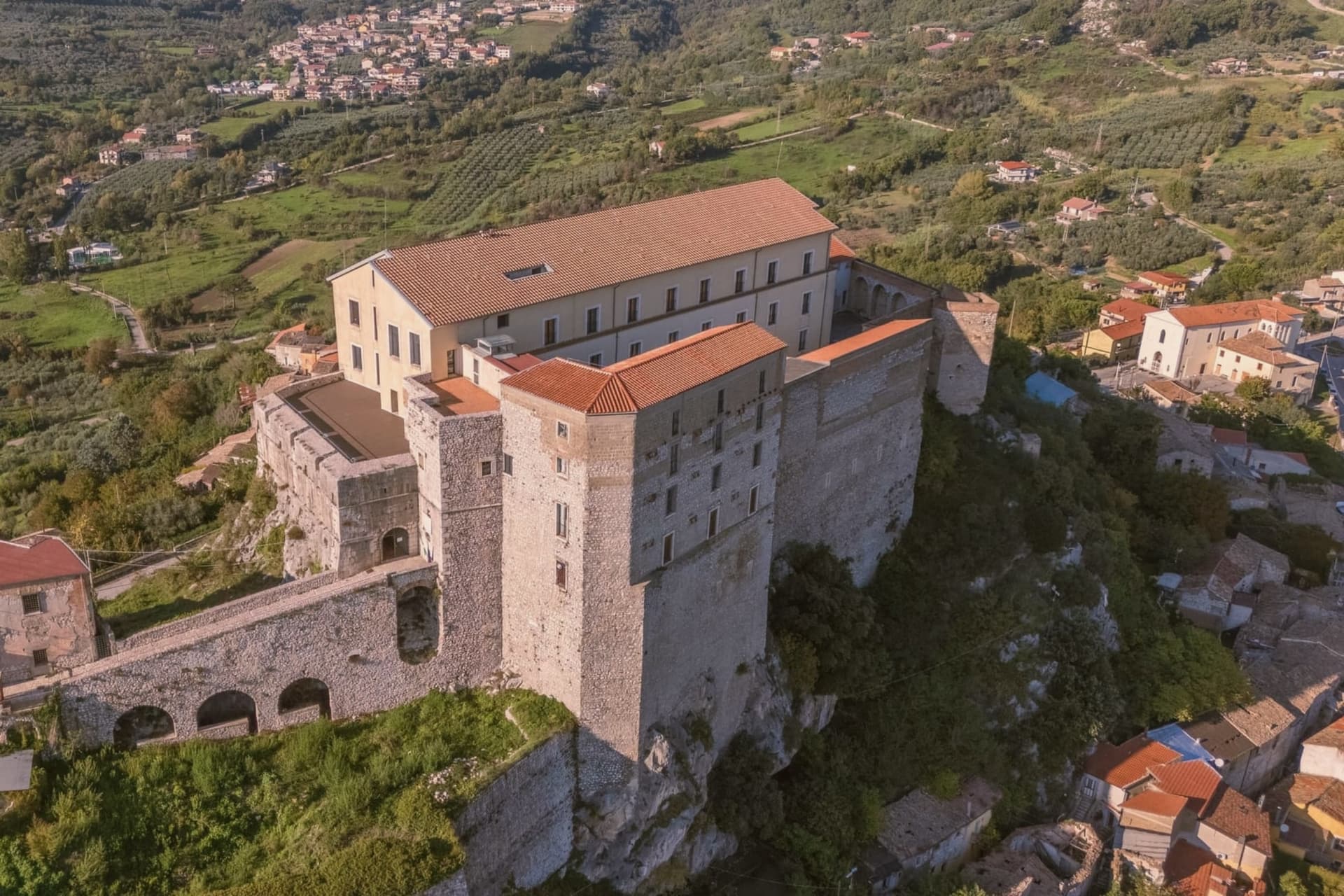
Montesarchio sits at 300 meters at the foot of Monte Taburno, eighteen kilometers southwest of Benevento. The Latin name is Caudium, an ancient Samnite city on the road from Beneventum to Capua, and the surrender at the pass below it was so unprecedented that the Roman Senate refused to ratify the treaty that followed.
The medieval town climbed the hill above the valley around its castle and tower, and that upper cluster still marks the highest and oldest part of the centro, with the newer town spreading below it into the Valle Caudina. The commune is a Borgo più bello d'Italia, a Città del Vino, and a Città della Nocciola.
What holds the place together is the vertical relationship between valley floor and hilltop: a road town and a battle site below, a fortified refuge and lookout above, the second built to guard what the first could not.
We confirmed you can reach this one by train.
What to see in Montesarchio
- Castello di Montesarchio. Medieval fortress on the hill above the town, restored and reopened in 2007 as part of the Museo Archeologico Nazionale del Sannio Caudino.
- Torre di Montesarchio. Cylindrical fifteenth-century tower next to the castle at 420 meters, the highest point of the centro and visible across the Valle Caudina.
- Museo Archeologico Nazionale del Sannio Caudino. Archaeological museum inside the castle, holding the krater as its centerpiece among the wider Samnite and Roman finds of the valley.
How to get to Montesarchio
There is a railway station in the town, so you can arrive without a car and never need one while you are here. Napoli is roughly 68 minutes away by road.
Our tip
April through early June and September into October are the months for Montesarchio. The Valle Caudina greens and the trails up Monte Taburno open without the haze of late summer. July and August can climb past thirty-five degrees on the floor of the valley, though the castle and tower at 420 meters cool earlier in the evening.
More from Anywhere Italy
- The best hill towns you can reach by train in Campania
 The best hidden hill towns within 90 minutes of Napoli
- The best hill towns you can reach by train within 90 minutes of Napoli
- The 7 best wine towns you can reach by train in Campania
- The best hill towns within 75 minutes of Naples
- The best small towns you can reach by train in Campania