
The best coastal towns in the province of Messina
The northeast corner of Sicily gives you two seas within sight of one another, the Ionian falling away below Ionian ridges and the Tyrrhenian opening north towards volcanic islands. Houses here are built of lava stone and pale limestone, rendered and faded, with balconies of wrought iron and roofs of curved tile. The food runs to swordfish rolled with breadcrumbs and mint, pasta with wild fennel, granita di mandorla taken standing up at a bar counter before the heat arrives. Spring brings citrus blossom and the first swimmable days; late September is warmer in the water than in the air.
Most people come for the Strait and for Etna. Cruise ships tie up at Messina and empty into coaches bound for the volcano's southern craters, and the coast road south fills with hire cars heading for the lava fields and the wine estates on the mountain's flank. It is a good day out and it is also the same day out that thousands of others are having, in the same order, at the same hours. By August the queues for the cable cars and the parking above the crater rim are long enough to eat the morning.
The coastline does not stop where the coach tours turn around. The same sea, the same terraced lemon groves and the same fishermen's landings continue north past the Strait and out into the Aeolian archipelago, and up into hill towns that look straight down onto the water they were built to watch for pirates. Fewer people go to these places, which means an evening passeggiata that is mostly local and a table for two without a booking. The towns below sit on that sea, or above it, close enough to smell the salt.
Of the 10 communes we have mapped in the province of Messina, 6 qualify as coastal towns: each sits directly on the sea. The smallest, Forza d'Agrò, has 835 residents.
If you are still choosing, we have also written The best small coastal towns in Sicilia and The prettiest villages in the province of Messina.
Forza d'Agrò
Why visit Forza d'Agrò
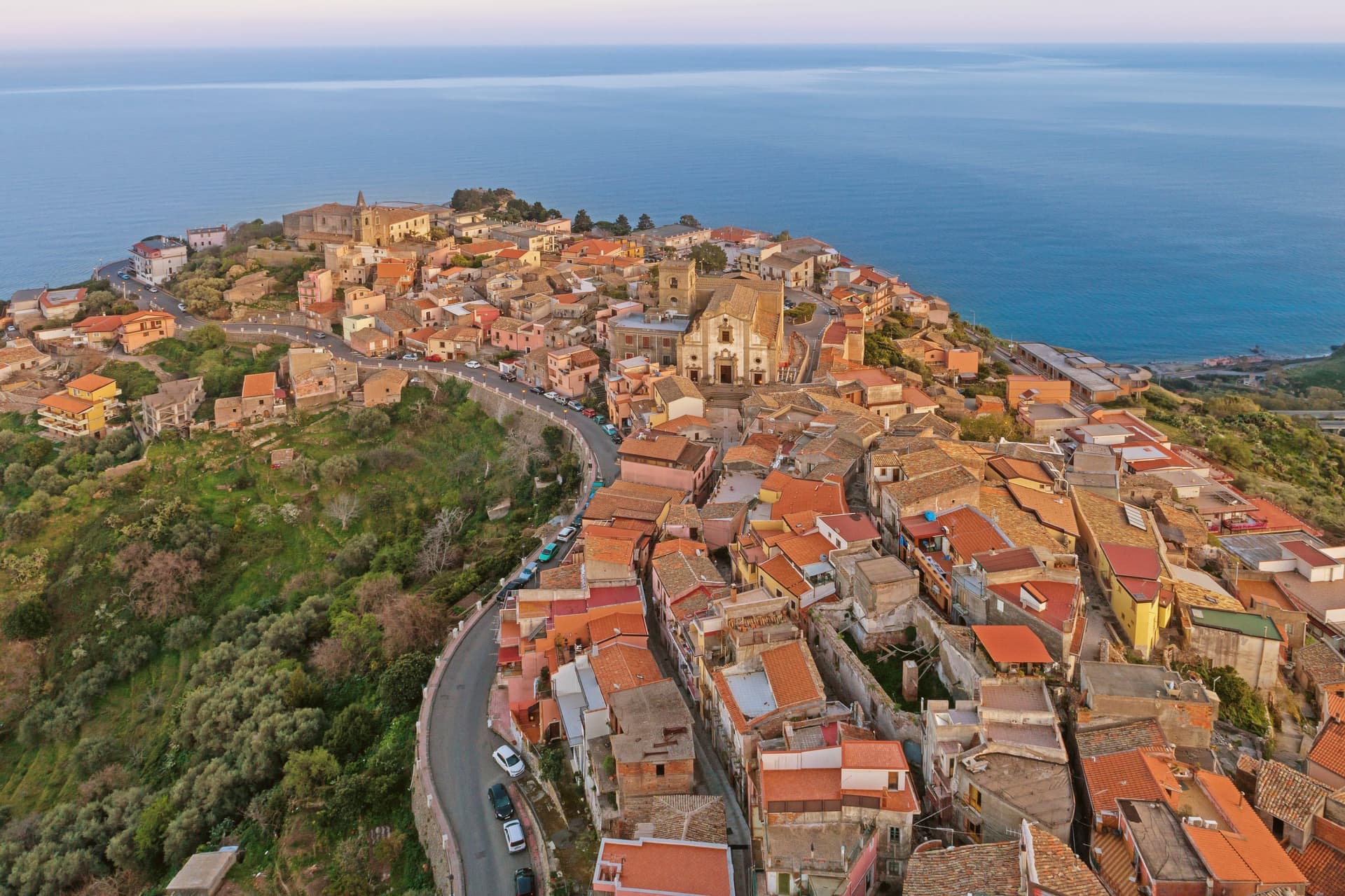
The first record of the settlement, vicum Agrillae, is in a 1117 decree of Roger II. It names a lower site, the one the residents eventually abandoned when they moved uphill to the rock and renamed the place Fortilicium d'Agrò, the fortress of Agrò, a name the ruin on the peak still carries.
The move from lower ground to the high rock explains the layout that remains: the fortress and its silhouette at the top, the mother church rebuilt after the 1648 and 1693 earthquakes lower down, and the Trinità with its convent of Sant'Agostino set apart from both, reached by its own staircase. The village looks north to Calabria across the strait and sits ten kilometers from Taormina, close enough to the coast to be seen from it but built with its back to the sea.
What the earthquakes and the rebuilding left behind is a village whose churches carry more damage and repair in their walls than its ruined castle does, a place shaped as much by disaster and recovery as by the Norman name on the summit.
What to see in Forza d'Agrò
- Castello Normanno. The ruin still crowns the highest point of the village, visible from the coast road below as the shape that names the place.
- Duomo di Maria Santissima Annunziata e Assunta. Mother church built 1400, damaged by the 1648 and 1693 earthquakes, rebuilt with a Spanish Baroque façade and spiral volutes.
- Chiesa della Santissima Trinità. The church sits above its own staircase, attached to the convent of Sant'Agostino, a quieter approach than the steps below suggest.
How to get to Forza d'Agrò
Messina is roughly 67 minutes away by road.
Our tip
May through October is the season the ridge village works best. The Ionian below stays usable, the air at 420 meters is several degrees cooler than Taormina, and the lanes fill on the days when tour buses come up from the coast to film the Godfather staircase. July and August are crowded with day-trippers and warm but rarely hostile, the sea breeze cuts through the village from late afternoon.
Castelmola
Why visit Castelmola
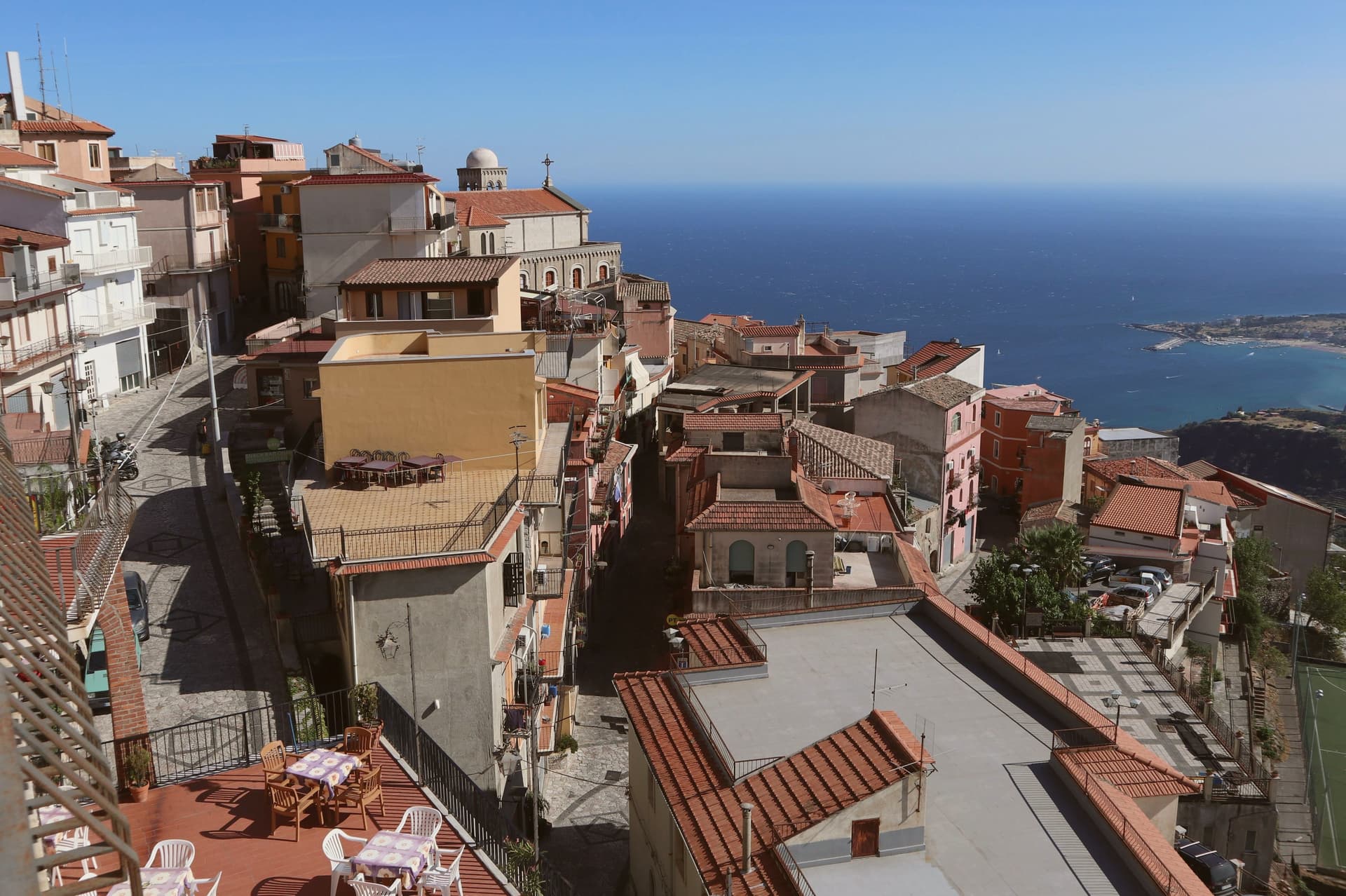
The village occupies a steep limestone rock two kilometers and several hundred meters above the coast, reached by a climb that Taormina itself does not require. The site served as an upper acropolis to Greek Tauromenium below it from the late fourth century BC, a relation of height and defense rather than distance: whoever held the summit watched the lower town and the sea beyond it.
The Byzantines fortified the rock around 800, and the local leader Costantino Caramalo strengthened the walls against Arab raids in the ninth century, work the Normans later built on when they raised the castle whose ruins still stand. The medieval plan of stone lanes climbs from the church at the center up toward that castle, the whole village stacked along the one rock rather than spread across it.
The result is a place defined by its verticality: a fortress town that grew inward and upward because it had nowhere else to go, and that still looks down on the city it was built to guard.
What to see in Castelmola
- Castello Normanno (Castello di Mola). Ruined walls on the summit, standing over Byzantine and Greek foundations. The climb up gives no roof and no interior, only the rock line and the drop on every side.
- Duomo di San Nicolò di Bari. Mother church at the centre of the village, rebuilt in the early twentieth century with a Baroque interior and original portal.
- Piazza Sant'Antonio. Mosaic-paved belvedere with views of Etna, the Gulf of Naxos, and Taormina five hundred meters below.
How to get to Castelmola
Catania is roughly 63 minutes away by road.
Our tip
May through October is the season Castelmola was built for. The Taormina coast fills with tourists, the village above empties out by dusk when the day-trippers descend, and the air at 529 meters stays cooler than the beach. July and August are crowded and hot; the climb from Taormina by foot is two hours and forty minutes of switchbacks.
Savoca
Why visit Savoca
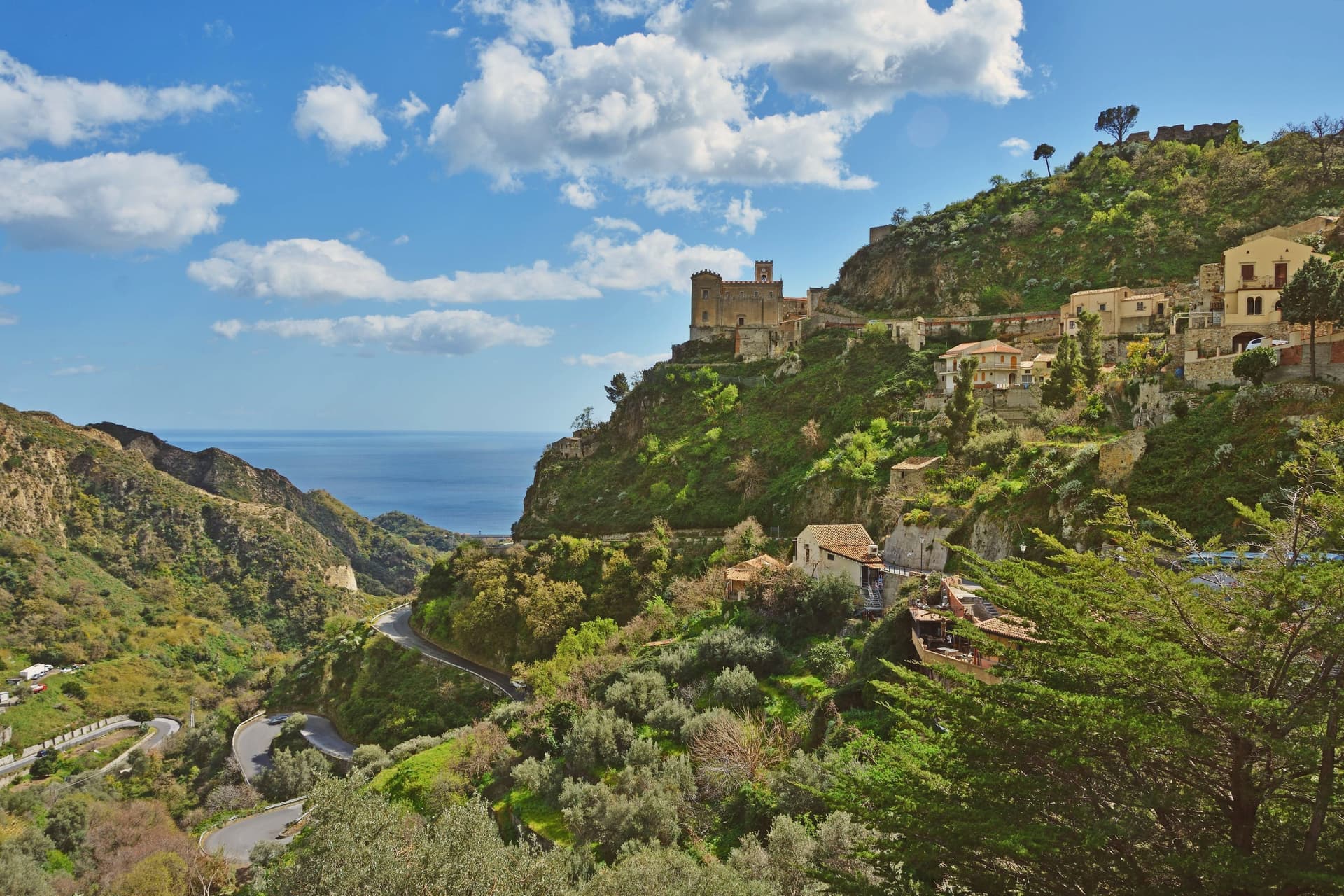
Savoca sits fifteen kilometers north of Taormina, on a hill above the Ionian coast. The centro storico runs along the ridge in stepped lanes and balconied stone houses, with the Capuchin convent below it at the lower edge of the village and the castle ruin above at the highest point, the two anchoring the village from bottom to top.
The convent's crypt holds thirty-seven mummified bodies of notables from the eighteenth and nineteenth centuries, preserved in a colatoio that desiccated the corpses with vinegar and salt. In the summer of 1971, Francis Ford Coppola and Mario Puzo arrived to film the Sicilian scenes of The Godfather here, after the original Corleone in Palermo province was judged too modern for the camera.
The village's shape, a compact ridge with a church at one end and a bar in the lower piazza, gave the film both its wedding location and its courtship scene without need for another set. What draws people now is largely what drew Coppola then: a village small enough to read in a single walk, old enough to need no dressing.
What to see in Savoca
- Chiesa di San Nicolò. Thirteenth-century church suspended on a rock promontory at the top of the village. The Godfather's wedding scene between Michael and Apollonia was filmed here.
- Bar Vitelli. Eighteenth-century palazzo and family bar in the lower piazza, still operating as it did when it stood in for Apollonia's father's bar in The Godfather.
- Cripta dei Frati Cappuccini. Crypt of the Capuchin convent below the centro storico, its ventilated chamber holding the mummified bodies of local notables.
How to get to Savoca
There is a railway station in the town, so you can arrive without a car and never need one while you are here. Messina is roughly 39 minutes away by road.
Our tip
May through October are the months Savoca is busy. The Godfather pilgrims arrive year-round, but the village photographs best in spring and autumn, when the Ionian below is clear and the hill stays cool. July and August are warm; the centro storico is shaded in late afternoon, and the climb up to Pentefur is best at dawn.
Castroreale
Why visit Castroreale
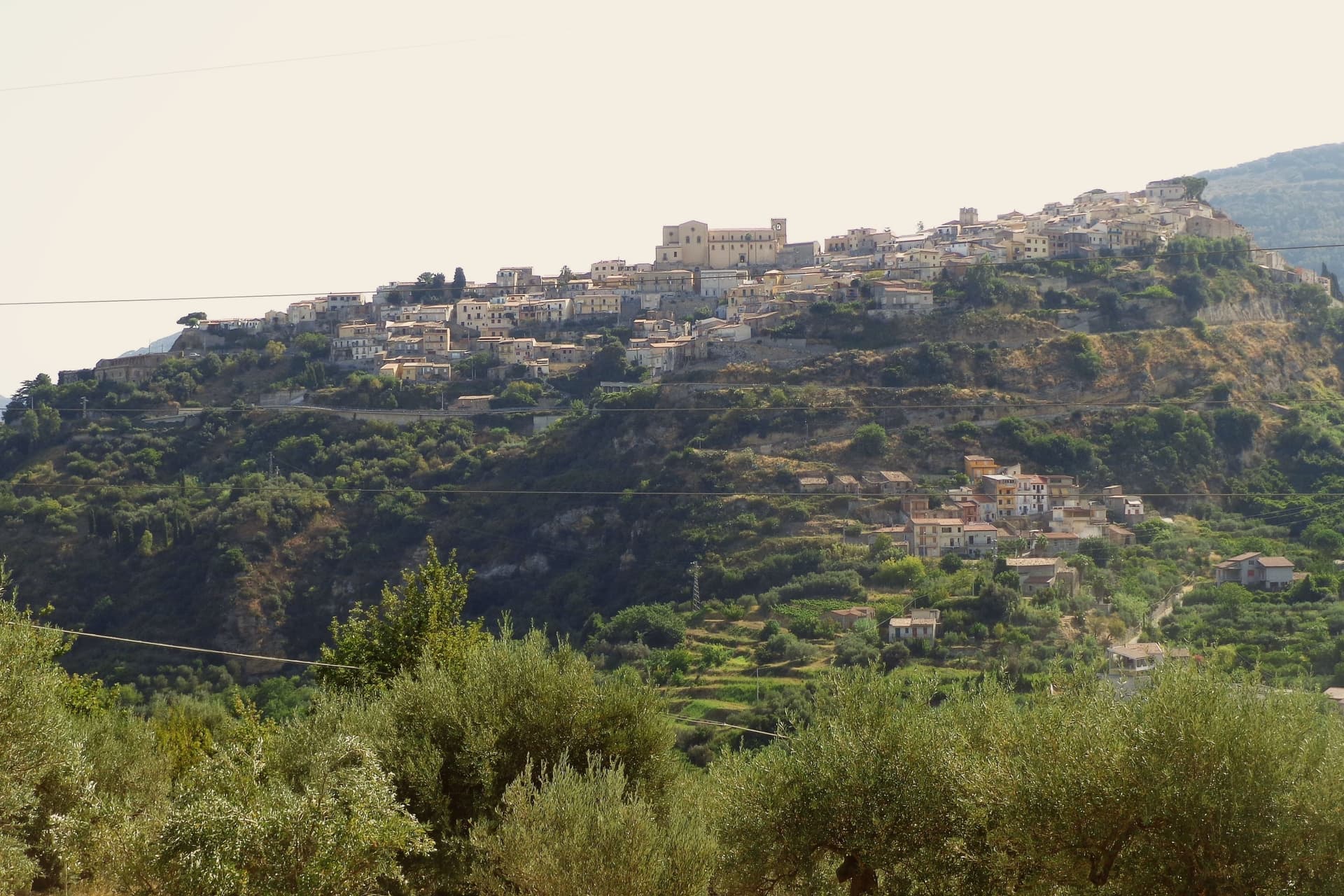
The ridge that carries the town sits between the Peloritani slopes and the Tyrrhenian, 394 meters above the Milazzo plain, a position that gave the place its name: castrum regale, the royal fortress. By the fifteenth century a Jewish community lived in the quarter behind what became the Monte di Pietà, and an arch of the lost Synagogue still stands there.
The 1717 earthquake killed many residents and brought down buildings across the town, a break that separates what survives now from what came before it. Against that loss, the church count is striking: over eighty churches for barely 2,246 people, a density that has left more sacred buildings than the town could ever have kept in active use, which is part of why so much of what remains ended up gathered into a single museum rather than left scattered through the countryside.
The upper ridge, the site of the vanished Jewish quarter, and the churches spread through the streets below are three layers of the same small footprint, royal, mercantile and devotional, compressed onto one spur of rock above the plain.
What to see in Castroreale
- Torre di Federico II d'Aragona. The tower stands on the highest point of the ridge, the last upright piece of the castle Frederick II of Aragon ordered rebuilt, still read from the plain below as the mark of the town.
- Duomo di Santa Maria Assunta. Mother church on the central piazza, with a Renaissance portal and works from the fifteenth and sixteenth centuries.
- Pinacoteca di Santa Maria degli Angeli. Parish museum housing what could be gathered after the territory's chapels and monasteries were lost, the objects now given a single roof.
How to get to Castroreale
Messina is roughly 59 minutes away by road.
Our tip
May through October is the season the ridge handles well. The Tyrrhenian below stays clear, the air at 394 meters is cooler than Milazzo on the plain, and the centro storico opens its trattorie and churches. July and August push past thirty-two degrees and the lanes empty in mid-afternoon, though the evening sea breeze cools the ridge quickly.
Taormina
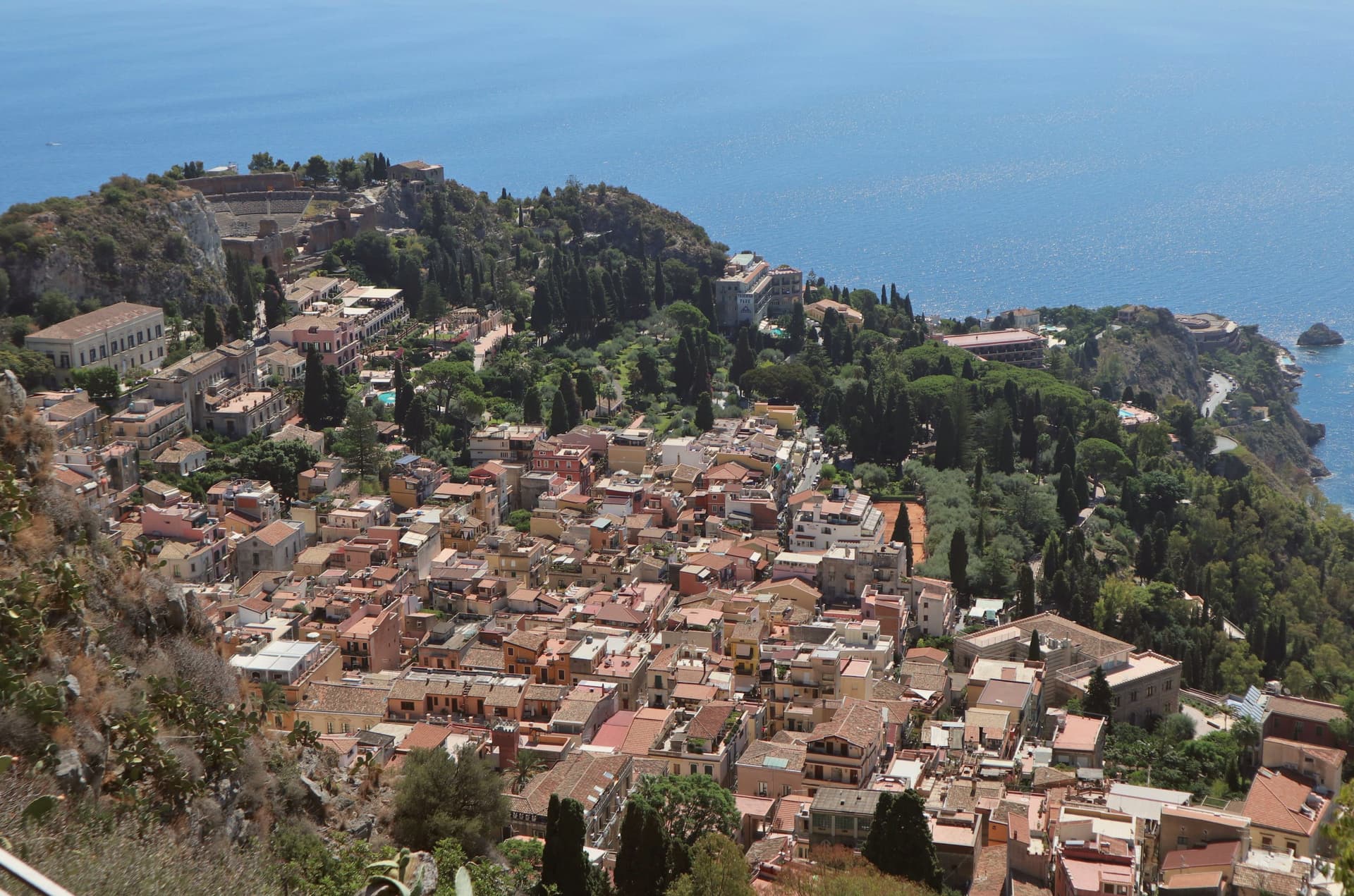
Why visit Taormina
The town sits at 204 meters on the rock above the coast, on the Ionian shore halfway between Messina and Catania. The Siculi welcomed the survivors of the Greek colony of Naxos in 358 BC after Dionysius of Syracuse destroyed it, and Andromachus refounded them as Tauromenium on the height above.
Augustus later made it a Roman colony, deporting much of the population and resettling it with Roman families. The centro sits below the fortress and above the sea: the Arab-Norman stronghold occupies the rock at 397 meters, while further up the hillside the frazione of Castelmola hangs at 884, both looking down on the same stretch of coast the theatre faces.
The small island reserve lies at the opposite end of that vertical arrangement, at sea level below the cliff, reached by cable car or path from the town above. A place built in tiers, from the beach at the base to the fortress on the rock to the village above that, all of it oriented toward the same view of the volcano and the water that made a nineteenth-century travel writer's description enough to start a tourist route still followed today.
The beach here holds the national bathing award, which a comune has to win back every year on water quality, beach management and safety.
What to see in Taormina
- Teatro Antico. The stone rows face south, so the audience looks past the stage wall to Etna rather than toward it. 109 meters in diameter, the remodelling under Roman rule widened the space for spectacle beyond Greek drama.
- Palazzo Corvaja. Fourteenth-century Sicilian-Gothic palace at the entrance to Corso Umberto, on the site of the Roman forum and the Arab cube of the citadel.
- Castello di Monte Tauro. Arab-Norman fortress at 397 meters on the rock above the centro, reached on foot from Via Circonvallazione.
How to get to Taormina
There is a railway station in the town, so you can arrive without a car and never need one while you are here. Catania is roughly 45 minutes away by road.
Our tip
May, June, September and October are the working months in Taormina. Late spring keeps the air clear over Etna and the cruise season has not yet peaked. Taormina Arte runs concerts and opera at the Teatro Antico from June through August; the same weeks bring the highest crowds on Corso Umberto.
Lipari
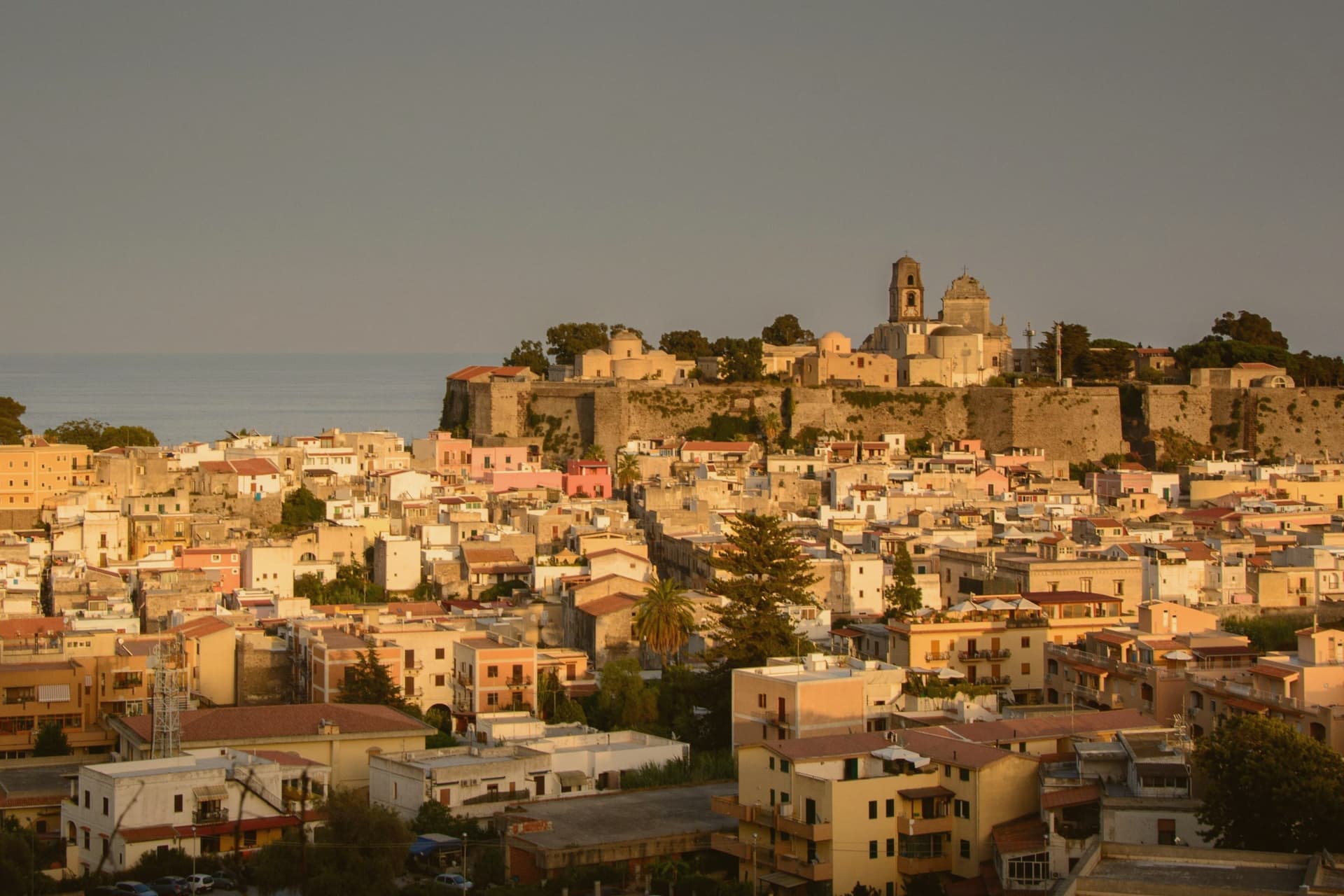
Why visit Lipari
Lipari sits forty kilometers off Sicily's Tyrrhenian coast, the largest of the seven Aeolian islands and the only commune that administers six of them: Vulcano, Panarea, Stromboli, Filicudi, Alicudi and Lipari itself. Humans have lived here since 5000 BC, drawn by deposits of obsidian, the volcanic glass that made Neolithic Lipari a Mediterranean trading center.
The Rocche Rosse obsidian flow on the north of the island dates to the last eruption in 729 CE. The Spanish rebuilt the castle walls after Hayreddin Barbarossa sacked the town and enslaved the population in 1544; the citadel above Marina Corta now holds the Museo Archeologico Eoliano, one of the most important archaeological collections in the Mediterranean.
The archipelago joined the UNESCO World Heritage list in 2000 for its volcanism. Around 12,500 people live here year-round.
In summer the population doubles. Ferries from Milazzo arrive every two hours.
What to see in Lipari
- Castello di Lipari. Fortified citadel on a volcanic rock fifty meters above the sea, rebuilt by the Spanish under Charles V after the 1544 Barbarossa sack.
- Museo Archeologico Regionale Eoliano. Six-section museum founded by Bernabò Brea and Cavalier in the 1950s, with prehistoric, classical, epigraphic and volcanological collections from the archipelago.
- Cattedrale di San Bartolomeo. Cathedral on the castle plateau, ninth-century foundation rebuilt several times, dedicated to the patron saint whose relics were moved to Benevento in 839.
How to get to Lipari
Our tip
May through June and September through early November are the months Lipari was made for. The sea is warm, the Stromboli boats run, and the ferries are not yet rationed by weather. July and August push toward thirty-five degrees and the population doubles with Italian holidaymakers.
More from Anywhere Italy
- The best small coastal towns in Sicilia
- The prettiest villages in the province of Messina
- The best coastal towns within an hour of Catania
- The best coastal towns you can reach by train in Sicilia
 The best hidden coastal towns that eat well in Sicilia
 The best hidden towns you can reach by train that eat well in Sicilia