
The best coastal towns in the province of Imperia
This is the flower coast, the last stretch of Liguria before France, and it smells of it: carnations and basil under glass, wild rosemary on the dry slopes, the sharp green of Taggiasca olives pressed in the mills behind the shore. The houses are built from the local grey stone and painted in ochre, rust and dusty pink, with black slate doorframes and vaulted alleys that run uphill from the sea rather than along it. Lunch is brandacujun, rabbit with olives and pine nuts, sardenaira straight from the bakery, and Rossese or Vermentino from vines that look down on the water. Spring is the season the coast was named for, though the light in late September is better and the sea is still warm enough to swim.
Most travellers who come to Liguria go east instead, to the Cinque Terre, where the trains from La Spezia run full all summer and the path between Vernazza and Monterosso has to be rationed. It is a beautiful piece of coast and it earned its reputation, but the terraces are narrow, the villages are small, and the arithmetic of cruise excursions and day trippers does not work in the visitor's favour. Portofino, further round, absorbs the rest, along with the yachts.
The same cliffs, the same olive terraces and the same warm stone carry on west, past Genoa and Savona, all the way to the Roya valley and the border. The province of Imperia gets a fraction of the attention: medieval hill towns looking straight down on the sea, a Napoleonic bridge over a river gorge, beaches of grey pebble below churches with striped bell towers. These are the towns on that coast, each one within sight or sound of the water, and fewer people go.
Of the 13 communes we have mapped in the province of Imperia, 6 qualify as coastal towns: each sits directly on the sea. The smallest, Cervo, has 1,086 residents.
If you are still choosing, we have also written The best olive oil towns in the province of Imperia and The prettiest small villages in the province of Imperia.
Cervo
Why visit Cervo
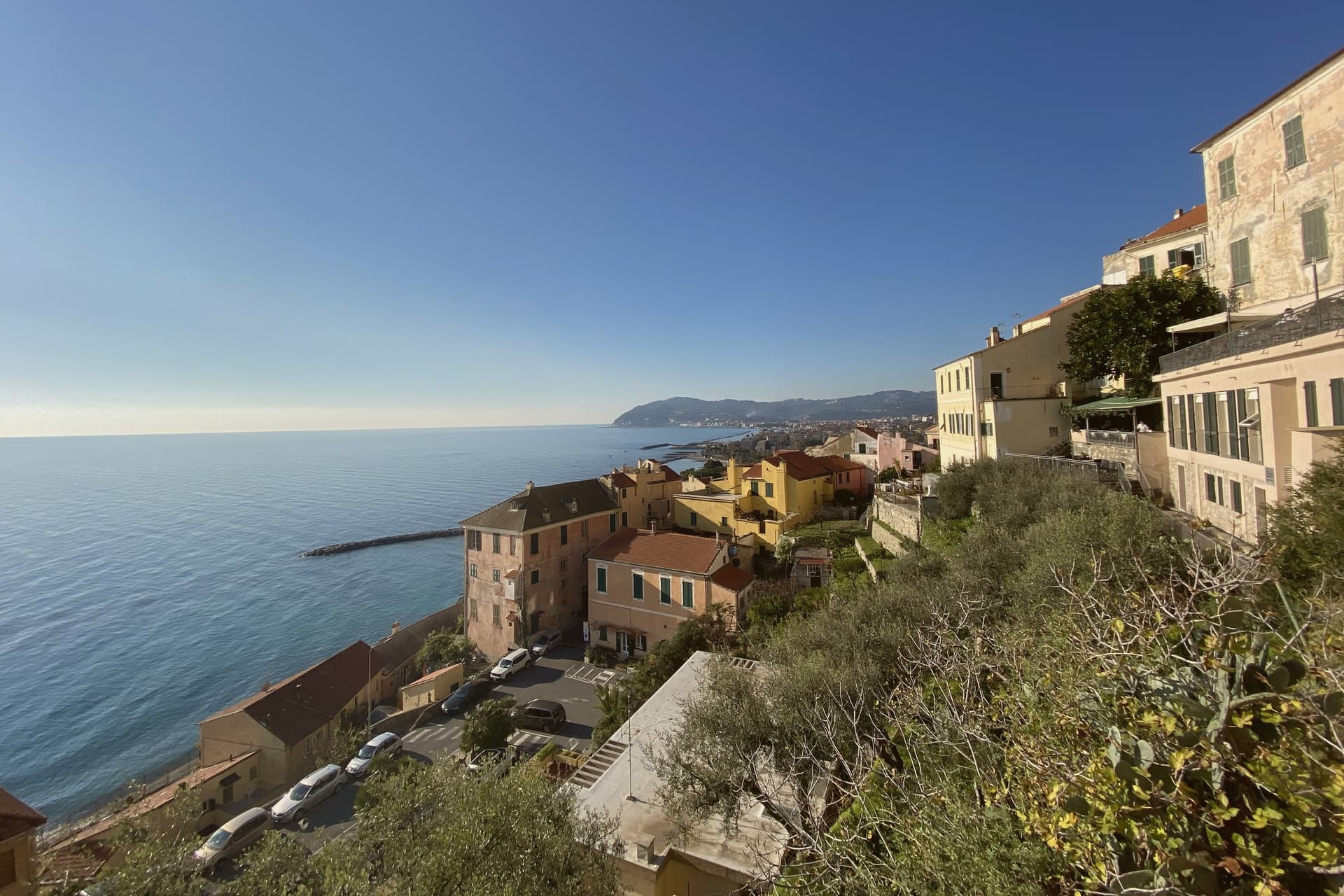
Cervo sits at 66 meters on a hill that drops straight to the Riviera di Ponente, between Imperia and Albenga. The settlement began as a Roman roadhouse on the Via Julia Augusta and grew into a medieval fief of the Marchesi di Clavesana, loyal vassals of the Republic of Genoa.
The sixteenth-century towers and ramparts that ring the upper village were built when Saracen incursions still threatened the coast, and the fortified high point where the marquis line once held power is now given over to a museum of the coral trade that shaped the town below. The lower streets run down toward the church square, where the coral money that built the parish church also paid, centuries later, for the open-air stage where the summer concerts are heard.
The two high points of the village, the castle above and the churchyard below, mark the two economies that built Cervo: a defensive fief guarding the coast, and a fishing community whose earnings from distant waters ended up carved into Baroque stone. What the hill preserves, in effect, is the record of both: a fortified lookout turned museum, and a merchant church turned concert hall.
What to see in Cervo
- Chiesa di San Giovanni Battista. Known as the Chiesa dei Corallini. Its concave Baroque façade faces the sea and gives the small square in front of it the acoustics that host the festival each summer.
- Castello dei Clavesana. Sits at the top of the village with walls that once looked out for Saracen ships. The Ethnographic Museum of Western Liguria now occupies its rooms, with displays on the coral trade and the fishing life that funded the church below.
- Oratorio di Santa Caterina. Small Romanesque oratory with eighteenth-century frescoes, set into the old defensive walls.
How to get to Cervo
Genova is roughly 89 minutes away by road.
Our tip
April through June and September through October are the right months for Cervo. The Riviera di Ponente is dry, the centro storico keeps its sea breeze, and the sagrato of San Giovanni hosts concerts from July into early August during the Festival Internazionale di Musica da Camera. Mid-summer is hot at sea level and the village fills with festival-goers; book accommodation well ahead.
Cipressa
Why visit Cipressa
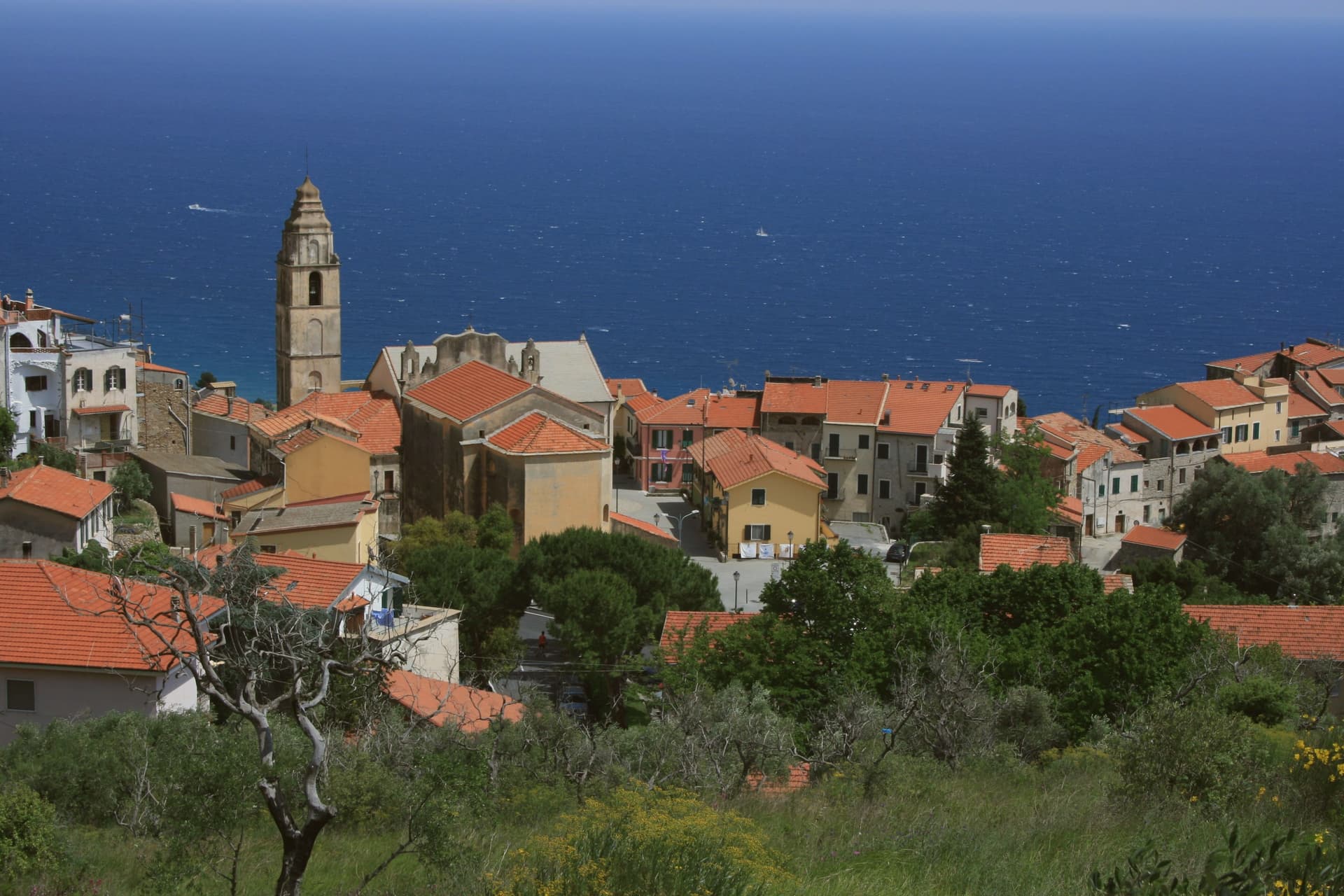
Cipressa sits at 232 meters on a ridge above the Ligurian Sea, ten kilometers west of Imperia. The ridge runs inland from the coast road, and the village occupies its high point, with the frazione of Lingueglietta set further west on the same line of hills, its medieval street plan still intact and separate in character from the centro storico below.
Above the village, a tower built against Saracen raids stands as one signal point in a chain that once ran the length of the coast from Ventimiglia to Genova, the raids themselves having shaped settlement patterns here through the late Middle Ages: villages set back and up from the shore, watch points on the high ground. In Lingueglietta the same pressure produced a church converted into a fortified shelter, merlons added to its roofline when the danger from the sea increased.
Below the ridge, the valley is olive country, Taggiasca terraces dropping from the high ground to the coast road. The result is a village whose defensive geography, built to keep distance from the water, now sits directly above a road cut for the opposite purpose: getting from the water to the ridge as fast as possible.
What to see in Cipressa
- Torre Gallinara. Cylindrical form on the ridge above the village, a viewpoint across the Riviera dei Fiori from the walkway that circles its base.
- Chiesa Fortezza di San Pietro. Proto-Romanesque church in Lingueglietta, its roofline still carrying the merlons added when pirate raids intensified along the coast.
- Lingueglietta. Frazione on the western ridge with intact medieval streets, reached by the road that climbs away from the centro storico.
How to get to Cipressa
Genova is roughly 106 minutes away by road.
Our tip
April through June and September to October are the windows for walking the ridge and cycling the climb itself: olive groves green, the coast clear from the Torre Gallinara, evenings under 25 degrees. Milano-San Remo runs in mid to late March, when the climb is at its hardest because winter rains have left the road surface uneven. July and August are hot on the coast below; the 232-metre elevation keeps the village cooler but cycling is best at dawn.
Dolceacqua
Why visit Dolceacqua
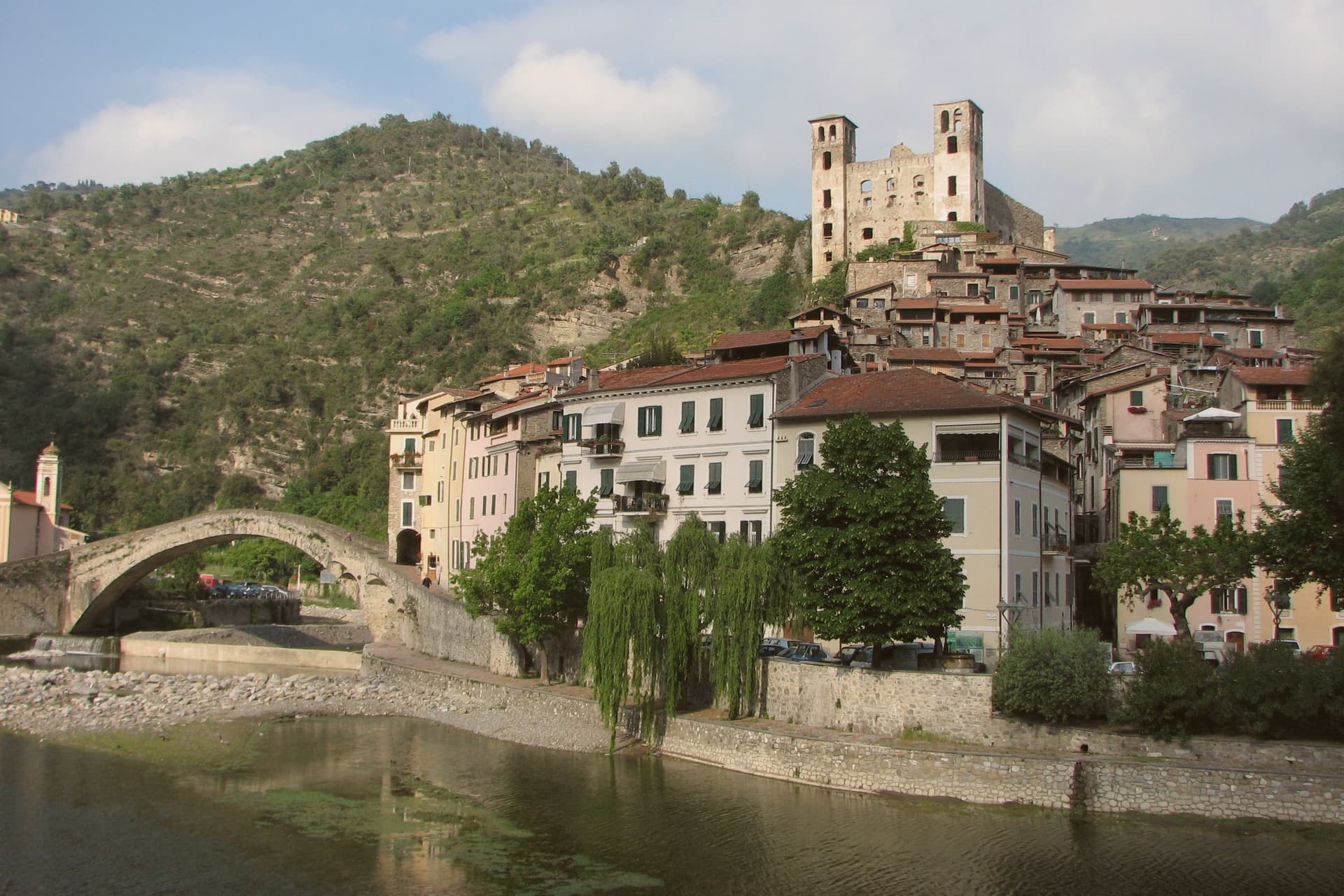
The village sits twenty kilometers from the French border and nine inland from Bordighera, in the Val Nervia. The river of the same name splits it into two: the older Terra on the left bank, its lanes stepping up toward the castle, and the newer Borgo on the right, where the parish church stands.
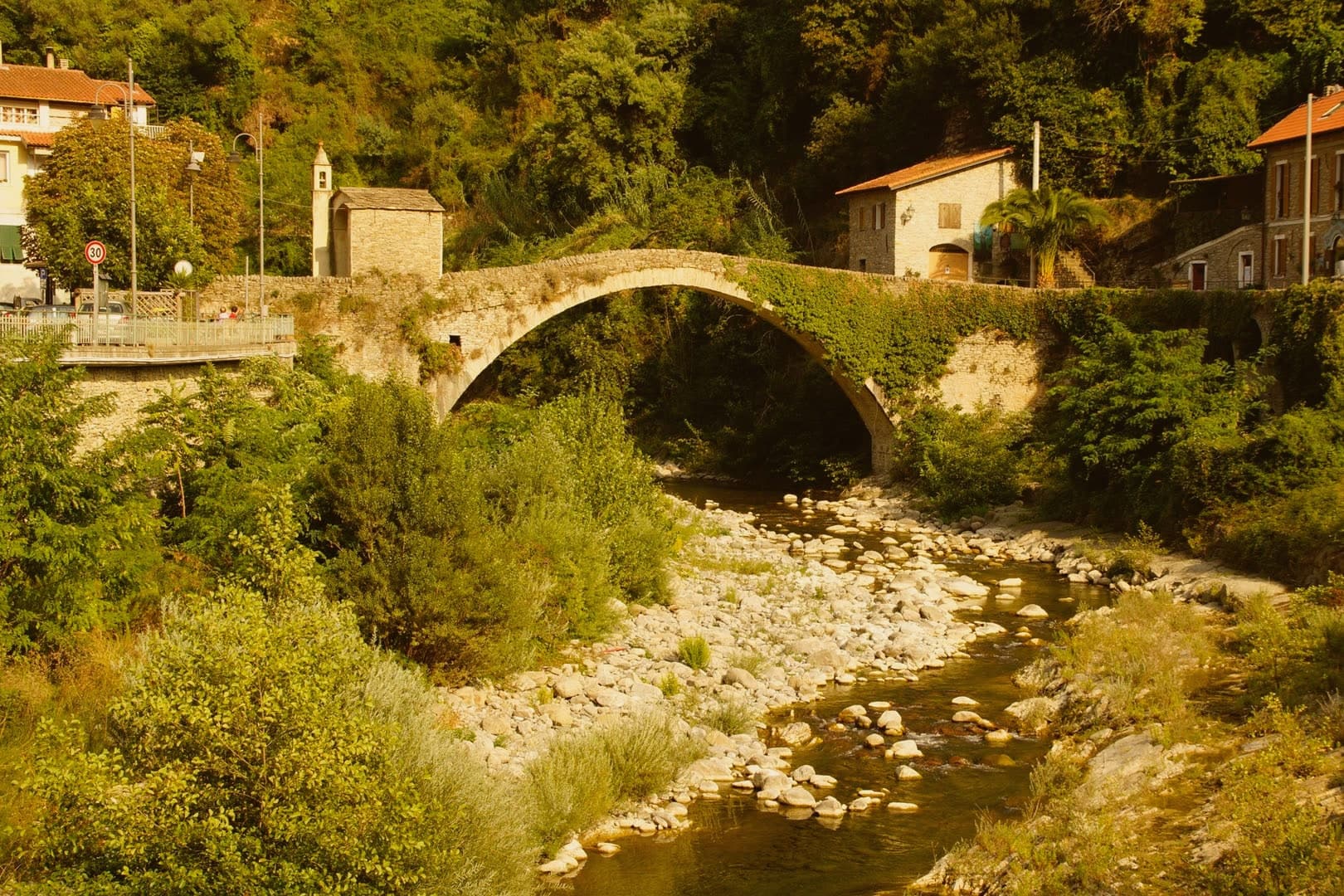
The bridge is what makes the two halves legible as one village rather than two settlements facing each other across water. The Doria held the fief from 1270, traded it with the Savoy, the French and the Spanish, and let the castle go by the mid-eighteenth century, so what remains above the rooftops is a ruin rather than a seat of power.
The surrounding hills still work, producing Rossese di Dolceacqua. In January, the Festa di San Sebastiano carries a laurel tree hung with consecrated wafers through the lanes of both banks.
The village, in other words, is still organized exactly as Monet found it in 1884: a river, two banks, and a bridge between them, with the working hillside and the ruined fortress as the constants either side of the water.
What to see in Dolceacqua
- Ponte Vecchio. Thirty-three meters across the river, the span that carried Monet's eye from the water up to the fortress above. It is what joins the village's two banks into one place.
- Castello dei Doria. Ruined above the rooftops, with a partial restoration underway. The climb up through the old quarter ends at its walls, looking back down over both halves of the village.
- Terra. Older half of the village on the left bank, a vertical network of carruggi climbing under arched passageways to the castle.
How to get to Dolceacqua
Genova is roughly 130 minutes away by road.
Our tip
April through June brings green hills, mild evenings, and the first Rossese tastings in the cellars along the road to Apricale. July and August are warmer than the coast, often 30 degrees in the riverbed; the village stays cool inside the carruggi but full of day-trippers from Bordighera and Ventimiglia. September is dry and clear, the best month for the bridge in the afternoon light.
Diano
Why visit Diano
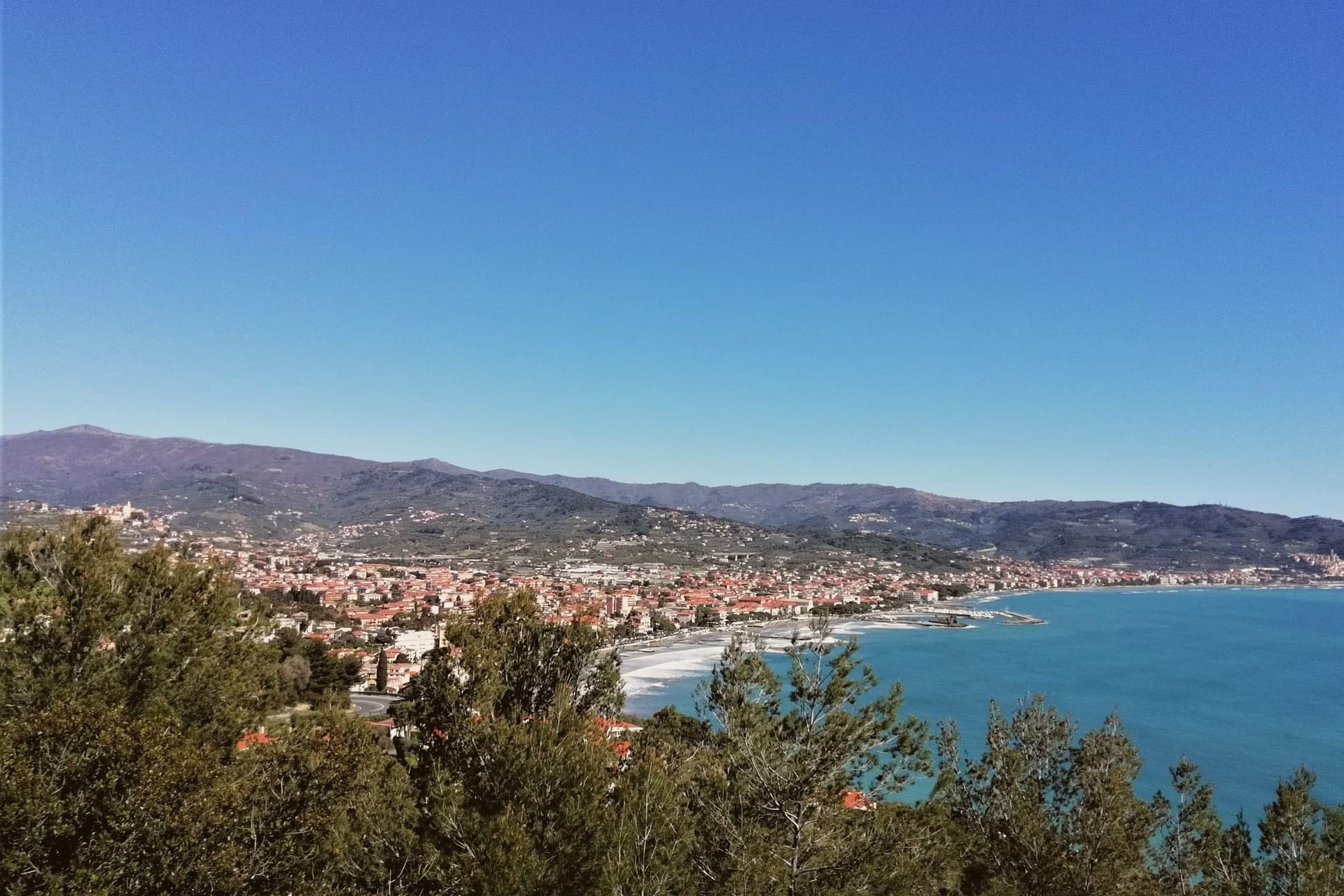
The hilltop and the coast were one commune until the seaside half was made independent in 1923, and the two still read as a single place split in two: a fortified settlement set back from the water, and the town it produced at sea level once the shoreline could be settled safely. The name of the upper town traces to the Latin Dianum, a temple to Diana, which places the site's origin well before the medieval walls that now define it.
Both halves sit on the same bay and draw on the same valley behind them, where the Taggiasca olive has been grown long enough to anchor the local Città dell'Olio membership shared by both. The bay itself is sheltered and south-facing, which gives the coastal half one of the milder climates on the Italian Riviera and explains why the beach resort grew where it did, directly below the older settlement rather than at any distance from it.
What Diano amounts to, then, is a single valley economy, olives above, sand below, that split administratively in the twentieth century without ever splitting geographically.
The beach here holds the national bathing award, which a comune has to win back every year on water quality, beach management and safety. It is also rated for accessibility, which most of this coast is not.
What to see in Diano
- Diano Castello — centro storico. Vaulted alleys and stone staircases climb through the old town to the parish church of San Nicola di Bari. The walls that ring the settlement still trace their full course, and the streets keep the tight, defensive layout of a hill settlement built for lookout rather than commerce.
- Diano Marina — Bandiera Blu beach. The seafront runs the length of the resort under a line of palms, with the flat, easy sand that makes it a family destination. Summer markets fill the promenade, and the town's calendar turns on the mid-August Madonna del Rosario procession.
- Museo dell'Olivo (Diano Marina). The exhibits move from Roman amphorae through medieval monastic cultivation to present-day production, tracing the Taggiasca olive's long presence in the valley. The museum was founded by the Carli oil family.
How to get to Diano
There is a railway station in the town, so you can arrive without a car and never need one while you are here. Genova is roughly 94 minutes away by road.
Our tip
April through October is the open season for both Dianos — warm coastal days, calm Mediterranean sea by late spring, and the Diano Marina beach packed from mid-June through August. The Sant'Antonio procession runs the second week of August. Diano Castello stays alive year-round (the medieval old town is residential) but the most pleasant months for the hilltop are May-June and September-October.
Taggia
Why visit Taggia
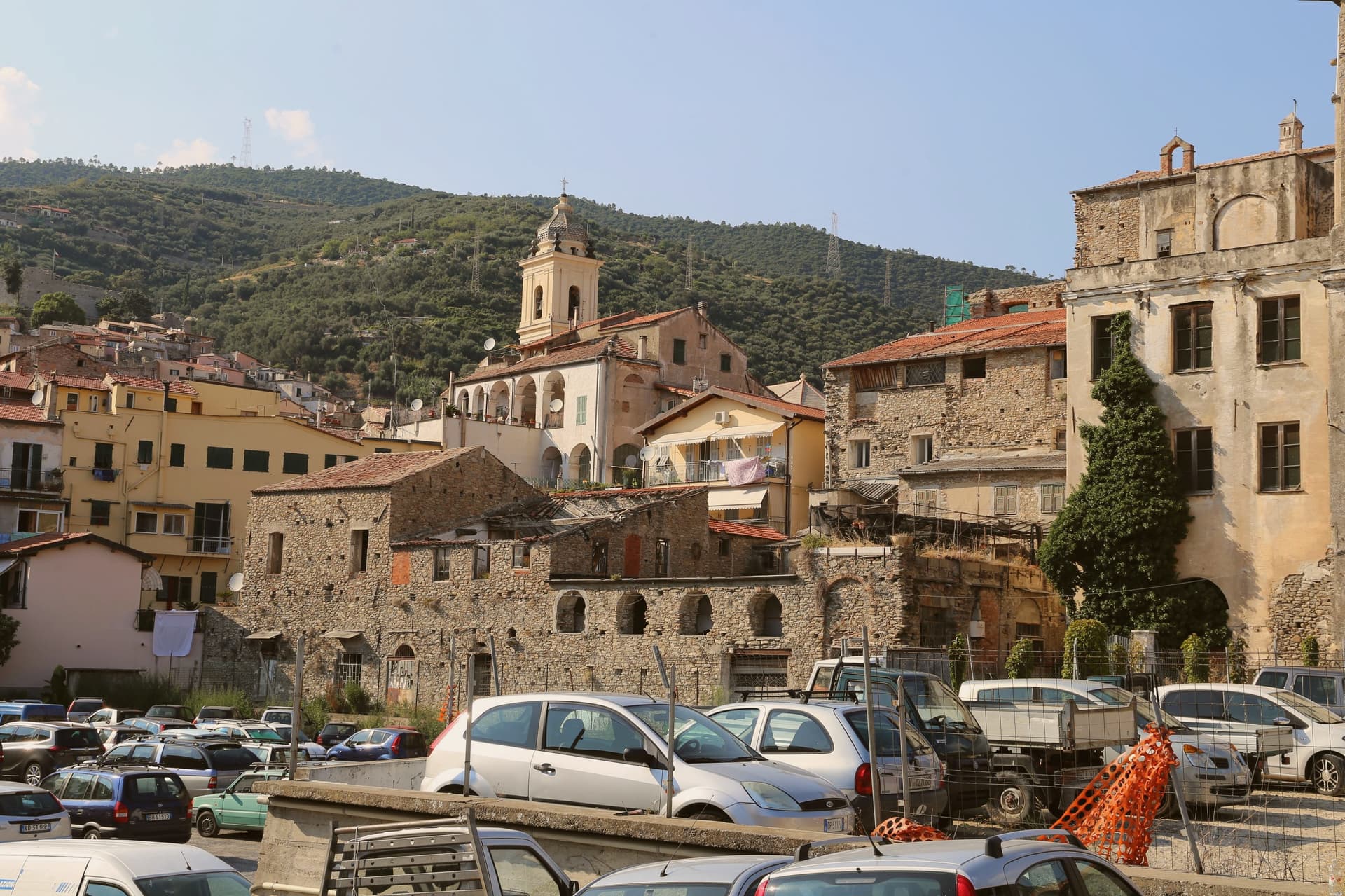
Taggia sits where the Argentina valley narrows toward the Ligurian coast, fifteen kilometers west of Imperia. Iron Age tombs have been found in the territory, and the small port at the mouth was called Costa Balenae in antiquity, a coastal settlement distinct from the medieval town that grew up along the river above it.
The Benedictine monks of Lérins came in the seventh and eighth centuries and, by tradition, brought the olive cultivar that took the town's name and now covers most of western Liguria's hillsides. The medieval centro storico runs along three parallel streets above the river, and sixteenth-century walls fortified the town against Ottoman raids that struck the coast in 1560 and 1564, the same period that produced the bridge's later arches and the walled gates still standing.
Taggia carries the Borghi più belli badge and the Città dell'Olio designation as the source of the Taggiasca name. The valley town, the coastal port, and the olive-covered hillsides are really one settlement pattern read at three scales: a river crossing fortified against the sea, feeding an oil that carried the name outward long after the raids stopped.
What to see in Taggia
- Convento di San Domenico. Founded in 1490. The Brea panels hang alongside works of the Nice school, four centuries of west-Ligurian painting gathered in one cloister.
- Ponte Antico. The arches step unevenly across the river, the earliest sections centuries older than the latest, a bridge built by accretion rather than plan.
- Centro storico di Taggia. Three parallel medieval streets above the river, sixteenth-century walls and gates intact from the era of Saracen and Ottoman raids.
How to get to Taggia
There is a railway station in the town, so you can arrive without a car and never need one while you are here. Genova is roughly 116 minutes away by road.
Our tip
April through June and September to October bring the best windows: olive groves still green or in harvest, the Argentina valley walkable, evenings on the centro storico stones below 25 degrees. Taggia's olive harvest, the Olioliva festival down the coast in Imperia, runs through November. July and August push 30 to 32 degrees and bring weekend traffic from Sanremo, ten kilometers west.
Sanremo
Why visit Sanremo
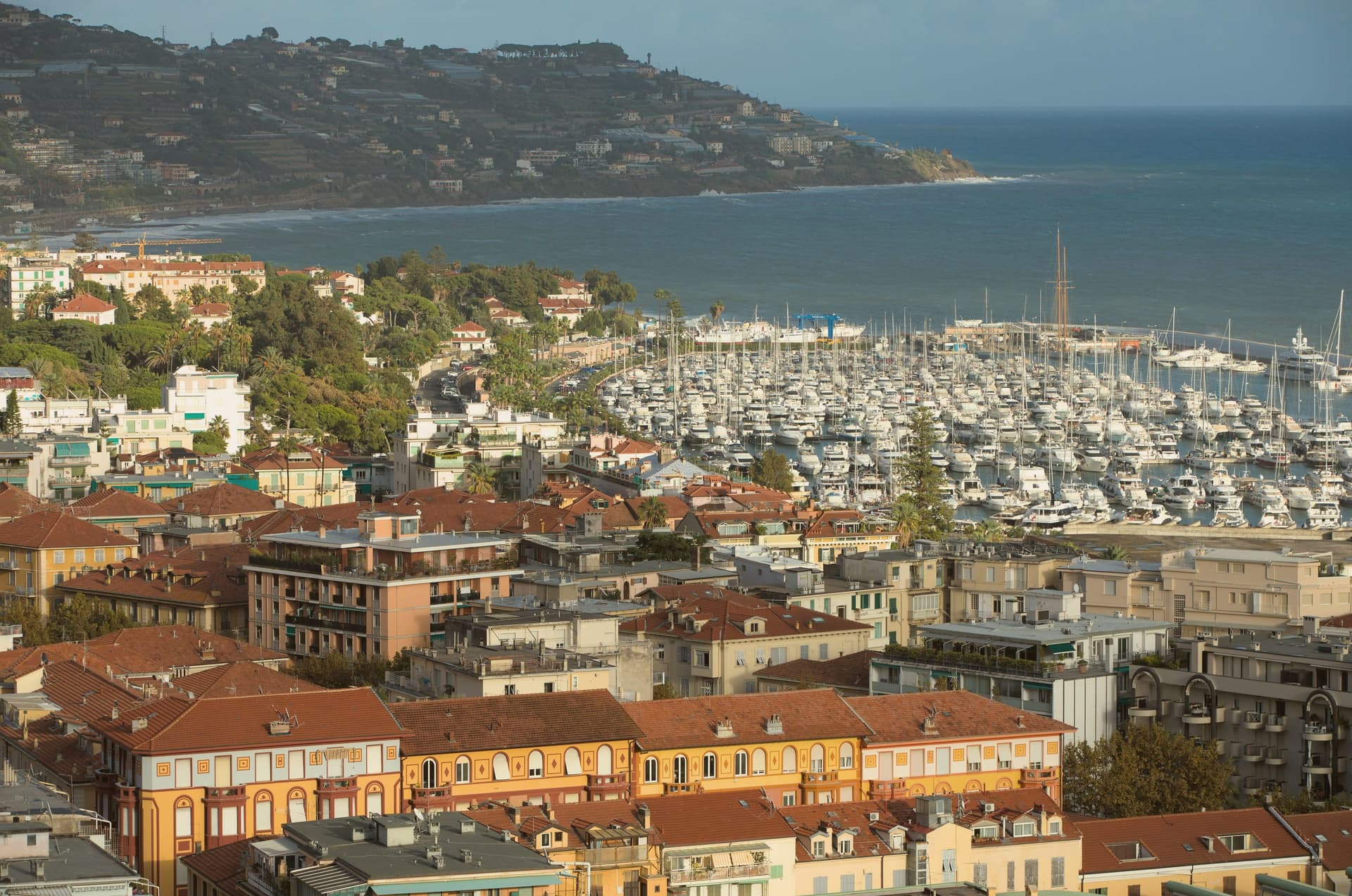
Sanremo is the largest town between Imperia and the French border. The site was settled by the Romans, and the name almost certainly contracts Sant'Eremo, after a 5th-century hermit named Romolus.
The modern city, though, was made by two later waves of wealth: Russian and English aristocracy who built winter villas along the seafront from the 1860s, and the Italian post-war music industry that fixed on the town from 1951 onward. That history splits the town into two parts that still read separately today.
La Pigna corkscrews up the hill behind the seafront in covered alleys and stone stairs, a medieval settlement turned in on itself. Below and along the water, the Lungomare Imperatrice and the quarter around it were built outward and open, laid out for a foreign wintering elite rather than for defense.
The hills behind both feed a flower trade for the European market, carnations, roses, ranuncoli, farmed in the agricultural quarter around the Mercato dei Fiori, part of the Spighe Verdi rural-quality network. Old Sanremo climbed the hill to defend itself; new Sanremo spread along the shore to be seen, and the town today is the sum of a hillside built inward and a seafront built outward toward the visitors who financed it.
The beach here holds the national bathing award, which a comune has to win back every year on water quality, beach management and safety.
What to see in Sanremo
- La Pigna (centro storico). Covered alleys and stone stairs stack up the hillside behind the seafront, the layout giving the quarter its name, pinecone in Italian. The climb ends at the Madonna della Costa sanctuary.
- Casinò Municipale. The building itself is a Liberty-style landmark on Corso degli Inglesi, its facade and interiors built to draw a Northern European winter clientele to the tables.
- Lungomare Imperatrice. Palm-lined seafront promenade named for the Russian Empress Maria Aleksandrovna, who wintered in Sanremo in the 1870s. Bracketed by the casino and the Russian Orthodox church.
How to get to Sanremo
There is a railway station in the town, so you can arrive without a car and never need one while you are here. Genova is roughly 119 minutes away by road.
Our tip
Sanremo is a year-round destination — the mildest winter climate on the Italian Riviera is why the Russian and English aristocracy built it in the first place. February belongs to the music festival; book everything months ahead or skip the week entirely. March-April see the flower harvest and the Milano-Sanremo finish line. Mercatini artigianato a Sanremo falls in September.
More from Anywhere Italy
 The best olive oil towns in the province of Imperia
 The prettiest small villages in the province of Imperia
 The best olive oil towns that eat well in Liguria
 The best olive oil towns you can reach by train in Liguria
 The best small coastal towns with a serious restaurant in Liguria
- The best hidden beach towns in Liguria