
The best olive oil towns you can reach by train in Liguria
Ligurian olive oil comes mostly from the taggiasca, a small dark olive grown on dry terraces held up by walls of stacked stone, and the oil it gives is pale gold and mild, closer to almond than to pepper. The harvest runs through the cold months, when the nets go down under the trees and the frantoi work late, and the coast smells of woodsmoke and crushed fruit. Eat it as the region does, on focaccia still warm, over trofie with basil, poured onto stockfish or a plate of boiled greens. The best of it never leaves the province, sold in tins from the mill door or the alimentari next to the church.
The stretch of coast most visitors book is the Cinque Terre, where the terraces are just as steep and the trains are just as frequent, and where the platform at Riomaggiore in July feels like a commuter station at rush hour. The walking paths are ticketed, the harbours are photographed from the same angle by everyone, and the small villages have very little room to absorb the numbers that arrive each morning. There are good reasons people go. There are also reasons to get back on the train.
The same railway carries on north and south past that famous stretch, following the water the whole way, stopping at towns where the olive terraces climb straight from the back of the old centre. These are places with working mills, a Saturday market, a beach that belongs mainly to the people who live there, and a station within walking distance of everything worth seeing. Fewer people get off here, which is the point.
Of the 54 communes we have mapped in Liguria, 7 qualify as olive oil towns you can reach by train: each belongs to the national association of olive-oil towns, and we have confirmed each is reachable without a car. The smallest, Levanto, has 5,140 residents.
Two more lists worth reading alongside this one: The best olive oil towns that eat well in Liguria and The 6 best olive oil towns within 90 minutes of Genova.
Levanto
Why visit Levanto
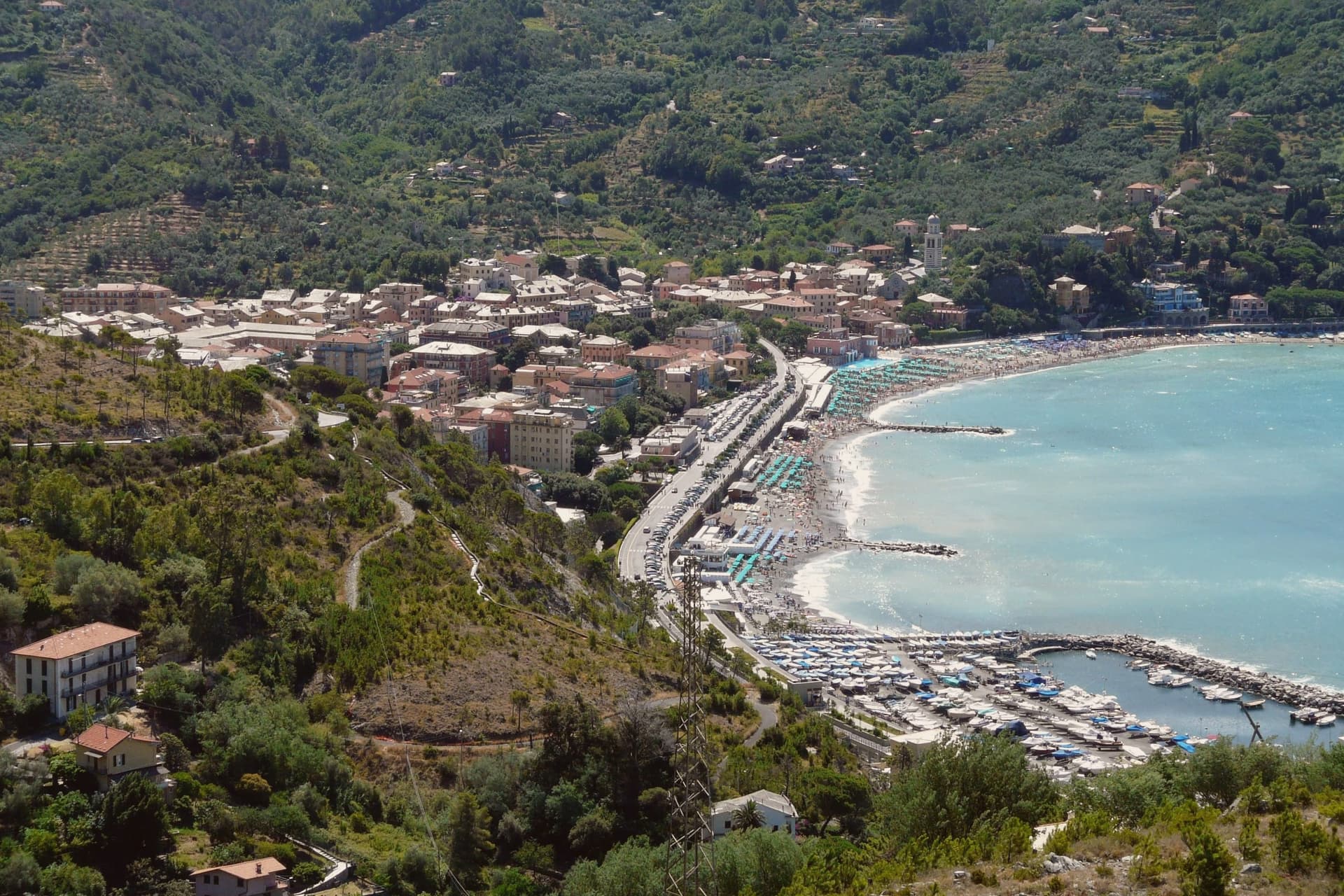
Levanto sits at sea level on the Ligurian coast, twenty kilometers northwest of La Spezia and just outside the Cinque Terre National Park. The Cinque Terre Express train stops here every half hour on its way to the five villages, but Levanto has the things they do not: a long sand-and-gravel beach with Bandiera Blu status, a flat centro storico, and a surf break that local guides classify as one of the few big-wave spots in Italy.
The Chiesa di Sant'Andrea, built in 1222, fronts the old town with horizontal bands of black and white marble and a large rose window. The thirteenth-century Loggia Comunale, on the same piazza, was awarded a UNESCO peace and culture title in 2007.
Casa Restani, on Via Grillo, is a surviving medieval merchant house with the ground floor where goods from the harbor were stored. Levanto holds Cittaslow, Bandiera Blu, Parco Nazionale, and Città dell'Olio at once.
We confirmed you can reach this one by train.
What to see in Levanto
- Chiesa di Sant'Andrea. Parish church built in 1222 in Ligurian Gothic style, with horizontal bands of black and white marble and a large rose window over the main door.
- Castello di Levanto. Thirteenth-century defensive castle on the hillside, still intact but privately owned and closed to the public.
- Loggia Comunale. Thirteenth-century arcaded loggia on the main piazza, awarded a UNESCO title in 2007 as a monument of culture and peace.
How to get to Levanto
There is a railway station in the town, so you can arrive without a car and never need one while you are here. Genova is roughly 72 minutes away by road.
Our tip
April through June and September into October are the dry months. The sea warms enough for swimming by late May. The surf builds in autumn and winter when Atlantic systems push swell into the gulf.
Andora
Why visit Andora
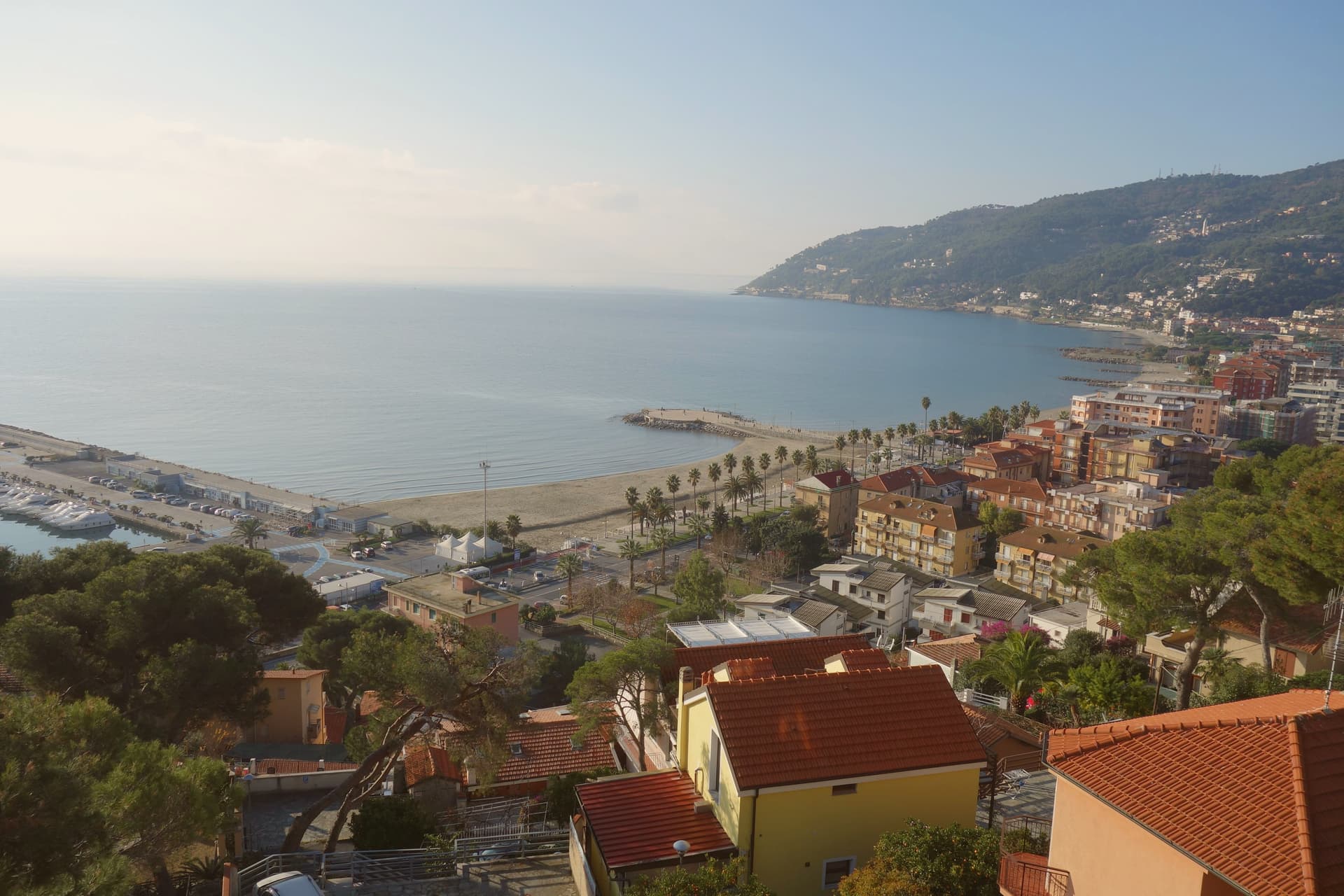
Andora sits on the Val Merula in the Riviera di Ponente, the westernmost commune of the Province of Savona before crossing into Imperia. The original settlement was Borgata Castello, perched on a hill called Paraxu set back from the coast because Saracen raids made the shore unsafe.
The Clavesana counts raised the castle on Paraxu around 1170, and beside it the late-thirteenth-century Romanesque-Gothic church of Saints Giacomo and Filippo, built in Capo Mele stone with a deep central polyphore and a rose window. Together they are considered the most significant medieval ensemble on the western Ligurian coast.
The modern town moved to the Aurelia coast road after the raids stopped. Colla Micheri, the hilltop hamlet bought and restored by Thor Heyerdahl of Kon-Tiki fame in the 1960s, sits above the modern beachfront.
The Spighe Verdi recognition flags the green network running through the commune; the olive grove network covers the Val Merula slopes.
We confirmed you can reach this one by train.
What to see in Andora
- Castello dei Clavesana. Ruined castle raised by the Clavesana counts around 1170 on the Paraxu hill, the first nucleus of medieval Andora, in Capo Mele stone.
- Chiesa dei Santi Giacomo e Filippo. Late thirteenth-century Romanesque-Gothic church beside the castle in Borgata Castello, central polyphore and rose window in Capo Mele stone.
- Colla Micheri. Hilltop hamlet of Saracen-era stone houses around the church of San Sebastiano, bought and restored by Thor Heyerdahl in the 1960s.
How to get to Andora
There is a railway station in the town, so you can arrive without a car and never need one while you are here. Genova is roughly 83 minutes away by road.
Our tip
April through June and September into October are the strongest months on Andora's coast. The olive groves come into harvest from late October into November. July and August fill the Aurelia beachfront and the Riviera dei Fiori traffic doubles. Street Food Time falls in August.
Diano
Why visit Diano
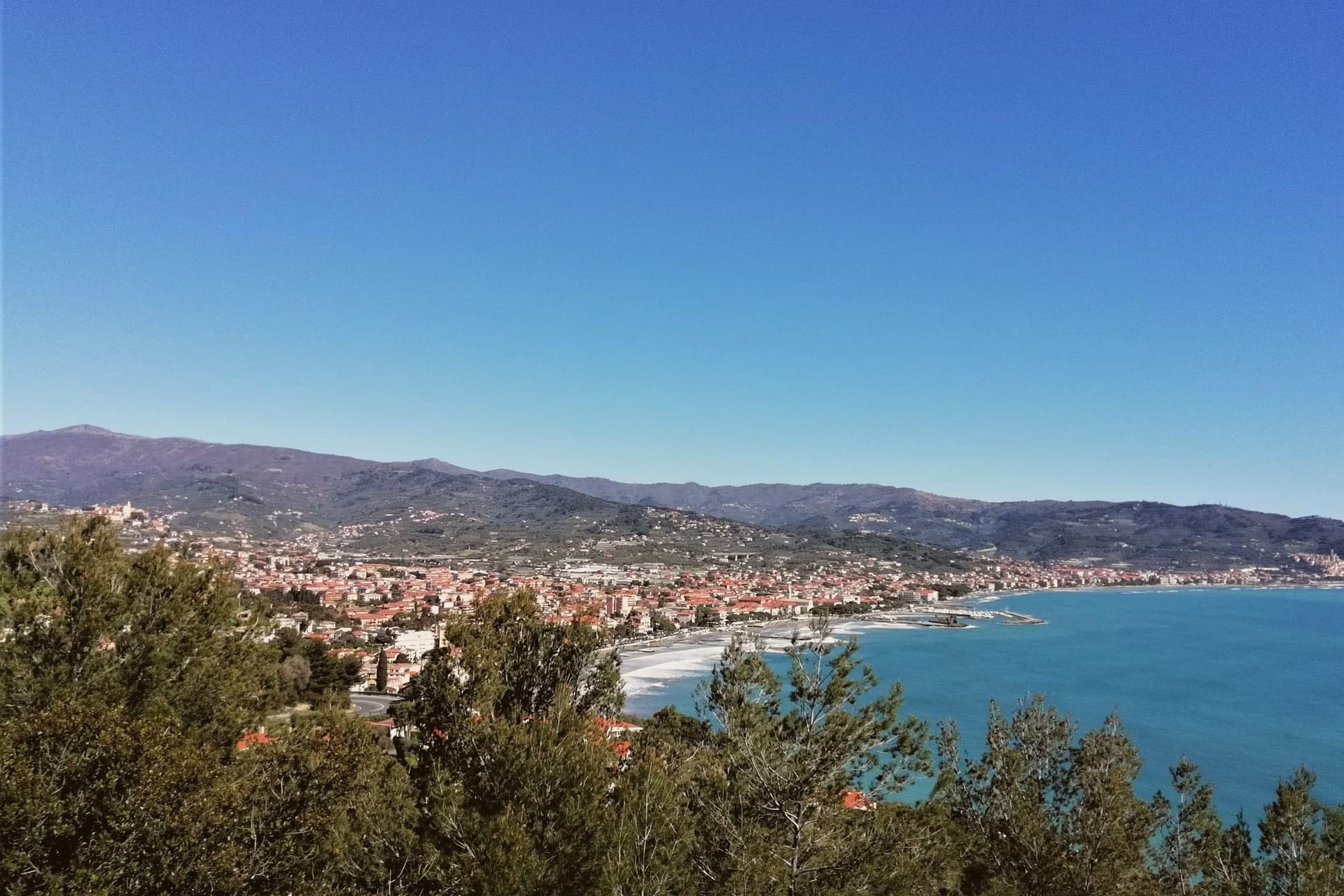
The hilltop and the coast were one commune until the seaside half was made independent in 1923, and the two still read as a single place split in two: a fortified settlement set back from the water, and the town it produced at sea level once the shoreline could be settled safely. The name of the upper town traces to the Latin Dianum, a temple to Diana, which places the site's origin well before the medieval walls that now define it.
Both halves sit on the same bay and draw on the same valley behind them, where the Taggiasca olive has been grown long enough to anchor the local Città dell'Olio membership shared by both. The bay itself is sheltered and south-facing, which gives the coastal half one of the milder climates on the Italian Riviera and explains why the beach resort grew where it did, directly below the older settlement rather than at any distance from it.
What Diano amounts to, then, is a single valley economy, olives above, sand below, that split administratively in the twentieth century without ever splitting geographically.
We confirmed you can reach this one by train.
What to see in Diano
- Diano Castello — centro storico. Vaulted alleys and stone staircases climb through the old town to the parish church of San Nicola di Bari. The walls that ring the settlement still trace their full course, and the streets keep the tight, defensive layout of a hill settlement built for lookout rather than commerce.
- Diano Marina — Bandiera Blu beach. The seafront runs the length of the resort under a line of palms, with the flat, easy sand that makes it a family destination. Summer markets fill the promenade, and the town's calendar turns on the mid-August Madonna del Rosario procession.
- Museo dell'Olivo (Diano Marina). The exhibits move from Roman amphorae through medieval monastic cultivation to present-day production, tracing the Taggiasca olive's long presence in the valley. The museum was founded by the Carli oil family.
How to get to Diano
There is a railway station in the town, so you can arrive without a car and never need one while you are here. Genova is roughly 94 minutes away by road.
Our tip
April through October is the open season for both Dianos — warm coastal days, calm Mediterranean sea by late spring, and the Diano Marina beach packed from mid-June through August. The Sant'Antonio procession runs the second week of August. Diano Castello stays alive year-round (the medieval old town is residential) but the most pleasant months for the hilltop are May-June and September-October.
Sestri Levante
Why visit Sestri Levante
Sestri Levante sits at the head of the Tigullio gulf, forty kilometers southeast of Genova, on a former island the Gromolo river silted into a peninsula by the eighteenth century. Roman Segesta Tigullorum was the predecessor; the town joined the Republic of Genova in 1133.
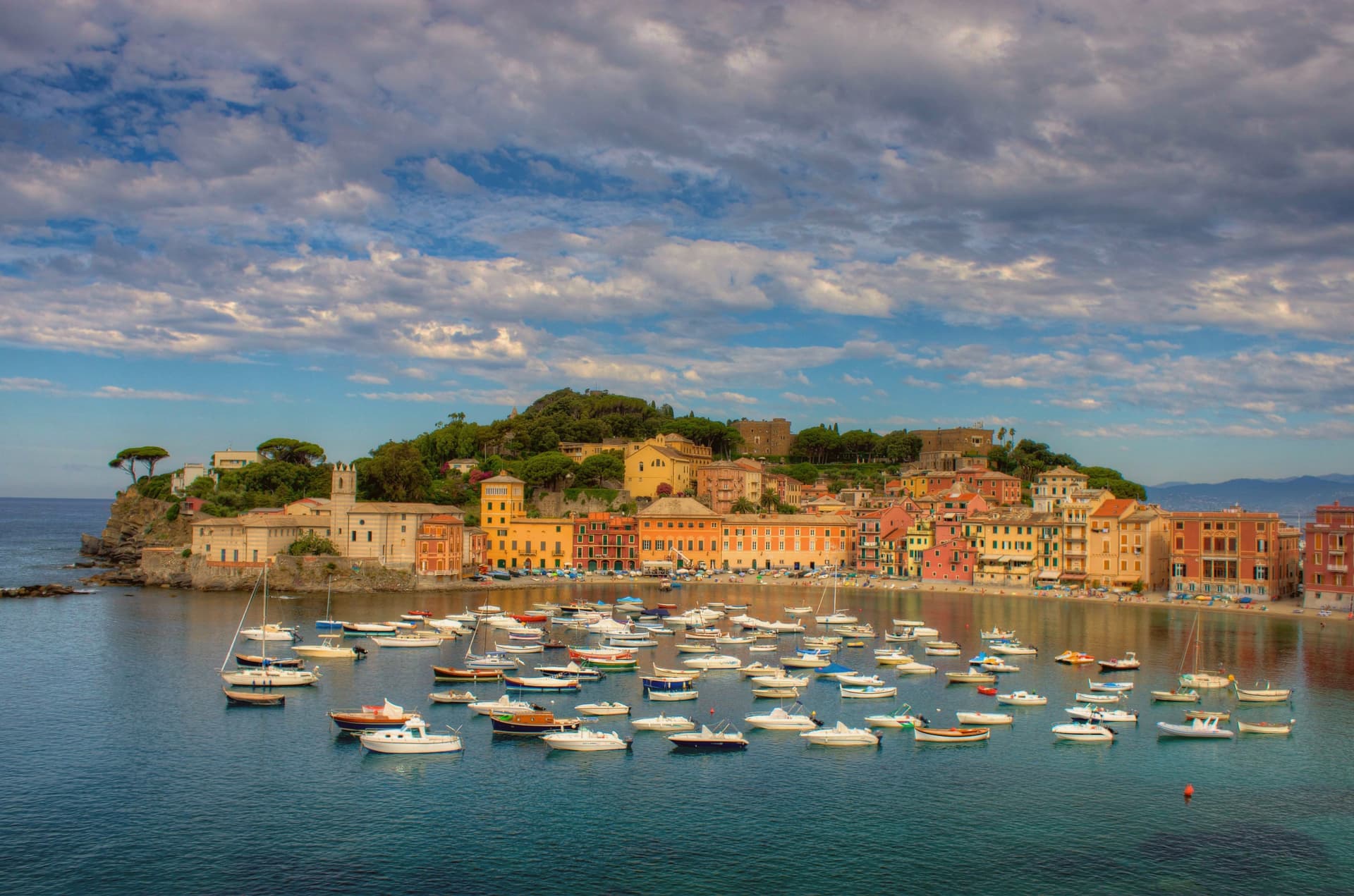
The peninsula splits the coast into two bays that face different ways and carry different names. To the north lies the long beach known as the Bay of Fables, named by a television host in a 1950s broadcast for the Danish writer who stayed here in 1833.
To the south lies the smaller, quieter bay, named by a Ligurian poet in 1919. Between them, on the high ground of the peninsula, stands the old watchtower where an inventor ran some of his most advanced shortwave radio work, work significant enough that the Navy renamed the gulf itself for him.
A town this small holds a beach with a literary name, a bay with a poet's name, and a headland with an engineer's name, three separate claims to attention pressed into one stretch of coast shaped by a silted river.
We confirmed you can reach this one by train.
What to see in Sestri Levante
- Baia del Silenzio. Smaller southern bay enclosed by colorful seventeenth- and eighteenth-century houses, named by poet Giovanni Descalzo in 1919.
- Baia delle Favole. Long northern beach and the Bandiera Blu stretch of the town, its name recalling Hans Christian Andersen, who looked out over the water from his inn.
- Torre Marconi. Old watchtower on the heights of the peninsula where Guglielmo Marconi carried out shortwave radio experiments in 1933 and 1934.
How to get to Sestri Levante
There is a railway station in the town, so you can arrive without a car and never need one while you are here. Genova is roughly 44 minutes away by road.
✷ We have written about Sestri Levante
“A steep hill falls into the sea. The houses are crammed on the slope and painted in bright colors because they are old, packed tight, and need help. There is a small port if the cove allows it and a bigger port if the cove is generous. There is a small piazza around a small church, with maybe four restaurants, three bars, and a gelato place. There is no space for a grand square, because there is no space for grand anything in Liguria.”
Read our piece on Sestri Levante →Tigullio Roadtrip | Four Versions of the Same Liguria
Our tip
April through June and September into October are the dry months on the Tigullio. The sea warms enough for swimming by late May. The Premio Andersen children's literature festival runs in June with author events across the town. Sagra dei Testaieu e Asado a Montedomenico falls in August.
Chiavari
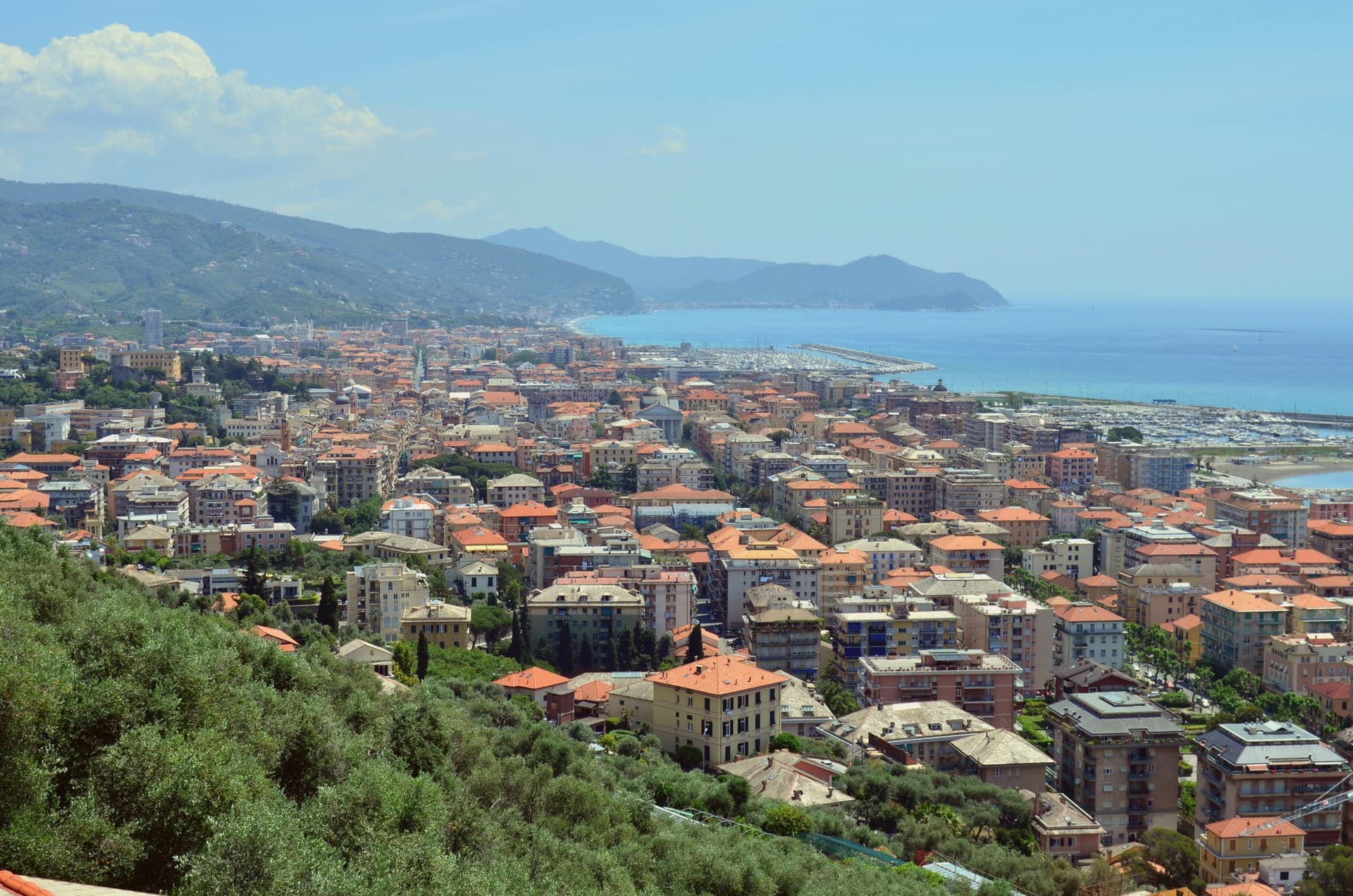
Why visit Chiavari
Chiavari sits on the Riviera di Levante where the Entella meets the Gulf of Tigullio, thirty kilometers east of Genoa. A pre-Roman necropolis from the eighth and seventh centuries BC has been excavated under the centre.
Genoa raised a castle here in 1147 and laid out the medieval town as a grid of porticoed streets, both sides of the carruggio continuous under Gothic columns, the most complete thirteenth-century Genoese commercial plan in Liguria. The Chiavari family produced two doges of the Republic.
In 1801 Napoleon made the city the capital of the Apennines department, one of three administrative units that absorbed Liguria into the French Empire. The Cattedrale di Nostra Signora dell'Orto was built 1613-1633 after a Marian apparition on 2 July 1610 to a local citizen, Sebastiano Descalzo; the neoclassical marble portico modelled on the Pantheon went up in 1841 as a vow for survival from cholera.
Chiavari became a diocese in 1892 and the church a minor basilica in 1904. Slate work, silk weaving and the eponymous Chiavari chair are still made in town.
We confirmed you can reach this one by train.
What to see in Chiavari
- Cattedrale di Nostra Signora dell'Orto. Built 1613-1633 after a Marian apparition in 1610, neoclassical Pantheon-style portico added 1841 as a cholera vow, minor basilica from 1904.
- Caruggio porticato. Thirteenth-century medieval commercial street, both sides continuous under Gothic-columned porticoes, the most intact Genoese plan in Liguria.
- Castello di Chiavari. Genoese fortress built in 1147 above the original town, irregular polygonal walls, partly absorbed into later residential buildings.
How to get to Chiavari
There is a railway station in the town, so you can arrive without a car and never need one while you are here. Genova is roughly 32 minutes away by road.
Our tip
April through June and September to October are the working months: Bandiera Blu beach swimmable from late May, the seafront walk to Lavagna open in any weather, evenings on Piazza Mazzini under 25 degrees. The Sagra del Pesce in Lavagna next door and the Chiavari book festival in late September draw weekend crowds. July and August fill the lungomare with Milanese and Genovese families, and accommodation runs at three times shoulder rates.
Lavagna
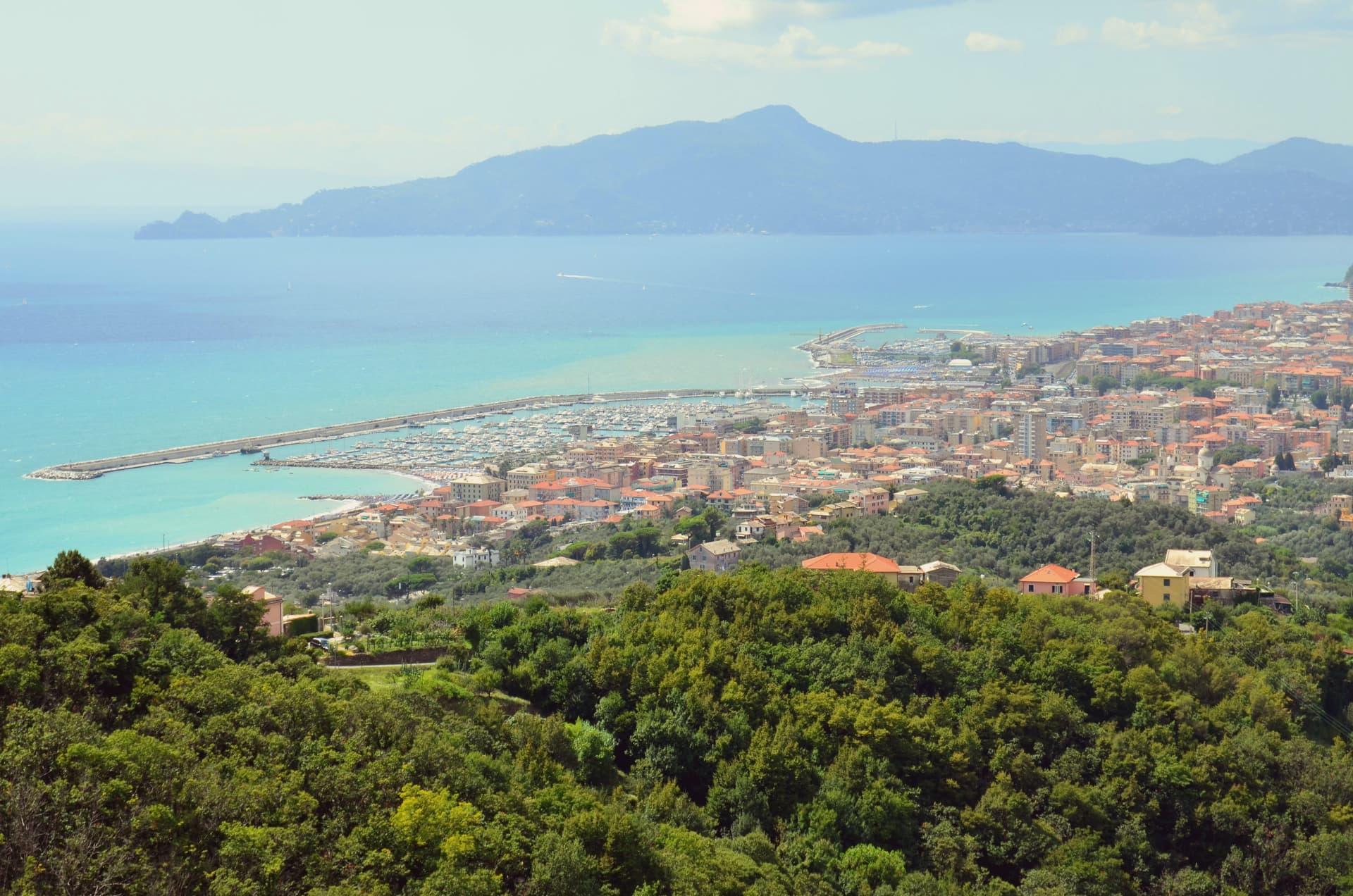
Why visit Lavagna
Lavagna sits at sea level on the eastern Tigullio, thirty-five kilometers southeast of Genova. The slate quarried from the San Giacomo mountains behind the town roofed the Genovese palazzi and lined the schoolrooms of half of Italy, which is why the Italian word for chalkboard is also lavagna.
Around the year 1000 the Counts of Lavagna held this territory, and the family that descended from them, the Fieschi, rose from it to produce two popes. The frazione of San Salvatore sits above the main town, holding the basilica that one of those popes ordered built in bands of white marble and slate.
Down at sea level, the old center folds around the staircase and square where, on 14 August, the town reenacts a thirteenth-century wedding with the Torta dei Fieschi, a giant cake carried out to the crowd. The beach holds Bandiera Blu at the opposite edge of town, near the port.
A town built on a stone that traveled far beyond it, and on a family that did the same.
We confirmed you can reach this one by train.
What to see in Lavagna
- Basilica di Santo Stefano. Parish church rebuilt over a sixth-century foundation, crowning the main square at the top of a wide staircase where the annual cake pageant begins its procession.
- Basilica di San Salvatore dei Fieschi. Thirteenth-century basilica in the frazione of San Salvatore, ordered by Pope Innocent IV in 1244, façade in alternating bands of white marble and local slate.
- Spiaggia di Lavagna. Long Bandiera Blu beach on the Tigullio, with one of the largest tourist ports in northern Italy at the western end.
How to get to Lavagna
There is a railway station in the town, so you can arrive without a car and never need one while you are here. Genova is roughly 44 minutes away by road.
Our tip
April through June and September into October are the dry months on the Tigullio. The beach water warms enough for swimming by late May. The 14 August Torta dei Fieschi is the central event of the summer: period costumes, procession from the Basilica di San Salvatore down to Piazza Marconi, and a giant cake distributed to anyone who matches a paired ticket. La Torta dei Fieschi falls in August.
Taggia
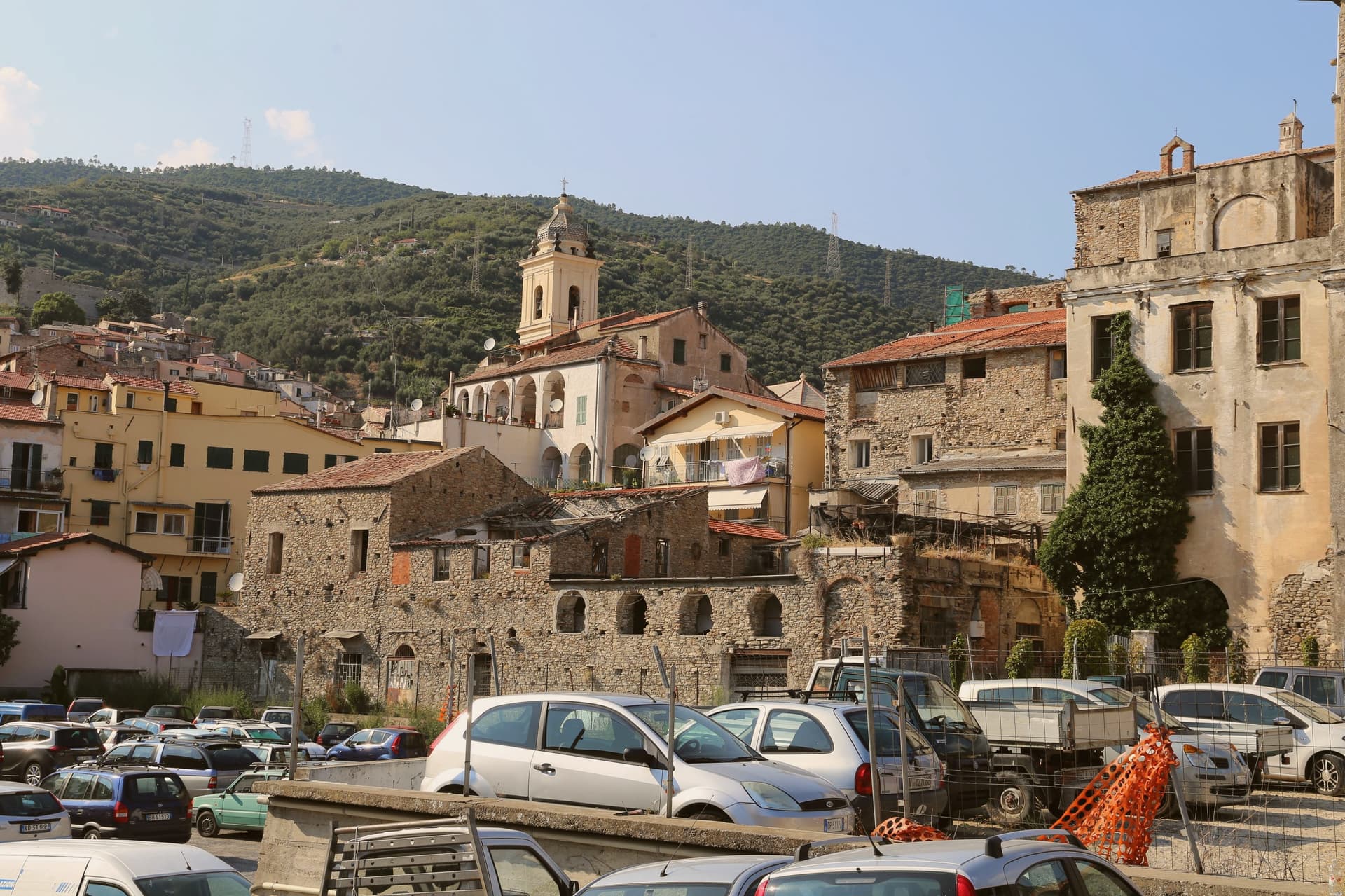
Why visit Taggia
Taggia sits where the Argentina valley narrows toward the Ligurian coast, fifteen kilometers west of Imperia. Iron Age tombs have been found in the territory, and the small port at the mouth was called Costa Balenae in antiquity, a coastal settlement distinct from the medieval town that grew up along the river above it.
The Benedictine monks of Lérins came in the seventh and eighth centuries and, by tradition, brought the olive cultivar that took the town's name and now covers most of western Liguria's hillsides. The medieval centro storico runs along three parallel streets above the river, and sixteenth-century walls fortified the town against Ottoman raids that struck the coast in 1560 and 1564, the same period that produced the bridge's later arches and the walled gates still standing.
Taggia carries the Borghi più belli badge and the Città dell'Olio designation as the source of the Taggiasca name. The valley town, the coastal port, and the olive-covered hillsides are really one settlement pattern read at three scales: a river crossing fortified against the sea, feeding an oil that carried the name outward long after the raids stopped.
We confirmed you can reach this one by train.
What to see in Taggia
- Convento di San Domenico. Founded in 1490. The Brea panels hang alongside works of the Nice school, four centuries of west-Ligurian painting gathered in one cloister.
- Ponte Antico. The arches step unevenly across the river, the earliest sections centuries older than the latest, a bridge built by accretion rather than plan.
- Centro storico di Taggia. Three parallel medieval streets above the river, sixteenth-century walls and gates intact from the era of Saracen and Ottoman raids.
How to get to Taggia
There is a railway station in the town, so you can arrive without a car and never need one while you are here. Genova is roughly 116 minutes away by road.
Our tip
April through June and September to October bring the best windows: olive groves still green or in harvest, the Argentina valley walkable, evenings on the centro storico stones below 25 degrees. Taggia's olive harvest, the Olioliva festival down the coast in Imperia, runs through November. July and August push 30 to 32 degrees and bring weekend traffic from Sanremo, ten kilometers west.
More from Anywhere Italy
 The best olive oil towns that eat well in Liguria
 The 6 best olive oil towns within 90 minutes of Genova
 The best olive oil towns within 45 minutes of Genoa
 The best towns you can reach by train that eat well in the province of Genova
- The best towns you can reach by train within 45 minutes of Genoa
 The best olive oil towns in the province of Imperia