
Without a car
Sicily by train
26 towns
Towns in this region where we confirmed an active station. Check the timetable before you go: a station on the map is not the same as a useful service.
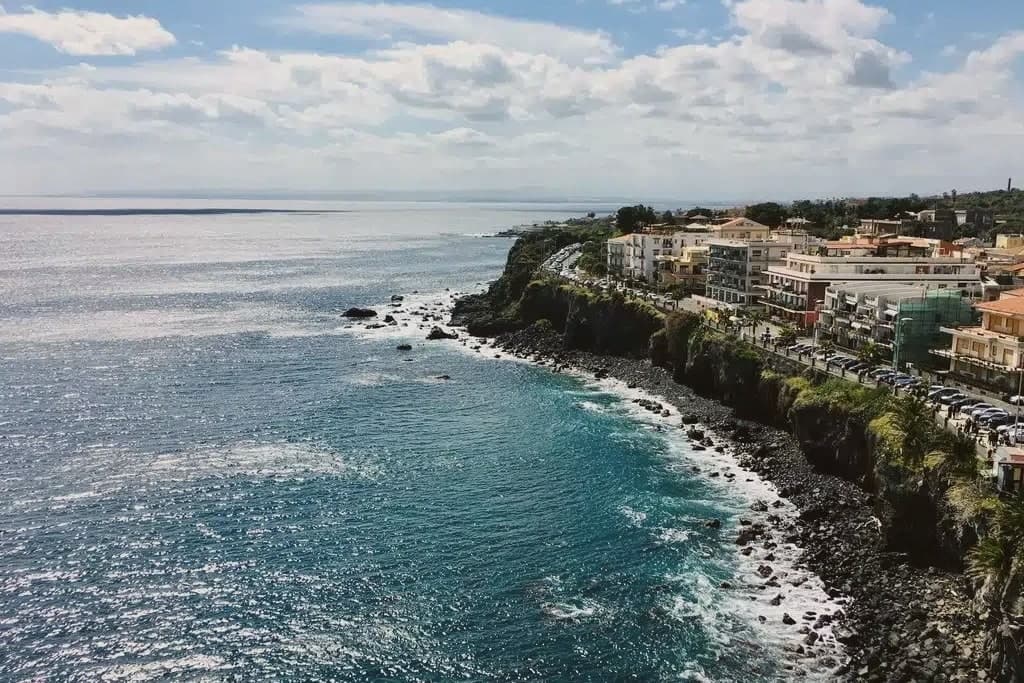
Aci Castello
Province: Catania · 15 m
A coastal town just north of Catania on the Riviera dei Ciclopi, where the basalt headland holds the 1076 Norman Castello d'Aci and the seven volcanic Faraglioni dei Ciclopi rise from the sea, the rocks the Cyclops threw at Odysseus in Homer's Odyssey.
Caltagirone
Province: Catania · 611 m
Sicily's ceramic capital at 611 meters on the Erei ridge, 142 majolica-tiled steps to Santa Maria del Monte and a Val di Noto UNESCO baroque rebuild.
Cammarata
Province: Agrigento · 700 m
A Sicani town at 700 meters on the northeast slope of the peak that gives the comune its name and shape.
Castelbuono
Province: Palermo · 423 m
A Madonie town at 423 meters around the Ventimiglia castle, where manna is still tapped from ash trees and Fiasconaro bakes the panettone.
Castelvetrano
Province: Trapani · 187 m
The Belice valley town that owns Selinunte, the largest archaeological park in Europe, and bakes black bread from grain found in its tombs.
Castiglione di Sicilia
Province: Catania · 621 m
A hill town on the north flank of Etna at 621 meters, base camp for the Alcantara valley and the volcano's most serious red wines.
Catania
Province: Catania · 7 m
Sicily's second city and the cultural anchor of the Ionian coast, a UNESCO late-Baroque centro storico rebuilt in lava-black stone after the 1693 earthquake, sitting at the foot of Etna with a 17th-century elephant fountain (U Liotru) as its civic symbol.
Cefalù
Province: Palermo · 16 m
A Norman cathedral at the foot of a 270-meter rock on the Tyrrhenian coast, founded in 1131.
Corleone
Province: Palermo · 542 m
A town of 10,364 in the Palermo hinterland that gave its name to Mario Puzo's Don Vito and now runs Italy's national antimafia documentation centre.
Erice
Province: Trapani · 751 m
An Elymian mountaintop city at 751 meters above Trapani, with a Norman castle on the site of the temple of Venus Erycina and a Cold War physics centre.
Giarre
Province: Catania · 81 m
An Etna town that split from Mascali in 1815 and built a neoclassical duomo, with two bell towers framing the volcano behind it.
Ispica
Province: Ragusa · 170 m
A Val di Noto Baroque hilltown on the southern Iblei plateau anchored by the 13-km Cava d'Ispica canyon with its 3,000+ rock-cut tombs and prehistoric dwellings, one of the largest cave-necropolis sites in the Mediterranean.
Marsala
Province: Trapani · 3 m
Sicily's westernmost city, born from the Phoenician refugees of Mozia, where Garibaldi landed in 1860 and English merchants invented Marsala wine.
Modica
Province: Ragusa · 296 m
A vertical Baroque city in the Hyblean Mountains, rebuilt from the 1693 earthquake and home to a chocolate recipe brought from Aztec Mexico.
Monreale
Province: Palermo · 310 m
Above the Conca d'Oro at 310 meters, the cathedral William II built between 1174 and 1182 holds 6,340 square meters of Norman mosaics.
Nicosia
Province: Enna · 720 m
A Byzantine-Norman royal city at 720 meters on four hills, one of Sicily's principal Gallo-Italic centres where the Lombard dialect nkoukkà still survives.
Noto
Province: Siracusa · 152 m
The capital of Sicilian Baroque, rebuilt entirely in golden limestone after 1693.
Palazzolo Acreide
Province: Siracusa · 670 m
An 8,000-resident hilltop town on the Iblei plateau at 670m, rebuilt entirely in late Baroque after the 1693 earthquake and founded over the Greek Akrai colony in 664 BC, with a Greek theatre and a cluster of rock carvings unlike anything else nearby.
Petralia Sottana
Province: Palermo · 1,000 m
A Madonie village at 1,000 meters, the only Bandiera Arancione in Sicily, and the headquarters of the Parco delle Madonie.
Ragusa
Province: Ragusa · 502 m
Two cities split by a ravine on a Hyblean plateau at 502 meters, both rebuilt after 1693 and both UNESCO Baroque.
Randazzo
Province: Catania · 750 m
A medieval town in black lava stone at 750 meters on Etna's north foot, with three quarter churches for Latins, Greeks and Lombards.
Riposto
Province: Catania · 6 m
The Ionian port whose name comes from the Sicilian for cellar, where the wine of Mascali and Giarre was stored before shipping.
Sambuca di Sicilia
Province: Agrigento · 350 m
An Arab-founded hill town in the Belice valley, still called Zabut in living memory before 1923.
Savoca
Province: Messina · 300 m
A hilltop borgo at 300 meters above the Ionian, its ridge lined with stepped lanes and balconied stone houses.
Siracusa
Province: Siracusa · 17 m
Ortigia island, wrapped in honey-coloured Baroque stone, sits at the heart of the city Cicero called the most beautiful in the world, on the eastern Sicilian coast south of Catania.
Taormina
Province: Messina · 204 m
A terrace on Monte Tauro above the Ionian, with Etna on the southern horizon.
The slow-trip planner
Plan a slow trip across the towns travelers skip.
Answer five questions. We will shape a geographically coherent slow trip from the 1,000 Italian towns most travelers skip. Yours to save and share.
From elsewhere in Italy
Five more towns to discover
Visso
Province: Macerata
The northern Sibillini gate at 607 meters where the Nera meets the Ussita, holding one of two surviving manuscripts of Leopardi's L'Infinito.
Goriano Sicoli
Province: L'Aquila
At 720 meters in the Subequana valley, a medieval village drawn by M.C. Escher in 1929 keeps a May ritual folklorists trace to Demeter.
Ugento
Province: Lecce
A Messapian-Roman town five kilometers from the Ionian, where a Baroque castle sits on the walls of the ancient city of Ozan.
Fontanellato
Province: Parma
A Parma-plain town built around the Rocca Sanvitale, the moated fortress at its center.
Pescina
Province: L'Aquila
A Marsica town at 735 meters, on the rim of the drained Fucino basin, that lost five thousand of six thousand people in a single morning in 1915.