
The best towns you can reach by train in the province of Catania
The province of Catania is built out of Etna. The stone in the church facades is lava, grey-black and porous, and the same rock runs down to the sea in cooled folds that people swim off in summer. Inland the land turns to citrus terraces, vineyards on volcanic sand, and hills of clay that have been fired into glazed tiles for centuries. Autumn brings pistachios and grape harvest on the mountain's northern flank, winter brings blood oranges, and the arancini, granita with brioche and horsemeat grills hold up in every season. Two railways serve it, the coastal main line and the narrow-gauge Circumetnea, which loops around the volcano through lava fields and orchards.
Most visitors treat all of this as the approach to Taormina. The town earns its reputation, with the Greek theatre framing the volcano and the sea below, but the coach parks fill early and the main street moves at a shuffle from spring through October. The cable car down to the beaches at Mazzaro queues in both directions. Those who go beyond it mostly head for the Etna summit road and the crater excursions above Nicolosi, which are also busy.
The coast and the volcano do not stop at that one hill. The same lava shoreline continues south, the same railway keeps calling at stations with fishing harbours and baroque squares attached, and the Circumetnea carries on inland to towns of black basalt and Norman churches on the quieter side of the mountain. Further in, the clay hills hold a ceramic town with a stairway of painted tiles. These are the places on this list, each one confirmed reachable without a car.
Of the 9 communes we have mapped in the province of Catania, 7 qualify as towns you can reach by train: we have confirmed each is reachable without a car. The smallest, Castiglione di Sicilia, has 2,903 residents.
If you are still choosing, we have also written The best towns you can reach by train that eat well within 90 minutes of Catania and The best coastal towns within an hour of Catania.
Castiglione di Sicilia
Why visit Castiglione di Sicilia
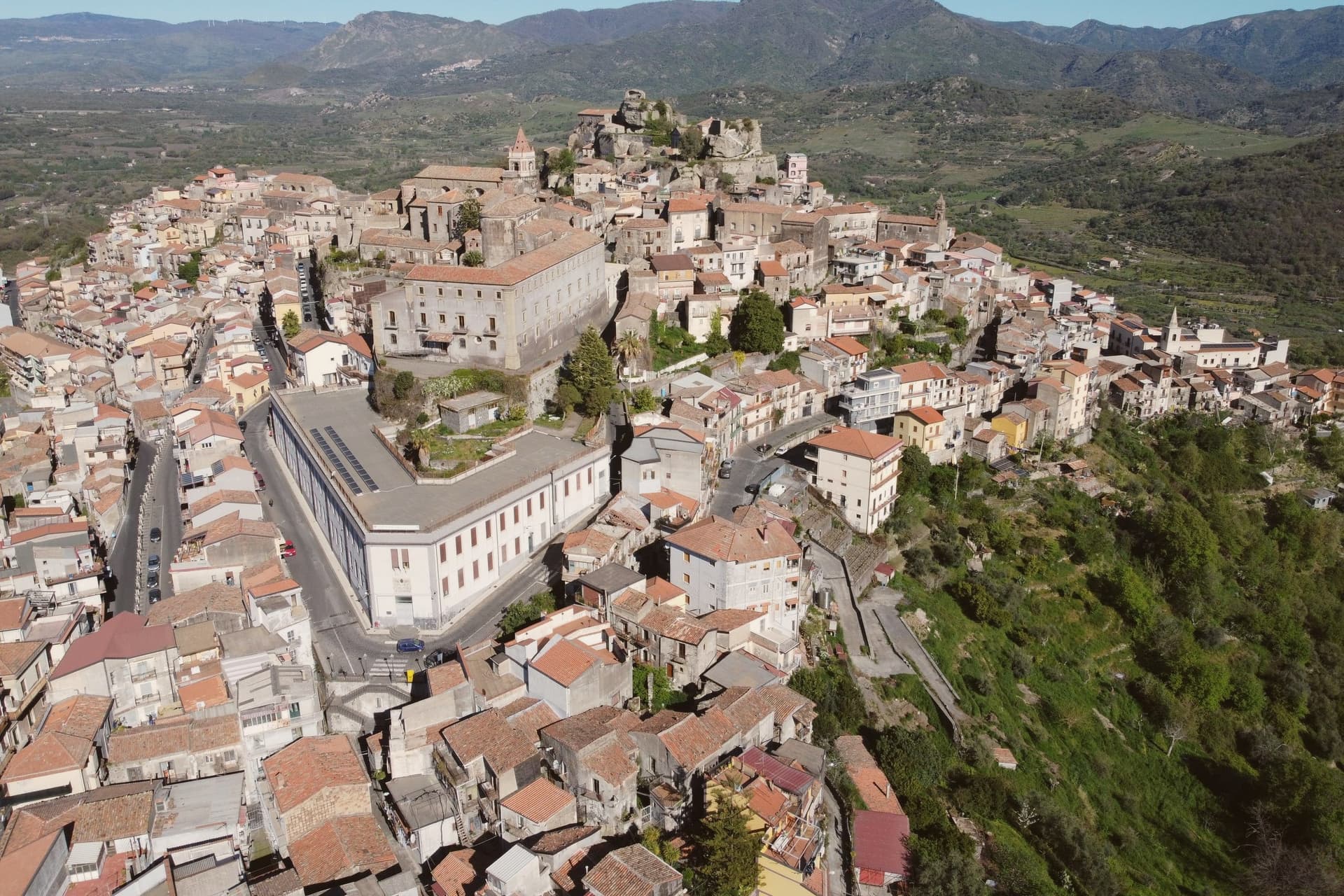
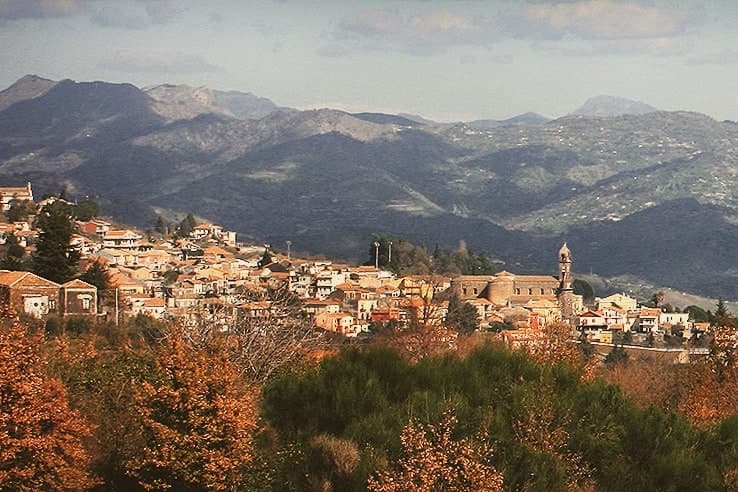
The town looks down the Alcantara river valley between Randazzo and Taormina, its position fixed by Norman count Roger I, who documented it in 1092 as Castrileonis, the great castle. That name still fits the territory more than the town itself: the commune's boundary runs uphill from the historic centre all the way to the summit of Etna, taking in the north-east crater, so the same municipality holds a huddle of streets at 621 meters and a stretch of active volcano above it.
The hills below the centre are the heart of the Etna DOC. Nerello Mascalese and Nerello Cappuccio grow on the volcanic soils around the village, with Carricante carrying the whites, and bottles from Cottanera, Passopisciaro, Tenuta delle Terre Nere and the Alcantara producers all ship from here.
Twenty minutes downhill the Alcantara has cut its gorges through the same lava that feeds those vineyards, basalt walls shaped by water where the fields above are shaped by the grape. Town, castle, vineyard and gorge read as one continuous volcanic system, worked over centuries into a fortress, a wine region and a river cut.
We confirmed you can reach this one by train.
What to see in Castiglione di Sicilia
- Castello di Lauria. The fortress stands on its basalt outcrop above the town, its walls carrying the weight of two rebuildings by Ruggero di Lauria's crews. The rooms now hold the Enoteca Regionale for eastern Sicily, so the same stone that once watched for approach up the valley now stores the bottles made from the vines below it.
- Cuba Bizantina di Santa Domenica. Small Byzantine cube-shaped church, seventh to ninth century, in the rural outskirts of the commune, one of the oldest surviving structures in the Etna area.
- Gole dell'Alcantara. Basalt gorges carved by the Alcantara river through prismatic lava columns, around twenty minutes downhill from the centro storico.
How to get to Castiglione di Sicilia
There is a railway station in the town, so you can arrive without a car and never need one while you are here. Catania is roughly 49 minutes away by road.
Our tip
May through October are the working months on Etna nord. Vineyard tours start in June, harvest runs late September through mid-October on the higher contrade, and the slopes turn red and gold into early November. July and August on Etna are bearable at 621 meters: nights drop to seventeen degrees, far cooler than Catania.
Randazzo
Why visit Randazzo
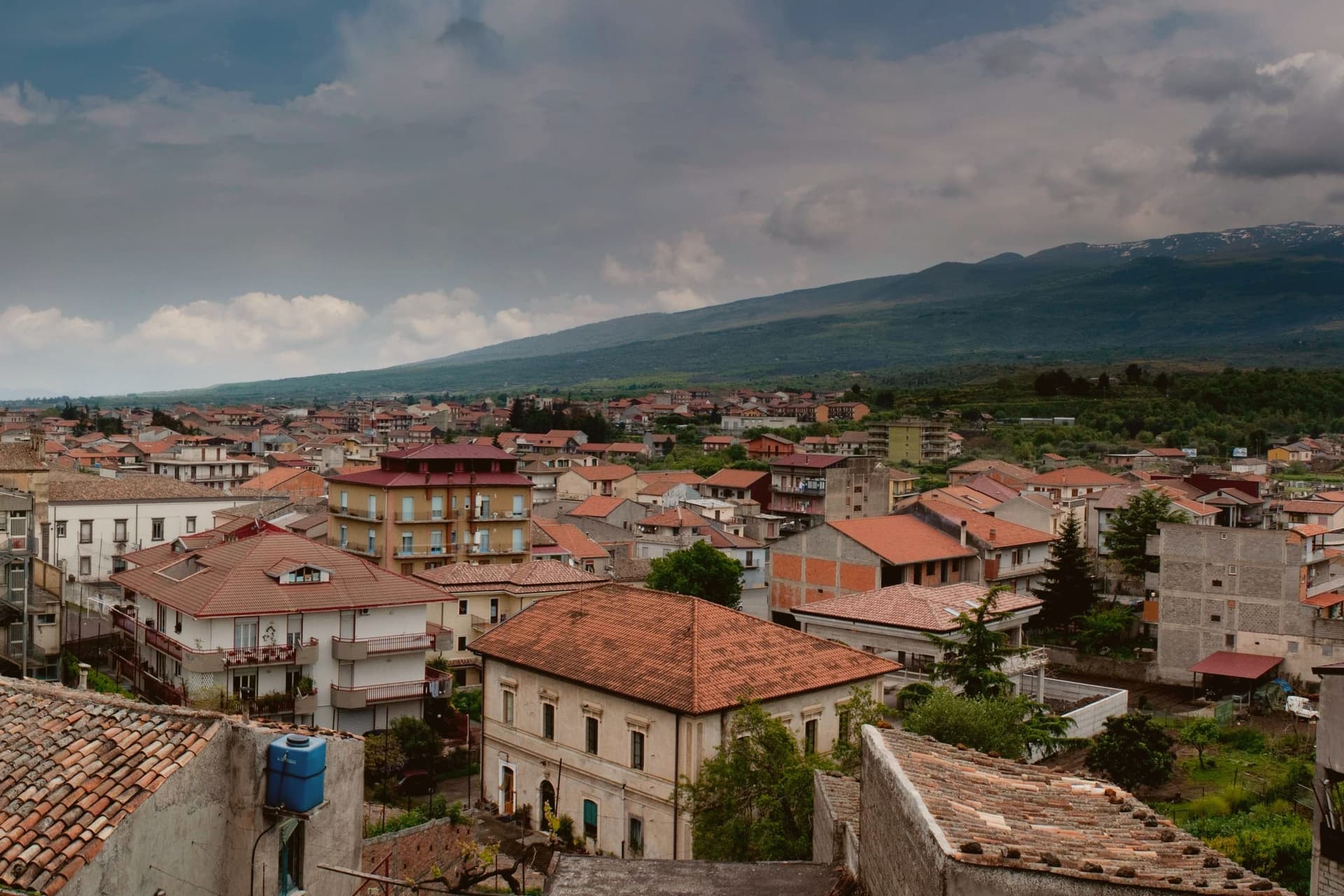
Randazzo sits at 750 meters on the northern foot of Etna, seventy kilometers northwest of Catania along the Alcantara valley. Byzantine in origin, Swabian and medieval in character, the town has three great churches that mark its three historic quarters, once inhabited by communities that spoke different tongues: the Latins in Santa Maria, the Greeks in San Nicolò, and the Lombards in San Martino.
In 1210 Frederick II of Hohenstaufen and his young wife Constance of Aragon sheltered here from the plague in Palermo; Randazzo became, after Palermo and Messina, one of the most populous towns on the island. The architecture is lava: Santa Maria Assunta, begun in the thirteenth century, has a façade entirely in black volcanic stone with three polygonal apses shaped as towers and Catalan-Gothic side portals.
The forty-one-meter bell tower of San Martino, called one of the most beautiful in Sicily, has stood since the thirteenth century.
We confirmed you can reach this one by train.
What to see in Randazzo
- Basilica di Santa Maria Assunta. Thirteenth-century basilica in black lava stone with three polygonal apses shaped as towers and fifteenth-century Catalan-Gothic side portals.
- Chiesa di San Martino. Church of Swabian origin from the thirteenth century with a forty-one-meter bell tower in four storeys, anchor of the Lombard quarter.
- Chiesa di San Nicolò. Largest of the three quarter churches, repeatedly rebuilt; the fourteenth-century bell tower fell in the 1693 earthquake.
How to get to Randazzo
There is a railway station in the town, so you can arrive without a car and never need one while you are here. Catania is roughly 60 minutes away by road.
Our tip
May through October is the open season. At 750 meters Randazzo stays cooler than the Catanese coast even in August; the harvest in the Etna Nord vineyards runs September into October. November through April is quiet; snow falls on the upper slopes through winter and the town gets occasional dustings.
Riposto
Why visit Riposto
Riposto sits on the Ionian coast twenty-five kilometres north of Catania, at the eastern foot of Etna and the southern edge of the Giarre-Riposto conurbation. The name is commercial: u ripostu in Sicilian, the cellar, because the wine produced in the surrounding county of Mascali was stored here before being loaded onto ships.
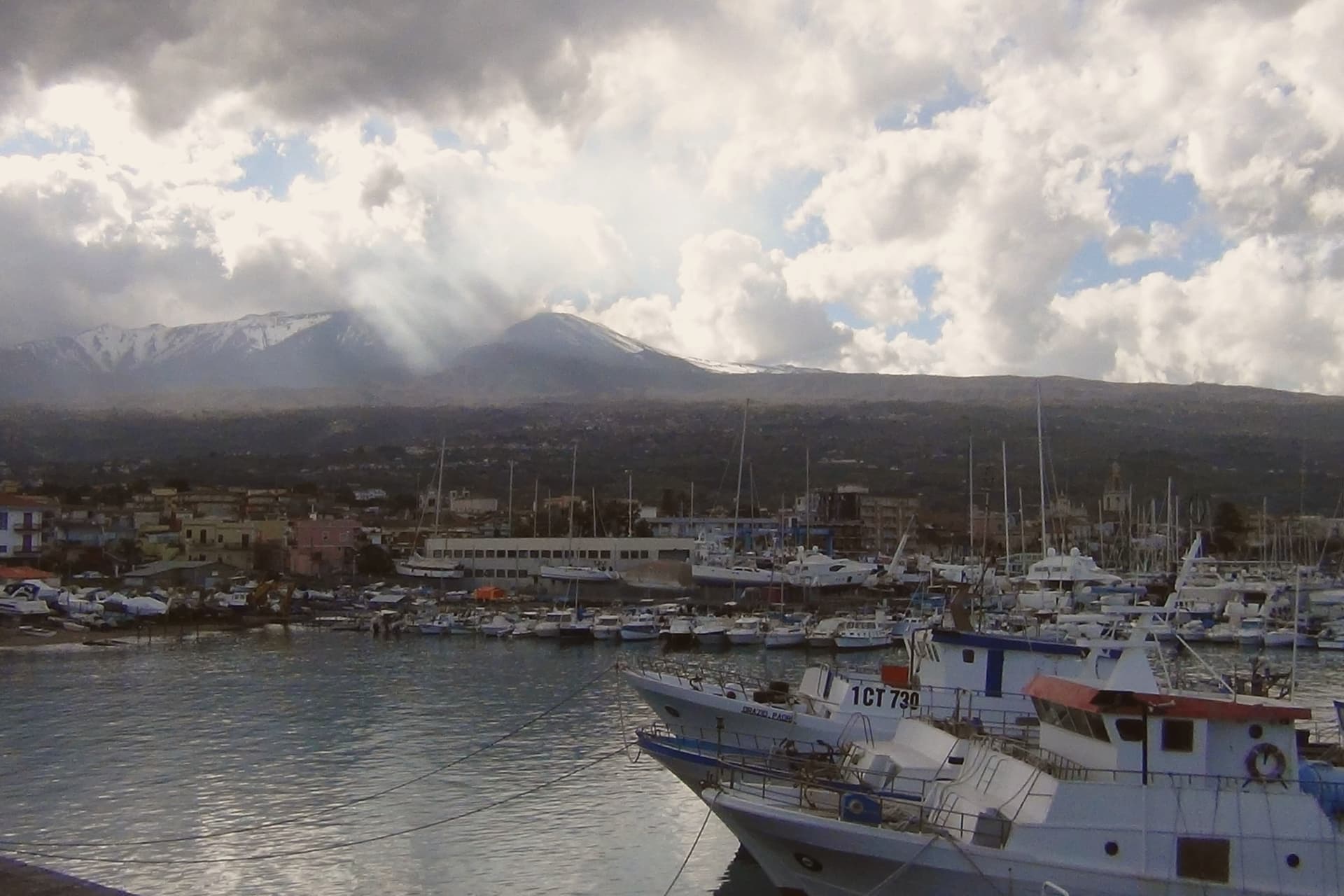
The town was the commercial port of Mascali from the sixteenth century onwards, won full administrative autonomy in the eighteenth, and was merged with neighbouring Giarre under the name Jonia from 1939 until 1945, when the two split again. Today the Porto dell'Etna, also called Marina di Riposto, runs as a combined tourist marina, fishing port and small commercial harbour.
Locals still call the town the port of the volcano. Etna fills the western skyline, the railway runs to Catania along the coast, and the historic centre threads between churches built when the wine trade still paid for them.
We confirmed you can reach this one by train.
What to see in Riposto
- Porto dell'Etna. The combined tourist marina, fishing and commercial port, the largest pleasure harbour between Catania and Messina.
- Chiesa Madre San Pietro. The mother church on the main square, rebuilt in the eighteenth century when Riposto's wine trade financed new construction.
- Centro storico. Grid of streets parallel to the seafront, with palazzi and warehouses built during the eighteenth and nineteenth century wine boom.
How to get to Riposto
There is a railway station in the town, so you can arrive without a car and never need one while you are here. Catania is roughly 29 minutes away by road.
Our tip
May, June, September and October are the dry, clear months when the Ionian is warm enough to swim and Etna stays visible from the seafront. July and August are hot and crowded: the marina fills with sailing traffic and the lungomare runs at full capacity until late. November through March is quiet.
Aci Castello
Why visit Aci Castello
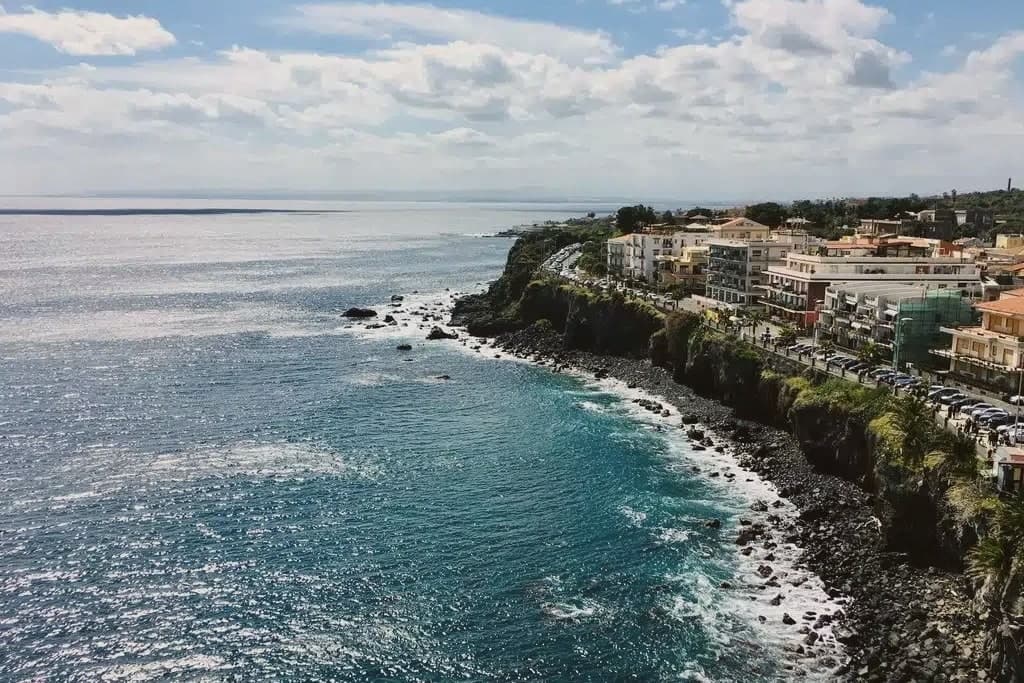
Aci Castello sits ten kilometres north of Catania on the Riviera dei Ciclopi, where the lava-black basalt coast meets the Ionian Sea. The town's anchor is the Castello Normanno (Castello d'Aci), built in 1076 by Roger I of Sicily on a basalt sea-stack thrown up by an underwater Etna eruption around 25,000 BC; the Aragonese expanded it in the 14th century and it now houses the Civic Museum of Aci Castello.
Just offshore stand the Isole dei Ciclopi — the seven basalt sea-stacks that Homer identified as the rocks Polyphemus the Cyclops hurled at Odysseus's ship in Book IX of the Odyssey, and which are now a protected marine reserve. The frazione of Aci Trezza (the larger fishing village south of the castle) is where Giovanni Verga set I Malavoglia (The House by the Medlar Tree, 1881), the founding novel of Italian verismo.
The coastline between Castello and Trezza is a single black-pebble swimming front, with the dramatic profile of Etna rising behind.
We confirmed you can reach this one by train.
What to see in Aci Castello
- Castello Normanno di Aci. 1076 Norman castle on a basalt sea-stack thrown up by an underwater Etna eruption c. 25,000 BC. Aragonese expansion 14th c. Houses the Civic Museum with the stratigraphic and natural-history collections.
- Isole dei Ciclopi. Seven basalt sea-stacks offshore — Homer's Cyclopean rocks from Odyssey Book IX. Now a protected marine reserve (AMP Isole Ciclopi), with snorkelling tours from Aci Trezza.
- Aci Trezza — terra di Verga. Fishing-village frazione where Giovanni Verga set I Malavoglia (1881), the founding novel of Italian verismo. The old harbour and Casa del Nespolo museum trace the literary setting.
How to get to Aci Castello
There is a railway station in the town, so you can arrive without a car and never need one while you are here. Catania is roughly 12 minutes away by road.
Our tip
April through October is the season on the Ionian coast. May and September are the best months: warm Mediterranean sea, lava-rock swimming comfortable, the castle museum at full hours. June brings the patronal feast of San Mauro. Arancino Festival falls in September.
Giarre
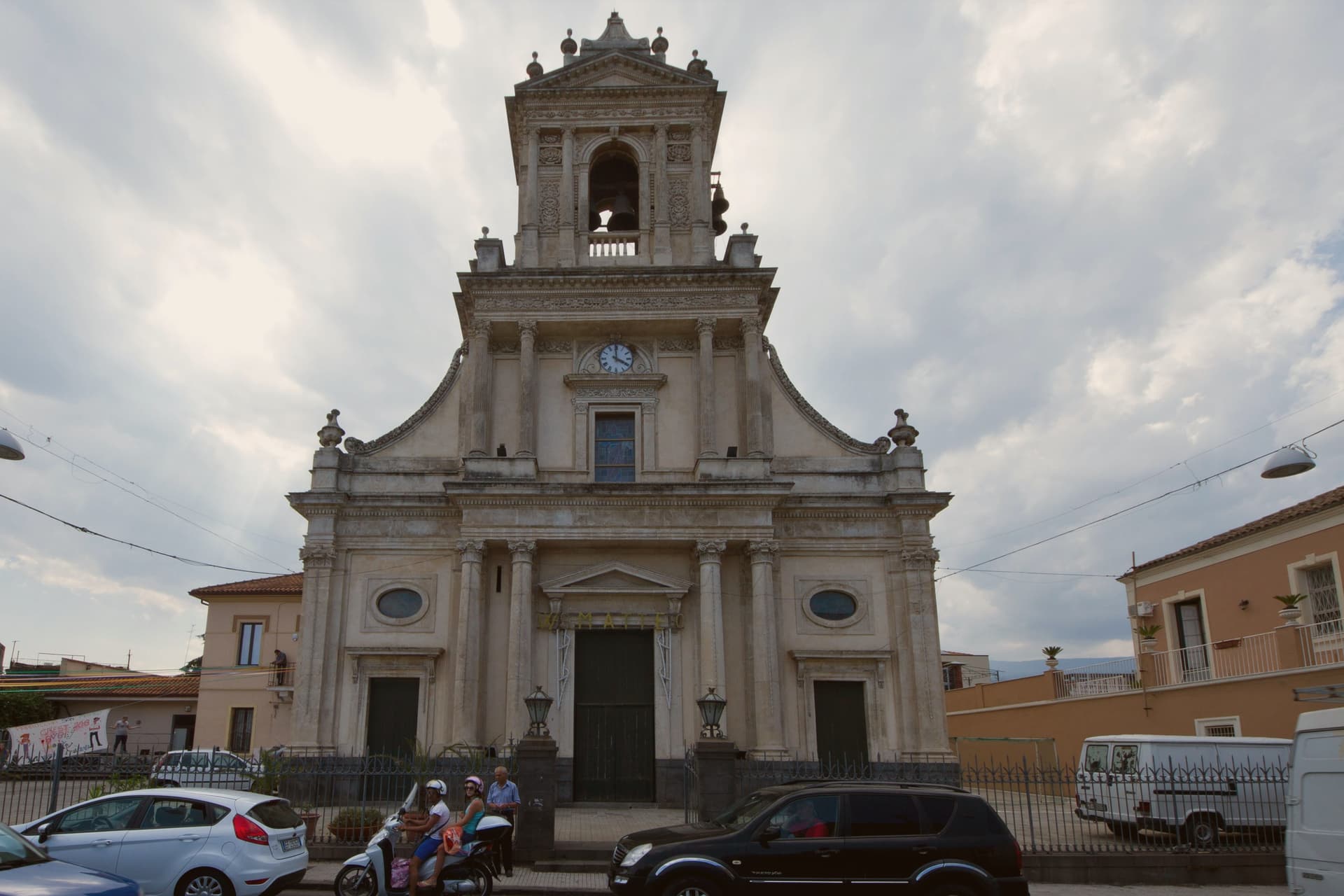
Why visit Giarre
Giarre sits on the lower eastern slope of Etna at eighty metres, thirty kilometres north of Catania and three from the sea at Riposto. From the late sixteenth century until 1815 it was a village of the county of Mascali; it separated after the abolition of feudalism and built itself a town centre in the decades that followed.
The Duomo di Sant'Isidoro Agricola, begun in 1794 and opened for worship in 1818, is the result: a neoclassical mother church in white stone, with a large central nave, two lateral naves, a transept, and a dome with lantern. The two bell towers, designed by the Neapolitan architect Pietro Valente, were begun in 1859 and finished only in 1890.
Inside, the church holds one of the most substantial collections of sacred silverware in eastern Sicily. From 1939 to 1945 Giarre was merged with Riposto under the fascist name Jonia.
The two towns still form a single conurbation along the coast.
We confirmed you can reach this one by train.
What to see in Giarre
- Duomo di Sant'Isidoro Agricola. Neoclassical mother church begun in 1794, two bell towers by Pietro Valente, and one of eastern Sicily's largest collections of sacred silverware.
- Piazza Duomo. The main square at the centre of the historic grid, with the duomo facing the foothill of Etna to the west.
- Corso Italia. The principal axis of the town, running between the duomo and the open country towards Riposto and the sea.
How to get to Giarre
There is a railway station in the town, so you can arrive without a car and never need one while you are here. Catania is roughly 26 minutes away by road.
Our tip
April through June, then September and October, are when Giarre is at its best: clear views of Etna from the duomo square, citrus blossom on the slopes above town, and the coast at Riposto still calm. July and August are hot and crowded along the seafront, though the upper town keeps cooler at eighty metres. November through March is the quiet season, with rain off the Ionian and snow on the volcano. Festival Etneo del Porcino falls in September.
Caltagirone
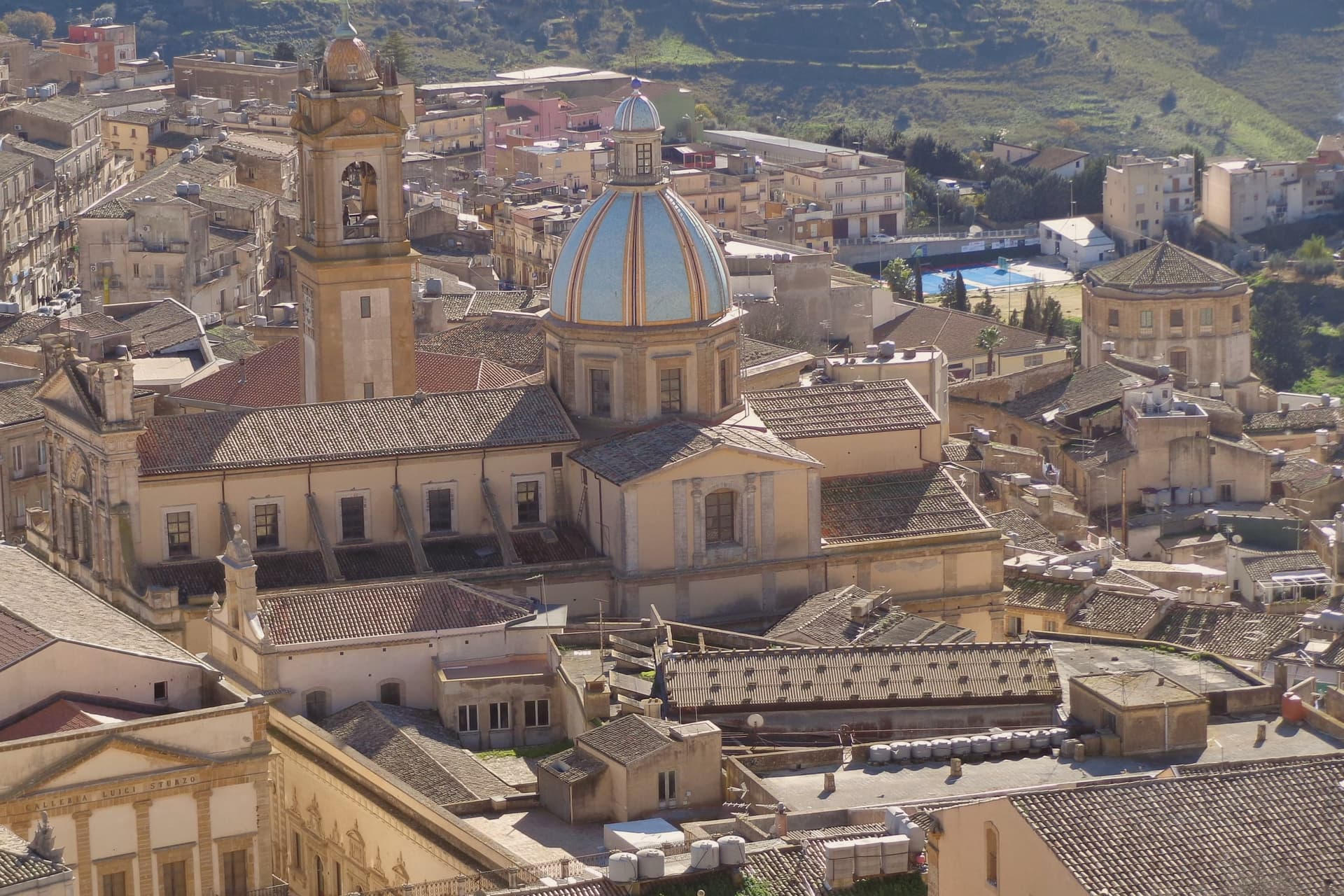
Why visit Caltagirone
Caltagirone sits at 611 meters on the Monti Erei between the plains of Catania and Gela, sixty kilometers inland from the coast. The Arabs took the town in the tenth century and brought the glazing technique that turned local terracotta into majolica; Caltagirone became the first majolica center the North Africans established in Sicily, and the trade survived under Norman, Hohenstaufen and Aragonese rule.
The 1693 Val di Noto earthquake destroyed the city. The rebuild produced the late-baroque centro storico that joined the UNESCO Val di Noto inscription in 2002, alongside Noto, Modica, Ragusa, Scicli and three others.
The 142-step Scala di Santa Maria del Monte, cut in 1606, was tiled in 1956 with majolica risers, each band a different pattern from Sicilian, Arab, Norman and Spanish design traditions. For three days every July, four thousand oil lamps line the steps for the patron San Giacomo.
Ceramic workshops still operate in the old town, the trade unbroken since the Arabs.
We confirmed you can reach this one by train.
What to see in Caltagirone
- Scala di Santa Maria del Monte. 142 baroque steps cut in 1606 connecting lower and upper town, tiled in 1956 with majolica risers, each band a different pattern from the city's ceramic tradition.
- Cattedrale di San Giuliano. Eighteenth-century rebuild of the medieval cathedral destroyed in the 1693 earthquake; neo-baroque façade and bell tower added in the early twentieth century.
- Museo della Ceramica. Regional ceramics museum at the Giardino Pubblico, tracing Caltagirone production from the prehistoric era through medieval Arab glazes to twentieth-century studios.
How to get to Caltagirone
There is a railway station in the town, so you can arrive without a car and never need one while you are here. Catania is roughly 72 minutes away by road.
Our tip
April through June brings the green Erei hills and mild dry weather, the right window for the ceramic workshops and the long climb up the Scala. July and August are hot inland, often past thirty-five, but the four-thousand-lamp Luminaria on 24-25 July is the spectacle the city was built around. September through November is dry and golden, the second best window, with the Scala Infiorata flower display in late spring and the patron's feast already past. Festa Maria SS del Ponte a Caltagirone falls in August.
Catania
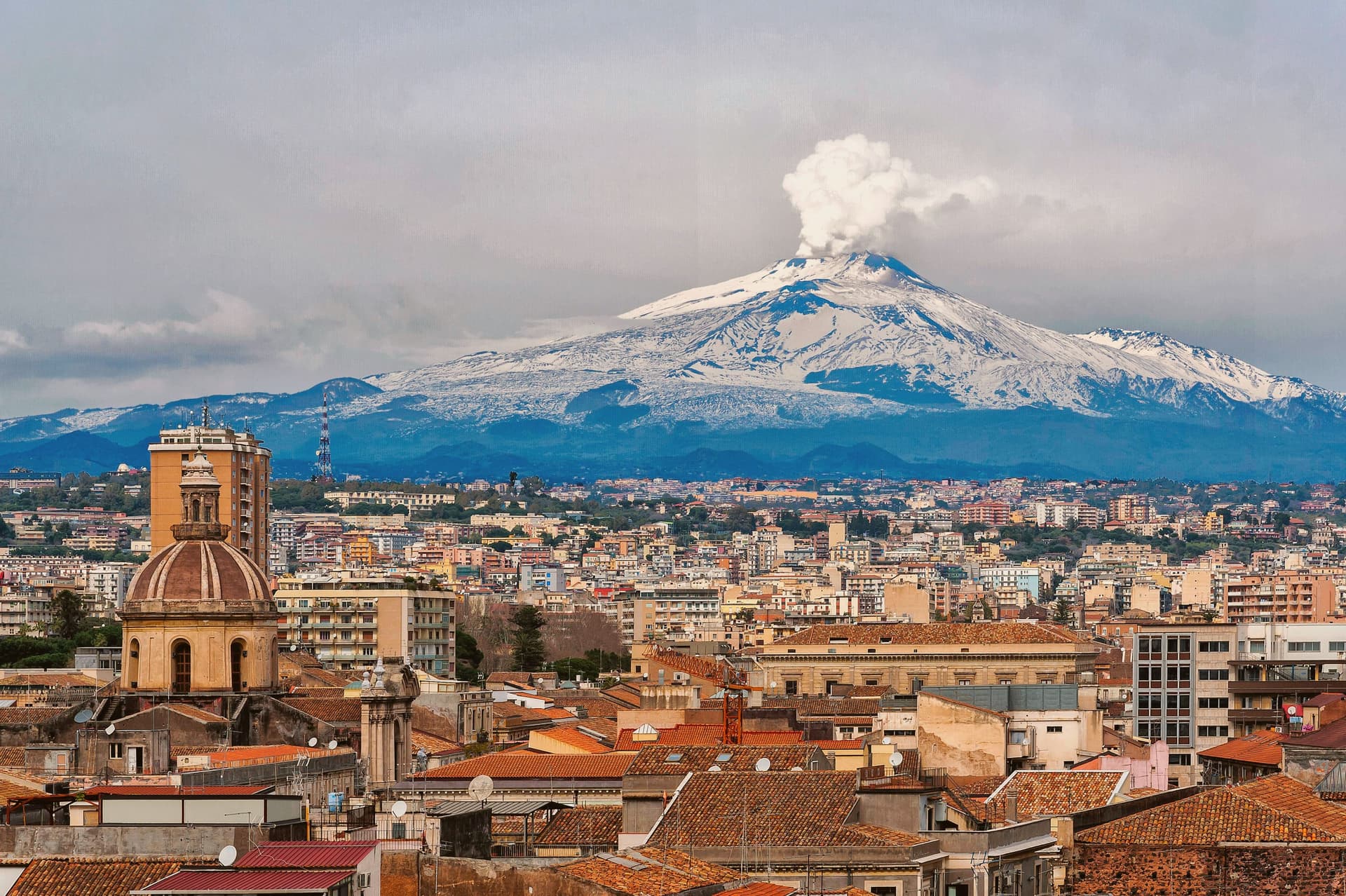
Why visit Catania
Catania is Sicily's second-largest city and the capital of the Ionian coast: 300,000 residents at the foot of Etna, with the volcano visible from every street that opens north. The current city is the third built on the same site — Greek Katánē (729 BC), Roman Catina, and the medieval town all in turn — and the version visible today was built almost entirely in the half-century after the 1693 Val di Noto earthquake destroyed 75% of the buildings and killed two-thirds of the population.
The reconstruction was led by Giovanni Battista Vaccarini, who gave Catania its distinctive late-Baroque profile: wide regular streets paved with lava basalt, palazzi faced in the same black stone with white limestone trim, and the Piazza del Duomo at the centre with Vaccarini's 1735 elephant fountain (U Liotru, a Roman-era basalt elephant supporting an Egyptian obelisk) as the city's symbol. The historic centre was inscribed on the UNESCO World Heritage list in 2002 as one of the Late Baroque Towns of the Val di Noto.
Beyond the Baroque: Bellini was born here, the Roman amphitheatre is the second-largest in Sicily, the Pescheria fish market runs every weekday morning, and the Etna cable car from Rifugio Sapienza is reachable in an hour for the high-altitude lava fields.
We confirmed you can reach this one by train.
What to see in Catania
- Piazza del Duomo + U Liotru. Vaccarini's 1735 elephant fountain in the central square — a Roman basalt elephant supporting an Egyptian obelisk. The cathedral of Sant'Agata anchors the south side. Both rebuilt post-1693 in lava-and-limestone Baroque.
- Via dei Crociferi. Pedestrian Baroque street with four churches in 200 metres — the densest stretch of post-1693 reconstruction. UNESCO World Heritage protected.
- Etna. Europe's largest active volcano (3,357 m), an hour from the city by cable car + jeep from Rifugio Sapienza. UNESCO World Heritage in its own right since 2013.
How to get to Catania
There is a railway station in the town, so you can arrive without a car and never need one while you are here. Catania is roughly 14 minutes away by road.
Our tip
Catania is year-round. October through April is the value season — warm Mediterranean light, the centro storico navigable, the Pescheria at full output, Etna often snow-capped and stunning above the Baroque rooftops. May and June are the best months for the volcano and the coast — long warm days, Etna fully accessible, sea swimming starts. Il Mercatino di Borgo Natura falls in the season.
More from Anywhere Italy
- The best towns you can reach by train that eat well within 90 minutes of Catania
 The best coastal towns within an hour of Catania
- The best coastal towns you can reach by train in Sicilia
 The best olive oil towns within 45 minutes of Catania
- The best hidden towns you can reach by train that eat well in Sicilia
 The 9 best towns inside a nature park that you can reach by train in Sicilia