
The best towns worth staying overnight in the province of Napoli
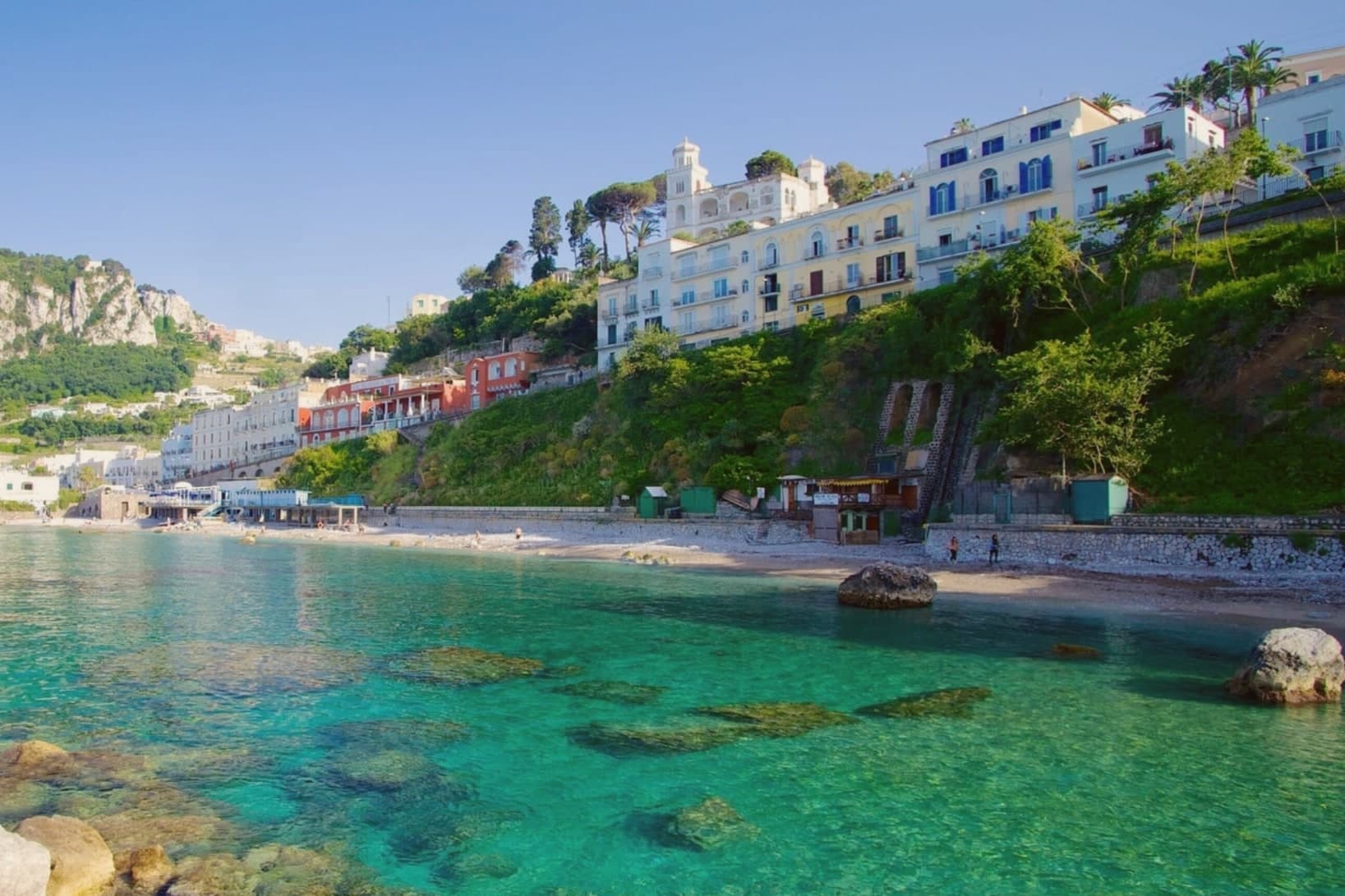
The province of Napoli is built from volcanic rock and citrus. Houses go up in tufo and limestone, vaulted and whitewashed, with pergolas of vine over the terrace and lemon groves stepping down towards the water. The food follows the geology, tomatoes grown on Vesuvian ash, mozzarella di bufala from the plain, provolone del monaco aged in the hills above the Sorrentine coast, and wine off vines that have never been grafted. Spring smells of orange blossom and late September still has warm sea, which is the argument for sleeping here rather than passing through.
The default is a day trip out of Naples, or a fast run down to Pompeii and the Amalfi Coast in the same afternoon. Positano absorbs an extraordinary number of people for its size, and the coast road above it moves at the pace of the slowest coach. The problem is not that any of it disappoints, it is that the schedule owns you: the ferry back, the last train from Circumvesuviana, the queue for the archaeological site at the hottest hour. Whole stretches of the bay are only ever seen between the middle of the morning and the middle of the afternoon.
The same cliffs, the same lemon terraces and the same volcanic soils carry on well past the famous names, into the Sorrentine peninsula, up onto Monte Faito, and across the water to Ischia and Capri. Fewer people stay overnight in these towns than pass through them, which changes what the evening looks like: the bathing places empty, the trattorie fill with people who live there, the thermal water on Ischia is free of the boat crowd. Every town here has a hotel a travel guide has vouched for, so staying is a practical proposition rather than a gamble.
Of the 15 communes we have mapped in the province of Napoli, 6 qualify as towns worth staying overnight: each has a hotel a travel guide has vouched for, so you can stay rather than day-trip. The smallest, Capri, has 6,804 residents.
Elsewhere in the catalogue: The 9 best towns with a serious restaurant in the province of Napoli and The best hidden towns worth staying overnight in Campania.
Capri
Why visit Capri
Capri sits at 142 meters above the Marina Grande harbor on the eastern half of the four-square-kilometer island that bears its name, divided between two communes. The town wraps around the Piazzetta, formally Piazza Umberto I, the social center of the island since the funicular replaced the donkey path in 1907.
Tiberius ruled the Roman Empire from here for the last ten years of his life, from twelve villas that Tacitus counted; the ruins of Villa Jovis still stand on the northeastern cape at 334 meters. The Faraglioni, three limestone stacks off the southern coast, rise to 109 meters; the middle one has an arched tunnel through it.
Capri is overwhelmed by day-trippers from June through September. After the last ferry leaves at six in the evening the island returns to its six thousand residents, and the Belvedere of Tragara becomes quiet again.
What to see in Capri
- Villa Jovis. Ruins of Tiberius's imperial villa on Monte Tiberio at 334 meters, the largest of his twelve Capri villas, abandoned after AD 37.
- Piazzetta (Piazza Umberto I). Small square at the heart of Capri town, social hub of the island since 1907 when the funicular replaced the donkey path.
- Belvedere di Tragara. Panoramic terrace at the end of Via Tragara, looking down on the three Faraglioni stacks rising from the southern sea.
How to get to Capri
Our tip
May and early June are the best weeks: the gardens are in bloom, the sea is warm enough to swim, and the day-tripper volume hasn't peaked. July and August are saturated with ferry traffic and tour groups; the Piazzetta is unwalkable between ten and four. September and early October return the island to a calmer pace with water still swimmable.
Anacapri
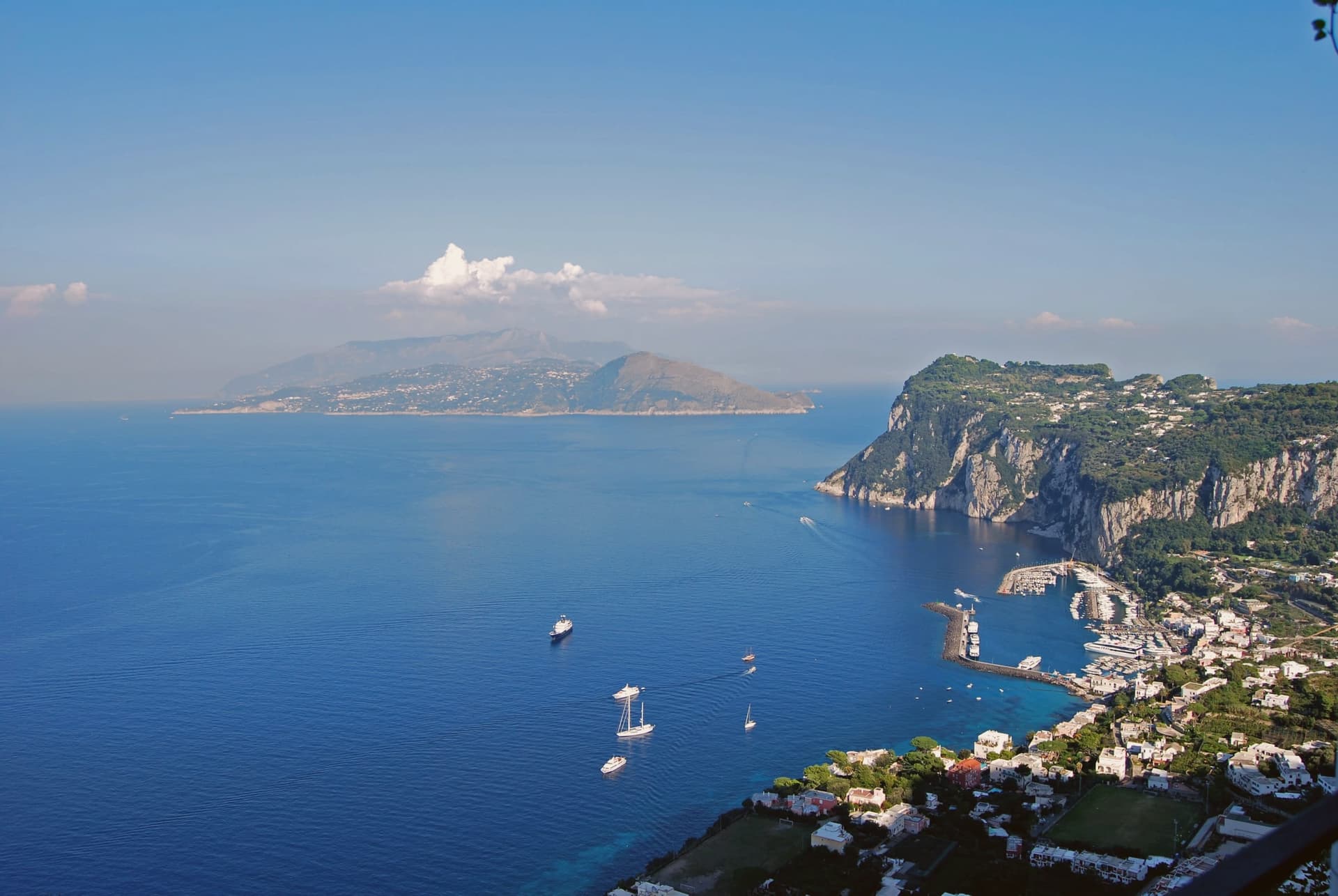
Why visit Anacapri
Anacapri occupies the western, higher plateau of Capri, about 150 meters above the harbour town, at 275 meters at the municipal centre and rising to 589 at Monte Solaro. The Ancient Greek prefix ana means up: the name simply says the upper one.
Until 1874 the only link between the two communes was a stairway of some 800 steps, cut by Greek settlers in the seventh or sixth century BC, not by Phoenicians despite what its common name suggests. In 1895 the Swedish physician Axel Munthe began building his villa on the ledge above those steps, on the ruins of one of Tiberius's residences and a tenth-century chapel.
His 1929 memoir turned the place into a literary destination. The two communes of Capri, one at sea level and one on the plateau above, were for centuries connected only by that stair cut into the rock, and a settlement reachable only on foot from its lower twin is a different kind of place than one arrived at by road.
What to see in Anacapri
- Villa San Michele. Neoclassical villa and garden with an antiquities collection and a granite Sphinx set over the harbour, facing east toward Vesuvius.
- Monte Solaro. Reached by a single-seat chairlift from Piazza Vittoria, the summit opens onto views across the whole of Capri.
- Faro di Punta Carena. Second-tallest lighthouse in Italy, built in 1862 and operational since 1867, at the southwestern tip of the island.
How to get to Anacapri
Our tip
May, June, September and the first half of October are the months Anacapri stays usable: blue water at Punta Carena, the Solaro chairlift running, and a degree or two cooler than Capri Marina below. July and August bring the day-trippers off the Naples and Sorrento ferries; the centro of Capri saturates by ten and Anacapri carries the spillover by lunchtime. Villa San Michele books out in advance.
Massa Lubrense
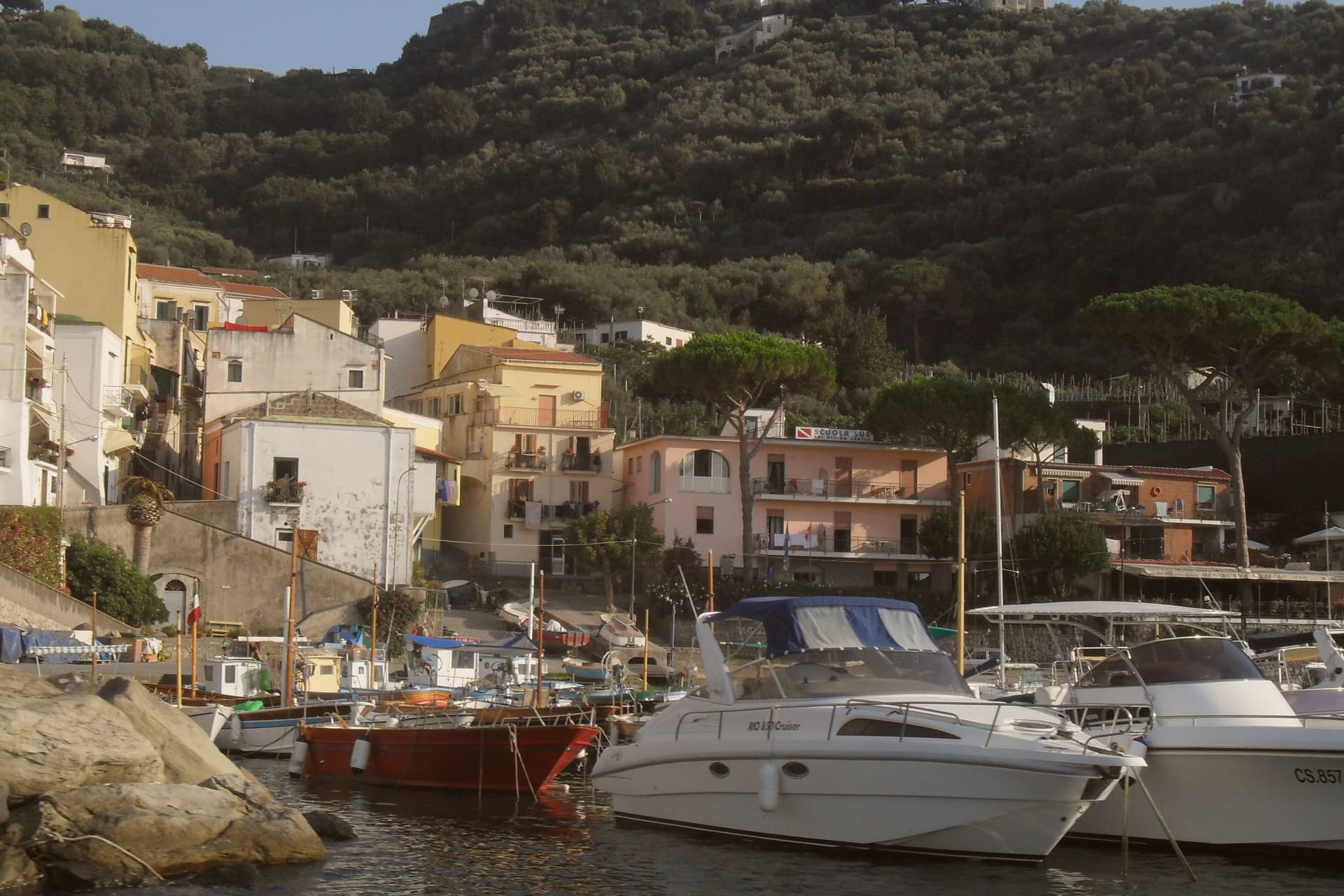
Why visit Massa Lubrense
Massa Lubrense holds the western tip of the Sorrentine Peninsula, the largest municipal area on the peninsula and the closest land to Capri, three nautical miles across the Bocche di Capri. The hilltop centro sits at 121 meters; the commune's eighteen frazioni spread between the Tyrrhenian and the Gulf of Salerno, including Termini, Nerano, Sant'Agata sui Due Golfi and the Marina della Lobra.
Punta Campanella, the cape at the end, has the remains of a Roman sanctuary of Athena and a sixteenth-century watchtower against Saracen raids; the surrounding sea is a protected marine area established in 1997. The commune holds a Bandiera Blu, a Spiga Verde, and Città dell'Olio status: the Penisola Sorrentina DOP olive groves climb the hills above the bays.
Spaghetti alla Nerano, courgette and provolone del Monaco, is the dish that came out of these kitchens in the 1950s.
What to see in Massa Lubrense
- Punta Campanella. Cape at the western tip of the peninsula, with the ruins of a Roman sanctuary of Athena, a watchtower, and the marine reserve established in 1997.
- Marina del Cantone. Pebble bay at Nerano, Italy's largest pebble beach by some measures and the kitchen where spaghetti alla Nerano was created.
- Chiesa di Santa Maria della Lobra. Sixteenth-century mother church above the small Marina della Lobra, with a wooden coffered ceiling and a former Franciscan convent attached.
How to get to Massa Lubrense
Napoli is roughly 69 minutes away by road.
Our tip
May, June, September and early October are the months Massa Lubrense was built for. The water around Punta Campanella sits above twenty degrees, the marine reserve runs daily boat tours, and the Sentiero degli Dei from Bomerano descends through olive groves in stable weather. July and August are full: the parking at Marina del Cantone closes by mid-morning and the SS145 from Sorrento backs up.
Sorrento
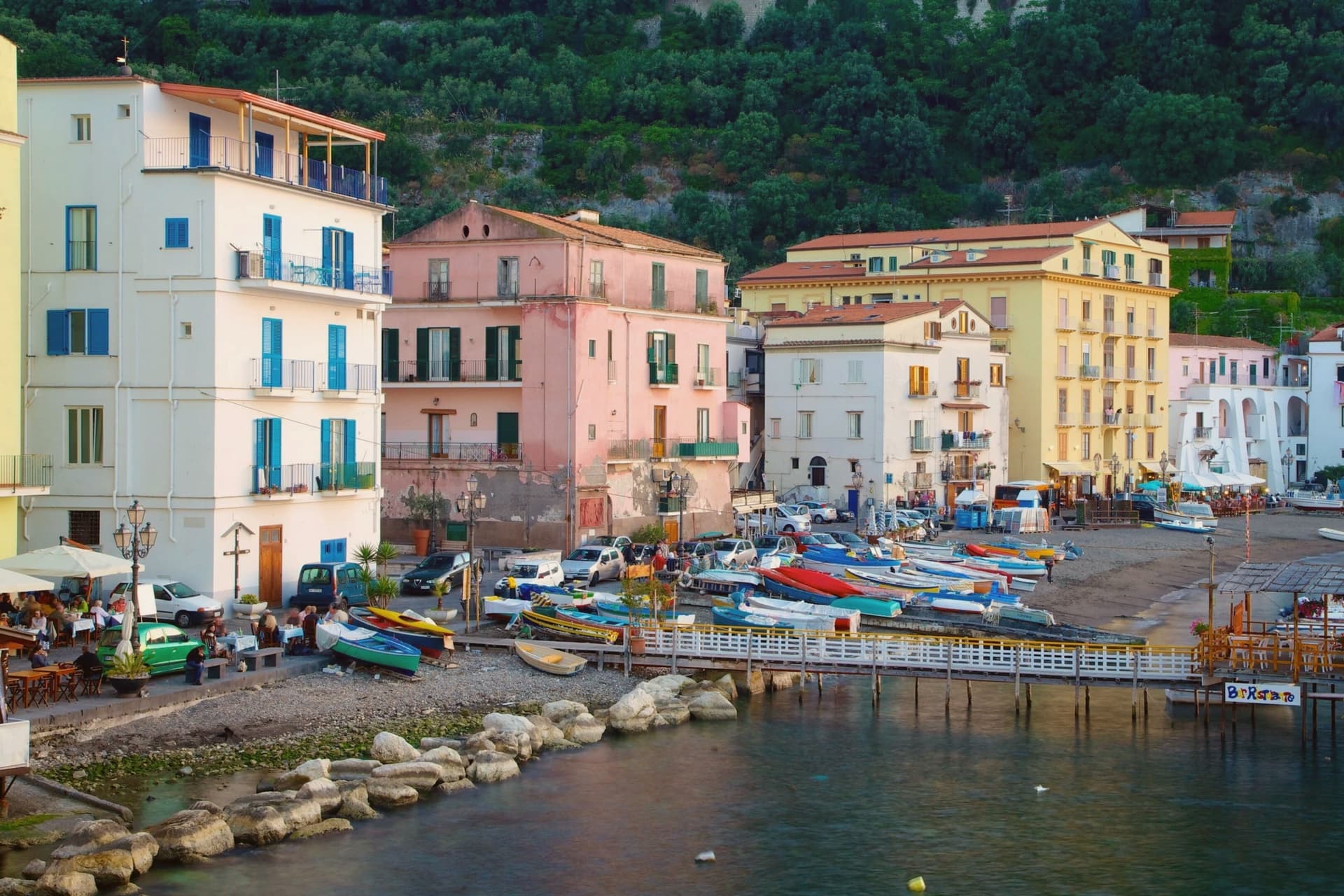
Why visit Sorrento
Sorrento sits on a block of tuff cliff fifty meters above the Bay of Napoli, thirty kilometers from the city by Circumvesuviana railway or ferry. The town began as a Greek foundation and became the Roman Surrentum, a resort favored by senators.
The current population is 15,407. The old town sits above, gathered around the Duomo and the cloister of San Francesco a few minutes apart, while Marina Grande lies below the cliff, reached through the ancient Greek gate, its harbor still working and its trattorie facing the bay.
Terraces of lemon groves ring the slopes above town, the same femminello sorrentino IGP fruit that supplies the limoncello sold through the centro storico. Piazza Tasso, at the head of the old town, is where Corso Italia begins and where the statue of Torquato Tasso stands; the poet was baptized in the cathedral below.
A cliff town facing the bay, its upper streets given to churches and squares, its lower shore to fishing and the harbor, and its surrounding slopes turned over entirely to the lemon that still funds much of what happens in between.
What to see in Sorrento
- Duomo di Sorrento. Eleventh-century cathedral rebuilt in Romanesque style in the fifteenth century, with a baroque interior and the baptistery where Torquato Tasso was christened.
- Chiostro di San Francesco. Fourteenth-century cloister of tuff arches and crossed columns, the marble façade redone in 1926, still used for civic weddings and chamber concerts.
- Museo Correale di Terranova. Decorative arts museum in a seventeenth-century villa opened in 1924, with Neapolitan porcelain, period furniture and seventeenth-century painting.
How to get to Sorrento
There is a railway station in the town, so you can arrive without a car and never need one while you are here. Napoli is roughly 57 minutes away by road.
Our tip
May, June, September and October are the months that work for Sorrento. The sea is warm enough to swim, the temperatures sit in the mid-twenties, and the centro storico is busy without being unworkable. July and August are crowded almost beyond use.
Forio
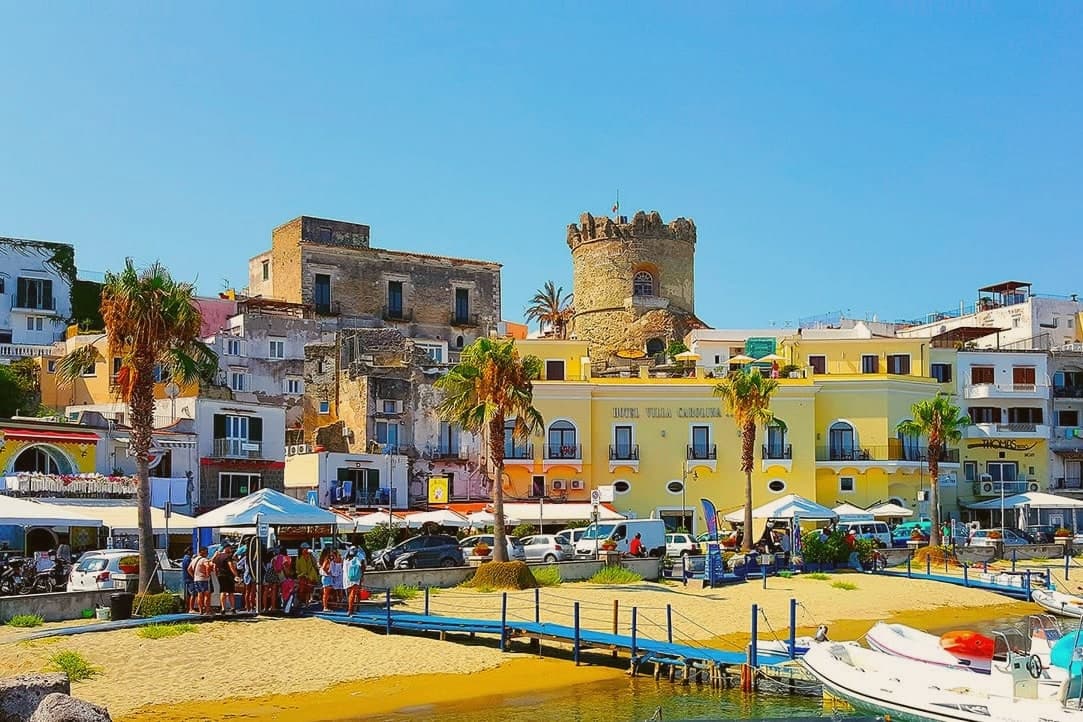
Why visit Forio
Forio sits at 18 meters on the western coast of Ischia, the largest commune of the island by area and the second by population. Seventeen towers, built between the fifteenth and seventeenth centuries to defend against Saracen raids, are scattered through the town and surrounding countryside, with the largest anchoring the old center and the rest marking the line where the built town gives way to open countryside.
The coast runs from the northern bay below the church of San Francesco di Paola down to the western beaches at Citara, where the volcanic sand faces the only sunset on the island. Inland and above, the hillside terrain that drew a composer to build and plant runs down toward the thermal springs feeding the pools near the shore.
The commune reads as a string of distinct pieces, defensive towers, a promontory church, a garden hillside, a thermal coast, held together less by a single center than by the shared western exposure that lights the water each evening.
What to see in Forio
- Chiesa del Soccorso. White walls on a promontory catch the light over the sea, the church mixing Moorish, Byzantine and Mediterranean elements in its rebuilding.
- Il Torrione. Fifteenth-century defensive tower in the centro storico, largest of the seventeen Forio towers, now a small museum and viewpoint.
- Giardini La Mortella. Susana Walton built the garden on the hillside her husband William composed on, terraces of subtropical species climbing the slope above the town.
How to get to Forio
Our tip
May and June are the cleanest weeks: thermal pools open, sea swimmable from late May, La Mortella in spring bloom. July and August are the high tourist months; Forio fills with northern Europeans on package stays at the western hotels, and the Citara springs run at full capacity. September and early October the crowds thin and the water stays warm.
Vico Equense
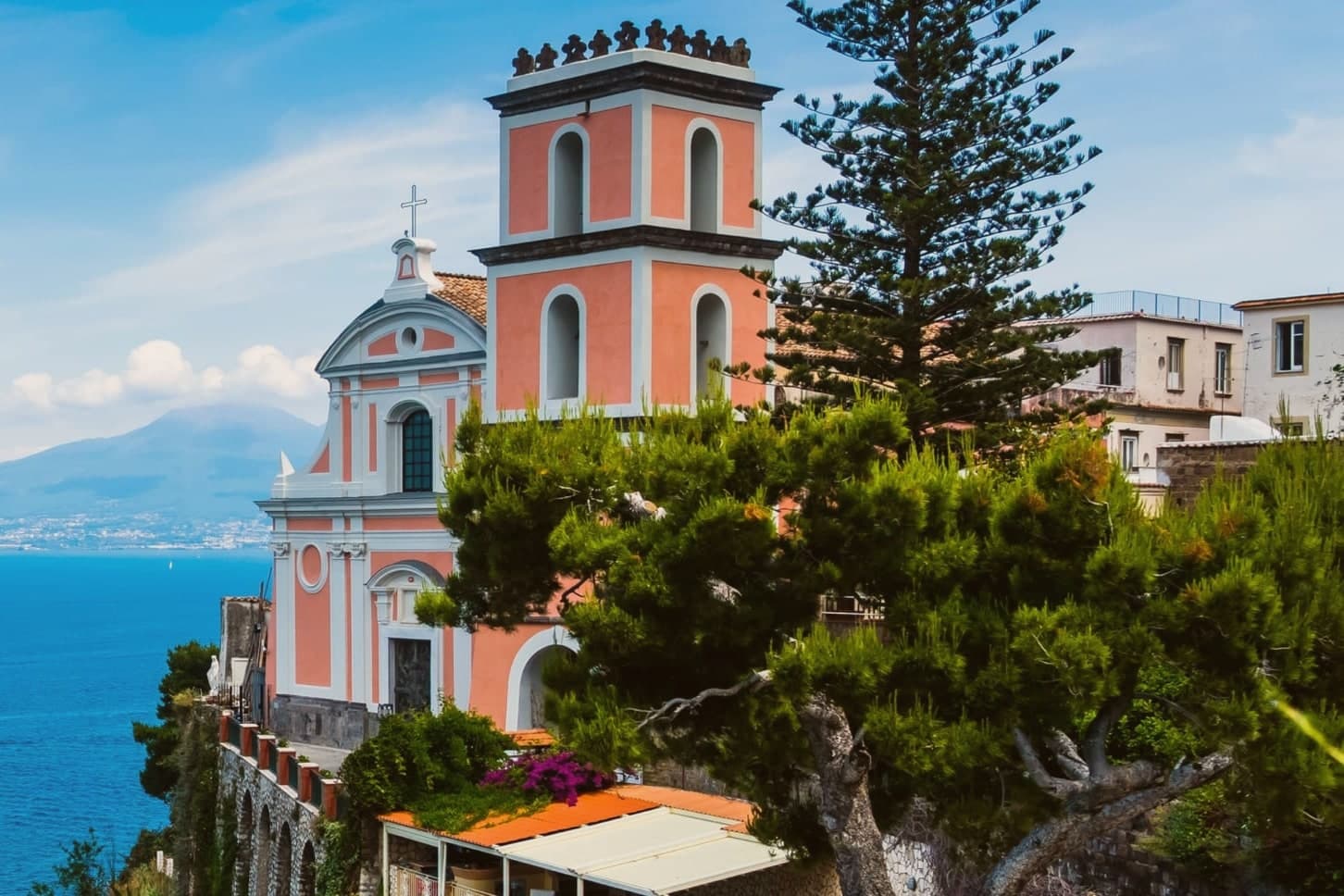
Why visit Vico Equense
Vico Equense sits on a block of tuff and limestone above the Bay of Napoli, twenty-five kilometers from the city and the first town on the Sorrento peninsula coming from the north. A seventh-century BC pre-Roman necropolis predates the Latin Aequana that Roman patricians built here for their villas, and the finds from that older settlement, funerary objects excavated in the 1960s and 1970s, sit now in a museum founded in 1966.
The medieval town that survives was walled by the Angevins after 1284, when Charles II ordered a fortress built on the cliff as both stronghold and residence, and the diocese's cathedral rose on a neighboring clifftop in the same century, before losing its status as a see in 1818. Behind the town, the limestone mass of the Lattari range closes off the land side, reached since 1952 by cable car from the coast at Castellammare.
Pizza by the meter, the town's best-known export, was invented here by Luigi Dell'Amura, called Gigino, in the 1930s, and his restaurant in the centro still serves it. What holds the town together is the sequence itself: a pre-Roman settlement, a Roman villa town, an Angevin fortress and a bishopric, and finally a twentieth-century dish, each layer built on a narrow shelf of rock between the mountain and the bay.
What to see in Vico Equense
- Chiesa dell'Annunziata. The church stands at the edge of the cliff, its Gothic interior at odds with the Baroque face it was given later. The old cathedral of a diocese that no longer has a seat here.
- Castello Giusso. Angevin castle built between 1284 and 1289 at the order of Charles II of Anjou, with a Renaissance residential wing and gardens above the bay.
- Antiquarium Silio Italico. Archaeological museum founded in 1966, with funerary objects from a seventh-century BC pre-Roman necropolis excavated in the 1960s and 1970s.
How to get to Vico Equense
There is a railway station in the town, so you can arrive without a car and never need one while you are here. Napoli is roughly 55 minutes away by road.
Our tip
May through September is the working season for Vico Equense. June and September are the best months: warm sea, fewer day-trippers than July and August, and the Monte Faito cable car operating on a full schedule. July and August are crowded and hot at sea level, though the Faito plateau stays cooler at around twenty-two degrees. Sagra del Riavulillo falls in the season.
More from Anywhere Italy
- The 9 best towns with a serious restaurant in the province of Napoli
 The best hidden towns worth staying overnight in Campania
 The 6 best beach towns with a serious restaurant in Campania
 The best towns inside a nature park that eat well in the province of Napoli
 The best towns with a serious restaurant that eat well within 90 minutes of Napoli
 The best cheese towns within 90 minutes of Salerno