
The best towns inside a nature park that eat well in the province of Napoli
The province of Napoli holds a lot of protected land for somewhere so densely built. West of the city the ground is volcanic, a field of low craters and steaming fumaroles where the soil grows Falanghina and Piedirosso and the harbours land anchovies, octopus and the small clams that go into a plate of spaghetti without much fuss. South and east, the Monti Lattari rise straight out of the sea in limestone, terraced with lemons and olives, cool in the evening even in August. The building material changes with the geology, yellow tuff on one side, whitewashed lime and stone on the other. Eating here follows the same split: fried and briny to the west, dairy and garden and citrus up in the hills.
Most people arriving with the coast in mind head for Capri or press on to Positano and Amalfi, and the ferries and the coast road in July and August show it. The Amalfi Coast earns its reputation, but it concentrates an enormous number of visitors onto a very narrow shelf of rock, and lunch is booked out by mid morning. Capri in high season is a queue for the funicular. It is worth going, once, and preferably in the shoulder season.
The same volcanic craters, the same lemon terraces and the same kitchens carry on either side of those places, inside two regional parks that few visitors think of as parks at all. Fewer people eat in the towns above the Sorrento road or around the Flegrean lakes, and the cooking there is not calibrated for people passing through once. These are the towns in this list.
Of the 15 communes we have mapped in the province of Napoli, 7 qualify as towns inside a nature park that eat well: each sits inside a regional nature park, and a dining guide has named a table in each. The smallest, Piano di Sorrento, has 12,355 residents.
Elsewhere in the catalogue: The best towns with a serious restaurant that eat well within 90 minutes of Napoli and The 9 best towns you can reach by train in the province of Napoli.
Piano di Sorrento
Why visit Piano di Sorrento
Piano di Sorrento sits at ninety-six meters on the tuff terrace of the Sorrentine peninsula, four kilometers east of Sorrento, thirty kilometers from Napoli. The upper plain has been inhabited since the second millennium BC: pottery and a necropolis from the Gaudo culture were excavated between the frazioni of Trinità and San Massimo.
The town was tied to Sorrento until 1808, when Joseph Bonaparte's reform separated it as an autonomous comune. The local name, Caruotto, comes from the Latin carottum, quarry, after the tuff pits that fed the building of the peninsula.
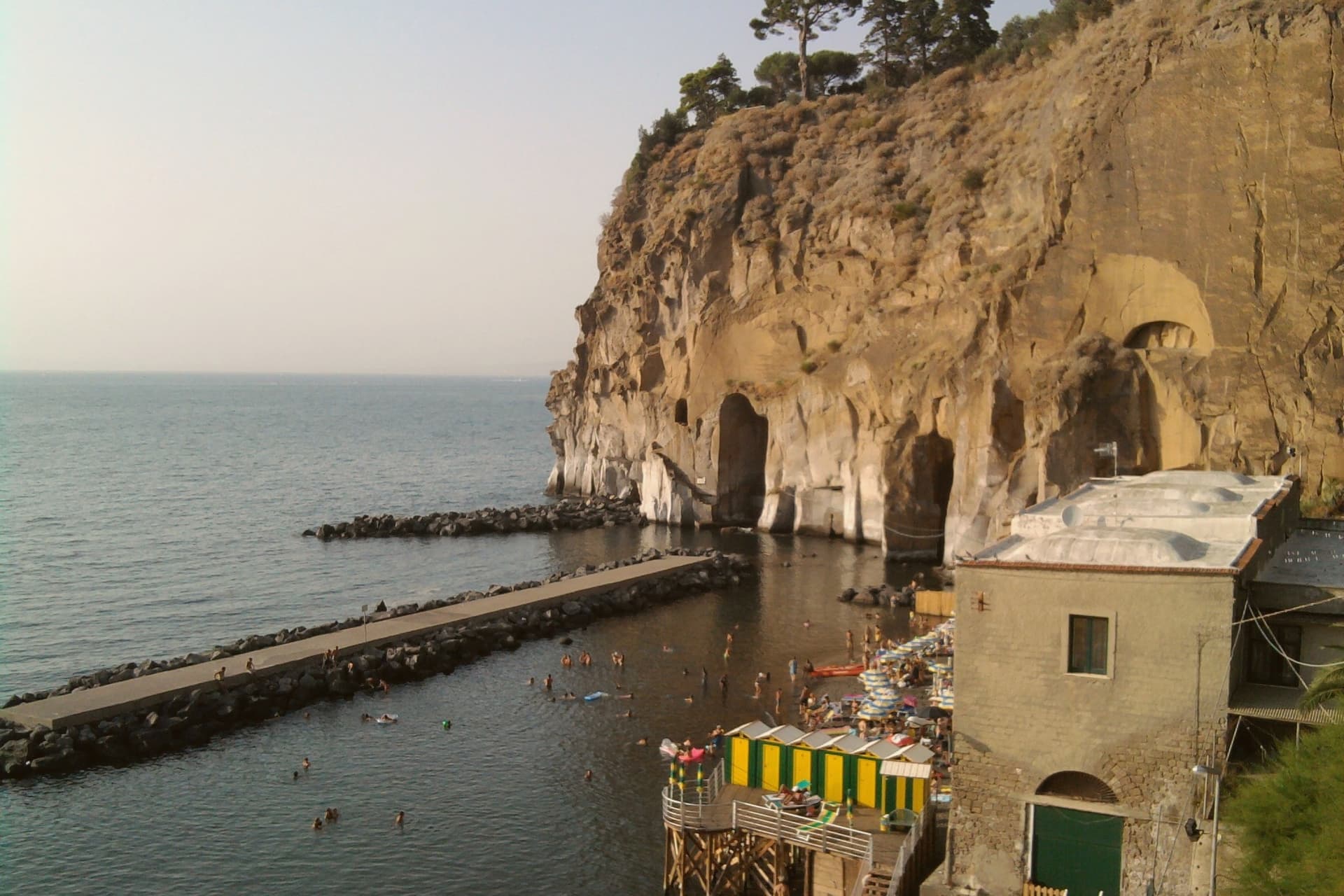
The Basilica di San Michele Arcangelo, ninth century in origin, was raised to papal basilica status by Benedict XV in 1914 and holds two large inlaid wooden doors. The Villa Fondi de Sangro, a neoclassical 1840 villa above the cliff, now houses the Georges Vallet archaeological museum and faces the Marina di Cassano below.
The marina has black volcanic sand, fishing boats and a small port that still works.
Le Tre Arcate have been named by a guide.
What to see in Piano di Sorrento
- Basilica di San Michele Arcangelo. Ninth-century church raised to papal basilica status in 1914 by Benedict XV, with large inlaid wooden doors and a baroque interior in the centro of Piano.
- Villa Fondi de Sangro. Neoclassical villa of 1840 above the cliff, now seat of the Museo Archeologico Georges Vallet, with finds from the Massa Lubrense and Sorrento peninsula excavations.
- Marina di Cassano. Small fishing port with black volcanic sand at the foot of the cliff, reached by a steep path from the upper town, still active for inshore fishing.
How to get to Piano di Sorrento
There is a railway station in the town, so you can arrive without a car and never need one while you are here. Napoli is roughly 49 minutes away by road.
Our tip
May through September is the working season for the Sorrentine peninsula, and Piano follows the same rhythm as Sorrento next door. June and September are the easiest months: warm sea, manageable crowds, full ferry schedules to Capri and Ischia. July and August are crowded with day-trippers; Marina di Cassano fills early and the upper town turns over to the lunch trade.
Massa Lubrense
Why visit Massa Lubrense
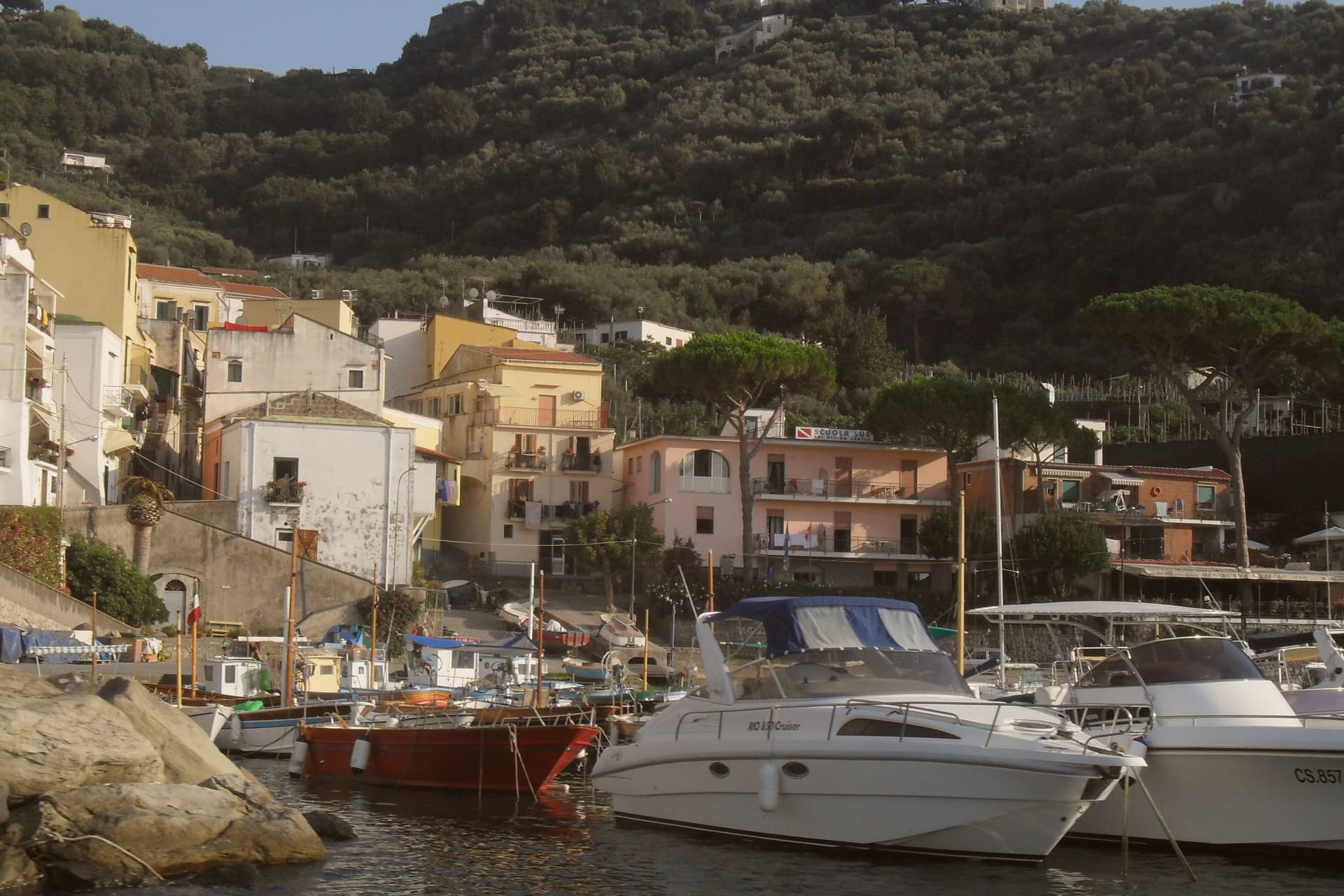
Massa Lubrense holds the western tip of the Sorrentine Peninsula, the largest municipal area on the peninsula and the closest land to Capri, three nautical miles across the Bocche di Capri. The hilltop centro sits at 121 meters; the commune's eighteen frazioni spread between the Tyrrhenian and the Gulf of Salerno, including Termini, Nerano, Sant'Agata sui Due Golfi and the Marina della Lobra.
Punta Campanella, the cape at the end, has the remains of a Roman sanctuary of Athena and a sixteenth-century watchtower against Saracen raids; the surrounding sea is a protected marine area established in 1997. The commune holds a Bandiera Blu, a Spiga Verde, and Città dell'Olio status: the Penisola Sorrentina DOP olive groves climb the hills above the bays.
Spaghetti alla Nerano, courgette and provolone del Monaco, is the dish that came out of these kitchens in the 1950s.
Ristorante Antico Francischiello da Peppino, Quattro Passi, Relais Blu and 6 more have been named by a guide.
What to see in Massa Lubrense
- Punta Campanella. Cape at the western tip of the peninsula, with the ruins of a Roman sanctuary of Athena, a watchtower, and the marine reserve established in 1997.
- Marina del Cantone. Pebble bay at Nerano, Italy's largest pebble beach by some measures and the kitchen where spaghetti alla Nerano was created.
- Chiesa di Santa Maria della Lobra. Sixteenth-century mother church above the small Marina della Lobra, with a wooden coffered ceiling and a former Franciscan convent attached.
How to get to Massa Lubrense
Napoli is roughly 69 minutes away by road.
Our tip
May, June, September and early October are the months Massa Lubrense was built for. The water around Punta Campanella sits above twenty degrees, the marine reserve runs daily boat tours, and the Sentiero degli Dei from Bomerano descends through olive groves in stable weather. July and August are full: the parking at Marina del Cantone closes by mid-morning and the SS145 from Sorrento backs up.
Sorrento
Why visit Sorrento
Sorrento sits on a block of tuff cliff fifty meters above the Bay of Napoli, thirty kilometers from the city by Circumvesuviana railway or ferry. The town began as a Greek foundation and became the Roman Surrentum, a resort favored by senators.
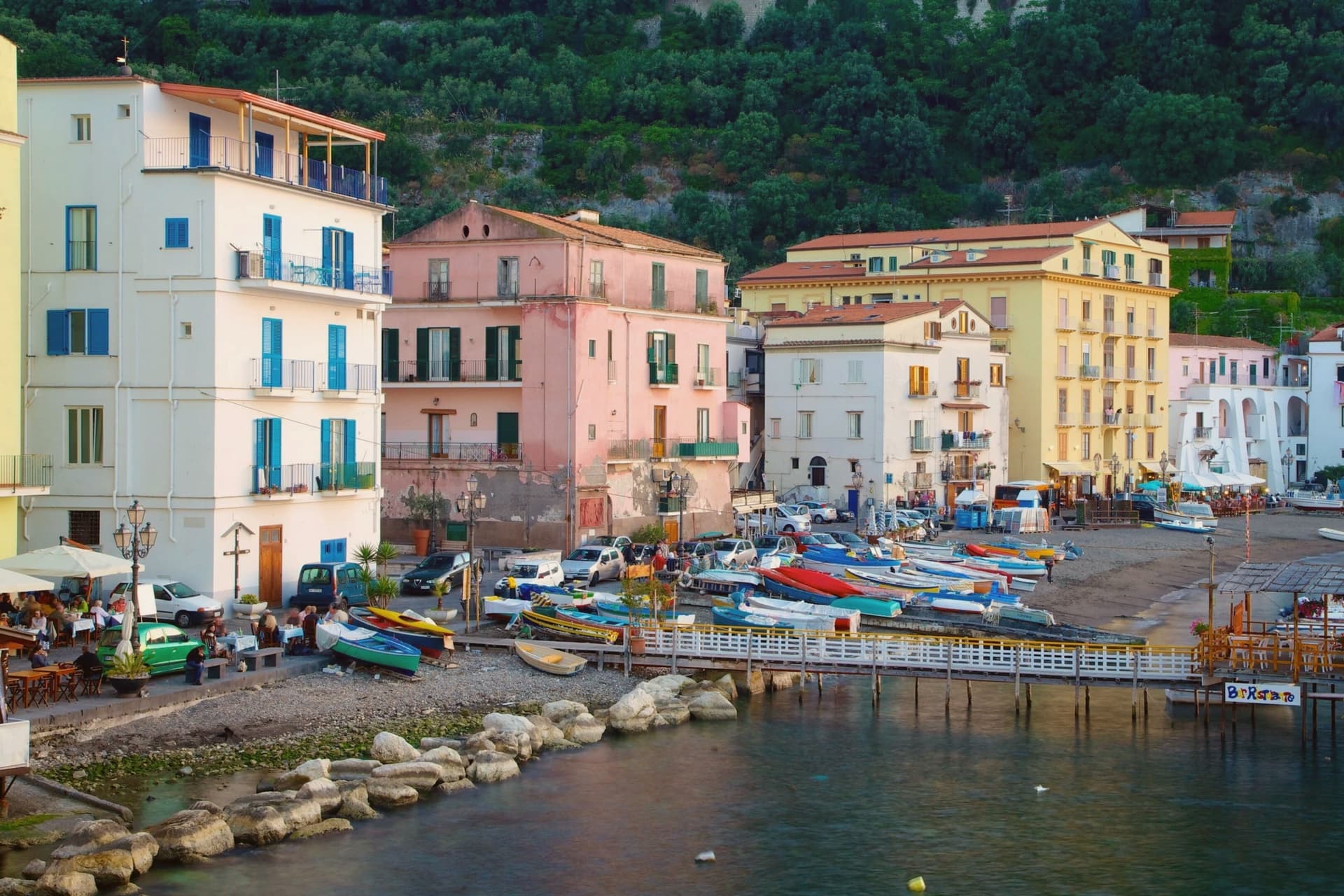
The current population is 15,407. The old town sits above, gathered around the Duomo and the cloister of San Francesco a few minutes apart, while Marina Grande lies below the cliff, reached through the ancient Greek gate, its harbor still working and its trattorie facing the bay.
Terraces of lemon groves ring the slopes above town, the same femminello sorrentino IGP fruit that supplies the limoncello sold through the centro storico. Piazza Tasso, at the head of the old town, is where Corso Italia begins and where the statue of Torquato Tasso stands; the poet was baptized in the cathedral below.
A cliff town facing the bay, its upper streets given to churches and squares, its lower shore to fishing and the harbor, and its surrounding slopes turned over entirely to the lemon that still funds much of what happens in between.
Ristorante O' Canonico 1898, Ristorante O' Parrucchiano, Terrazza Bosquet and 8 more have been named by a guide.
What to see in Sorrento
- Duomo di Sorrento. Eleventh-century cathedral rebuilt in Romanesque style in the fifteenth century, with a baroque interior and the baptistery where Torquato Tasso was christened.
- Chiostro di San Francesco. Fourteenth-century cloister of tuff arches and crossed columns, the marble façade redone in 1926, still used for civic weddings and chamber concerts.
- Museo Correale di Terranova. Decorative arts museum in a seventeenth-century villa opened in 1924, with Neapolitan porcelain, period furniture and seventeenth-century painting.
How to get to Sorrento
There is a railway station in the town, so you can arrive without a car and never need one while you are here. Napoli is roughly 57 minutes away by road.
Our tip
May, June, September and October are the months that work for Sorrento. The sea is warm enough to swim, the temperatures sit in the mid-twenties, and the centro storico is busy without being unworkable. July and August are crowded almost beyond use.
Vico Equense
Why visit Vico Equense
Vico Equense sits on a block of tuff and limestone above the Bay of Napoli, twenty-five kilometers from the city and the first town on the Sorrento peninsula coming from the north. A seventh-century BC pre-Roman necropolis predates the Latin Aequana that Roman patricians built here for their villas, and the finds from that older settlement, funerary objects excavated in the 1960s and 1970s, sit now in a museum founded in 1966.
The medieval town that survives was walled by the Angevins after 1284, when Charles II ordered a fortress built on the cliff as both stronghold and residence, and the diocese's cathedral rose on a neighboring clifftop in the same century, before losing its status as a see in 1818. Behind the town, the limestone mass of the Lattari range closes off the land side, reached since 1952 by cable car from the coast at Castellammare.
Pizza by the meter, the town's best-known export, was invented here by Luigi Dell'Amura, called Gigino, in the 1930s, and his restaurant in the centro still serves it. What holds the town together is the sequence itself: a pre-Roman settlement, a Roman villa town, an Angevin fortress and a bishopric, and finally a twentieth-century dish, each layer built on a narrow shelf of rock between the mountain and the bay.
Torre del Saracino, Antica Osteria Nonna Rosa, Cannavacciuolo Countryside and 8 more have been named by a guide.
What to see in Vico Equense
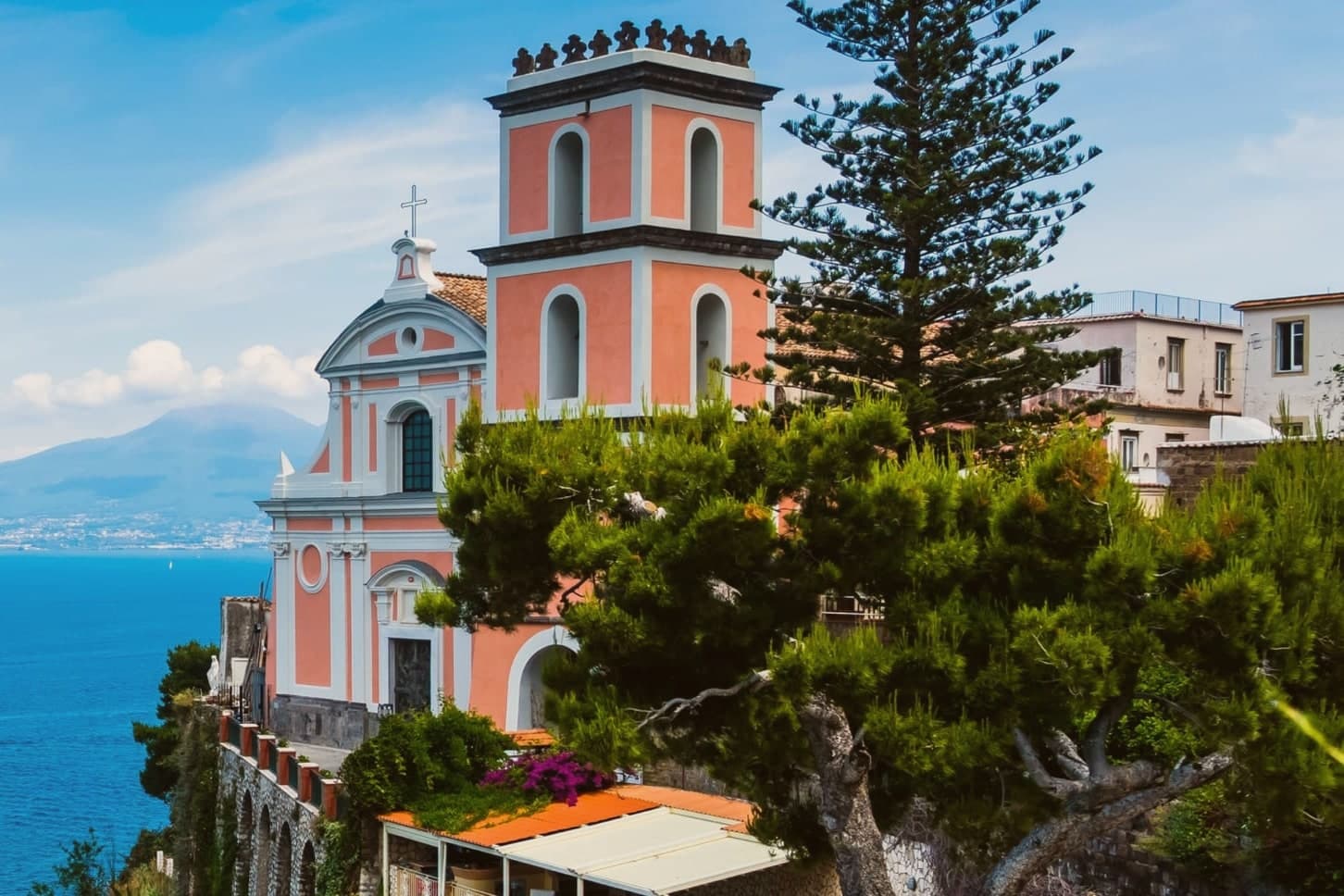
- Chiesa dell'Annunziata. The church stands at the edge of the cliff, its Gothic interior at odds with the Baroque face it was given later. The old cathedral of a diocese that no longer has a seat here.
- Castello Giusso. Angevin castle built between 1284 and 1289 at the order of Charles II of Anjou, with a Renaissance residential wing and gardens above the bay.
- Antiquarium Silio Italico. Archaeological museum founded in 1966, with funerary objects from a seventh-century BC pre-Roman necropolis excavated in the 1960s and 1970s.
How to get to Vico Equense
There is a railway station in the town, so you can arrive without a car and never need one while you are here. Napoli is roughly 55 minutes away by road.
Our tip
May through September is the working season for Vico Equense. June and September are the best months: warm sea, fewer day-trippers than July and August, and the Monte Faito cable car operating on a full schedule. July and August are crowded and hot at sea level, though the Faito plateau stays cooler at around twenty-two degrees. Sagra del Riavulillo falls in the season.
Pompei
Why visit Pompei
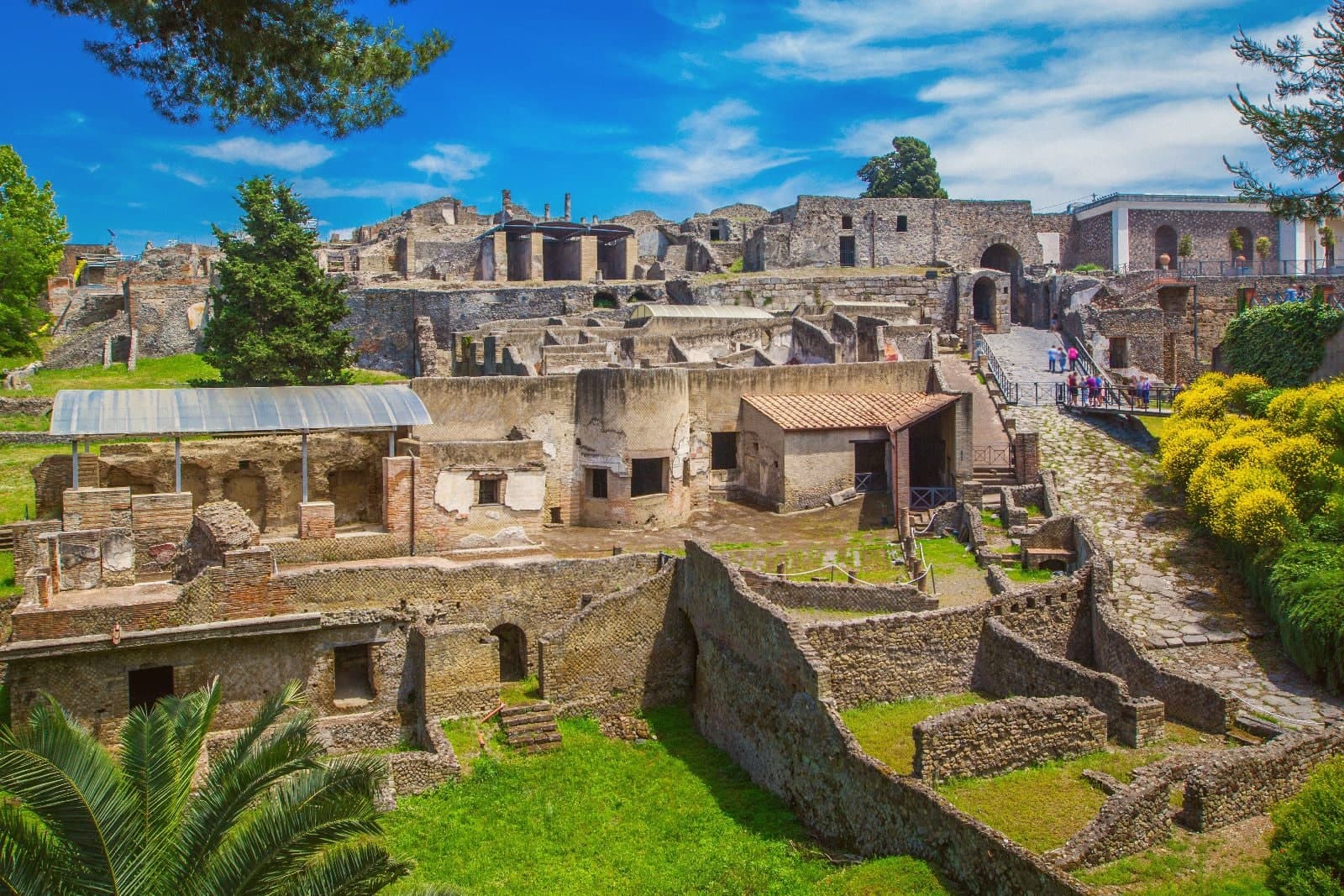
Pompei sits at 30 meters on a volcanic plateau on the south slope of Vesuvius, twenty kilometers from Naples and a hundred meters from where the Sarno meets the sea. The Roman city was buried under five to six meters of ash and lapilli when the volcano erupted on 24 October 79 AD, killing the part of the population that had not already left.
Excavations began in 1748 under the Bourbons and have never stopped; the site has been UNESCO-listed since 1997 alongside Herculaneum and Torre Annunziata, and is the third most visited archaeological site in the world. Modern Pompei was founded in 1881 by the lawyer Bartolo Longo, who built the Santuario della Beata Vergine del Rosario as a center for pilgrimage and social work.
The basilica with its 80-meter campanile and the surrounding grid of streets are entirely a creation of the 1880s, separate from the dig and laid over fields that had been farmland until then.
President, Cosmo Restaurant, Capasanta and 1 more have been named by a guide.
What to see in Pompei
- Parco Archeologico di Pompei. The Roman city buried in 79 AD and excavated since 1748, UNESCO-listed since 1997, with the Forum, the Villa dei Misteri and the Lupanare.
- Santuario della Beata Vergine del Rosario. Pontifical basilica built between 1876 and 1891 by the lawyer Bartolo Longo, the heart of modern Pompei and a pilgrimage site of four million a year.
- Casa del Fauno. Roman patrician house in the dig with a bronze faun at its center and the Alexander Mosaic floor depicting Issus, now in the Naples museum.
How to get to Pompei
There is a railway station in the town, so you can arrive without a car and never need one while you are here. Napoli is roughly 24 minutes away by road.
Our tip
May, June, September and early October are the strongest months for Pompei. The dig opens at nine and the Forum stays walkable before midday heat sets in. July and August are punishing: the site sits on volcanic plateau at thirty meters with no shade in the main streets, and afternoon temperatures cross thirty-five degrees.
Bacoli
Why visit Bacoli
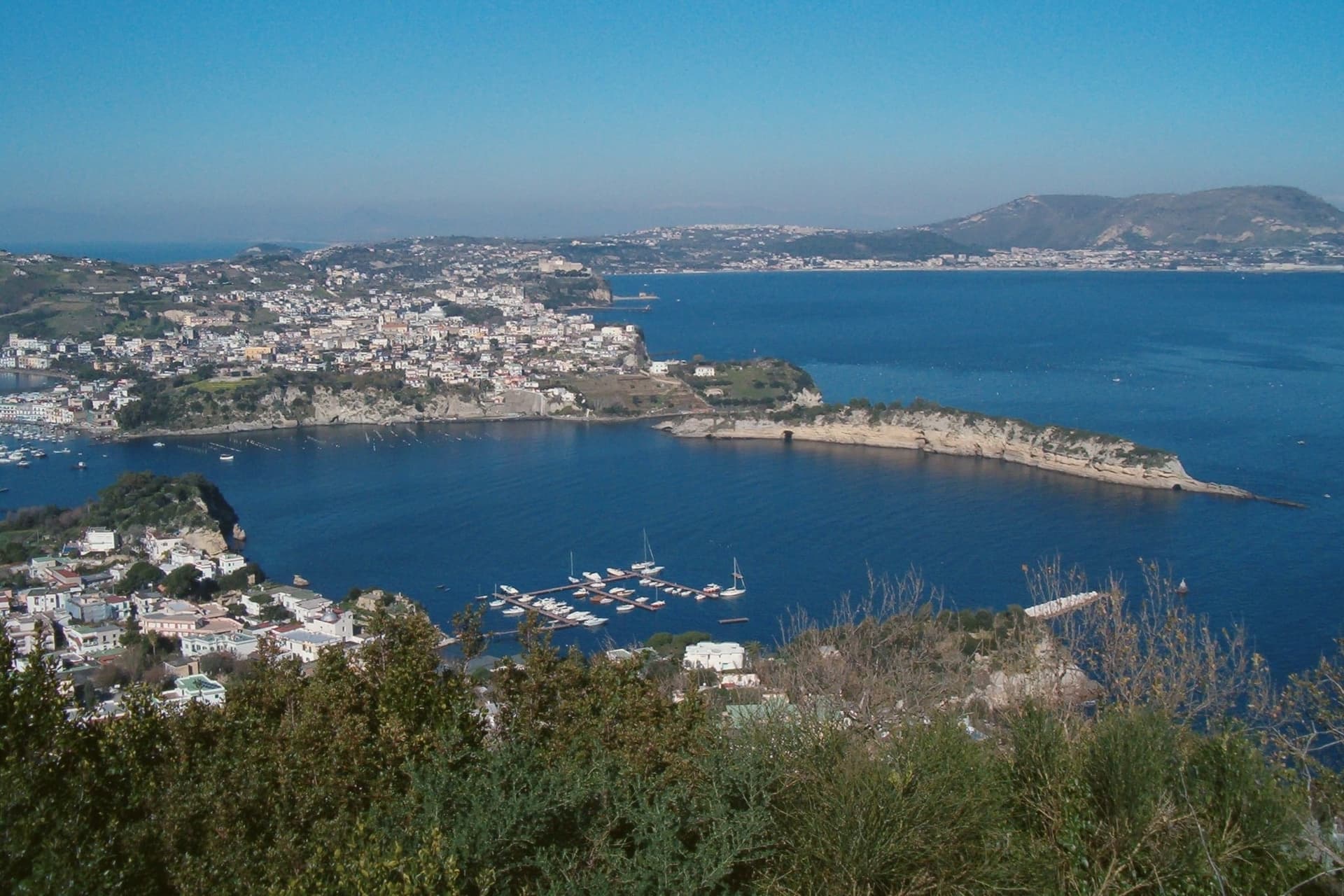
Bacoli sits at thirty meters on the western lobe of the Campi Flegrei, looking onto Lake Miseno and its headland across the Bay of Pozzuoli. The Romans called it Bauli.
In the late Republic and early Empire it was a resort lined with the villas of senators and emperors, and the fleet base nearby, the Classis Misenensis, was the largest in the Mediterranean. Most of that infrastructure is still here, scattered through the residential blocks that now fill the town, so that a cistern or a cistern complex turns up between apartment buildings rather than in an isolated park.
The town's two promontories divide its Roman past between them: the harbor side toward Miseno, where the fleet and its water supply were based, and the Baia side, where the villas and the later Aragonese castle stand. Bacoli is also an active geothermal zone, and bradyseism, the slow rise and fall of the Campi Flegrei coastline, is still measurable here, the same force that put the Roman villas at Baia underwater.
What survives above ground and what has sunk below the sea are the same story of ground that will not stay still.
Caracol, Riccio Restaurant, Aguglia osteria di mare 2021 and 2 more have been named by a guide.
What to see in Bacoli
- Piscina Mirabilis. Forty-eight cross-shaped pillars hold up the roof in rows, the scale meant to be walked through rather than read about, still standing among the residential blocks that have grown up around it.
- Cento Camerelle. Second cistern complex four hundred meters from the Piscina Mirabilis, on two superimposed levels, locally called the Prisons of Nero.
- Castello Aragonese di Baia. Late-fifteenth-century Aragonese fortress on the Baia promontory, since 1993 the seat of the Museo Archeologico dei Campi Flegrei.
How to get to Bacoli
There is a railway station in the town, so you can arrive without a car and never need one while you are here. Napoli is roughly 31 minutes away by road.
Our tip
May through September is the season for Bacoli. The Bay of Pozzuoli warms by late spring, and the underwater archaeological park at Baia runs glass-bottom and snorkel tours through the summer. July and August are hot and crowded, with day-trippers from Napoli and Ischia ferries crossing constantly; the open ruins like the Piscina Mirabilis are worth visiting early in the day.
Pozzuoli
Why visit Pozzuoli
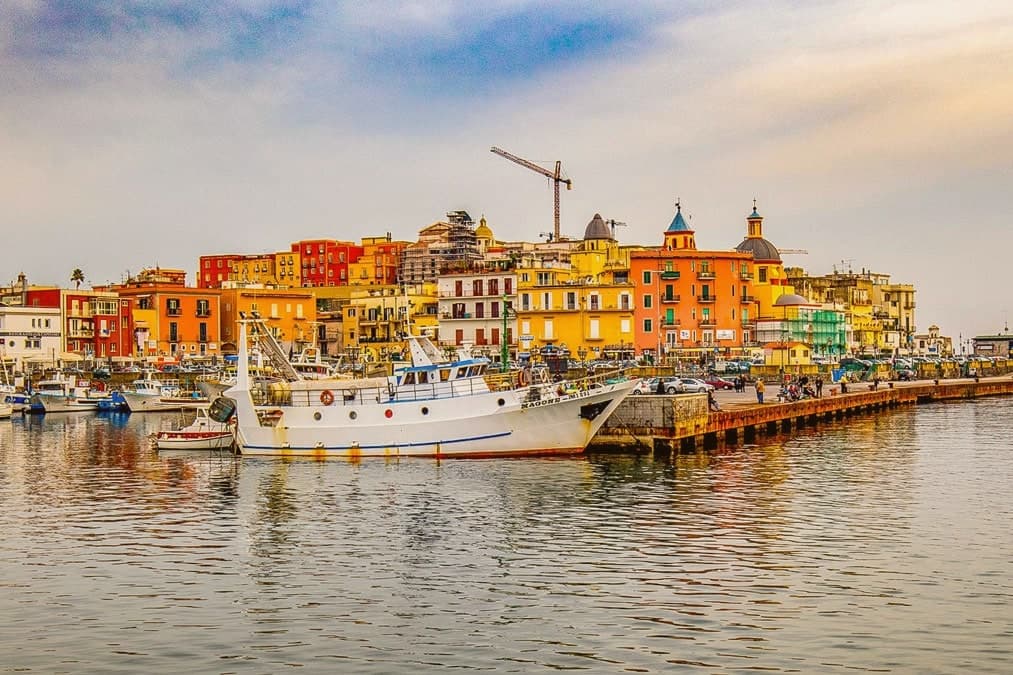
Pozzuoli sits at twenty-eight meters on the rim of the Campi Flegrei caldera, fifteen kilometers west of Napoli. Greek refugees from Samos founded the city in 531 BC as Dicearchia; Rome took it in 195 BC and renamed it Puteoli, a name the port kept through its centuries as Rome's busiest gateway by sea.
The old town and the working town are not the same ground. Rione Terra, the headland acropolis, was the city center for both the Greek and Roman settlements before it was evacuated in 1970 and reopened only piece by piece since.
The rest of Pozzuoli has grown around and below it, on a caldera that does not hold still: the crater above town still vents sulfur, and the crust beneath the whole area continues its slow rise and fall, watched closely enough that the alert level was raised again in 2023. A port city built its wealth on ground that was always going to move under it, and the town's oldest quarter has spent the last half century learning to live with that fact rather than escape it.
Abraxas, La Fattoria del Campiglione, Punto Nave and 1 more have been named by a guide.
What to see in Pozzuoli
- Anfiteatro Flavio. The cage chambers and lift machinery beneath the arena floor survive largely intact, giving a rare view of how the underground works of a Roman amphitheater actually functioned.
- Macellum (Tempio di Serapide). A market building long misread as a temple to Serapis. The three marked columns still stand at the center of the floor, close enough to touch.
- Rione Terra. The headland acropolis and original old town, evacuated in 1970 after a bradyseismic crisis and reopened only in stages since.
How to get to Pozzuoli
There is a railway station in the town, so you can arrive without a car and never need one while you are here. Napoli is roughly 25 minutes away by road.
Our tip
May through September is the working season for Pozzuoli, with June and September the easiest months. Sea temperatures rise into the mid-twenties, and the open-air sites stay accessible without afternoon heat closures. July and August are hot and crowded; the Anfiteatro and Macellum work best in the first morning slots.
More from Anywhere Italy
 The best towns with a serious restaurant that eat well within 90 minutes of Napoli
- The 9 best towns you can reach by train in the province of Napoli
 The 9 best towns with a serious restaurant in the province of Napoli
 The best coastal towns within an hour of Naples
- The best towns that eat well within 45 minutes of Naples
 The best cheese towns within 90 minutes of Salerno