
The 9 best towns with a serious restaurant in the province of Napoli
The province of Napoli eats off volcanic soil and a warm sea, and the cooking shows it. Tomatoes grown on the flanks of Vesuvius, lemons from the terraces above the Sorrentine cliffs, provolone del Monaco, buffalo mozzarella brought up from the plain, red prawns and anchovies landed in the morning. The serious kitchens here work in tufo cellars, in converted farmhouses among the lemon groves, on terraces cut into rock the colour of ash. Spring and early autumn are the best months for a table with the windows open, when the heat has gone out of the day but the sea is still holding its warmth.
The default plan is Naples itself, and the pizza. Reasonably so, because the city invented the thing and defends it with real conviction, and the historic centre is one of the great places in Europe to walk and eat at the same time. But the queues outside the famous pizzerie on Via dei Tribunali now run for hours, tables turn in minutes, and the whole business has become something closer to a ticketed attraction than a meal. Ambitious cooking exists in the city, though it competes for attention with a street-food economy at full volume.
The same produce, the same fishing boats and the same growers supply the province beyond the ring road, and that is where the tasting menus have room to breathe. These are towns on the islands and along the peninsula, in the crater country west of the city and out on the plain where Vesuvius flattens into farmland, each holding a restaurant listed by the most demanding of the dining guides. Fewer people book them, and the drive or the ferry out is part of the point.
Of the 15 communes we have mapped in the province of Napoli, 9 qualify as towns with a serious restaurant: each holds a restaurant listed by the most demanding of the dining guides. The smallest, Capri, has 6,804 residents.
Two more lists worth reading alongside this one: The best towns with a serious restaurant that eat well within 90 minutes of Napoli and The best towns worth staying overnight in the province of Napoli.
Capri
Why visit Capri
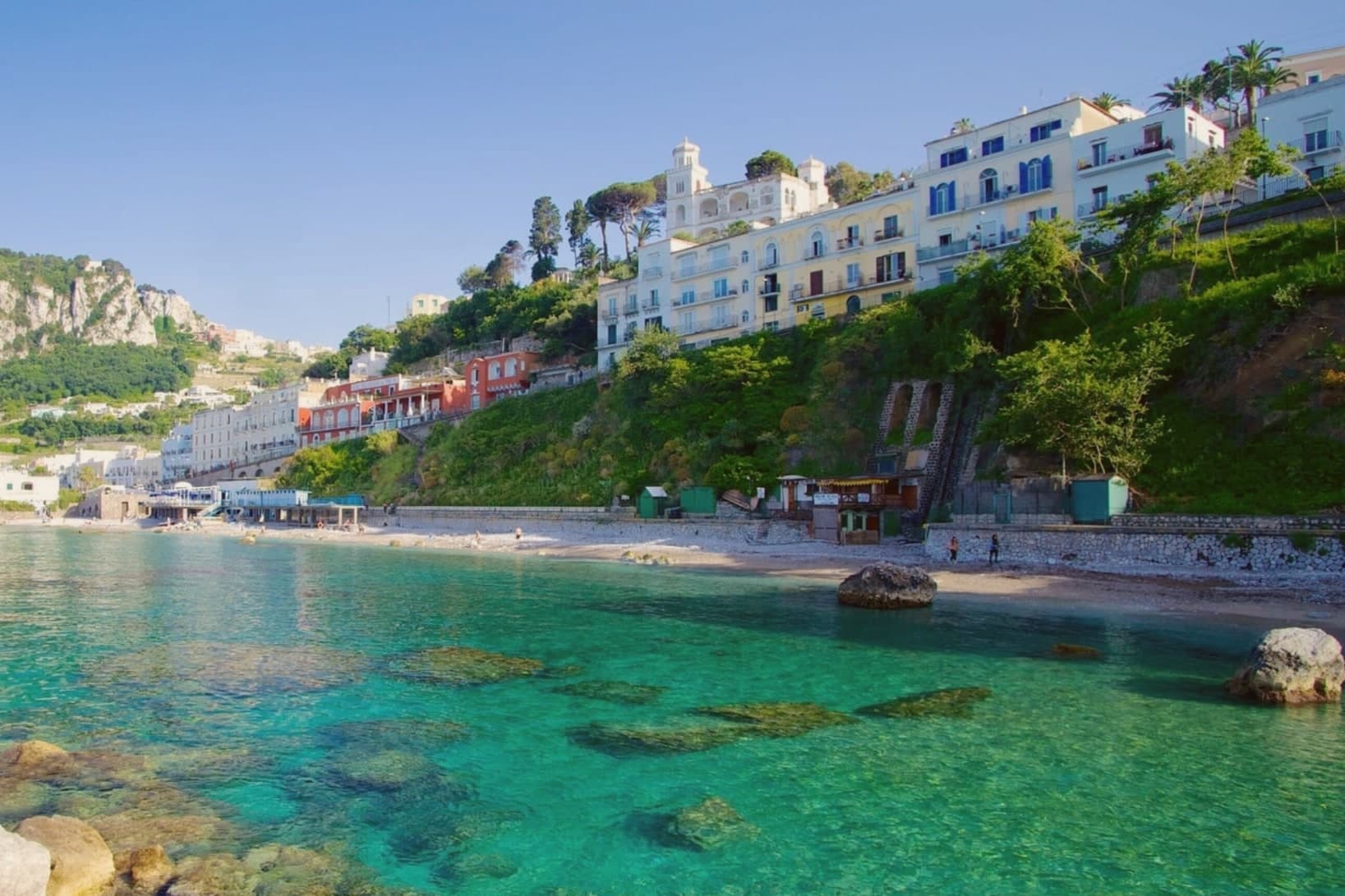
Capri sits at 142 meters above the Marina Grande harbor on the eastern half of the four-square-kilometer island that bears its name, divided between two communes. The town wraps around the Piazzetta, formally Piazza Umberto I, the social center of the island since the funicular replaced the donkey path in 1907.
Tiberius ruled the Roman Empire from here for the last ten years of his life, from twelve villas that Tacitus counted; the ruins of Villa Jovis still stand on the northeastern cape at 334 meters. The Faraglioni, three limestone stacks off the southern coast, rise to 109 meters; the middle one has an arched tunnel through it.
Capri is overwhelmed by day-trippers from June through September. After the last ferry leaves at six in the evening the island returns to its six thousand residents, and the Belvedere of Tragara becomes quiet again.
Le Monzù, Da Tonino, Terrazza Tiberio and 7 more have been named by a guide.
What to see in Capri
- Villa Jovis. Ruins of Tiberius's imperial villa on Monte Tiberio at 334 meters, the largest of his twelve Capri villas, abandoned after AD 37.
- Piazzetta (Piazza Umberto I). Small square at the heart of Capri town, social hub of the island since 1907 when the funicular replaced the donkey path.
- Belvedere di Tragara. Panoramic terrace at the end of Via Tragara, looking down on the three Faraglioni stacks rising from the southern sea.
How to get to Capri
Our tip
May and early June are the best weeks: the gardens are in bloom, the sea is warm enough to swim, and the day-tripper volume hasn't peaked. July and August are saturated with ferry traffic and tour groups; the Piazzetta is unwalkable between ten and four. September and early October return the island to a calmer pace with water still swimmable.
Anacapri
Why visit Anacapri
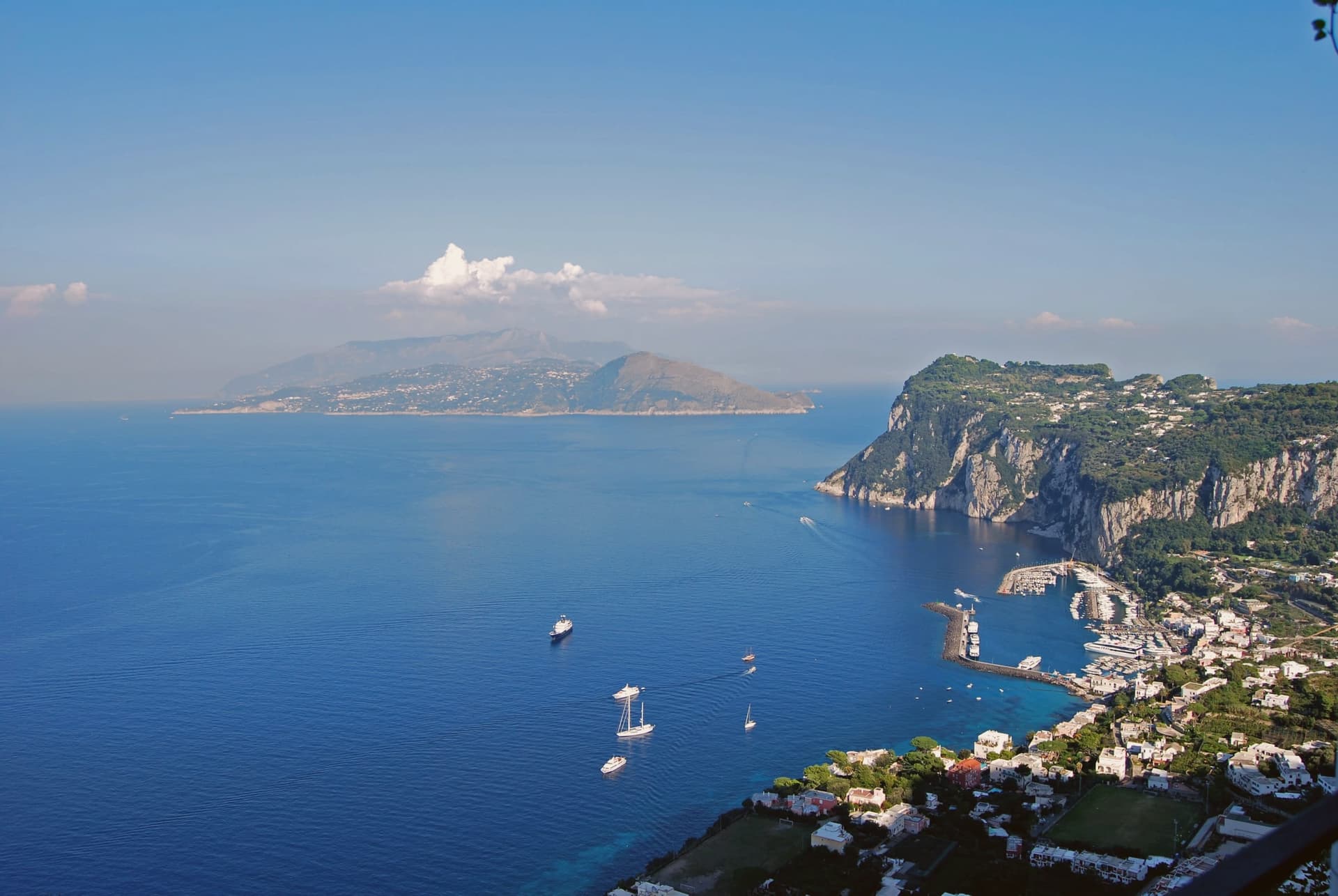
Anacapri occupies the western, higher plateau of Capri, about 150 meters above the harbour town, at 275 meters at the municipal centre and rising to 589 at Monte Solaro. The Ancient Greek prefix ana means up: the name simply says the upper one.
Until 1874 the only link between the two communes was a stairway of some 800 steps, cut by Greek settlers in the seventh or sixth century BC, not by Phoenicians despite what its common name suggests. In 1895 the Swedish physician Axel Munthe began building his villa on the ledge above those steps, on the ruins of one of Tiberius's residences and a tenth-century chapel.
His 1929 memoir turned the place into a literary destination. The two communes of Capri, one at sea level and one on the plateau above, were for centuries connected only by that stair cut into the rock, and a settlement reachable only on foot from its lower twin is a different kind of place than one arrived at by road.
L'Olivo, Da Gelsomina, Il Riccio and 2 more have been named by a guide.
What to see in Anacapri
- Villa San Michele. Neoclassical villa and garden with an antiquities collection and a granite Sphinx set over the harbour, facing east toward Vesuvius.
- Monte Solaro. Reached by a single-seat chairlift from Piazza Vittoria, the summit opens onto views across the whole of Capri.
- Faro di Punta Carena. Second-tallest lighthouse in Italy, built in 1862 and operational since 1867, at the southwestern tip of the island.
How to get to Anacapri
Our tip
May, June, September and the first half of October are the months Anacapri stays usable: blue water at Punta Carena, the Solaro chairlift running, and a degree or two cooler than Capri Marina below. July and August bring the day-trippers off the Naples and Sorrento ferries; the centro of Capri saturates by ten and Anacapri carries the spillover by lunchtime. Villa San Michele books out in advance.
Massa Lubrense
Why visit Massa Lubrense
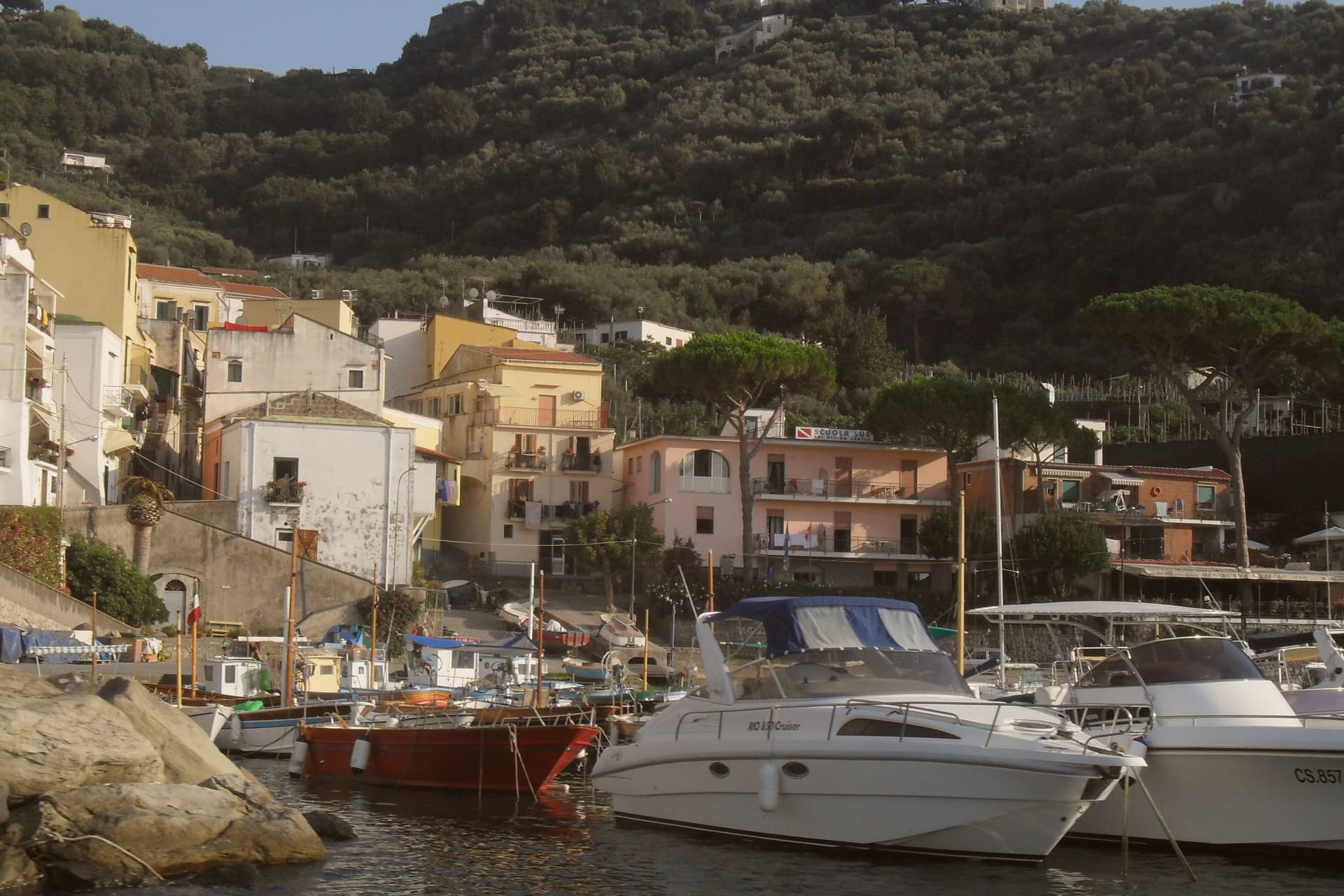
Massa Lubrense holds the western tip of the Sorrentine Peninsula, the largest municipal area on the peninsula and the closest land to Capri, three nautical miles across the Bocche di Capri. The hilltop centro sits at 121 meters; the commune's eighteen frazioni spread between the Tyrrhenian and the Gulf of Salerno, including Termini, Nerano, Sant'Agata sui Due Golfi and the Marina della Lobra.
Punta Campanella, the cape at the end, has the remains of a Roman sanctuary of Athena and a sixteenth-century watchtower against Saracen raids; the surrounding sea is a protected marine area established in 1997. The commune holds a Bandiera Blu, a Spiga Verde, and Città dell'Olio status: the Penisola Sorrentina DOP olive groves climb the hills above the bays.
Spaghetti alla Nerano, courgette and provolone del Monaco, is the dish that came out of these kitchens in the 1950s.
Ristorante Antico Francischiello da Peppino, Quattro Passi, Relais Blu and 6 more have been named by a guide.
What to see in Massa Lubrense
- Punta Campanella. Cape at the western tip of the peninsula, with the ruins of a Roman sanctuary of Athena, a watchtower, and the marine reserve established in 1997.
- Marina del Cantone. Pebble bay at Nerano, Italy's largest pebble beach by some measures and the kitchen where spaghetti alla Nerano was created.
- Chiesa di Santa Maria della Lobra. Sixteenth-century mother church above the small Marina della Lobra, with a wooden coffered ceiling and a former Franciscan convent attached.
How to get to Massa Lubrense
Napoli is roughly 69 minutes away by road.
Our tip
May, June, September and early October are the months Massa Lubrense was built for. The water around Punta Campanella sits above twenty degrees, the marine reserve runs daily boat tours, and the Sentiero degli Dei from Bomerano descends through olive groves in stable weather. July and August are full: the parking at Marina del Cantone closes by mid-morning and the SS145 from Sorrento backs up.
Sorrento
Why visit Sorrento
Sorrento sits on a block of tuff cliff fifty meters above the Bay of Napoli, thirty kilometers from the city by Circumvesuviana railway or ferry. The town began as a Greek foundation and became the Roman Surrentum, a resort favored by senators.
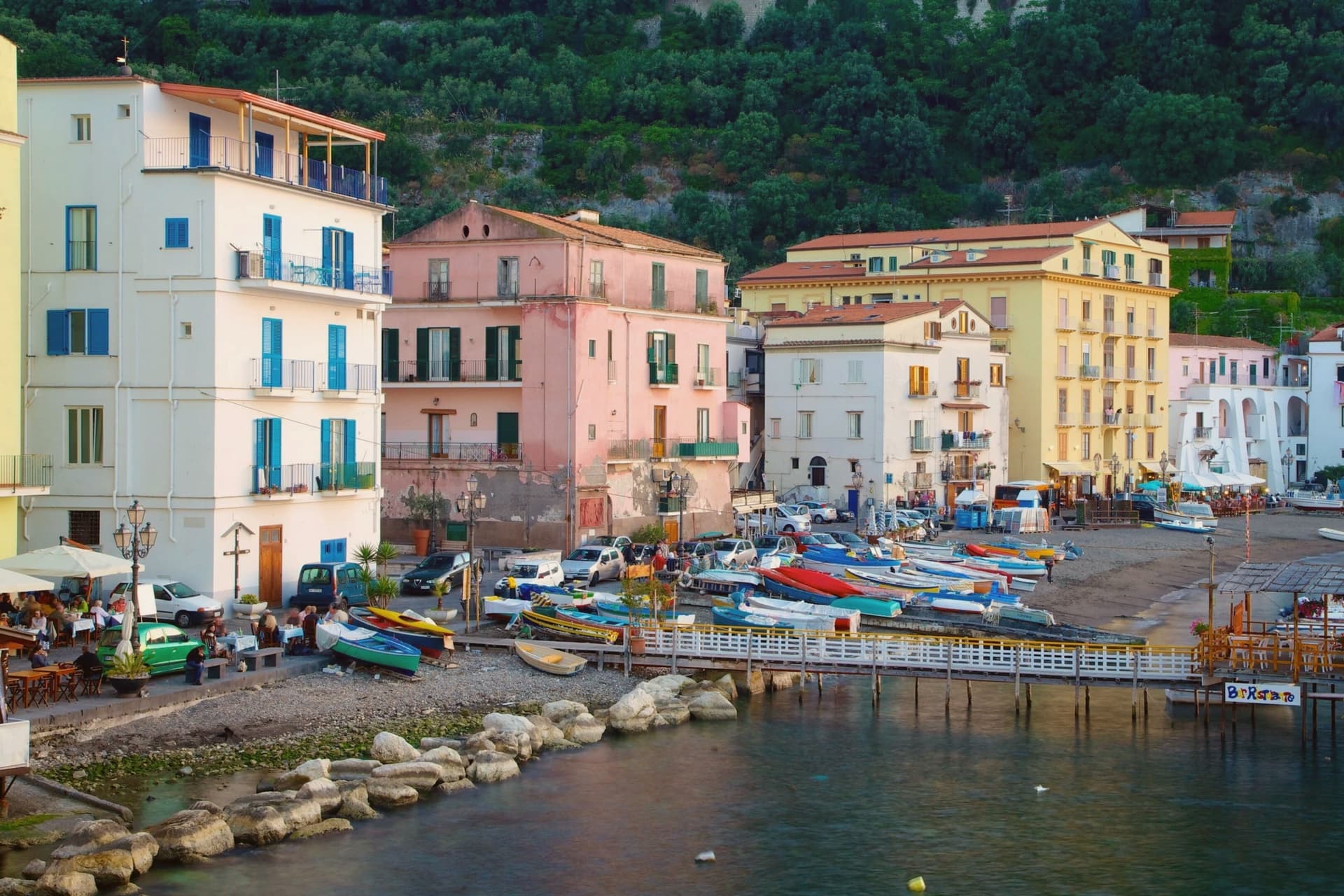
The current population is 15,407. The old town sits above, gathered around the Duomo and the cloister of San Francesco a few minutes apart, while Marina Grande lies below the cliff, reached through the ancient Greek gate, its harbor still working and its trattorie facing the bay.
Terraces of lemon groves ring the slopes above town, the same femminello sorrentino IGP fruit that supplies the limoncello sold through the centro storico. Piazza Tasso, at the head of the old town, is where Corso Italia begins and where the statue of Torquato Tasso stands; the poet was baptized in the cathedral below.
A cliff town facing the bay, its upper streets given to churches and squares, its lower shore to fishing and the harbor, and its surrounding slopes turned over entirely to the lemon that still funds much of what happens in between.
Ristorante O' Canonico 1898, Ristorante O' Parrucchiano, Terrazza Bosquet and 8 more have been named by a guide.
What to see in Sorrento
- Duomo di Sorrento. Eleventh-century cathedral rebuilt in Romanesque style in the fifteenth century, with a baroque interior and the baptistery where Torquato Tasso was christened.
- Chiostro di San Francesco. Fourteenth-century cloister of tuff arches and crossed columns, the marble façade redone in 1926, still used for civic weddings and chamber concerts.
- Museo Correale di Terranova. Decorative arts museum in a seventeenth-century villa opened in 1924, with Neapolitan porcelain, period furniture and seventeenth-century painting.
How to get to Sorrento
There is a railway station in the town, so you can arrive without a car and never need one while you are here. Napoli is roughly 57 minutes away by road.
Our tip
May, June, September and October are the months that work for Sorrento. The sea is warm enough to swim, the temperatures sit in the mid-twenties, and the centro storico is busy without being unworkable. July and August are crowded almost beyond use.
Forio
Why visit Forio
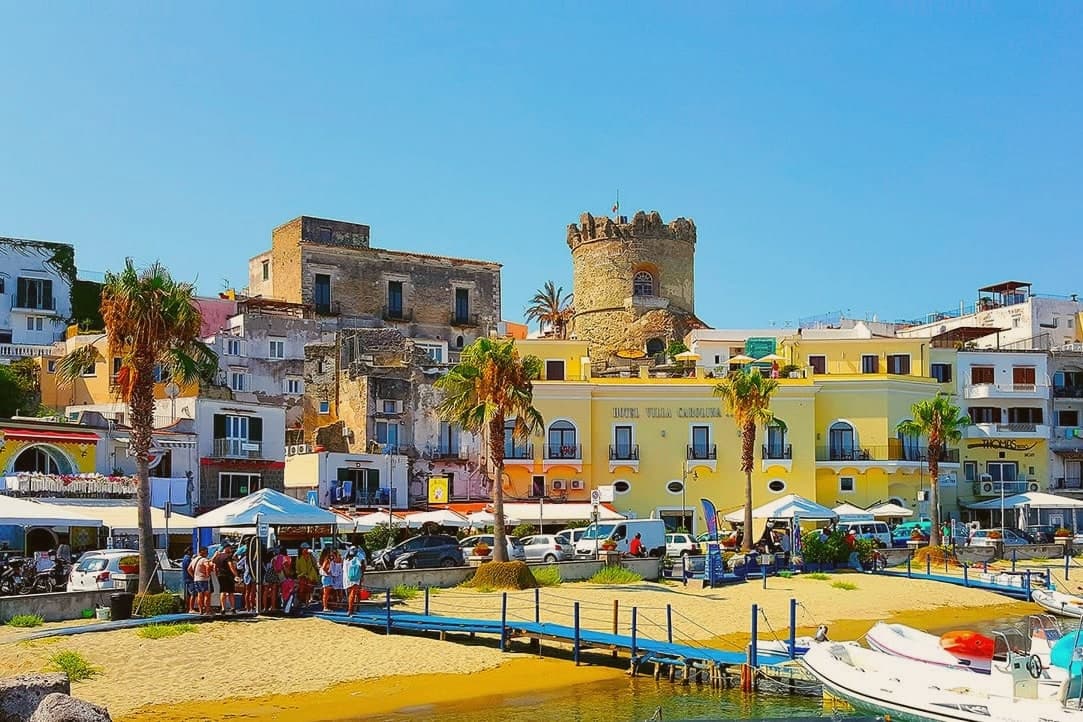
Forio sits at 18 meters on the western coast of Ischia, the largest commune of the island by area and the second by population. Seventeen towers, built between the fifteenth and seventeenth centuries to defend against Saracen raids, are scattered through the town and surrounding countryside, with the largest anchoring the old center and the rest marking the line where the built town gives way to open countryside.
The coast runs from the northern bay below the church of San Francesco di Paola down to the western beaches at Citara, where the volcanic sand faces the only sunset on the island. Inland and above, the hillside terrain that drew a composer to build and plant runs down toward the thermal springs feeding the pools near the shore.
The commune reads as a string of distinct pieces, defensive towers, a promontory church, a garden hillside, a thermal coast, held together less by a single center than by the shared western exposure that lights the water each evening.
Il Saturnino, Il Mirto have been named by a guide.
What to see in Forio
- Chiesa del Soccorso. White walls on a promontory catch the light over the sea, the church mixing Moorish, Byzantine and Mediterranean elements in its rebuilding.
- Il Torrione. Fifteenth-century defensive tower in the centro storico, largest of the seventeen Forio towers, now a small museum and viewpoint.
- Giardini La Mortella. Susana Walton built the garden on the hillside her husband William composed on, terraces of subtropical species climbing the slope above the town.
How to get to Forio
Our tip
May and June are the cleanest weeks: thermal pools open, sea swimmable from late May, La Mortella in spring bloom. July and August are the high tourist months; Forio fills with northern Europeans on package stays at the western hotels, and the Citara springs run at full capacity. September and early October the crowds thin and the water stays warm.
Vico Equense
Why visit Vico Equense
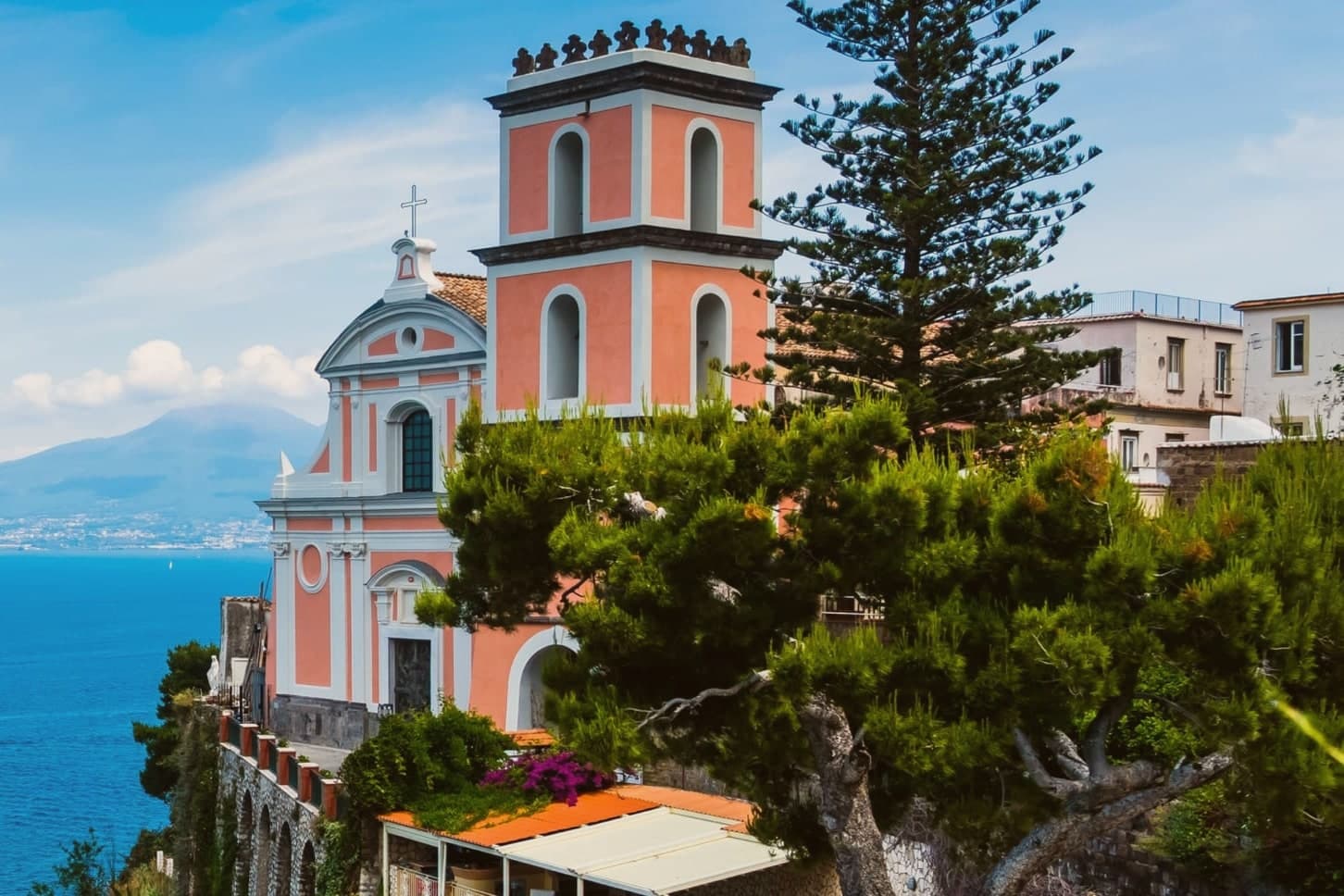
Vico Equense sits on a block of tuff and limestone above the Bay of Napoli, twenty-five kilometers from the city and the first town on the Sorrento peninsula coming from the north. A seventh-century BC pre-Roman necropolis predates the Latin Aequana that Roman patricians built here for their villas, and the finds from that older settlement, funerary objects excavated in the 1960s and 1970s, sit now in a museum founded in 1966.
The medieval town that survives was walled by the Angevins after 1284, when Charles II ordered a fortress built on the cliff as both stronghold and residence, and the diocese's cathedral rose on a neighboring clifftop in the same century, before losing its status as a see in 1818. Behind the town, the limestone mass of the Lattari range closes off the land side, reached since 1952 by cable car from the coast at Castellammare.
Pizza by the meter, the town's best-known export, was invented here by Luigi Dell'Amura, called Gigino, in the 1930s, and his restaurant in the centro still serves it. What holds the town together is the sequence itself: a pre-Roman settlement, a Roman villa town, an Angevin fortress and a bishopric, and finally a twentieth-century dish, each layer built on a narrow shelf of rock between the mountain and the bay.
Torre del Saracino, Antica Osteria Nonna Rosa, Cannavacciuolo Countryside and 8 more have been named by a guide.
What to see in Vico Equense
- Chiesa dell'Annunziata. The church stands at the edge of the cliff, its Gothic interior at odds with the Baroque face it was given later. The old cathedral of a diocese that no longer has a seat here.
- Castello Giusso. Angevin castle built between 1284 and 1289 at the order of Charles II of Anjou, with a Renaissance residential wing and gardens above the bay.
- Antiquarium Silio Italico. Archaeological museum founded in 1966, with funerary objects from a seventh-century BC pre-Roman necropolis excavated in the 1960s and 1970s.
How to get to Vico Equense
There is a railway station in the town, so you can arrive without a car and never need one while you are here. Napoli is roughly 55 minutes away by road.
Our tip
May through September is the working season for Vico Equense. June and September are the best months: warm sea, fewer day-trippers than July and August, and the Monte Faito cable car operating on a full schedule. July and August are crowded and hot at sea level, though the Faito plateau stays cooler at around twenty-two degrees. Sagra del Riavulillo falls in the season.
Pompei
Why visit Pompei
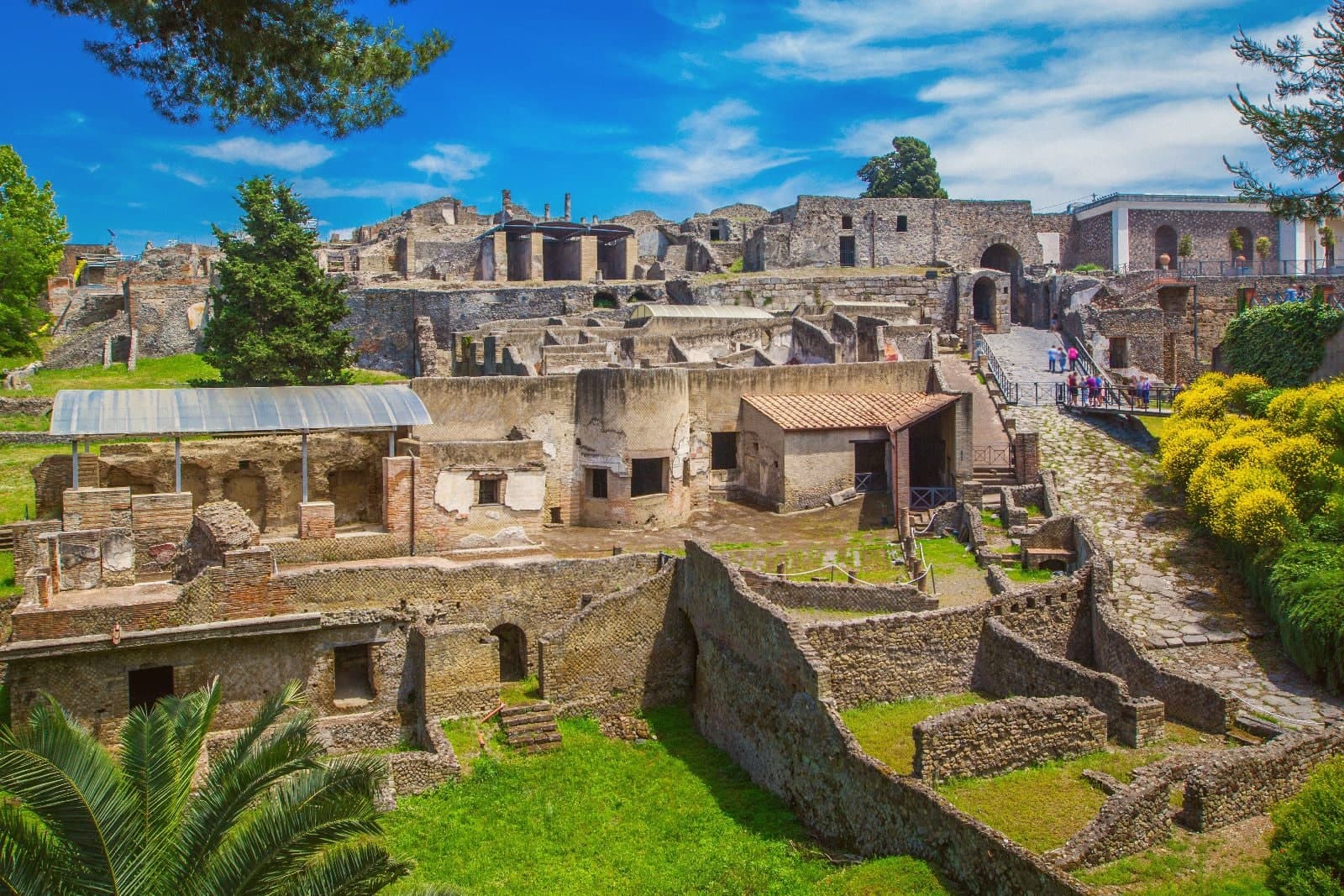
Pompei sits at 30 meters on a volcanic plateau on the south slope of Vesuvius, twenty kilometers from Naples and a hundred meters from where the Sarno meets the sea. The Roman city was buried under five to six meters of ash and lapilli when the volcano erupted on 24 October 79 AD, killing the part of the population that had not already left.
Excavations began in 1748 under the Bourbons and have never stopped; the site has been UNESCO-listed since 1997 alongside Herculaneum and Torre Annunziata, and is the third most visited archaeological site in the world. Modern Pompei was founded in 1881 by the lawyer Bartolo Longo, who built the Santuario della Beata Vergine del Rosario as a center for pilgrimage and social work.
The basilica with its 80-meter campanile and the surrounding grid of streets are entirely a creation of the 1880s, separate from the dig and laid over fields that had been farmland until then.
President, Cosmo Restaurant, Capasanta and 1 more have been named by a guide.
What to see in Pompei
- Parco Archeologico di Pompei. The Roman city buried in 79 AD and excavated since 1748, UNESCO-listed since 1997, with the Forum, the Villa dei Misteri and the Lupanare.
- Santuario della Beata Vergine del Rosario. Pontifical basilica built between 1876 and 1891 by the lawyer Bartolo Longo, the heart of modern Pompei and a pilgrimage site of four million a year.
- Casa del Fauno. Roman patrician house in the dig with a bronze faun at its center and the Alexander Mosaic floor depicting Issus, now in the Naples museum.
How to get to Pompei
There is a railway station in the town, so you can arrive without a car and never need one while you are here. Napoli is roughly 24 minutes away by road.
Our tip
May, June, September and early October are the strongest months for Pompei. The dig opens at nine and the Forum stays walkable before midday heat sets in. July and August are punishing: the site sits on volcanic plateau at thirty meters with no shade in the main streets, and afternoon temperatures cross thirty-five degrees.
Bacoli
Why visit Bacoli
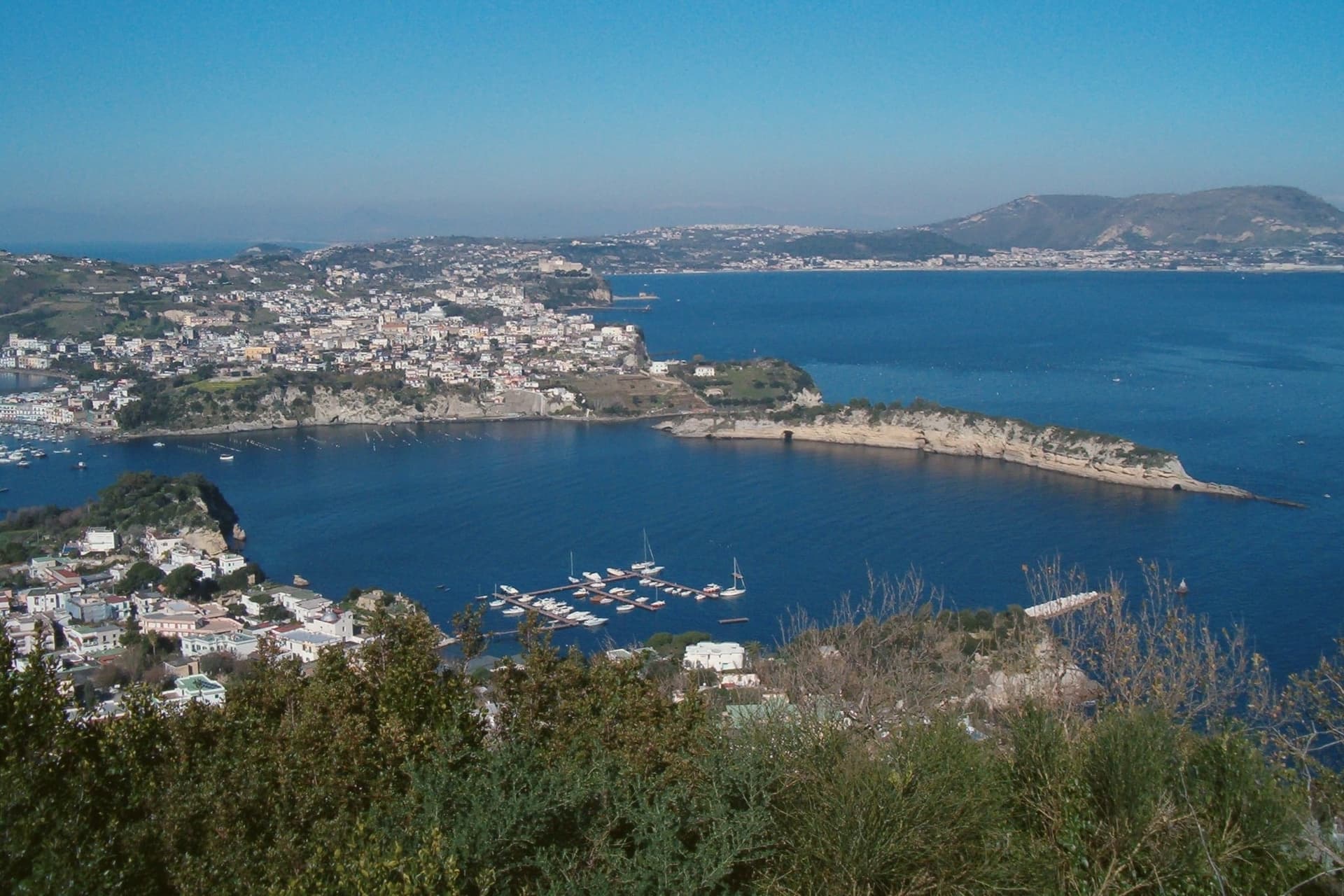
Bacoli sits at thirty meters on the western lobe of the Campi Flegrei, looking onto Lake Miseno and its headland across the Bay of Pozzuoli. The Romans called it Bauli.
In the late Republic and early Empire it was a resort lined with the villas of senators and emperors, and the fleet base nearby, the Classis Misenensis, was the largest in the Mediterranean. Most of that infrastructure is still here, scattered through the residential blocks that now fill the town, so that a cistern or a cistern complex turns up between apartment buildings rather than in an isolated park.
The town's two promontories divide its Roman past between them: the harbor side toward Miseno, where the fleet and its water supply were based, and the Baia side, where the villas and the later Aragonese castle stand. Bacoli is also an active geothermal zone, and bradyseism, the slow rise and fall of the Campi Flegrei coastline, is still measurable here, the same force that put the Roman villas at Baia underwater.
What survives above ground and what has sunk below the sea are the same story of ground that will not stay still.
Caracol, Riccio Restaurant, Aguglia osteria di mare 2021 and 2 more have been named by a guide.
What to see in Bacoli
- Piscina Mirabilis. Forty-eight cross-shaped pillars hold up the roof in rows, the scale meant to be walked through rather than read about, still standing among the residential blocks that have grown up around it.
- Cento Camerelle. Second cistern complex four hundred meters from the Piscina Mirabilis, on two superimposed levels, locally called the Prisons of Nero.
- Castello Aragonese di Baia. Late-fifteenth-century Aragonese fortress on the Baia promontory, since 1993 the seat of the Museo Archeologico dei Campi Flegrei.
How to get to Bacoli
There is a railway station in the town, so you can arrive without a car and never need one while you are here. Napoli is roughly 31 minutes away by road.
Our tip
May through September is the season for Bacoli. The Bay of Pozzuoli warms by late spring, and the underwater archaeological park at Baia runs glass-bottom and snorkel tours through the summer. July and August are hot and crowded, with day-trippers from Napoli and Ischia ferries crossing constantly; the open ruins like the Piscina Mirabilis are worth visiting early in the day.
Nola
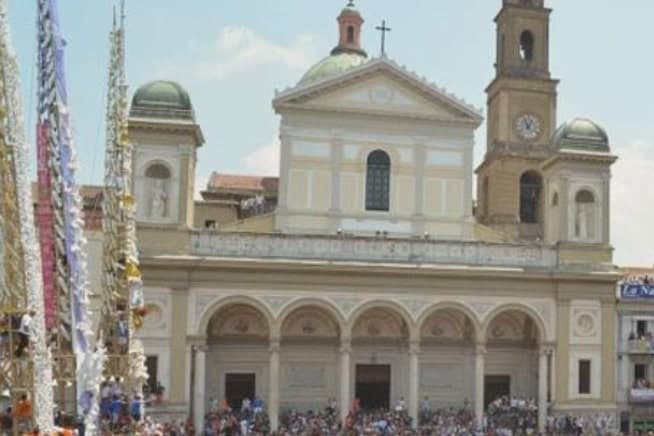
Why visit Nola
Nola sits at 34 meters on the plain between Vesuvius and the Apennines, twenty kilometers east of Napoli. It was an Oscan and Samnite town before Rome, and the place where Augustus died in AD 14, in the same house his father had died in.
Giordano Bruno was born here in 1548, the Nolano who called his philosophy nolana before he was burned at the Campo de' Fiori in 1600. The town is best known today for the Festa dei Gigli, a UNESCO Intangible Heritage celebration on the Sunday before June 22 in which eight twenty-five-meter wooden obelisks, each weighing over a ton, are carried through the streets by teams of one hundred bearers.
The festival honors Paolino di Nola, the fifth-century bishop whose return from captivity in North Africa it commemorates. Outside the festival, Nola is a working town of warehouses and commerce.
Re Santi e Leoni, Le Baccanti, Rear Restaurant and 2 more have been named by a guide.
What to see in Nola
- Cattedrale di Nola. Cathedral of the Assunta and San Paolino, twentieth-century rebuilt after fire, with relics of the patron bishop who returned from Africa.
- Festa dei Gigli. UNESCO Intangible Heritage festival in June: eight 25-meter wooden obelisks carried through the streets by teams of one hundred bearers.
- Anfiteatro Romano di Nola. Roman amphitheater excavated on the southern edge of town, where Augustus was honored with funeral games in AD 14.
How to get to Nola
There is a railway station in the town, so you can arrive without a car and never need one while you are here. Napoli is roughly 28 minutes away by road.
Our tip
April through June covers the green months and culminates in the Festa dei Gigli on the Sunday before June 22, the one weekend when Nola fills with hundreds of thousands of visitors. September and October are warm and quieter, with the wine and hazelnut harvests in nearby Irpinia bringing activity to the markets. July and August are hot and humid on the plain.
More from Anywhere Italy
 The best towns with a serious restaurant that eat well within 90 minutes of Napoli
- The best towns worth staying overnight in the province of Napoli
 The best towns with a serious restaurant that you can reach by train in Campania
 The 9 best towns you can reach by train in the province of Napoli
- The best towns inside a nature park that eat well in the province of Napoli
- The 6 best beach towns with a serious restaurant in Campania