
The best towns with a serious restaurant in the province of Grosseto
The Maremma eats differently from the rest of Tuscany. This is cattle country and boar country, with butteri still working the flats, and the food follows: acquacotta thickened with bread and egg, tortelli maremmani, eel and mullet from the Orbetello lagoon, tomatoes and artichokes off the sandy coastal plain, Morellino di Scansano in the glass. Inland the villages are cut from tufa, honey-coloured and soft, and the streets run between walls the Etruscans started; on the coast the buildings are lime-washed and low behind the pines. Autumn is the best of it, when the boar hunt opens and the new oil comes down from the mills above Manciano.
Most people looking for a proper meal in Tuscany still head for Chianti, where the roads between Greve and Radda are lined with restaurants that have been fully booked since spring and priced accordingly. It is good cooking, mostly, but it is cooking that knows exactly how famous it is. The tables turn twice, the wine list is longer than the menu, and the villages outside are given over almost entirely to the business of feeding visitors.
The same standard of kitchen continues south, past Siena and down into the province of Grosseto, where fewer people go and the dining rooms are smaller. The towns here hold restaurants that the most demanding of the guides has judged worth the drive, in hill towns above the Fiora and in ports on the Argentario, and the ingredients come from within sight of the door.
Of the 10 communes we have mapped in the province of Grosseto, 7 qualify as towns with a serious restaurant: each holds a restaurant listed by the most demanding of the dining guides. The smallest, Pitigliano, has 3,586 residents.
Two more lists worth reading alongside this one: The best coastal towns in the province of Grosseto and The best hidden towns with a food festival that have a serious restaurant in Toscana.
Pitigliano
Why visit Pitigliano
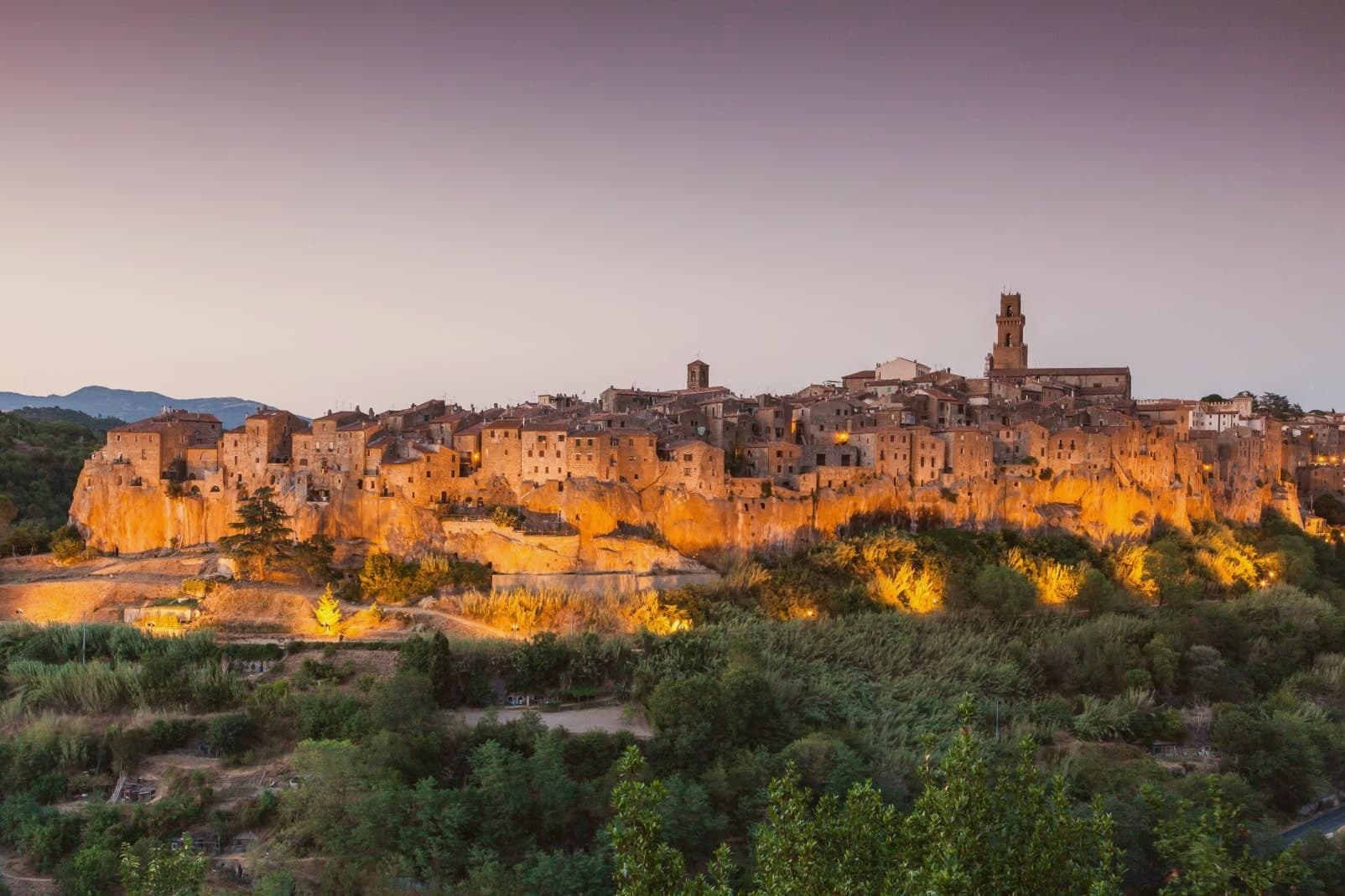
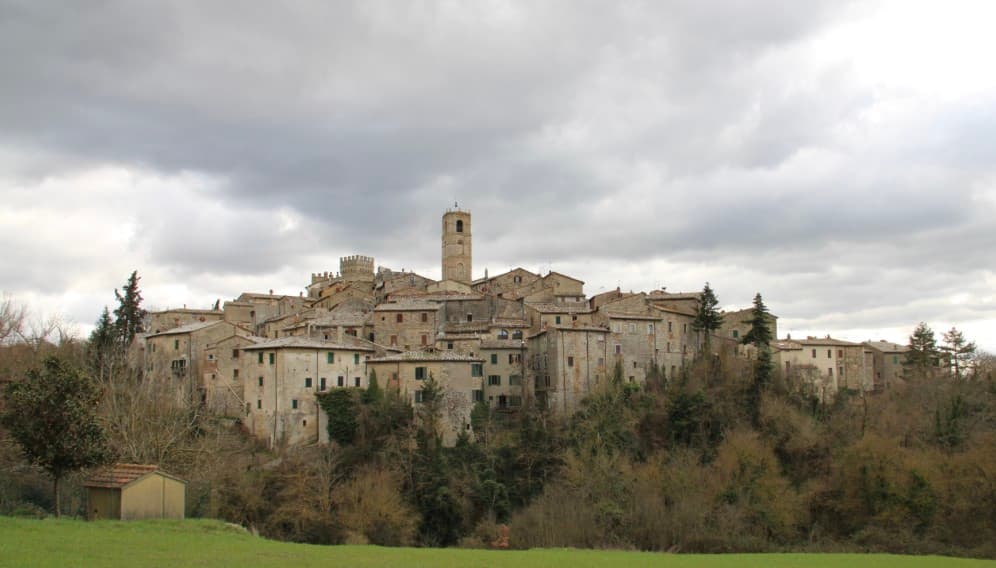
Pitigliano sits at 313 meters on a tuff spur in the southern Maremma, eighty kilometers southeast of Grosseto and close to the Lazio border. The town is built into the rock it stands on: cellars, stables and synagogue all carved into the same volcanic tuff that the houses rise from above.
The county passed to the Orsini family in 1293 and stayed Orsini for 150 years of wars with Siena. In 1556 Niccolò IV Orsini gave land for a Jewish cemetery to his physician David de Pomis; the synagogue followed in 1598.
When Pitigliano was absorbed into the Grand Duchy of Tuscany in 1608, the Medici imposed a ghetto in 1622 around the synagogue, on the cliff edge. The nickname Little Jerusalem comes from there.
The Etruscan tagliate, channels cut into the tuff at depths from one to over ten meters, were carved long before any of that, and remain in use as paths and roads. The DOC Bianco di Pitigliano, a Trebbiano blend, is grown on the surrounding slopes.
Il Tufo Allegro, Angiolina, Il Caveau and 1 more have been named by a guide.
What to see in Pitigliano
- Palazzo Orsini. Twelfth-century fortress remodeled by Antonio da Sangallo the Younger in the sixteenth century, now housing the Museo Civico Archeologico and the Diocesan Museum.
- Sinagoga di Pitigliano. Synagogue built in 1598, restored after partial collapse, the heart of the Jewish quarter that gave the town its Little Jerusalem nickname.
- Quartiere Ebraico. The ghetto established in 1622 around the synagogue, with the kosher bakery, mikveh, oven and wine cellar carved into the tuff.
How to get to Pitigliano
Terni is roughly 107 minutes away by road.
Our tip
April through June and September into October are the dry months in the southern Maremma: vine work, mild days, evening light that hits the tuff cliff at low angle. July and August push into the mid-thirties and the rock holds the heat; the centro storico empties between four and seven. The Sagra dello Sfratto, celebrating the Jewish honey-and-walnut pastry, runs in September.
Massa Marittima
Why visit Massa Marittima
Massa Marittima sits on an isolated hill in the Colline Metallifere, the Tuscan hills that supplied copper and silver from Etruscan times. Despite the name, the sea is roughly twenty kilometers away.
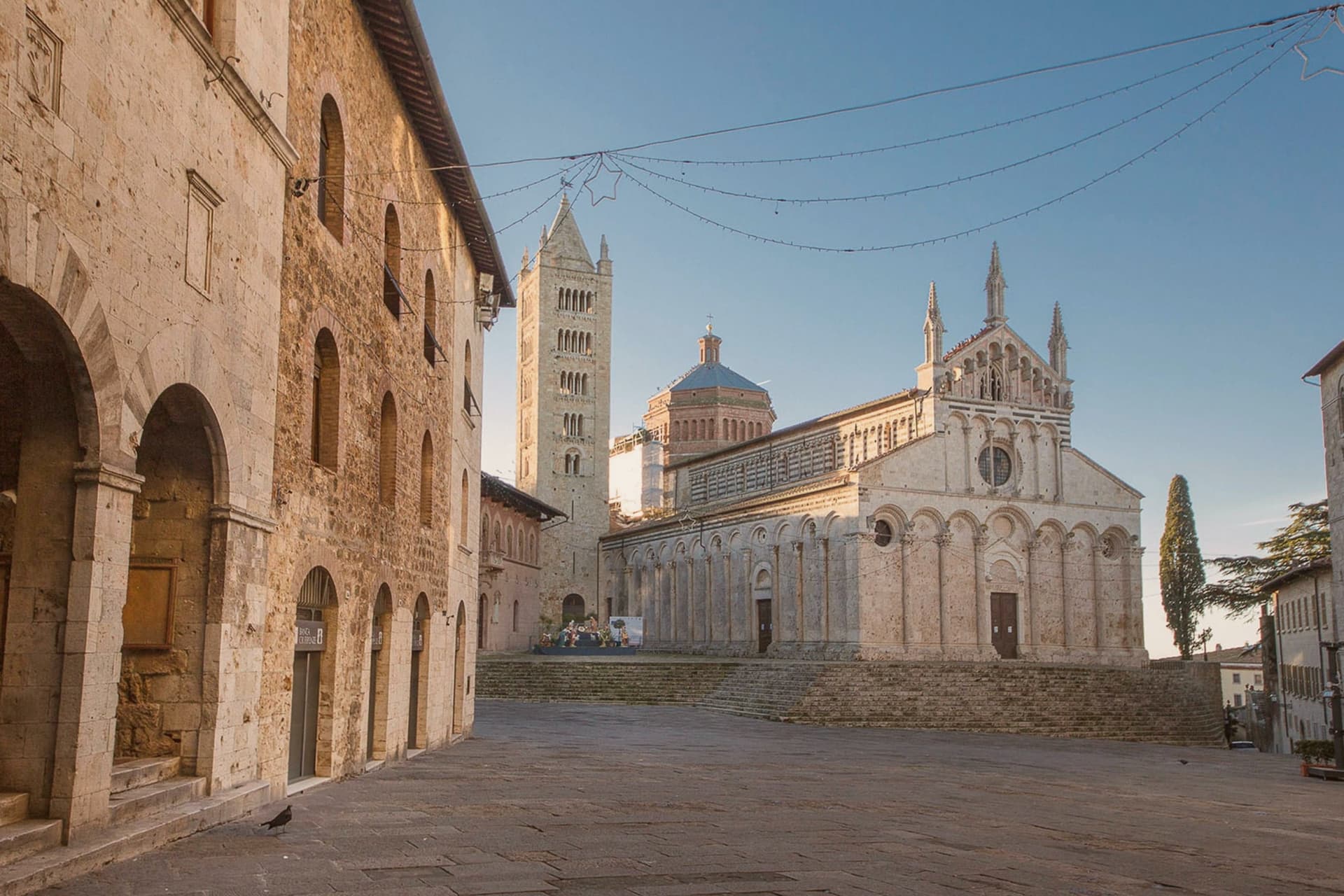
The town's wealth as a free commune was built on that ore, and the buildings on Piazza Garibaldi still date from the century of its independence: the cathedral, the communal palace, the Palazzo Comunale, all raised while the mines were active. The old center keeps a medieval grid, with the Città Nuova rising above it and the watchtower marking the join between the two.
Mining gave way to tourism after the seams ran out, but the layout never had to be redrawn for cars or commerce: what stands today is largely what stood when the terzieri divided the town for its crossbow contest. The hill, the ore beneath it and the thirteenth-century square form one continuous fact: the town's shape was set by what it dug out of the ground, and its history stopped adding new layers once the ground stopped paying.
Bracali have been named by a guide.
What to see in Massa Marittima
- Duomo di San Cerbone. Pisan Romanesque cathedral on Piazza Garibaldi, its facade rising in tiers above the square. The Arca inside holds the saint's remains beneath carved marble figures.
- Fonti dell'Abbondanza. The vaulted fountain building where the fresco survives on the interior wall, plaster and pigment exposed after centuries hidden under whitewash.
- Palazzo del Podestà. Communal palace on Piazza Garibaldi, now housing the Museo Archeologico, with the Maestà by Ambrogio Lorenzetti among its rooms.
How to get to Massa Marittima
There is a railway station in the town, so you can arrive without a car and never need one while you are here. Livorno is roughly 95 minutes away by road.
Our tip
April through June and September into October are the months Massa Marittima opens up. The Balestro del Girifalco runs on the fourth Sunday of May and again on the second Sunday of August, and the town fills with archers in costume from the three terzieri. July and August are hot inland and the centro storico thins in the afternoon; the Tyrrhenian beaches at Follonica are half an hour away by car. Balestro del Girifalco di Agosto a Massa Marittima falls in August.
Manciano
Why visit Manciano
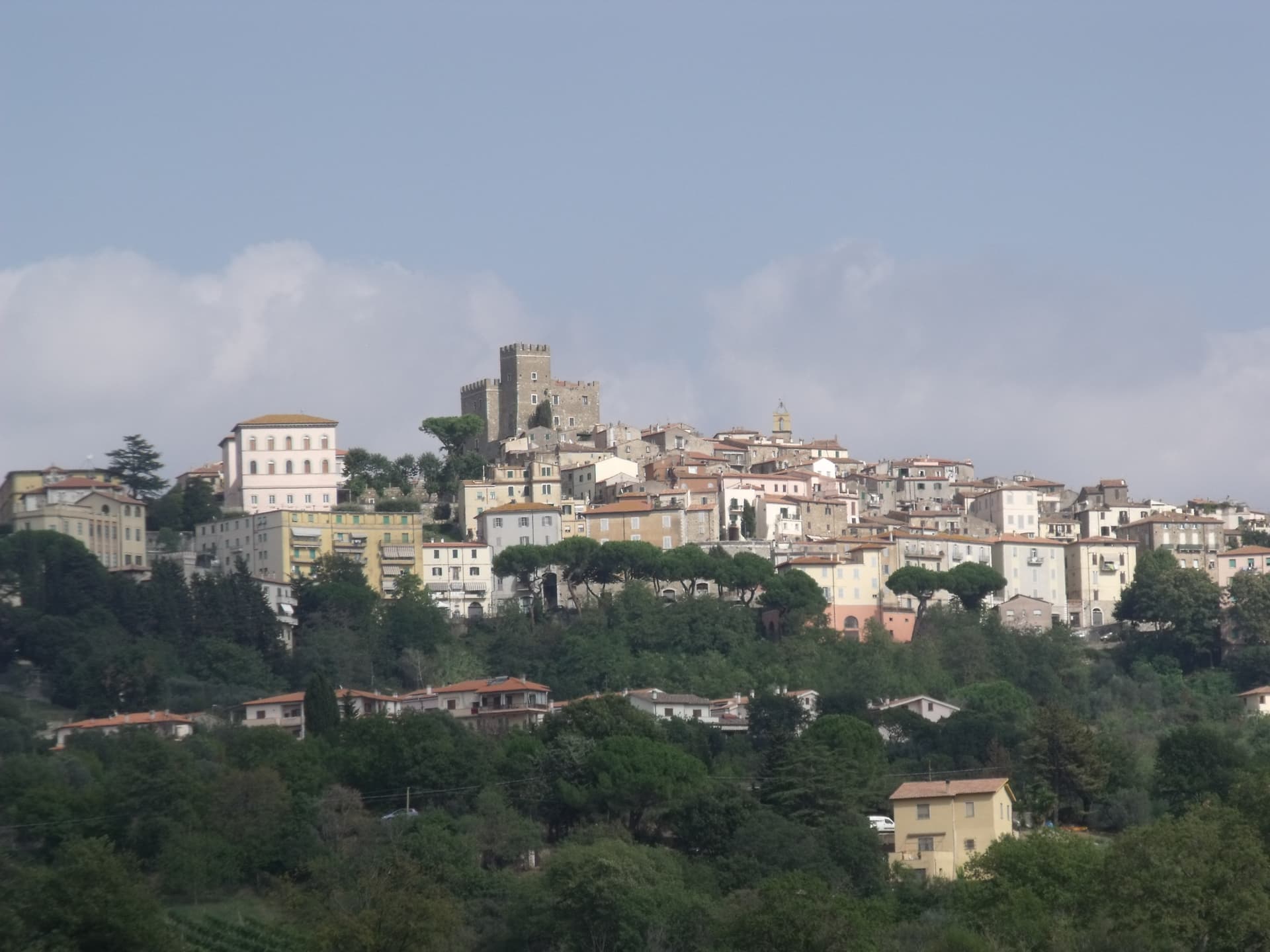
Manciano sits at 444 meters on a hill in the southern Maremma grossetana, with a 360-degree view that runs from Monte Amiata north to the Tyrrhenian coast. The Aldobrandeschi held the original stronghold from the twelfth century.
Siena occupied the town between 1419 and 1455 and built the Rocca that still dominates the centro storico, a square keep with battlements on a shoe-base. After 1455 it returned to local rule and passed eventually to the Medici Grand Duchy.
The comune is large by Toscana standards and includes some of the best-known places of the southern Maremma: Saturnia, the Etruscan town built around its sulphurous hot springs, and Montemerano, a small walled borgo on the road to the Lago di Bolsena. The Albegna and Fiora valleys, which the town once served as a regional market, still meet at its foot.
Wine, olive oil and wild boar work the territory in roughly the order they sit on a Maremmano menu.
Caino, I Due Cippi dal 1976, La Filanda and 1 more have been named by a guide.
What to see in Manciano
- Rocca Aldobrandesca. Sienese fortress of 1424 on Aldobrandeschi foundations, square keep, walls with battlements and a solid shoe-base, dominating the centro storico.
- Saturnia. Etruscan town and frazione south of Manciano, with medieval walls, remains of a Roman road and the sulphurous hot springs used since antiquity.
- Montemerano. Small walled borgo east of Manciano, three concentric circles of streets and a fifteenth-century Madonna della Gattaiola in the parish church.
How to get to Manciano
Terni is roughly 132 minutes away by road.
Our tip
April through June and September into October are the months Manciano shows the southern Maremma at its best, the territory dry but green, the Saturnia pools warm against cool mornings. The Sagra dell'Anatra runs in mid-August. July and August are hot at 444 meters but easier than the coast; afternoons in the centro storico empty between two and six. Palio delle Botti di Manciano falls in August.
Castiglione della Pescaia
Why visit Castiglione della Pescaia
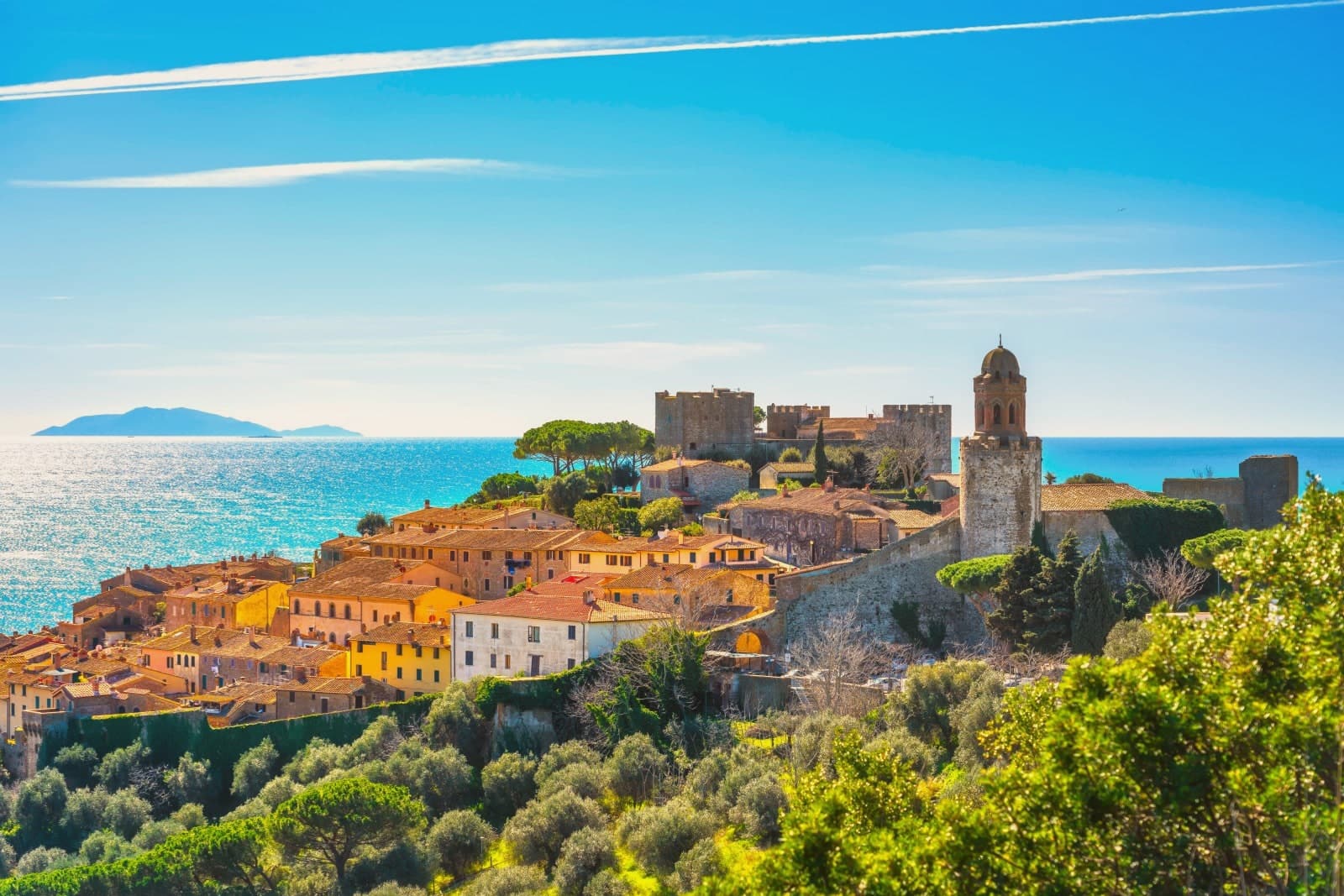
Castiglione della Pescaia sits at sea level on the Maremma coast, north of Grosseto, with a medieval upper town rising on the promontory above the harbor. The site was Roman Salebrone, before that Etruscan and Umbrian, settled because of the lake behind it that the Romans called Portus Traianus.
The lake silted up over time; what remains of it is the wetland reserve southeast of town, a Ramsar site since 1991. The upper town and the harbor below it read as two halves of one settlement: the fortress watching the water from above, the working port beneath, and behind both the flat reclaimed ground where the lake used to be.
Inland and to the east, the hills hold the remains of one of the major Etruscan cities, apart from the coastal life below. North of town, the pine forest gave Calvino his summers and now holds his grave on the hill above the harbor.
The place is built in layers: a silted lake turned nature reserve, a watchtower turned fortress, an Etruscan hill city, and a modern coastline still shaped by all of it.
La Trattoria Enrico Bartolini, Osteria del Mare già il Votapentole, Clann and 1 more have been named by a guide.
What to see in Castiglione della Pescaia
- Rocca Aragonese. Castle on the promontory above the harbor, 10th-century watchtower core enlarged by Alfonso of Aragon in the 15th century, modified by Cosimo I and the Lorraine.
- Riserva Naturale Diaccia Botrona. Wetland reserve southeast of town with bird-watching hides, pink flamingos and white herons in season.
- Casa Rossa Ximenes. Hydraulic structure built by Jesuit engineer Leonardo Ximenes for the Lorraine drainage works; now multimedia museum of the wetland reserve.
How to get to Castiglione della Pescaia
Livorno is roughly 113 minutes away by road.
✷ We have written about Castiglione della Pescaia
“Everyone driving from Florence down to Rome crosses the Maremma without noticing, because there is nothing on that stretch to make them slow down. The hills give out. The cypresses stop. What opens up instead is flat open country, wheat and grass running off to a few low rises, the least Tuscan-looking part of Tuscany, a landscape you would call dull if you were being honest and which most guidebooks solve by leaving out.”
Read our piece on Castiglione della Pescaia →Maremma | The Last Cowboys of Tuscany
Our tip
May and June bring warm sea and quiet beaches, before the high-summer crowds arrive from Rome and Florence. June through September holds the Bandiera Blu and the Diaccia Botrona stays accessible in the cooler hours. July and August push the coast above thirty; Punta Ala and the harbor fill, and the Rocca above the old town becomes a sunset destination. Palio Marinaro di Castiglione della Pescaia falls in August.
Monte Argentario
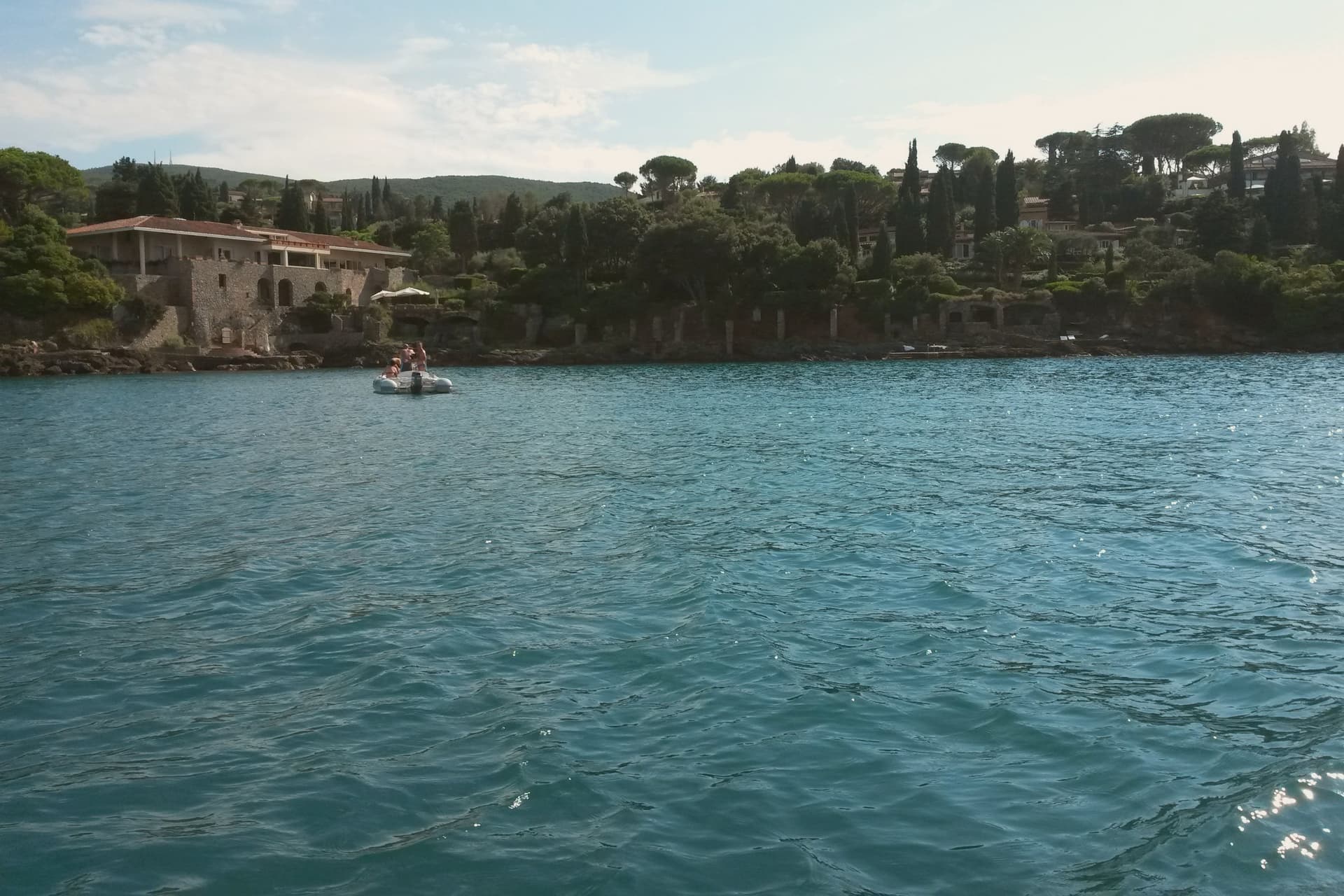
Why visit Monte Argentario
Monte Argentario is a peninsula on the southern Tuscan coast, 35 kilometers south of Grosseto, connected to the mainland by three sand spits that enclose the lagoons of Orbetello. The mountain at its center rises to 635 meters, and the two seats of the comune sit at sea level on opposite sides of it, the northern harbor facing toward Grosseto, the southern one turned toward the open coast below.
The history of the peninsula splits from the rest of Tuscany after 1557, when the territory was carved out of Sienese land and handed to the Spanish crown, which spent the next century and a half fortifying the coastline against corsair raids rather than building the kind of inland towns found elsewhere in the region. The result is a place organized around its edges rather than a center: two ports facing different waters, a mountain of forts between them, and a coastal road that ties the whole shape together for anyone crossing from one harbor to the other.
What the peninsula adds up to is a piece of Tuscany that spent its formative centuries as a Spanish military frontier, and still wears that history in its two-harbor shape and the ring of stone above them.
Il Pellicano, Alicina sul porto, Ristorante Dama Dama and 1 more have been named by a guide.
What to see in Monte Argentario
- Forte Stella. Six-pointed star fort above Porto Ercole, designed for the Spanish by Buontalenti and Camerini and completed in the mid-1600s as part of the Presidi defense system.
- Forte Filippo. Spanish bastioned fortress above Porto Ercole, named for Philip II and built in the late 16th century to protect the Stato dei Presidi from corsair raids.
- Rocca Aldobrandesca, Porto Ercole. Earlier Aldobrandeschi fortress incorporated into the Spanish defense system, dominating the harbor and the old town of Porto Ercole.
How to get to Monte Argentario
There is a railway station in the town, so you can arrive without a car and never need one while you are here. Roma is roughly 137 minutes away by road.
Our tip
May through September is the season on the peninsula. Porto Santo Stefano and Porto Ercole fill in July and August; the Palio Marinaro on August 15 doubles the population of Porto Santo Stefano for a single afternoon. June and September are the easiest months, with warm water and fewer day-trippers. Palio Marinaro dell'Argentario falls in August.
Orbetello
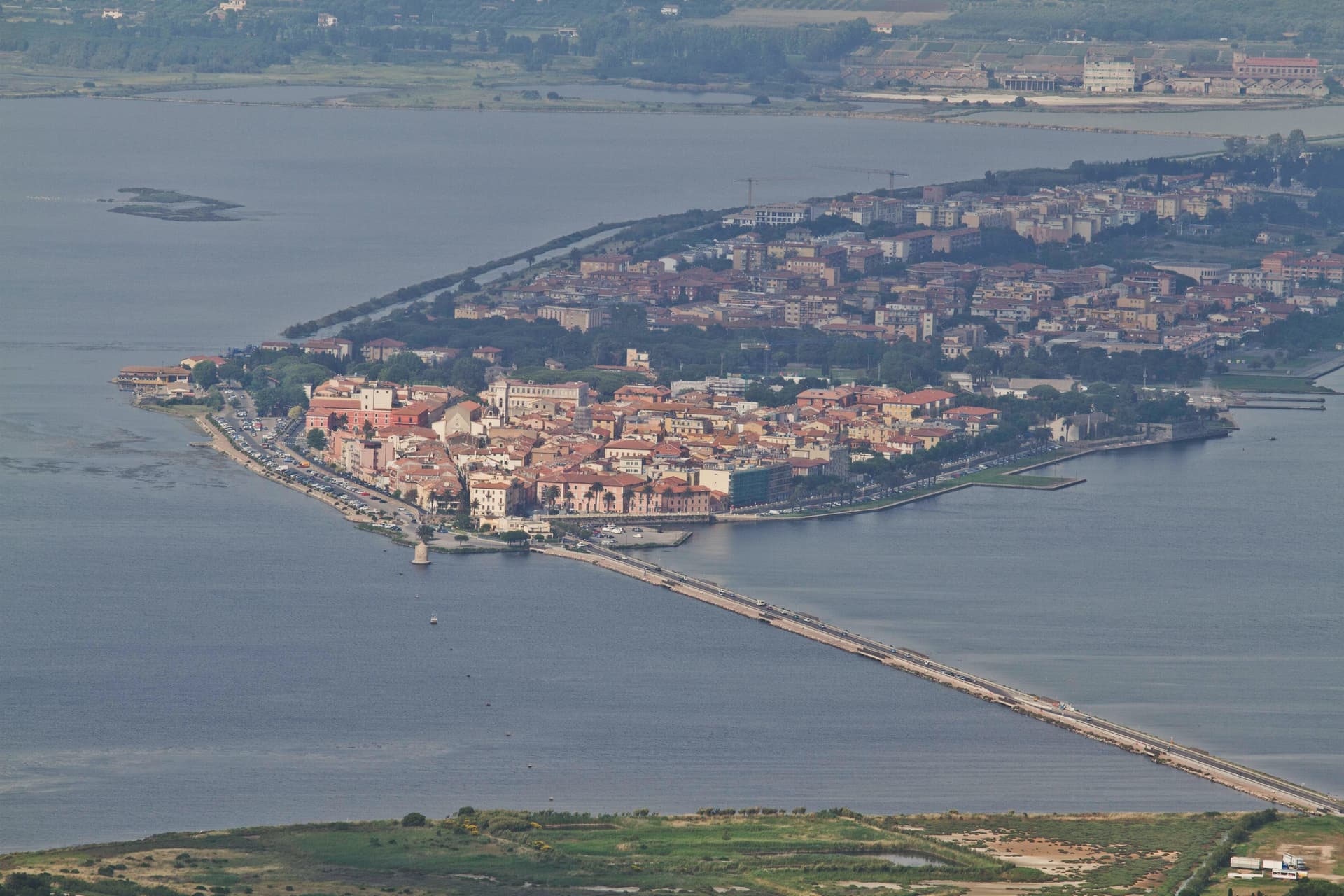
Why visit Orbetello
The isthmus runs out into the lagoon and splits it into two basins, Ponente and Levante. Two sand tombolos close the shape from either side: Giannella to the north, Feniglia to the south, both reaching toward the Monte Argentario promontory and meeting it at either end.
The Etruscans settled the site first, the Romans followed with their colony of Cosa nearby, and centuries later the Spanish took the isthmus as the seat of their coastal enclave, leaving the Governor's Palace on the main square where it still stands. Of the nine Sienese windmills once built out in the water, one remains in place, the only Italian water-and-wind mill of its type still fixed where it was built.
The lagoon that once carried Balbo's flying boats out toward Rio and Chicago now carries a WWF reserve and the nets of a bottarga and eel cooperative working the same waters since 1965. A town built on the water it is named for, held between two arms of sand and one mountain it never quite touches.
L'Oste Dispensa, Osteria Bolle have been named by a guide.
What to see in Orbetello
- Duomo di Santa Maria Assunta. Fourteenth-century cathedral with a Gothic travertine façade, rebuilt over an earlier Etruscan-Roman temple foundation.
- Fortificazioni Spagnole. The bastions and the Polveriera Guzman magazine, still standing along the edges of the historic center.
- Laguna di Orbetello. The brackish water splits into two basins and is now a WWF reserve and Ramsar wetland.
How to get to Orbetello
There is a railway station in the town, so you can arrive without a car and never need one while you are here. Roma is roughly 124 minutes away by road.
Our tip
May through September is when the lagoon and the Feniglia and Giannella beaches do their work. June brings the migratory bird count back up: flamingos, herons, avocets. July and August push temperatures over thirty degrees and the tombolos fill with Roman day-trippers, so the lagoon path on the Ponente side stays the quieter option. Sagra del Pesce di Albinia falls in the season.
Grosseto
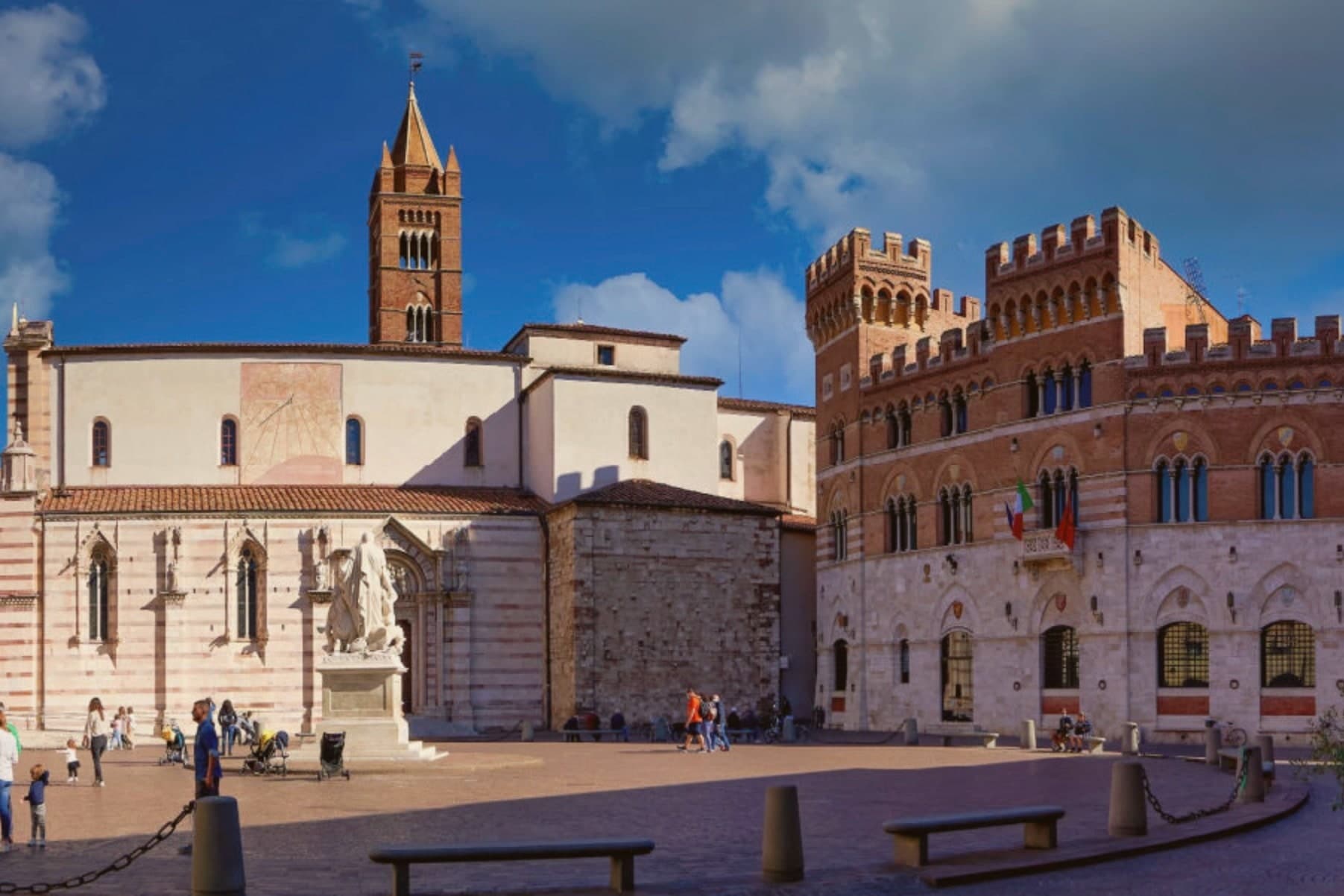
Why visit Grosseto
Grosseto sits on the right bank of the Ombrone, ten meters above sea level and twelve kilometers inland from the Tyrrhenian. The Roman city of Roselle was destroyed in 935 by Saracen pirates; refugees regrouped on the plain below and Grosseto inherited the bishopric.
From 1336 it was Sienese; in 1559 it passed to the Medici after the battle of Montalcino. Cosimo I commissioned Baldassarre Lanci to replace the medieval walls with a hexagonal bastioned circuit, begun in 1565 and finished a decade later.
The walls are intact. Six bastions, two main gates, a continuous earthwork four kilometers around, now planted and used as the city's promenade.
Inside, the Duomo di San Lorenzo holds a Romanesque-Gothic façade in alternating white and pink marble. The Cassero Senese, the Sienese fortress of 1345 swallowed into the later Medici walls, anchors the southeast corner.
Grosseto is the largest city of southern Toscana and the working capital of the Maremma.
L'Uva e il Malto, Canapone, Oste Scuro and 1 more have been named by a guide.
What to see in Grosseto
- Mura Medicee. Hexagonal bastioned circuit commissioned by Cosimo I in 1564, designed by Baldassarre Lanci, intact and walkable for the full four kilometers.
- Duomo di San Lorenzo. Thirteenth-century cathedral with a façade in alternating white and pink marble, Latin-cross plan, semicircular apse over the nave.
- Cassero Senese. Travertine-clad Sienese fortress completed in 1345, incorporated into the southeast corner of the Medici walls, now used for exhibitions.
How to get to Grosseto
There is a railway station in the town, so you can arrive without a car and never need one while you are here. Livorno is roughly 110 minutes away by road.
Our tip
May, September and October are the Maremma months. The walls and the Parco Regionale are open without the heat, the umbrella pines hold their shade, and the wild horses are visible at dawn near the Ombrone mouth. July and August push past thirty-five degrees and the city empties between one and six in the afternoon.
More from Anywhere Italy
 The best coastal towns in the province of Grosseto
 The best hidden towns with a food festival that have a serious restaurant in Toscana
- The prettiest hidden villages with a serious restaurant in Toscana
- A 7-day trip through the Tuscan Maremma, based in Grosseto
- The prettiest villages in the province of Grosseto
 The best coastal towns within two hours of Siena