
The best towns that eat well in the province of Sondrio
The province of Sondrio cooks with buckwheat, butter and cow. Pizzoccheri arrive dark and heavy under melted Valtellina Casera, potato and cabbage folded through, sage burnt in butter on top. Bresaola is air-cured beef sliced to the thickness of paper, sciatt are cheese fritters that stretch when torn, and Bitto comes off summer pastures where the herds still climb. The wine is Nebbiolo, grown on dry-stone terraces above the Adda and sold as Sassella, Grumello, Inferno and Valgella, and it is built for exactly this food, especially between October and February when the valley cooks its heaviest.
Most people eating in northern Lombardy in summer are doing it on Lake Como, at a table with a view of the water in Bellagio or Varenna, having queued for the ferry to get there. The shoreline restaurants are good and they know it, which is reflected in the price and in how far ahead you book. The lake is the reason the trains from Milan fill up, and the crowd rarely goes past the top of it.
Follow the water north past Colico and the valley opens inland, up the Adda and towards the Swiss border, and the cooking gets better as the road climbs. Fewer people eat here, but the guides have been through: there are named tables in the valley floor towns, in the old wine terraces above Sondrio, and up where the passes start. These are the places where pizzoccheri is a local dish rather than a menu item.
Of the 7 communes we have mapped in the province of Sondrio, 6 qualify as towns that eat well: a national or international dining guide has named a table in each. The smallest, Madesimo, has 507 residents.
If you are still choosing, we have also written The best high-altitude villages in Lombardia and The best ski towns in Lombardia.
Madesimo
Why visit Madesimo
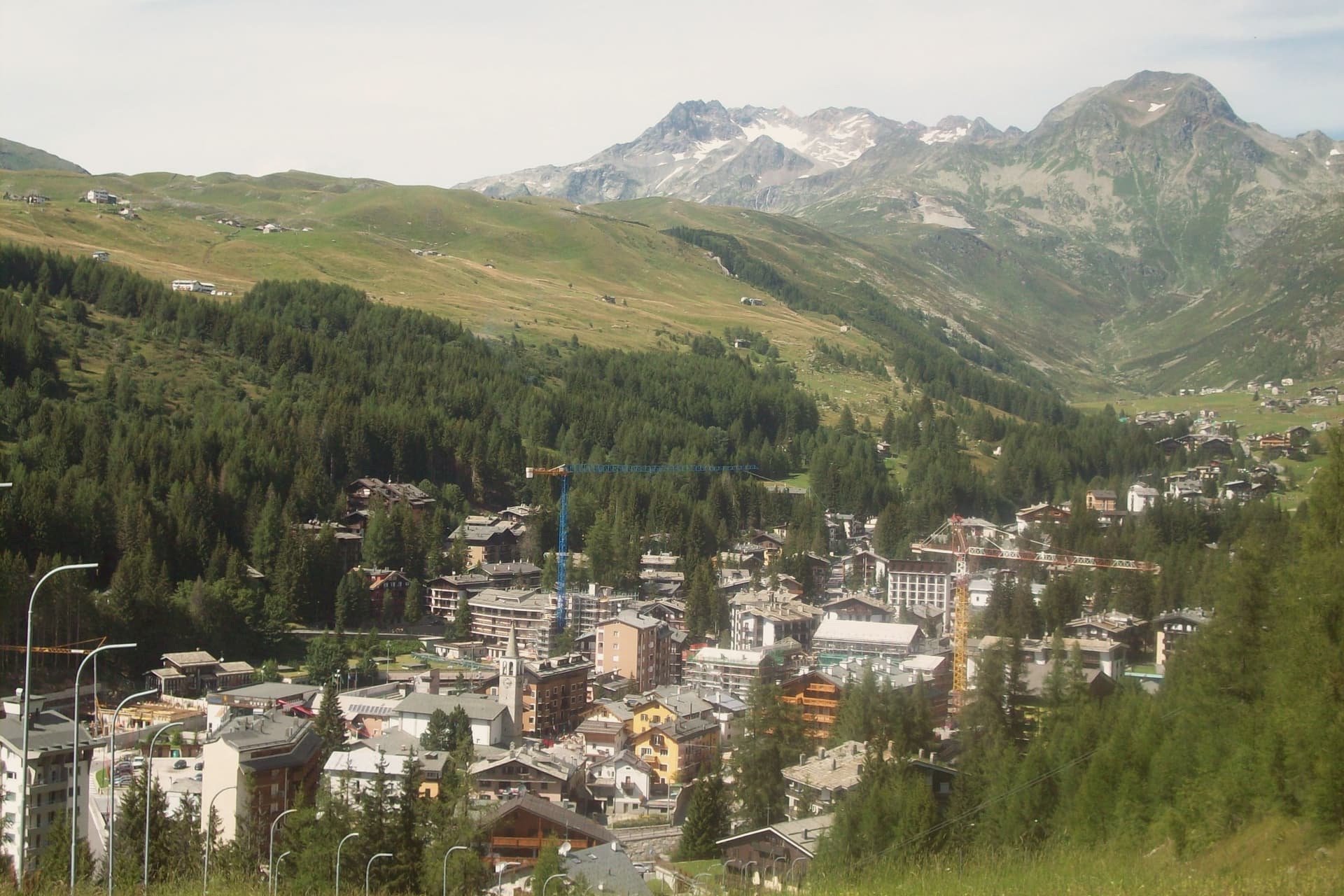
The village sits at the head of Valle Spluga, near enough to the Splügen Pass and the Swiss border that it counts as the most northerly commune in Lombardia. A funicular drops six kilometers down the valley to Campodolcino, climbing on the return to the Motta high station at 1,723 meters, the link that ties the two settlements into a single ski domain rather than two separate villages sharing a road.
Most of the resident population, 507, works in winter tourism, and the rhythm of the place follows the lifts as much as the calendar. Summer changes the traffic rather than the terrain: hikers replace skiers on the way up to the Laghi d'Emet and the high passes toward Switzerland, where the air is clean enough that the Pizzo Stella is visible from the village square on most days.
A small year-round population supporting a domain built for winter, and a valley oriented so squarely toward the high ground that even the summer view looks toward the peaks rather than back down the valley, is what the geography of Madesimo comes down to.
Il Cantinone have been named by a guide.
What to see in Madesimo
- Comprensorio sciistico Madesimo. Ski domain from 1,550 to 2,880 meters across 30 runs, served by the funicular link to Motta and the lifts on the peak above the village.
- Canalone Stretto. A steep natural couloir on Pizzo Groppera, the kind of line where the marked piste ends and the descent is left to the skier's own judgment of the snow.
- Cascata del Groppera. Waterfall on the upper Liro near the village, fed by glacier meltwater from the massif above.
How to get to Madesimo
Monza is roughly 147 minutes away by road.
Our tip
December through March is the season Madesimo was built for. Lifts open in early December, snow falls reliably above 1,500 meters, and the funicular from Campodolcino runs daily through to mid-April in good years. June through September is the alpine summer: the trails to the Laghi d'Emet and the passes toward Switzerland clear by mid-June, and at 1,550 meters even August afternoons stay below 22 degrees.
Bormio
Why visit Bormio
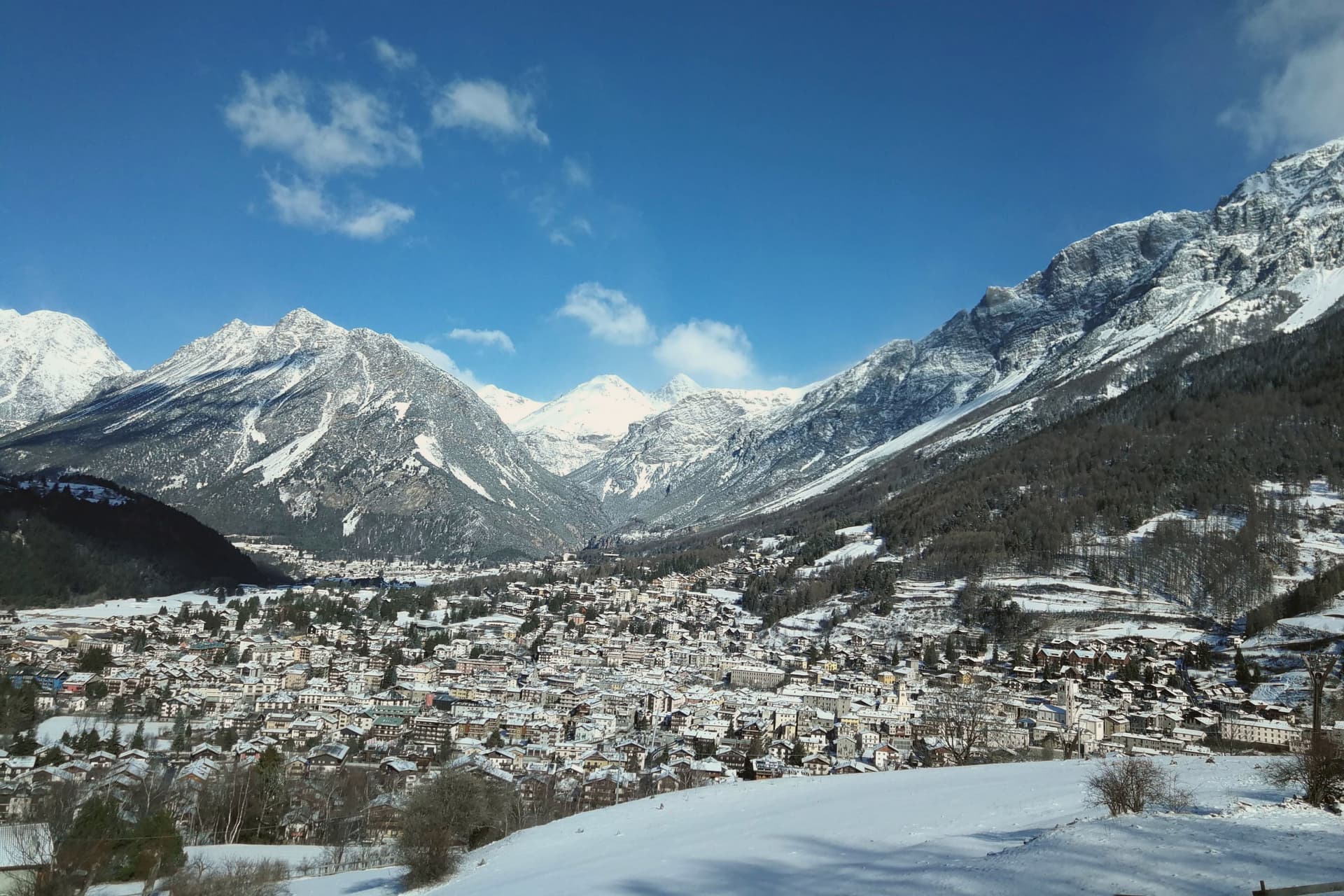
Bormio sits at 1,225 meters in upper Valtellina, at the junction where three high passes, the Stelvio, the Gavia, and the Mortirolo, converge inside the Stelvio National Park. The park ranges from 650 to 3,905 meters, and the springs that feed the town's baths rise separately at 1,420 meters, well above the settlement itself, before being carried down to the three thermal centres: QC Terme Bagni Vecchi, QC Terme Bagni Nuovi, and Bormio Terme.
The town's layout follows this same split between high and low. The Bagni Vecchi sit above the town in caves cut into the rock, closer to the mountain than to the streets, while the medieval center, the Kuerc, with its ninth-century podestà building, holds the civic and commercial life down in the commune itself.
The pass road above, meanwhile, belongs to a separate register entirely, an engineered climb rather than a settled place. What holds Bormio together is this vertical arrangement: water, rock, and road stacked above a small alpine commune that has stayed the administrative and social center while the mountain around it accumulated separate identities, as thermal ground, as national park, as pass, as ski slope.
Al Filò, Gavioli, Vecchia Combo have been named by a guide.
What to see in Bormio
- QC Terme Bagni Vecchi. Stone rooms and caves above the town, where the same water has run over Roman-era construction for two thousand years.
- QC Terme Bagni Nuovi. Belle Époque thermal complex below the Bagni Vecchi, with outdoor pools facing the Alpine peaks and the Valtellina valley.
- Kuerc e Palazzo del Podestà. Medieval civic center of Bormio, the Kuerc loggia and the ninth-century Podestà building in the heart of the centro storico.
How to get to Bormio
Bolzano is roughly 119 minutes away by road.
Our tip
December through March is the season Bormio was built for, with the Cima Bianca lifts open, the Stelvio downhill course hosting the men's World Cup, and the Bagni Vecchi running outdoor thermal pools against the snow. June through September is the second season: 1,225 meters keeps the air cool when the plain hits thirty-five, the Stelvio Pass road is open for bikes and cars, and the National Park trails are dry. April, May, October, November are the shoulder months.
Teglio
Why visit Teglio
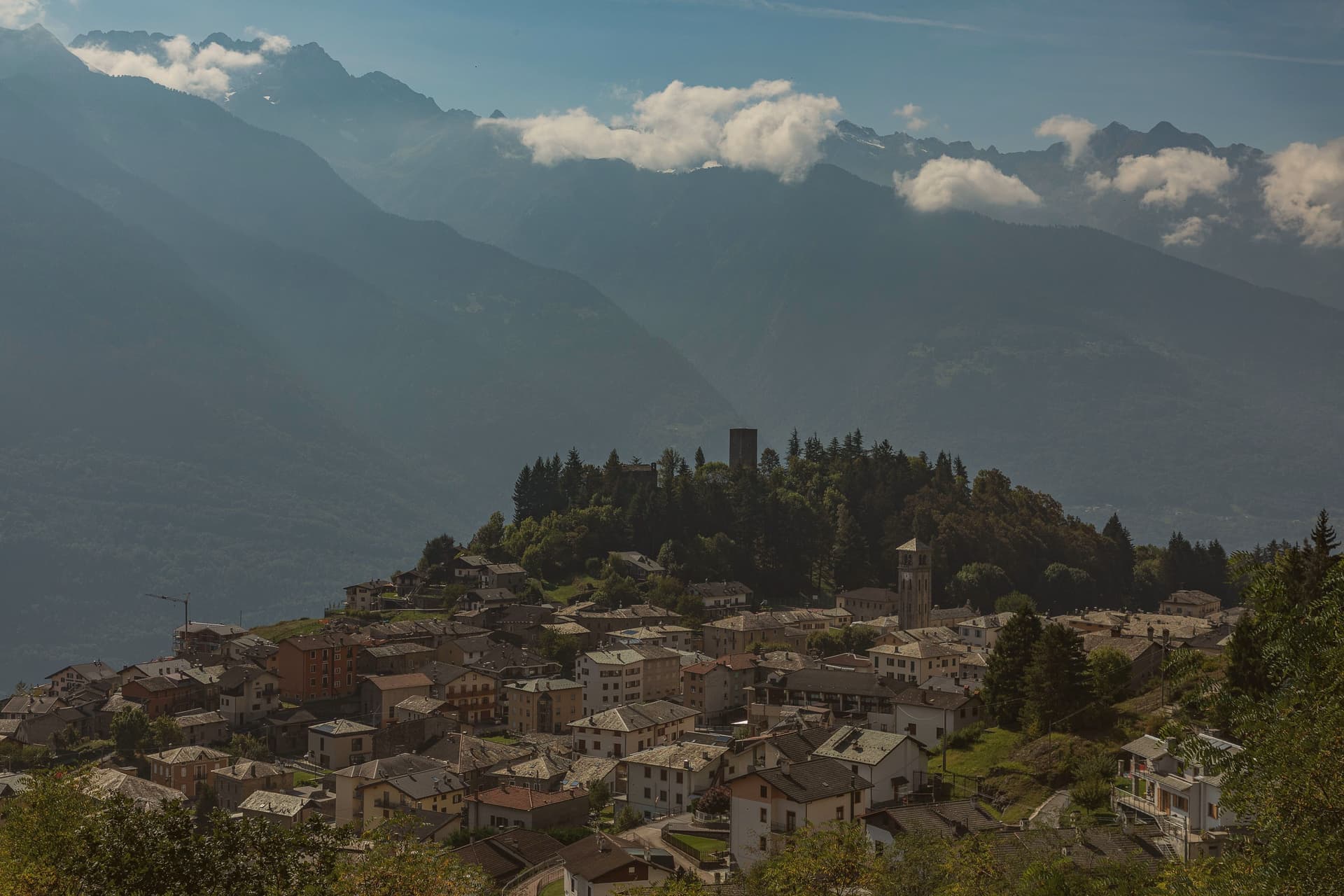
Teglio sits on the south-facing slope of the Valtellina, terraced vineyards dropping toward the Adda below the village and pine forest climbing behind it to the Orobie ridge. The Latin Tellina Vallis, valley of Teglio, gave the whole Valtellina its name, and the comune's own records reach back to the 9th century, when the village held the strategic centre of the valley.
The upper village keeps that older, defensive character; the vineyards and the valley floor below are where the food and wine culture of the place plays out, the two halves of the town facing different directions in what they do. Pizzoccheri, buckwheat tagliatelle with savoy cabbage, potato, garlic-and-butter sauce and casera cheese, has its official home here, and Teglio holds Cittaslow status on the strength of that food culture together with the terraced viticulture below the village.
A hill town that named a valley, still turned toward the river and the vines that keep its economy going, while its height and its records point back to why it was worth holding in the first place.
Fracia have been named by a guide.
What to see in Teglio
- Palazzo Besta. The courtyard cycle depicts Virgil's Aeneid; the upper salons hold further biblical and mythological scenes. The Antiquarium Tellinum inside holds Iron Age and Roman material from the valley.
- Accademia del Pizzocchero. The body that certifies trattorie and holds the recipe to its original form: buckwheat tagliatelle with savoy cabbage, potato, and a butter-garlic sauce alongside the cheese.
- Vigneti terrazzati della Valtellina. South-facing terraces stepping down toward the Adda, part of a viticultural landscape under UNESCO candidacy, producing Sforzato and Inferno Nebbiolo.
How to get to Teglio
There is a railway station in the town, so you can arrive without a car and never need one while you are here. Brescia is roughly 142 minutes away by road.
Our tip
May through October is the open season at 856 metres — Palazzo Besta open daily, terraced vineyards green, and the Valtellina wine route in full operation. June and September are the best months for both architecture and wine: long warm light, fewer tourists than peak summer, and the Sforzato and Inferno harvests just preparing in September. July-August stay temperate at this elevation and the trattorie are at full pizzocchero output.
Livigno
Why visit Livigno
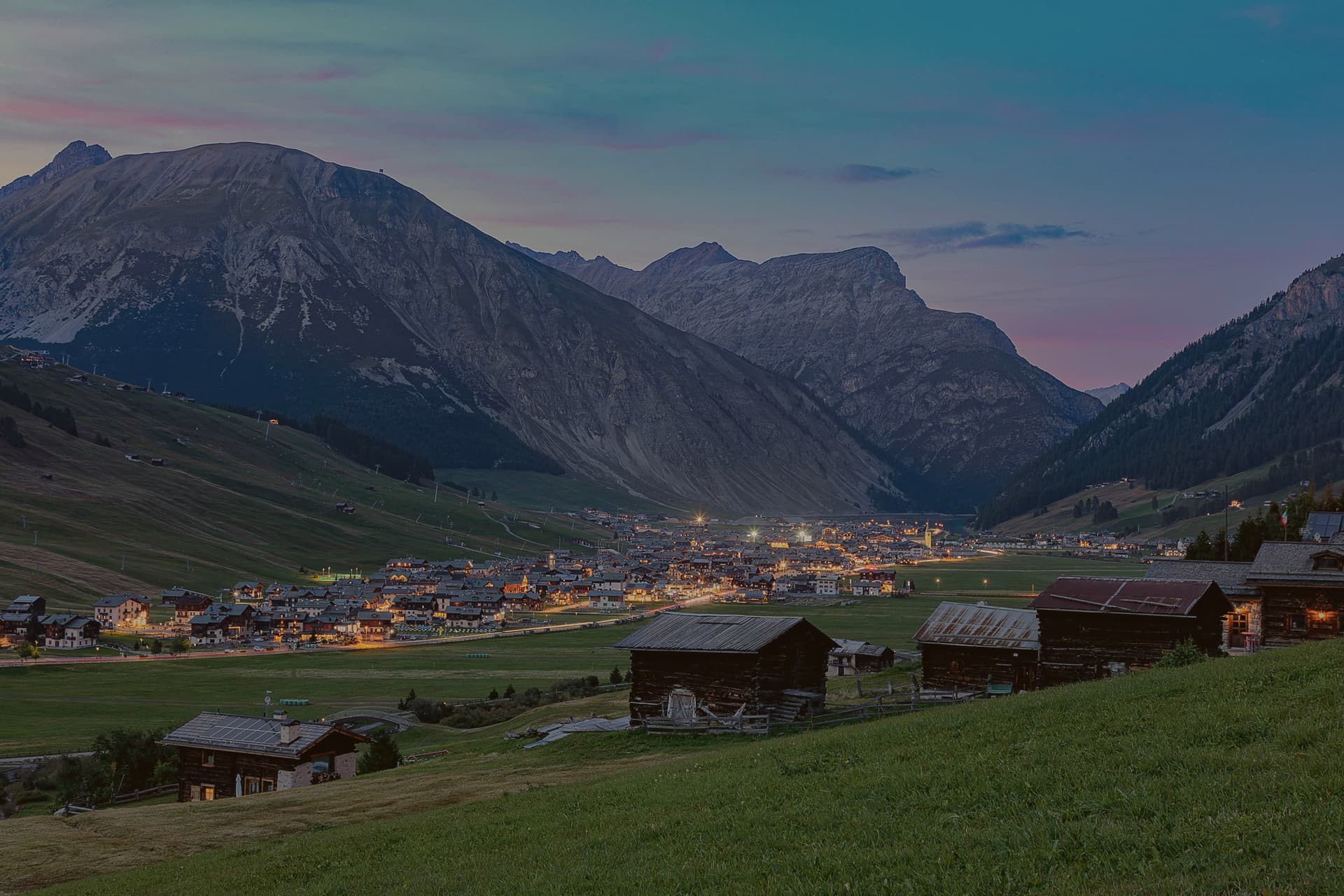
Livigno sits at 1,816 meters in a high valley between the Stelvio National Park and Switzerland's Engadine, one of the few Italian communes whose waters drain north to the Black Sea rather than south to the Mediterranean. The name probably comes from an old German word for avalanche; the last one to hit the village killed seven people in 1951.
Until the 1970s this was a farming village of shepherds and small farms. The duty-free status, first granted by Austria around 1840 and confirmed by Italy in 1960, is what changed it.
Today the slopes of Carosello 3000 on one side of the valley and Mottolino on the other carry the ski traffic that arrives by the busload from Milan and the rest of Europe. Saint Mary's parish church, rebuilt at the end of the 19th century around its older predecessor, still anchors the centre.
The duty-free shops along Via Plan handle the rest of the visitor economy.
Al Persef, Camana Veglia, Stua Noa Fine Dining and 3 more have been named by a guide.
What to see in Livigno
- Chiesa di Santa Maria Nascente. Late 19th-century parish church built around the older church it replaced, so that services continued during construction.
- Chiesa di San Rocco. Small votive church built at the start of the 16th century as protection against plague, on the edge of the historic settlement.
- Chiesa della Madonna di Caravaggio. Country church holding ex voto paintings and a picture traditionally attributed to Caravaggio.
How to get to Livigno
Bolzano is roughly 152 minutes away by road.
Our tip
December through March is the ski season Livigno was built for: 1,816 meters guarantees snow, the duty-free shops stay open late, and the two ski areas run at capacity. June through September is the second season. Trails climb into the Stelvio park, the valley keeps temperatures under 25 degrees even in August, and bike traffic replaces ski traffic on Mottolino.
Chiavenna
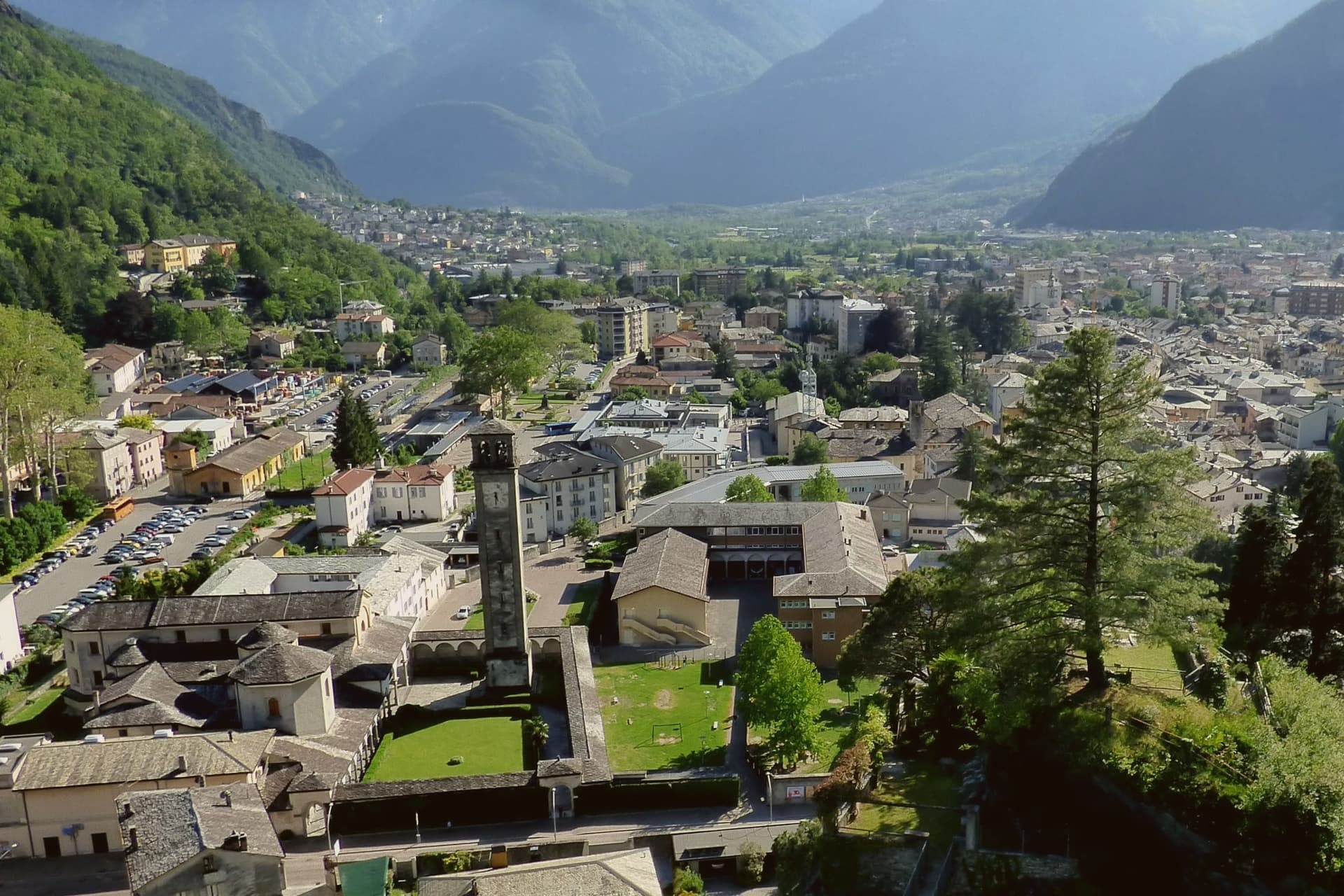
Why visit Chiavenna
Chiavenna is the administrative and cultural centre of the Valchiavenna, at the foot of the Splügen Pass. The town arose on a large ancient landslide, and the boulders that fell across the slope left behind the air pockets and rock crevices that became its defining feature: a crotto is a domed cellar built over one of these cracks, called a sorèl, and Valchiavenna counts about eighty of them, mostly in private hands.
The old town sits along the Mera, its stone streets carrying palazzi from the era when the town lived off the trade crossing the Alps, with stretches of foundation going back to Roman work below them. The church and its font and treasury stand within this same fabric, one more layer laid over the Roman crossroads the town took its name from.
The result is a town built twice over by the same geology and the same geography: the rock that cracked open to store food and wine is the same rock the streets and trade route were cut through, so the town's food culture and its position on the pass turn out to be two expressions of one fact of the ground it sits on.
Villa Giade have been named by a guide.
What to see in Chiavenna
- Collegiata di San Lorenzo. Church on the Mera with preserved Romanesque walls and fragments of eleventh-century frescoes still visible on the interior surfaces.
- Fonte battesimale. Monolithic block carved with the rite of blessing the water on Holy Saturday, cut from a single piece of stone.
- Museo del Tesoro. Annexed to the Collegiata, holding the Pace di Chiavenna, a cover inlaid with enamels and pearls, kept apart from the church proper.
How to get to Chiavenna
There is a railway station in the town, so you can arrive without a car and never need one while you are here. Monza is roughly 105 minutes away by road.
Our tip
May through October is the Alpine season. The Mera trails are open, the Collegiata holds full hours, and the crotti host their summer service of salami, cheese, and Valchiavenna wine. June, July, August and September are the busiest months, with hikers heading up to the Splügen and the Bregaglia valleys.
Sondrio
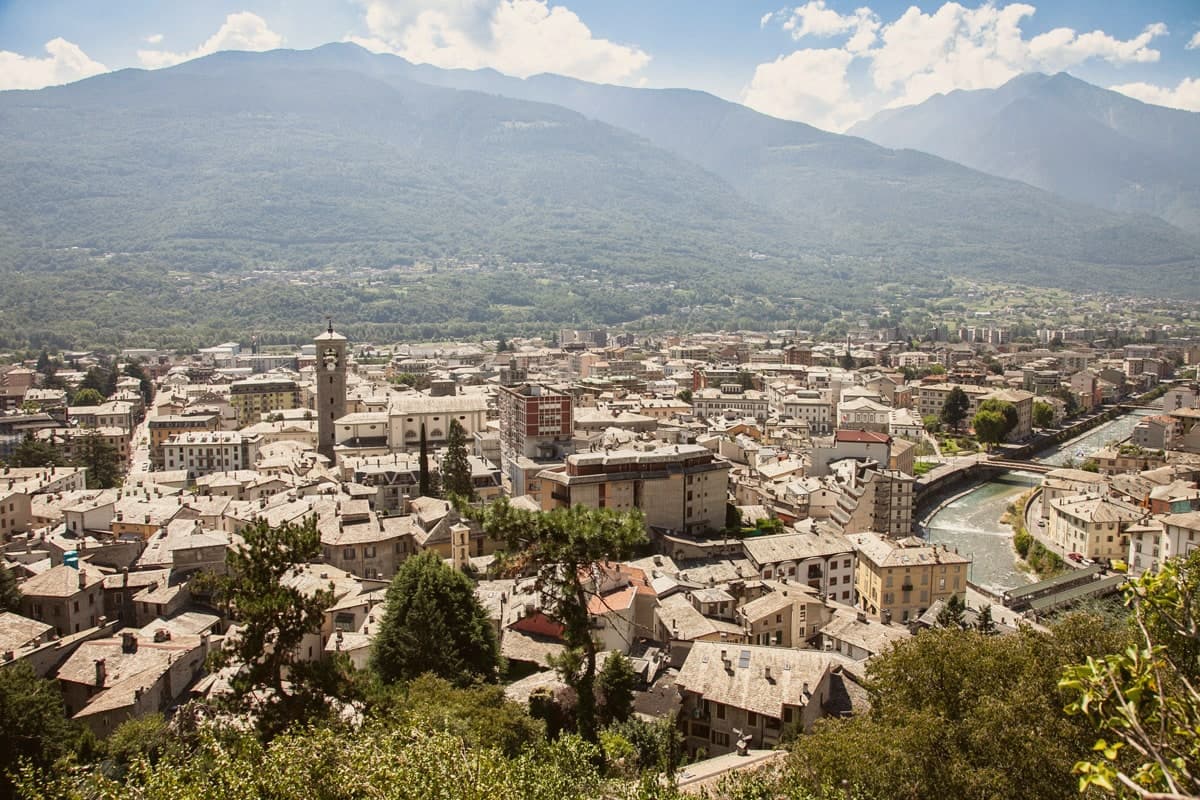
Why visit Sondrio
Sondrio sits at 307 meters on the floor of the upper Adda valley, the administrative heart of Valtellina and its terraced wine country. The Romans built a military camp here.
The Lombards renamed it Sundrium, meaning the exclusive property of free men. From the late 16th century until 1797 the city was the capital of Valtellina under the Three Grey Leagues of the Grisons, an Alpine canton across the Splügen Pass that ran the valley from Chur.
Castel Masegra, an 11th-century Capitanei stronghold on a rock above the centro storico, is the only urban castle that survived the demolitions of the 17th century and now houses the CAST mountain museum. The terraced vineyards above the city, between 300 and 800 meters, produce Sassella and Grumello, the two Nebbiolo subzones that define Valtellina Superiore DOCG.
Most of the work on those terraces is still done by hand.
Trippi have been named by a guide.
What to see in Sondrio
- Castel Masegra. Eleventh-century hilltop castle of the Capitanei family, the only urban fortress to survive 17th-century demolitions, now home to the CAST mountain museum.
- Collegiata dei Santi Gervasio e Protasio. The town's main church, with a baroque nave and a neoclassical façade, standing at the edge of the old centro.
- Piazza Garibaldi. The principal square, surrounded by neoclassical buildings, with a central monument to Giuseppe Garibaldi and the city's main cafés and shops.
How to get to Sondrio
There is a railway station in the town, so you can arrive without a car and never need one while you are here. Monza is roughly 116 minutes away by road.
Our tip
April through June and September through October are the cleanest months in Sondrio. The vineyards above the city are green or gold, the Adda runs full from snowmelt, and the air is clear enough to see the Bernina range from Piazza Garibaldi. July and August get hot in the valley floor, and the city empties into the higher Valmalenco.
More from Anywhere Italy
 The best high-altitude villages in Lombardia
- The best ski towns in Lombardia
- The best hidden ski towns in Lombardy
- The best small towns with a serious restaurant in Lombardia
 The best towns with a serious restaurant that you can reach by train in Lombardia
 The 8 best hidden towns that eat well in the province of Brescia