
The best towns that cure their own meat within two hours of Verona
The ham country between the Po and the Apennines runs on damp air. Cellars hold winter fog against salted legs of pork for the better part of a year, and the results carry names that are legally tied to the ground they came from: culatello, prosciutto, soppressa, salame. In the low brick towns of the plain the butcher and the norcino are often the same person, working behind a counter of pale marble, and the bread they hand you with it is unsalted on purpose. Autumn and winter are the honest seasons here, when the mist arrives and the pig is worked, and the food is heavier for a reason. On the hill towns to the south the balsamic barrels sit in unheated attics, doing the same slow thing to grape must that the cellar does to meat.
People eat cured meat in Verona instead, and it is a fine place to do it, at a table in Piazza delle Erbe with a glass of Valpolicella and a plate of soppressa cut too thin. Verona's centre absorbs the opera crowd, the Juliet balcony crowd and the wine-fair crowd in the same calendar year, so the terraces are full and the prices reflect it. Bologna's Quadrilatero has the same problem with a longer queue and better lighting. What you get in both is meat brought in from somewhere else, plated well.
The somewhere else is an hour or two down the road, and it is not hard to reach. The same production zones that supply those city counters cover a scatter of smaller towns on the plain and in the foothills, where the salumeria is on the main street and the cellar is behind it, and where the annual fair for a single product still fills the square. Fewer people go, which mostly means you can ask what was cured when, and get an answer.
Of the 88 communes we have mapped in a 120-minute drive of Verona, 6 qualify as towns that cure their own meat: each sits inside the production zone of a protected cured meat. The smallest, Busseto, has 6,763 residents.
Two more lists worth reading alongside this one: The best towns that cure their own meat within two hours of Bologna and The best towns that cure their own meat within two hours of Padua.
Busseto
Why visit Busseto
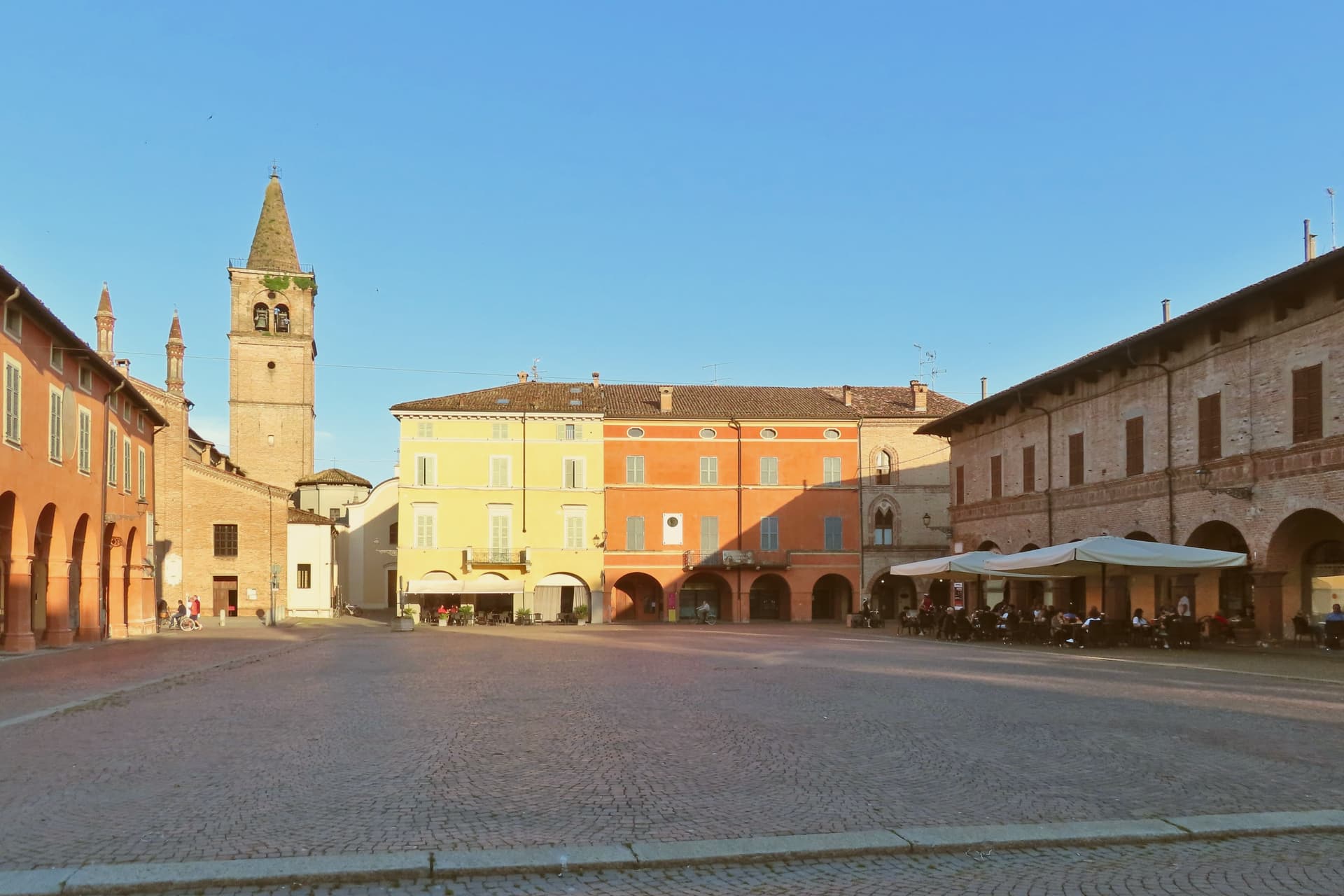
The town sits twenty-five kilometers northwest of Parma, in the flat farming country of the Bassa Parmense between the Po and the Apennine foothills. It was the capital of the Stato Pallavicino for almost five hundred years before the territory was absorbed into the Duchy of Parma, and the fortress built for that state still anchors the main piazza today.
Roncole, the frazione where Verdi was born, lies three kilometers east; he moved into Busseto proper as a boy in 1824, and Villa Sant'Agata, the house he later bought and kept until his death, lies five kilometers north of the center. The three places trace a line outward from the town: birth to the east, boyhood at the center, and the household of his adult life to the north.
The Bassa around the town is also farming country in a more literal sense, producing the Culatello di Zibello and the Parmigiano Reggiano that the local consortium has aged here since the nineteenth century. A small provincial capital, in other words, whose built center was shaped by one family's rule and whose long afterlife has been shaped by one composer's, with the surrounding plain supplying the food economy underneath both.
Campanini have been named by a guide.
What to see in Busseto
- Teatro Giuseppe Verdi. The stage sits inside the fortress walls, reached through the courtyard rather than a freestanding facade. The empty box he kept is still pointed out.
- Rocca dei Pallavicino. Fifteenth-century fortress on the main piazza, seat of the Stato Pallavicino for centuries. It now holds the theatre in one wing and the town hall in another.
- Casa Natale di Verdi. A modest house at Roncole, three kilometers east, kept much as it would have been, with the rooms where a child grew up rather than the trappings of later fame.
How to get to Busseto
There is a railway station in the town, so you can arrive without a car and never need one while you are here. Parma is roughly 38 minutes away by road.
Our tip
April through June and September through October are the working months in the Bassa. The Po Valley sky clears and the cured-meat acetaie reopen their tasting rooms after winter. July and August are heavy.
Montagnana
Why visit Montagnana
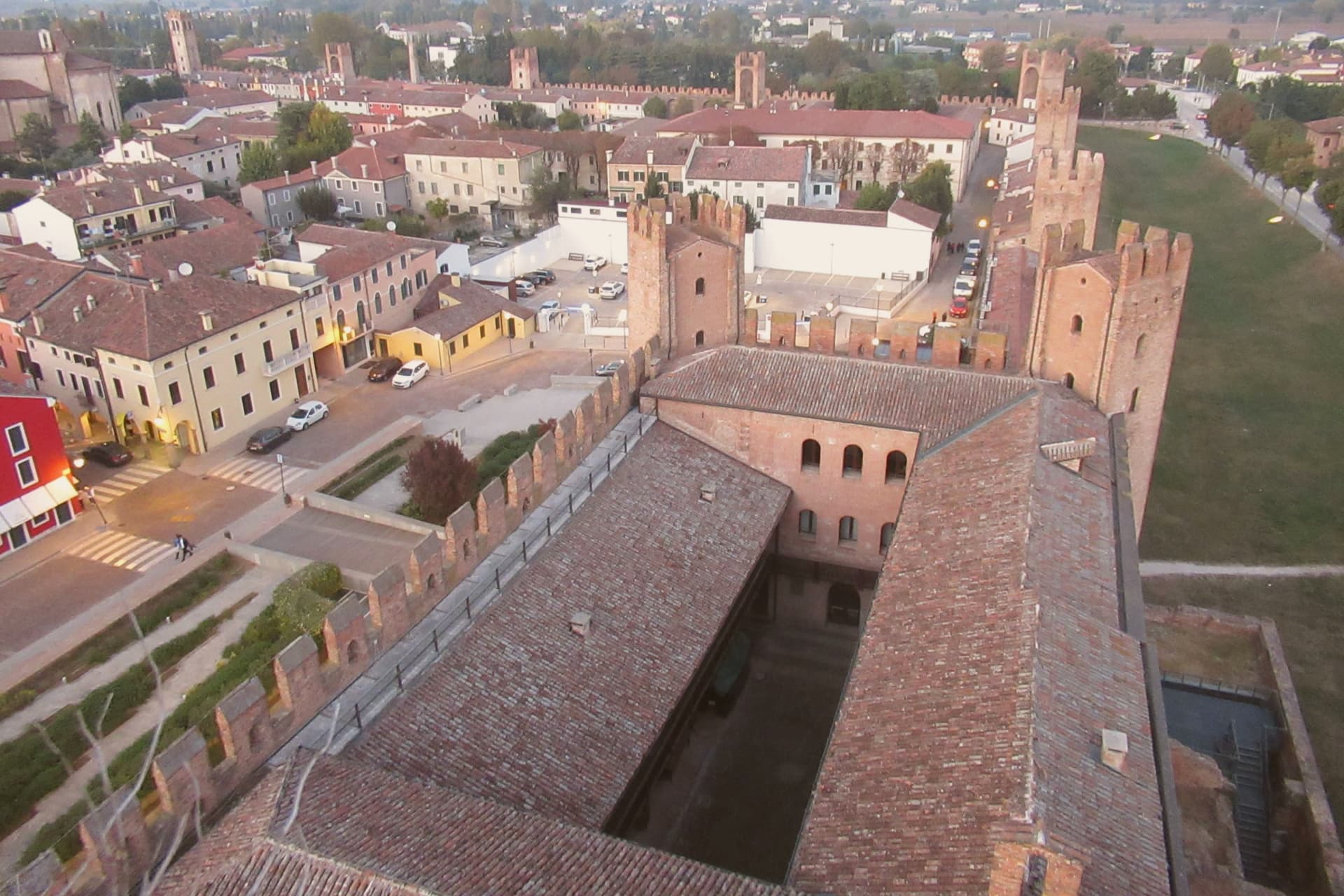
Montagnana sits at 16 meters on the lower Padova plain, thirty-five kilometers southwest of Padova, on the watershed between the Adige and the Bacchiglione. The wall ring is unbroken enough that the town's whole plan still reads as the fortification that produced it: the castle anchors the eastern gate, the rocca anchors the western one, and the road to Verona runs between them through what was once contested ground between Ezzelino's garrison and the Carraresi who came after.
Inside the walls, the center holds the Duomo and the two flanking palazzi around Piazza Maggiore, while the villa built for the cardinal stands deliberately outside the gate, a country house that still shows its face to the town. The May festival now fills the same ground the walls were built to defend, the modern economy of the place staged inside its medieval perimeter.
What to see in Montagnana
- Cinta muraria. Six to eight meters high and ninety-six centimeters thick, the rampart carries a continuous parapet walk, so the towers can be counted from above rather than just from the road.
- Castello di San Zeno. Fortress at the eastern gate, built by Ezzelino III da Romano in 1242, with the Mastio tower 38 meters high and a civic museum inside.
- Rocca degli Alberi. Western gate fortress built by the Carraresi between 1360 and 1362, with a moat and double drawbridge defending the road to Verona.
How to get to Montagnana
There is a railway station in the town, so you can arrive without a car and never need one while you are here. Vicenza is roughly 47 minutes away by road.
Our tip
April through June and September through October are the right months for Montagnana. The lower Padova plain runs cool and clear in those windows, and the parapet walk on the walls gives the best views when the haze lifts. The Festa del Prosciutto Veneto DOP runs across two weekends in mid-May, the largest event of the year, with tastings and tours of the curing houses.
Spilamberto
Why visit Spilamberto
Spilamberto sits at 69 meters on the right bank of the Panaro, fifteen kilometers southeast of Modena, on the line of the ancient Via Romea that ran from northern Europe to Rome. The town is documented from 776.
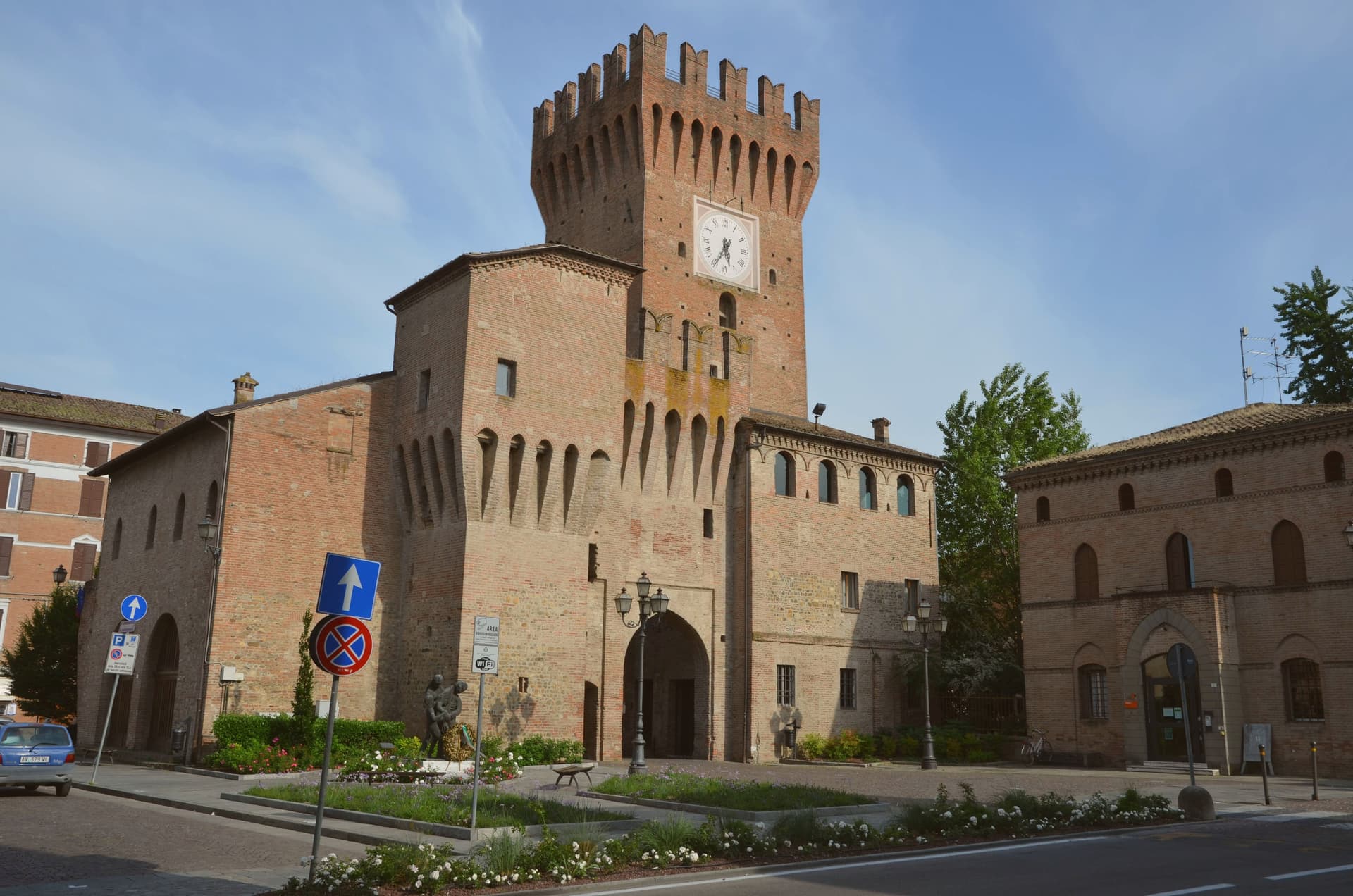
The Rangoni family of Modena held it for more than 650 years, and the fortress they built still anchors the centro storico, with the medieval bell tower at the edge of the borgo holding both an archaeological museum and the headquarters of the walnut liqueur order. In 1967 a group of local enthusiasts founded the Consorteria dell'Aceto Balsamico Tradizionale di Modena here, and it still certifies the twelve- and twenty-five-year-aged DOP product through annual blind tastings.
An eighteenth-century Este road that ran from Modena to Massa leaves the town heading south, a reminder that Spilamberto has always sat at a crossing point: the old route running through it toward the north and Rome, another road departing from it toward the south, the river marking its edge. A plain town that became, almost by local initiative rather than geography, the place where a regional product got its rules written down.
What to see in Spilamberto
- Rocca Rangoni. The fortress anchors the centro storico, its walls facing onto the streets that grew up around it rather than set apart from them.
- Torrione. Medieval bell tower at the edge of the borgo, housing the Antiquarium museum and the headquarters of the Ordine del Nocino Modenese.
- Museo dell'Aceto Balsamico Tradizionale. Museum at Villa Fabriani laying out the production cycle in physical form: the cooked must, the graduated run of casks, the attic rooms where fifty years of seasoning take place.
How to get to Spilamberto
There is a railway station in the town, so you can arrive without a car and never need one while you are here. Modena is roughly 24 minutes away by road.
Our tip
April through June and September through October are the months for Spilamberto. The Greenway del Panaro runs without crowds, the cantine open their tasting rooms, and the Mast Còt festival in October pulls together producers from the entire Modenese balsamic chain for two weekends of new-must boiling and old-cask tasting. July and August are heavy on the plain; thirty-five degrees and humidity that doesn't drop after dark.
Sasso Marconi
Why visit Sasso Marconi
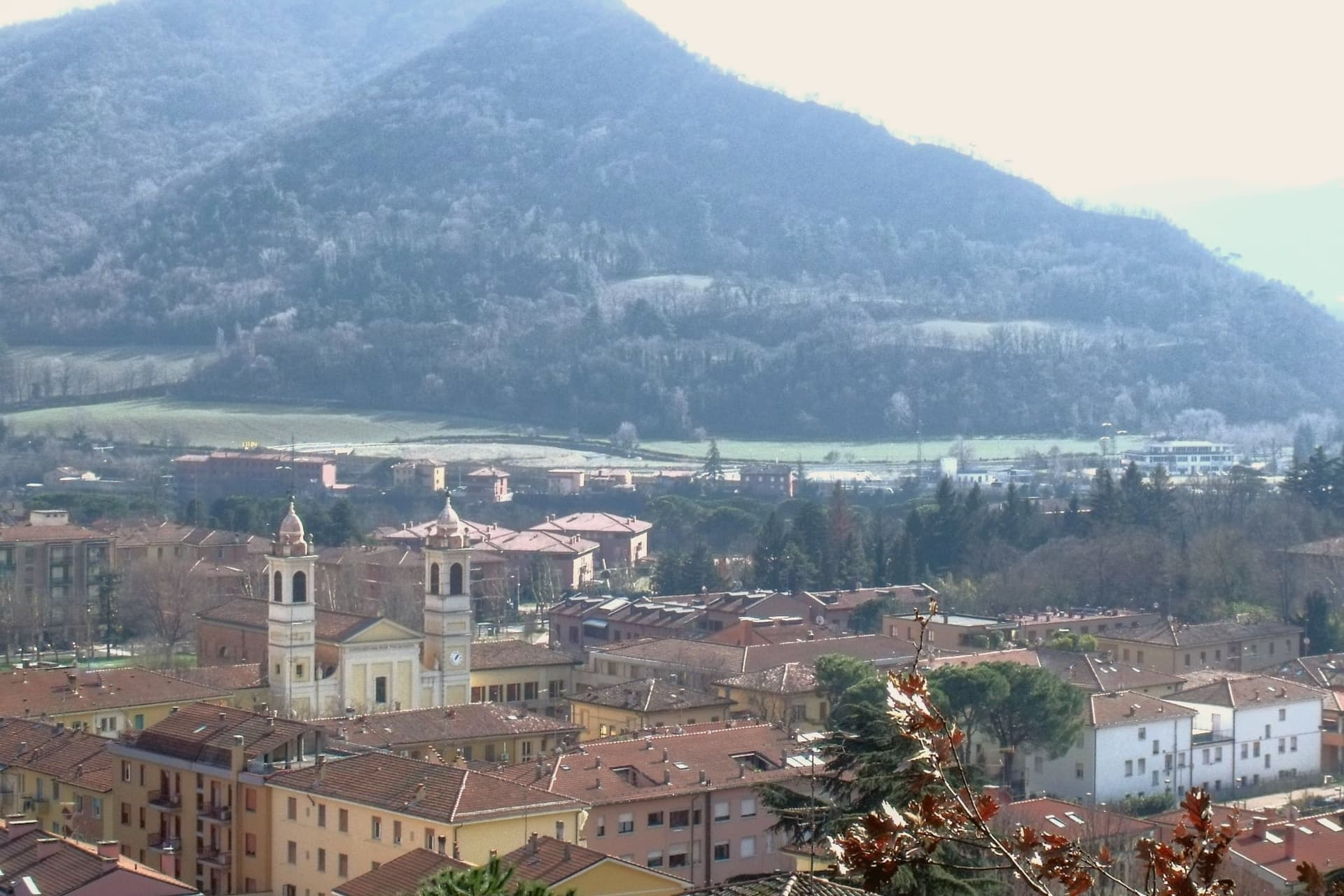
The Setta and Reno rivers meet below the rock that gives the town its name, at the point where the pre-Apennine hills begin their climb south of Bologna. The Sasso della Glosina dominates the bend, a Pliocene formation old enough to have shaped how the crossing below it was used long before the valley took its modern name.
The town itself was called Sasso Bolognese until 1938, when it was renamed for the family whose estate lies in the frazione of Pontecchio, on the valley floor rather than on the rock itself. The territory reaches from that river confluence up into the Apennine slopes, and the change in elevation shows in what the land produces: white truffle from the valley floor near the Reno, and vineyards on the hills around Pieve del Pino and Mongardino, recognition earned on two different registers of the same ground.
The lower town, built around the rivers and the old road to Pistoia, and the upper slopes, given to woods and terraced vines, read as one territory doing two different kinds of work.
Casa Mazzucchelli, Antica Trattoria la Grotta dal 1918 have been named by a guide.
What to see in Sasso Marconi
- Villa Griffone - Museo Marconi. Marconi family villa in the frazione of Pontecchio. The mausoleum sits alongside the attic laboratory, and the museum holds working reproductions of his early apparatus.
- Sasso della Glosina. The rock rises directly over the river bend, its bulk visible from the crossing below and from much of the surrounding valley.
- Confluenza Setta-Reno. Meeting of the two valleys at the foot of the rock, with the historic crossing of the Via Porrettana toward Pistoia.
How to get to Sasso Marconi
There is a railway station in the town, so you can arrive without a car and never need one while you are here. Bologna is roughly 26 minutes away by road.
Our tip
April through October is the working season in Sasso Marconi. Spring and early autumn are best on the Reno valley trails and at Villa Griffone, with mild temperatures and the Apennine foothills green or autumn-coloured. July and August can touch thirty-five degrees in the valley, though the higher frazioni stay cooler; many visitors come up from Bologna for a day on a weekend. Fira di Sdaz di Sasso Marconi falls in September.
Vignola
Why visit Vignola
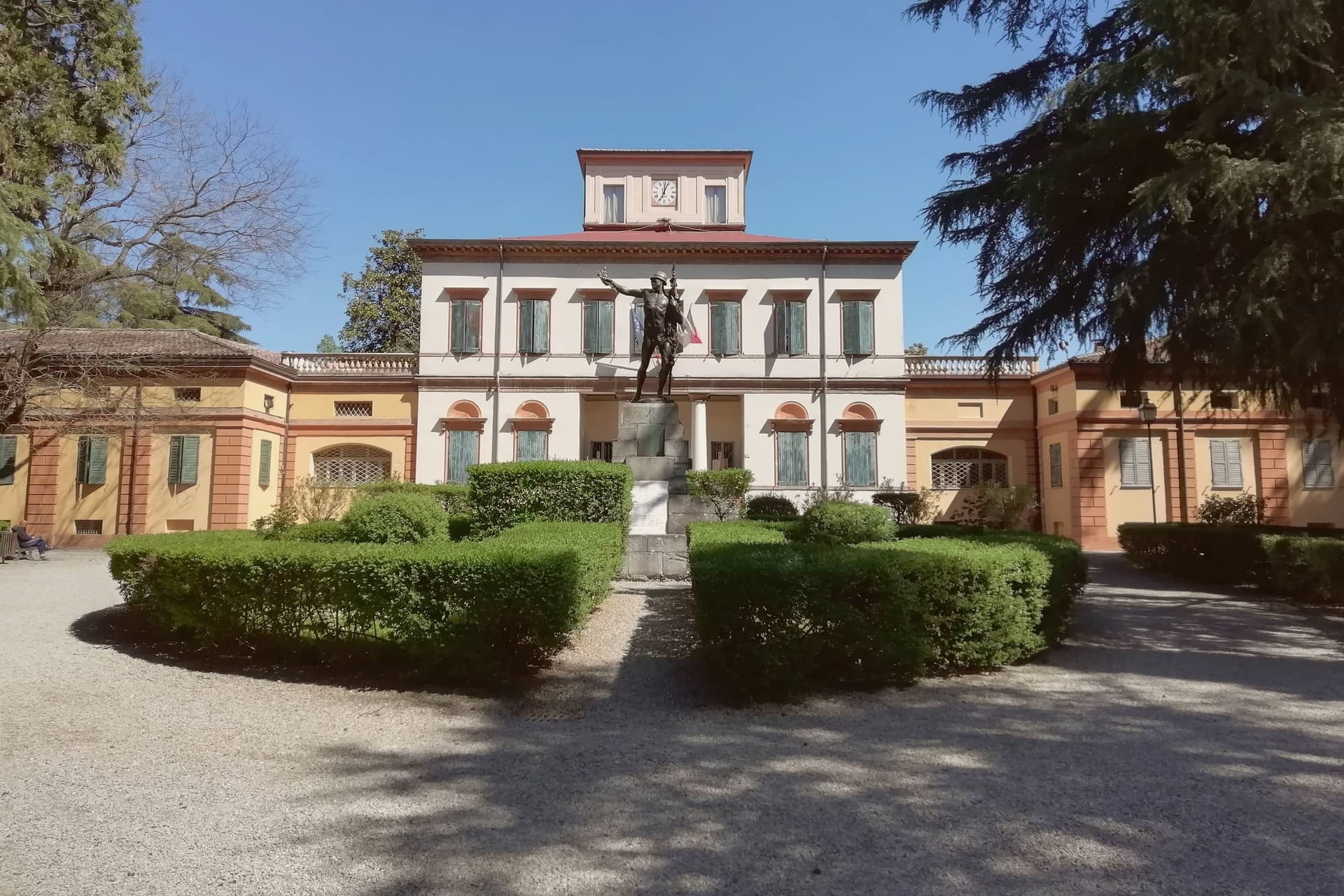
Vignola sits at 125 meters on the right bank of the Panaro, twenty-five kilometers south of Bologna and twenty east of Modena, where the Modenese plain meets the Apennine foothills. The fortress there is documented from the eighth century, raised by the Abbot of Nonantola to guard the abbey's lands before the Contrari family rebuilt it in the fifteenth century as a fortified residence; in 1577 it passed to the Boncompagni-Ludovisi, who held it until 1965.
The palace beside it takes its second name from the family that acquired it, and from the architect born in the town in 1507, who died in 1573 after a career among the leading figures of late Renaissance architecture. The cherries that carry the town's name upriver and down are IGP-protected across twenty-eight communes stretching from Modena to Bologna, and the blossom that precedes the fruit each spring fills the Panaro valley below the walls.
A disused railway, now a greenway, threads through the same ground on its way between Mirandola and Bologna. The town's identity rests on this pairing of a fortified height above the river and an agricultural valley beneath it, one lineage of stone, one of orchards, both still legible in the place today.
What to see in Vignola
- Rocca di Vignola. Eighth-century origin, built to guard the lands of an abbey and later rebuilt as a fortified residence. The frescoed interiors and four corner towers stand over the river much as the rebuilding left them.
- Scala a Chiocciola di Palazzo Barozzi. The 106 steps rise with no central support, an engineering feat as much as a decorative one, tucked inside the palace next to the fortress.
- Palazzo Boncompagni. The palace passed to the family that gives it its name in the late sixteenth century and held the fortress until 1965. Its reception rooms carry frescoes alongside the staircase it is best known for.
How to get to Vignola
There is a railway station in the town, so you can arrive without a car and never need one while you are here. Modena is roughly 34 minutes away by road.
Our tip
April through June and September through October are the working months on the Panaro foothills. The first two weekends of April fill the centro with the Festa dei Ciliegi in Fiore, when the orchards along the river bloom. June brings cherries to market and the Panaro at high water.
Vicenza
Why visit Vicenza
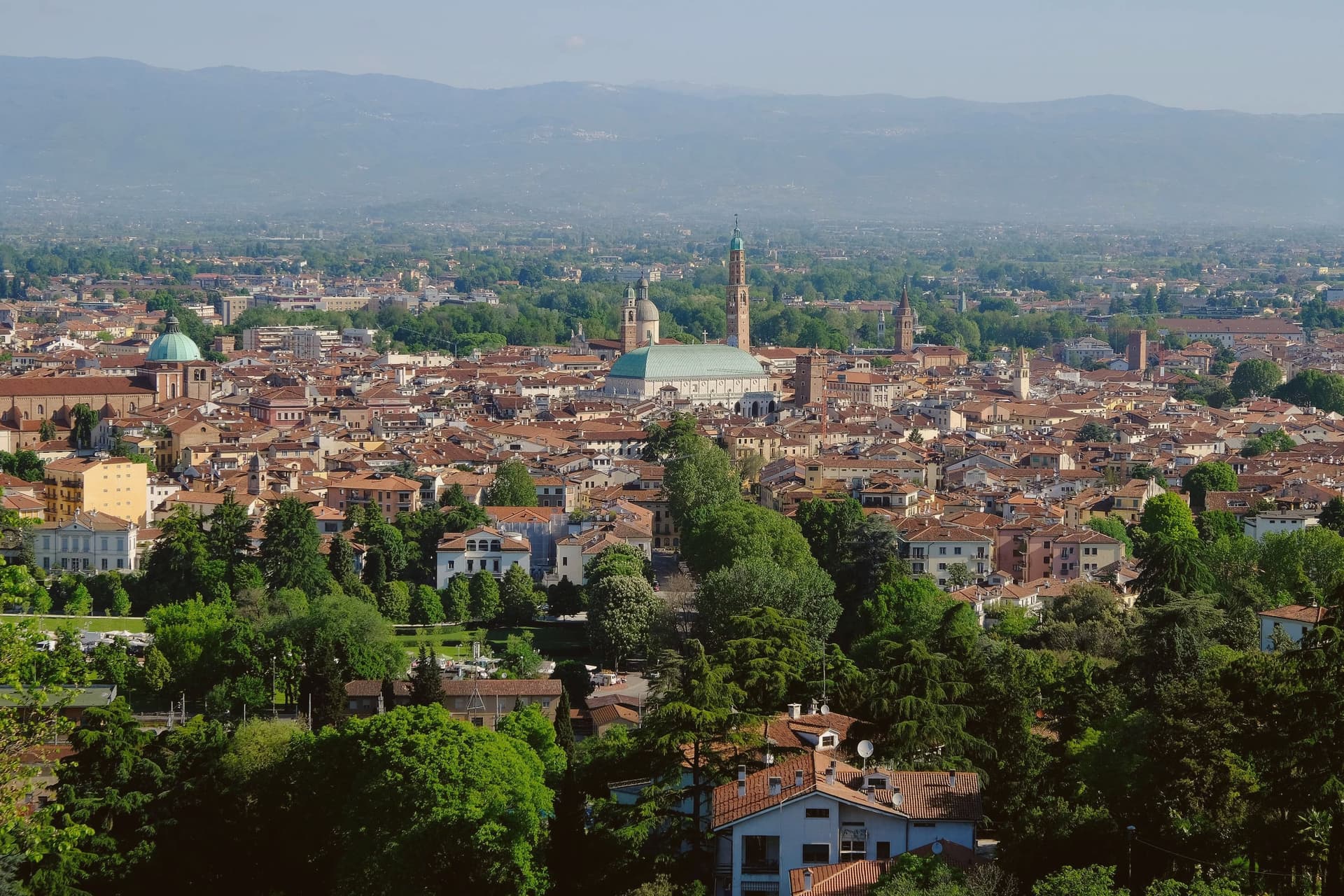
Vicenza is the city that made Palladio and that Palladio made. Andrea della Gondola — better known as Palladio — was a stonemason's apprentice in Vicenza in the 1520s, was renamed by his patron Trissino after the Greek goddess Pallas Athena, and spent the next 50 years building villas, palazzi and churches for the local Venetian-territory aristocracy.
The result: a 16th-century city of unprecedented architectural coherence, UNESCO-inscribed in 1994 as 'The City of Vicenza and the Palladian Villas of the Veneto'. The greatest hits cluster inside the walls: the Basilica Palladiana on Piazza dei Signori (his first major commission, 1549 — a Gothic medieval town hall wrapped in a white loggia of perfectly proportioned arches), Palazzo Chiericati (now the Pinacoteca), Loggia del Capitaniato, Palazzo Thiene, and the Teatro Olimpico — his final building (1580–1585), the world's oldest surviving indoor theatre, with a permanent trompe-l'œil stage set by Scamozzi depicting 'the seven streets of Thebes' in forced perspective.
A 20-minute walk south of the centro: Villa La Rotonda (1567), the symmetrical perfect-square villa that every American state capitol and Monticello copied. Vicenza also has Venice's gold and silver — half the gold sold in Italy passes through here annually (it's Europe's largest gold-jewellery district), and Vicenzaoro is the world's biggest gold trade fair.
Plus the Veneto kitchen: baccalà alla vicentina (salt cod with milk, anchovies and onions, served over polenta), bigoli with duck ragù, the local Lessini Durello sparkling wine, and Vicenza's own asparago bianco DOP in May.
Osteria Bertoliana, Matteo Grandi in Basilica, FuoriModena - Cucina km 200 and 1 more have been named by a guide.
What to see in Vicenza
- Basilica Palladiana + Piazza dei Signori. Palladio's 1549 wrap of perfect-proportioned white arches around the medieval Palazzo della Ragione — his first major commission, the building that made his name. The rooftop terrace is open and free.
- Teatro Olimpico. Palladio's final work (1580–85) and the world's oldest surviving indoor theatre. Scamozzi's permanent stage set shows 'the seven streets of Thebes' in trompe-l'œil forced perspective — they still perform here.
- Villa Capra 'La Rotonda'. The perfectly symmetrical 1567 villa on a hilltop 2 km south — a square plan with four identical pedimented porticoes, copied by Jefferson at Monticello and every state capitol in America.
How to get to Vicenza
There is a railway station in the town, so you can arrive without a car and never need one while you are here. Vicenza is roughly 3 minutes away by road.
Our tip
Vicenza is best from April through June and September through October — the Veneto plain gets hot and sticky in July and August, and the Palladian villas (especially the Rotonda) are most photogenic in low-angle spring or autumn light. May is asparago bianco season and the gardens are full. Winter is foggy and quiet but the indoor sights — Teatro Olimpico, the Pinacoteca, the basilica's interior — are at their most atmospheric. Festa dei Oto a Vicenza falls in August.
More from Anywhere Italy
 The best towns that cure their own meat within two hours of Bologna
- The best towns that cure their own meat within two hours of Padua
 The best towns that cure their own meat within two hours of Brescia
- The best towns that cure their own meat within two hours of Parma
 The best hidden towns you can reach by train in Emilia-Romagna
 The best towns you can reach by train within 45 minutes of Bologna