
The best small hill towns you can reach by train in Piemonte
Piemonte inland is a country of ridges: vines on the sunny flank, hazelnut groves and oak on the cold one, and a village of ochre brick and river stone balanced along the top of each. Autumn is the season the region is built around, when the fog sits in the valleys below the towns, the white truffle comes up out of the ground near Alba and Asti, and the kitchens turn to tajarin, agnolotti del plin, braised beef in Barbera. Spring brings something quieter and greener, with asparagus, robiola and long light over the rows. The building material tells you where you are, brick in the Monferrato, stone as you head north towards the Ossola.
The default plan is Alba and the Barolo villages, hired car, cellar visits booked in advance, lunch somewhere with a Michelin star. It works, and it is also the reason the roads between La Morra and Barolo move at walking pace through October, and why a room in Alba during the truffle fair costs what it costs. The Langhe UNESCO listing did what listings do. Coaches now park where tractors used to.
The same hills carry on well past that stretch, north into the Monferrato and up the Bormida and the Toce, and the railway carries on with them. Regional lines from Turin, Asti, Alessandria and Novara stop at the foot of hill towns that keep their weekly market, their cantina sociale and their trattoria, and get a fraction of the visitors. These are the smaller ones, each an inland hill settlement, each confirmed reachable without a car.
Of the 65 communes we have mapped in Piemonte, 20 qualify as hill towns you can reach by train: each is an inland hill settlement, and we have confirmed each is reachable without a car. This list is the small ones, 6 in all, ordered smallest first. The smallest, Mombaldone, has 197 residents.
If you are still choosing, we have also written The best hill towns in the province of Asti and The best hidden hill towns you can reach by train within 90 minutes of Torino.
Mombaldone
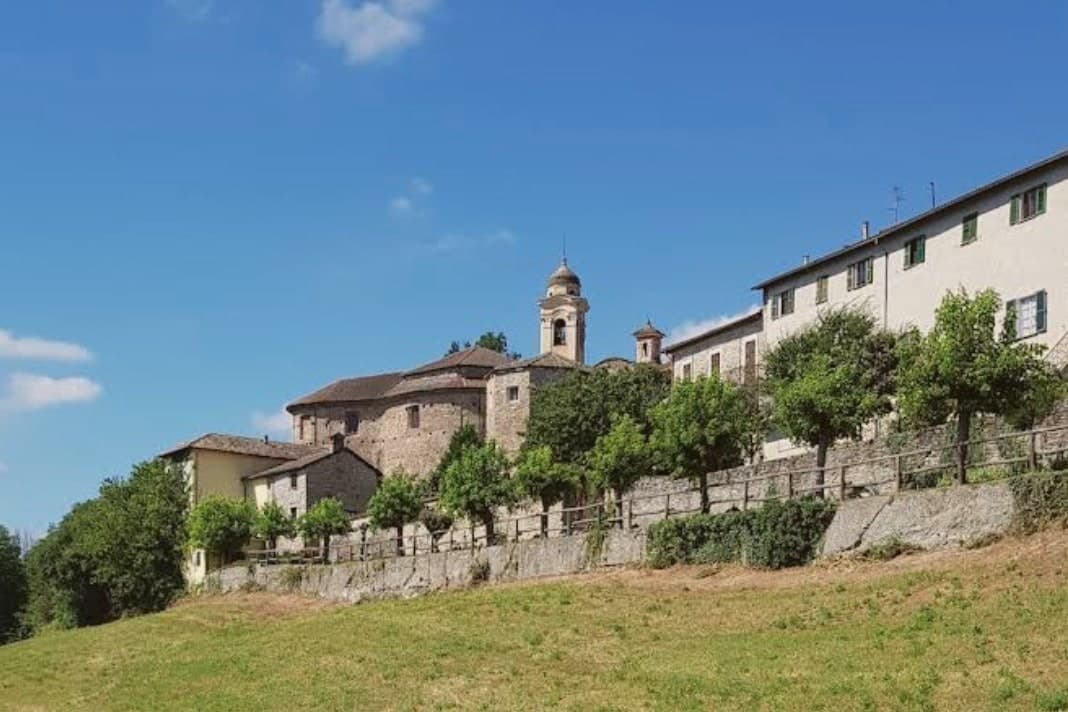
Why visit Mombaldone
The village sits at 260 meters on a ridge, fifty kilometers north of Genova and well outside the Barolo and Barbaresco circuits. The Aleramici held the land from 991, when they founded the monastery of San Quintino di Spigno; in 1209 control passed to the Del Carretto, whose descendants still own property in the village.
The castle on the high point fell in 1637 and stands in ruin, a square tower and a stretch of wall, while the walled center below has kept its ring intact around the resident population. The church built into the old moat carries canvases by the Monevi family of Acqui, a 17th-century addition to an 18th-century building.
Bormida-valley badlands open below the walls toward Liguria. The layout reads as a sequence: ruined high point, intact walled ring beneath it, open valley beyond.
What survives is not the seat of power but the perimeter that once served it, outlasting the family and the castle both.
We confirmed you can reach this one by train.
What to see in Mombaldone
- Castello dei Del Carretto. 13th-century castle on the highest point of the ridge, partially demolished in 1637; a square tower and wall fragments survive.
- Chiesa di San Nicolao. 18th-century Baroque parish church by Matteo Zucchi on a hexagonal plan, built into the old castle moat.
- Centro storico murato. Complete medieval walled perimeter, the only one preserved in full in the Langa Astigiana, enclosing the small borgo intact.
How to get to Mombaldone
There is a railway station in the town, so you can arrive without a car and never need one while you are here. Genova is roughly 84 minutes away by road.
Our tip
April through June bring the hills back to green and the walls draw a few weekend walkers from Acqui and Asti. September and October are dry and gold, with truffle weeks in nearby communes pulling small crowds onto the ridge roads. July and August can push past thirty degrees and the centro stays empty between two and six.
Verduno
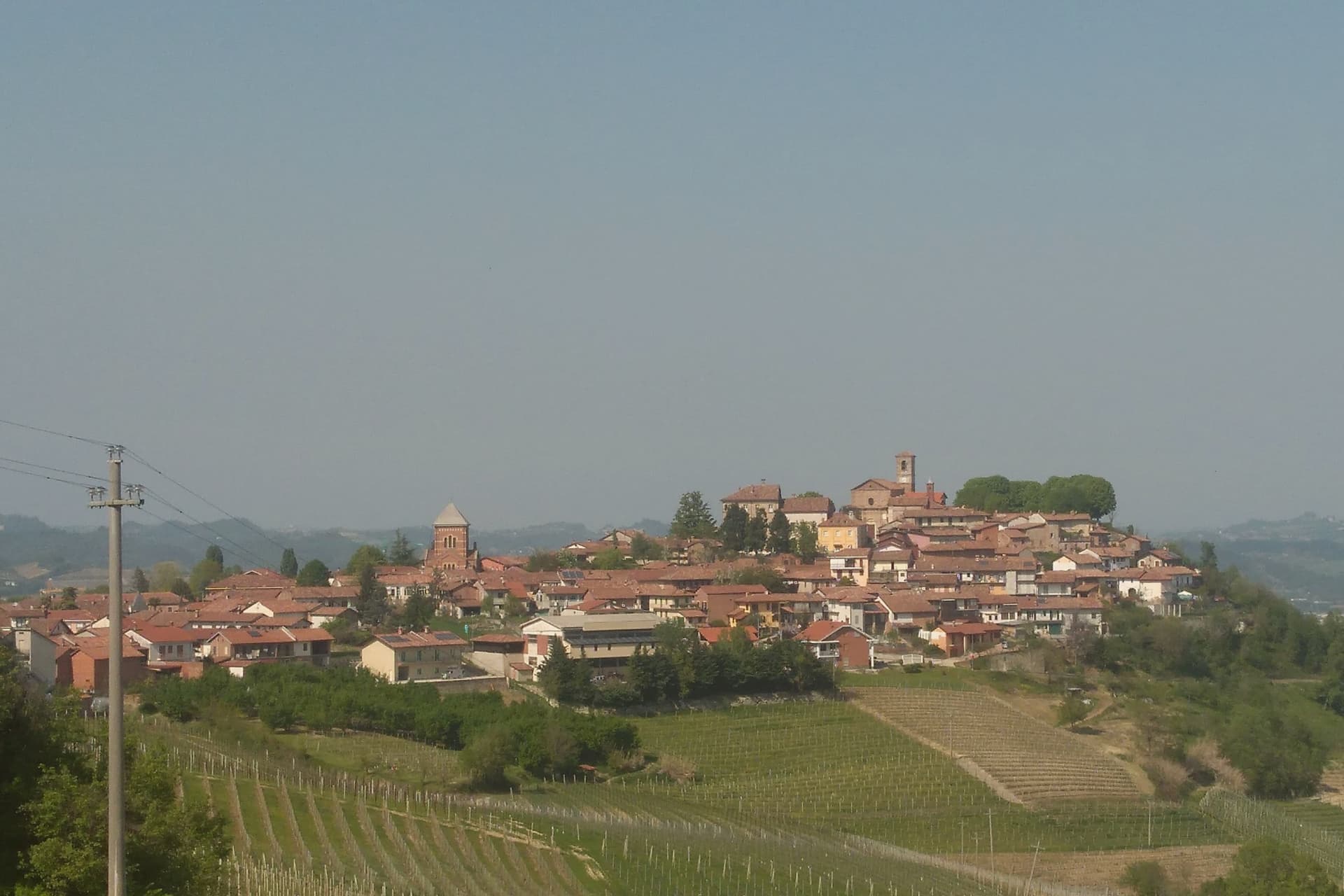
Why visit Verduno
Verduno sits fifty kilometers south of Torino on a Langhe ridge above the Tanaro, its vineyards the only ones among the eleven Barolo communes to lean partly toward the river plain rather than folding back into the hills. That position, facing the water and the Alps beyond it, sets the village apart from the rest of the DOCG even before the wine is considered.
The other thing that sets it apart is Pelaverga Piccolo, a native black grape cultivated commercially in only three Langhe communes: Verduno, La Morra and Roddi. It yields a light ruby red with strawberry, rose and a distinct white-pepper finish, and the first single-variety Pelaverga vineyard on these slopes was planted in 1972.
Between the castle on the ridge and the vine on the plain-facing slope, Verduno holds two things most of its neighbors do not: a wine that is Barolo's own, structurally, and a wine that belongs to almost nowhere else.
We confirmed you can reach this one by train.
What to see in Verduno
- Castello di Verduno. The castle stands on the Langhe ridge and passed to the Burlotto family in 1909, who still work it as a winery producing Barolo and Pelaverga.
- Centro storico. Small hilltop village arranged around the castle and the parish church, with views across the Tanaro and the northern Barolo vineyards.
- Vigneti di Pelaverga. Indigenous Pelaverga Piccolo plantings on the Verduno slopes, including the first single-variety Pelaverga vineyard planted in 1972.
How to get to Verduno
There is a railway station in the town, so you can arrive without a car and never need one while you are here. Torino is roughly 60 minutes away by road.
Our tip
April through June is the green window in the Langhe, hillsides striped between Nebbiolo and Pelaverga vines, mild evenings on the Verduno ridge. September and October are the harvest months: Pelaverga first, Nebbiolo last, with the surrounding cantine open for tastings and walking through the rows possible without crowds. July and August touch the low thirties on the hills; the centro storico thins after lunch and the cellar tastings move under stone vaults to stay cool.
Cocconato
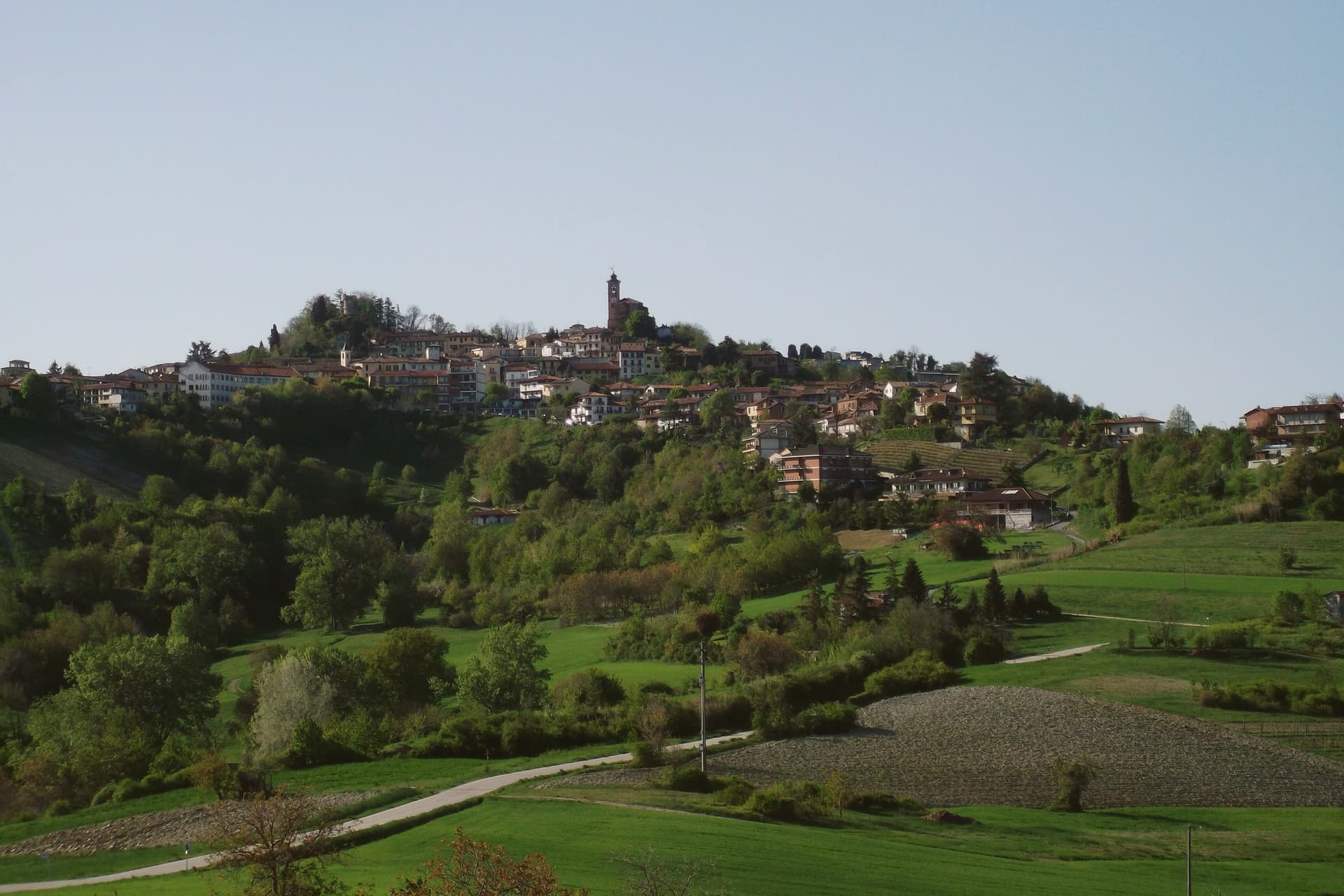
Why visit Cocconato
Cocconato sits thirty kilometers east of Torino, on a ridge whose south-facing slope catches enough sun to keep olives, palms and mimosas alive this far north, the reason locals call the area the Riviera del Monferrato. From the tenth century the ridge was held by the Radicati counts, a Manfredian family, as an imperial fief for four hundred years, until 1586: the centro storico that survives is their seat, not a later reconstruction.
The town's two anchors sit close together but answer to different authorities. The civic palace, built in the fifteenth century, faces the seventeenth-century parish church of Santa Maria della Consolazione across the upper piazza, government and religion holding opposite ends of the same small square.
Beyond the built center, the ridge opens onto a belvedere looking south across vineyards toward the Alta Langa and, on clear days, the Monviso massif. Since 1970 the six frazioni of Airali, Brina, Colline Magre, San Carlo, Torre and Tuffo have raced their donkeys in the Palio degli Asini, a modern rivalry laid over an old administrative one.
Cocconato is the only commune in the province of Asti to hold the Bandiera Arancione, a fitting distinction for a ridge that has been organizing the same handful of parts, fief, palace, church, frazioni, for centuries.
We confirmed you can reach this one by train.
What to see in Cocconato
- Palazzo Comunale. Pointed-arch porticoes and terracotta-framed windows on the Late Gothic facade, still the building the ridge town organizes itself around.
- Chiesa di Santa Maria della Consolazione. Seventeenth-century parish church anchoring the upper piazza, the religious counterweight to the medieval civic palace below it.
- Centro storico. Medieval ridge town that was the seat of the Radicati counts from the tenth century until 1586, well preserved on the south-facing slope.
How to get to Cocconato
There is a railway station in the town, so you can arrive without a car and never need one while you are here. Torino is roughly 57 minutes away by road.
Our tip
April through June and September through October are the months that earn Cocconato its Riviera nickname: dry warm days on the ridge, vineyards in green or gold, and the palms in the lower gardens visibly out of season. July and August are warm and busy, with Cocco Wine at the end of summer drawing crowds into the centro storico. November through March is the quiet half of the year.
Vogogna
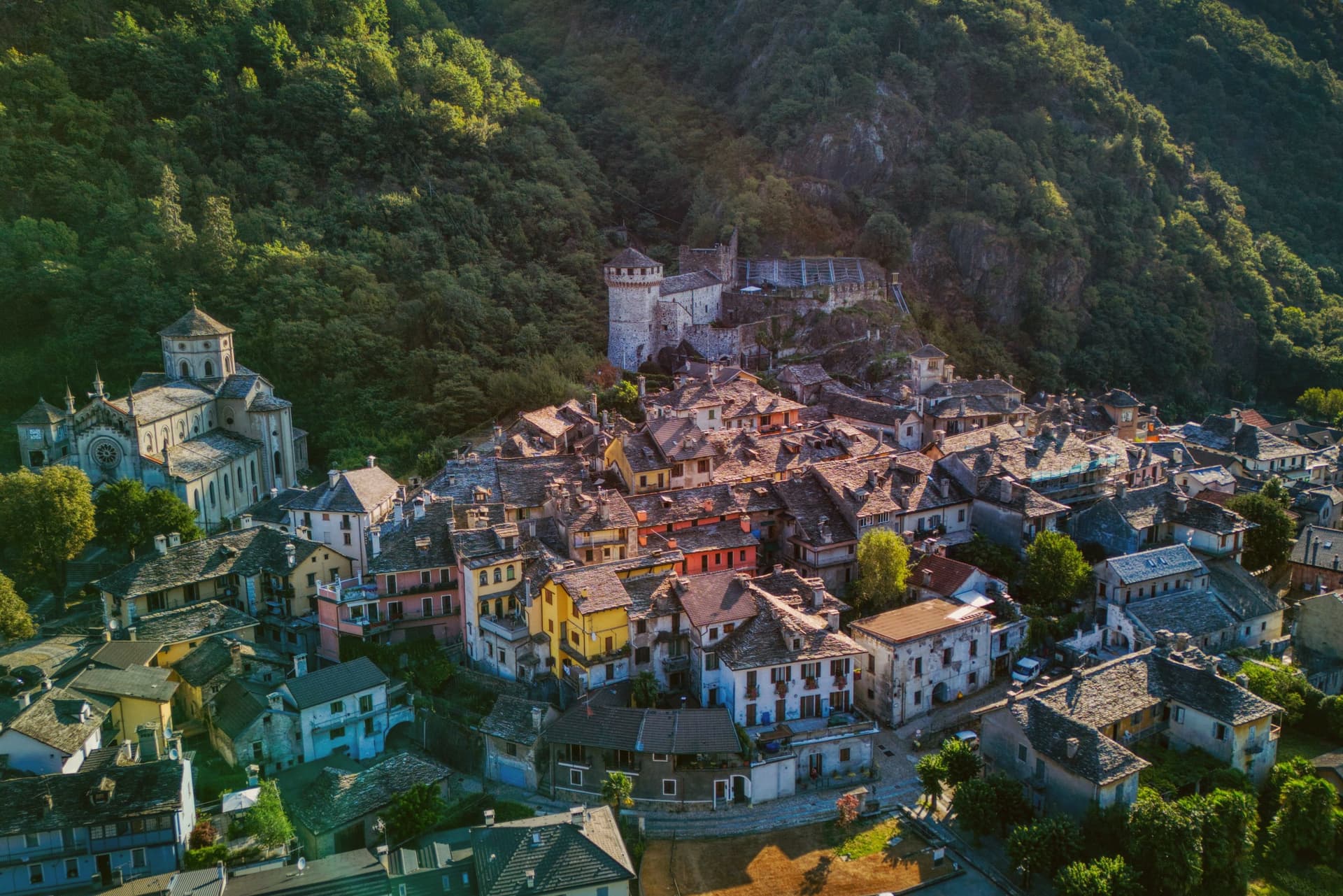
Why visit Vogogna
Vogogna sits at 226 meters on the floor of Val d'Ossola, at the narrow point of the valley where the Toce bends south toward Lago Maggiore. The castle went up on the spur above the village as part of a broader reinforcement of the Duchy of Milan against Swiss incursions over the Sempione, built alongside an older fortified rock that had already held the same defensive line.
Together they anchored the town's promotion to administrative seat for the lower half of the valley, in balance with Domodossola further up, which held the upper half. Spanish rule from the sixteenth century onward reduced the castle's strategic weight, and in 1798 it passed into municipal hands, used at one stage as a prison, before the long restoration that closed in 2005.
The borgo carries Borghi più belli d'Italia and the Bandiera Arancione, and Val Grande National Park borders the commune on the west. What the town amounts to is a lower valley's seat of government grown around a fortress that outlived its military purpose by centuries, wedged between wilderness on one side and the river's bend on the other.
We confirmed you can reach this one by train.
What to see in Vogogna
- Castello Visconteo. Restored from 1990 to 2005, the castle is now open to visitors with a multimedia conference room installed inside its walls.
- Rocca di Vogogna. Earlier fortified rock above the Visconti castle, the original medieval defensive post over the narrow point of the Toce valley.
- Centro storico. Medieval core below the castle with stone houses, narrow streets and the Palazzo Pretorio, the historic administrative seat of Ossola Inferiore.
How to get to Vogogna
There is a railway station in the town, so you can arrive without a car and never need one while you are here. Novara is roughly 75 minutes away by road.
Our tip
April through June brings clear walking weather to the Toce valley, with the upper Val Grande slopes drying out and the Visconti castle terraces open for full hours. September and October are the harvest months in Ossola, when chestnut woods turn on the lower slopes and the cooler air carries the view from the Rocca down the valley toward Lago Maggiore. July and August warm the valley floor, but the stone houses of the centro storico keep the streets shaded.
Moncalvo
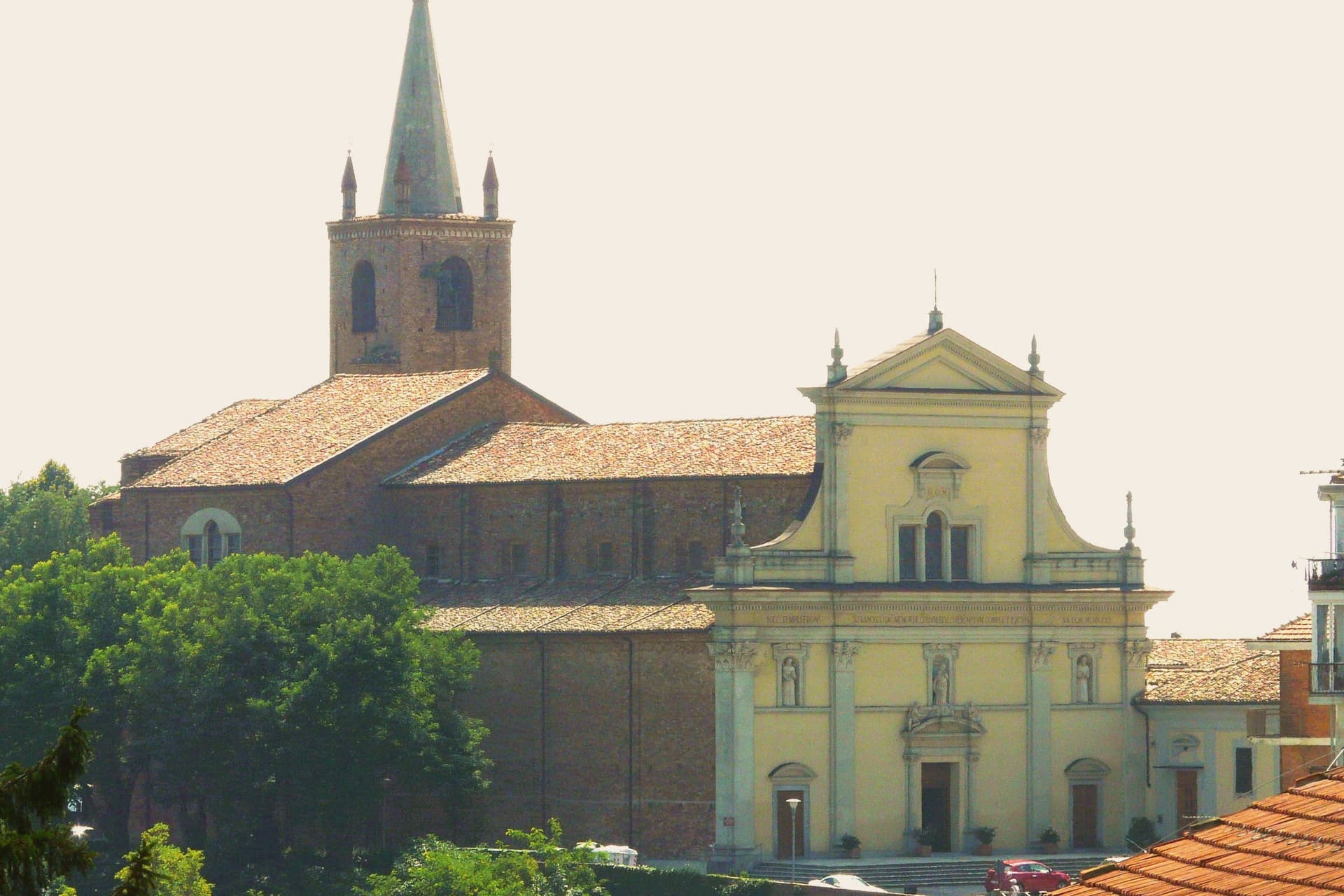
Why visit Moncalvo
Moncalvo sits at 305 meters on a Monferrato ridge, forty-five kilometers east of Torino. It carries the title of smallest city in Italy, granted by Duke Ferdinando Carlo Gonzaga in 1705 and confirmed by Victor Amadeus III of Savoy in 1775.
The town was the first capital of the Marquisate of Monferrato, founded by the Aleramici in the 10th century. Guglielmo Caccia, the Counter-Reformation painter known as il Moncalvo, was born here in 1568 and left major canvases in the churches of San Francesco and Sant'Antonio, alongside works by his daughter Orsola.
The synagogue on Piazza Carlo Alberto is the only one in the world built directly on a city's main piazza, a remnant of the Jewish community recorded here since the 1500s. The Fiera Nazionale del Tartufo, documented for more than five centuries, runs the last three weekends of October and pulls the truffle trade north of Alba into this ridge.
We confirmed you can reach this one by train.
What to see in Moncalvo
- Chiesa di San Francesco. Conventual church holding major canvases by Guglielmo Caccia (il Moncalvo) and his daughter Orsola, both 17th century.
- Sinagoga di Moncalvo. Synagogue on Piazza Carlo Alberto, the only one in the world built directly on a city's main square, with 18th-century interior.
- Chiesa di Sant'Antonio. Smaller historic church preserving further works by Guglielmo Caccia and the Moncalvo school of his workshop.
How to get to Moncalvo
There is a railway station in the town, so you can arrive without a car and never need one while you are here. Novara is roughly 62 minutes away by road.
Our tip
April through June and September into October are the months the ridge feels right. October is the truffle weeks, when buyers and restaurants book the ridge well ahead and the streets around Piazza Carlo Alberto fill on Saturday and Sunday mornings. July and August push past thirty degrees and the centro empties in the afternoon, though the elevation keeps evenings tolerable. His Majesty the Fat Ox's National Fair falls in February.
Castagnole delle Lanze
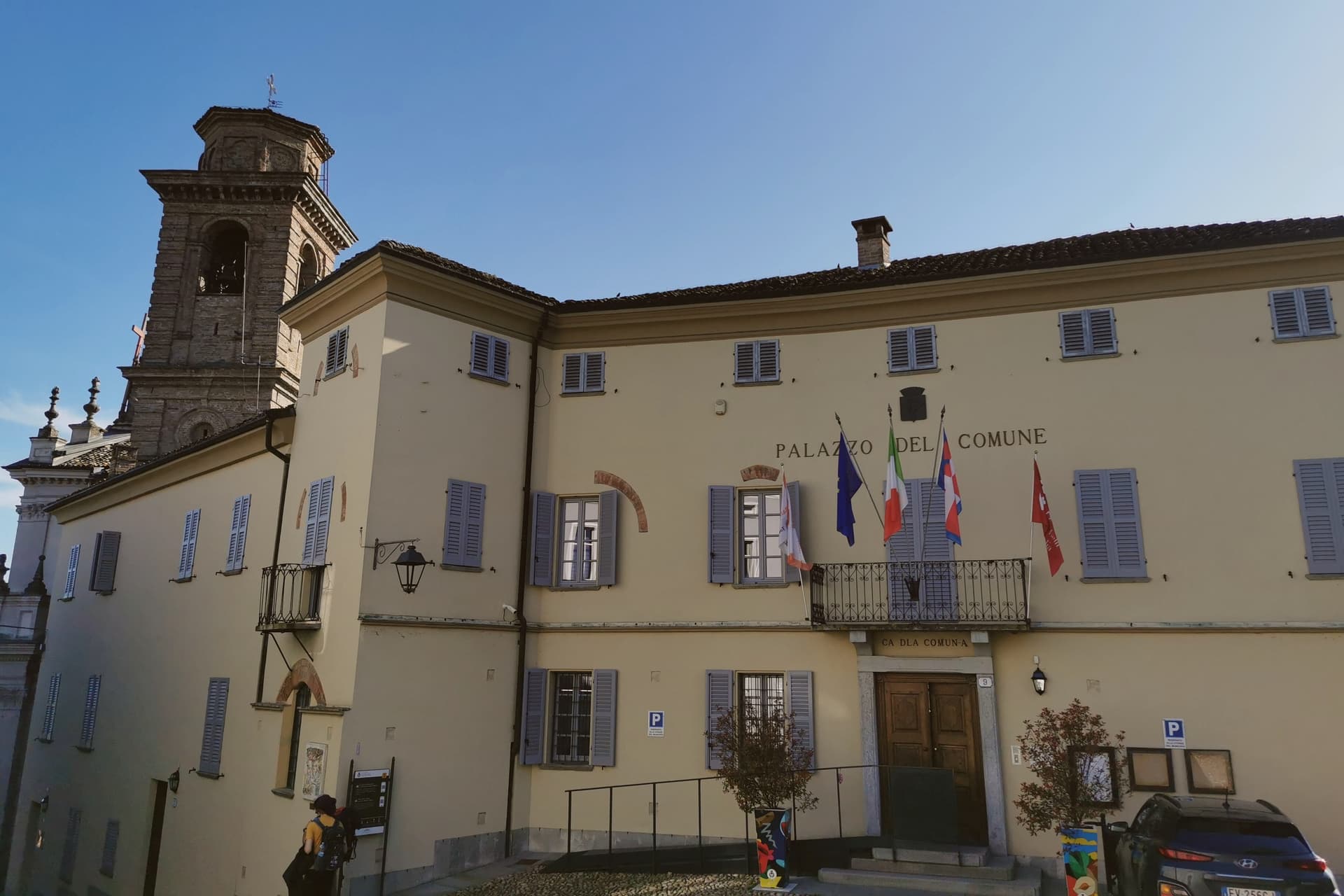
Why visit Castagnole delle Lanze
Fifteen kilometers south of Asti, Castagnole delle Lanze lies in the UNESCO Vineyard Landscape of Piedmont, on ground once crossed by a Roman road branching off the Via Aemilia between Acqui and Pollenzo. In the Middle Ages the lands belonged to the counts of Loreto, with Manfredo I the count most tied to the community; their castle, probably destroyed in 1255 when the contado fell, has not survived, and from the thirteenth century the town passed under the Comune of Asti.
The main square and Piazza Balbo hold the two churches that anchor the lower town, while the Parco della Rimembranza occupies the highest ground of the village, looking over the Tinella and Tanaro valleys. What remains is a settlement built in layers: a Roman route, a lost medieval castle, a pair of Baroque churches, and a nineteenth-century tower, each belonging to a different century and none of them replacing the one before it.
We confirmed you can reach this one by train.
What to see in Castagnole delle Lanze
- Chiesa di San Pietro in Vincoli. Parish church of 1681 on the main square, Ligurian-Piedmontese Baroque with a twin-bell-tower façade.
- Chiesa dei Battuti Bianchi. Confraternity church of 1668 in Piazza Balbo, deconsecrated and now used as a space for cultural events.
- Torre di San Robert. Built by Count Paolo Ballada di San Robert, the tower stands at the top of the Parco della Rimembranza and still functions as a lookout over the surrounding hills.
How to get to Castagnole delle Lanze
There is a railway station in the town, so you can arrive without a car and never need one while you are here. Torino is roughly 72 minutes away by road.
Our tip
April through June brings the vines into leaf and the Tinella valley into clear light, with the Torre di San Robert opening on weekends. September and October are harvest, the high season for the Langhe-Monferrato hills and the time the Adotta un filare initiative runs its tastings. July and August get hot on the south-facing slopes; mornings in the Parco della Rimembranza and evenings on the main piazza are the cooler hours. Borgo diVino tour falls in October.
More from Anywhere Italy
- The best hill towns in the province of Asti
 The best hidden hill towns you can reach by train within 90 minutes of Torino
 The best small wine towns within 90 minutes of Torino
- The 7 best wine towns you can reach by train within 90 minutes of Torino
- The best small towns you can reach by train that have a serious restaurant in Piemonte
- The 6 best hidden towns you can reach by train that eat well within 90 minutes of Torino