
The best hot-spring towns within two hours of Parma
Thermal water in Emilia is not a garnish. It comes up salty or sulphurous from under the plain and the low Apennines, and the towns that sit on it have organised themselves around it, with liberty-era bathhouses, colonnaded drinking halls, tiled pools and gardens of plane trees planted for shade between treatments. Autumn is the season locals use, when the vines are being stripped, the fog starts to sit in the Po valley in the early evening, and a soak makes obvious sense. The food does not soften for the wellness crowd either: anolini in brodo, culatello from the river villages, torta fritta and stracchino, gnocco fritto with the local ham. Houses here run to brick and render, ochre and rose, with deep eaves and courtyards that stay cool.
Most people looking for thermal water in northern Italy go to Salsomaggiore Terme, or drive on to the Euganean hills around Abano Terme, where the mud treatments and the big hotel spas have been packaged for coach groups and weekend traffic since the middle of last century. The infrastructure is good and the water is mineral, but the scale is a resort's. Booking windows tighten in spring and autumn, the car parks fill, and the promenades belong to the hotels rather than the town.
The geology does not stop at the famous names. The same springs surface along the Via Emilia and up into the Apennine valleys, in market towns and castle towns that happen to have thermal baths at the edge of the historic centre, and where the bar next door still serves people who are not there for the water. These are the smaller places, easily reached from Parma by car or, in several cases, by train, and worth a detour whether or not you get in the pool.
Of the 87 communes we have mapped in a 120-minute drive of Parma, 6 qualify as hot-spring towns: each has thermal water a town has been built around. The smallest, Bobbio, has 3,408 residents.
If you are still choosing, we have also written The best hot spring towns in Emilia-Romagna and The best hot-spring towns within two hours of Brescia.
Bobbio
Why visit Bobbio
Bobbio sits on the left bank of the Trebbia at 272 meters, at the foot of Monte Penice in the Piacentine Apennines. The land was granted to Saint Columbanus by the Lombard king Agilulf in 614, and the monastery he raised on it grew, by the eighth century, into one of the principal libraries north of Rome, copying Greek, Latin, and Irish manuscripts that survived nowhere else.
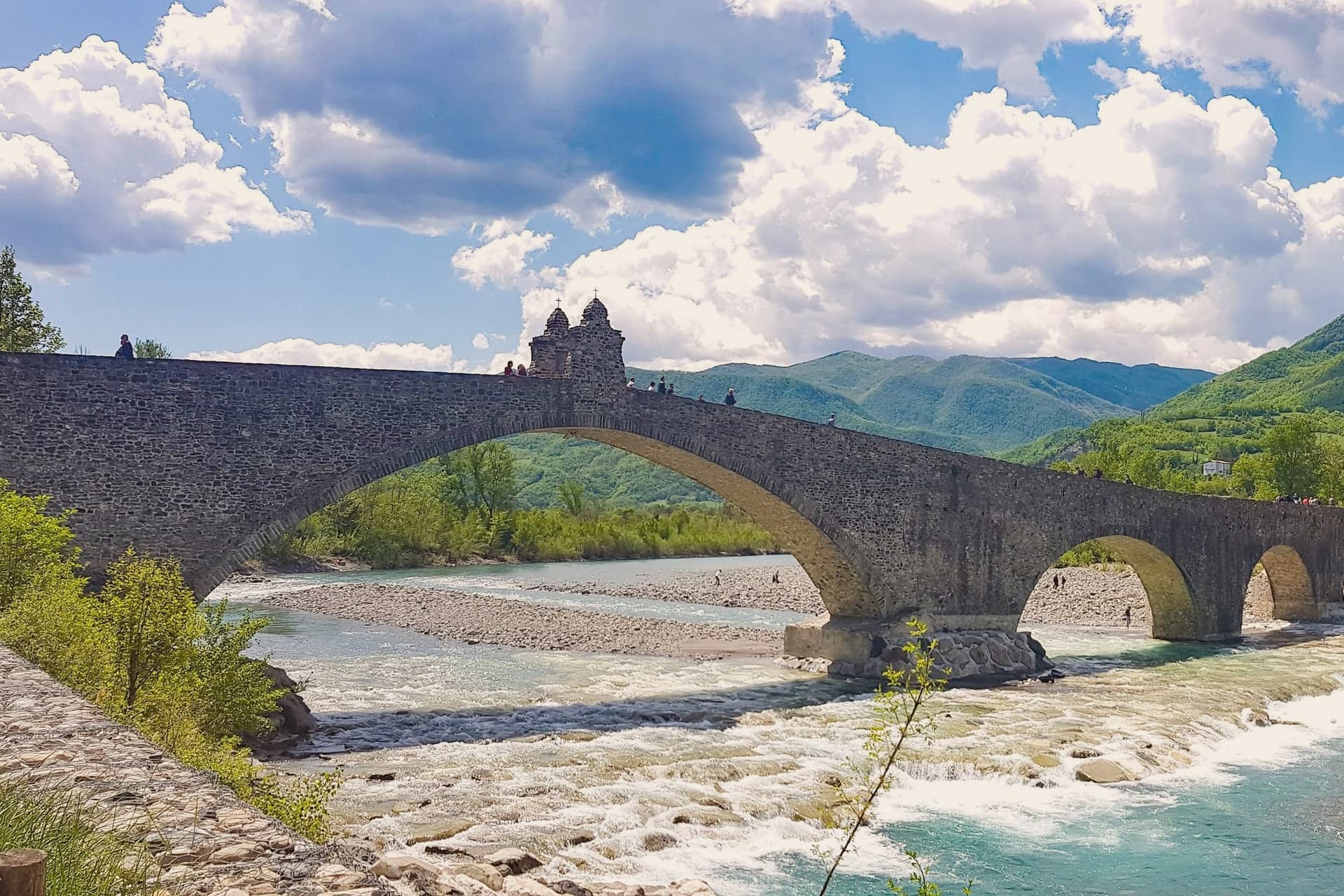
The French suppressed the monastery in 1803; what the scriptorium and library once held now lives in fragments, kept in the basilica and its museum. The town below the abbey is crossed by the Trebbia on the Ponte Gobbo, its eleven irregular arches stretching 273 meters, a shape that gave rise to the story of the Devil and the saint dividing the bridge between them.
Bobbio still carries the Borghi più belli and Bandiera Arancione designations alongside the 2019 RAI title. A river crossing, a hill fortress, and a monastery ruin sit within reach of one another here, each holding a different piece of the same long settlement, one built by faith, one by feudal power, and one by the river itself.
What to see in Bobbio
- Abbazia di San Colombano. The basilica and grounds where Saint Columbanus settled still stand; the scriptorium he founded is gone but its output is documented in surviving manuscripts held elsewhere.
- Ponte Gobbo. The eleven arches sit unevenly across the riverbed, the irregularity of their spacing the source of both the Devil's Bridge name and the Columbanus legend attached to it.
- Duomo di Bobbio. Romanesque cathedral begun in 1075, dedicated to Santa Maria Assunta, with a fifteenth-century fresco cycle in the apse.
How to get to Bobbio
Piacenza is roughly 63 minutes away by road.
Our tip
April through June brings the green Val Trebbia season, when the river runs clear enough for swimming holes downstream. September and October are the working months for chestnuts, mushrooms, and the maccheroni alla bobbiese the town fills its trattorie with. July and August can hit thirty-three degrees in the valley, and the 2019 Borgo dei Borghi win still draws weekend crowds that fill the Ponte Gobbo. La Festa del Pinolo falls in August.
Sirmione
Why visit Sirmione
The peninsula runs four kilometers into the southern end of the lake, narrow enough that the old town occupies a triangle of land just over a mile long. Three low hills organize it: Cortine, San Pietro, and the rise at the tip where the Roman villa stands.
The fortress sits at the single entrance to the walled town, so the only way in by land passes through its gate, and the water it once enclosed as a fortified port is still shut in behind it. Past that gate the medieval streets are packed between the hills, and the ground rises toward the church at the highest point before falling away again toward the villa ruins at the peninsula's end.
The name attached to the villa is literary rather than archaeological: the poet's return in his thirty-first poem was to a family property on this tip of land, and nothing dug from the ground proves the two are the same place, but the name has held for a thousand years regardless. Maria Callas kept a villa here through the 1950s and 60s.
Between the enclosed water at one end and the hot spring at the other, the peninsula reads as a strip of land defined entirely by what edges it: lake on three sides, a gated approach on the fourth, and a history that settled into the name of a poem long before anyone could confirm it belonged there.
What to see in Sirmione
- Castello Scaligero. Fortress at the entrance to the old town, with a 37-meter keep and a fortified port still enclosing a piece of the lake.
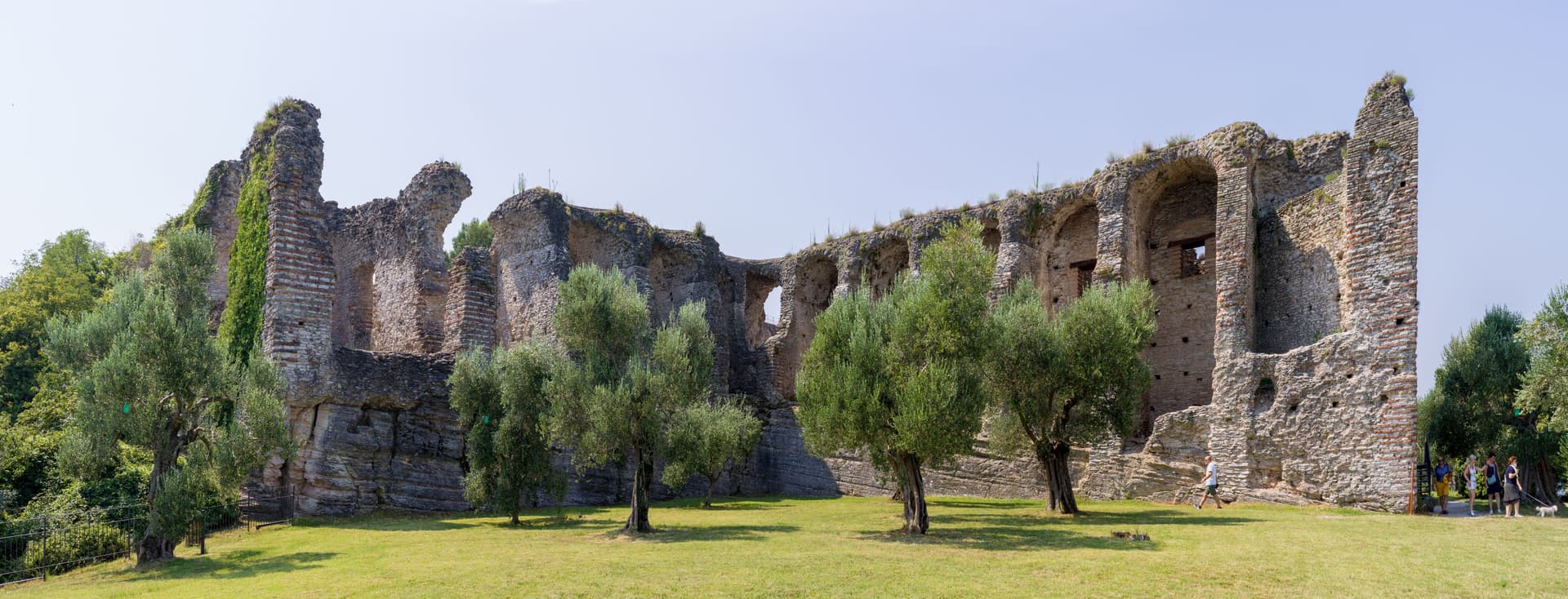
- Grotte di Catullo. Villa complex built late first century BC to early first century AD, its ruins scattered across olive terraces at the tip of the peninsula.
- Terme di Catullo. Thermal spa drawing on the same mineral spring that surfaces offshore in Lake Garda.
How to get to Sirmione
Verona is roughly 36 minutes away by road.
Our tip
April through October is the lake season. The Grotte di Catullo open with the spring archaeological calendar, the Scaligero is open year-round, and the peninsula promenade fills with day-trippers from Verona and the German A22 corridor. July and August are the heaviest months, with the old town packed between ten and seven; April, May, September and October are the easier months.
Montignoso
Why visit Montignoso
Montignoso sits at 132 meters at the foot of the Apuan Alps, between Massa and Pietrasanta, in the corner where Massa-Carrara province meets Versilia. Inland, the hill village stands under the castle's rise; the coastal frazione lies well apart from it, opening onto the Versilia beach, so the commune is really two settlements, one on the slope and one on the sand, with the wetland reserve filling the plain between them.
The town declined through the sixteenth century because of coastal malaria, which explains the gap between the fortified hill and the later life of the shore: the two halves of Montignoso grew up in different centuries for the same reason, one retreating from the coast, the other only possible once that reason had passed. The thermal signal comes from a small spring on the Pasquilio side of the commune.
Read together, Montignoso is a place defined less by any single site than by the line running from mountain to marsh to sea, each part settled on its own schedule.
What to see in Montignoso
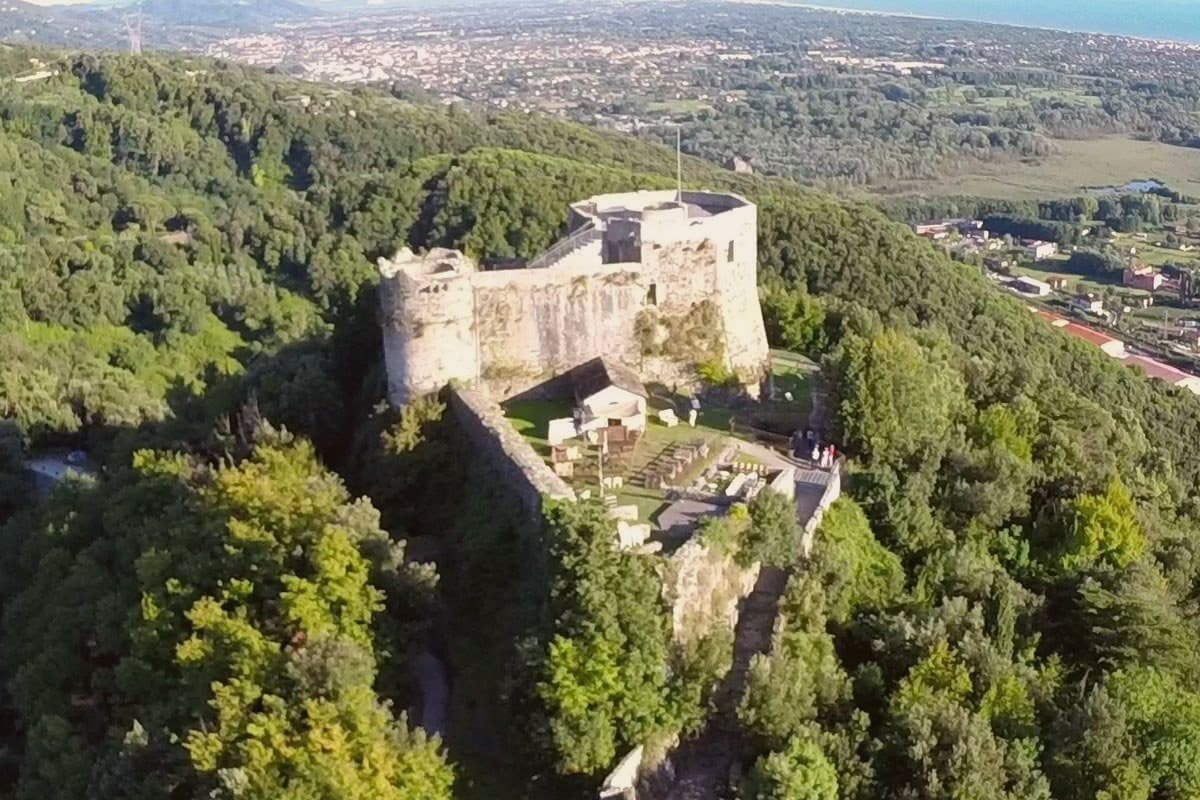
- Castello Aghinolfi. The castle stands on an isolated rise above the village. What remains is the strongpoint that once taxed and watched the road below, not a ruin left to itself but a position, still legible as one.
- Lago di Porta. The reserve covers the coastal plain, flat water against the line of the Apuan Alps. The gate it is named for is gone; the wetland it left behind is not.
- Cinquale. Fine sand with the Apuan Alps rising directly behind it, a seafront quieter than its better-known neighbor and shaped by that comparison rather than by its own crowds.
How to get to Montignoso
There is a railway station in the town, so you can arrive without a car and never need one while you are here. Pisa is roughly 52 minutes away by road.
Our tip
May through September brings the Cinquale beach into use and the trails to the Castello Aghinolfi clear of winter rain. June and September are the cleanest weather. July and August fill the seaside parking and push the Pasquilio uplands into wildfire-risk hours.
Montechiarugolo
Why visit Montechiarugolo
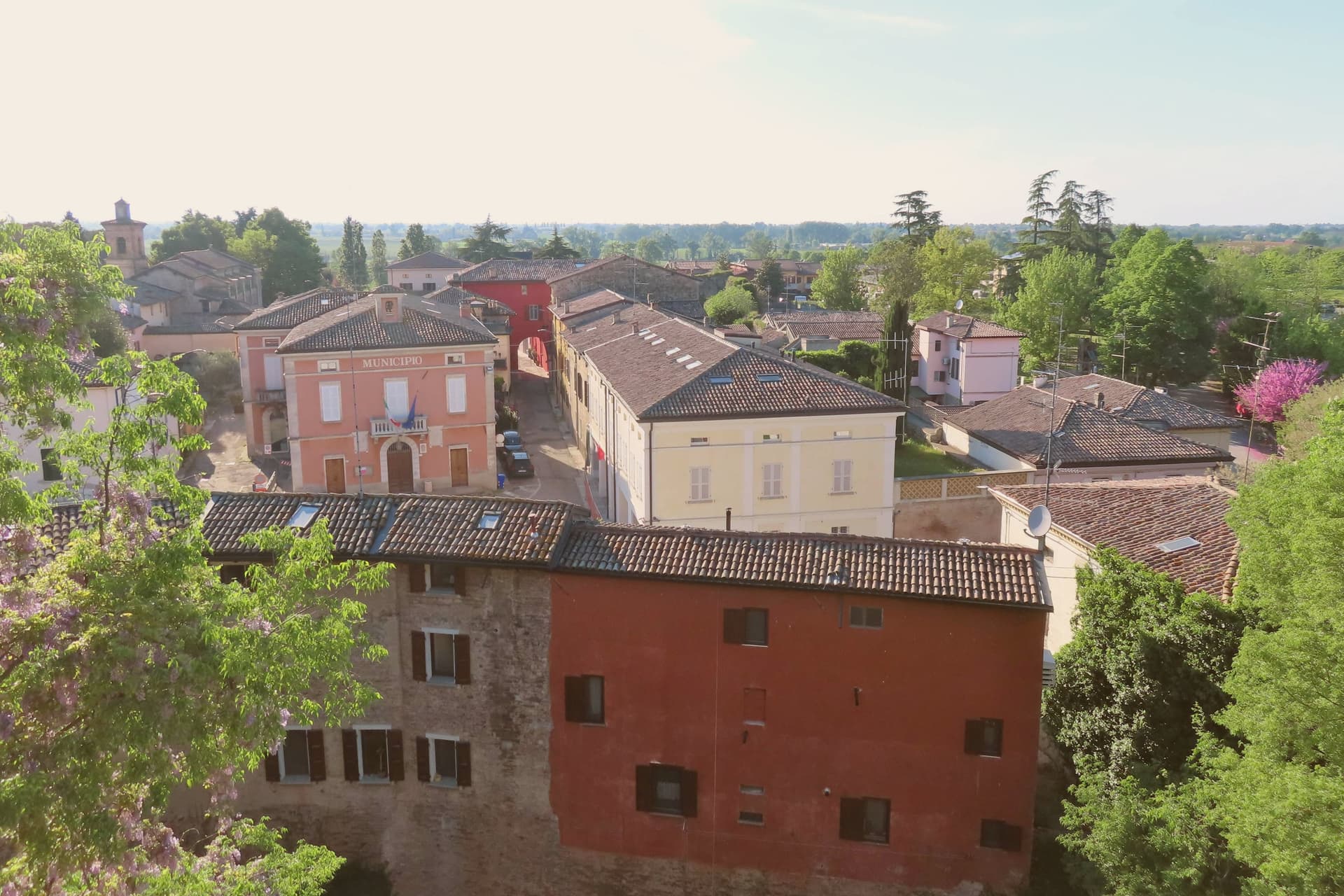
Montechiarugolo sits ten kilometers southeast of Parma at the edge of the Enza valley, on the historical border between the Duchy of Parma and the Reggio territory. The Sanvitale family raised a first military outpost here in 1121; the current castle, polygonal in plan with walls five meters thick and a thirty-meter ditch, was rebuilt by the Torelli after 1406 and hosted Pope Paul III and Francis I of France during the sixteenth century.
The Kingdom of Italy sold the manor to Antonio Marchi in 1864, and his descendants still own and open it. The surrounding fields run with the middle Enza dairies that produce Parmigiano-Reggiano under the Parma consortium.
The commune extends to the Monticelli spa frazione, the only thermal complex in the province. Beyond Parmigiano and the castle, Montechiarugolo holds two institutional signals: Borghi più belli d'Italia and Comuni Virtuosi for its environmental policy.
What to see in Montechiarugolo
- Castello di Montechiarugolo. Polygonal fourteenth-century fortress on a promontory above the Enza, with five-meter walls, a wide ditch, and frescoed halls; still privately owned by the Marchi family.
- Chiesa di San Quintino. Eighteenth-century parish church on the edge of the centro storico, rebuilt after the older medieval pieve was incorporated into the castle complex.
- Terme di Monticelli. Thermal spa in the Monticelli frazione, drawing on iodine-bromine-salt waters discovered in 1924 during oil exploration in the Enza plain.
How to get to Montechiarugolo
Parma is roughly 24 minutes away by road.
Our tip
April through June and September through October are the working months. The Enza fields turn green in spring and stay that way until the cheese-making cycle quiets in summer. July and August touch thirty-five degrees on the plain and the castle terrace becomes the coolest spot in the borgo.
Castel San Pietro Terme
Why visit Castel San Pietro Terme
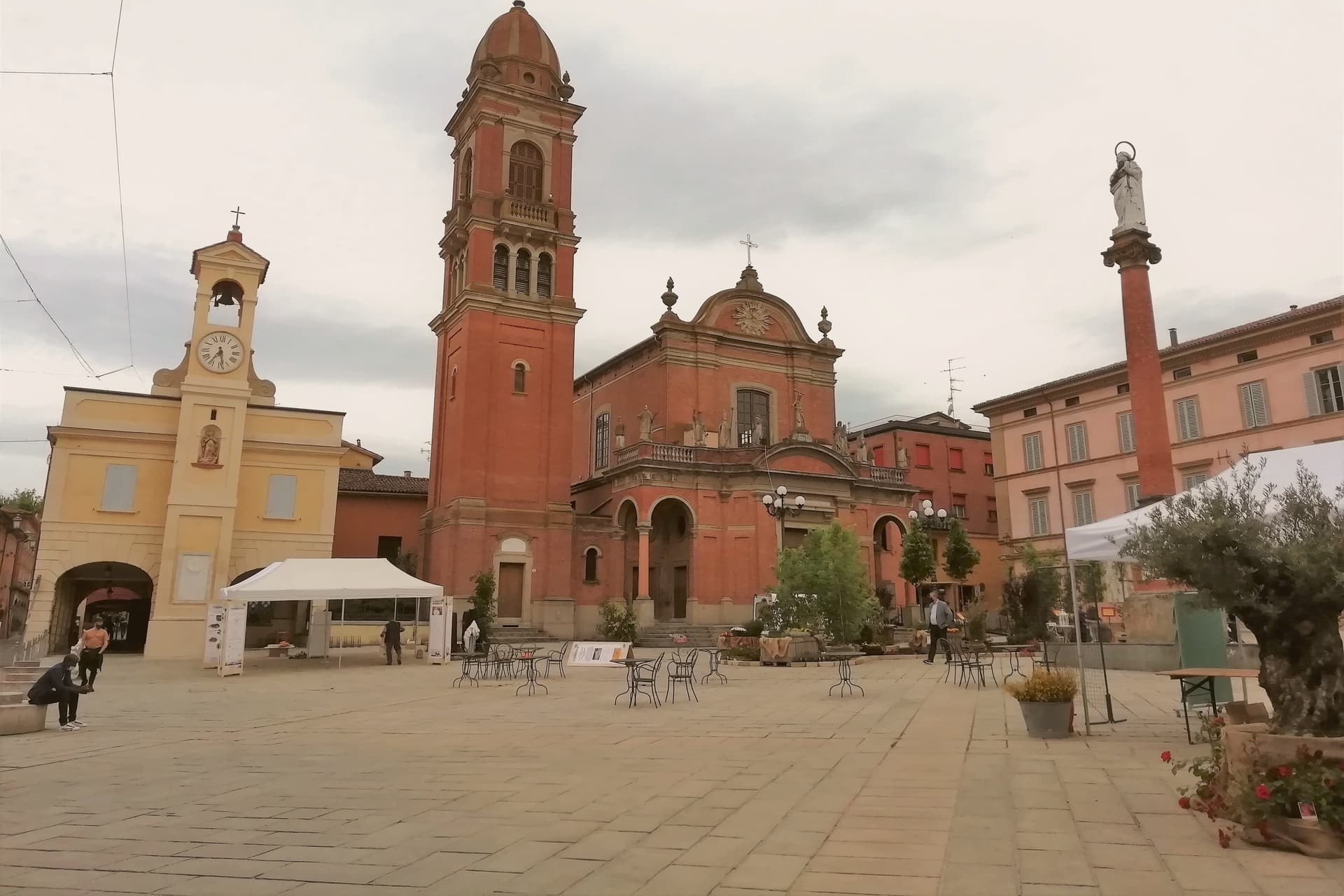
The town sits on the Sillaro river, which marks the historic border between Emilia and Romagna, twenty kilometers east of Bologna on the Via Emilia. It was founded as a Bolognese castrum in 1200, and the walled core still follows that original plan, with the river bridge on one edge and the road toward Imola leading out past the walls to the pilgrimage shrine beyond.
Castel San Pietro also joined the Città dell'Olio network for its hillside olive cultivation, a rural counterpart to the spa and civic life inside the walls. The Conservatorio Santa Caterina, founded in 1741, is one of the older female educational institutions still active in the region, sitting inside the same historic core as the gateway and the town hall.
The town reads as two things held together: a walled medieval seat on a border river, and a spa destination whose waters predate the walls by decades. Both draw on what was already there long before either was built up for visitors.
What to see in Castel San Pietro Terme
- Cassero. The gateway stands at the southern edge of the old walls, its stone face marking what was once the main entry into the castrum. Inside, the civic theater now occupies the space, so the structure that once controlled access to the town now hosts its audiences.
- Terme di Castel San Pietro. The complex draws on sulphurous, ferruginous and salt-bromine-iodide springs, with the first establishment opened in 1870. The waters run year-round from the same sources used centuries before the modern building existed.
- Santuario del Crocifisso del Piratello. Pilgrimage shrine on the Via Emilia toward Imola, built around a fifteenth-century crucifix and decorated by Innocenzo da Imola. It drew pilgrim traffic from across northern Emilia, standing apart from the walled town on the road out toward Romagna.
How to get to Castel San Pietro Terme
There is a railway station in the town, so you can arrive without a car and never need one while you are here. Bologna is roughly 39 minutes away by road.
Our tip
Castel San Pietro Terme runs all twelve months because the thermal water does. Spring and autumn are the easier months for walking the centro storico and the Sillaro valley, with mild light and the olive groves on the hill above town green or harvest-coloured. June through August touches the low thirties and humid, but the spa runs longer hours in summer and the riverside frazione of Osteria Grande stays cool.
Imola
Why visit Imola
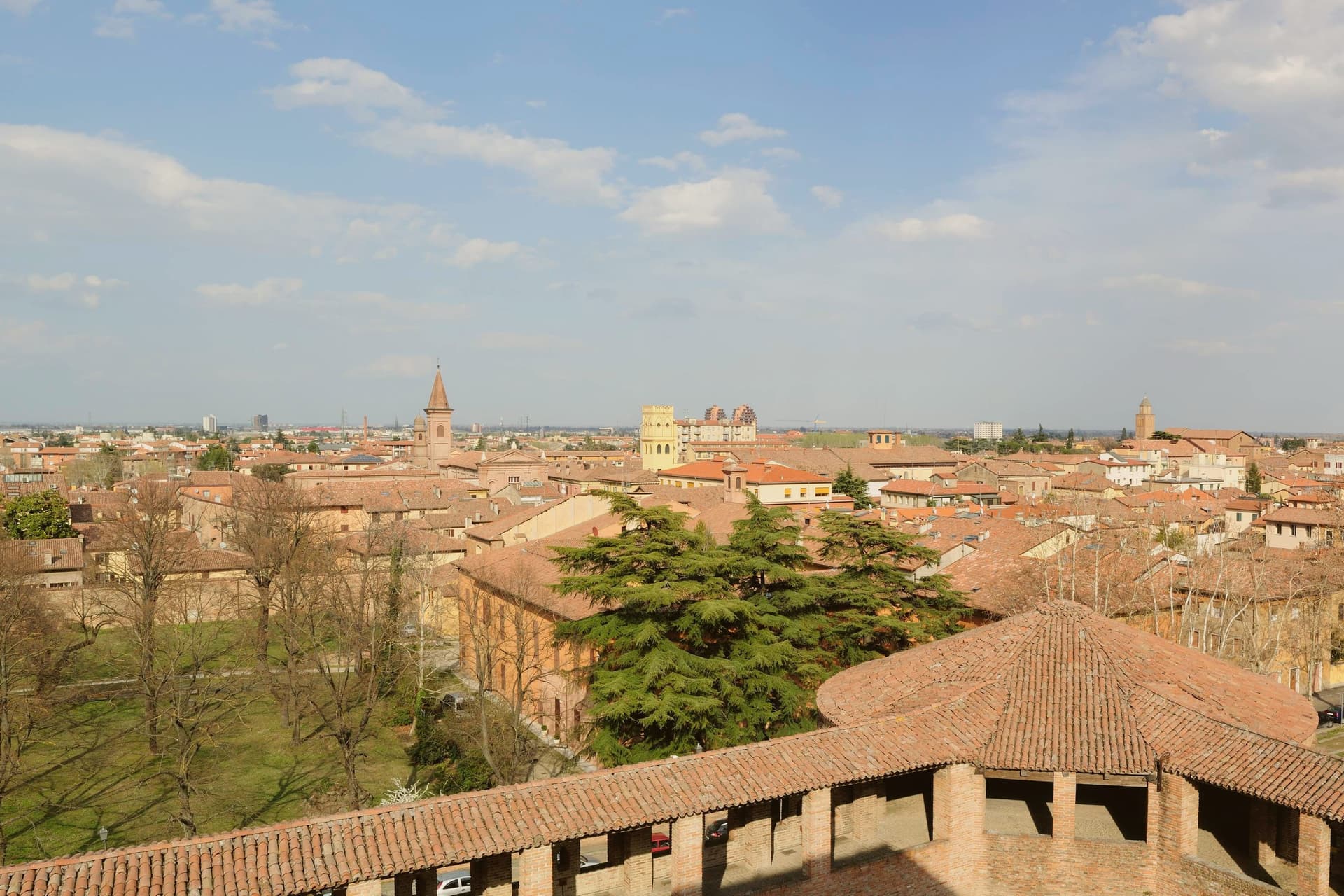
Imola is two cities sharing a name. The medieval one is a quietly handsome Romagna brick town 35 km southeast of Bologna along the Via Emilia, with the Rocca Sforzesca (rebuilt by Caterina Sforza in 1473–1499 — the Tigress of Forlì, who held this fortress through the Borgia siege of 1500) anchoring the centro.
The Palazzo Tozzoni museum, the 11th-century Cattedrale di San Cassiano with its crypt of the city's patron, the Palazzo Sersanti on the central piazza, and the medieval grid of porticoed brick streets all read as a smaller-scale Bologna. The OTHER Imola is the Autodromo Enzo e Dino Ferrari — the 4.9-km F1 circuit on the south bank of the Santerno, built 1953 and named for Enzo Ferrari and his son Dino after Dino's death.
It hosted the San Marino Grand Prix every May from 1981 to 2006 (and again 2020–present), and is the circuit where Ayrton Senna died in 1994 at the Tamburello corner — a memorial still stands there. The Emilia Romagna Grand Prix in April–May is the city's biggest tourist event of the year.
Outside race weekends the circuit is a public park; locals jog the track. The food is Romagna: piadina romagnola (the city is Città dell'Olio, and the local Brisighella Nostrana di Brisighella DOP olive oil is what dresses it), passatelli in brodo, cappelletti, Sangiovese di Romagna from the surrounding hills, and the local nocino walnut liqueur made by every grandmother in the foothills.
What to see in Imola
- Rocca Sforzesca. Caterina Sforza's 1499 four-towered brick fortress at the centro's edge — the Tigress of Forlì held it against Cesare Borgia in 1500. Museum of arms and ceramics inside.
- Autodromo Enzo e Dino Ferrari. The 4.9-km F1 circuit on the Santerno. Senna memorial at Tamburello. Open as a public park outside race weekends — locals jog the track.
- Cattedrale di San Cassiano + crypt. 11th-c cathedral with the city patron's crypt; the Madonna del Piratello pilgrimage church just outside the walls is a major regional sanctuary.
How to get to Imola
There is a railway station in the town, so you can arrive without a car and never need one while you are here. Forlì is roughly 34 minutes away by road.
Our tip
Imola is best April–June and September–October. The Emilia Romagna Grand Prix (last weekend April / first weekend May) fills every hotel for 80 km — wonderful if you're going, brutal if you're not. Summer is hot and sticky. Baccanale Imola falls in October.
More from Anywhere Italy
- The best hot spring towns in Emilia-Romagna
 The best hot-spring towns within two hours of Brescia
- The best hot-spring towns within two hours of Milan
- The best hot-spring towns within two hours of Padua
- The best hot-spring towns within two hours of Verona
- The best hot-spring towns within 90 minutes of Bologna