
The best hill towns you can reach by train within 90 minutes of Ancona
Behind Ancona the land folds quickly. Within the time it takes to drink a coffee and read the paper, the train has left the Adriatic and is running up river valleys between wheat, sunflowers and rows of Verdicchio, with hill towns standing on the ridges above in brick and pale stone. This is the Marche that eats well and quietly: vincisgrassi baked in heavy trays, olive ascolane, ciauscolo soft enough to spread on bread, wine from Matelica and the Esino valley. Late spring and early autumn are the best of it, when the light is long and the hill roads are green rather than bleached.
The obvious move is to stay on the coast, or to take the bus inland to Urbino for the Palazzo Ducale and the Raphael house. Urbino is worth the trip and everyone knows it, so the ducal courtyard fills through the middle of the day in summer and the town's small centre absorbs a lot of coaches. The Conero riviera does the same on a weekend, with the beaches below Sirolo and Numana packed from morning.
The hills do not stop at Urbino. The same ridges and the same kitchens run south and west along the Esino, the Potenza and the Chienti, through gorges, abbeys, caves and arcaded squares, and the regional line follows the valleys most of the way. The towns here are the smaller stops on those lines, inland settlements we have confirmed you can reach without a car.
Of the 35 communes we have mapped within 90 minutes of Ancona, 7 qualify as hill towns you can reach by train: each is an inland hill settlement, and we have confirmed each is reachable without a car. The smallest, Genga, has 1,682 residents.
If you are still choosing, we have also written The best hidden hill towns you can reach by train in Marche and The 10 best hill towns that eat well within 90 minutes of Ancona.
Genga
Why visit Genga
Genga sits at 322 meters on the Sentino river in the Apennine foothills of the Marche, seven kilometers downstream from Sassoferrato and twelve north of Fabriano. The commune is the ancestral seat of the della Genga, the noble family that gave the Catholic Church Pope Leo XII, born at the Castello della Genga in 1760.
The territory is best known for the Grotte di Frasassi, a thirteen-kilometer karst system whose entrance was found in 1971 and opened to visitors in 1974. The Abisso Ancona, a single chamber roughly 180 by 120 meters and nearly 200 tall, is large enough to hold the Milan cathedral.
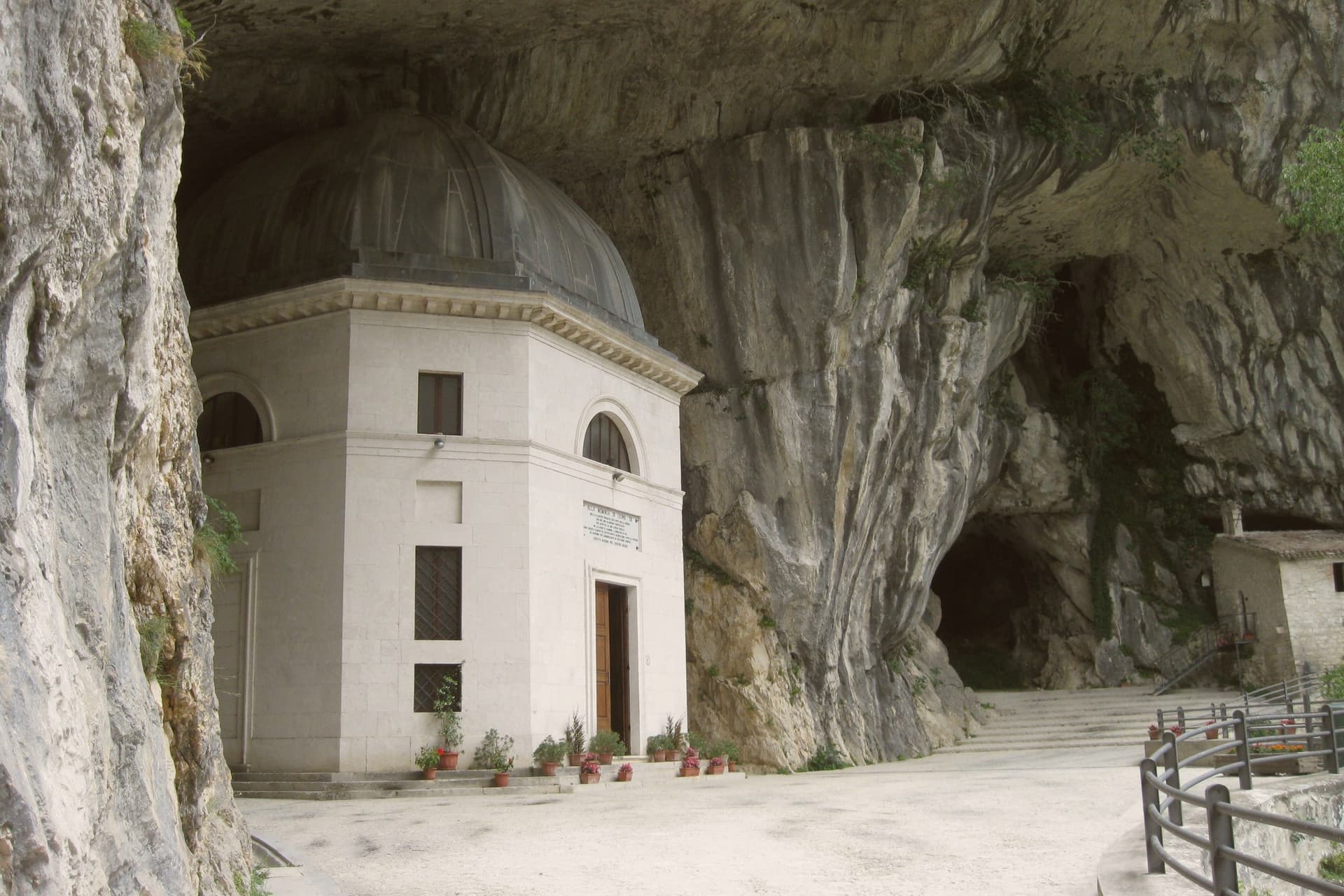
Above the cave entrance, the Tempio del Valadier, an octagonal neoclassical chapel set into a cliff wall, was commissioned by Leo XII from Giuseppe Valadier in 1828. The Abbazia di San Vittore alle Chiuse, a Romanesque Benedictine church on a Greek-cross plan, stands at the gorge mouth and dates to before 1080.
We confirmed you can reach this one by train.
What to see in Genga
- Grotte di Frasassi. Thirteen kilometers of karst passageways found in 1971 and opened in 1974, with the Abisso Ancona chamber 180 by 120 meters wide and 200 meters tall.
- Tempio del Valadier. Octagonal neoclassical chapel commissioned by Pope Leo XII from Giuseppe Valadier in 1828, built of travertine and set into the cliff above the gorge.
- Abbazia di San Vittore alle Chiuse. Romanesque Benedictine church on a Greek-cross plan with four columns, built of local limestone, attested before 1080 at the mouth of the Frasassi gorge.
How to get to Genga
There is a railway station in the town, so you can arrive without a car and never need one while you are here. Ancona is roughly 62 minutes away by road.
Our tip
April through June and September into October are the best months for Genga. The Sentino valley turns green from April, the limestone gorges hold the cool, and the woodland trails through the Gola della Rossa park stay open through autumn. The Frasassi caves run at a constant fourteen degrees year-round; a light jacket is needed even in August.
Serra San Quirico
Why visit Serra San Quirico
Serra San Quirico sits at 409 meters on the left bank of the Esino river, at the foot of Monte Murano and the entrance to the Gola della Rossa, forty-five kilometers from Ancona. Etruscan, Picene and Roman remains have been found in the area; the Romans established a military garrison that grew into the original village.
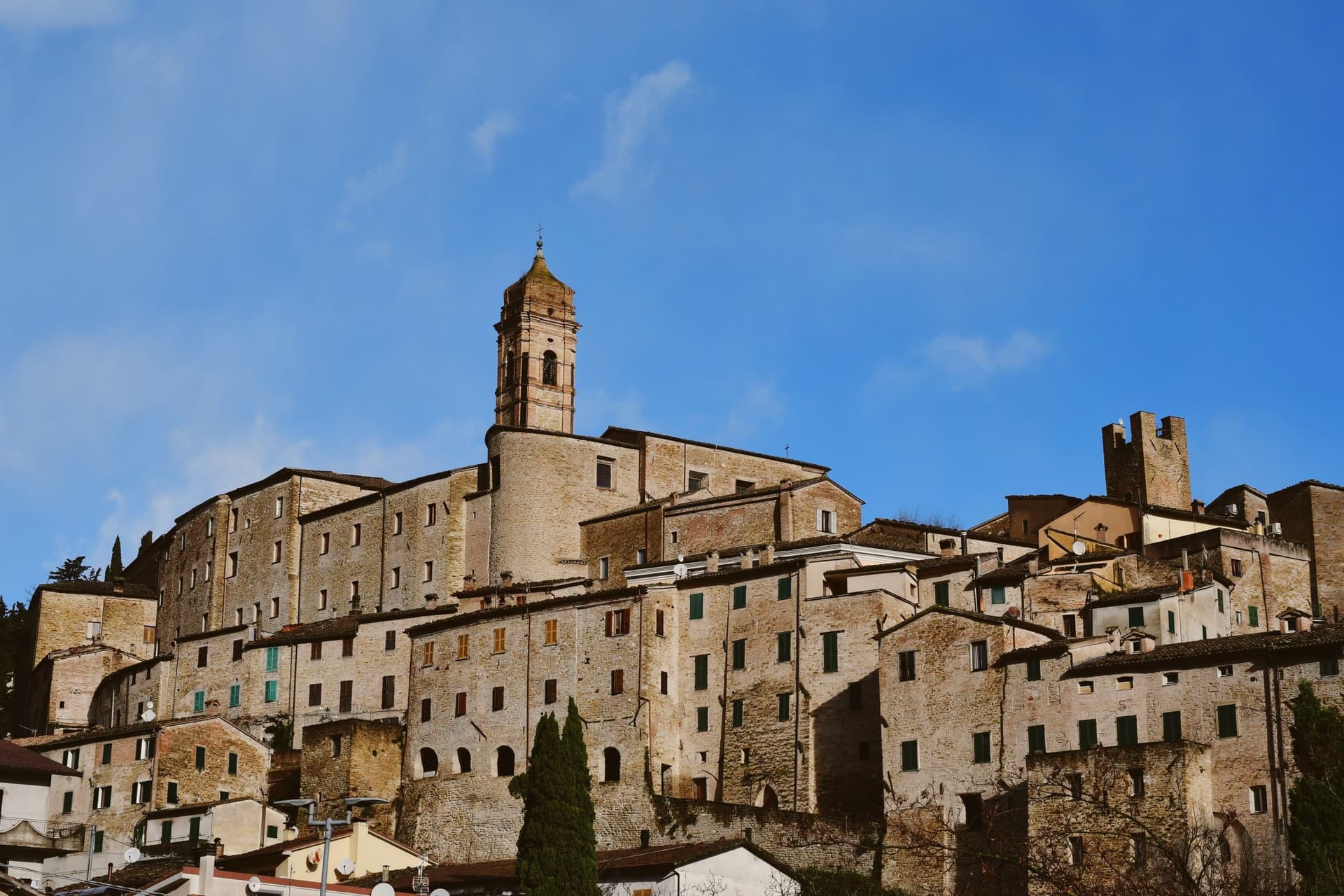
The medieval town is built almost entirely in stone and rock, ringed by walls dating to around 1300. Above those walls run the Copertelle, covered passageways that line the outer circuit, the true visual signature of the borgo.
The Santa Lucia complex, the former monastery in the centro storico, houses the headquarters of the Parco Naturale Regionale della Gola della Rossa e di Frasassi, the 9,167-hectare regional park that runs from Serra south to the Frasassi caves. The Chiesa di Santa Lucia, baroque inside with marble decoration and gold-leaf stucco, sits next door.
The Festa del Centro Storico in late July fills the stone lanes with theatrical reenactments.
We confirmed you can reach this one by train.
What to see in Serra San Quirico
- Le Copertelle. Covered passageways running above the medieval outer walls from around 1300, the true visual signature of the stone borgo.
- Chiesa di Santa Lucia. Baroque church in the centro storico, with marble decoration, gold-leaf stucco and a Pasqualino Rossi seventeenth-century altarpiece.
- Parco Naturale Gola della Rossa e di Frasassi. 9,167-hectare regional park with headquarters at the Santa Lucia complex in the centro storico, running south to the Frasassi caves.
How to get to Serra San Quirico
There is a railway station in the town, so you can arrive without a car and never need one while you are here. Ancona is roughly 49 minutes away by road.
Our tip
April through June and September into October are the best months for Serra San Quirico. The Esino valley turns green from April, the Gola della Rossa runs cool through the limestone walls, and the autumn light brings out the stone of the Copertelle along the outer ring. July and August touch the high twenties at 409 meters; the gorge stays cooler than the valley floor and the centro storico catches afternoon breezes off the ridge. Sagra del Coniglio in Porchetta falls in July.
Montecosaro
Why visit Montecosaro
Montecosaro sits at 267 meters on a hill above the lower Chienti valley, fifteen kilometers from Macerata and inland from the Adriatic at Civitanova. The first record of a monastery in the river plain dates to 936, when the abbot Ildebrando received the church of Santa Maria from Farfa.
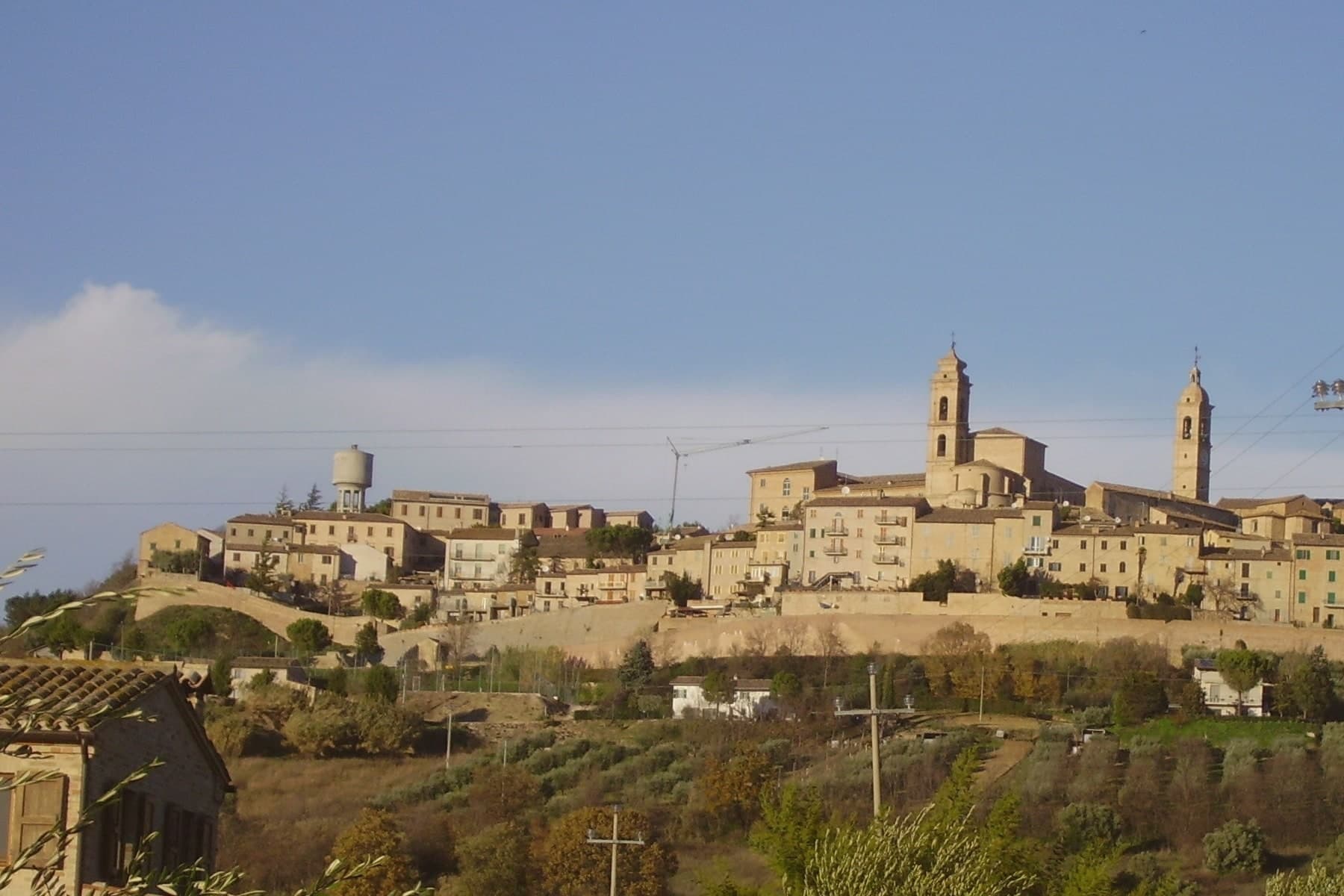
The current Basilica di Santa Maria a Piè di Chienti was raised in 1125 by the Lombard abbot Agenolfo, on the left bank a few kilometers from the river mouth: a three-nave Romanesque church with a raised presbytery and a ring of apsidioles, holding among the strongest Cluniac architecture in central Italy. The hilltop borgo above grew from a medieval castle after 1200, walled in the fourteenth century inside an oval that culminates at the Cassero, the former fortress now a public garden.
The Augustinian convent and the church of Sant'Agostino in the upper town date from the same century, rebuilt in the late eighteenth.
We confirmed you can reach this one by train.
What to see in Montecosaro
- Basilica di Santa Maria a Piè di Chienti. Romanesque church rebuilt in 1125 by the Lombard abbot Agenolfo on a Farfa monastic foundation of 936, three naves with raised presbytery and apsidioles.
- Centro storico. Oval-walled medieval centro storico on the hill, with fourteenth-century walls and concentric streets climbing toward the Cassero.
- Cassero. Highest point of the walled borgo, where the medieval fortress once stood, now a public garden with views over the Chienti valley.
How to get to Montecosaro
There is a railway station in the town, so you can arrive without a car and never need one while you are here. Ancona is roughly 46 minutes away by road.
Our tip
April through June and September into October are the best months for Montecosaro. The Chienti valley turns green in spring and gold through the autumn harvest weeks, with mild afternoons on the hilltop and long views from the Cassero across to the Sibillini. July and August touch the low thirties; the hill catches more breeze than the river plain below, and the Basilica di Santa Maria stays cool through the day. Contesa dei Cento Ducati falls in August.
Matelica
Why visit Matelica
Matelica sits at 354 meters in the upper Esino valley between Monte San Vicino at 1,479 meters to the west and Monte Gemmo at 719 meters to the east. The Picentes and Umbri settled here in the first millennium BC; Rome turned the town into a municipium around 70 BC under the name Matilica.
After the Lombard sack of 578 AD Matelica re-emerged as a free commune by 1160 under its bishop. Verdicchio di Matelica, DOC since 1967, is the smaller and higher-altitude of the two Verdicchio appellations: the closed mountain valley gives the wine a sharper mineral profile than the Castelli di Jesi version closer to the coast.
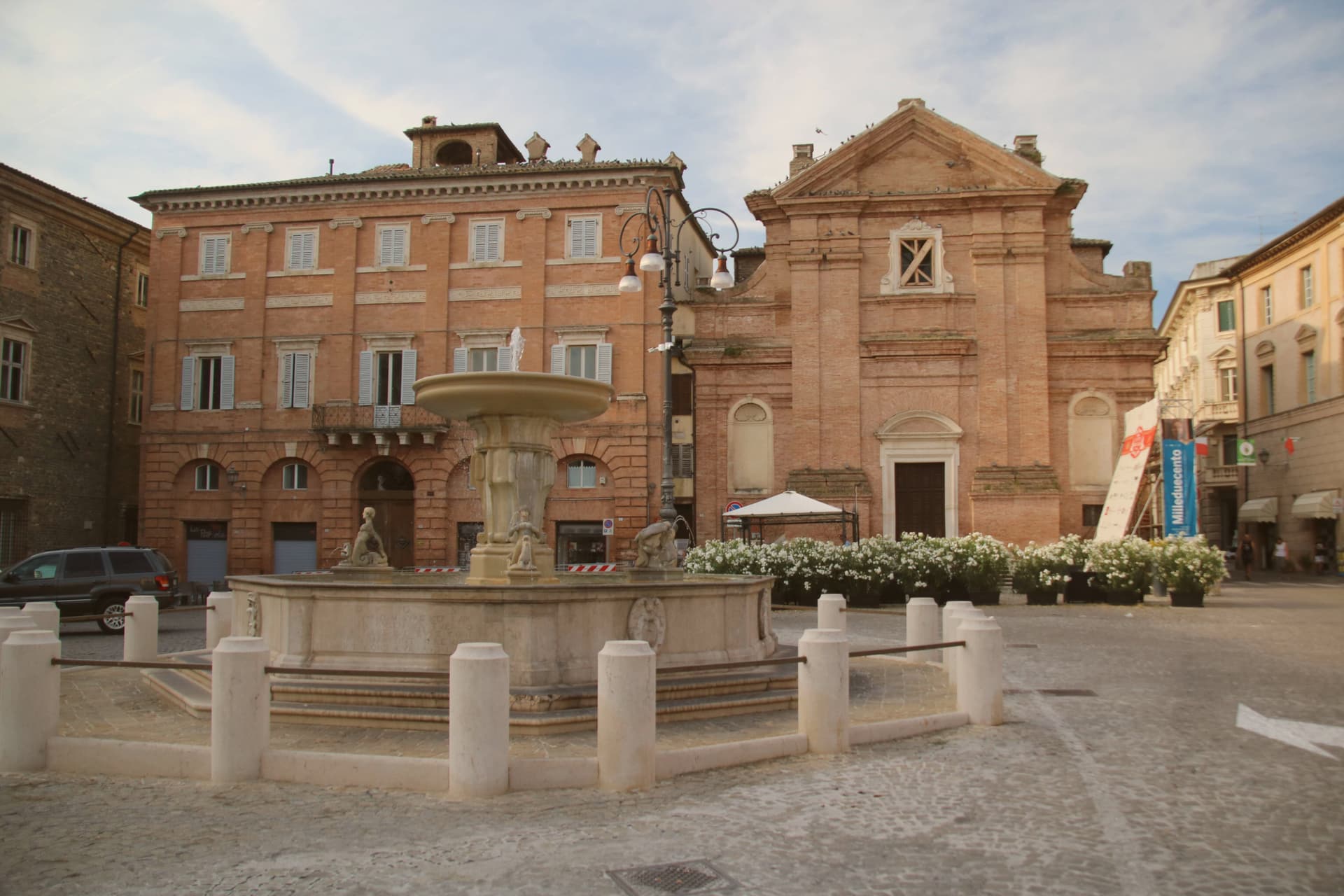
The Museo Civico Archeologico holds the Globo di Matelica, a thirty-centimeter Roman marble sphere from the second century AD, engraved with lines that may have been used for a sundial. Palazzo Ottoni, built in 1472 on the main piazza, and the Museo Piersanti, the collection of the eighteenth-century papal master of ceremonies, anchor the centro storico.
We confirmed you can reach this one by train.
What to see in Matelica
- Museo Civico Archeologico. Civic archaeology collection holding the Globo di Matelica, a Roman marble sphere of the second century AD engraved with reference lines, possibly a sundial.
- Palazzo Ottoni. Renaissance palazzo built in 1472 by the Ottoni family on the main piazza, now part of the civic administration.
- Museo Piersanti. Late fifteenth-century palazzo holding the collection of Monsignor Venanzio Filippo Piersanti, papal master of ceremonies from 1718 to 1761, with works by Bellini, Salvator Rosa and Carlo Maratta.
How to get to Matelica
There is a railway station in the town, so you can arrive without a car and never need one while you are here. Ancona is roughly 71 minutes away by road.
Our tip
April through October is the working window for Matelica. The Esino valley turns green from April, the Verdicchio vineyards at 400 meters on the surrounding slopes flower in June and color from late August, and the harvest runs through September. June through August touches the low thirties in the valley; the mountain breeze between Monte San Vicino and Monte Gemmo keeps the centro storico cooler than the lowland and the cellars below town hold their constant cellar temperature. Festa del Quartiere Regina Pacis falls in August.
Morrovalle
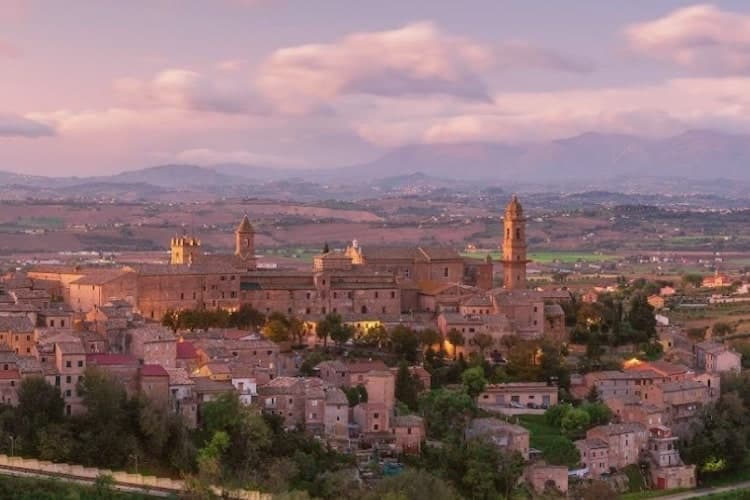
Why visit Morrovalle
Morrovalle sits eleven kilometers east of Macerata, on a hill above the lower Chienti valley. The Roman municipality of Pausolae stood nearby, but the present town grew in the early Middle Ages from a ministerium de Valle dependent on the bishop of Fermo, with a castle called Mor-ro on the hilltop that gradually freed itself from episcopal control.
That castle is the origin of the walled centro storico that still occupies the hilltop today, its layout and signage now recognized as an orange flag town. Just outside those walls stands the former convent, founded around 1290 and now serving as an auditorium.
On the night between 16 and 17 April 1560 a fire destroyed its conventual church, and clearing the high altar on 27 April revealed a consecrated host and a silver pyx intact in a wall cavity, an event a pope authenticated by bull that September. Works recovered from the burned church were later moved to the parish church in the centro storico, tying the hilltop town to the convent below it.
Below both, the slopes descend toward the Chienti, where the same hills that gave the town its defensive position now carry the vineyards of the surrounding wine commune.
We confirmed you can reach this one by train.
What to see in Morrovalle
- Ex Convento di San Francesco (Auditorium Borgo Marconi). Franciscan convent founded around 1290 just outside the walls, its conventual church the site of the fire that produced the Eucharistic Miracle. The building now serves as the municipal auditorium.
- Centro storico. Walled medieval hilltop layout with the signage and visitor route that earned the Bandiera Arancione recognition.
- Palazzo Lazzarini. Noble palace on Piazza Vittorio Emanuele, with a brick facade and a portal that frames the civic centre of the medieval borgo.
How to get to Morrovalle
There is a railway station in the town, so you can arrive without a car and never need one while you are here. Ancona is roughly 50 minutes away by road.
Our tip
April through June and September into October are the best months for Morrovalle. The Chienti valley turns green by late April and gold through August, the hilltop catches Adriatic breezes from the coast eighteen kilometers east, and the Sibillini stay visible on clear afternoons. July and August touch the low thirties, with the centro storico quietest between three and seven. Calici di Stelle falls in August.
San Severino Marche
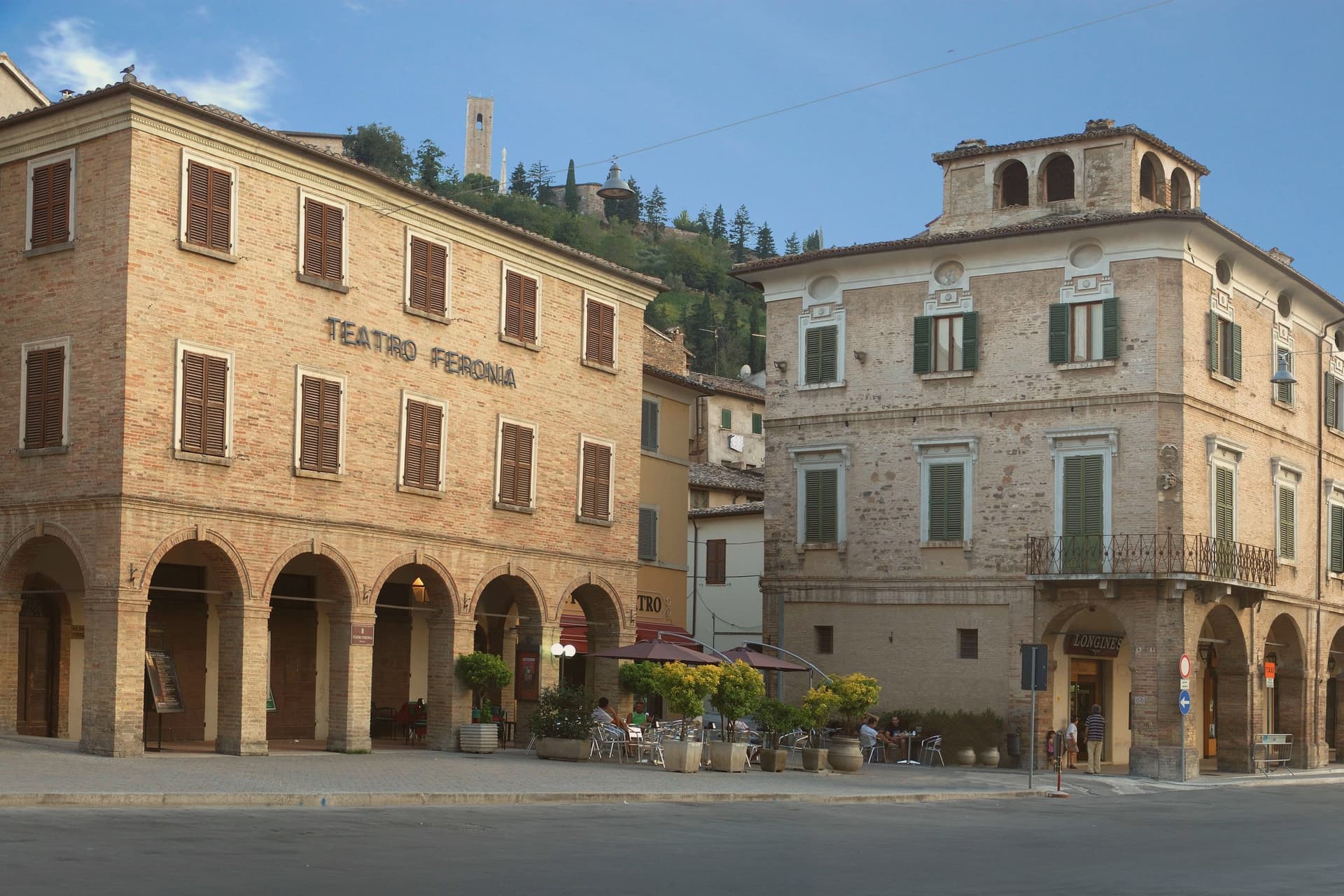
Why visit San Severino Marche
San Severino Marche sits at 235 meters in the Potenza valley, fifty kilometers southwest of Ancona, and the town is built in two distinct pieces rather than one continuous fabric. The medieval Castello occupies the hill above the town, still ringed by surviving city walls, while the Borgo below grew up around its own civic center on the valley floor.
The two parts do different jobs: the hill was governed and defended, walled and towered under the Smeducci dynasty through the fourteenth century, while the valley floor was built for markets and public life, organized around the wide colonnaded ellipse that still serves as the town's gathering space. The Salimbeni brothers, Lorenzo and Jacopo, were born in the town and worked across both halves of it, painting in a hilltop church and in a crypt-church alike, and their frescoes, along with a Vittore Crivelli polyptych, have since been gathered into a civic gallery in the lower town.
That movement of paintings from hill to valley mirrors the town's own shift in weight over time, from a fortified seat of government above to a civic and commercial center below, with the art now sitting closer to the square than to the walls that first sheltered it.
We confirmed you can reach this one by train.
What to see in San Severino Marche
- Piazza del Popolo. The elliptical square anchors the lower town, its porticoes running unbroken around the full curve, giving the Borgo a single continuous gathering space rather than a scattering of smaller squares.
- Duomo Vecchio. The bell tower and the raised setting on Monte Nero are what register first, the cathedral standing above the walls rather than among them. Inside, the chapel that once held the Salimbeni Saint John cycle is now empty, the frescoes moved elsewhere in town.
- Torre degli Smeducci. The tower is the only structure on the hill that reads as purely defensive, plain where the church nearby is decorated, and it still dominates the skyline of the upper town.
How to get to San Severino Marche
There is a railway station in the town, so you can arrive without a car and never need one while you are here. Ancona is roughly 71 minutes away by road.
Our tip
April through June and September into October are the working months for San Severino Marche. The Potenza valley turns green from April, the climb to the Duomo Vecchio holds its best light through the autumn afternoons, and the Palio dei Castelli on the second Sunday of June fills both city centers with neighborhood processions. July and August touch the low thirties; the elliptical Piazza del Popolo offers shaded porticoes through the hottest hours and the lower city empties between four and seven.
Macerata
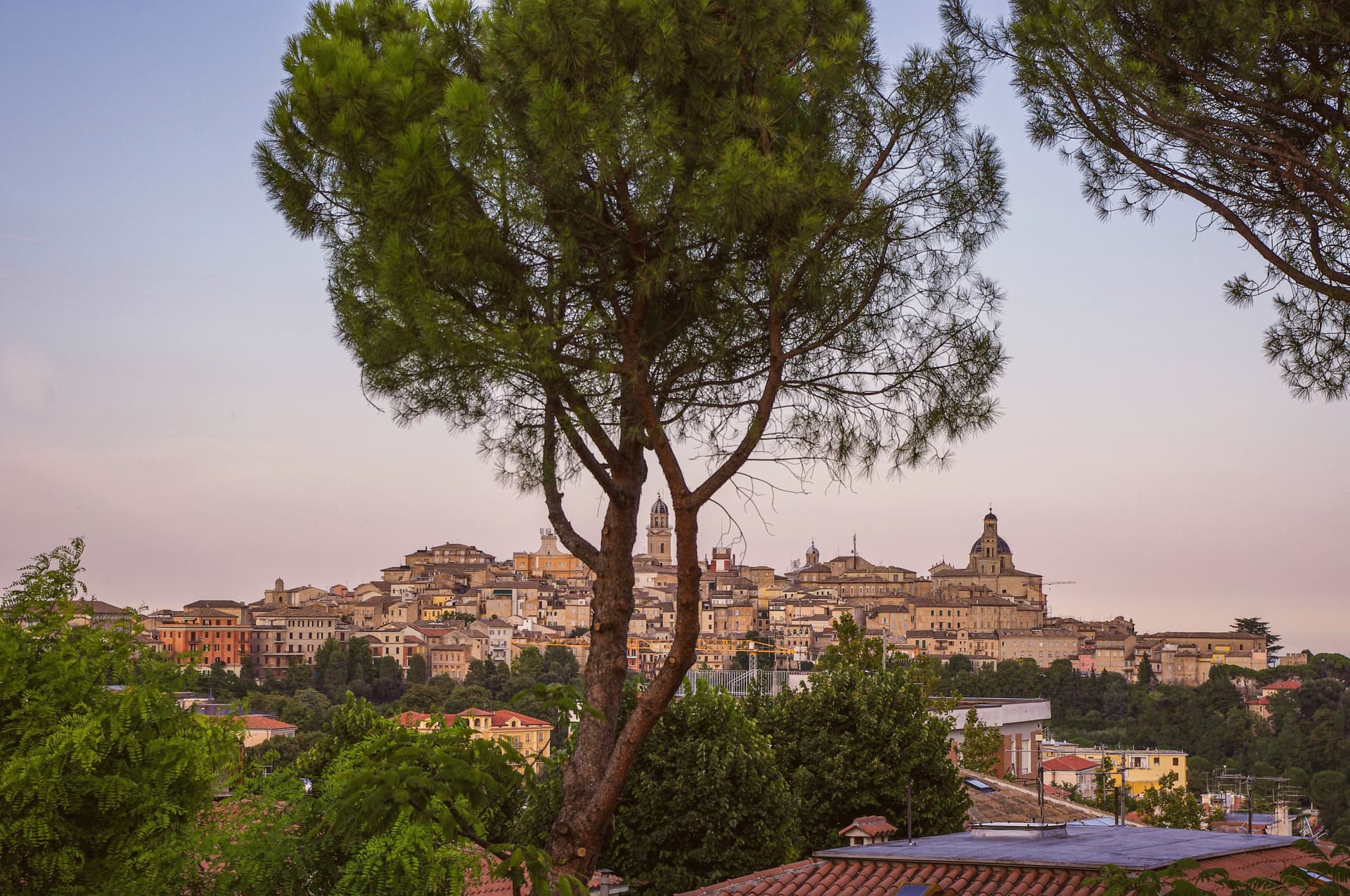
Why visit Macerata
Macerata sits at 315 meters on a hilltop between the Chienti and Potenza valleys, thirty-five kilometers south of Ancona. The Roman Helvia Recina stood on the plain below; after the city was destroyed by the Goths the survivors moved up to the present site, where the town grew into the provincial capital.
The University, founded in 1290, is one of the oldest in continuous operation in Europe. The Sferisterio, the city's signature monument, is a 100-meter neoclassical arena designed by Ireneo Aleandri in 1823, originally built for pallone col bracciale, the bracelet-ball game once played across central Italy.
From 1921, when Verdi's Aida was first staged there, it became one of Italy's principal open-air opera venues. The Macerata Opera Festival runs through July and August.
The provincial museum holds works by Carlo Crivelli, Lorenzo Lotto and Antonio Canova. The 2016 earthquakes damaged outlying frazioni but the centro storico held.
We confirmed you can reach this one by train.
What to see in Macerata
- Sferisterio. Neoclassical 100-meter open-air arena designed by Ireneo Aleandri in 1823, originally built for pallone col bracciale, now seat of the Macerata Opera Festival since 1921.
- Università di Macerata. Founded in 1290, one of the oldest continuously operating universities in Europe, with its main rectorate on Piazza della Libertà.
- Piazza della Libertà. Main square of the centro storico, holds the Loggia dei Mercanti, the Palazzo del Comune and the Torre dei Tempi with its astronomical clock.
How to get to Macerata
There is a railway station in the town, so you can arrive without a car and never need one while you are here. Ancona is roughly 58 minutes away by road.
Our tip
April through June and September into October are the best months for Macerata. The Chienti and Potenza valleys hold green from April, the centro storico runs cool in the morning and the surrounding hills toward Montelupone and Treia are open for walking. July and August anchor the Macerata Opera Festival at the Sferisterio, with three major productions across roughly six weeks; nights stay warm but the open arena keeps moving air. Rievocazione storica della Trebbiatura - Degustazione dell'oca falls in June.
More from Anywhere Italy
- The best hidden hill towns you can reach by train in Marche
 The 10 best hill towns that eat well within 90 minutes of Ancona
 The best hill towns with a food festival within 90 minutes of Ancona
- The 8 best towns you can reach by train that eat well within 90 minutes of Ancona
- The best towns that eat well in the province of Macerata
 The best hidden towns you can reach by train that eat well in Marche