
The best hill towns worth staying overnight within 90 minutes of Firenze
The land behind Florence rises in long ridges of olive terrace and vineyard, and the towns sit on top of them, walled, compact, built of grey pietra serena and sun-warmed brick. Mornings smell of woodsmoke and bread; lunch is pappa al pomodoro, pici with garlic and oil, bistecca cut thick and cooked over vine cuttings. Autumn is the season most people want, when the grape harvest finishes and porcini and chestnuts come into the markets, though late spring gives you wisteria on the walls and empty roads. Staying the night is the point: the coaches leave at five, and what follows is the part worth booking a room for.
Almost everyone bases themselves in Florence and treats the hills as an afternoon. The city earns the attention, but the Duomo queue, the Uffizi timed slot and the crush on Ponte Vecchio consume a day quickly, and the countryside gets reduced to a bus window on the way back. In high summer the historic centre is one of the densest tourist concentrations in Europe, and hotel prices behave accordingly. Reasonable enough, and it is why so few visitors ever see a Tuscan hill town after dark.
The same hills carry on well past the last day-trip stop, north into the Mugello and Montalbano, south through Chianti towards the Crete Senesi, west into the Valdelsa. These are inland hill towns rather than coastal or valley-floor places, each with somewhere to sleep that a travel guide has vouched for, all of them inside an hour and a half of Florence by car or train. Fewer people stay in them than pass through them. That is the difference this list is built on.
Of the 12 communes we have mapped within 90 minutes of Firenze, 7 qualify as hill towns worth staying overnight: each is an inland hill settlement, and each has a hotel a travel guide has vouched for. The smallest, Montaione, has 3,492 residents.
Two more lists worth reading alongside this one: The 9 best towns with a serious restaurant that eat well within 90 minutes of Firenze and The best hidden hill towns within 90 minutes of Firenze.
Why visit Montaione
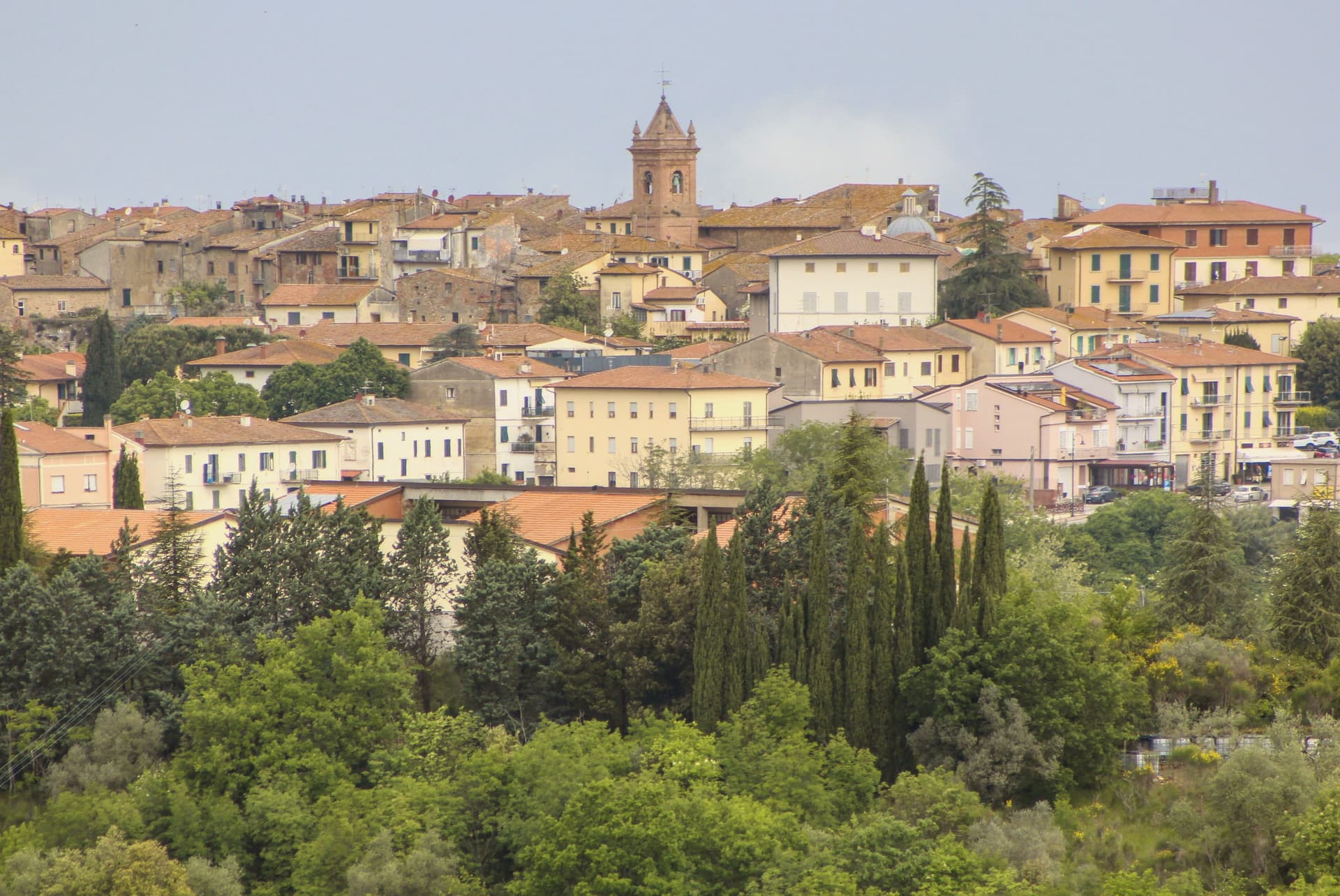
Montaione sits at 341 meters on a ridge above the Valdelsa, in the wooded hills west of Florence on the road toward Volterra. Etruscan and Roman finds at Poggio all'Aglione, Bellafonte and Iano confirm continuous occupation across the territory, material now held in the town's archaeological museum.
The medieval castello was the seat of an autonomous comune from 1256 and passed to Florence in 1369. From the early fourteenth century, glassmaking ran in the surrounding woods, and an eighteenth-century decree by the Grand Duke required master glassmakers to teach the craft to their fellow citizens.
The town joined Borghi più belli in 2007. The territory spreads well beyond the ridge itself.
Five kilometers west, a Franciscan convent founded in 1500 stands in the woods, its chapels laid out as a walkable replica of Jerusalem's holy sites. Ten kilometers south, Castelfalfi carries a separate, older Lombard origin, now a resort with its own vineyards and church.
Between them, the centro storico keeps the civic core: the tower, the palace, the parish church rebuilt on twelfth-century foundations. The comune, in effect, holds three distinct centuries of settlement at once: an ancient scatter of finds, a fourteenth-century craft economy, and a devotional complex from the 1500s, spread across ridge, castle and wood rather than gathered in one place.
What to see in Montaione
- Sacro Monte di San Vivaldo. Complex five kilometers west of the borgo. Seventeen chapels stand among oak woods, each holding a scene built as part of the topographical replica, still reached on foot along the paths between them.
- Castelfalfi. Lombard-origin castle and frazione ten kilometers south, restored as a private resort with vineyards and a Romanesque church of San Floriano.
- Centro storico. Medieval grid on the ridge, with the Palazzo Pretorio, the Torre del Cassero and the Chiesa di San Regolo restored after 1118 foundations.
How to get to Montaione
Firenze is roughly 67 minutes away by road.
Our tip
April through June and September into October are the months Montaione shows best, the Valdelsa light low on the wooded ridges and the San Vivaldo chapels in their full October ochre. The Mostra del Tartufo Bianco runs the last weekend of October and the first of November. July and August push past thirty in the valley but the centro storico at 341 meters stays manageable. Tartufesta a Montaione falls in October.
Why visit Cerreto Guidi
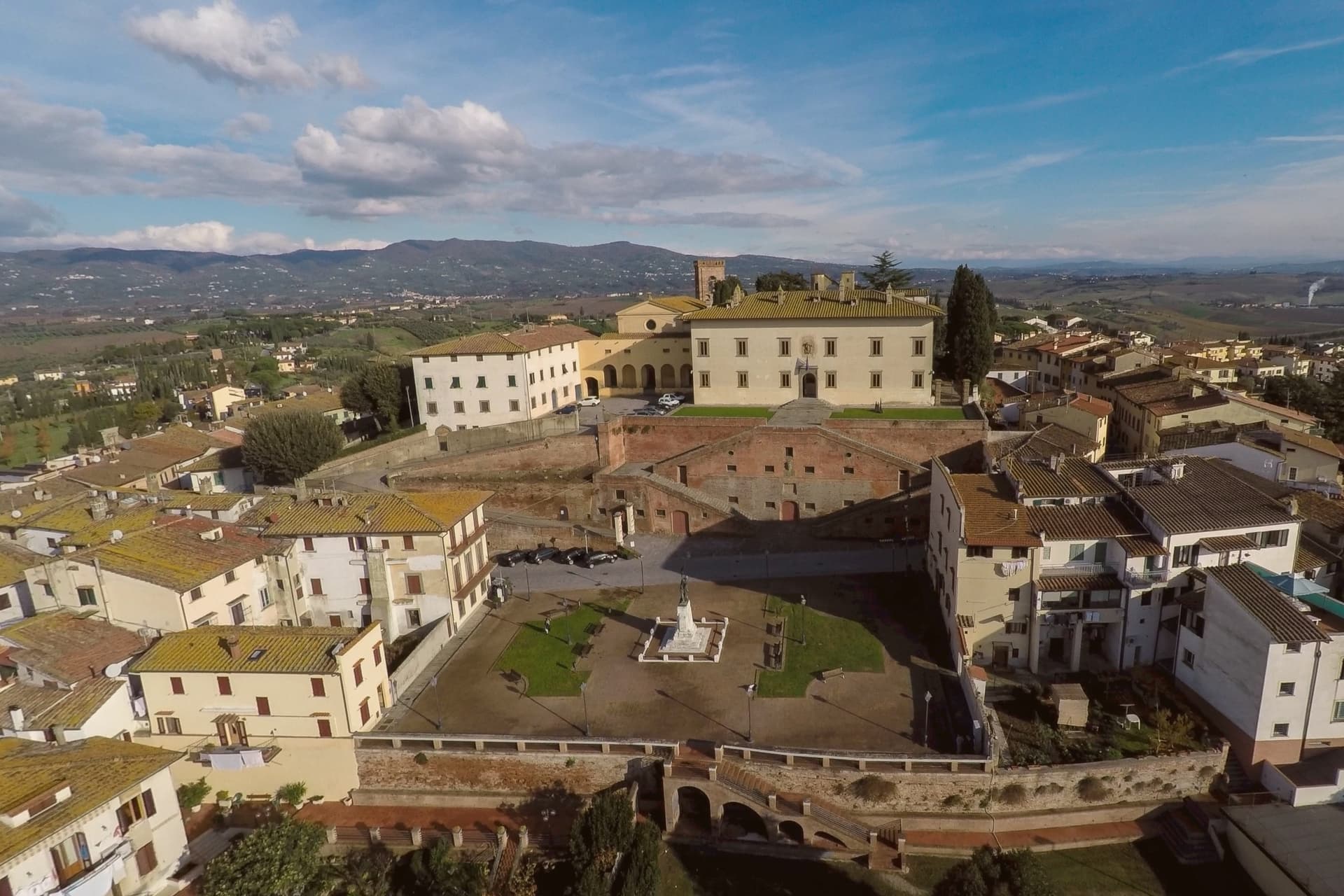
Cerreto Guidi sits at 123 meters above the Padule di Fucecchio, thirty kilometers west of Florence, on the old hunting grounds of the Counts Guidi and later the Medici. Cosimo I commissioned the Villa Medicea here between 1564 and 1567 as a hunting lodge and territorial outpost over the marsh.
The villa is mounted on a scenographic base of four symmetrical ramps of stairs, the ponti medicei, traditionally attributed to Bernardo Buontalenti, designed to raise the perspective plane and the level of the entrance. In 2013 the villa entered the UNESCO list of Medici Villas and Gardens of Tuscany along with twelve others, and it remains one of the few permanently open as a museum, housing the Museo Storico della Caccia e del Territorio since 2002.
The Via Francigena passes a few kilometers south. Isabella de' Medici, daughter of Cosimo I, was strangled in this villa by her husband Paolo Giordano Orsini in July 1576.
What to see in Cerreto Guidi
- Villa Medicea di Cerreto Guidi. Hunting villa built for Cosimo I de' Medici between 1564 and 1567, UNESCO World Heritage since 2013, holding the Museo Storico della Caccia.
- Ponti Medicei. Four symmetric ramps of stairs attributed to Buontalenti, supporting the villa above the village and forming its scenographic base.
- Museo Storico della Caccia e del Territorio. Hunting and local history museum housed in the villa since 2002, with weapons, prints and documents from the Medici hunting grounds.
How to get to Cerreto Guidi
Firenze is roughly 50 minutes away by road.
Our tip
April through June is the easiest time to walk the village and the villa garden, with the Padule di Fucecchio at its greenest. September and October dry the marsh, the harvest in the surrounding Chianti Montalbano vineyards runs through late September. July and August are hot in the lower Arno plain and the villa is the cool place to be; visitor numbers peak around mid-August. Palio del Cerro falls in September.
Why visit Fiesole
Fiesole was Viesul to the Etruscans and Faesulae to the Romans, who took it in 283 BC. Florence claimed it in 1125 and never let it go, which is the reverse of the usual order: the hill town came first, the valley city second, and the ridge has watched its own successor grow across the centuries since.
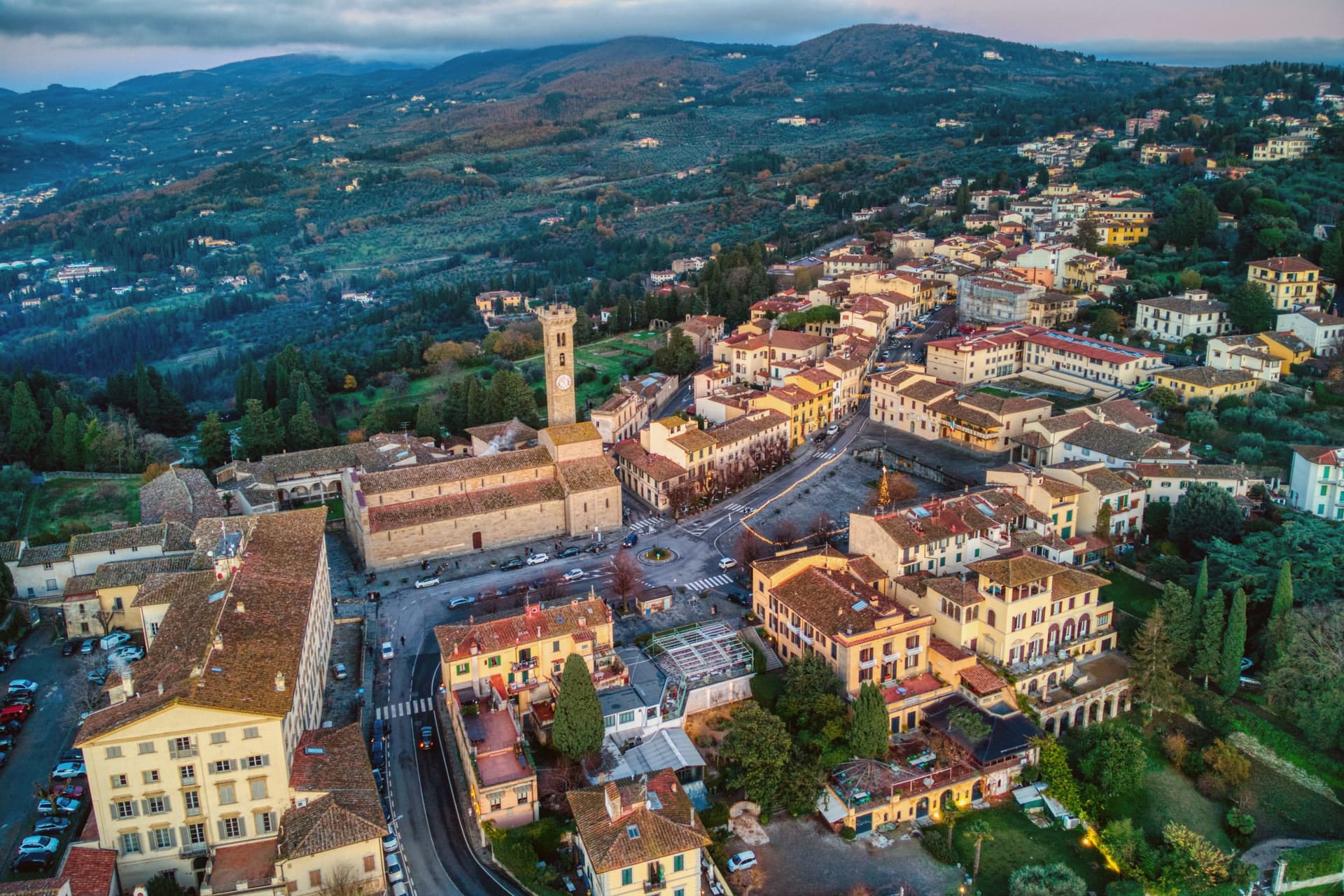
The convent that crowns the highest point, at 345 meters, sits at the same height Boccaccio gave the brigata in the Decameron's frame story, a detail that ties the summit to the plague-fleeing storytellers rather than to any building fact already given. Today the town functions as the hill seat of Florentine villas, the Villa Medici among them, so the relationship between Fiesole and Florence is not just historical but residential: those with means built upward, toward the older settlement, to look down on the newer one.
The panorama from the piazza is the view that supplies the standard image of Florence from above, which means the town that Rome conquered has ended up owning the picture of the city that conquered it back.
What to see in Fiesole
- Teatro Romano. Stone tiers set into the hillside below the cathedral, still used each summer for the Estate Fiesolana, so the seats fill for performances the way they once did in antiquity.
- Cattedrale di San Romolo. Romanesque cathedral founded in 1028, flanked by a 42-meter bell tower, with a marble altar from 1273 and two Pietro Perugino frescoes.
- Convento di San Francesco. Romanesque-Gothic Franciscan convent at the ridge's highest point, 345 meters, with cloisters and a panoramic view back over Florence.
How to get to Fiesole
There is a railway station in the town, so you can arrive without a car and never need one while you are here. Firenze is roughly 24 minutes away by road.
Our tip
April through June and September through October are the months Fiesole was built for: the air cooler than Florence by three to five degrees, the cypress alleys clean of haze, and the Roman theatre season runs through July and early August with concerts under the open sky. July and August push the day temperature high enough that even the hilltop feels heavy at midday, though the evenings come back. November through March is quiet, light hits the cathedral late and low, and the wood-burning trattorias around Piazza Mino do their best work. Sagra del Tartufo falls in September.
Why visit San Gimignano
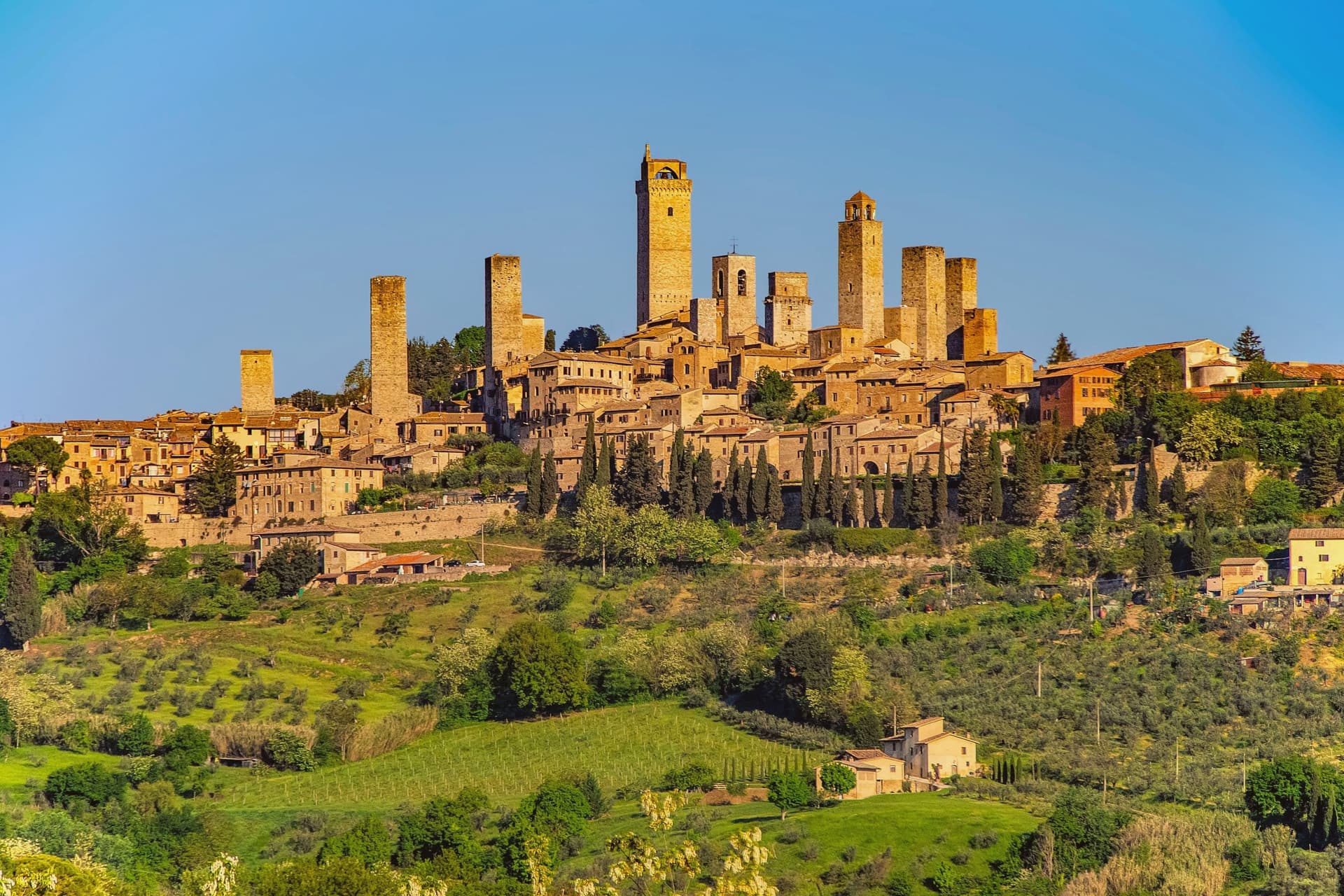
San Gimignano sits at 334 meters in the Val d'Elsa, halfway between Firenze and Siena on the medieval pilgrim road to Rome. Patrician families built 72 tower-houses in the twelfth and thirteenth centuries as proofs of wealth and platforms for vendettas; 14 still stand, the tallest being the Torre Grossa at 54 meters.
The town declared independence from the bishops of Volterra in 1199 and grew rich on saffron and Vernaccia, the white wine grown on the surrounding hills and praised since Dante. The Black Death of 1348 broke the boom; San Gimignano lost more than half its population and submitted to Florence.
That collapse is the reason the medieval skyline survived. UNESCO listed the historic centre in 1990 as a complete record of feudal architecture.
Roughly three million visitors come each year, more than 400 times the resident population, and the centro storico empties into the surrounding olive groves once the day-trippers leave.
What to see in San Gimignano
- Torre Grossa. Fifty-four meter civic tower attached to the Palazzo Comunale, the tallest of the surviving 14, open for the climb to the panoramic terrace.
- Piazza della Cisterna. Triangular medieval square paved in brick around an octagonal well of 1287, lined by tower houses and Romanesque palaces.
- Collegiata di Santa Maria Assunta. Romanesque parish church on Piazza Duomo, walls covered by Bartolo di Fredi and Lippo Memmi frescoes of Old and New Testament scenes.
How to get to San Gimignano
Firenze is roughly 61 minutes away by road.
✷ We have written about San Gimignano
“We arrived in the afternoon, into the second half of the day’s crowd. Off-season meant it was groups and guides rather than a flood, but the shops were open and doing their worst, the same garbage souvenirs, the same pasta no one local would eat, and we walked through it the way you walk through a thing you have decided not to let ruin your evening. The towers stood over all of it, indifferent, which is their whole talent.”
Read our piece on San Gimignano →San Gimignano | The Town After Seven
Our tip
April through June and September into October are the months the town is worth a full day rather than three hours. The buses still come, but late afternoon empties the piazzas and lets the towers take their light. July and August push temperatures past thirty and the centro storico becomes uncomfortable between two and six, when the stone radiates heat. Fiere delle Messi di San Gimignano falls in June.
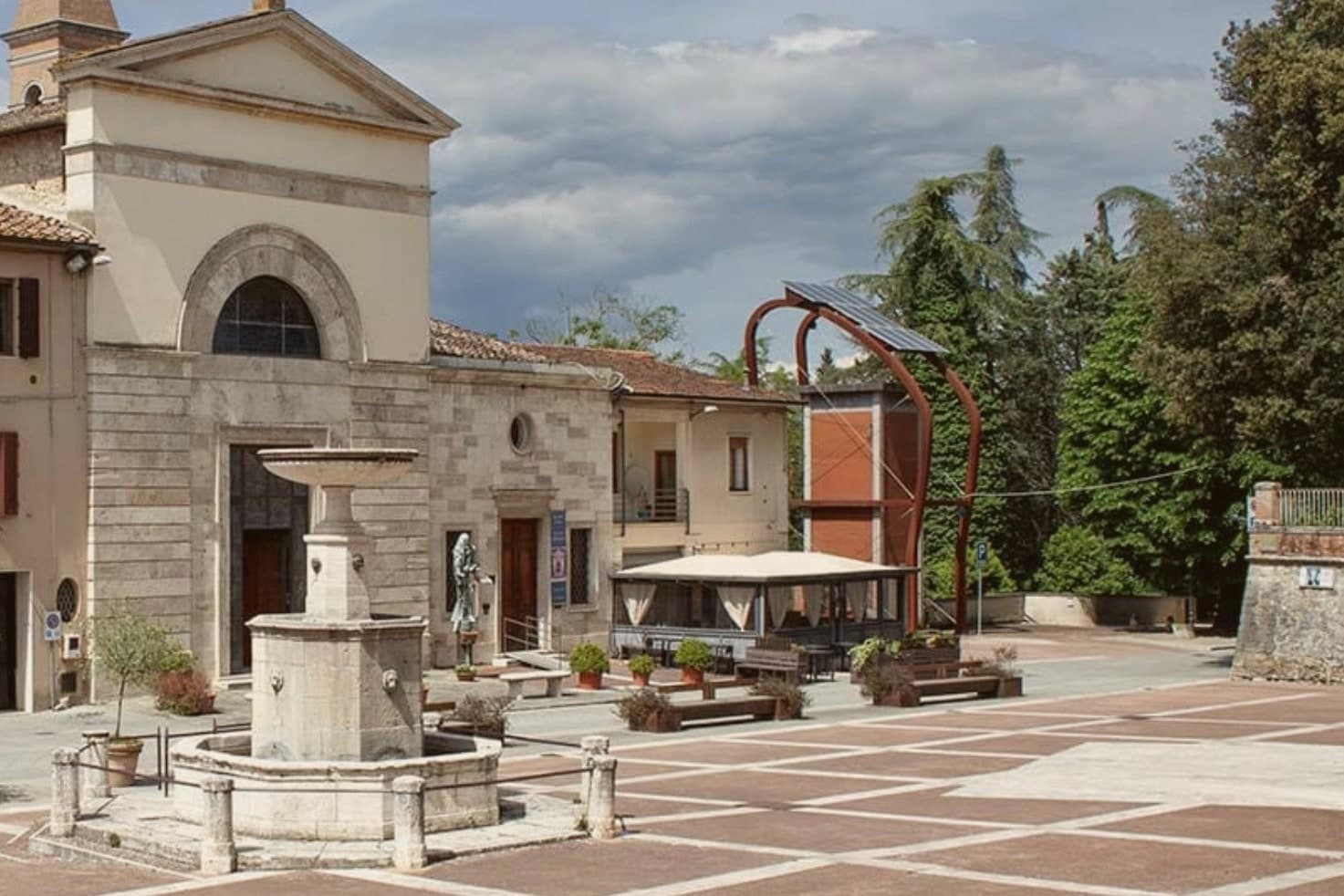
Why visit Castelnuovo Berardenga
The commune sits east of Siena, where the hills give way to the clay swells of the Crete Senesi. The name comes from the Terra Berardinga, the area controlled in the tenth century by a Frankish nobleman named Berardo, and the borgo grew up around the castle walls the Sienese Republic raised against Florence.
The centro storico, the villa and gardens at its heart, and the surrounding zone of vineyards form one continuous pattern rather than separate parts: fortress town above, wine country falling away below it toward the clay hills. Across the wider territory, 13 castles, 70 churches and 200 farms record the medieval pattern of the Sienese contado, a scatter of small fortified points and parish churches administering land rather than one dominant center.
The place reads as a border post that outlived its military purpose and settled into agriculture and the arts, its castle now a clock tower, its noble villa now a music foundation, its walls now overlooking rows of Sangiovese.
What to see in Castelnuovo Berardenga
- Villa Chigi Saracini. Eighteenth-century villa and Italian garden inside the centro storico, its park designed by the Sienese composer Guido Chigi Saracini, whose family foundation still runs the Accademia Musicale Chigiana in Siena.
- Torre dell'Orologio. Surviving tower of the fortress, now bearing the civic clock, the highest visible point of the centro storico.
- Chiesa dei Santi Giusto e Clemente. Eighteenth-century parish church with a neoclassical façade, built on the site of an earlier Romanesque pieve.
How to get to Castelnuovo Berardenga
There is a railway station in the town, so you can arrive without a car and never need one while you are here. Firenze is roughly 77 minutes away by road.
✷ We have written about Castelnuovo Berardenga
“The wine is the whole economy of these hills, every village with its own, the region’s name stamped on the most famous red in Italy. Tuscan food runs to cured and roasted meat, so the wine ran red to meet it, lighter than you expect, almost fruity, easy, made to sit beside a steak and not to be lectured about. Here is the only wine knowledge you need on this road: it is all good.”
Read our piece on Castelnuovo Berardenga →Road to Siena | The Long Way Is the Better Way
Our tip
April through June and September into October are the months Chianti Classico shows best, the green hills moving toward the gold of harvest. The Sagra del Vino runs the second weekend of September. July and August push past thirty and the centro storico empties between two and six; the cellars on the surrounding hills offer cool tastings and longer rentals. Dit'unto – Festival del Mangiar con le Mani falls in the season.
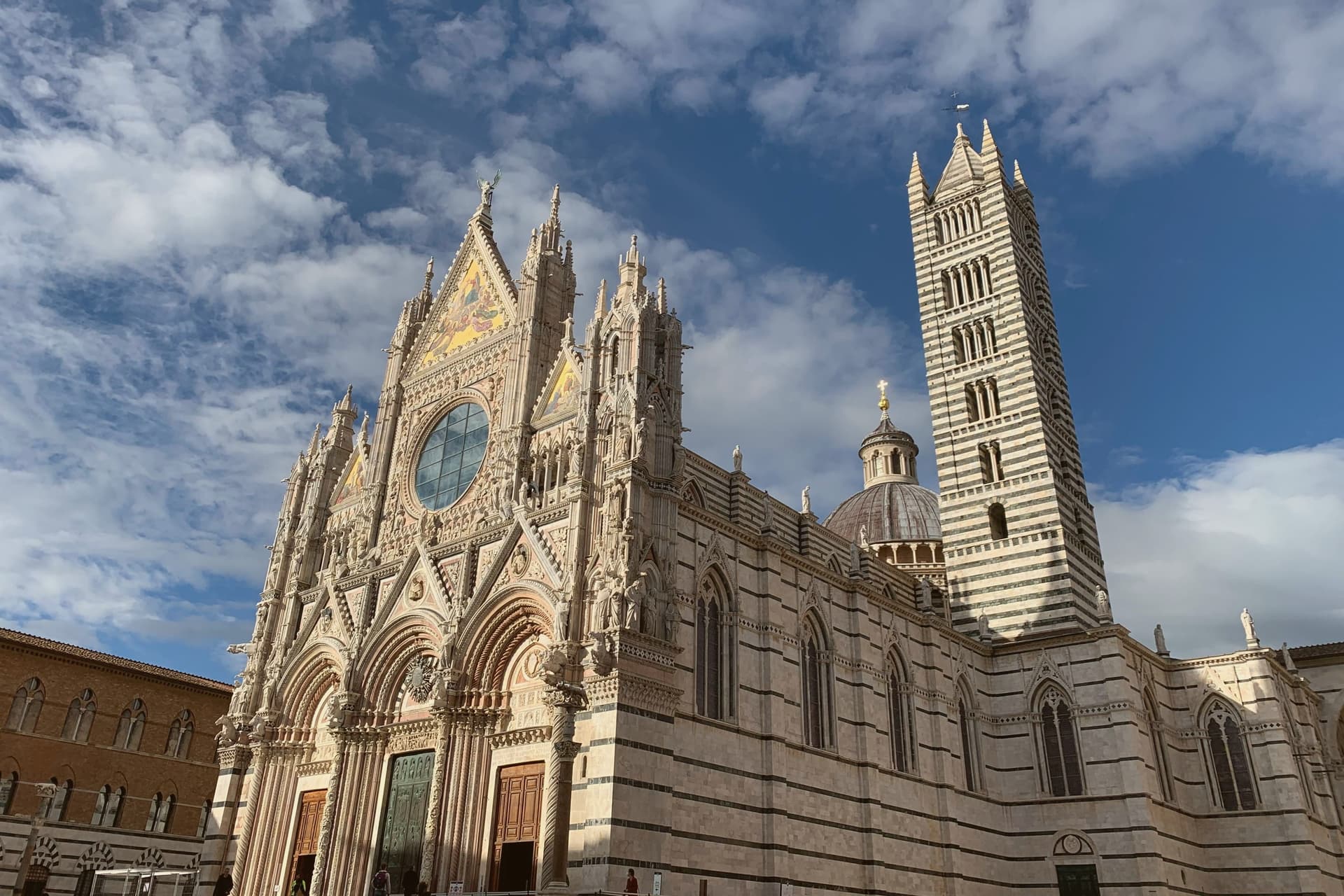
Why visit Siena
Siena sits at 322 meters on three hills fifty kilometers south of Florence, with which it fought a defining rivalry through the thirteenth and fourteenth centuries. The historic center has been UNESCO World Heritage since 1995, preserved as a medieval city that worked deliberately to differ from Florentine urban planning.
Piazza del Campo, the shell-shaped square at the meeting point of the three original hills, fans out toward the Palazzo Pubblico, whose construction began in 1297. The Torre del Mangia next to it, built between 1338 and 1348, stands 87 meters tall, the exact height of the Duomo, a deliberate equality between church and state.
The Duomo itself, marble-clad in horizontal black and white bands, holds the inlaid mosaic floor that Vasari called the most beautiful ever made, and sculptures by Donatello, the Pisano family and Michelangelo. The Palio runs twice a year, on 2 July and 16 August: bareback riders representing seventeen contrade circle the Campo three times in roughly ninety seconds.
What to see in Siena
- Piazza del Campo. Shell-shaped medieval square at the meeting point of Siena's three hills, paved in 1349 in red brick divided into nine sectors for the Council of Nine.
- Palazzo Pubblico. Town hall begun in 1297, with the Sala dei Nove holding Lorenzetti's Allegory of Good and Bad Government from 1338-1339.
- Torre del Mangia. Brick tower built 1338-1348 next to the Palazzo Pubblico, 87 meters tall, set deliberately to match the height of the Duomo.
How to get to Siena
There is a railway station in the town, so you can arrive without a car and never need one while you are here. Firenze is roughly 73 minutes away by road.
✷ We have written about Siena
“Before Florence was the banking capital of the known world, the bench belonged to Siena. The word itself comes from the bench, the banco, where the money changers sat, and in the twelfth century, the Sienese ran some of the largest banking houses in Europe, moving the money of popes and kings while Florence was still finding its feet.”
Read our piece on Siena →Siena | What you are really here for
Our tip
April through June and September into October are the dry months in central Tuscany: mild days, full openings at the museums, the Campo busy but not packed. The Palio runs on 2 July and 16 August: the city stops for the four days around each race, the trial races fill the piazza twice a day, and accommodation books out a year ahead. July and August are otherwise hot and crowded with day-trippers from Florence. L'Angolo del Collezionista a Siena falls in the season.
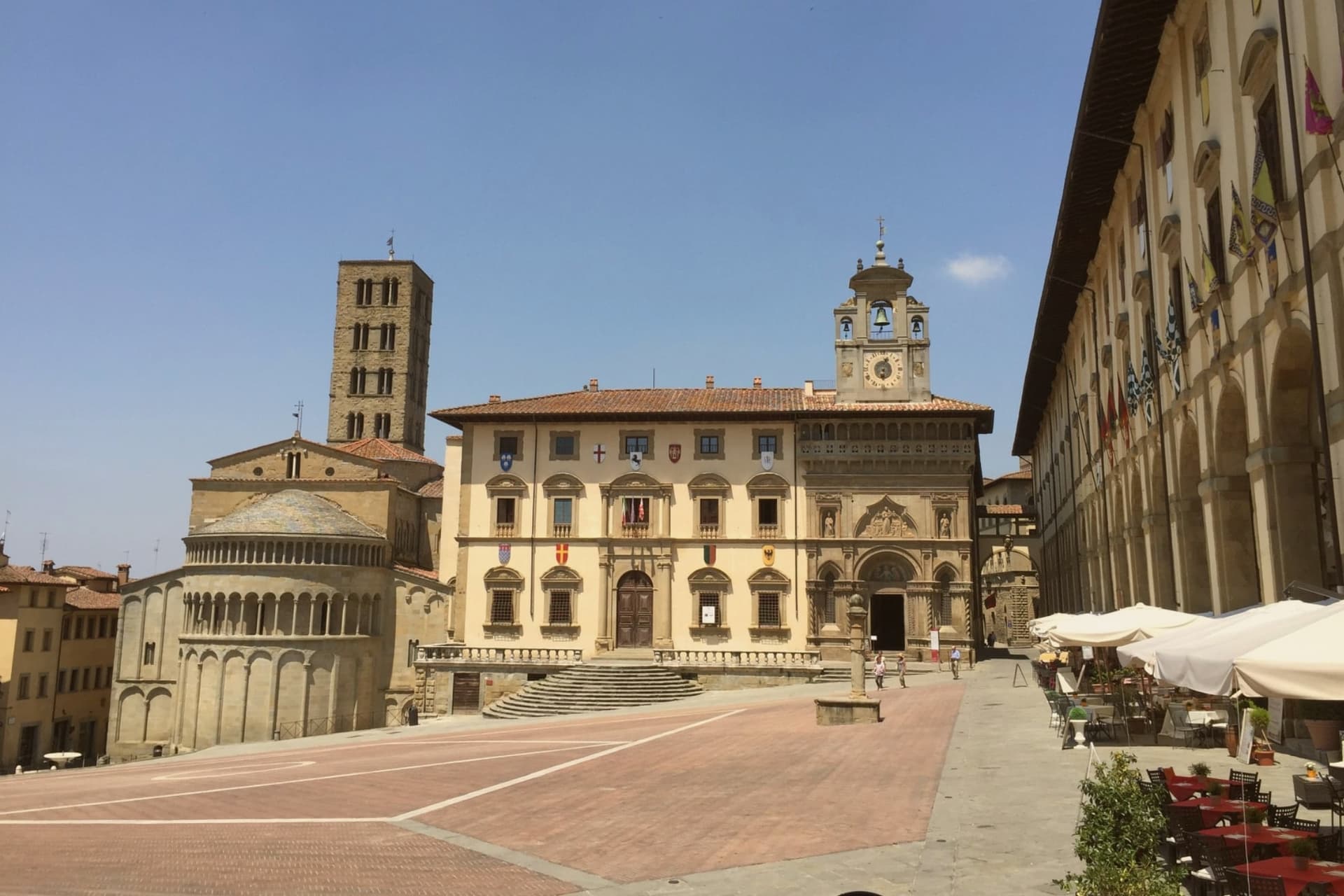
Why visit Arezzo
The city sits on a Tuscan hilltop 80 km southeast of Florence, and the ground beneath it holds one of the densest layers of Etruscan, Roman, medieval and early-Renaissance building anywhere in the region, without the tour-bus crush of its more famous siblings. The lower streets and the upper square pull the town's whole history together: the Pieve di Santa Maria's Romanesque exterior and five-tier facade were widely copied across central Italy, the Cattedrale di San Donato is Gothic with stained glass by Guillaume de Marcillat, and the Casa Vasari is the painter-architect's own house, frescoed by himself.
Giorgio Vasari was Arezzo's other native son, and beyond his own house his Loggia still frames one side of the sloped trapezoidal square, alongside the 14th-century facade of the Palazzo della Fraternita dei Laici and the Romanesque apse of the Pieve. The Museo Archeologico Nazionale stands on the site of the Roman Amphitheatre, where the Vasi corallini, coral-red glazed Roman pottery, were made as a manufacturing centre for the empire.
The fresco cycle narrates the journey of the Cross from Adam's grave through Solomon to Constantine to Heraclius in 10 panels of geometric serenity and silver-grey light, and the film that made the square famous used its slope as a stage set, the same slope the antique dealers now fill every first weekend of the month with more than 500 stalls drawing buyers from across Europe. Twice a year, in June and September, the four city quartieri, Porta Crucifera, Porta del Foro, Porta Sant'Andrea and Porta Santo Spirito, meet in the jousting tournament, riders charging the wooden target on horseback in a contest that has run since the 13th century.
The food is Tuscan: pici with hare ragù, ribollita, bistecca chianina from the Val di Chiana below the city, Pecorino Toscano, with Vino Nobile, Brunello and Chianti Classico all within an hour's drive south. Together the fresco, the square, the joust and the antique trade give the city a working civic life built on Renaissance art and medieval ritual rather than a museum piece preserved around it.
What to see in Arezzo
- Piero della Francesca's Leggenda della Vera Croce. 10-panel fresco cycle in the Cappella Bacci of San Francesco. Timed entry: 25 people, 30 min, book 2-3 weeks ahead.
- Piazza Grande + Pieve di Santa Maria. Sloped trapezoidal square lined by the Palazzo della Fraternita, Vasari's Loggia, and the 12th-c Lombard-Romanesque apse of Santa Maria.
- Fiera Antiquaria (every first weekend). 500+ dealers fill the square and surrounding streets, drawing dealers and buyers from across Europe.
How to get to Arezzo
There is a railway station in the town, so you can arrive without a car and never need one while you are here. Firenze is roughly 62 minutes away by road.
✷ We have written about Arezzo
“Arezzo is the last of this region’s losers, the cousin of Siena, beaten and absorbed and left behind, and like all of them, it kept what the winners spent. The same edge that cost it an empire is the moat that keeps the tour buses in Florence. It does not perform. It does not sell you a lie about itself. It works its gold, runs its schools, and lets the heat sit on the great empty square, and it will not notice whether you stay a day or a life.”
Read our piece on Arezzo →Arezzo | The City That Ignores You
Our tip
Arezzo is best April–June and September–October. The Fiera Antiquaria's first weekend of the month is the year-round draw (book hotels 2 weeks ahead). The Giostra del Saracino (third Saturday June + first Sunday September) is the year's two civic highlights. Mercato Internazionale falls in the season.
More from Anywhere Italy
 The 9 best towns with a serious restaurant that eat well within 90 minutes of Firenze
- The best hidden hill towns within 90 minutes of Firenze
- The best olive oil towns within 90 minutes of Firenze
- The best hill towns you can reach by train within 90 minutes of Firenze
- The best hill towns in the province of Firenze
 The 9 best hidden hill towns on a walking route in Toscana