
The best hill towns within 45 minutes of Udine
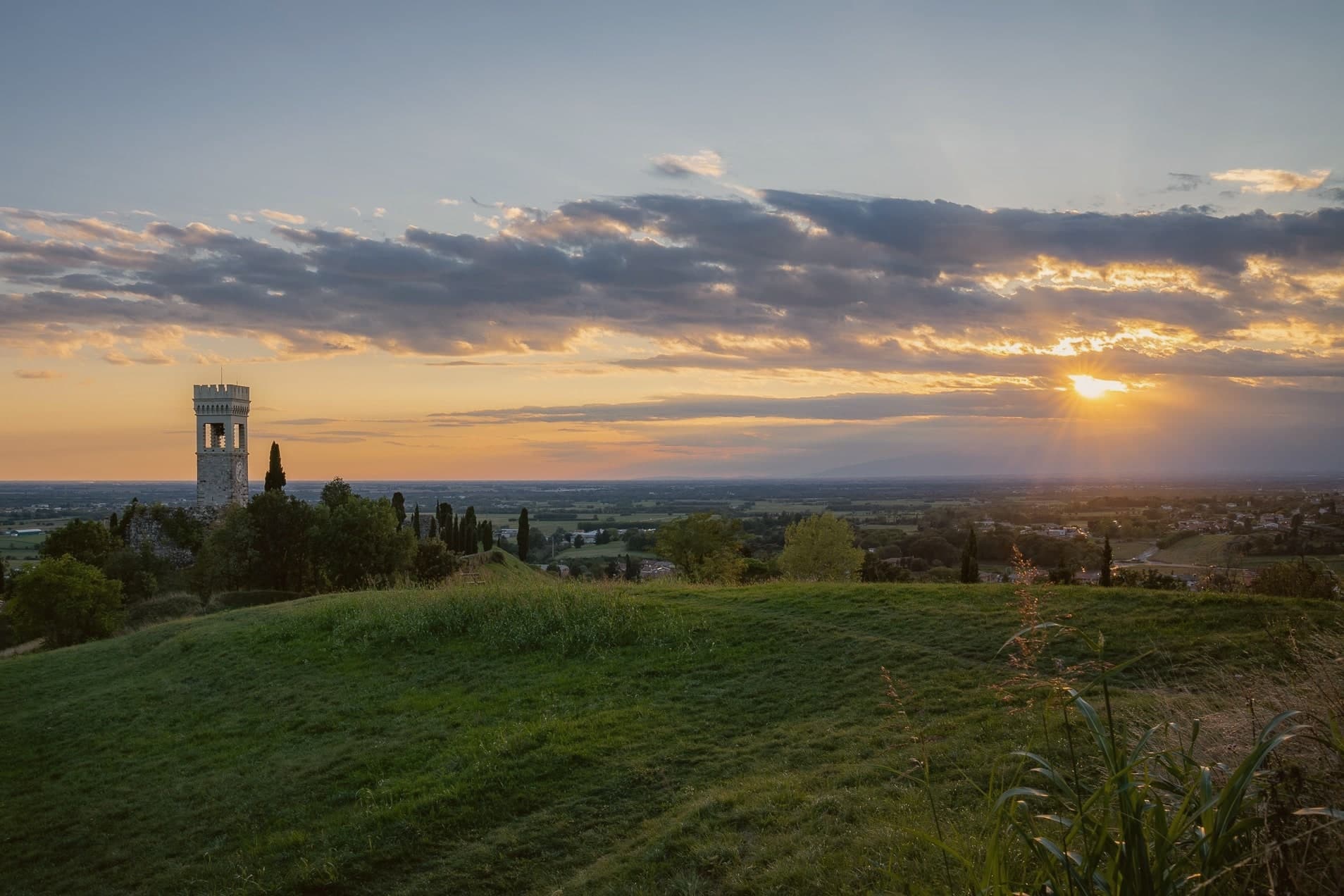
Friuli changes character the moment the plain runs out. The flat farmland north of Udine gives way to low moraine hills left by glaciers, planted with Friulano and ribolla gialla, cut through by gravel rivers running down from the Julian Alps. The towns sit on the high points, built in pale local stone and stucco the colour of dust, with cellars underneath and hams hanging in curing rooms where the mountain air meets the Adriatic breeze. Autumn is the season that rewards the drive most: grape harvest, new wine in the osterie, chestnuts, and a plate of prosciutto cut by hand with a glass of something cold and mineral.
Most visitors to this corner of Italy give their time to Trieste, and it earns the attention, with its Habsburg squares, its coffee houses and its sea. In summer the seafront at Grado and the Roman ruins at Aquileia take the coach traffic, and the wine roads closest to the Slovenian border fill with day trippers running down from Austria. All of it is worth seeing. None of it is quiet, and none of it is in the hills.
The hills are the point here. The same vines, the same curing rooms, the same Longobard and Venetian stonework continue inland and upward, into towns that stand on high ground rather than on the flat, each of them close enough to Udine for a morning departure and a late lunch. Fewer people go, which mostly means the osteria has a table and the piazza belongs to whoever lives there.
Of the 13 communes we have mapped in a 45-minute drive of Udine, 6 qualify as hill towns: each stands on high ground rather than on the plain. The smallest, Fagagna, has 5,980 residents.
Two more lists worth reading alongside this one: The best hill towns in Friuli-Venezia Giulia and The best hill towns that eat well in Friuli-Venezia Giulia.
Fagagna
Why visit Fagagna
Fagagna, Friulian Feagne, sits at 177 meters on the morainic hills thirteen kilometers northwest of Udine. The hill has been strategic since Roman times, and the castle passed to the Patriarch Rodoaldus as part of the 983 donation.
What remains today is scattered rather than whole: a stretch of wall, the Borgo gate, the clock-tower converted into a bell tower, the ruined keep, a fourteenth-century house, and the small church tucked inside the old walls. The four boroughs, Centro, Palûd, Pic, and Riul, each keep a colour and a stake in the town's identity that surfaces once a year in the piazza, and otherwise define the town's internal geography more than its street plan does.
A regional nature reserve on the edge of town gives Fagagna a second, unrelated distinction alongside its medieval fragments. The town has been a member of Borghi più belli d'Italia since 2007.
Between the broken castle, the annual race, and the ibis reserve, the town reads less as one attraction than as several small, unconnected reasons to stop, each surviving on its own terms.
What to see in Fagagna
- Castello di Fagagna. What survives is fragmentary: wall fragments, the Borgo gate, and the clock-tower, the visible remnant of the donated fortress.
- Chiesa di San Michele Arcangelo. Small castle chapel inside the original walls, one of the surviving medieval structures from the patriarchal period.
- Oasi dei Quadris. Regional wetland reserve where the ibis colony nests and feeds, set in the countryside outside the built-up center.
How to get to Fagagna
Udine is roughly 20 minutes away by road.
Our tip
April through October is the working window. May and June bring the morainic hills at their greenest; the Oasi dei Quadris is busiest with ibis breeding and visiting birders. July and August get hot, though the elevation keeps nights cooler than Udine on the plain. Sagrute di Vilalte falls in July.
Cormons
Why visit Cormons
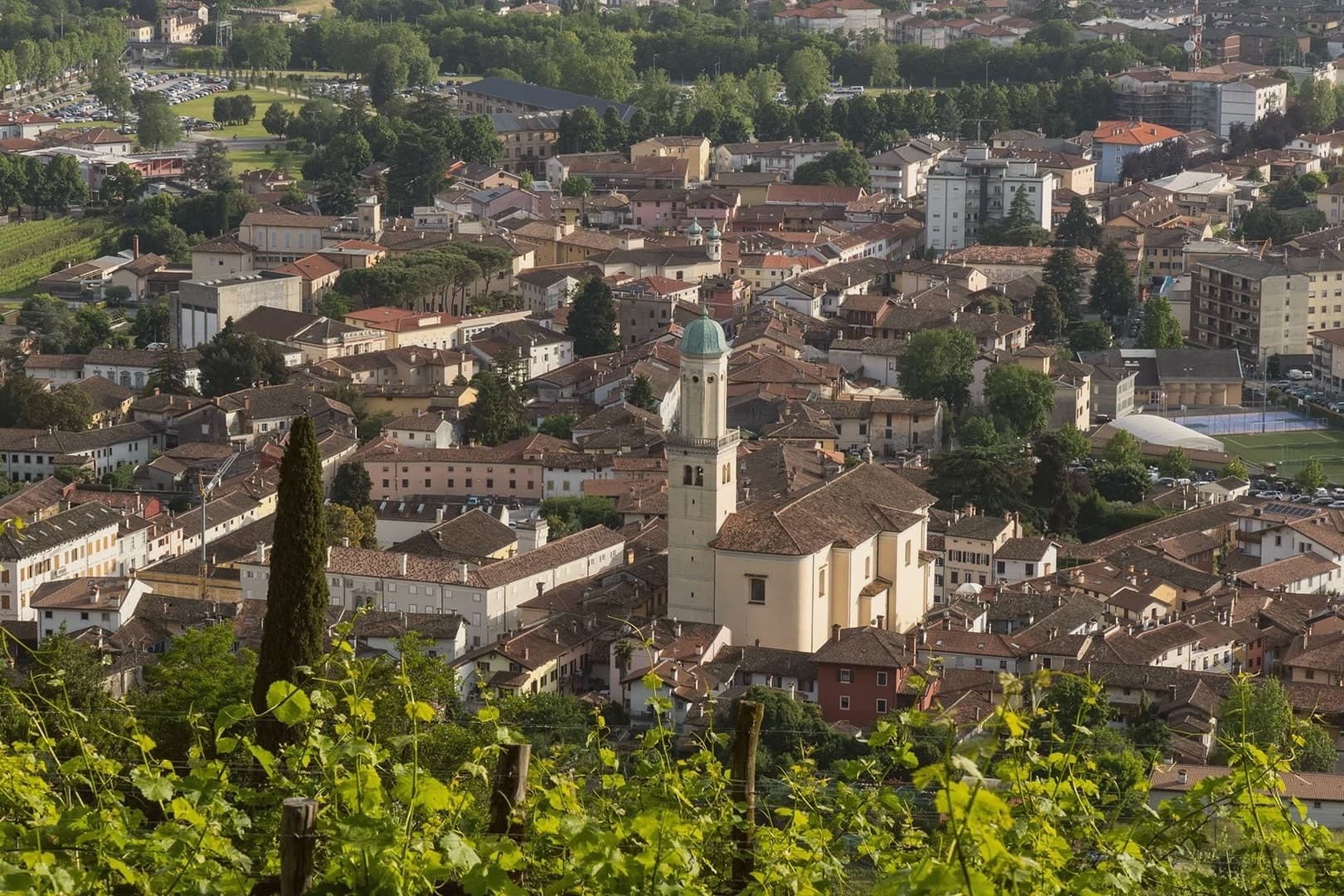
Cormons sits at 51 meters where the Friulian plain rises into the Collio hills, twelve kilometers west of Gorizia on the Slovenian border. Once a Lombard fortress, then a residence of the Patriarchs of Aquileia, the town was contested between Venice and the Habsburgs and stayed Austrian from 1500 to 1918.
Palazzo Locatelli and Palazzo Waiz Del Mestri, facing the main square, keep the Viennese restraint of that period, and the church that anchors the square dates from the same Habsburg-era rebuilding. The vineyards begin on the slopes immediately north of town, where the soil locals call ponka gives way to the hill of Monte Quarin above, its ruined fortress looking down over the DOC zone and across the border into Slovenia.
The cooperative cellar draws its grapes from growers scattered through those same slopes. In 1870 Count La Tour brought French vines into nearby Russiz di Capriva for the Imperial Court palate, which the 1891 Austrian Oenological Congress in Gorizia codified.
What holds the town together is the border itself: a fortress height, a planted slope, and a square built by the empire that once ruled both, still standing in the order Austrian rule left them.
What to see in Cormons
- Piazza della Libertà. Central Habsburg-era square framed by Palazzo Locatelli and other Austrian-influenced civic buildings, with the statue of Emperor Maximilian I at its center.
- Duomo di Sant'Adalberto. Eighteenth-century cathedral on the central square, the principal church of the Habsburg-era town, with painted ceiling and altarpieces of the period.
- Monte Quarin. Hill above Cormons (274 m) with ruins of the Lombard-patriarchal fortress, panoramic views over the Collio vineyards and into Slovenia.
How to get to Cormons
There is a railway station in the town, so you can arrive without a car and never need one while you are here. Udine is roughly 34 minutes away by road.
Our tip
April through June is the green window on the Collio hills, vines budding then leafing, ponka soil still cool from spring. September and October are the vendemmia months, the harvest dictating the rhythm of every cantina in the commune. July and August are warm and humid, the plain's heat pushed into the hills; tasting rooms run on appointment. Borgnano in Festa! falls in August.
San Daniele del Friuli
Why visit San Daniele del Friuli
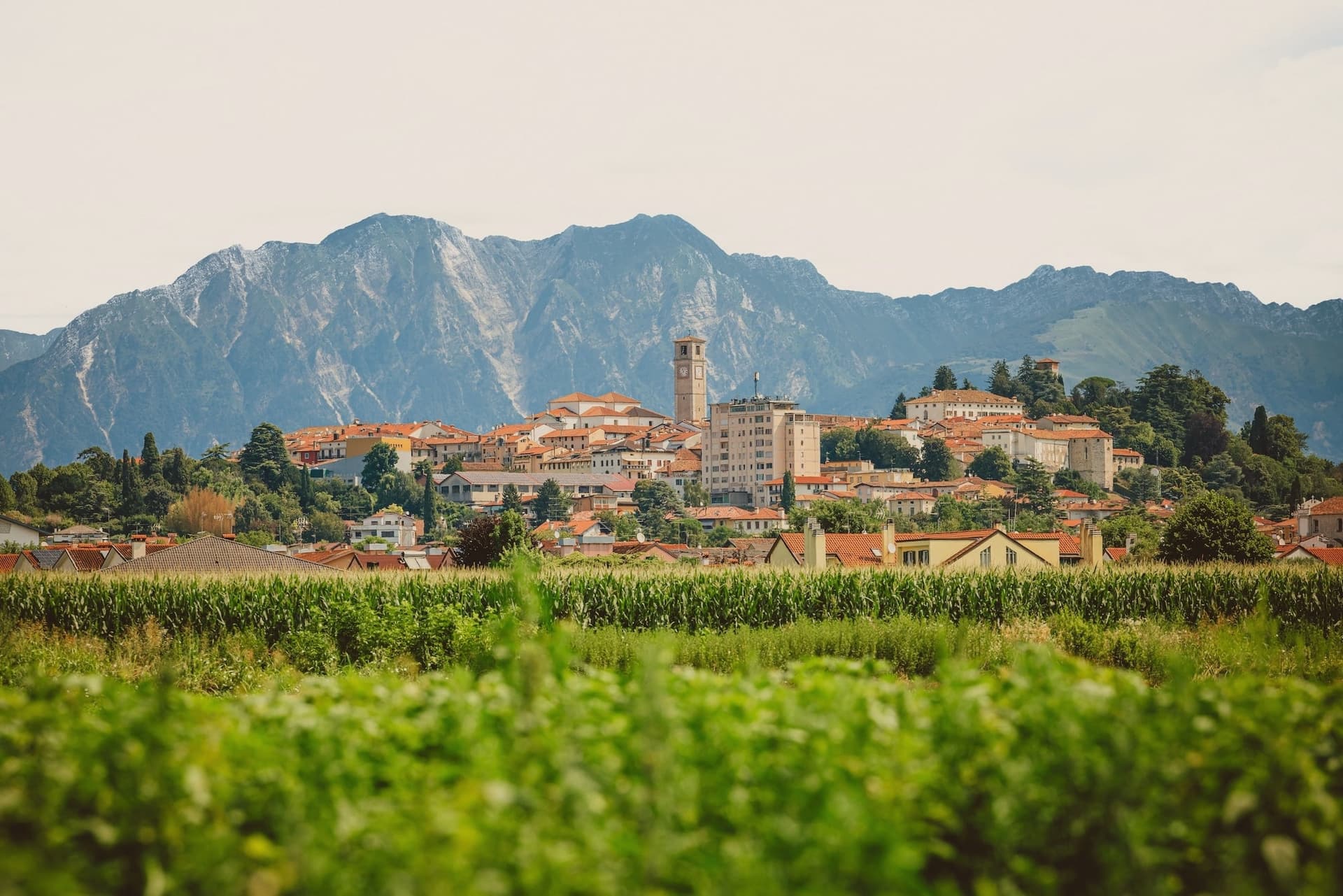
San Daniele del Friuli is where Italy's most prized raw-cured ham is made, and the town has been producing prosciutto continuously since at least 1063 (the first documented mention is in a Patriarchate of Aquileia tax record). The geography is the entire reason: San Daniele sits on a 252m hilltop in the Friuli morainic amphitheatre, where the Tagliamento valley funnels warm south winds from the Adriatic upward and the alpine downdraughts from the Carnic Alps come down to meet them — the result is a uniquely dry, ventilated microclimate that cures hams perfectly without artificial control.
The Consorzio del Prosciutto di San Daniele admits 31 producers, all within the historic centro and immediate frazioni, all curing whole pork legs (deboned only after curing) with sea salt and a minimum 14 months of aging. The trademark crescent-moon shape, the sweetness from low-salt curing, and the Trota di Mare softness are what distinguish San Daniele from its Parma cousin.
The Aria di Festa in late June (4-day festival, 100k+ visitors) is the year's main event — all 31 producers open their workshops, plus tastings across the centro. Beyond prosciutto: the Chiesa di Sant'Antonio Abate (15th-c) contains the complete fresco cycle by Pellegrino da San Daniele (1497–1522, the most important Friulan painter of his generation, called 'il Pellegrino' for his itinerant career), the Biblioteca Guarneriana (1466, the oldest public library in Friuli, founded by the humanist Guarnerio d'Artegna, with manuscripts including a 13th-c Bible), the Cattedrale di San Michele (rebuilt 1707), and the panoramic Belvedere over the Friulan plain stretching to the Adriatic.
The Tagliamento river loops past the town and the Carnic Alps rise to the north. Beyond prosciutto: the Friulan kitchen — frico (potato + Montasio cheese pancake), cjarsons (sweet-savoury filled pasta from Carnia), polenta, the local Friulano DOC white wine.
What to see in San Daniele del Friuli
- Prosciutterie + Consorzio del Prosciutto. 31 producers within the centro and immediate frazioni — all open for visits and tastings. The Consorzio HQ runs daily guided tours. The Aria di Festa late June is the 4-day festival.
- Chiesa di Sant'Antonio Abate (Pellegrino frescoes). Complete 1497–1522 fresco cycle by Pellegrino da San Daniele — the most important Friulan Renaissance painter, in the church that gives its name to his style.
- Biblioteca Guarneriana. The oldest public library in Friuli (founded 1466 by Guarnerio d'Artegna). Manuscripts include a 13th-c illuminated Bible. Open for visits + scheduled research access.
How to get to San Daniele del Friuli
Udine is roughly 33 minutes away by road.
Our tip
San Daniele is best April–June and September–October — the Aria di Festa late June is the year's main event (book accommodation 2 months ahead). Summer is hot in the Friulan plain but the 252m hilltop catches the alpine downdraught breeze. Autumn is harvest season for the surrounding Friulano vineyards. Festa Due Pistoni falls in July.
Cividale del Friuli
Why visit Cividale del Friuli
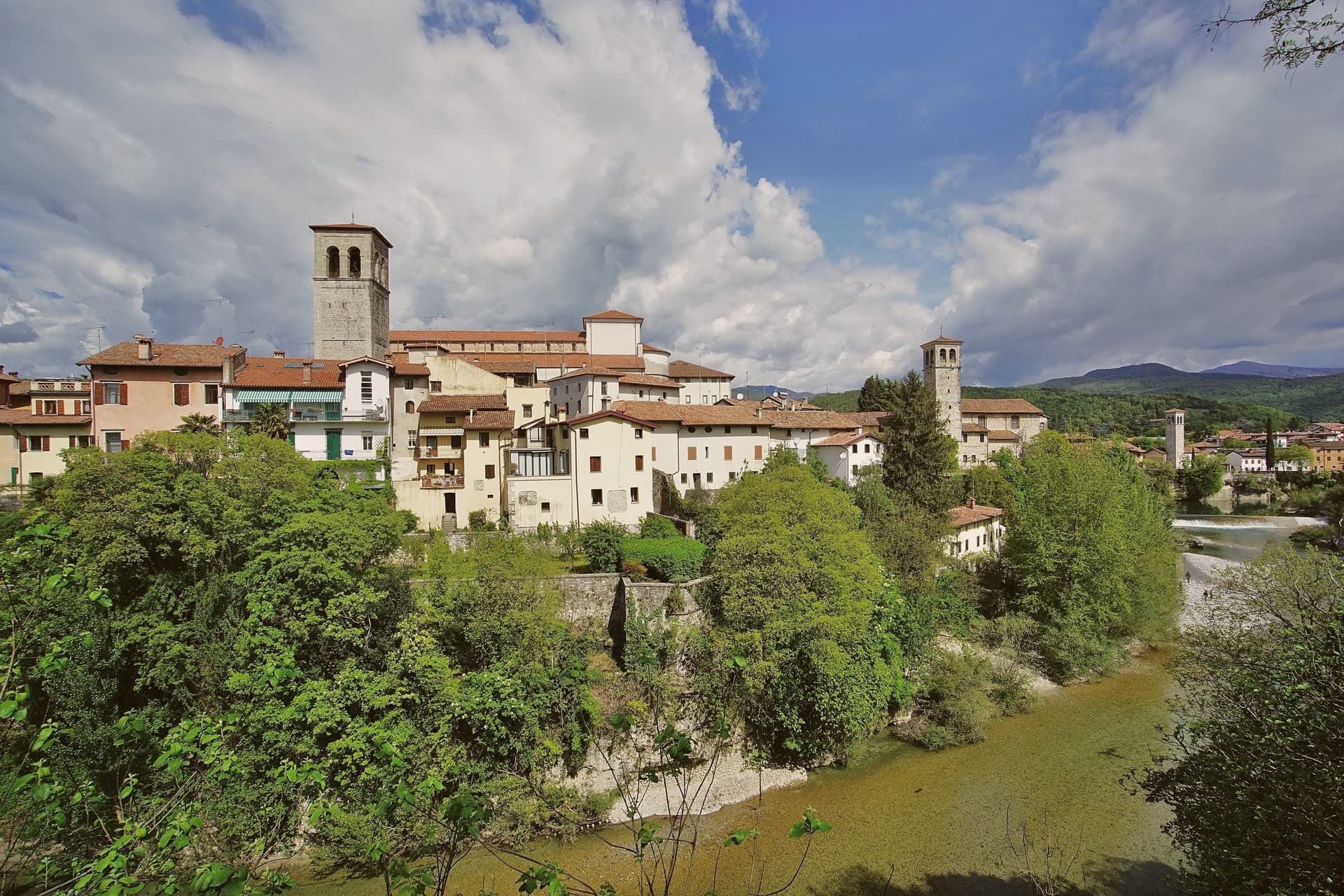
Cividale del Friuli sits at 138 meters on the right bank of the Natisone, fifteen kilometers from Udine and close enough to the Slovenian border that the river marks it. Julius Caesar founded the place as Forum Iulii in the first century BC, the name that eventually gave Friuli its own.
In 568 the Lombard king Alboin made it the capital of his first Italian duchy, and the Patriarchate of Aquileia later moved its seat here for four centuries. The Tempietto Longobardo, an eighth-century palatine chapel, holds six stucco female saints carved around 760, the best-preserved sculpture of the Lombard age in Europe.
It is one of seven sites in the UNESCO serial nomination Longobardi in Italia. The Ponte del Diavolo, begun in 1442, spans the Natisone gorge in two asymmetrical arches.
The Palio di San Donato fills the streets in late August, and Mittelfest brings Central European theater and music to the piazzas every July.
What to see in Cividale del Friuli
- Tempietto Longobardo. Eighth-century palatine chapel in the Monastero di Santa Maria in Valle, with six stucco female saints in high relief, UNESCO-listed since 2011.
- Ponte del Diavolo. Stone bridge over the Natisone gorge, begun in 1442 on two asymmetrical arches resting on a central rock outcrop.
- Duomo di Santa Maria Assunta. Fifteenth-century cathedral with the Pala di Pellegrino II, a twelfth-century gilded silver altarpiece, and an attached Museo Cristiano.
How to get to Cividale del Friuli
There is a railway station in the town, so you can arrive without a car and never need one while you are here. Udine is roughly 26 minutes away by road.
Our tip
April through June and September into October are the months when the Natisone valley shows best, with green hills, mild evenings, and the Slovenian border country open for walking. July brings Mittelfest and August the Palio di San Donato, so the centro storico fills with theater crowds and historical pageant. Both months can push past thirty degrees, though 138 meters of elevation and the river keep nights cooler than the Friulian plain. Palio di San Donato falls in August.
Spilimbergo
Why visit Spilimbergo
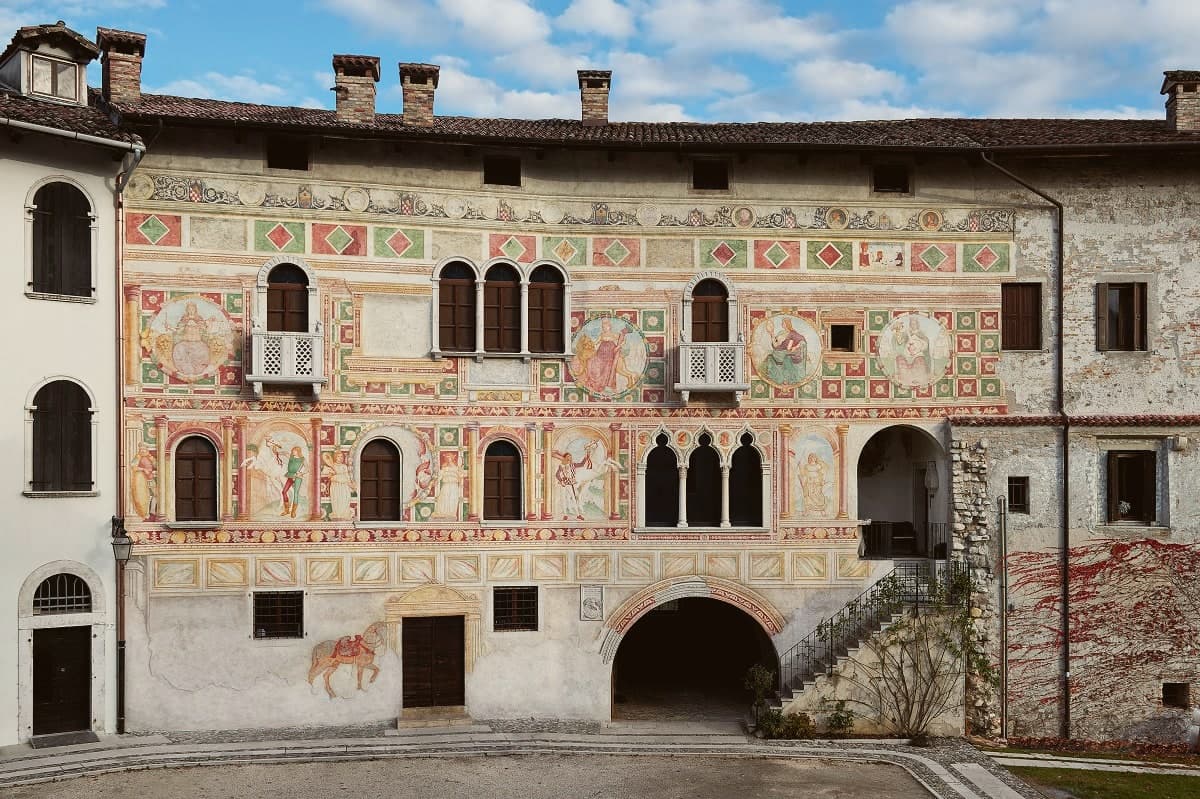
Spilimbergo takes its name from the castrum de Spengenberg, built by Carinthian counts who came south as vassals of the Patriarch of Aquileia. Their fortress anchors one end of a centro storico that reads as a sequence of additions: the Romanesque-Gothic cathedral raised through the fourteenth century, the painted palace that later hosted Charles V, Bona Sforza, and Henry III of France, and Corso Roma running between frescoed palazzi to the old market stone still used to measure trade.
The Scuola Mosaicisti, founded in 1922, is the newest of these layers but the one that has carried the town's name furthest, its alumni's work turning up in the Library of Congress, the Holy Sepulchre, the Foro Italico, and the World Trade Center transit hub. The Folkest folk-music festival runs every July, and the town carries Borghi più belli and Borgo dei Borghi finalist recognition.
Outside it, the Tagliamento broadens into the braided, three-kilometer bed that gives the town its setting on the right bank. A place, in sum, where a medieval frontier post and a twentieth-century craft school have ended up equally responsible for putting Spilimbergo on a map.
What to see in Spilimbergo
- Castello di Spilimbergo. Eleventh-century fortress of the Spengenberg counts, burned in the 1511 popular revolt and partially rebuilt; the palace with the painted façade survived.
- Palazzo Dipinto. The frescoes cover prancing horses, ladies, pages, and figures of the Theological and Cardinal virtues across the fifteenth-century façade.
- Duomo di Santa Maria Maggiore. Romanesque-Gothic cathedral begun in 1284 by count Walterpertoldo II, with apse frescoes executed between 1350 and 1359.
How to get to Spilimbergo
Udine is roughly 39 minutes away by road.
Our tip
April through June is the season for the Tagliamento gravel beds and the Bellunello frescoes; the light catches the Palazzo Dipinto best in the late afternoon. Folkest fills the piazzas with folk musicians from across Europe through early July. August is hot and the centro storico empties between two and five. Istrago in Festa falls in the season.
Gorizia
Why visit Gorizia
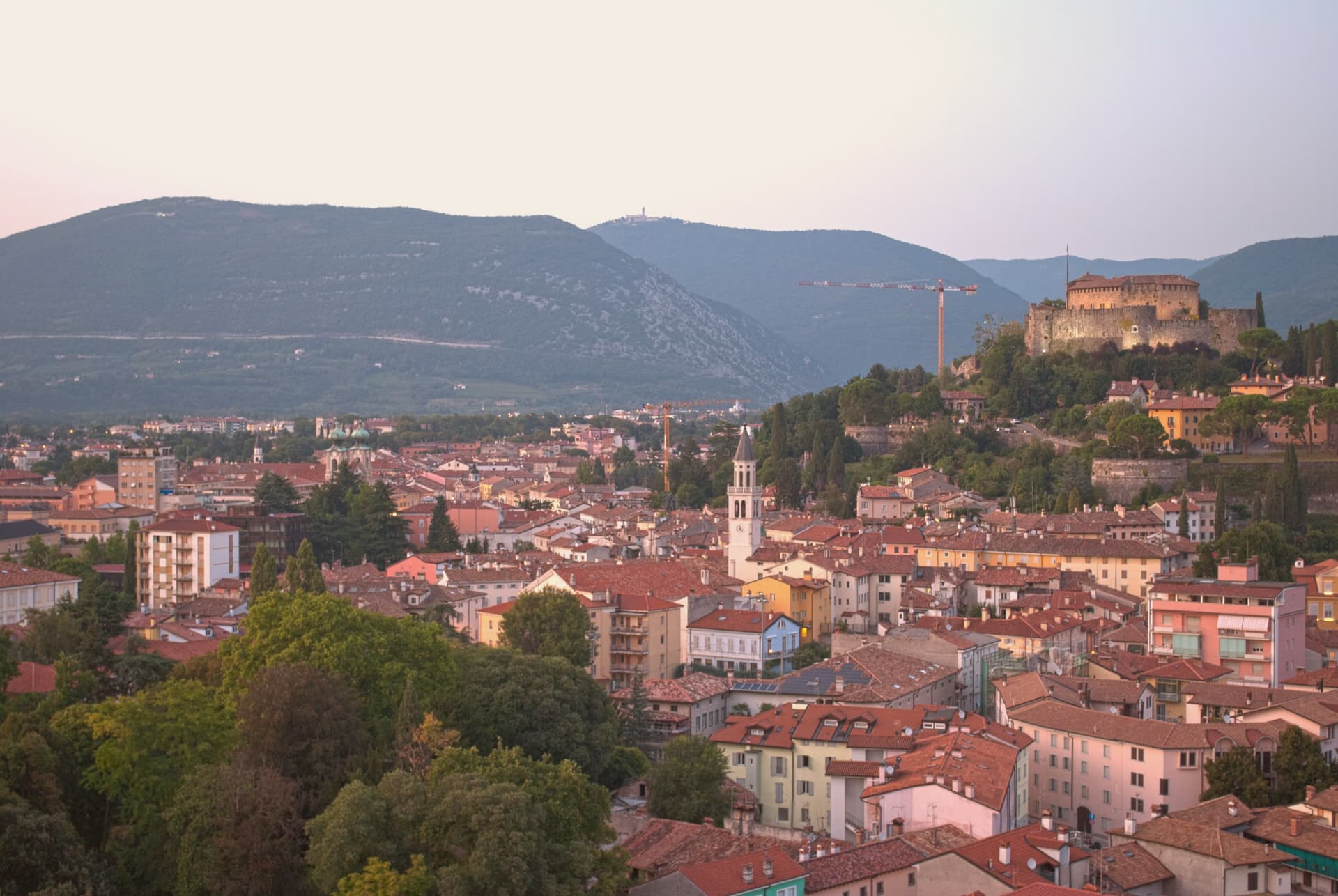
Gorizia sits at 84 meters at the foot of the Julian Alps, on the Slovenian border. The Counts of Gorizia held the town as an independent county from 1127 until 1500, when it passed to the Habsburgs, who kept it until 1918.
Annexed to Italy after World War I, the city lost part of its territory to Yugoslavia in 1947, when a wall went up that became one of the symbols of the Iron Curtain, cutting the border square in front of the railway station the Austrians had built in 1906 into two halves. Schengen lifted the border in 2007, and in 2025 Gorizia and Nova Gorica together held the joint cultural title that marked the year, the first cross-border holders in the program's history.
The city itself divides between the medieval upper town, Borgo Castello, rising around the eleventh-century castle, and the plain below, where the Isontino stretches out to produce Collio and Carso wines. The rebozzato cafés on Corso Verdi still serve in Friulian, Italian, Slovenian, and German, a hangover from a border that has moved but never quite disappeared.
A city built on a fault line, first political, then physical, now a shared cultural address for two towns that were once one and then were forced apart.
What to see in Gorizia
- Castello di Gorizia. Eleventh-century castle on the hill above the city, restored after World War I damage, with museum rooms and ramparts open to walk.
- Borgo Castello. Medieval upper town inside the castle ramparts, the original nucleus of the city before it spread onto the plain below.
- Piazza della Transalpina (Trg Evrope). Border square cut in two by the 1947 line, reunited in 2004, with the old dividing line still marked by a strip of pavement tile. Served as the inauguration stage of European Capital of Culture.
How to get to Gorizia
There is a railway station in the town, so you can arrive without a car and never need one while you are here. Udine is roughly 41 minutes away by road.
Our tip
April through June and September into October are the working windows, the Isontino plain green or gold, the hill paths around the castle walkable without humidity. July and August carry the Friulian-plain heat moderated only slightly by altitude. The European Capital of Culture program in 2025 stretched events across all twelve months and proved that the city carries shoulder-season weight. Flavors of the Frontier falls in September.
More from Anywhere Italy
 The best hill towns in Friuli-Venezia Giulia
- The best hill towns that eat well in Friuli-Venezia Giulia
 The best hill towns within 90 minutes of Trieste
 The best towns with a food festival in Friuli-Venezia Giulia
- The 9 best towns with a serious restaurant in Friuli-Venezia Giulia
 The best towns that eat well within 75 minutes of Trieste