
The best hill towns in the province of Arezzo
Eastern Tuscany rises in ridges rather than the smooth swells of the postcards, and the towns here sit on the steepest ground they could hold, walls of pietra serena and thin Tuscan brick following the contour instead of a grid. Kitchens run to Chianina beef grilled over embers, bringoli and pici rolled by hand, pecorino from the Casentino, chestnut flour ground in the mills along the Pratomagno streams. Autumn is the season with the most in it, porcini and chestnuts, the first oil pressed in November, mist filling the Arno valley below the ridge roads. Spring brings the wool fairs, the antique stalls and the crociata processions, and it comes early on the south-facing slopes of the Valdichiana.
The Tuscan hill town is the country's most reliable holiday image, and the traffic runs where the image was made: Siena, San Gimignano and the Val d'Orcia between Pienza and Montalcino, with buses parked below the walls from morning. The reason is genuine. Those places are magnificent, the roads there are good, and the wine and the views justify the effort. But high season turns the main street into a queue, and prices track the crowd.
The same geology and much of the same cooking carry east across the Valdarno, the Casentino and the Valdichiana, and that is where the province of Arezzo sits. The hills keep going past the famous names into oak forest, Camaldoli and Vallombrosa, castles of the Guidi counts, Romanesque parish churches on terraces above ravines, Della Robbia glaze in village chapels. Fewer people go, the Chianina is often better, and the towns below are the ones worth the detour.
Of the 7 communes we have mapped in the province of Arezzo, 7 qualify as hill towns: each is an inland hill settlement built on ground too steep to spread. The smallest, Lucignano, has 3,383 residents.
Two more lists worth reading alongside this one: The prettiest hidden villages with a serious restaurant in Toscana and The best towns with a medieval festival that you can reach by train within 90 minutes of Perugia.
Lucignano
Why visit Lucignano
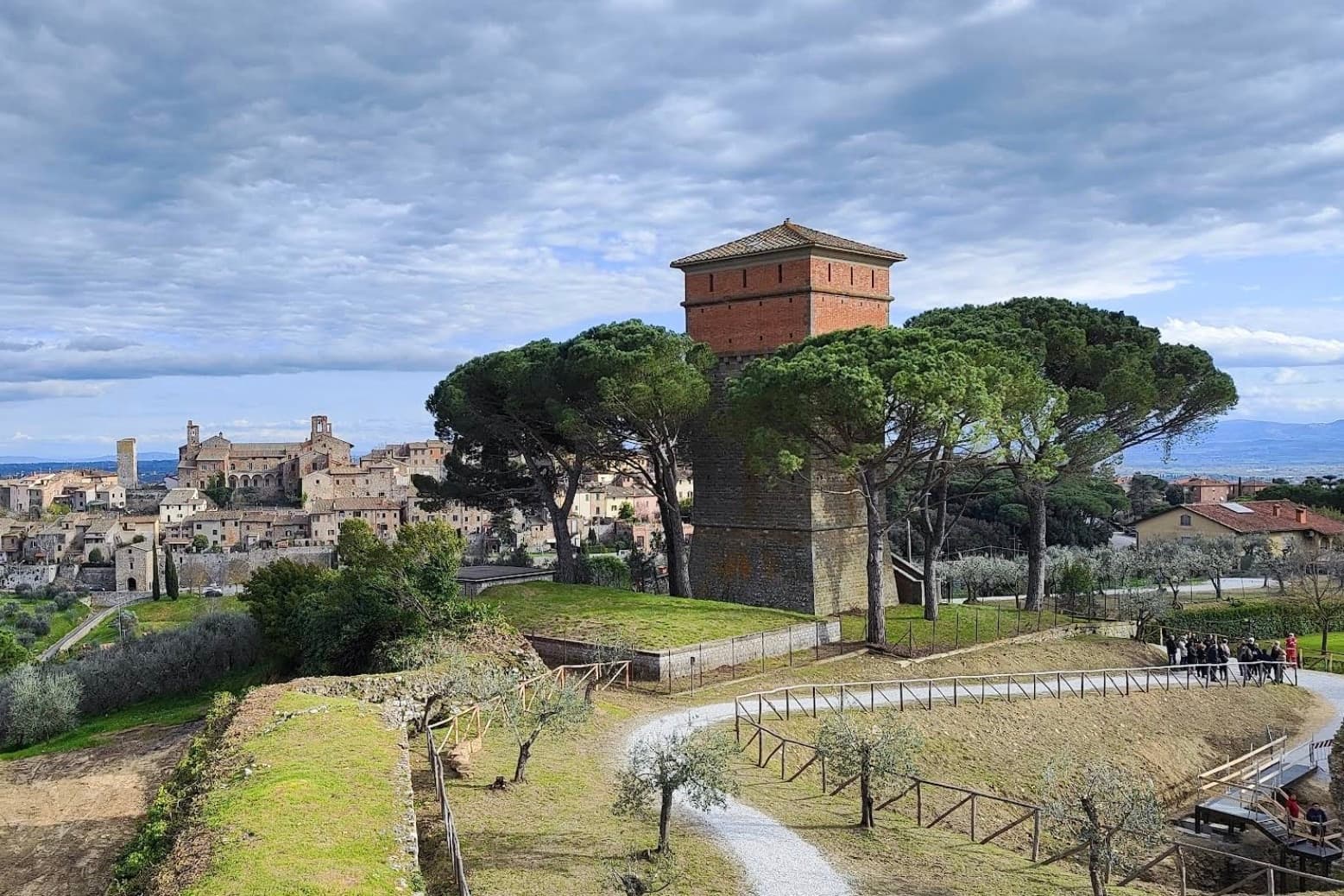
Lucignano sits at 400 meters on a hill in the Valdichiana, halfway between Siena and Arezzo, built on a tight elliptical plan of four concentric rings of streets. Its position made it one of the most contested settlements of medieval Toscana: Siena, Arezzo, Florence and Perugia all fought over it between 1200 and 1500.
The current walls and three gates date to a Sienese reconstruction of 1371. In the Museo Civico inside the Palazzo Comunale stands the Albero d'Oro, a 260-centimeter Gothic gold-and-coral reliquary in the shape of a tree, begun by Ugolino di Vieri in 1350 and finished by Gabriello d'Antonio in 1471.
Local tradition turned it into the Albero dell'Amore, a marriage charm. The Collegiata di San Michele Arcangelo dominates the highest ring of the borgo, and the elliptical plan is best read from the air, which is why drone footage of Lucignano keeps appearing in articles about medieval Tuscan urbanism.
What to see in Lucignano
- Albero d'Oro. 260-cm Gothic reliquary in the shape of a tree, gold, coral and enamel, begun by Ugolino di Vieri in 1350 and completed by Gabriello d'Antonio in 1471.
- Centro storico ellittico. Four concentric rings of streets inside elliptical walls, the most complete example of medieval Tuscan elliptical town planning.
- Collegiata di San Michele Arcangelo. Eighteenth-century church on the highest ring of the borgo, with a Vasari façade adjustment and a baroque organ inside the medieval shell.
How to get to Lucignano
There is a railway station in the town, so you can arrive without a car and never need one while you are here. Perugia is roughly 65 minutes away by road.
Our tip
April through June and September into October are the months Lucignano keeps its balance, the Valdichiana green or gold depending on the half and the centro storico cool inside its elliptical walls. The Maggiolata, a flower festival between the four quarters of the borgo, runs across the last two Sundays of May. July and August push the valley past thirty and the centro storico thins after lunch. Sagra della Filiera del Tartufo Marzuolo falls in March.
Anghiari
Why visit Anghiari
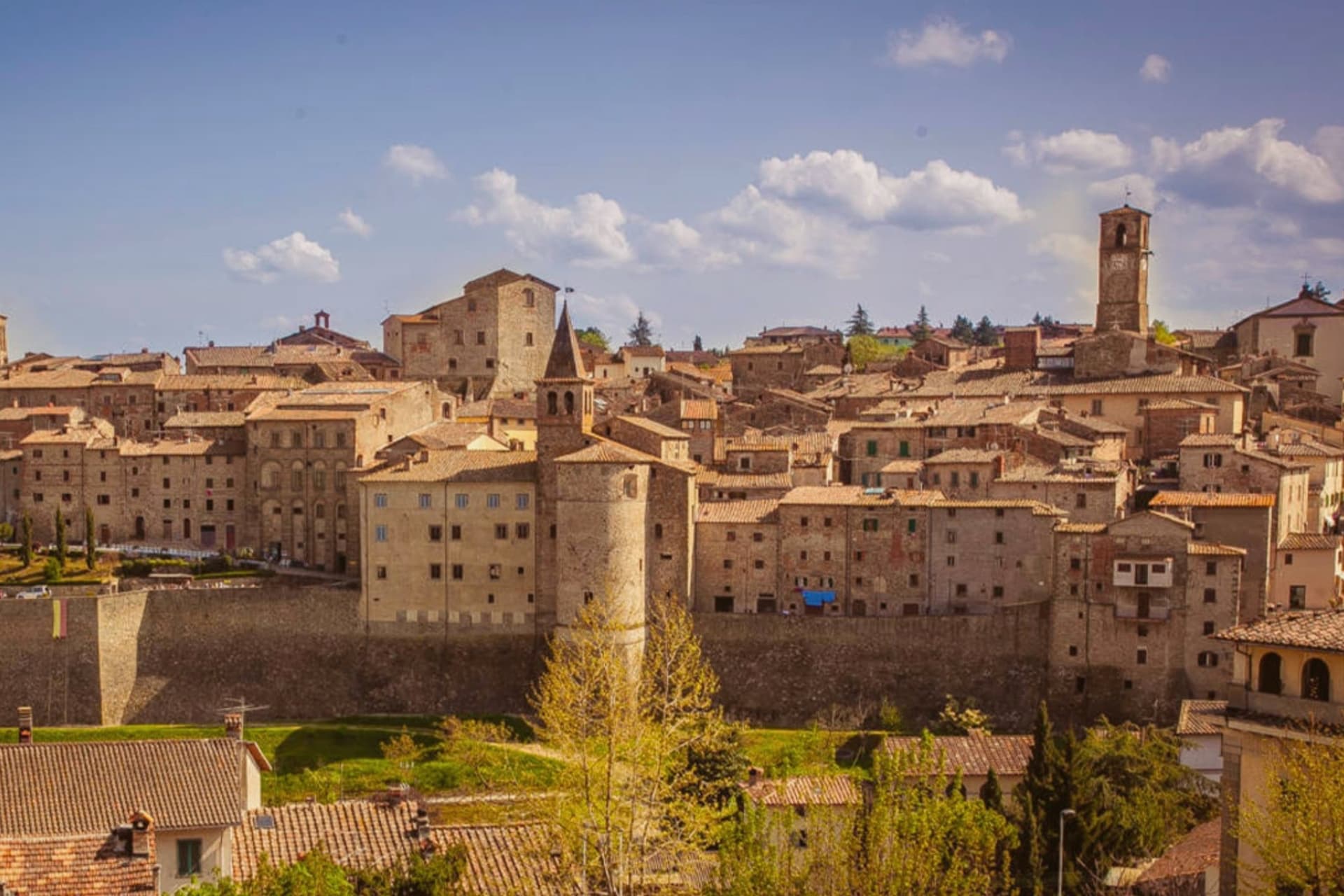
Anghiari sits at 430 meters on a spur above the upper Tiber valley, the Valtiberina, between Arezzo and the Umbrian border. The walled centro storico is intact, the streets running steeply from the Porta Sant'Angelo up to the Castello.
On 29 June 1440 the Florentine army defeated a Milanese force under Niccolò Piccinino in the plain below town, a battle that secured Florence's hold over central Italy and gave Leonardo da Vinci the commission for the Palazzo Vecchio fresco he started in 1505 and never finished. The painting, the Lost Leonardo, is presumed still to be hidden behind a Vasari wall in Florence.
Palazzo Taglieschi in the centro storico holds a polychrome wooden Madonna by Jacopo della Quercia and a working sixteenth-century table organ. The Mostra Mercato dell'Artigianato della Valtiberina has filled the streets with craft producers every spring since 1976, a working continuation of the textile and woodwork traditions that supported the town through the twentieth century.
What to see in Anghiari
- Palazzo Taglieschi. Sixteenth-century palace in the centro storico, now the Museo Statale di Palazzo Taglieschi, with a wooden Madonna by Jacopo della Quercia and a working table organ.
- Castello di Anghiari. Medieval fortified core at the top of the town, walls and gates still intact, the visual anchor of the silhouette from the valley below.
- Campo della Battaglia. The plain at the foot of the walls where Florence defeated Milan on 29 June 1440, the battle that inspired Leonardo's lost Palazzo Vecchio fresco.
How to get to Anghiari
Perugia is roughly 82 minutes away by road.
Our tip
April through June and September into October are the working months in the Valtiberina: dry days, low cloud over the upper Tiber, the surrounding farmland green or gold by season. The Mostra Mercato dell'Artigianato runs the last week of April and the first week of May, filling the streets with artisans from across the valley. Late June marks the anniversary of the 1440 battle, with reenactments below the walls. Palio della Vittoria di Anghiari falls in June.
Poppi
Why visit Poppi
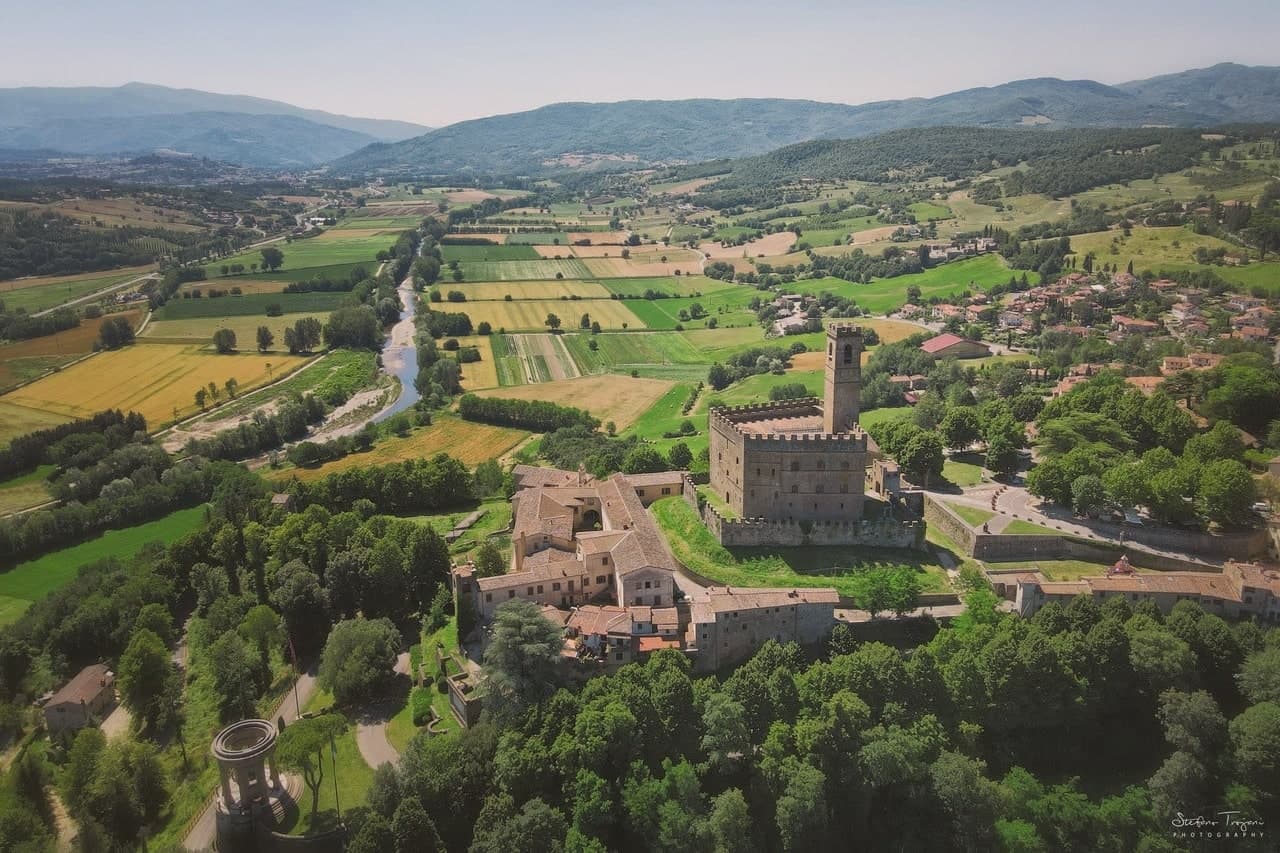
Poppi rises above the upper Arno in the Casentino, the wooded valley set between Pratovecchio and Bibbiena. The Counts Guidi held this hill from at least 1169, and the castle they raised across the late twelfth and thirteenth centuries is attributed in its older part to Lapo di Cambio and in the later upper section to Arnolfo di Cambio.
Dante Alighieri, who fought below the hill as a young man, returned to it later as a guest of the Guidi during his exile, so the borgo held him twice, once as a soldier and once as a household guest. The town itself sits above the battle plain, the abbey church inside the walls, the castle over both.
A further Romanesque pieve stands a short distance off, and the forested ridges of the Apennine watershed rise to the east, the same terrain the Guidi once ruled from their hill. What the place adds up to is a single family's hold on a valley, visible still in the line from castle to plain to church, with the forest marking where their lordship ran out.
What to see in Poppi
- Castello dei Conti Guidi. The castle keeps a working library and a fourteenth-century chapel frescoed by the school of Giotto, along with a hand-painted model of the battle below, more than four thousand tin soldiers set out on the table.
- Piano di Campaldino. The plain sits directly beneath the castle walls, open ground still readable as a battlefield, with nothing built across it since.
- Abbazia di San Fedele. Romanesque abbey church inside the borgo, with single nave and stone façade, dating from the early twelfth century.
How to get to Poppi
There is a railway station in the town, so you can arrive without a car and never need one while you are here. Firenze is roughly 64 minutes away by road.
Our tip
April through June brings the Casentino into clear sun, the beech forests in their first leaf and the upper Arno full from spring rain. July and August are pleasant at 437 meters, never coastal-hot, with the castle and library full of weekend visitors from Florence. September and October are the harvest and chestnut months: the Foreste Casentinesi turn orange in the high cuts above Pratovecchio. Il Casentino nel piatto falls in June.
Arezzo
Why visit Arezzo
The city sits on a Tuscan hilltop 80 km southeast of Florence, and the ground beneath it holds one of the densest layers of Etruscan, Roman, medieval and early-Renaissance building anywhere in the region, without the tour-bus crush of its more famous siblings. The lower streets and the upper square pull the town's whole history together: the Pieve di Santa Maria's Romanesque exterior and five-tier facade were widely copied across central Italy, the Cattedrale di San Donato is Gothic with stained glass by Guillaume de Marcillat, and the Casa Vasari is the painter-architect's own house, frescoed by himself.
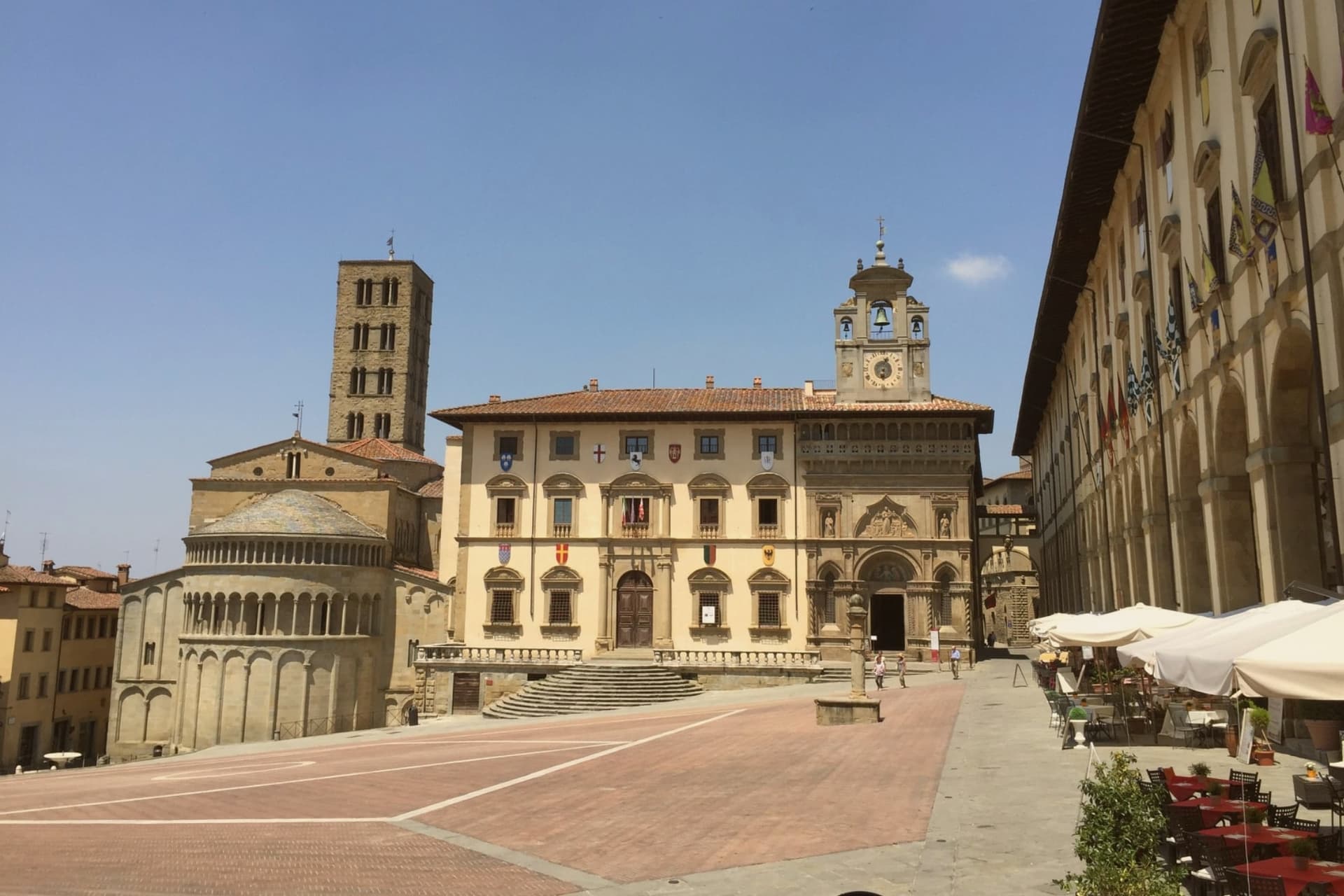
Giorgio Vasari was Arezzo's other native son, and beyond his own house his Loggia still frames one side of the sloped trapezoidal square, alongside the 14th-century facade of the Palazzo della Fraternita dei Laici and the Romanesque apse of the Pieve. The Museo Archeologico Nazionale stands on the site of the Roman Amphitheatre, where the Vasi corallini, coral-red glazed Roman pottery, were made as a manufacturing centre for the empire.
The fresco cycle narrates the journey of the Cross from Adam's grave through Solomon to Constantine to Heraclius in 10 panels of geometric serenity and silver-grey light, and the film that made the square famous used its slope as a stage set, the same slope the antique dealers now fill every first weekend of the month with more than 500 stalls drawing buyers from across Europe. Twice a year, in June and September, the four city quartieri, Porta Crucifera, Porta del Foro, Porta Sant'Andrea and Porta Santo Spirito, meet in the jousting tournament, riders charging the wooden target on horseback in a contest that has run since the 13th century.
The food is Tuscan: pici with hare ragù, ribollita, bistecca chianina from the Val di Chiana below the city, Pecorino Toscano, with Vino Nobile, Brunello and Chianti Classico all within an hour's drive south. Together the fresco, the square, the joust and the antique trade give the city a working civic life built on Renaissance art and medieval ritual rather than a museum piece preserved around it.
What to see in Arezzo
- Piero della Francesca's Leggenda della Vera Croce. 10-panel fresco cycle in the Cappella Bacci of San Francesco. Timed entry: 25 people, 30 min, book 2-3 weeks ahead.
- Piazza Grande + Pieve di Santa Maria. Sloped trapezoidal square lined by the Palazzo della Fraternita, Vasari's Loggia, and the 12th-c Lombard-Romanesque apse of Santa Maria.
- Fiera Antiquaria (every first weekend). 500+ dealers fill the square and surrounding streets, drawing dealers and buyers from across Europe.
How to get to Arezzo
There is a railway station in the town, so you can arrive without a car and never need one while you are here. Firenze is roughly 62 minutes away by road.
✷ We have written about Arezzo
“Arezzo is the last of this region’s losers, the cousin of Siena, beaten and absorbed and left behind, and like all of them, it kept what the winners spent. The same edge that cost it an empire is the moat that keeps the tour buses in Florence. It does not perform. It does not sell you a lie about itself. It works its gold, runs its schools, and lets the heat sit on the great empty square, and it will not notice whether you stay a day or a life.”
Read our piece on Arezzo →Arezzo | The City That Ignores You
Our tip
Arezzo is best April–June and September–October. The Fiera Antiquaria's first weekend of the month is the year-round draw (book hotels 2 weeks ahead). The Giostra del Saracino (third Saturday June + first Sunday September) is the year's two civic highlights. Giostra del Saracino di Arezzo (Giugno) falls in June.
Loro Ciuffenna
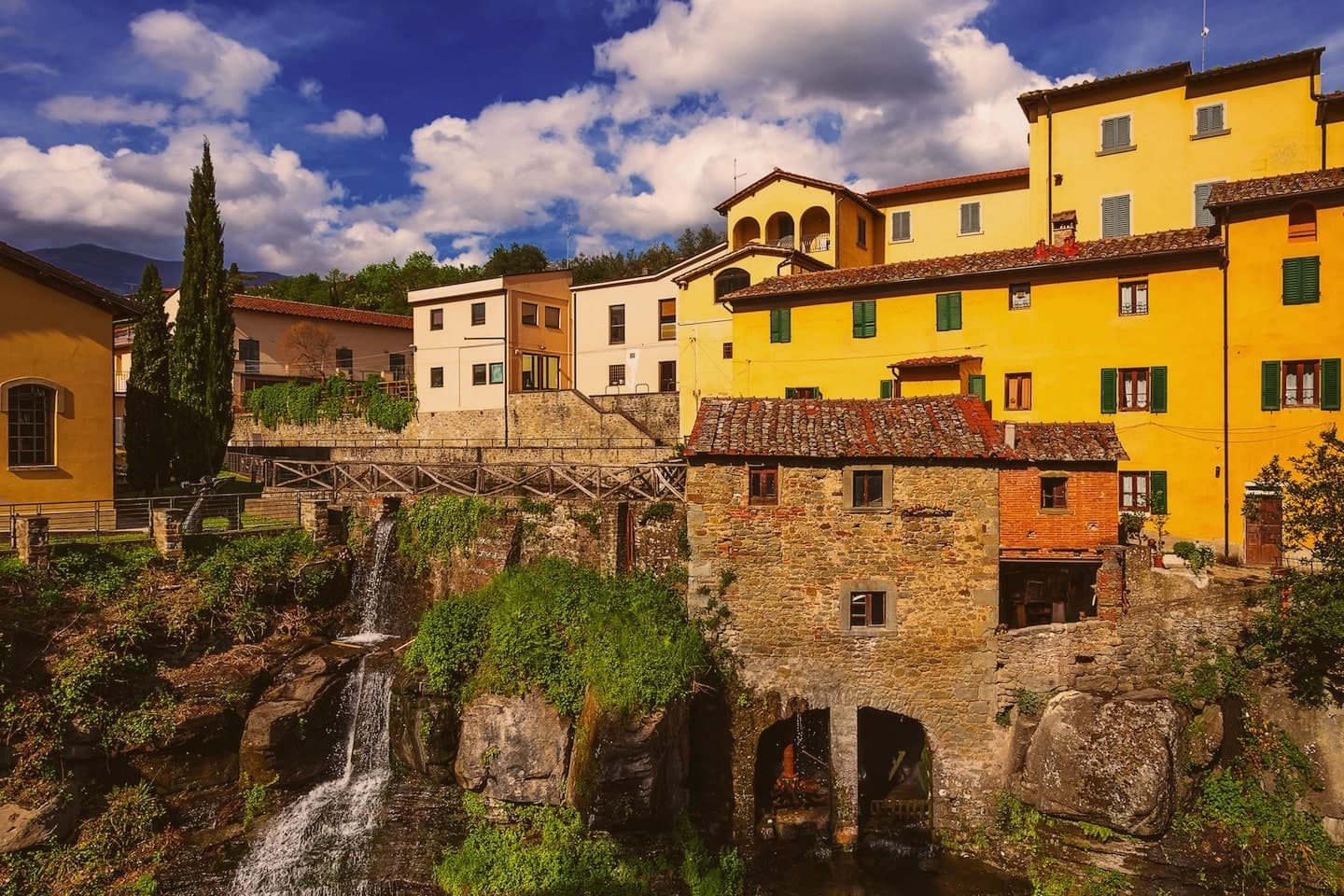
Why visit Loro Ciuffenna
Loro Ciuffenna sits at 330 meters on the western slopes of the Pratomagno, between the Arno valley and the Casentino. The torrent it is named for cuts through the centro storico under a hump-backed stone bridge of Roman origin, remodeled in the Middle Ages.
A water mill on the bank is still in operation, the oldest active mill in Tuscany, dating to the 12th century and used until recently to grind chestnuts into flour. The inhabitants of the castle of Loro were the first to submit to the Florentine Republic in 1306, and the village formed its own statutes as an autonomous comune in 1462.
Two kilometers up the Setteponti road stands the Pieve di San Pietro a Gropina, one of the great Romanesque parish churches of Tuscany, built around the year 1000 over two earlier churches; its circular pulpit, supported by two knotted Lombard columns, is 8th century.
What to see in Loro Ciuffenna
- Pieve di San Pietro a Gropina. Romanesque parish church 2 km south of the village, built around 1000 over a 5th-century church and an 8th-century Lombard one with a knotted-column pulpit.
- Ponte sul Ciuffenna. Hump-backed stone bridge of Roman origin crossing the torrent in the centro storico, heavily remodeled in the medieval period.
- Mulino di Loro Ciuffenna. 12th-century water mill on the Ciuffenna, the oldest active mill in Tuscany, traditionally used to grind chestnut flour.
How to get to Loro Ciuffenna
Firenze is roughly 62 minutes away by road.
Our tip
April through June brings green slopes, mild evenings and water in the Ciuffenna torrent. September and October are the dry months, when the Pratomagno chestnuts ripen and the Setteponti road sees the best light of the year. July and August can push the Valdarno floor into the mid-thirties; the village stays cooler at 330 meters than the plain below, but the centro storico empties in the afternoon hours.
Castiglion Fiorentino
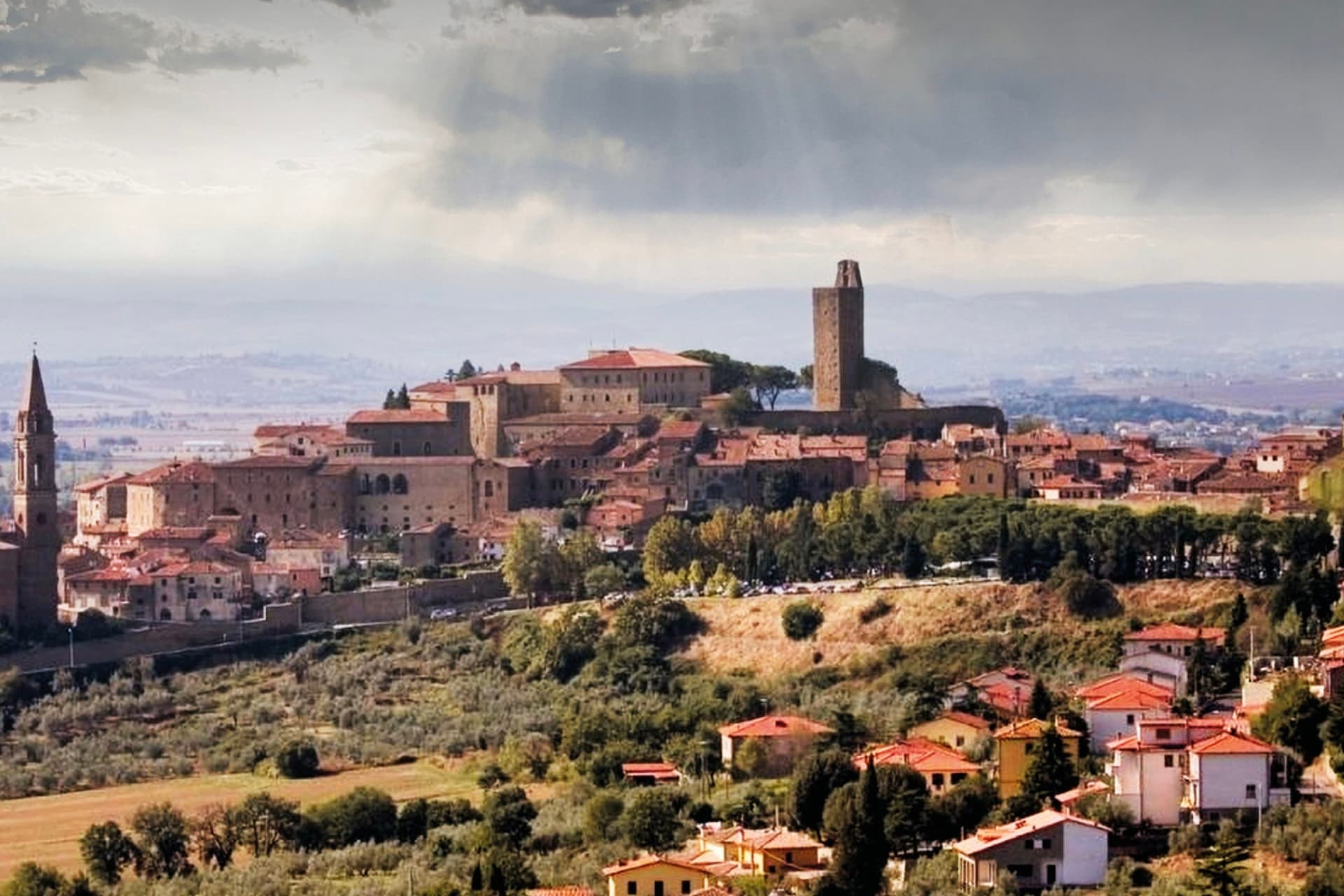
Why visit Castiglion Fiorentino
The hill stands between Arezzo and Cortona, above the fertile plain that gives the area its name. The centro storico is layered directly on what came before it: the medieval streets and the fortress at the summit sit on foundations from the fourth century BC, so walking from the lower gates to the top of the town is also a climb through the town's own construction history, one period built on the next rather than beside it.
The upper terrace holds the oldest religious building along with the fortress, while the main piazza lower down gathers the later additions, the parish church, the arcade, and the gallery, into a single civic space. The town carried allegiance first to Perugia, then to Florence from 1384, and was renamed at that moment, a change of name that marks the point where the additions to the skyline, the arcade among them, became possible.
What results is a town where the sightlines do the explaining: the arcade frames the plain because the plain was always the reason to build here, and the fortress crowns the hill because it was already fortified ground long before anyone called it that.
What to see in Castiglion Fiorentino
- Cassero. Fortified core at the top of the town. The tower is reached by climbing through the streets of the centro storico, with the drop toward the plain opening out only at the top.
- Logge del Vasari. The three arches sit at the edge of Piazza del Municipio, so the arcade functions as a frame for the view rather than a monument to walk around. Below it, the Pinacoteca occupies the neighboring building.
- Pinacoteca Comunale. Civic gallery next to the Logge with works by Bartolomeo della Gatta, Margaritone d'Arezzo, Taddeo Gaddi and a notable bust reliquary in gilded silver.
How to get to Castiglion Fiorentino
There is a railway station in the town, so you can arrive without a car and never need one while you are here. Perugia is roughly 54 minutes away by road.
Our tip
April through June and September into October are the working months in the Val di Chiana: dry days, mild evenings, harvest of olives and Sangiovese into October. July and August push past thirty degrees and the plain below holds the heat; the town at 342 meters runs a few degrees cooler. The Palio dei Rioni in mid-June fills the streets with banners between the four historic quarters and a horse race in the Cassero square. Palio dei Rioni di Castiglion Fiorentino (Arezzo) falls in June.
Cortona
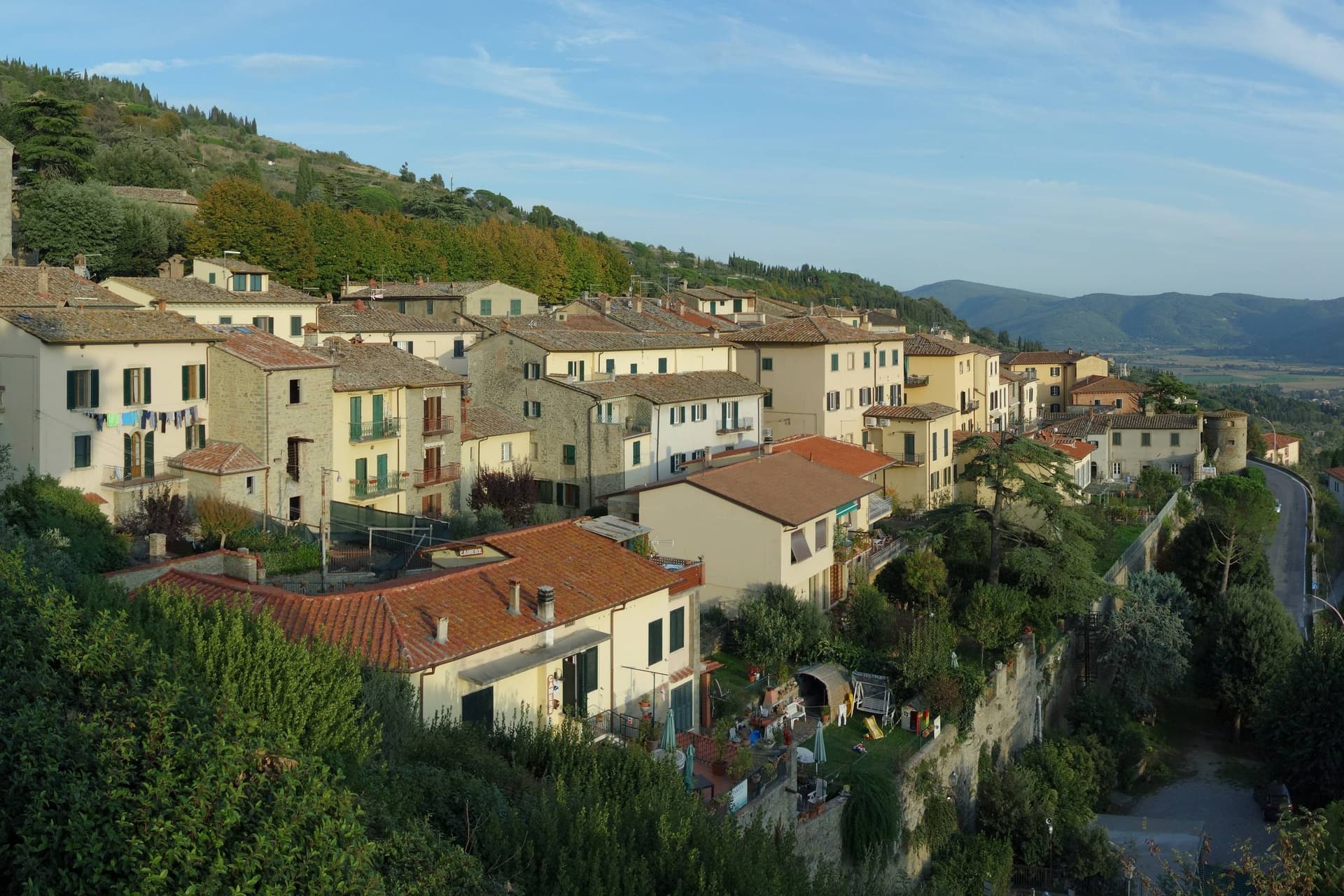
Why visit Cortona
Cortona stands on the southern flank of the Val di Chiana, looking across to Lake Trasimeno: a position that put it in sight of both the plain it governed and the water beyond it. The Etruscan name Curtun survives fixed in stone, and the city that carried it was built in tiers up the hillside, walls and fortress at the crown, church and convent lower down at the edges of the slope, houses and squares filling the ground between.
The bishop granted Francis of Assisi a place for retreat in 1211, and what resulted was built into a narrow valley below the town rather than within its walls, a retreat kept apart from the civic center even as it stayed within reach. Santa Margherita, the city's patron, is held on the ridge above the streets she once walked.
The painters Luca Signorelli and Pietro da Cortona were born inside the walls that still define the town's shape. Frances Mayes published her memoir in 1996, and the town has not been quiet since.
What emerges is a hill town whose Etruscan skeleton, medieval faith, and modern fame sit stacked on the same slope, each layer visible without erasing the one beneath it.
What to see in Cortona
- Mura etrusche. The walls still ring the city entire, the foundation under every later layer of building, Roman and medieval alike.
- MAEC. Museum of the Etruscan Academy in Palazzo Casali, holding the bronze plaque and the lampadario di Cortona.
- Museo Diocesano. Collection in the former Chiesa del Gesù with Beato Angelico's Annunciation of 1430 and works by Luca Signorelli.
How to get to Cortona
There is a railway station in the town, so you can arrive without a car and never need one while you are here. Perugia is roughly 45 minutes away by road.
Our tip
April through June brings green hills, cool evenings and the longest hours in the Diocesano without a queue. September and October are the dry, gold months, light coming in low across Lake Trasimeno and the olive harvest running until November. July and August are the difficult months. Giostra dell'Archidado di Cortona falls in June.
More from Anywhere Italy
 The prettiest hidden villages with a serious restaurant in Toscana
- The best towns with a medieval festival that you can reach by train within 90 minutes of Perugia
- The 9 best towns with a serious restaurant that eat well within 90 minutes of Firenze
 The 10 best towns you can reach by train that hold a food festival within 90 minutes of Perugia
 The best hidden hill towns with a food festival within 90 minutes of Perugia
 The best hidden hill towns with a medieval festival within 90 minutes of Perugia