
The best hill towns in Molise
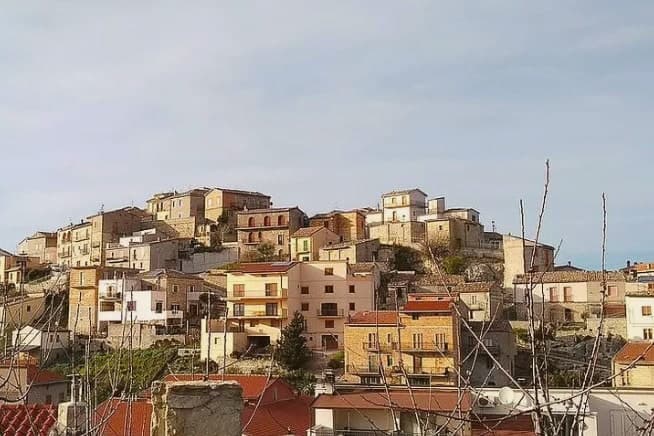
Molise is a region of ridges. Villages sit on limestone spurs with the ground falling away on both sides, so the houses are stacked rather than spread, built from the same pale stone as the hill they stand on, roofed in worn terracotta. The land between them is olive terrace, oak wood and sheep track, the old tratturi that carried flocks down towards the Adriatic and Puglia in autumn. The food follows the altitude: caciocavallo hung to age, pecorino, lamb cooked over wood, pasta shapes like cavatelli, and the local bread that keeps for days. Spring brings broom and wild asparagus on the slopes, and by late October the mills are pressing.
Most people travelling this stretch of the country do not stop in Molise at all. They aim for Abruzzo, for the Gran Sasso and the Parco Nazionale d'Abruzzo, where the hill villages have been photographed for decades and the summer traffic on the road to Scanno backs up in the gorge. Those places earned their reputation, and the mountains behind them are fine. But the car parks fill by mid-morning in August, and the bars along the main square are priced for the day trippers who arrived on a coach.
The same Apennine ridges continue south past the regional border, and so do the stone villages, the sheep tracks and the mills. Molise gets fewer visitors than any other mainland region, which means hill towns of comparable age and position with a fraction of the summer pressure: Roman amphitheatres, Samnite walls, Romanesque churches on ridges above reservoir water. The towns below are all inland hill settlements on ground too steep to grow outwards, which is why they still look the way they do.
Of the 27 communes we have mapped in Molise, 7 qualify as hill towns: each is an inland hill settlement built on ground too steep to spread. The smallest, Roccavivara, has 622 residents.
If you are still choosing, we have also written The best hidden olive oil towns in Molise and The best olive oil towns in the province of Campobasso.
Roccavivara
Why visit Roccavivara
Roccavivara sits at 652 meters above the Trigno river in northern Molise, 30 kilometers north of Campobasso. Its name has two competing etymologies — either from Rocca Bonnarii, after a founder named Bonnario, or from the nearby Vivara contrada that still borders the commune.
The lower valley holds Roman-era remains from both republican and imperial periods, including a villa with a megalithic substructure at the San Fabiano locality. From 1268 the village was a feudo of Gualtiero di Vollers, later passing through the Cantelmo, Sangro, Carafa and Coppola families until the abolition of feudalism.
Today Roccavivara's anchor is the Santuario della Madonna del Canneto, a Romanesque sanctuary on the Trigno first documented in 706 AD when Duke Gisulfo I of Benevento donated it to the Benedictines of San Vincenzo al Volturno; by 1097 the church had passed to Montecassino. The current 11th-12th century building holds a rare 1223 ambone with six high-relief Benedictine monks and a 14th-century gothic statue known as the Madonna del Sorriso.
The town belongs to the Città dell'Olio network on the strength of its olive groves along the warm Trigno slopes.
What to see in Roccavivara
- Santuario della Madonna del Canneto. Romanesque sanctuary on the Trigno river, first mentioned in 706 AD. Holds a rare 1223 ambone with six Benedictine reliefs and a 14th-century gothic Madonna statue known as the Vergine del Sorriso.
- Chiesa di San Michele Arcangelo. 13th-century parish church in Largo Chiesa with a gothic pointed-arch portal, baroque interior altars added after 1575, and a Neapolitan late-baroque bell tower with curvilinear cuspid.
- Villa romana di San Fabiano. Roman villa from the 1st century AD with a megalithic substructure, in the lower valley of the Trigno where the agro shows continuous occupation from the republican to the imperial period.
How to get to Roccavivara
Pescara is roughly 89 minutes away by road.
Our tip
April through October is the open season in the Trigno valley: warm spring and autumn days, hot summers tempered by the river breeze, and the olive harvest running from late October through November. May and June bring wildflowers along the river and processions to the sanctuary. July and August are warmer but the elevation keeps evenings cool; mid-August often hosts patronal feasts in the village.
Guardialfiera
Why visit Guardialfiera
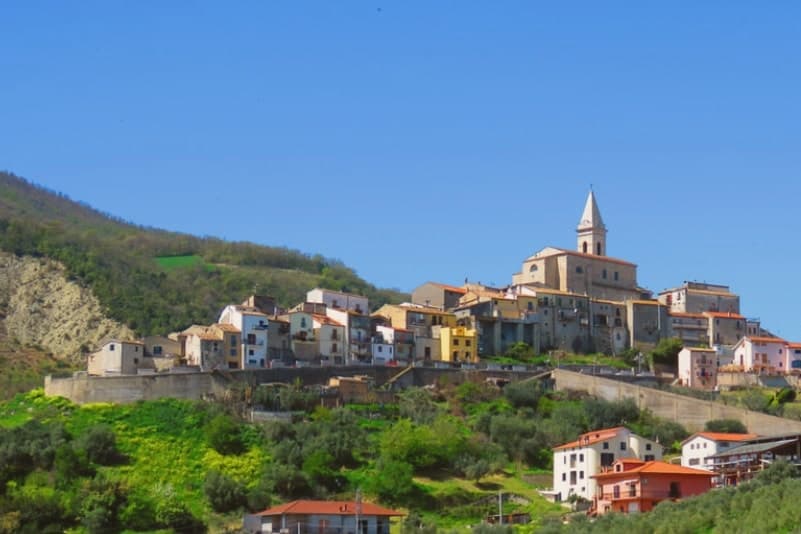
Guardialfiera sits on a 285-meter ridge above the Biferno valley. The town has been inhabited since at least the eleventh century, with a Roman tower visible on the western edge until the tenth.
Roger II conquered it in 1130; the Soliaco and Marzano families held it through the fourteenth century; a 1688 earthquake levelled it and forced the rebuild whose stone streets still climb the ridge today. Pope Alexander II established the Diocese of Guardialfiera in 1061; it was suppressed in 1818 and survives as a titular see.
The river below was dammed in 1976, and the valley the town once overlooked became the lake it now overlooks, the largest in Molise. The hills that climb away from that water are the same ones that produce the oil good enough for the Città dell'Olio mark, and the same ones a native writer used as the settings for his fiction.
A ridge town, a drowned valley, and a diocese reduced to a title: Guardialfiera is a place that has been remade more than once and kept climbing back up its own hill each time.
What to see in Guardialfiera
- Concattedrale di Santa Maria Assunta. Co-cathedral with origins in the eleventh century, incorporating ancient stones carved with seventh and eighth-century pagan and early Christian iconography.
- Lago di Guardialfiera. Stone piers of an older, submerged bridge surface in the shallows during dry summers, the only visible trace of the valley the reservoir replaced.
- Parco Letterario Francesco Jovine. Literary park dedicated to the writer, laid out through the hills that furnished the settings of his novels.
How to get to Guardialfiera
Foggia is roughly 95 minutes away by road.
Our tip
April through October is the open window. Spring sets the lake into its full reach and the hills above into colour. June and September give the steadiest light for the long view from the village.
Fornelli
Why visit Fornelli
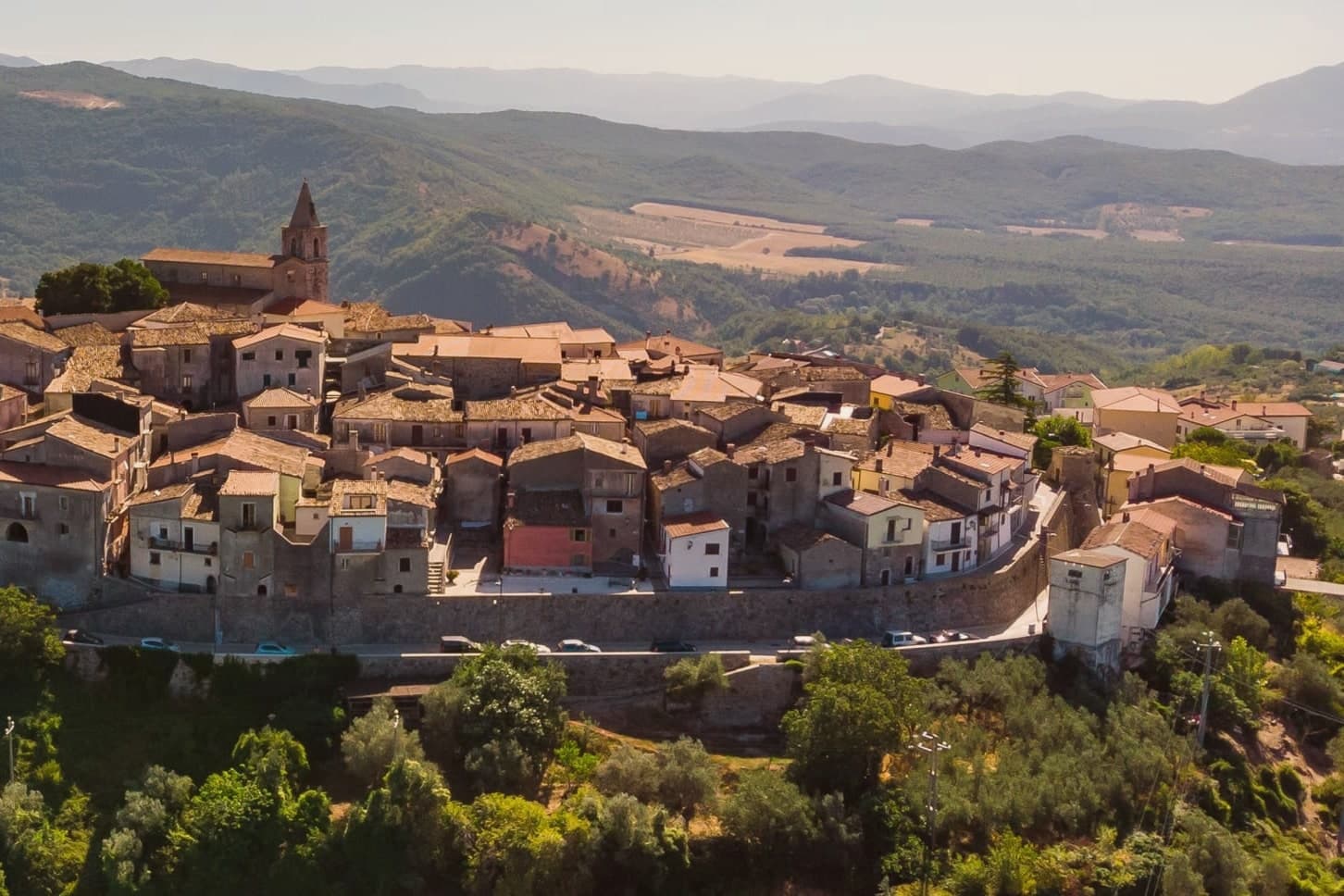
Fornelli sits at 530 meters on a hill west of Isernia, surrounded by olive groves and oak woods on the southern edge of the Parco Nazionale d'Abruzzo, Lazio e Molise. The village is documented from the tenth century as one of the castles defending the abbey of San Vincenzo al Volturno, and its name probably comes from the furnaces that once worked iron and brick on the slope.
What stands today is one of the best-preserved medieval wall circuits in Molise, accessed through a single gate that once had a drawbridge and moat. Seven towers ring the perimeter; the Palazzo Baronale anchors the centro storico with its circular corner towers and Baroque facing.
Annunziata Lombardi, mother of US Speaker Nancy Pelosi, was born here in 1909 and left for Baltimore as a toddler. The town carries three institutional badges at once: Borghi più belli, Parco Nazionale, Città dell'Olio.
What to see in Fornelli
- Cinta muraria medievale. One of the best-preserved medieval wall circuits in Molise, with seven towers and a single gate that once carried a drawbridge and moat.
- Palazzo Baronale. Feudal palace at the heart of the borgo, with two circular corner towers and a Baroque-trimmed façade softening the fortified shell.
- Chiesa di San Michele Arcangelo. Parish church inside the walls, dedicated to the archangel and holding the village's principal religious artworks.
How to get to Fornelli
Napoli is roughly 102 minutes away by road.
Our tip
April through June and September into October are the months for Fornelli. The olive harvest begins in late October and runs through November, and the slopes below the walls fill with families and crates. Summer afternoons cross thirty degrees and the centro storico empties between three and six.
Guglionesi
Why visit Guglionesi
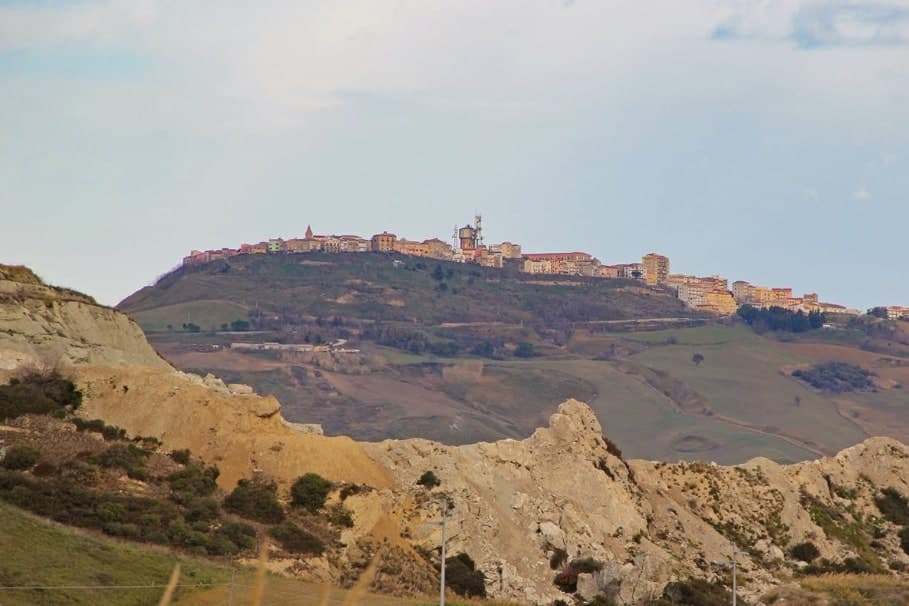
Guglionesi sits on a 369-meter ridge between the Biferno and Trigno valleys, halfway between the Adriatic coast and the inland hills of Molise. The Frentani founded the place in the fifth century BC, under the name Uscosium, and it was one of their principal centres before Rome absorbed the confederation.
In the sixteenth century the Dominican Serafino Razzi listed Guglionesi alongside the Slav-founded villages of lower Molise; he also recorded that Brother Serafino led the local defence against an Ottoman raid led by Sulayman at the city walls. The Romanesque Chiesa di San Nicola di Bari and the Collegiata di Santa Maria Maggiore are the medieval anchors of the centro storico; the latter goes back to the twelfth century and holds the relics of the abate Sant'Adamo.
The hills produce olive oil good enough for the Città dell'Olio designation, and on a clear afternoon you can see the Tremiti islands offshore.
What to see in Guglionesi
- Collegiata di Santa Maria Maggiore. Collegiate church with twelfth-century origins, reworked in the eighteenth century in Baroque style; holds the relics of Sant'Adamo Abate.
- Chiesa di San Nicola di Bari. Romanesque church in the centro storico, the oldest documented religious building in the town.
- Centro storico. Stone old town along the ridge, with city walls Brother Serafino is recorded as defending against an Ottoman raid in the sixteenth century.
How to get to Guglionesi
There is a railway station in the town, so you can arrive without a car and never need one while you are here. Foggia is roughly 82 minutes away by road.
Our tip
April through October is the working window. Spring greens the valleys and brings the long Adriatic views back into focus. June and September are the calmest months for the centro storico.
Larino
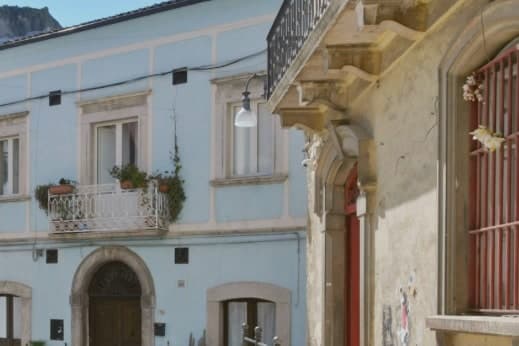
Why visit Larino
Larino sits at 341 meters in the lower Biferno valley, twenty kilometers inland from Termoli. The Frentani held the place before Rome and minted bronze coins here in the third century BC; the wool trade made it a regional centre.
The orator Cicero defended a Larino-born equestrian, Aulus Cluentius Habitus, in his Pro Cluentio of 66 BC, a case that ties the town to the wider world of the capital beyond its own remains. The old town runs along the ridge above the ancient city, so the medieval borgo and the old street plan sit in view of each other rather than layered one on top of the other.
The cathedral stands at one end of this arrangement, the arena and forum fragments at the level below. Every 25 to 27 May the streets carry the Carrese di San Pardo, a three-day procession of oxen and flower-decked carts that retraces the eleventh-century translation of the patron's relics from Daunia, linking the medieval town's religious life to the same ground the Frentani and the arena's builders had already used.
The surrounding hills carry the Città dell'Olio mark. What holds the town together, across the Frentani coinage, the law case, the arena, and the May procession, is that each layer used the same ridge and valley without erasing what came before it.
What to see in Larino
- Anfiteatro Romano. Elliptical arena, 100 by 80 meters, built by a Larinum citizen who made his fortune in Rome. It stands within walking distance of the old town, its outline still legible against the surrounding streets.
- Cattedrale di San Pardo. The portal is the work to look at closely, carved by Francesco Petrini of Lanciano, its stone figures still sharp against the facade's plainer masonry.
- Centro storico (borgo). Medieval old town stretched along the ridge above the Roman remains, with Renaissance palazzi and narrow stone streets.
How to get to Larino
There is a railway station in the town, so you can arrive without a car and never need one while you are here. Foggia is roughly 82 minutes away by road.
Our tip
April through October is the working season. May is the month most travellers come for: the three-day Carrese di San Pardo runs 25 to 27 May, with around 130 flower-decked ox carts moving through the town. June and September keep the Roman amphitheatre and cathedral comfortable to walk.
Venafro
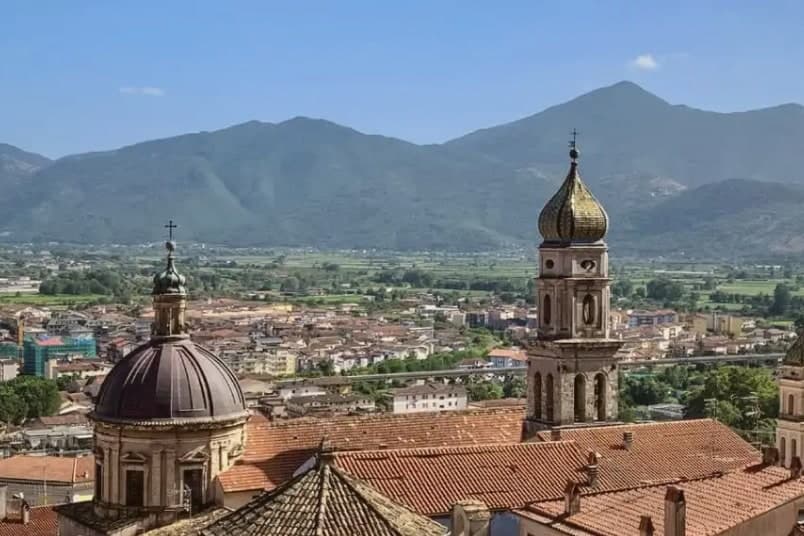
Why visit Venafro
Venafro lies at 222 meters in the lower Volturno valley, on the road between Cassino and Isernia, near the Lazio border. Horace praised the place as a resort, and the surrounding hills still carry the native Aurino olive groves that made the town's name.
Until 1863 Venafro belonged to the Terra di Lavoro and the province of Caserta, was then reassigned to Campobasso, and joined the new Isernia province only in 1970, a late arrival to the map it now sits on. The old town climbs from the lower quarters up toward the castle at its highest point, with the basilica and its convent anchoring the base of that climb below.
Roman remains, amphitheatre, theatre, and aqueduct, lie folded into and beneath the medieval fabric, so that walls, churches, and antiquity share the same ground rather than sitting in separate districts. Venafro carries Parco Nazionale and Città dell'Olio marks.
The town reads as a place where a Roman colony, a resort praised by poets, and a shifting patchwork of provincial borders all left their layer without erasing the ones beneath.
What to see in Venafro
- Castello Pandone. Hilltop castle of the Pandone family from the fifteenth century. The noble rooms carry the equestrian frescoes, among them the Sala del Cavallo di Carlo V and the gallery of racehorses, painted over the whole cycle of chambers.
- Basilica di San Nicandro. Town basilica with attached convent, where Padre Pio stayed for medical treatment in the early twentieth century.
- Centro storico. Old town said to hold 33 churches between Roman remains and medieval walls, climbing toward the castle at its high point.
How to get to Venafro
There is a railway station in the town, so you can arrive without a car and never need one while you are here. Napoli is roughly 79 minutes away by road.
Our tip
April through October is the working season. Spring brings the Volturno valley back into colour and the Pandone castle's outdoor rooms back into use. June and September are the steadiest months for walking the centro storico.
Isernia
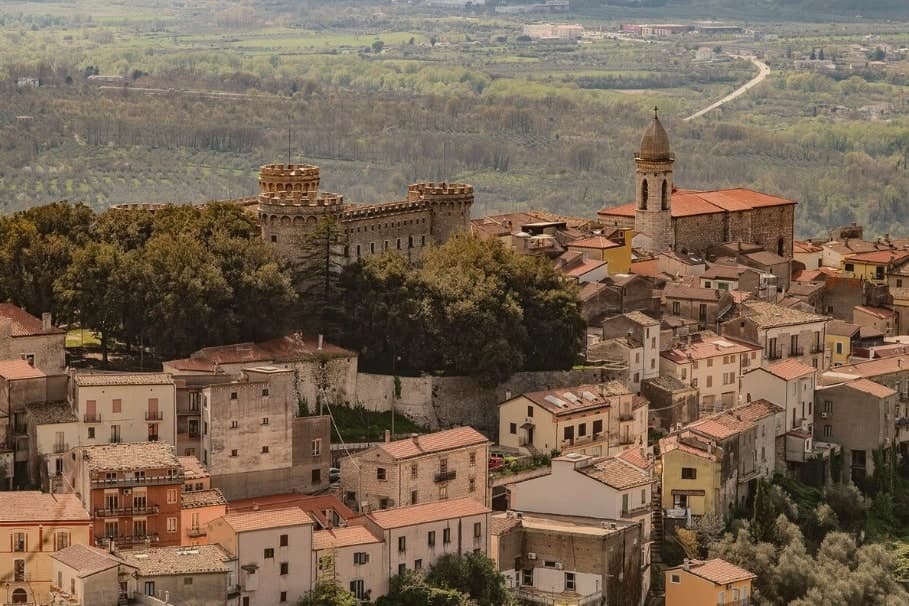
Why visit Isernia
Isernia stands on a narrow rock spine between two rivers, 423 meters above sea level, in the upper Volturno valley. The hill is one of the oldest inhabited places in Europe.
The archaeological site of Isernia La Pineta has yielded tools and animal bones dated to about 700,000 years ago and the milk tooth of a child who lived 583,000 years ago. The Pentri Samnites built Aesernia here in the seventh century BC; Rome took it in 295 BC and founded a Latin colony in 264 BC.
The medieval city replaced the Roman streets with its own grid, and in 1240 the public Fontana Fraterna went up in the centro storico, six water jets behind a stone arcade made of repurposed Roman blocks. The Cattedrale di San Pietro Apostolo, built from 1349 on the foundations of a Samnite-era temple, sits a short walk away.
Isernia carries the Città del Tartufo mark for the white truffle harvested in the surrounding woods.
What to see in Isernia
- Museo Nazionale del Paleolitico (Isernia La Pineta). Archaeological site and museum showing tools and bones dated to 700,000 years ago, one of the oldest human sites in Europe.
- Fontana Fraterna. Thirteenth-century public fountain with six water jets behind a stone arcade, made of repurposed Roman blocks.
- Cattedrale di San Pietro Apostolo. Cathedral begun in 1349 on the foundations of a third-century-BC Italic temple, seat of the Bishop of Isernia-Venafro.
How to get to Isernia
There is a railway station in the town, so you can arrive without a car and never need one while you are here. Napoli is roughly 103 minutes away by road.
Our tip
April through October is the open season. Spring brings the Volturno valley green and the truffle hills back into walkable shape. June and September are the cleanest months for the centro storico.
More from Anywhere Italy
- The best hidden olive oil towns in Molise
- The best olive oil towns in the province of Campobasso
 The best towns in Molise you can reach without a car
 The best towns inside a national park in the province of Isernia
 The best towns that eat well in the province of Isernia
 The best hidden hill towns within 90 minutes of Foggia