
The best towns you can reach by train that have a serious restaurant in Veneto
Veneto cooking changes every hour you travel across it. On the lagoon edge it is moeche, sardines in saor, brodetto thick with cuttlefish ink. Inland it turns to risotto, bigoli, radicchio blistered on the grill in the cold months, and duck and guinea fowl in autumn, with Amarone and Valpolicella from the terraces above Verona and prosecco from the Asolo hills. The towns themselves are built from brick and Istrian stone, with arcaded streets that keep the rain off and porticoes where the bars put their tables out from spring. The regional railway threads most of it together, which means a serious lunch does not have to end with someone staying sober.
Almost everyone arrives through Venice, and Venice absorbs them. The trains from Santa Lucia fill and empty, the restaurants nearest the water price accordingly, and the queue for a table with a canal view is longer than the meal. It is a superb place to eat if you know where to go and are willing to walk away from San Marco, but the pressure on the city is real, and much of what visitors eat there is cooked for people who will not return.
The same food culture carries on down every line out of the city. The plain towns keep their radicchio and their osterie, the lagoon towns still land the fish, and the hills behind Verona and the Piave keep the wine and the game. These are towns with a station and a kitchen worth the trip, close enough for lunch and far enough that the room is mostly local. Fewer people go, and the booking is easier.
Of the 41 communes we have mapped in Veneto, 10 qualify as towns you can reach by train with a serious restaurant: we have confirmed each is reachable without a car, and each holds a restaurant listed by the most demanding of the guides. The smallest, Costermano sul Garda, has 3,974 residents.
If you are still choosing, we have also written The best towns you can reach by train within an hour of Venice and The best towns that eat well within an hour of Venice.
Costermano sul Garda
Why visit Costermano sul Garda
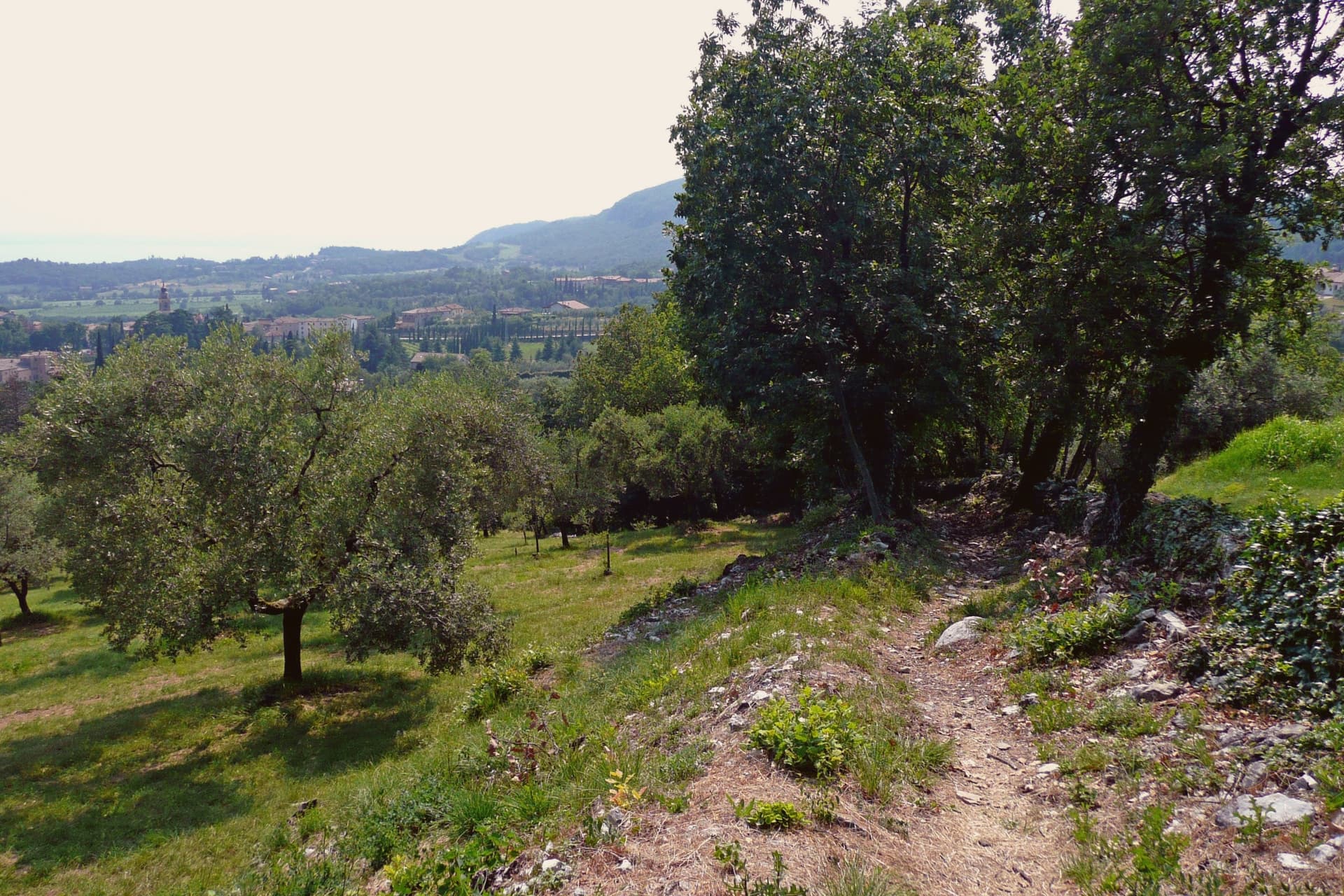
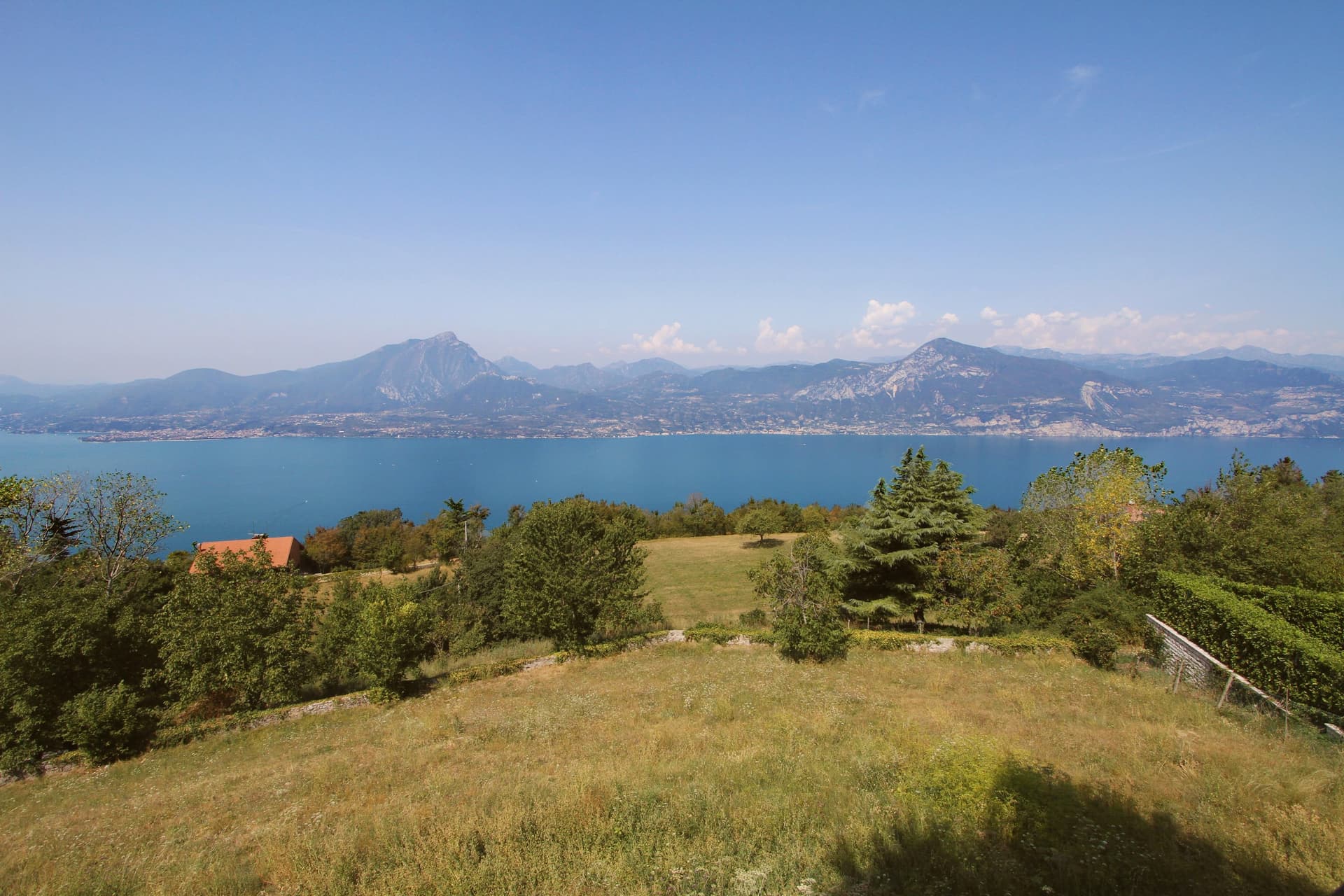
The commune sits on a moraine amphitheater twenty-five kilometers northwest of Verona. The hills were a feud of the Brescia monastery of Santa Giulia in the early Middle Ages, then passed through Scaliger and Venetian rule before joining Italy in 1866; the name sul Garda was added only in 2018, to anchor the town's tourism identity to the water it sits above rather than on.
That distinction matters here: this is not a lakefront village but a hill settlement looking down at the shore, its center, its cemetery hill, and its vineyard slopes arranged around the belvedere at Marciaga rather than around a harbor. The economy runs on olive oil and hillside vines, and on the holiday accommodation that has filled these slopes since the 1970s, but the single largest reason people come here is not agricultural.
The cemetery holds the dead of a war fought decades after the monastery's feud and centuries after the Scaliger lords, and it sits on the same morainal hill as the sanctuary, the parish church, and the vine rows, a place where the working landscape and the memorial landscape occupy the same short walk rather than separate zones.
La Casa degli Spiriti, Osteria dai Coghi have been named by a guide.
What to see in Costermano sul Garda
- Santuario della Madonna del Castello. Sanctuary on the spur of Marciaga, its fifteenth-century frescoes intact, with a terrace looking over Lake Garda and the eastern shore.
- Deutsche Soldatenfriedhof. The graves cover the hillside above the lake, laid out since 1967 for the dead of the Second World War, a place kept in silence rather than commentary.
- Chiesa di San Siro. Parish church rebuilt in the nineteenth century in the center of the village, its freestanding campanile visible from the surrounding slopes, with a sightline to Monte Baldo across the water.
How to get to Costermano sul Garda
There is a railway station in the town, so you can arrive without a car and never need one while you are here. Verona is roughly 34 minutes away by road.
Our tip
April through October is the working window. April and May bring the lake back to swimming temperature on the shore four kilometers below, and the morainal hills into wildflower. June through August fills the holiday rentals and the lakefront day-traffic from Garda and Bardolino; the hills stay a few degrees cooler than the shore.
Bardolino
Why visit Bardolino
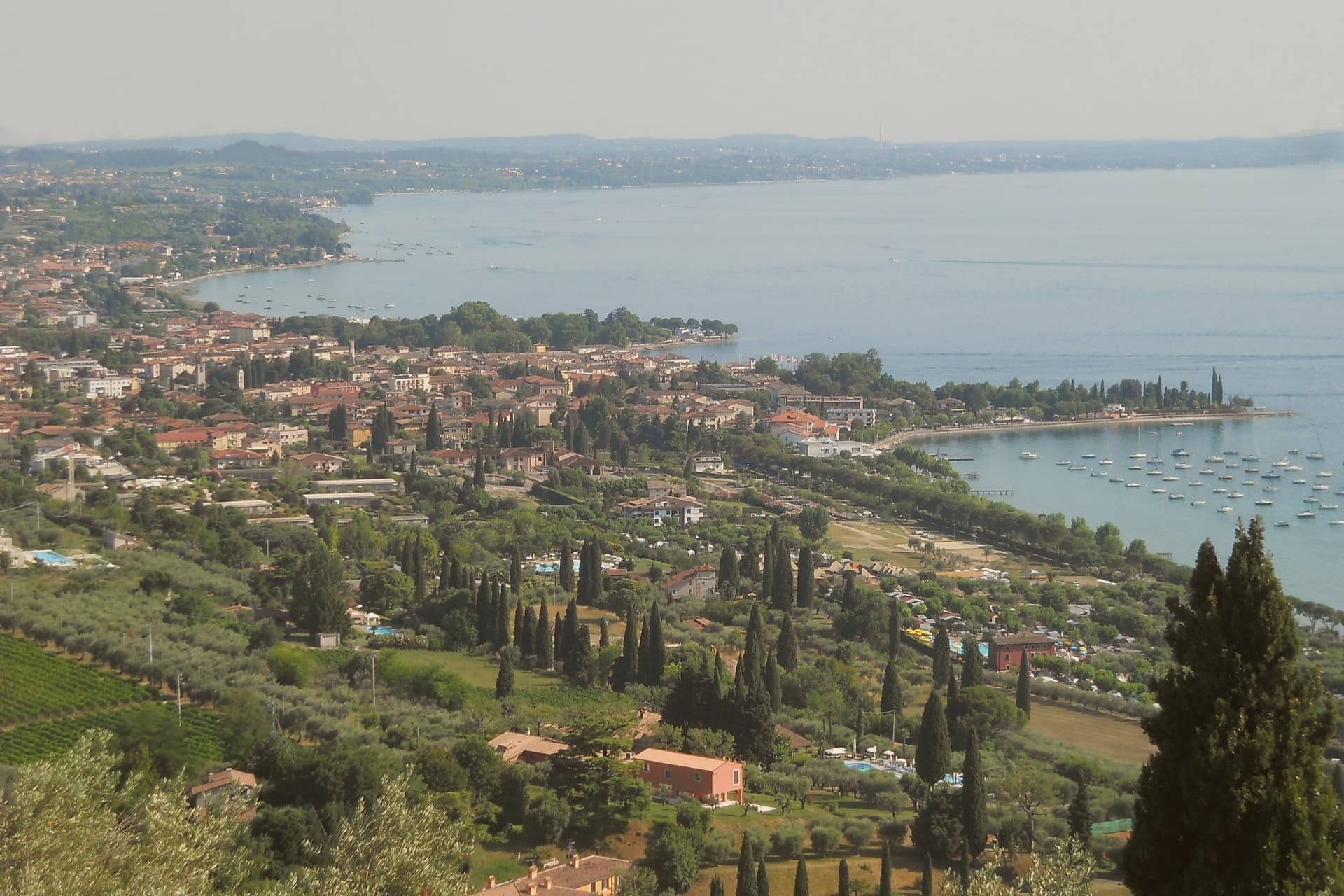
Bardolino sits on the eastern shore of Lake Garda at 65 meters, twenty-five kilometers northwest of Verona. The hills behind town have been planted with vines since the Roman period, and the modern DOC was granted in 1968.
Three grapes do the work: Corvina, Rondinella and Molinara. Long maceration produces Bardolino, the light red the town has lived on since the nineteenth century; short skin contact produces Chiaretto, the rosé that has overtaken the red in current sales.
Two churches hold the medieval line. San Zeno in the centro storico is ninth-century, one of the oldest in the province of Verona.
San Severo, built between the late eleventh and early twelfth centuries on the foundations of an earlier church mentioned in an 893 charter of Berengario, is the town's Romanesque anchor. The lakefront has been a tourist promenade since the 1950s.
The Palio del Chiaretto runs the first weekend of June; the Festa dell'Uva e del Vino runs the first week of October.
Il Giardino delle Esperidi, La Veranda del Color have been named by a guide.
What to see in Bardolino
- Chiesa di San Severo. Romanesque church built between the late eleventh and early twelfth centuries on the foundations of a structure mentioned in a 893 charter.
- Chiesa di San Zeno. Ninth-century church in the centro storico, one of the oldest in the province of Verona, on a Latin cross plan with a small apse.
- Centro storico. Walled medieval core around Piazza Matteotti, with arcaded streets dating to the Venetian period from the fifteenth century.
How to get to Bardolino
There is a railway station in the town, so you can arrive without a car and never need one while you are here. Verona is roughly 36 minutes away by road.
Our tip
April through October is the working season. April and May bring the lake back to swimming temperature and the Romanesque churches at their quietest. June through August fills the lungolago with German and Austrian visitors; weekends are crowded, weekday mornings still manageable. Bardolino Freddo falls in August.
Sant'Ambrogio di Valpolicella
Why visit Sant'Ambrogio di Valpolicella
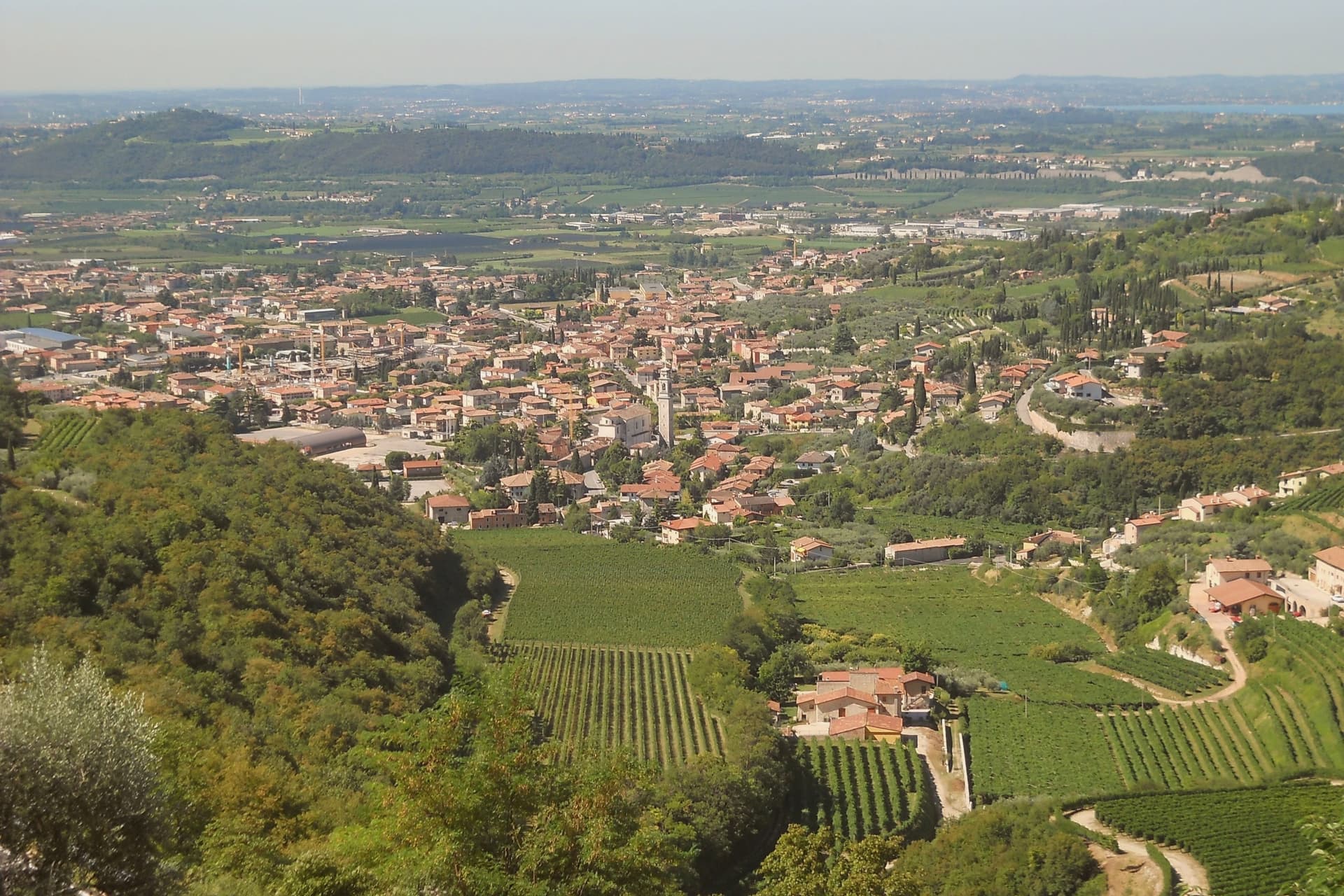
Sant'Ambrogio di Valpolicella sits at 174 meters in the heart of the Valpolicella DOC, fifteen kilometers northwest of Verona, on the rolling hills that close the eastern shore of Lake Garda. The commune groups five frazioni around the main village: Domegliara, Gargagnago, Monte, Ponton and the ridge settlement above them.
Gargagnago sits at the foot of the hills, its cellars closest to the valley floor; the ridge frazione occupies the higher limestone ground, reached by a climb steep enough to have earned the church its nickname. Between them the Serego Alighieri estate has worked the same parcels since Pietro Alighieri, son of Dante the poet who had followed his father into exile in Verona, bought the property in 1353, and the family still grows Corvina, Rondinella and Molinara there, with the Vaio Armaron Amarone counted among the appellation's cru benchmarks.
The pattern of the commune is one of a valley economy and a hill economy sharing a single administrative roof: wine pressed and aged below, an older, stiller settlement kept above it, with the quarries that once supplied Verona still worked on the slopes that join the two.
Dalla Rosa Alda, Masi Agricola have been named by a guide.
What to see in Sant'Ambrogio di Valpolicella
- Pieve di San Giorgio Ingannapoltron. Romanesque parish church whose ciborium columns carry an inscription naming the master builder Orso and his disciples Juventino and Juviano.
- San Giorgio di Valpolicella. Frazione on the limestone ridge above the valley, in the Borghi più belli d'Italia network, nicknamed Ingannapoltron for the steep climb up to it.
- Villa Serego Alighieri. Estate still owned by the Alighieri descendants; produces Vaio Armaron Amarone from Corvina, Rondinella and Molinara grown on the same parcels the family has worked.
How to get to Sant'Ambrogio di Valpolicella
There is a railway station in the town, so you can arrive without a car and never need one while you are here. Verona is roughly 34 minutes away by road.
Our tip
April through June and September through October are the months for Valpolicella. The vineyards green up in spring, harvest runs from mid-September into October, and the appassimento drying begins in the cellars while the leaves turn. July and August push past thirty degrees in the valley and the village empties between two and six in the afternoon; cellar visits move to morning slots.
Abano Terme
Why visit Abano Terme
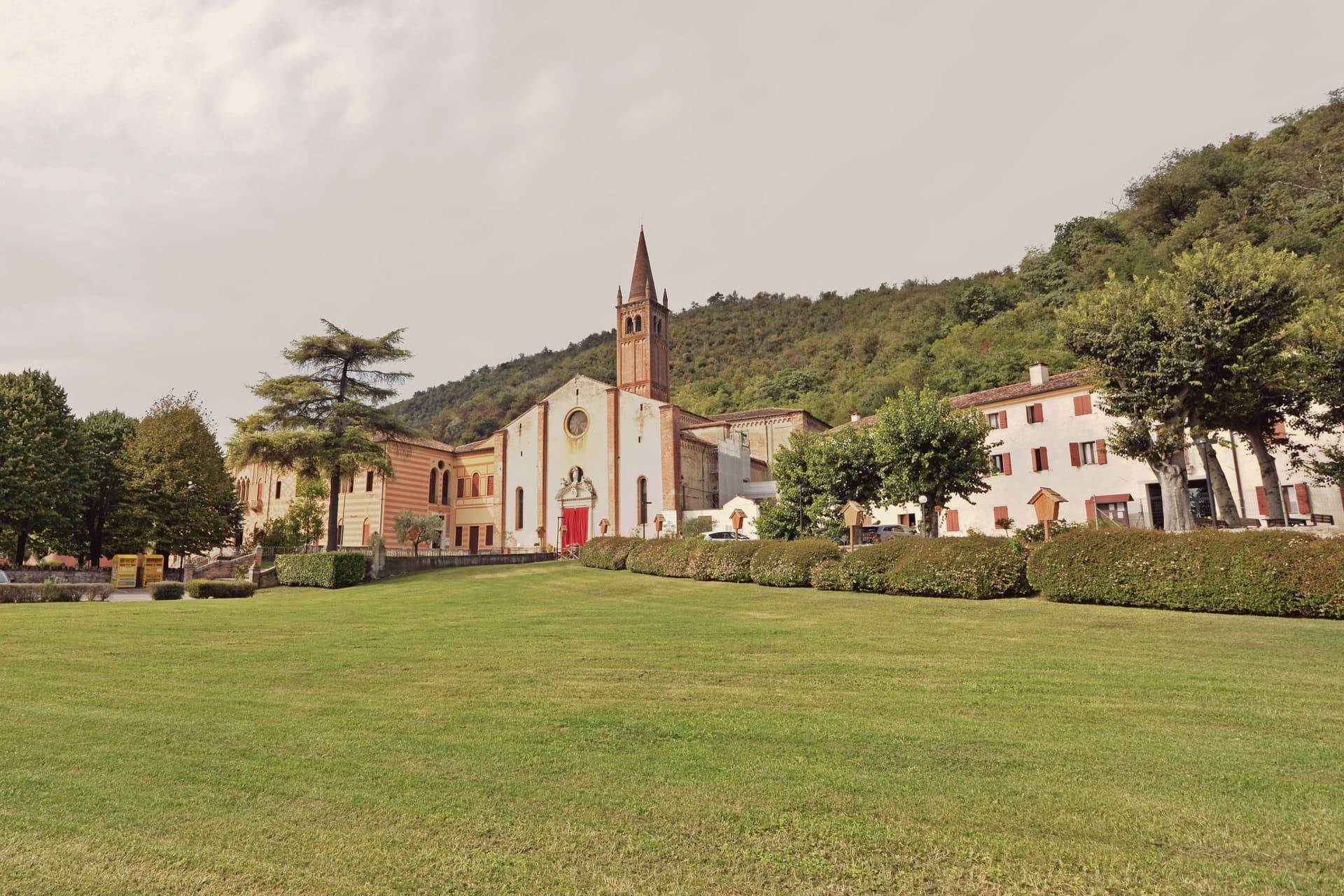
Abano Terme sits at 14 meters on the eastern slope of the Euganean Hills, ten kilometers southwest of Padova. The springs surface at 80°C, classified as hyperthermal bromo-iodine-salt water, and the Veneti were already worshipping them in the eighth century BC.
The Romans built a temple to Aponus here and called the place Aquae Patavinae. The Lombards destroyed the baths in the sixth century.
They were rebuilt when Abano became an autonomous comune in the twelfth, enlarged again in the late fourteenth, and absorbed into the Republic of Venice from 1405 to 1797. The Colle Montirone archaeological site still holds traces of the Roman thermal complex, and the Duomo di San Lorenzo, rebuilt in 1780 over an older church, anchors the historic center.
The contemporary draw is fango-balneotherapy: mineral mud aged for sixty days in the source basins, then applied at body temperature. Most of the 250 hotels in Abano-Montegrotto are spa hotels.
Aubergine have been named by a guide.
What to see in Abano Terme
- Duomo di San Lorenzo. Cathedral rebuilt in 1780 over a pre-existing church, with a campanile dating to the fourteenth century and a Baroque interior.
- Colle Montirone. Archaeological site on a small thermal hill, with traces of the Roman baths of Aponus and an obelisk erected in the eighteenth century.
- Parco Termale Urbano. Public thermal park threading the centro storico, with footpaths between hotels, gardens and the source pools.
How to get to Abano Terme
There is a railway station in the town, so you can arrive without a car and never need one while you are here. Padova is roughly 15 minutes away by road.
Our tip
Abano works year-round because the heat comes from underground. January through March is peak spa season for residents of northern Italy: the contrast between cold air and hot pools is part of the appeal, and hotel cure programs run twelve days at this time. April through June and September through October bring the hills into play, with walking weather and lighter spa traffic.
Feltre
Why visit Feltre
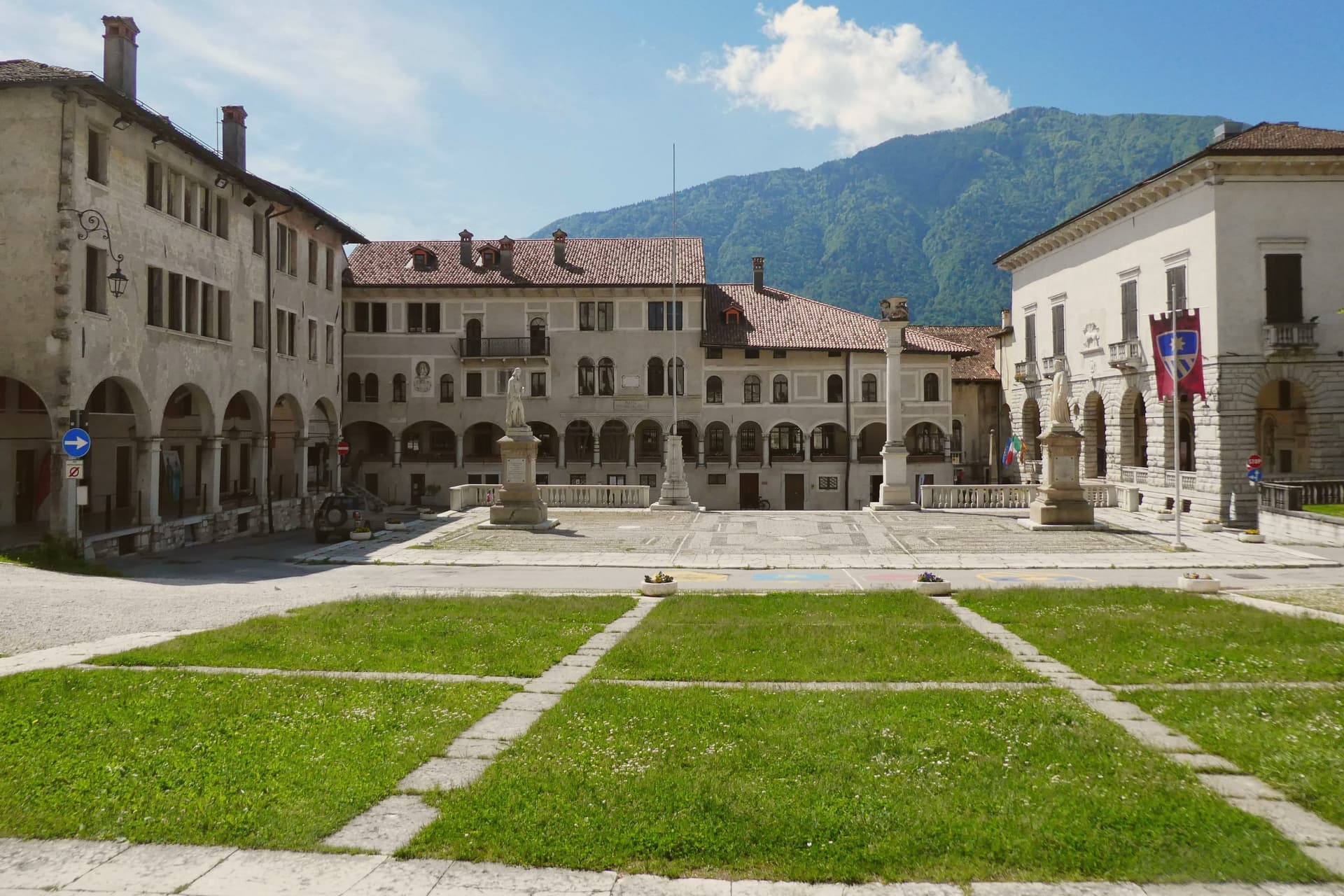
Feltre sits at 325 meters on a hill above the Stizzon, near its confluence with the Piave, seventy kilometers north of Padova. Roman Feltria was a municipium on the Via Claudia Augusta.
The defining episode in the city's appearance came in 1510, during the War of the League of Cambrai, when troops under Maximilian I of Habsburg sacked the town after the Venetian defeat at Agnadello, burning most of it. The city rebuilt over the next sixty years, and that reconstruction shapes how its parts relate to each other still.
The upper city, the citadel built around the main square, holds the seat of civic government, the medieval keep with its views to the peaks and forests north of the city, and the church of San Rocco. Below it, the long arcaded street through the lower city carries the same sixteenth-century idiom down the hill, so the whole centro storico reads as one build rather than a patchwork of eras.
What Feltre offers, in the end, is a rare case where destruction produced coherence: a single burning followed by a single, unhurried rebuilding, and the town has looked essentially like itself ever since.
Aurora, Enoteca Contemporanea have been named by a guide.
What to see in Feltre
- Piazza Maggiore. Main square of the upper city, at the highest point of the centro storico, surrounded by Renaissance palaces and the citadel walls.
- Palazzo della Ragione. Sixteenth-century town hall on the square with a loggia traditionally attributed to Andrea Palladio.
- Castello di Alboino. Medieval keep above the centro storico, named for the Lombard king Alboin, with views across the Piave valley to the peaks north of the city.
How to get to Feltre
There is a railway station in the town, so you can arrive without a car and never need one while you are here. Trento is roughly 81 minutes away by road.
Our tip
April through October is the working season. The hill stays a few degrees cooler than the Piave valley below, and the Vette Feltrine to the north stay walkable from May to October. The Palio di Feltre runs the first weekend of August: five rioni in costume, archery, a horse race around Piazza Maggiore, and the city fills past its 20,000 residents.
Vittorio Veneto
Why visit Vittorio Veneto
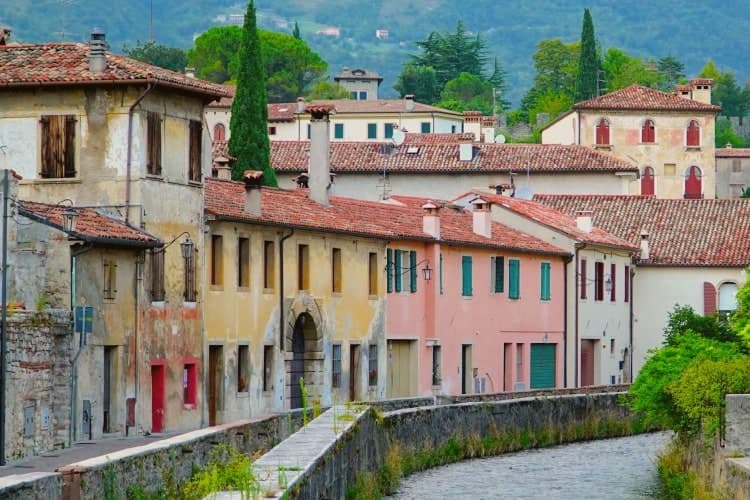
Vittorio Veneto sits at 138 meters at the foot of the Cansiglio plateau, seventy-five kilometers north of Padova. The commune was formed in 1866 by merging Ceneda, on the plain, with Serravalle, in the narrow valley above, and named for King Vittorio Emanuele II.
The two centers kept their own identities rather than blending into one. Serravalle is the older, walled district, set higher in the valley, with its cathedral holding the altarpiece of the Virgin with two saints.
Ceneda lies lower down on the plain, holding the Loggia of the Comunità and an eighteenth-century cathedral of its own alongside the castle ruins on the hill above it. In July 1923 the town took the name it carries now, after the battle that had taken its name from it three years earlier: the offensive of 24 October 1918 broke the Austro-Hungarian line, and the Armistice of Villa Giusti, effective 4 November, closed the war on this front.
The renaming fixed a wartime event permanently onto a place that had, until then, been two separate medieval settlements sharing a valley. What stands today is that same double structure, upper town and lower town, walled district and plain, still legible as two places joined by one name.
Le Macine have been named by a guide.
What to see in Vittorio Veneto
- Duomo di Serravalle. Rebuilt cathedral in the upper walled centro storico, holding the altarpiece of the Virgin with Saints Peter and Andrew in continuous liturgical use since it was painted.
- Museo della Battaglia. In the Loggia of the Comunità di Ceneda, built 1534-1538, with relics and documents of the offensive that ended the war on this front.
- Serravalle. Northern walled district above Ceneda, with sixteenth-century arcaded houses along the Meschio and the 1462 Loggia Serravallese.
How to get to Vittorio Veneto
There is a railway station in the town, so you can arrive without a car and never need one while you are here. Venezia is roughly 59 minutes away by road.
Our tip
April through October is the working season. April and May bring the Cansiglio plateau into play with walking weather and the upper Meschio at full flow. June through August stays cooler than the plain, with the narrow Serravalle valley holding shade through midday; the lower part around Ceneda pushes into the low thirties. Festa della Val Lapisina falls in July.
Bassano del Grappa
Why visit Bassano del Grappa
Bassano sits at 129 meters on the Brenta, where the river breaks out of the Alpine foothills onto the Veneto plain forty-five kilometers north of Padova. A Roman estate gave the town its name in the second century BC; a pre-Roman bronze sword found here in 2009 dates to the seventh century BC.
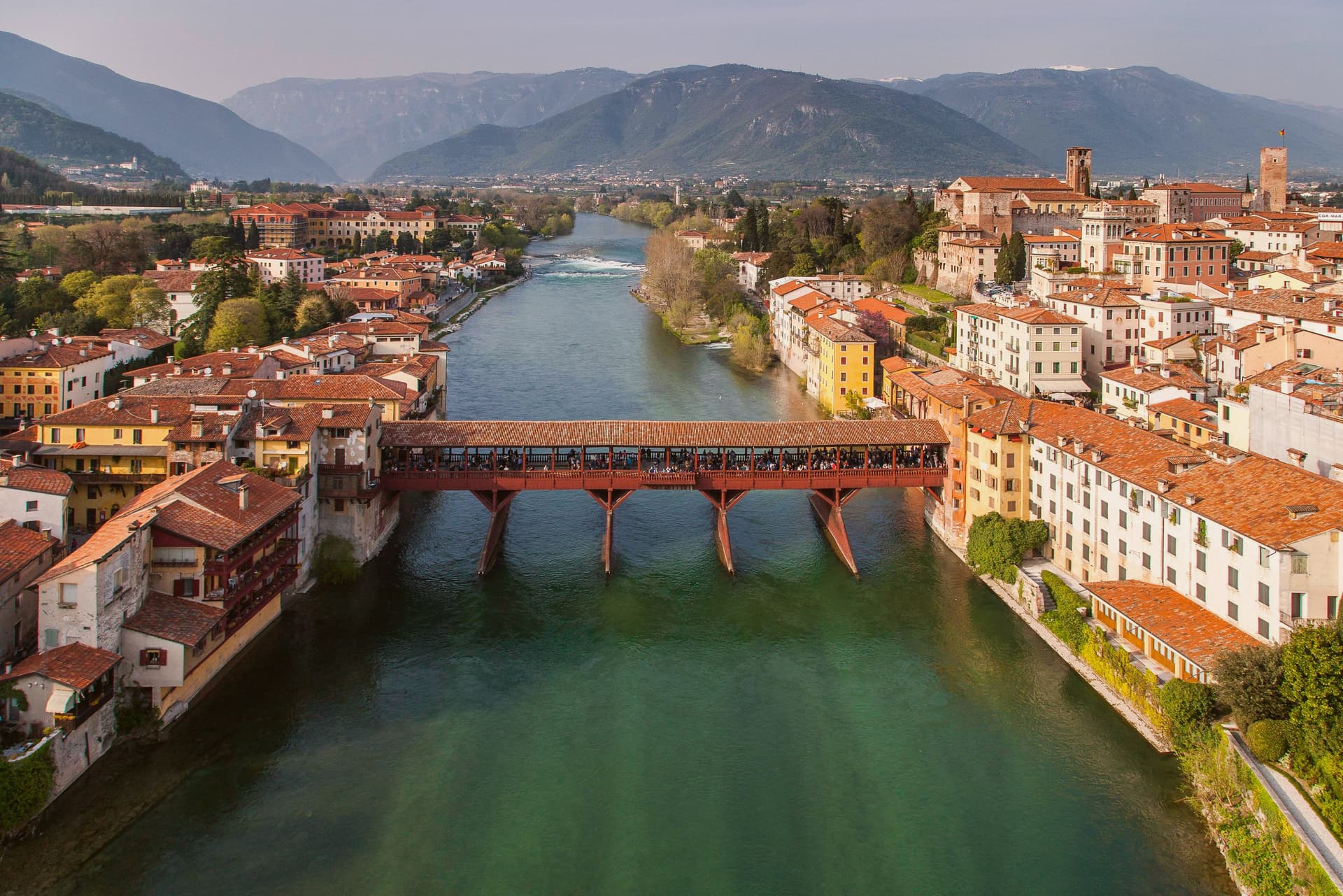
The medieval city is first mentioned in 998. Andrea Palladio designed the covered wooden bridge across the Brenta in 1569, replacing an older bridge documented since 1209.
Floods and wars destroyed it repeatedly; the current version, inaugurated 3 October 1948 with Alcide De Gasperi present, was the seventh build. The Alpini, the Italian mountain troops, adopted the bridge as their symbol in the First World War.
Nardini opened its distillery on the bridge in 1779, the oldest grappa house in Italy; Poli is its main local competitor. The city also kept the ceramics trade that flourished here from the sixteenth century, sharing the tradition with neighboring Nove.
Piazza della Libertà, with its fifteenth-century loggia and clock, holds the historic center together.
Ristorante Birraria Ottone, Distilleria Nardini, Ca' 7 have been named by a guide.
What to see in Bassano del Grappa
- Ponte degli Alpini. Covered wooden bridge designed by Andrea Palladio in 1569, rebuilt seven times after floods and wars, current version inaugurated 1948.
- Piazza della Libertà. Main square of the centro storico, overlooked by the Palazzo Municipale with its fifteenth-century loggia and clock tower.
- Grapperia Nardini. Founded 1779, the oldest grappa distillery in Italy; the tasting room on the Ponte degli Alpini still operates daily.
How to get to Bassano del Grappa
There is a railway station in the town, so you can arrive without a car and never need one while you are here. Vicenza is roughly 45 minutes away by road.
Our tip
April through June and September through October are the working months. The Brenta runs cold and clear in spring, the centro storico fills slowly on weekends, and Piazza della Libertà holds the late-afternoon aperitivo crowd without spilling over. July and August push past thirty-two degrees in the valley; Bassano is a transit town for the Asiago plateau then, used for breakfast on the way up.
Chioggia
Why visit Chioggia
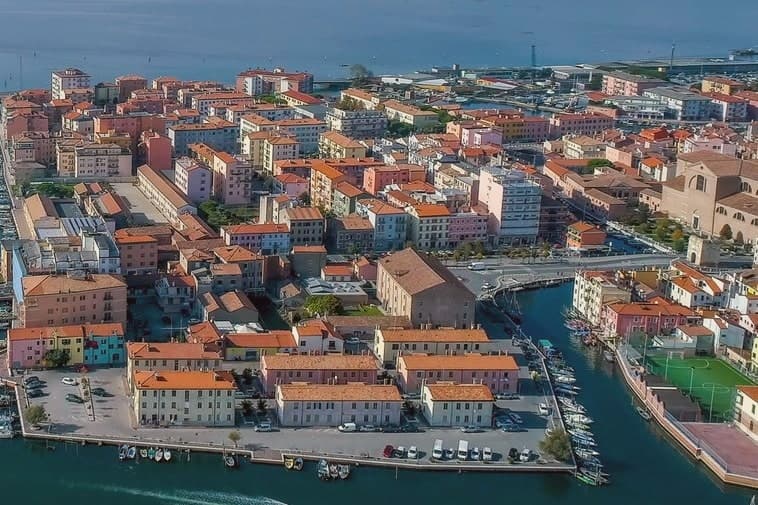
Chioggia sits at 2 meters on a small island at the southern entrance to the Venetian Lagoon, twenty-five kilometers south of Venice and connected to the mainland and to its frazione Sottomarina by causeways. The Romans knew it as Clodia.
By the eleventh and twelfth centuries it had grown into a salt-producing port and became a free commune in 1110. The naval war that carries the town's name ran through 1378-81 and ended Genoese rivalry with Venice, leaving Chioggia under the Serenissima for the next four centuries.
The defeat reduced the town to fishing, salt and limited Adriatic trade. The fleet never left.
The street plan is a herringbone of calli running off the town's single straight spine, with three canals threading between them and the bridges that gave the town its Little Venice nickname. Inland lies the historic island itself; across the causeway sits Sottomarina, the beach frazione facing the open Adriatic where the lagoon town has none.
What Chioggia lost at sea it kept at the dock: a working port still built around the same trade that outlasted the war which was supposed to end it.
El Gato have been named by a guide.
What to see in Chioggia
- Cattedrale di Santa Maria Assunta. Cathedral founded in the eleventh century, raised to episcopal seat in 1110, rebuilt from 1623 to designs by Baldassare Longhena.
- Canale Vena. Main canal of the centro storico, lined with fishing boats and crossed by nine bridges including the seventeenth-century Ponte Vigo.
- Mercato del Pesce. Wholesale fish market on the canal, open before dawn six days a week, the operating center of the Adriatic fleet.
How to get to Chioggia
There is a railway station in the town, so you can arrive without a car and never need one while you are here. Venezia is roughly 46 minutes away by road.
Our tip
May through September is the working season. June and early July bring warm Adriatic water and the long Sottomarina beach to capacity on weekends; mid-August fills it past comfort. The Sagra del Pesce on the third weekend of July puts the whole fleet on display along Canale Vena.
Treviso
Why visit Treviso
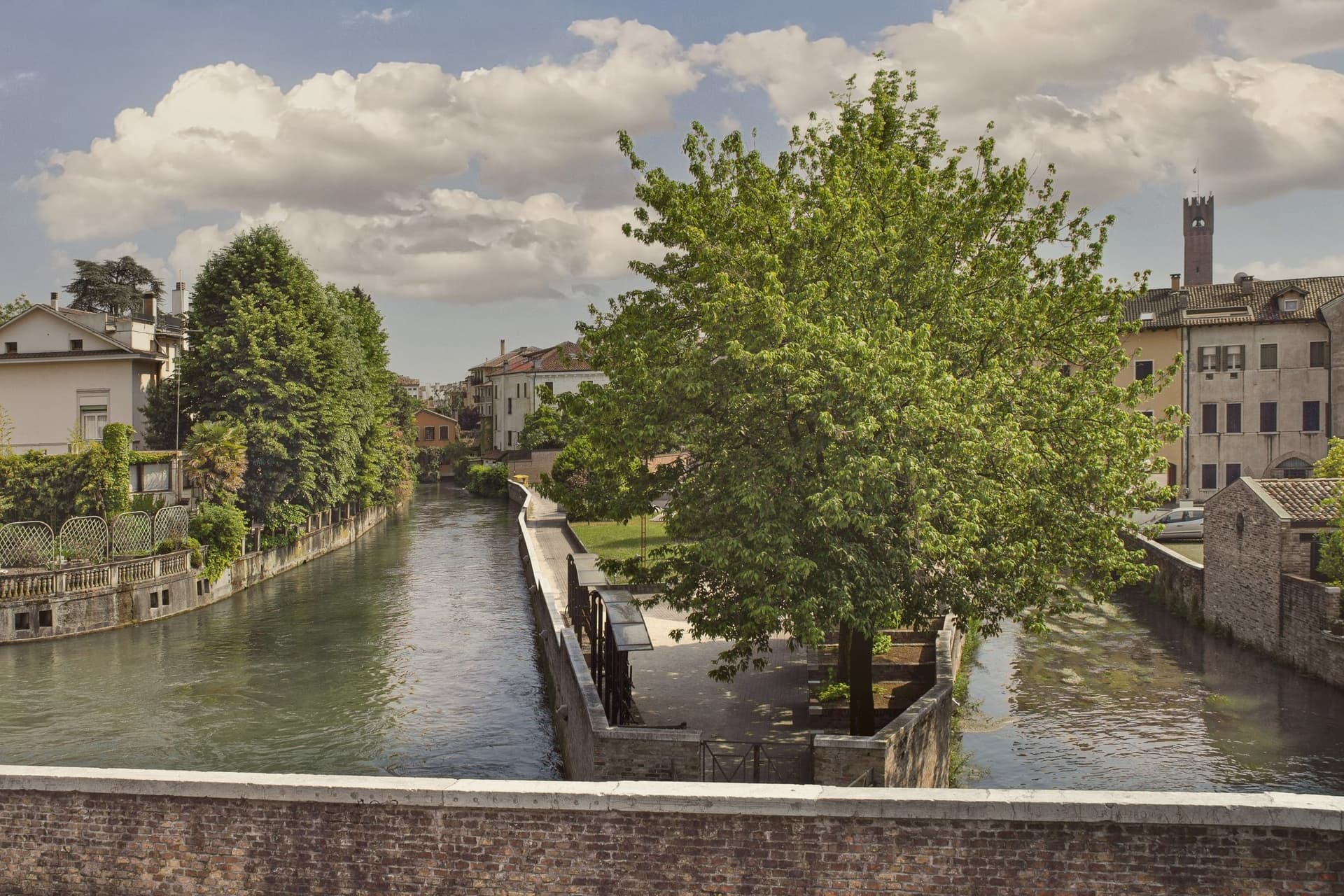
Treviso sits at 15 meters where the Botteniga flows into the Sile, twenty-five kilometers inland from Venice. The Roman Tarvisium took its name from a Celtic root for bull, and the city became a municipium after 89 BC.
After the Caminesi and a brief Scaliger domination, Treviso submitted to the Republic of Venice on 29 June 1339, the first major mainland territory of the Serenissima. The walls and ramparts that still ring the centro storico were built then and renewed in the next century under Fra Giocondo.
The Botteniga splits into a network of canals locals call the cagnan; the Sile runs the southern flank of the walls and feeds the Pescheria, the fish market on its own island. The Palazzo dei Trecento on Piazza dei Signori, the Loggia dei Cavalieri, the Duomo with the Annunciazione of Titian and the frescoed cloister of San Nicolò give the city its medieval and Renaissance spine.
Tiramisu was invented at the Alle Beccherie restaurant near the duomo in the 1970s.
Il Basilisco, Le Beccherie, Feria and 8 more have been named by a guide.
What to see in Treviso
- Piazza dei Signori. Civic heart of Treviso, with the thirteenth-century Palazzo dei Trecento, the Torre Civica and the arcades that frame the medieval public space.
- Duomo di San Pietro. Cathedral founded in the twelfth century and rebuilt in the eighteenth, with the Annunciazione by Titian in the Malchiostro chapel.
- Chiesa di San Nicolò. Gothic Dominican church with frescoes by Tomaso da Modena, including the 1352 chapter house portraits of forty Dominican brothers.
How to get to Treviso
There is a railway station in the town, so you can arrive without a car and never need one while you are here. Venezia is roughly 39 minutes away by road.
Our tip
April through June and September through October are the working months. The Sile and the canals are at their best in spring and autumn, when the willows along the southern walls are in leaf and the trattorie open their courtyards. July and August push past thirty degrees and the centro storico empties in the afternoon; the canals still hold cooler air at dusk.
Padova
Why visit Padova
The Università degli Studi di Padova was founded in 1222 by scholars who had left Bologna in search of academic freedom, and for half a millennium it supplied the Veneto with its doctors and lawyers. Galileo lectured on physics here between 1592 and 1610.
Copernicus studied here. Elena Cornaro Piscopia became, in 1678, the first woman anywhere to receive a university doctorate.
The teaching happened in the same rooms tourists now walk through, which is part of what makes the university feel less like a monument and more like a machine that has never stopped running. The city's older story predates the university by centuries in spirit if not in stone: in 1303 Enrico Scrovegni commissioned a fresco cycle for his family chapel, an act of atonement for his father's usury, and the result changed what painting could do.
Separately, and for entirely different reasons, the city's botanical garden preserves a walled circular plan laid down in the sixteenth century, the layout that made it the template for every university garden that followed. Away from these two, the Basilica di Sant'Antonio draws pilgrims to a reliquary and a bronze outside its doors, the Palazzo della Ragione holds an astrological fresco hall and a two-hundred-year-old wooden horse, and a historic caffè has served coffee since 1831 in a neoclassical room that once served as Risorgimento headquarters.
The kitchen runs to bigoli with duck ragù, baccalà mantecato, risi e bisi in spring, and white asparagus from the Piazza delle Erbe market in May. What holds the city together is the university's habit of making its past into working infrastructure: a lecture hall still gives lectures, a dissection theatre still stands where it was built, a garden still grows on its original beds.
Caffè Pedrocchi, Stefano Mocellin al Padovanino, Belle Parti and 9 more have been named by a guide.
What to see in Padova
- Cappella degli Scrovegni (Giotto, 1303–1305). 38 scenes from the life of Christ and Mary, painted directly onto the plaster of a single chapel. The air-handling required to keep the pigment stable is why entry is capped at 15 minutes and 25 people at a time.
- Orto Botanico (1545, UNESCO). A walled circular garden, laid out on its founding plan and unchanged in shape since. Goethe stood among its beds. A modern biodiversity greenhouse has been added alongside the historic plot.
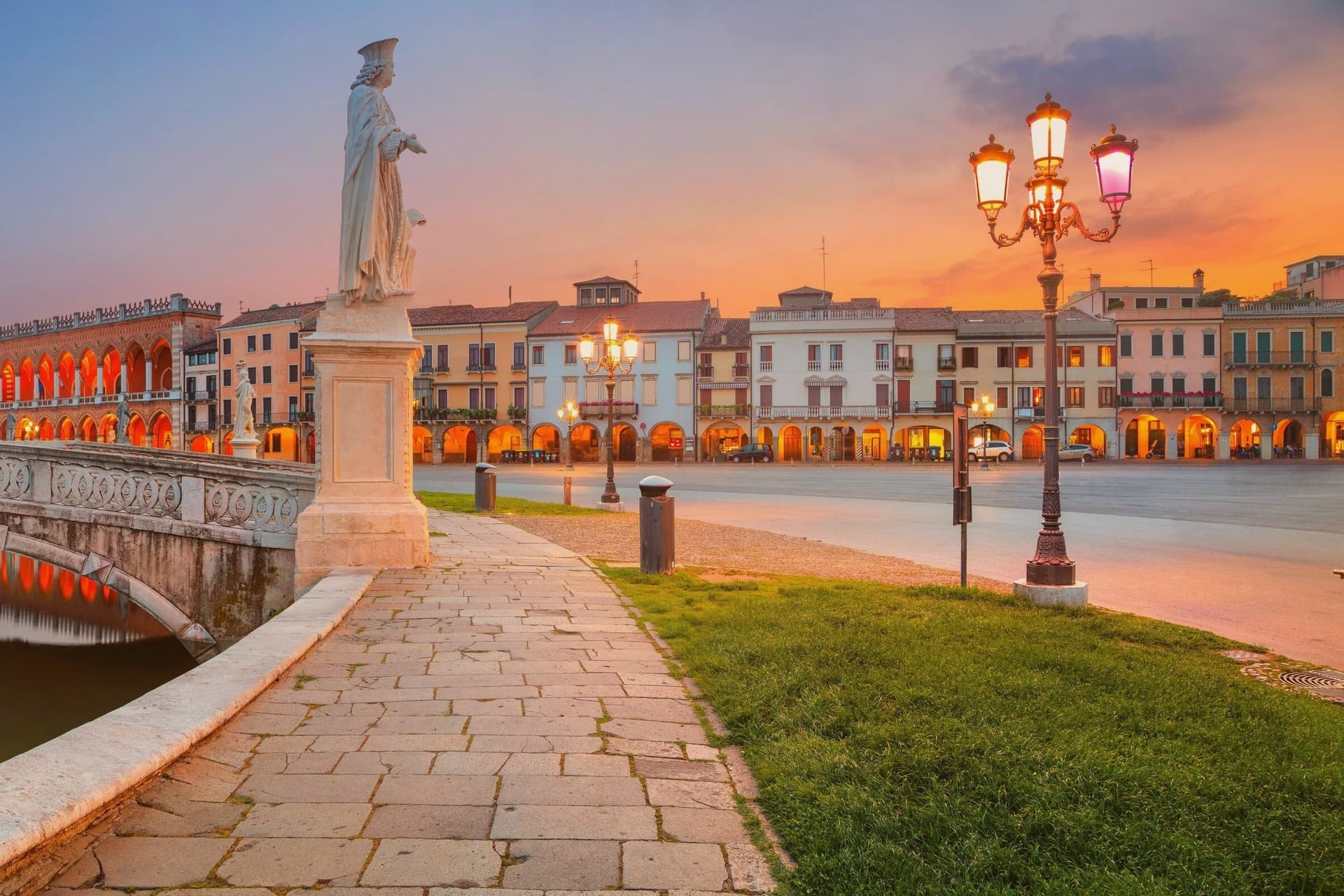
- Prato della Valle. An elliptical canal ringed by 78 statues of Padovan worthies, enclosing a central island and facing the Basilica of Santa Giustina. At 88,000 square metres it is the largest piazza in Italy.
How to get to Padova
There is a railway station in the town, so you can arrive without a car and never need one while you are here. Padova is roughly 3 minutes away by road.
Our tip
Padova is best April–June and September–October. May is the Padovan asparago bianco IGP at the Piazza delle Erbe market and the gardens at the Orto Botanico in full bloom. June 13 is the feast of Sant'Antonio — a quarter-million pilgrims, hotels full for 50 km.
More from Anywhere Italy
 The best towns you can reach by train within an hour of Venice
- The best towns that eat well within an hour of Venice
 The best hill towns with a serious restaurant in Veneto
- The best towns you can reach by train within an hour of Padua
- The 7 best hidden towns you can reach by train in Veneto
 The best towns with a serious restaurant in the province of Verona