
The best towns with a World Heritage site that sit inside a national park in Campania
90 towns visited, 910 to go. Follow along, free: Subscribe on Substack
Campania stacks its landscapes: volcanic ground the color of ash, terraced with vines and apricot trees, then limestone ridges falling into the Tyrrhenian at Cilento, where the water goes clear over pale stones and the macchia smells of myrtle in the heat. The buildings follow the geology, tuff blocks in the shadow of Vesuvius, whitewash and river stone in the south. Spring brings artichokes from the coastal plain and the first buffalo mozzarella eaten still warm, mid morning, with bread and nothing else. Autumn is figs, chestnuts from the interior, and beaches empty enough to swim in October. The national parks here are not wilderness set aside from people, they are lived in, farmed, and full of ruins.
People come to Campania for the Amalfi Coast, and the reasons are sound: Positano down its cliff, the lemon terraces, the ferries running between Sorrento and Capri all summer. The road is narrow, the buses are full, and July puts more visitors on that stretch than the villages were ever built to hold. Naples absorbs the rest, its center a World Heritage site in its own right and heaving accordingly. None of it is a mistake, but it is a small fraction of the region and it takes most of the crowd.
The same volcano, the same coast and the same mountains carry on well past the famous stretch. Inland from the Vallo di Diano the Carthusian complex sits under wooded slopes; in Cilento the Greek columns stand a walk from the dunes; on the bay the excavations run right up against the park boundary on Vesuvius's flank. These are the towns where the World Heritage listing and the national park overlap, and where fewer people go.
Of the 66 communes we have mapped in Campania, 6 qualify as towns with a World Heritage site inside a national park: each holds or sits inside a UNESCO World Heritage site, and each sits inside a national park. The smallest, Padula, has 4,903 residents.
Two more lists worth reading alongside this one: The best towns you can reach by train that sit inside a national park in Campania and The best towns with a World Heritage site that you can reach by train in Campania.
Why visit Padula
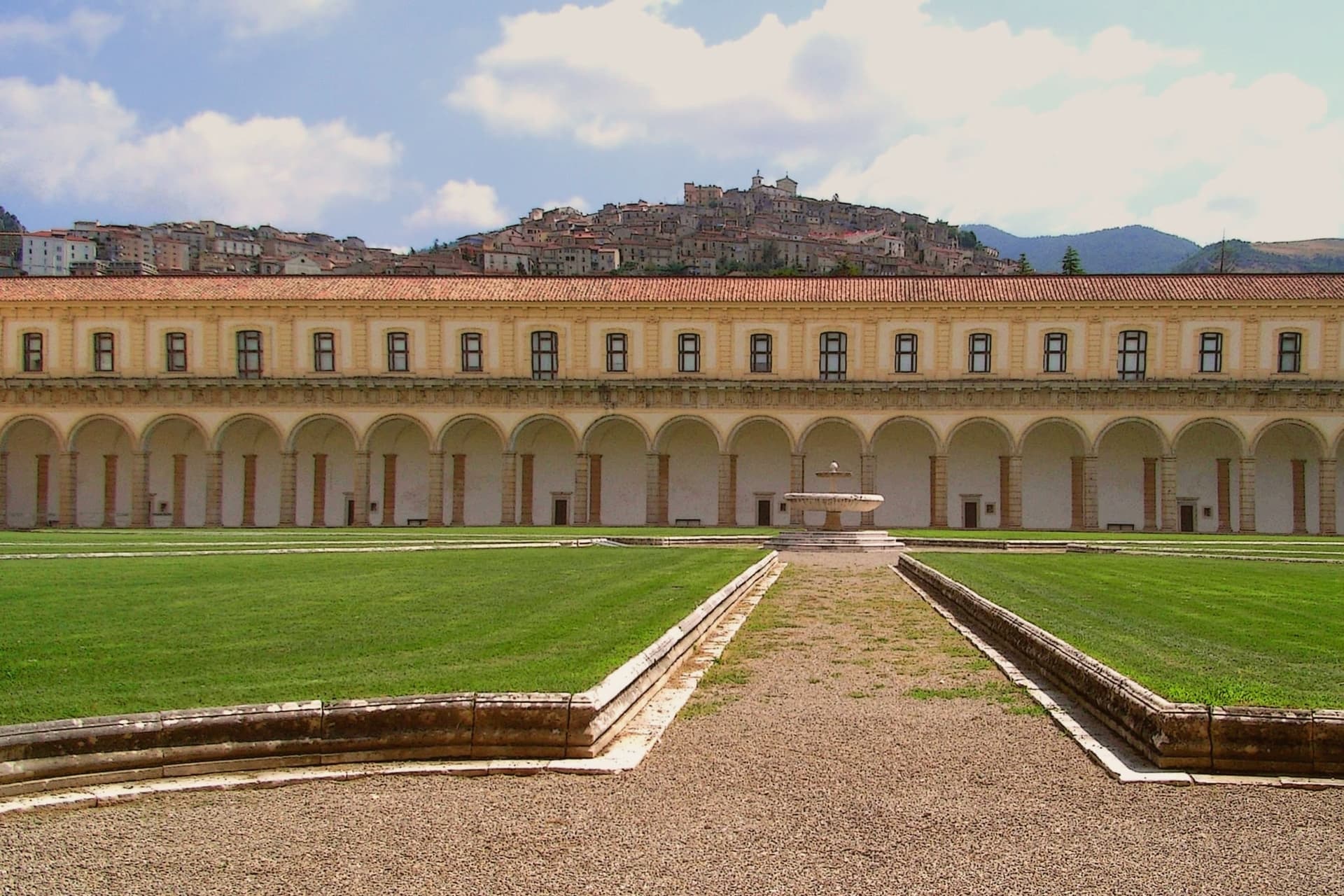
Padula sits on two hills above the Vallo di Diano, the long valley between the Cilento and the Lucanian Apennines. The monastery was founded on 27 April 1306 by Tommaso di Sanseverino, and UNESCO listed it in 1998 as part of the Cilento and Vallo di Diano serial site.
The medieval centro climbs the hill above it, stone houses and narrow lanes rising to the church of San Michele Arcangelo at the summit, from where the valley opens out below. It was in these streets that the 1857 volunteers were captured and killed, an event the town still marks with its monument.
The commune is also Città del Pane, for the round wheat loaves baked in local wood ovens. Padula reads as a town built around a single enormous fact below it and a smaller, older settlement above, the two connected by a hillside that has seen both monastic ambition and a violent end to a political expedition.
What to see in Padula
- Certosa di San Lorenzo. 320 rooms and 51,500 m² of floor above the Vallo di Diano, its plan said to recall the griddle on which the dedicatee saint was burned alive. Built and rebuilt over four centuries by Carthusians suppressed in 1866.
- Centro storico di Padula. Medieval hill town above the monastery, with stone houses, narrow lanes, and the church of San Michele Arcangelo at the top.
- Battaglia di Padula. Monument to the fight in which the volunteers were captured and killed by Bourbon troops and local farmers in the streets of the centro.
How to get to Padula
Salerno is about 1 h 13 min away by road. The full route from Naples.
Our tip
May through September is the strongest window. The Vallo di Diano at 699 meters keeps cool nights even in August, and the Certosa di San Lorenzo opens longer hours through summer. July and August can climb past thirty degrees on the valley floor but the hill above keeps a usable breeze.
Why visit Ascea
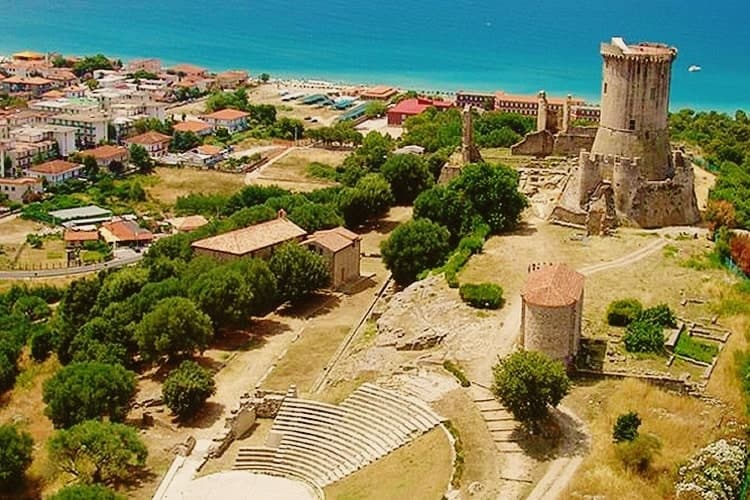
Ascea sits on the southern Cilento coast, two settlements in one comune: Ascea Paese at 230 meters above olive groves, and Ascea Marina on the flat between the Alento river and the sea. The Greek colonists from Phocaea founded Hyele here around 538 BC after fleeing the Persians; the city became Elea in Greek and Velia in Roman times, and produced the Eleatic school of Parmenides and Zeno that founded Western metaphysics.
The archaeological park keeps the Porta Rosa, the oldest known round arch in Europe, an Ionian temple acropolis, Roman baths and the medieval Castelluccio Angioino built on the city's highest point. Modern Ascea is a Bandiera Blu beach commune of nine kilometers of sand inside the Cilento, Vallo di Diano and Alburni National Park, with the Spighe Verdi mark for agro-environmental quality.
What to see in Ascea
- Parco Archeologico di Elea-Velia. Ruins of the Greek city founded around 538 BC by Phocaeans, home to Parmenides and the Eleatic school, with Porta Rosa, Ionic temple acropolis and Roman baths.
- Castelluccio Angioino. Medieval Angevin tower built on the highest point of ancient Velia, reusing Greek and Roman masonry, restored as the park's viewpoint.
- Marina di Ascea. Nine kilometers of fine sand between the Alento river mouth and Punta del Telegrafo, Bandiera Blu and Spighe Verdi within the Cilento national park.
How to get to Ascea
It has its own railway station. Salerno is about 1 h 50 min away by road.
Our tip
May through September is the open Cilento summer, with the Marina filling up from late June onward and the archaeological park staying open for evening visits in July and August. Mid-summer touches the high thirties and the beach absorbs most of the day; the paese on the hill stays a few degrees cooler. April and early October are dry and quiet, ideal for walking Velia without crowds or sun damage to the stone.
Why visit Capaccio Paestum
Capaccio Paestum is the only commune in Italy where the name pairs a medieval hilltown with an ancient city on the plain below. The seat of Capaccio sits at 419 meters on Monte Calpazio, while the archaeological park below, the city of Poseidonia founded around 600 BC, occupies the flat between the Sele river and the sea.
The two halves of the name mark two different settlements built centuries apart and never merged into one another. The layering below Monte Calpazio runs deeper than the founding city and the medieval hilltown: a Roman city followed the earlier one on the same plain, and the medieval Capaccio Vecchia, razed by Frederick II, was rebuilt as the hilltown that still carries the seat today.
The buffalo pastures that made the area's DOP mozzarella sit inside the same national park boundary as the Sele plain and the Monte Calpazio spur, so the cheese-making land and the ruins share one stretch of ground. The commune, in effect, is stacked: hill above, plain below, and each layer on the plain built over or beside the one before it.
What to see in Capaccio Paestum
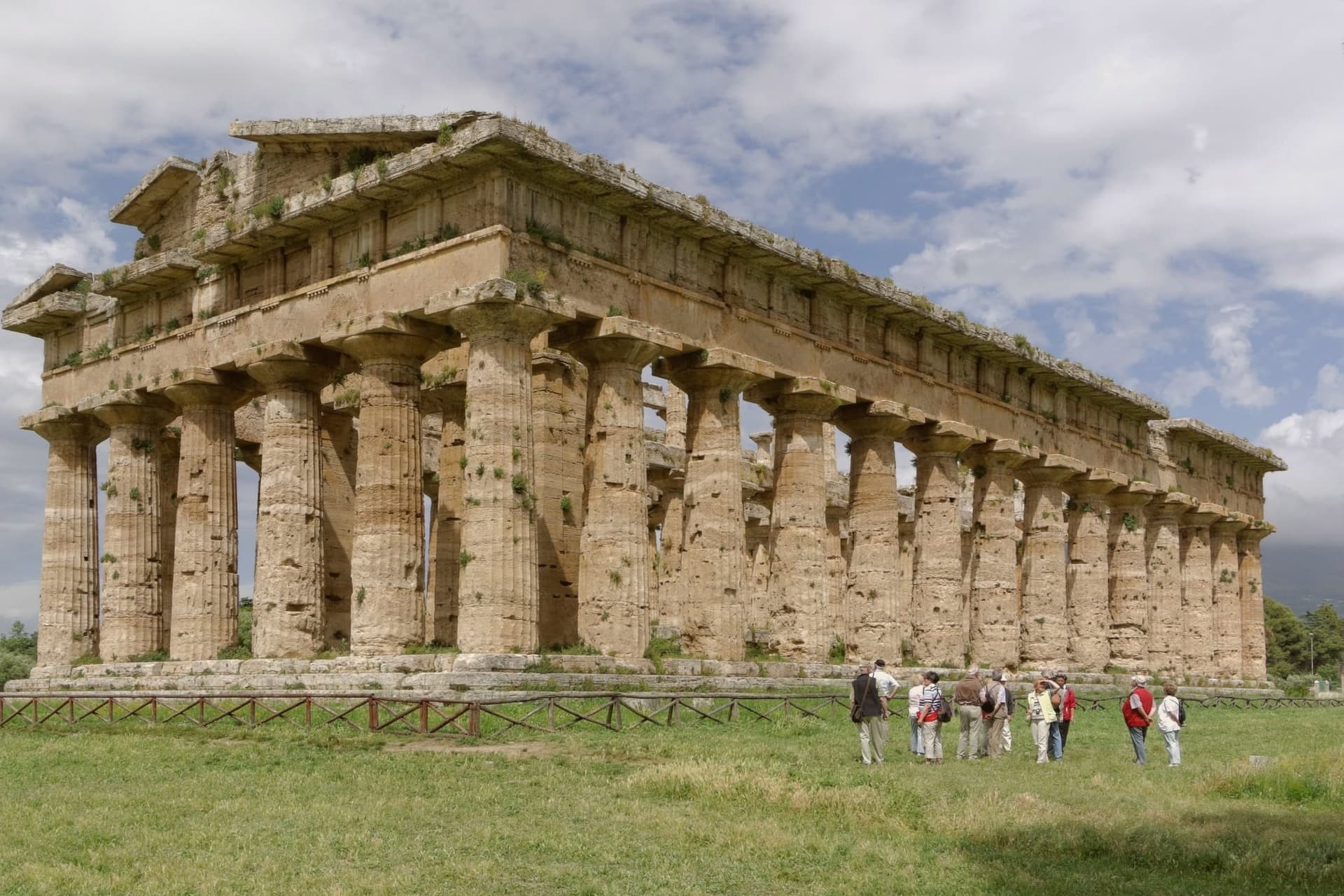
- Templi di Paestum. The Basilica, the Temple of Hera II and the Temple of Athena stand on the flat ground between the Sele river and the sea, close enough to walk between in an afternoon.
- Museo Archeologico Nazionale di Paestum. The frescoes are kept indoors, apart from the temples they were painted near, giving a rare look at how the tomb's painters depicted the afterlife.
- Mura greche di Paestum. Almost five kilometers of Greek and Roman defensive walls with four gates, intact across the entire perimeter of the ancient city.
How to get to Capaccio Paestum
It has its own railway station. Salerno is about 51 min away by road. The full route from Naples.
Our tip
May, June and September are the right months on the Sele plain, with the temples at sunrise or late afternoon and the buffalo pastures still green. July and August push the plain past thirty-eight degrees, the archaeological park closes its high noon hours and the beach absorbs most visitors. April and October are dry and quiet, the Madonna del Granato feast falls on the first Sunday of May and the temples are walkable without queues.
Why visit Pompei
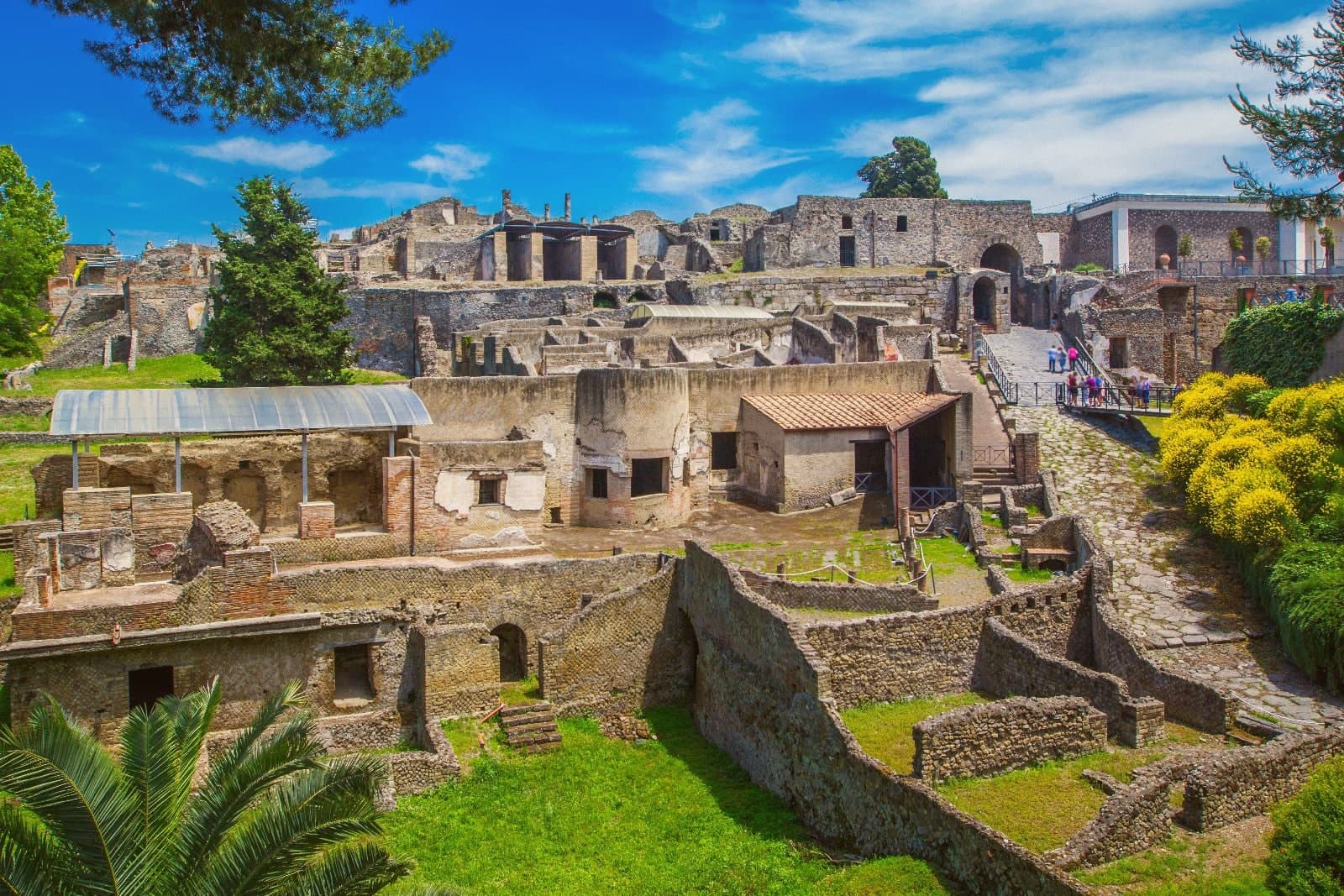
Pompei sits at 30 meters on a volcanic plateau on the south slope of Vesuvius, twenty kilometers from Naples and a few kilometers inland from where the Sarno meets the sea. The Roman city was buried under five to six meters of ash and lapilli when the volcano erupted on 24 October 79 AD, killing the part of the population that had not already left.
Excavations began in 1748 under the Bourbons and have never stopped; the site has been UNESCO-listed since 1997 alongside Herculaneum and Torre Annunziata, and is the third most visited archaeological site in the world. Modern Pompei was founded in 1881 by the lawyer Bartolo Longo, who built the Santuario della Beata Vergine del Rosario as a center for pilgrimage and social work.
The basilica with its 80-meter campanile and the surrounding grid of streets are entirely a creation of the 1880s, separate from the dig and laid over fields that had been farmland until then.
What to see in Pompei
- Parco Archeologico di Pompei. The Roman city buried in 79 AD and excavated since 1748, UNESCO-listed since 1997, with the Forum, the Villa dei Misteri and the Lupanare.
- Santuario della Beata Vergine del Rosario. Pontifical basilica built between 1876 and 1891 by the lawyer Bartolo Longo, the heart of modern Pompei and a pilgrimage site of four million a year.
- Casa del Fauno. Roman patrician house in the dig with a bronze faun at its center and the Alexander Mosaic floor depicting Issus, now in the Naples museum.
How to get to Pompei
It has its own railway station. Napoli is about 24 min away by road. The full route from Naples.
Our tip
May, June, September and early October are the strongest months for Pompei. The dig opens at nine and the Forum stays walkable before midday heat sets in. July and August are punishing: the site sits on volcanic plateau at thirty meters with no shade in the main streets, and afternoon temperatures cross thirty-five degrees.
Why visit Torre Annunziata
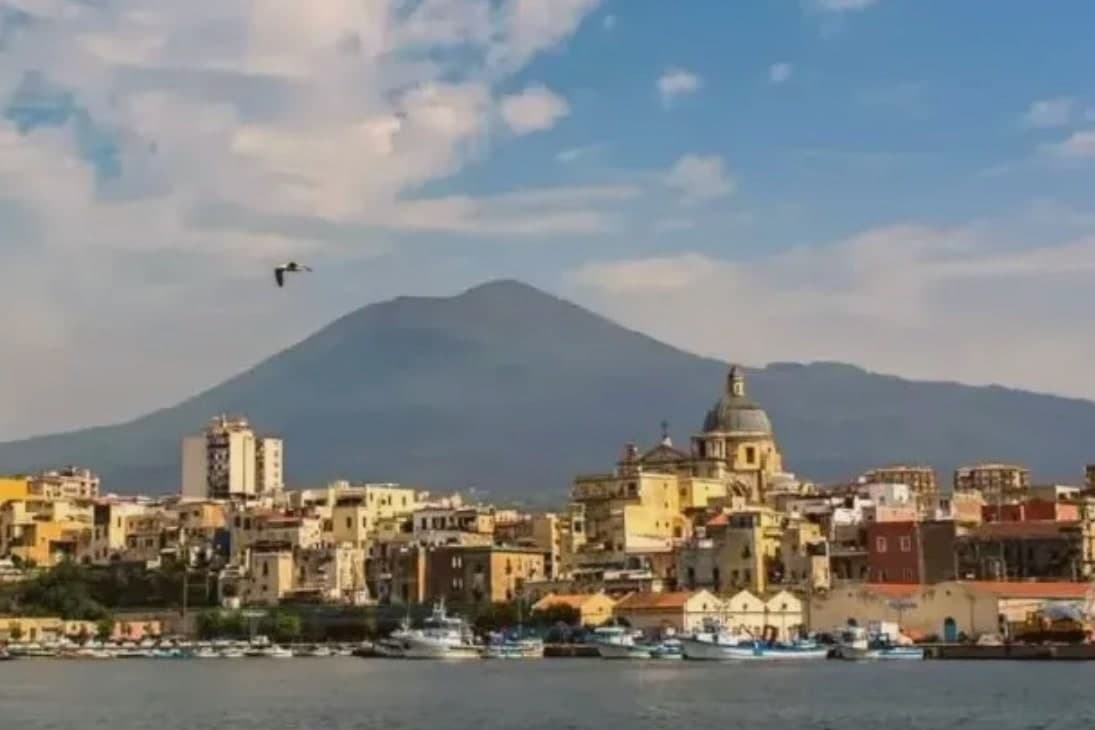
Torre Annunziata sits at 15 meters on the Bay of Naples, 20 kilometers south of the city at the western foot of Vesuvius, where the Sarno river meets the sea. The Roman town of Oplontis stood here before 79 AD; Villa A, called the Villa di Poppea after Nero's second wife who probably owned it, is the largest of the seafront villas buried by the eruption and the most completely excavated, listed by UNESCO in 1997 with Pompeii and Herculaneum.
The modern town is named for the 1319 watchtower and the chapel of the Annunziata built next to it. From the 17th century the Sarno was channelled to power flour and pasta mills, and by 1900 Torre Annunziata had more than sixty pastifici.
Together with Naples and Gragnano it was called the Capital of the White Art, the term for industrial dried pasta. Setaro and a handful of other small pastifici still produce by traditional bronze die and slow drying.
The town was hit hard by postwar industrial decline and the 1980 Irpinia earthquake.
What to see in Torre Annunziata
- Scavi di Oplontis - Villa di Poppea. Seafront Roman villa attributed to Nero's wife Poppaea, buried 79 AD, the largest and best-preserved of the Oplontis villas, UNESCO-listed 1997.
- Basilica della Madonna della Neve. Sixteenth-century shrine of the Madonna della Neve, the patron of the town, rebuilt after 18th-century earthquakes.
- Torre dell'Annunziata. Fourteenth-century watchtower for which the town is named, built 1319 to guard against Saracen raids on the Vesuvian coast.
How to get to Torre Annunziata
It has its own railway station. Napoli is about 22 min away by road. The full route from Naples.
Our tip
April through June and September through October are the workable months. The Villa di Poppea is open all year but the unshaded Roman peristyles get punishing in July and August, when the site temperature can push 35 degrees. The bay breeze cools the lungomare in the evenings.
Why visit Ercolano
The eruption of AD 79 treated the two Roman towns differently. Pompeii took 3 to 4 meters of ash, hot enough to scorch organic material but not to seal it.
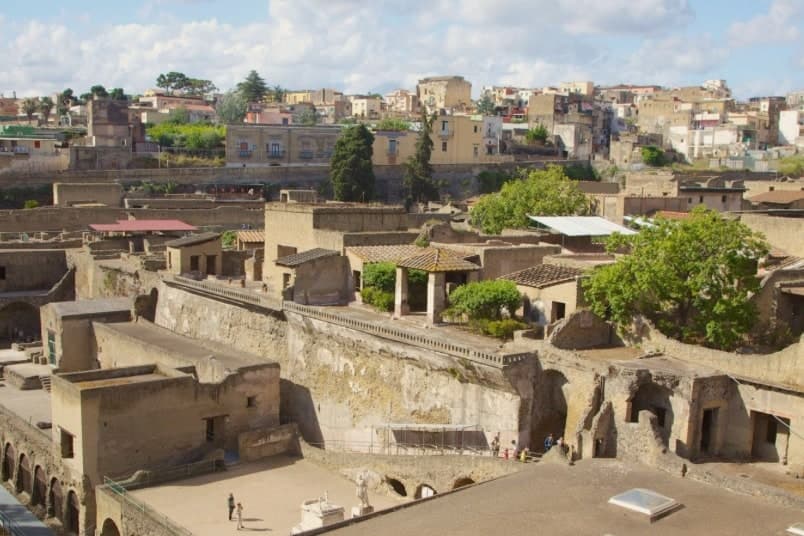
Herculaneum, closer to the mountain and down at the shore, was hit by repeated pyroclastic surges and ended up under a mud flow that cooled hard around everything it touched: roofs, furniture, scrolls, upper floors. That difference in burial is the reason one site kept its wood and the other did not: the carbonised wooden screen of the House of the Wooden Partition, the wooden bed in the House of the Carbonised Furniture, and the second-storey overhangs are all here because the mud sealed rather than scorched them.
The site was named UNESCO World Heritage in 1997, jointly with Pompeii and Torre Annunziata. The suburban villa attributed to Julius Caesar's father-in-law, Lucius Calpurnius Piso, once stood on the ancient seafront, now buried well inland under the weight of the deposit.
Inside it, roughly 1,800 carbonised papyrus scrolls were recovered, including the entire Epicurean philosophical library of Philodemus of Gadara. That find, the largest single ancient library ever recovered, is still being unrolled with multispectral imaging at the Officina dei Papiri Ercolanesi in Naples, and it is the building the J. Paul Getty Museum in Malibu replicated 1:1 as its main structure.
Along the old shoreline nearby, the arched boathouses hold the remains of 300 fugitives killed by the 500 degree pyroclastic surge while they waited for a rescue that never reached them, discovered in the 1980s and 1990s and now the most-photographed image of that moment. The modern town sits directly on top of the ancient one, 50,000 people on the lower slopes of the volcano, with the excavated ruins sunk below current street level in a pit at the center of things.
Excavation has gone on since 1738, when Charles of Bourbon began it, and continues piecemeal now. To the east, the ground rises toward the national park and the Gran Cono crater, reached by a half-day hike from the upper car park with reservation required.
To the west, the road along the old Golden Mile strings 122 Bourbon-era villas, built between the 1730s and 1820s by the Naples aristocracy, toward the coast; Villa Campolieto, designed by Vanvitelli in 1763 and now a cultural center, and Villa Favorita, a former royal residence, are the ones open to visitors. Upper slope, buried town, and shoreline road are three bands of the same landscape, each shaped by proximity to the same mountain.
The town's food follows the same geology: spaghetti alle vongole, mozzarella di bufala, pomodorino del piennolo del Vesuvio DOP grown on the volcanic slopes, and Lacryma Christi del Vesuvio DOC red and white from vineyards on the same soil. What holds the place together is that the volcano is not backdrop here.
It is the reason the ruins are intact, the reason the villas needed a gateway road, and the reason the food tastes the way it does.
What to see in Ercolano
- Parco Archeologico di Ercolano (UNESCO). Wooden screens, beds, and second-storey balconies stand in place, sealed by the mud rather than reduced by it. Walking the excavated streets means walking below the level of the modern town, which sits on top of what the mud buried.
- Villa dei Papiri. A 100m-long suburban villa attributed to Caesar's father-in-law, its rooms opening onto what was once the ancient seafront, now well inland of the shore under the weight of volcanic deposit.
- Boathouse skeletons. 300 fugitives killed while sheltering in the arches along the old shoreline, waiting for a rescue that the surge outran. Found in the 1980s, the arches are left much as they were uncovered.
How to get to Ercolano
It has its own railway station. Napoli is about 16 min away by road. The full route from Naples.
Our tip
Ercolano is best March–June and September–October: the archaeological park is open year-round but summer Naples heat (35°C+) is brutal on the unshaded site, and the Vesuvio crater hike is best before 10am or after 4pm in summer. Allow a full day for the site + the crater. Book Villa dei Papiri visit slots in advance: the substructure tours are limited capacity.
Read a sample letter
A detour with a fixed race
Letters from the towns we visit. Free.
The button takes you to the letter's own page on Substack, where you leave your email. About the letter
More from Anywhere Italy
- The best towns you can reach by train that sit inside a national park in CampaniaCampaniainside a parkby train9 towns · smallest 2,428 residents
- The best towns with a World Heritage site that you can reach by train in CampaniaCampaniaby trainWorld Heritage8 towns · smallest 5,750 residents
- The best coastal towns inside a national park in CampaniaCampaniacoastalinside a park9 towns · smallest 2,428 residents
- The best towns with a World Heritage site within 45 minutes of SalernoNear Salernowithin 45 minWorld Heritage10 towns · smallest 688 residents · closest 24 min away
- The best towns with a World Heritage site within an hour of NaplesNear Napleswithin 60 minWorld Heritage10 towns · smallest 664 residents · closest 16 min away
- The 9 best towns you can reach by train in the province of NapoliNapoli provinceby train9 towns · smallest 12,355 residents