
The best hill towns in the province of Pisa
The province of Pisa is not really flat, whatever the run of the Arno suggests. Behind the plain the land folds into clay ridges and sandstone spurs, terraced with olives, cut by the Era and the Cecina, and topped by towns whose walls follow the contour because there was nowhere else for them to go. Autumn is the season that pays best here: white truffle from the woods above the Arno, wild boar in tegame, chestnut flour, new oil pressed in November and drunk almost green on unsalted bread. The building materials change as you climb, brick and river stone low down, then pale limestone and alabaster as you get near the Volterran plateau.
Almost everyone who comes to this province stops in the same place. The city of Pisa collects its visitors in a single walled field, the tower, the duomo, the baptistery, and the airport a short bus ride away means many people see nothing else before moving on to Florence or Siena. The Piazza dei Miracoli is one of the great architectural set pieces in Europe, and it is also crossed by tour groups from morning until closing, with a corridor of souvenir stalls to match. Even the wider Tuscan hill-town circuit narrows quickly, funnelling coaches towards San Gimignano and its towers.
The hills keep going, though, well past the point where the coaches turn back. The same ridges, the same oil and truffle and Sangiovese, the same medieval gates and Etruscan foundations continue south and east through the Valdera and down into the Val di Cecina, where geothermal steam vents beside the road. The towns in this list are those inland settlements, some walled and some barely bigger than the hill they stand on, and fewer people go to them. They are close enough to each other to be strung together over a few days by car, with market days, Romanesque parish churches and a good deal of quiet.
Of the 10 communes we have mapped in the province of Pisa, 7 qualify as hill towns: each is an inland hill settlement built on ground too steep to spread. The smallest, Casale Marittimo, has 1,051 residents.
Elsewhere in the catalogue: The best hill towns within 90 minutes of Pisa and The best towns with a serious restaurant in the province of Pisa.
Casale Marittimo
Why visit Casale Marittimo
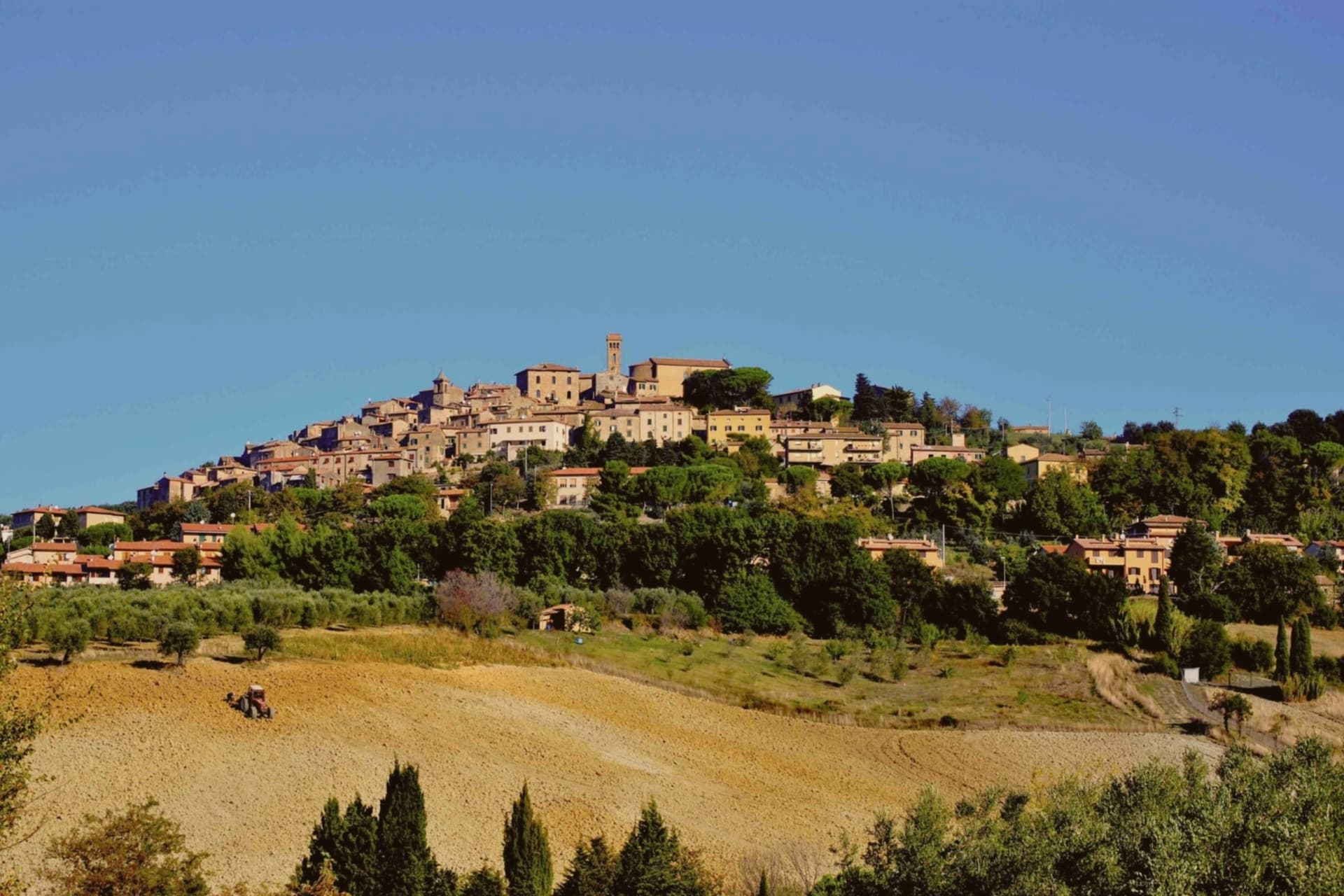
Casale Marittimo rises on a hill at 214 meters above the Val di Cecina, fifty kilometers southeast of Pisa, the Tyrrhenian coast visible from the upper streets. The settlement here was an outpost of Etruscan Volterra in the seventh century BC; the necropolis of Casa Nocera turned up two stone statues of warrior princes, now in the Archaeological Museum of Florence, among the oldest figurative sculptures in European art.
The medieval centro is recorded as a castle of the Counts of Gherardesca by 1004, the streets arranged in concentric rings inside the old walls, stone houses pressed against the slope. Casale Marittimo carries both the Borghi più belli d'Italia and Bandiera Arancione marks, unusual for a commune of just over a thousand inhabitants.
The Chiesa di Sant'Andrea sits on the foundations of an older parish church; Palazzo Rocca and the eighteenth-century Santa Maria delle Grazie close the small loop of the centro storico.
What to see in Casale Marittimo
- Centro storico. Concentric ring of stone streets inside the medieval walls, with houses pressed against the slope and Palazzo Rocca at the top.
- Chiesa di Sant'Andrea. Parish church rebuilt on the ruins of an older pieve, the principal religious building of the borgo.
- Santa Maria delle Grazie. Eighteenth-century church on the lower edge of the centro storico, simple Tuscan late-Baroque façade.
How to get to Casale Marittimo
Livorno is roughly 50 minutes away by road.
Our tip
April through June brings the warm coastal hills into their best season, evenings still cool on the ridge. September and October are dry and clear, the harvest in the surrounding vineyards followed by the olive pick. July and August are hot in the Val di Cecina, but the sea breeze reaches the upper streets and tempers the worst of it. Sagra della Tagliata Mare e Terra falls in July.
Castelnuovo di Val di Cecina
Why visit Castelnuovo di Val di Cecina
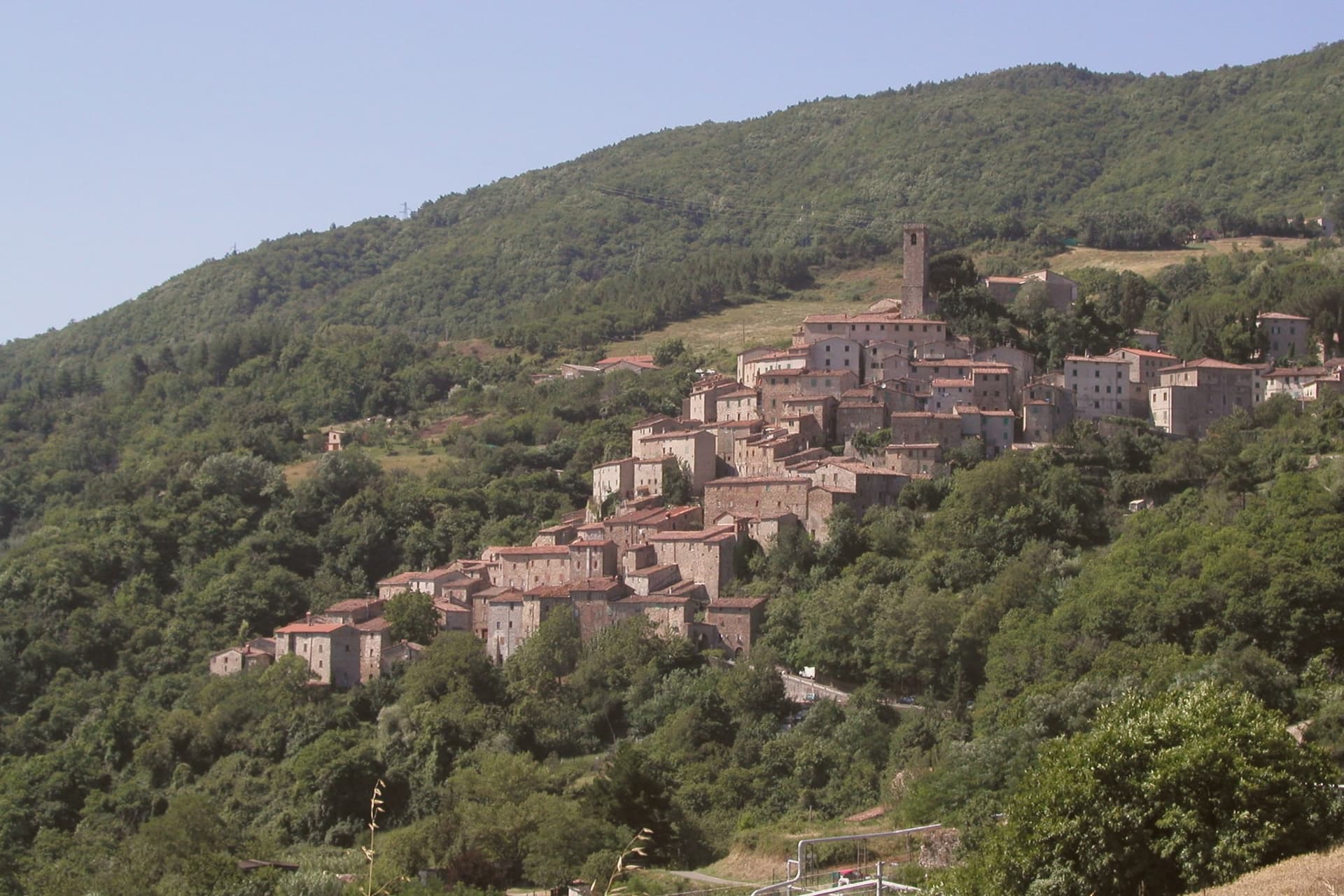
Castelnuovo di Val di Cecina sits on a high spur above the Cecina river, in the geothermal heart of Tuscany. The hills around it are scored with soffioni, the same steam that Francesco Larderel learned to harness in 1818 a few kilometers down the road: the natural resource that made this stretch of Tuscany industrial rather than merely agricultural.
The frazione with the steam vents in its streets sits apart from the main village, which grew instead around copper. The two economies, mineral steam and mined ore, shaped separate parts of the comune rather than the same hill, and the fortress on the neighboring ridge stood to survey the valley that connected them.
The chestnut, gathered on the slopes above both, was the food that got people through the winter regardless of what came out of the ground. What this comune amounts to, then, is a single valley organized around three different things the earth gave it: heat, copper, and chestnuts, each claimed by a different part of the terrain.
What to see in Castelnuovo di Val di Cecina
- Centro storico. Surviving towers and stone houses mark the boundary of the old ore concession, laid out around the medieval copper-mining works at 576 meters.
- Parco delle Fumarole di Sasso Pisano. Boiling pools and vents on the slopes around Sasso Pisano, ground that hisses underfoot and a landscape that shaped Tuscan industry before it became a place to walk through.
- Rocca Sillana. Pentagonal keep on the next ridge, with views that take in the full sweep of the upper Cecina valley from its walls.
How to get to Castelnuovo di Val di Cecina
Livorno is roughly 94 minutes away by road.
Our tip
April through June is dry and green at altitude, with the fumarole steam visible against cold morning air. September and October are the chestnut season, with the smaller sagre across the comune. July and August are warm but tempered by elevation; the soffioni feel less dramatic when the air outside them is already hot.
Vicopisano
Why visit Vicopisano
Vicopisano sits at the foot of Monte Pisano where the plain of the Arno meets the hills, twenty kilometers east of Pisa. The town was a Pisan river port on the old course of the Arno until the river shifted south in the sixteenth century, leaving the walls inland.
Florence captured the town in 1407, which is what brought Brunelleschi and his engineering to a place that had until then belonged to Pisa's river trade rather than to Florentine territory. The fortress and its covered passage sit above the older watchtower and the parish church, all reachable by the lanes that climb from the walls toward the ridge of Monte Pisano.
The hills above carry the olive groves that earned the town its Città dell'Olio listing, so the same slope that gave Brunelleschi high ground to defend also gives the town its oil. What the plain lost when the Arno shifted, the hillside above supplied instead: first a port town, then a fortified inland one, and finally an agricultural one.
What to see in Vicopisano
- Rocca del Brunelleschi. Restored fortress open to visitors, built on the slope where the walls back onto Monte Pisano.
- Torre delle Quattro Porte. Twelfth-century watchtower with four arched gates, reinforced rather than built during the Brunelleschi works, the architectural symbol of the medieval town.
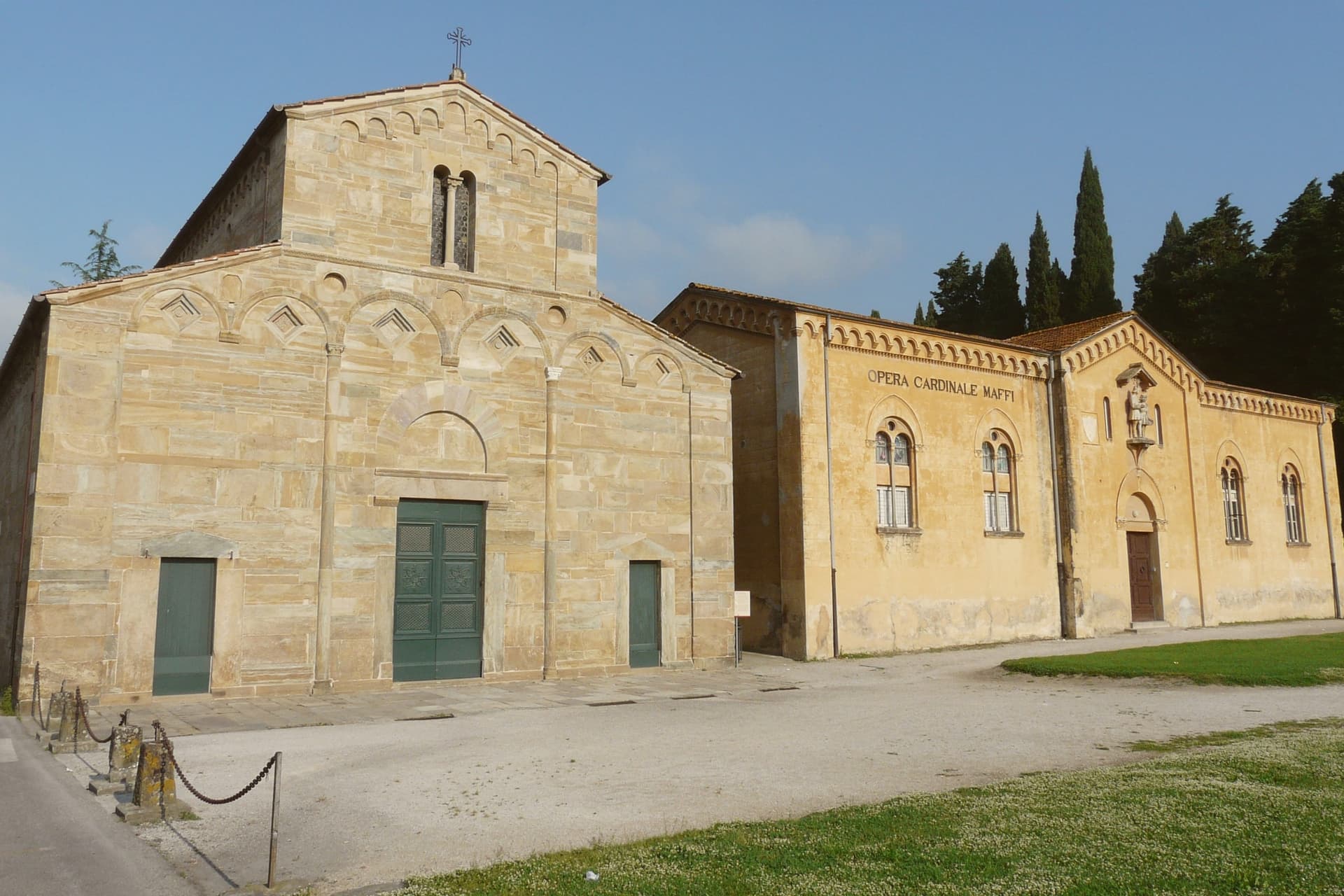
- Pieve di Santa Maria. Eleventh-century Romanesque parish church holding a wooden Deposition group carved around 1200, the second oldest such carving in Italy.
How to get to Vicopisano
There is a railway station in the town, so you can arrive without a car and never need one while you are here. Pisa is roughly 33 minutes away by road.
Our tip
April through June is dry and green, with the Monte Pisano olive groves at their best. September and October are the second window, cool mornings and the start of the harvest. The Festa Medievale runs the first weekend of September, three days of jousts and costumed processions inside the Brunelleschi walls. Festa Medievale falls in September.
Peccioli
Why visit Peccioli
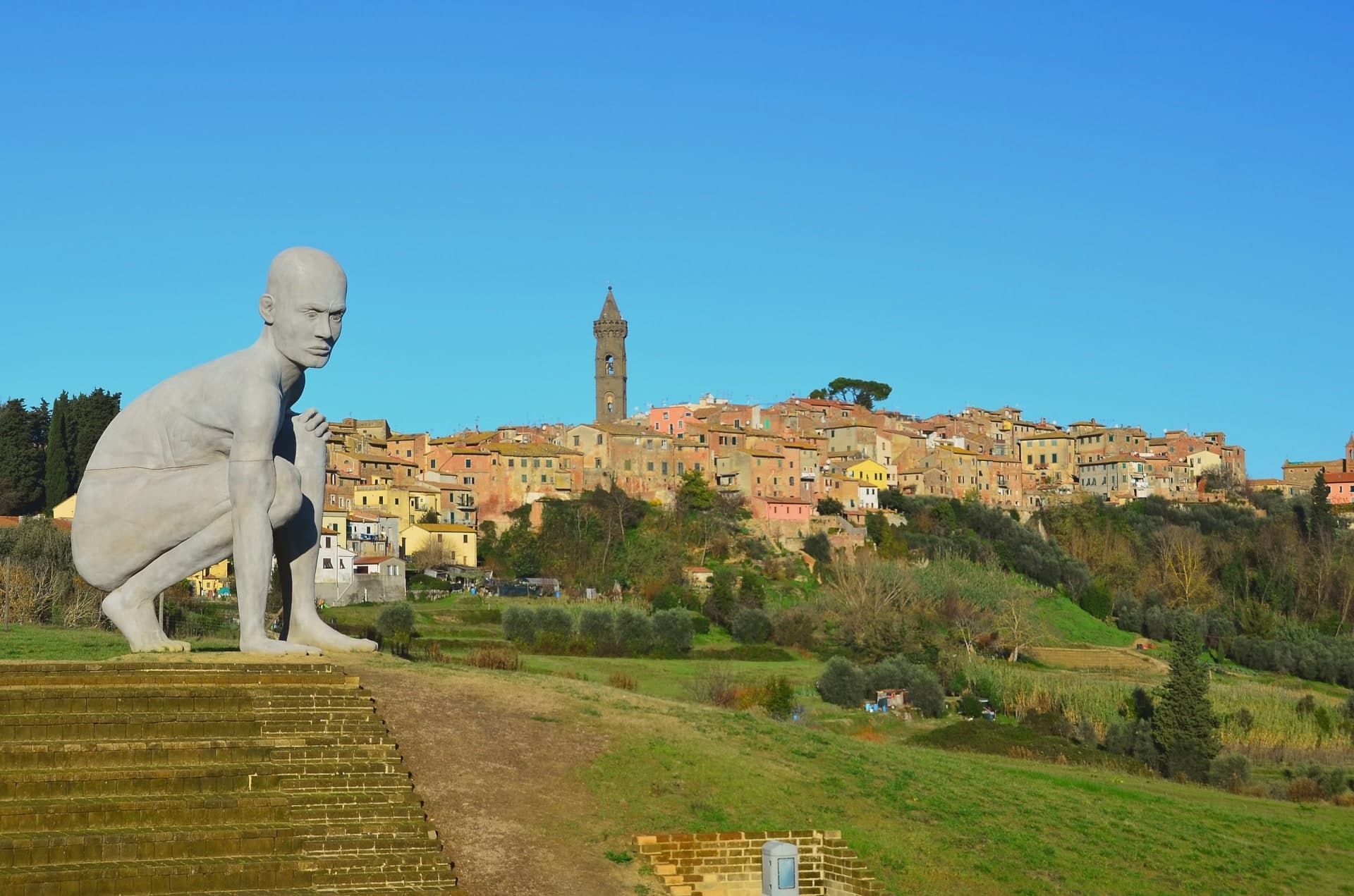
Peccioli sits at 144 meters in the Valdera, thirty kilometers southeast of Pisa, on a hill above the Era river. The historic center is medieval: the Pieve di San Verano is documented in 1171 in a papal bull of Alexander III, the layout standing today is twelfth and thirteenth century, and the bell tower beside it climbs forty-two meters above the rooftops.
What sets Peccioli apart is what happened after. In the 1990s the comune partnered with a private operator to build a waste treatment plant on the slope below town.
The Triangolo Verde, the green amphitheater built into the landfill site, hosts open-air concerts and contemporary-art installations. Revenue from the plant funds the Fondazione Peccioliper, a cultural foundation that since 2004 has commissioned sculptural and painted interventions throughout the borgo by international artists.
The village won the RAI Borgo dei Borghi contest in 2024 on that combination: medieval bones, open-air contemporary art, and a landfill that paid for it.
What to see in Peccioli
- Pieve di San Verano. Romanesque parish church documented in 1171, twelfth-century layout, with a forty-two meter bell tower beside it.
- Anfiteatro Fonte Mazzola. Open-air theater built in the shape of an ancient Greek amphitheater, two thousand seats, used for the Peccioli summer festival.
- Museo di Palazzo Pretorio. Civic museum on the main square, part of the Museum Complex that includes the archaeological collection and the Sacred Art museum.
How to get to Peccioli
Pisa is roughly 52 minutes away by road.
✷ We have written about Peccioli
“The first giant is more than 15 years old, but the town hasn’t given up on them, the latest one is crawling out of an old house in Fabbrica, one of Peccioli’s little hamlets, a short drive from the town. The giants brought in visitors. The town then invested even more in public art. Now Peccioli looks like a public art festival.”
Read our piece on Peccioli →Peccioli | The Giants of Garbage
Our tip
April through June and September into October are the months when the Valdera hills are at their best and the open-air program at Fonte Mazzola and the Triangolo Verde runs without the heat. July and August push past thirty-three degrees and the centro storico empties between two and six. The summer festival, 11Lune, runs July with concerts, theater and contemporary-art openings in the public spaces of the borgo.
Volterra
Why visit Volterra
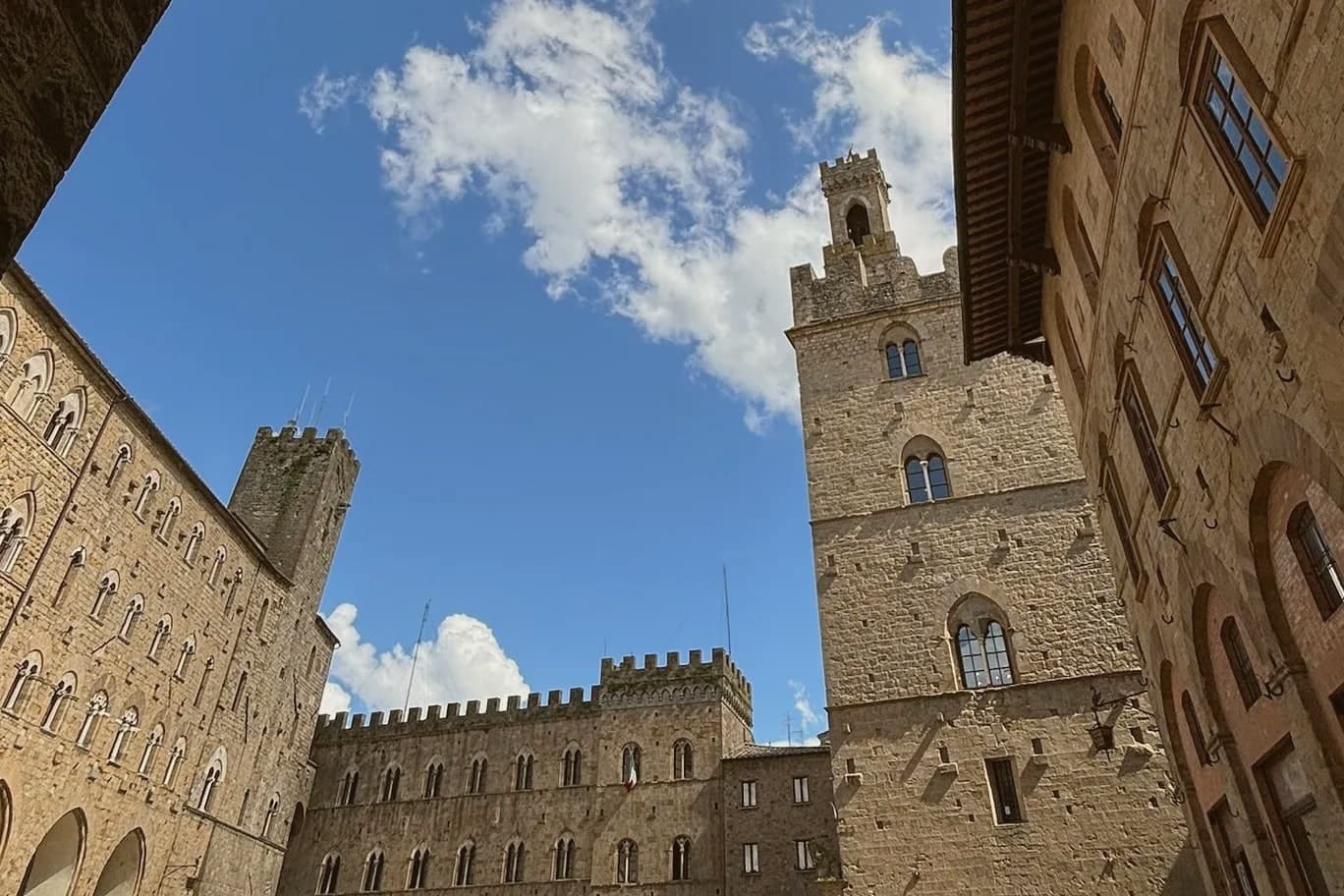
Volterra sits at 531 meters on a long ridge between the Era and Cecina valleys, one of the twelve cities of the Etruscan dodecapolis and the only one still occupied on its original ground. The Etruscans called it Velathri, the Romans Volaterrae; the Porta all'Arco, with three blackened tufa heads of unknown deities, has been the western gate of the town since the fourth century BC.
The Roman theater below the walls, excavated in the 1950s, holds two complete rows of columns and the bath complex behind the stage. Above stands the Palazzo dei Priori, begun in 1208 and the oldest town hall in Tuscany, the model for Florence's Palazzo Vecchio.
The town has been carving alabaster since the Etruscans, who used it for funerary urns; the same workshops on Via Porta all'Arco still cut and polish the soft white stone today. Le Balze, the eroded clay cliffs west of town, swallow a few meters of churchyard every century.
What to see in Volterra
- Porta all'Arco. Etruscan city gate from the fourth century BC, with three eroded tufa heads of unknown deities set above the arch.
- Teatro Romano. First-century BC Roman theater excavated in the 1950s, with two complete rows of columns and the bath complex behind the stage.
- Palazzo dei Priori. Begun in 1208, the oldest town hall in Tuscany, the architectural model for Florence's Palazzo Vecchio.
How to get to Volterra
Livorno is roughly 83 minutes away by road.
✷ We have written about Volterra
“The wine is the whole economy of these hills, every village with its own, the region’s name stamped on the most famous red in Italy. Tuscan food runs to cured and roasted meat, so the wine ran red to meet it, lighter than you expect, almost fruity, easy, made to sit beside a steak and not to be lectured about. Here is the only wine knowledge you need on this road: it is all good.”
Read our piece on Volterra →Road to Siena | The Long Way Is the Better Way
Our tip
April through June brings the surrounding clay hills green and the temperatures bearable on the exposed ridge. September and October are the second window, with the white truffle harvest peaking at Volterragusto in late October. July and August are hot and bright at altitude; the town fills with Italian and foreign visitors, and the Etruscan urns at the Guarnacci feel cool by comparison. Mostra Mercato del Tartufo Marzuolo falls in April.
San Miniato
Why visit San Miniato
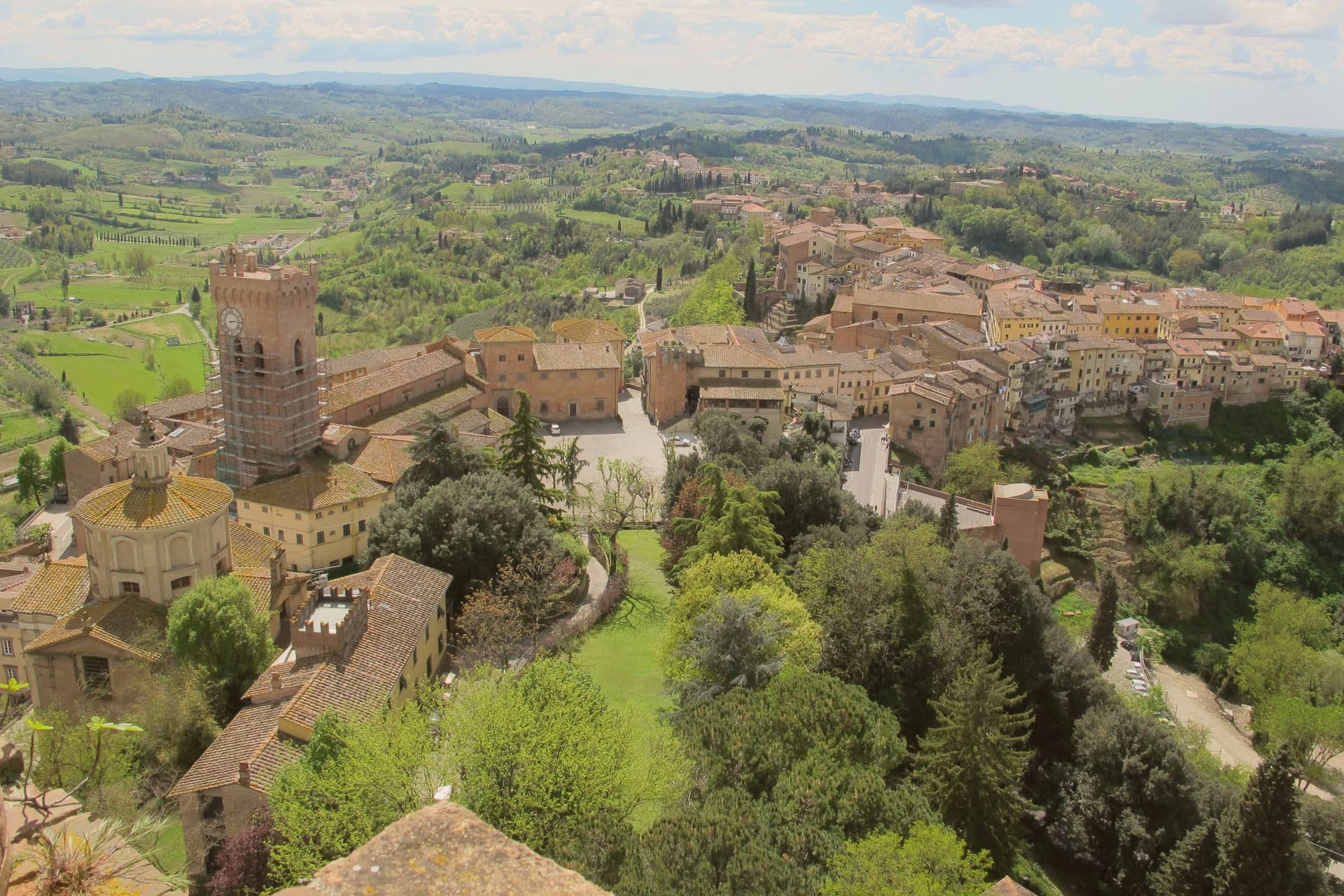
San Miniato runs along three hills at 150 meters above the lower Arno, halfway between Pisa and Florence. In 962, Otto I of Saxony made it one of the seats of imperial administration in central Italy; in 1218 Frederick II turned it into a tax collection point, and the brick tower he built between 1217 and 1223 still rises above the town, rebuilt in 1958 after the retreating Germans mined it in 1944.
The Via Francigena passes through. The Duomo, dedicated to Sant'Assunta and Santo Genesio, holds the asymmetrical clock tower called the Matilde.
What the town is mainly known for today comes from the woods around it. San Miniato produces roughly a quarter of Tuscany's white truffles, including a tuber of over two kilos found in 1954.
The National White Truffle Exhibition, running through the last three weekends of November, has been held in Piazza del Duomo since 1969.
What to see in San Miniato
- Rocca di Federico II. Thirty-meter brick tower built by Frederick II between 1217 and 1223, destroyed by retreating Germans in 1944 and rebuilt in 1958.
- Duomo di Santa Maria Assunta e San Genesio. Originally Romanesque cathedral with Gothic and Renaissance additions, dedicated to two patrons, with the asymmetrical Matilde clock tower as campanile.
- Palazzo dei Vicari dell'Imperatore. Medieval palace of the imperial vicars who governed San Miniato when it was an imperial administrative seat.
How to get to San Miniato
There is a railway station in the town, so you can arrive without a car and never need one while you are here. Pisa is roughly 49 minutes away by road.
✷ We have written about San Miniato
“And then time passed, which is the part the town doesn’t tell you about, because the town only sees you on the day. The jars sat in the cupboard. We are not people who keep proper white truffle at home; almost nobody is. But we do buy black truffle now and then, and we don’t buy it on a hill behind a closed road. We buy it from a man named Marco who runs a food truck in a supermarket parking lot down on the Marina near us. He digs some of it himself and sells the rest for the farmers around him, and there is no shuttle bus.”
Read our piece on San Miniato →San Miniato | The Truffle I Couldn’t Taste
Our tip
April through June brings the long Tuscan spring, mild on the ridge with views clear to the Apennines. September and October are dry and gold, the same colors painters come for. November is the truffle month: the National White Truffle Exhibition fills Piazza del Duomo across three weekends, hotel rates double, restaurants book out weeks ahead. Fiera Mercato del Tartufo Bianco di Corazzano falls in the season.
Pontedera
Why visit Pontedera
Pontedera is a working town on the flat land where the Era meets the Arno, halfway along the railway between Pisa and Florence. Piaggio moved its aircraft works here in the 1920s; the Allies bombed the plant flat in 1943 and 1944, and out of the rebuilt halls in 1946 came Corradino D'Ascanio's first Vespa.
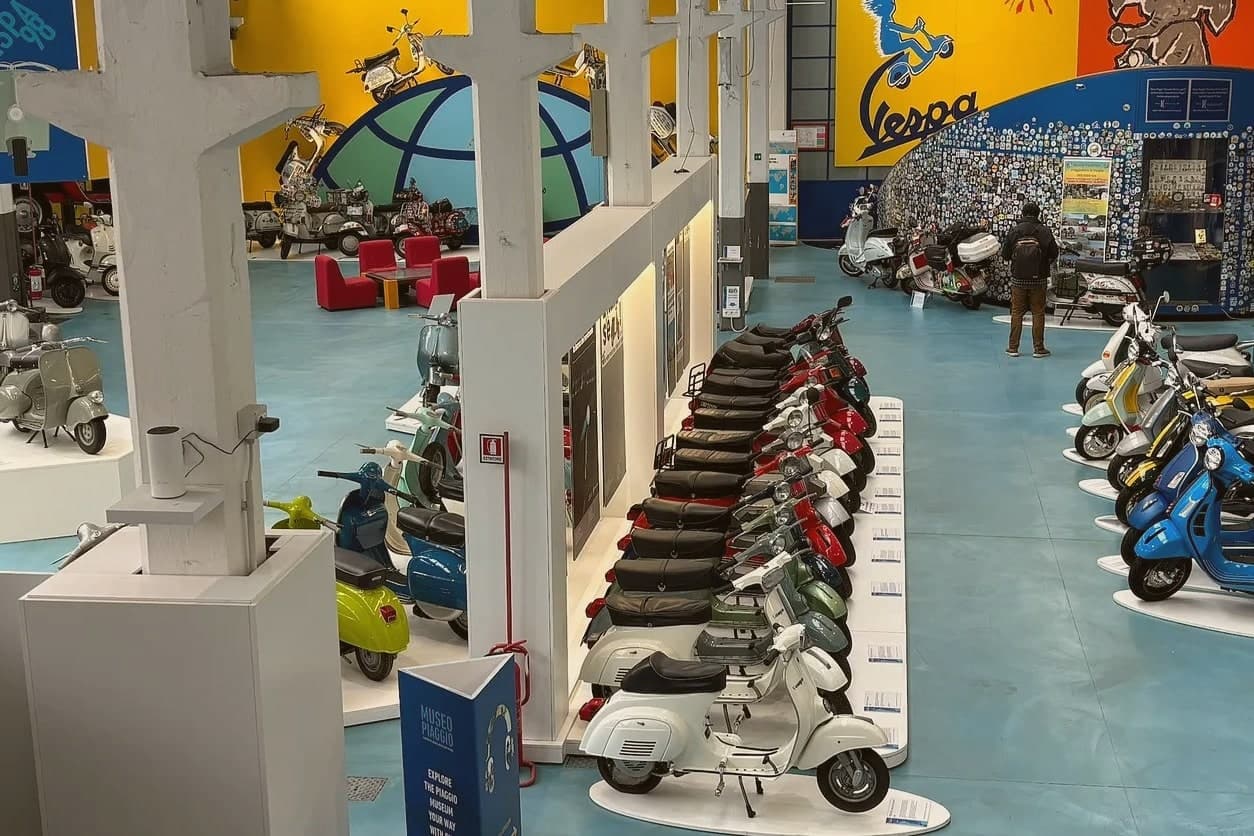
The town has run on that factory ever since. The Museo Piaggio, set in the old tooling workshop by the station, holds the world's largest Vespa collection, from the first 98cc series to the machines that crossed continents.
Around it is an ordinary Tuscan market city: a long pedestrian corso, a street market that serves the whole Valdera, and frequent trains in both directions. Nobody stays the night for postcards.
You come for the museum, the shopping streets, and the feel of the Tuscany that works for a living.
What to see in Pontedera
- Museo Piaggio. The world's largest Vespa collection, kept in the former tooling workshop on Viale Rinaldo Piaggio where Corradino D'Ascanio's 1946 prototype was built, alongside Gileras and the Ape in every variant.
- Teatro Era. The theatre that made a factory town matter to actors worldwide: Jerzy Grotowski moved his Workcenter here in 1986 and ran it until his death in 1999, and the research company still works inside the building.
- PALP Palazzo Pretorio. The old praetorian palace at the head of the corso, reworked as the town's exhibition hall, with rotating art shows carrying names far bigger than the town.
How to get to Pontedera
There is a railway station in the town, so you can arrive without a car and never need one while you are here. Pisa is roughly 25 minutes away by road.
✷ We have written about Pontedera
“Pontedera, the town, we knew nothing about. The brain-dump version, which I will give you now and defend in a moment, is that Pontedera is a working factory town in the Valdera, and we have nothing in particular to say about it. Yes, there is a piazza, with a church, and some restaurants around it in an old town. But that is true to almost all Italian towns. We were there for the Museo Piaggio, in short: the Vespa museum. The museum is the reason to go.”
Read our piece on Pontedera →Pontedera | The Museum That Is More Than the Vespa
Our tip
April through October is the comfortable range, with the Valdera markets busiest on Saturday mornings. July and August are hot on the flat river land; the town keeps working through them but the piazza empties by early afternoon. The Museo Piaggio runs year-round and is an all-weather reason to come, which makes Pontedera one of the few towns here that a grey winter day does not close. Sagra del Bombolone falls in September.
More from Anywhere Italy
 The best hill towns within 90 minutes of Pisa
 The best towns with a serious restaurant in the province of Pisa
- The best towns you can reach by train that have a serious restaurant within 90 minutes of Pisa
 The 9 best hill towns that live slowly in Toscana
 The best hill towns within an hour of Florence
 The best towns with a serious restaurant that sit on a walking route within 90 minutes of Pisa