
The best towns that eat well within 45 minutes of Naples
The land around Vesuvius is black and fertile, and it shows on the plate. Piennolo tomatoes hang in bunches on cellar walls through winter, buffalo herds graze the flat country towards the Volturno, and the fish comes off boats working the crater bays of the Phlegraean coast. Houses here are built of tufo, the soft yellow volcanic stone that gives the older streets their colour, and the good eating tracks the growing season: artichokes in spring, tomatoes and aubergine through the heat, chestnuts and broccoli when the weather turns. The wine, Falanghina and Piedirosso and Lacryma Christi, comes from vines rooted in the same ash.
Almost everyone eats in Naples itself, and with reason. The pizzerie of the centro storico, Via dei Tribunali and the Spanish Quarter, are the reference point for the entire form, and the queues outside the famous doors on Via dei Tribunali run long into the evening from spring through autumn. Cruise passengers and day-trippers concentrate into a few streets, and a table at eight without booking is optimistic. The food is as good as its reputation, which is exactly why so many people are standing in front of it.
The same soil, the same fishing grounds and the same suppliers continue well past the city limits, and the trains and the tangenziale reach them in well under an hour. On the bay west of the city, on the plain under the volcano and inland towards the Reggia country, there are towns with dining rooms that guides have named, where the room is full of people who live nearby rather than people passing through. These are those towns, each one holding at least one table worth planning a day around.
Of the 7 communes we have mapped in a 45-minute drive of Naples, 6 qualify as towns that eat well: each holds a table a guide put its name to. The smallest, Pompei, has 23,910 residents.
Two more lists worth reading alongside this one: The best towns you can reach by train within 45 minutes of Naples and The best towns with a serious restaurant that eat well within 90 minutes of Napoli.
Pompei
Why visit Pompei
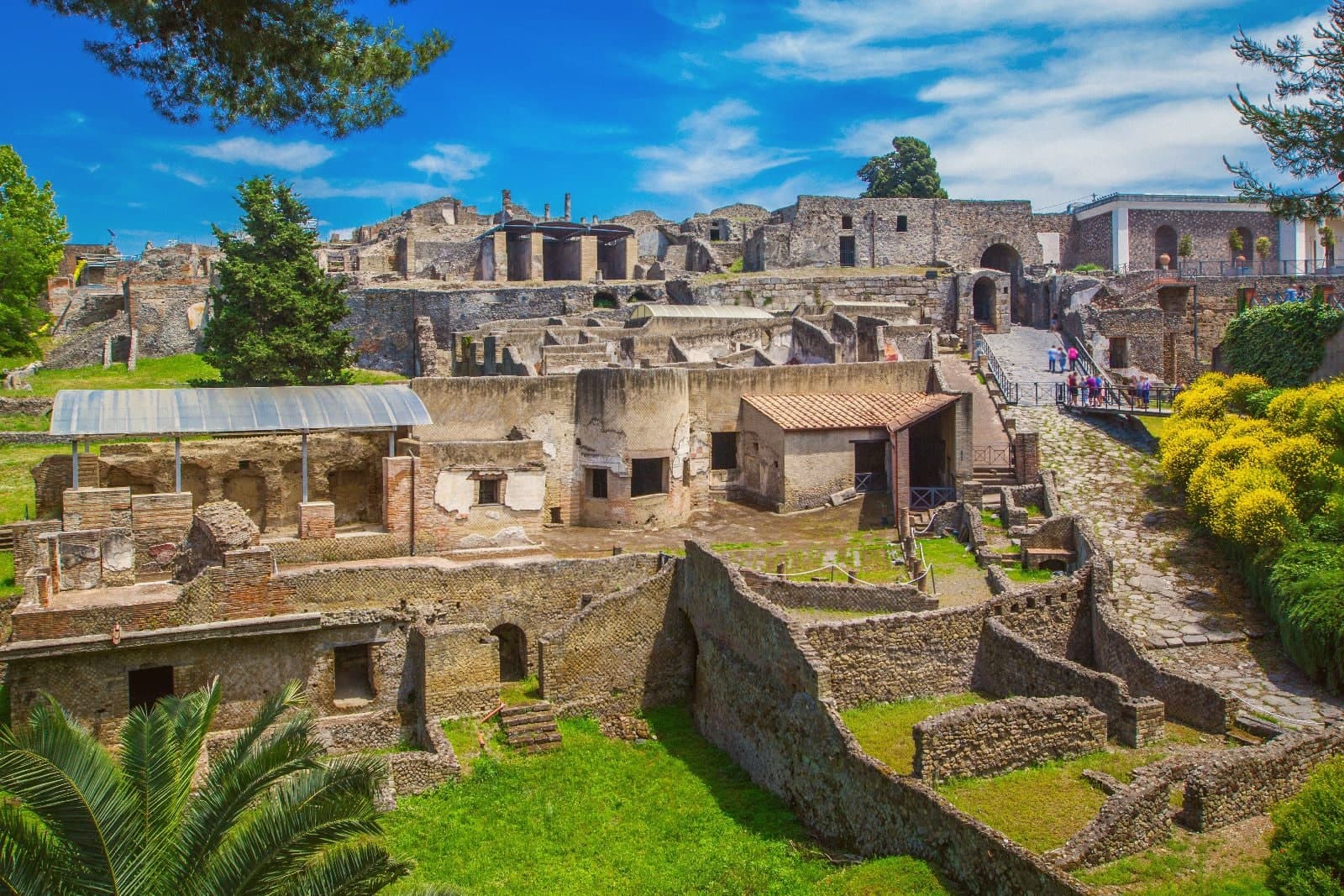
Pompei sits at 30 meters on a volcanic plateau on the south slope of Vesuvius, twenty kilometers from Naples and a hundred meters from where the Sarno meets the sea. The Roman city was buried under five to six meters of ash and lapilli when the volcano erupted on 24 October 79 AD, killing the part of the population that had not already left.
Excavations began in 1748 under the Bourbons and have never stopped; the site has been UNESCO-listed since 1997 alongside Herculaneum and Torre Annunziata, and is the third most visited archaeological site in the world. Modern Pompei was founded in 1881 by the lawyer Bartolo Longo, who built the Santuario della Beata Vergine del Rosario as a center for pilgrimage and social work.
The basilica with its 80-meter campanile and the surrounding grid of streets are entirely a creation of the 1880s, separate from the dig and laid over fields that had been farmland until then.
President, Cosmo Restaurant, Capasanta and 1 more have been named by a guide.
What to see in Pompei
- Parco Archeologico di Pompei. The Roman city buried in 79 AD and excavated since 1748, UNESCO-listed since 1997, with the Forum, the Villa dei Misteri and the Lupanare.
- Santuario della Beata Vergine del Rosario. Pontifical basilica built between 1876 and 1891 by the lawyer Bartolo Longo, the heart of modern Pompei and a pilgrimage site of four million a year.
- Casa del Fauno. Roman patrician house in the dig with a bronze faun at its center and the Alexander Mosaic floor depicting Issus, now in the Naples museum.
How to get to Pompei
There is a railway station in the town, so you can arrive without a car and never need one while you are here. Napoli is roughly 24 minutes away by road.
Our tip
May, June, September and early October are the strongest months for Pompei. The dig opens at nine and the Forum stays walkable before midday heat sets in. July and August are punishing: the site sits on volcanic plateau at thirty meters with no shade in the main streets, and afternoon temperatures cross thirty-five degrees.
Bacoli
Why visit Bacoli
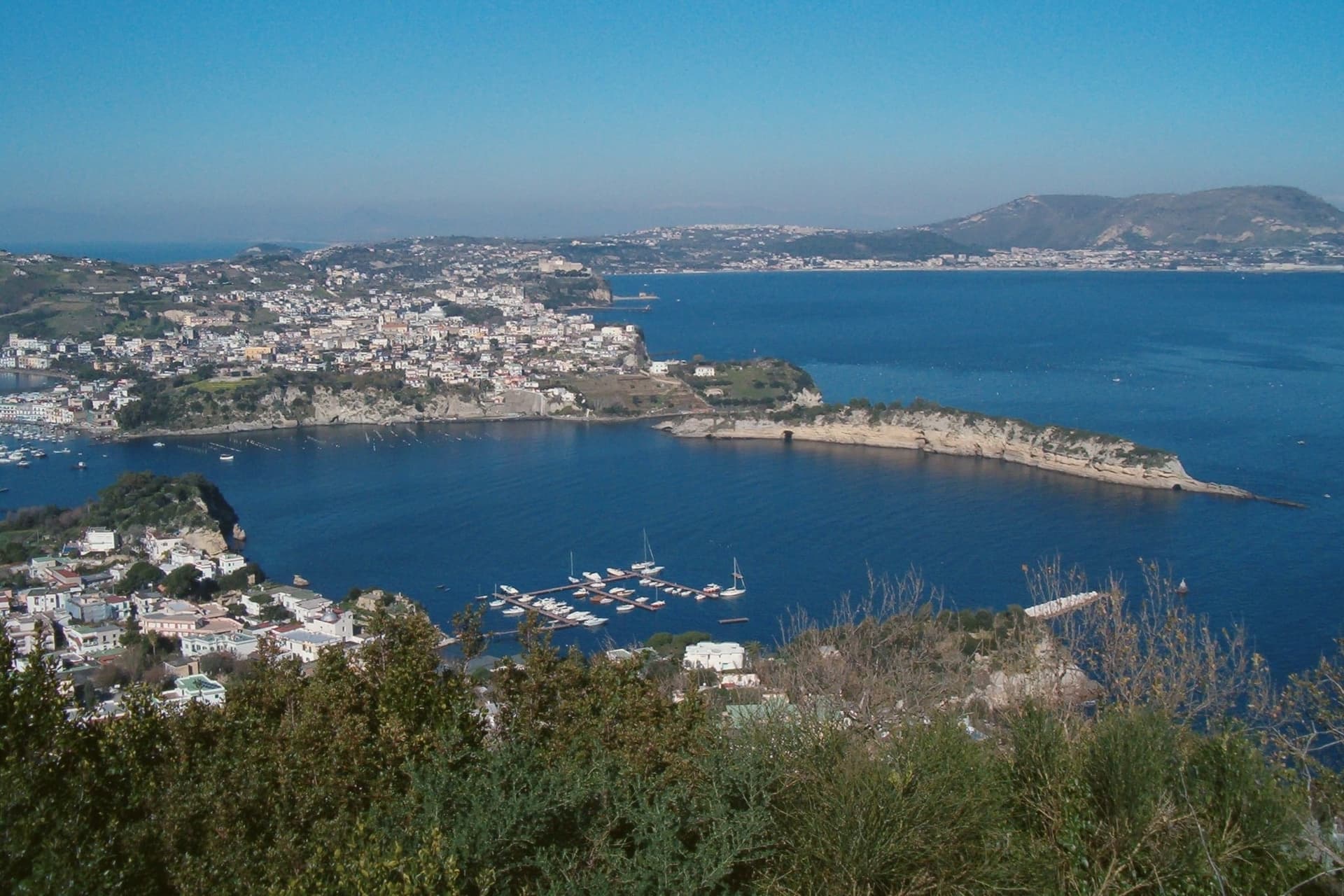
Bacoli sits at thirty meters on the western lobe of the Campi Flegrei, looking onto Lake Miseno and its headland across the Bay of Pozzuoli. The Romans called it Bauli.
In the late Republic and early Empire it was a resort lined with the villas of senators and emperors, and the fleet base nearby, the Classis Misenensis, was the largest in the Mediterranean. Most of that infrastructure is still here, scattered through the residential blocks that now fill the town, so that a cistern or a cistern complex turns up between apartment buildings rather than in an isolated park.
The town's two promontories divide its Roman past between them: the harbor side toward Miseno, where the fleet and its water supply were based, and the Baia side, where the villas and the later Aragonese castle stand. Bacoli is also an active geothermal zone, and bradyseism, the slow rise and fall of the Campi Flegrei coastline, is still measurable here, the same force that put the Roman villas at Baia underwater.
What survives above ground and what has sunk below the sea are the same story of ground that will not stay still.
Caracol, Riccio Restaurant, Aguglia osteria di mare 2021 and 2 more have been named by a guide.
What to see in Bacoli
- Piscina Mirabilis. Forty-eight cross-shaped pillars hold up the roof in rows, the scale meant to be walked through rather than read about, still standing among the residential blocks that have grown up around it.
- Cento Camerelle. Second cistern complex four hundred meters from the Piscina Mirabilis, on two superimposed levels, locally called the Prisons of Nero.
- Castello Aragonese di Baia. Late-fifteenth-century Aragonese fortress on the Baia promontory, since 1993 the seat of the Museo Archeologico dei Campi Flegrei.
How to get to Bacoli
There is a railway station in the town, so you can arrive without a car and never need one while you are here. Napoli is roughly 31 minutes away by road.
Our tip
May through September is the season for Bacoli. The Bay of Pozzuoli warms by late spring, and the underwater archaeological park at Baia runs glass-bottom and snorkel tours through the summer. July and August are hot and crowded, with day-trippers from Napoli and Ischia ferries crossing constantly; the open ruins like the Piscina Mirabilis are worth visiting early in the day.
Nola
Why visit Nola
Nola sits at 34 meters on the plain between Vesuvius and the Apennines, twenty kilometers east of Napoli. It was an Oscan and Samnite town before Rome, and the place where Augustus died in AD 14, in the same house his father had died in.
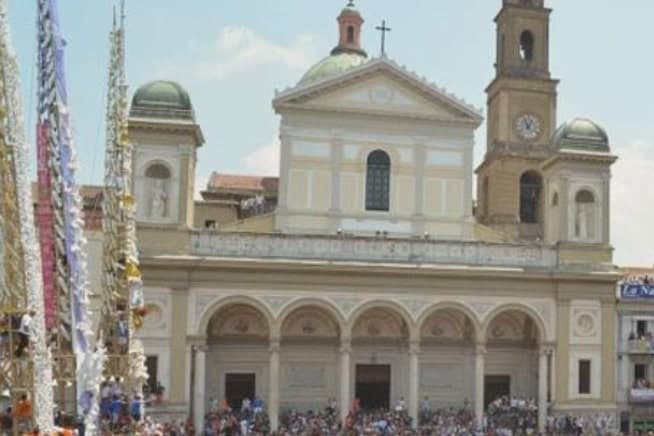
Giordano Bruno was born here in 1548, the Nolano who called his philosophy nolana before he was burned at the Campo de' Fiori in 1600. The town is best known today for the Festa dei Gigli, a UNESCO Intangible Heritage celebration on the Sunday before June 22 in which eight twenty-five-meter wooden obelisks, each weighing over a ton, are carried through the streets by teams of one hundred bearers.
The festival honors Paolino di Nola, the fifth-century bishop whose return from captivity in North Africa it commemorates. Outside the festival, Nola is a working town of warehouses and commerce.
Re Santi e Leoni, Le Baccanti, Rear Restaurant and 2 more have been named by a guide.
What to see in Nola
- Cattedrale di Nola. Cathedral of the Assunta and San Paolino, twentieth-century rebuilt after fire, with relics of the patron bishop who returned from Africa.
- Festa dei Gigli. UNESCO Intangible Heritage festival in June: eight 25-meter wooden obelisks carried through the streets by teams of one hundred bearers.
- Anfiteatro Romano di Nola. Roman amphitheater excavated on the southern edge of town, where Augustus was honored with funeral games in AD 14.
How to get to Nola
There is a railway station in the town, so you can arrive without a car and never need one while you are here. Napoli is roughly 28 minutes away by road.
Our tip
April through June covers the green months and culminates in the Festa dei Gigli on the Sunday before June 22, the one weekend when Nola fills with hundreds of thousands of visitors. September and October are warm and quieter, with the wine and hazelnut harvests in nearby Irpinia bringing activity to the markets. July and August are hot and humid on the plain.
Ercolano
Why visit Ercolano
The eruption of AD 79 treated the two Roman towns differently. Pompeii took 3 to 4 metres of ash, hot enough to scorch organic material but not to seal it.
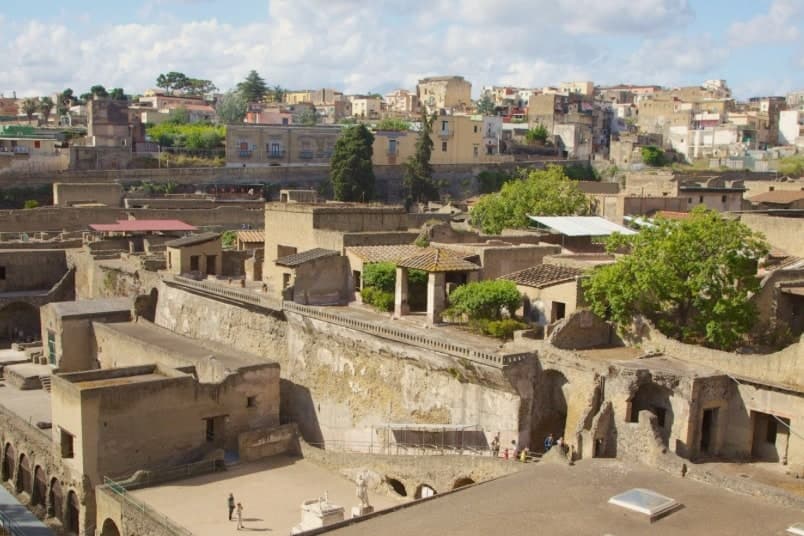
Herculaneum, closer to the mountain and down at the shore, was hit by repeated pyroclastic surges and ended up under a mud flow that cooled hard around everything it touched: roofs, furniture, scrolls, upper floors. That difference in burial is the reason one site kept its wood and the other did not: the carbonised wooden screen of the House of the Wooden Partition, the wooden bed in the House of the Carbonised Furniture, and the second-storey overhangs are all here because the mud sealed rather than scorched them.
The site was named UNESCO World Heritage in 1997, jointly with Pompeii and Torre Annunziata. The suburban villa attributed to Julius Caesar's father-in-law, Lucius Calpurnius Piso, once stood on the ancient seafront, now buried well inland under the weight of the deposit.
Inside it, roughly 1,800 carbonised papyrus scrolls were recovered, including the entire Epicurean philosophical library of Philodemus of Gadara. That find, the largest single ancient library ever recovered, is still being unrolled with multispectral imaging at the Officina dei Papiri Ercolanesi in Naples, and it is the building the J.
Paul Getty Museum in Malibu replicated 1:1 as its main structure. Along the old shoreline nearby, the arched boathouses hold the remains of 300 fugitives killed by the 500 degree pyroclastic surge while they waited for a rescue that never reached them, discovered in the 1980s and 1990s and now the most-photographed image of that moment.
The modern town sits directly on top of the ancient one, 50,000 people on the lower slopes of the volcano, with the excavated ruins sunk below current street level in a pit at the centre of things. Excavation has gone on since 1738, when Charles of Bourbon began it, and continues piecemeal now.
To the east, the ground rises toward the national park and the Gran Cono crater, reached by a half-day hike from the upper car park with reservation required. To the west, the road along the old Golden Mile strings 122 Bourbon-era villas, built between the 1730s and 1820s by the Naples aristocracy, toward the coast; Villa Campolieto, designed by Vanvitelli in 1763 and now a cultural centre, and Villa Favorita, a former royal residence, are the ones open to visitors.
Upper slope, buried town, and shoreline road are three bands of the same landscape, each shaped by proximity to the same mountain. The town's food follows the same geology: spaghetti alle vongole, mozzarella di bufala, pomodorino del piennolo del Vesuvio DOP grown on the volcanic slopes, and Lacryma Christi del Vesuvio DOC red and white from vineyards on the same soil.
What holds the place together is that the volcano is not backdrop here. It is the reason the ruins are intact, the reason the villas needed a gateway road, and the reason the food tastes the way it does.
Viva lo Re have been named by a guide.
What to see in Ercolano
- Parco Archeologico di Ercolano (UNESCO). Wooden screens, beds, and second-storey balconies stand in place, sealed by the mud rather than reduced by it. Walking the excavated streets means walking below the level of the modern town, which sits on top of what the mud buried.
- Villa dei Papiri. A 100m-long suburban villa attributed to Caesar's father-in-law, its rooms opening onto what was once the ancient seafront, now well inland of the shore under the weight of volcanic deposit.
- Boathouse skeletons. 300 fugitives killed while sheltering in the arches along the old shoreline, waiting for a rescue that the surge outran. Found in the 1980s, the arches are left much as they were uncovered.
How to get to Ercolano
There is a railway station in the town, so you can arrive without a car and never need one while you are here. Napoli is roughly 16 minutes away by road.
Our tip
Ercolano is best March–June and September–October — the archaeological park is open year-round but summer Naples heat (35°C+) is brutal on the unshaded site, and the Vesuvio crater hike is best before 10am or after 4pm in summer. Allow a full day for the site + the crater. Book Villa dei Papiri visit slots in advance — the substructure tours are limited capacity.
Caserta
Why visit Caserta
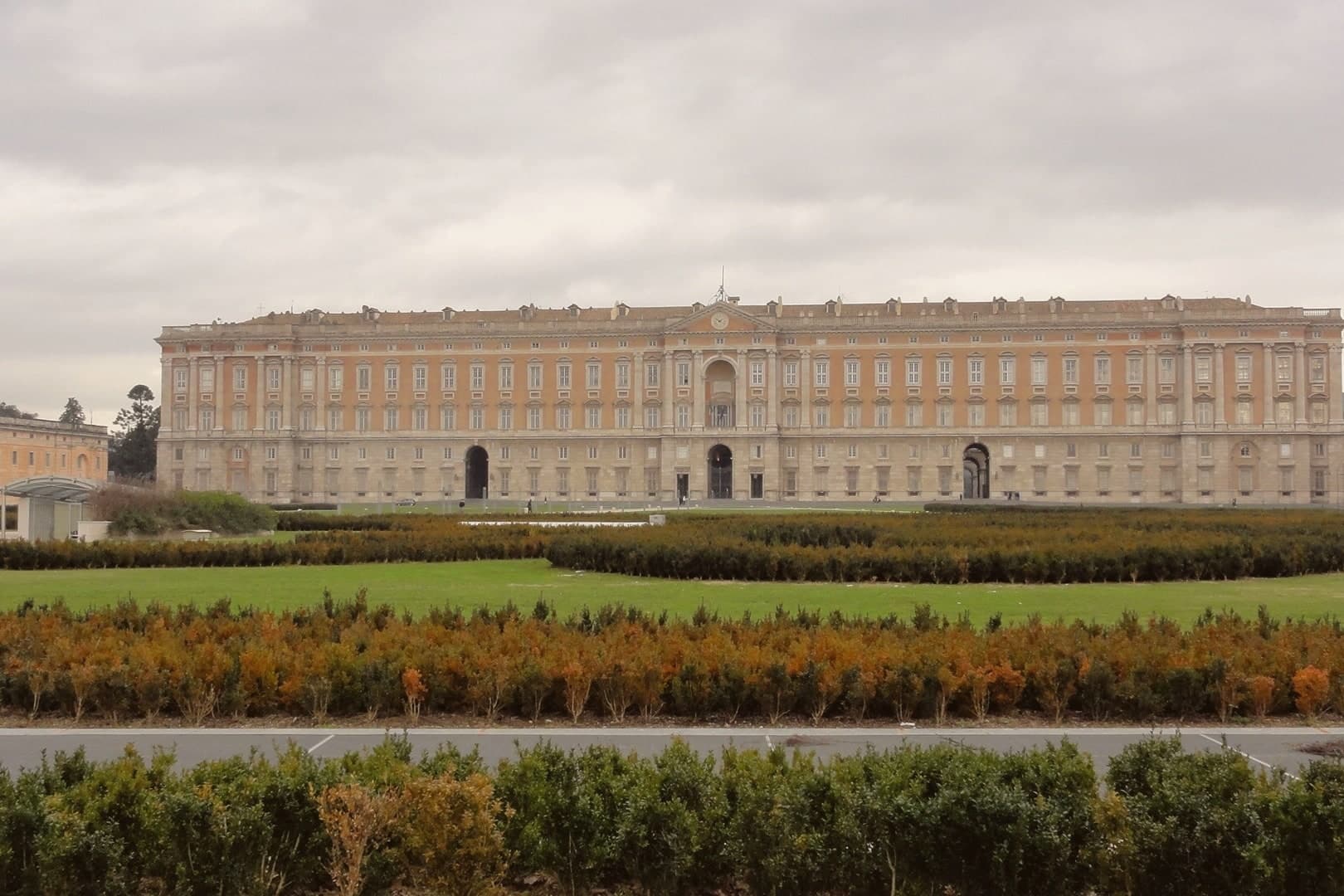
Caserta sits at 68 meters on the Campanian plain, 25 kilometers north of Naples at the foot of the Tifatini hills. The city exists because Charles III of Bourbon decided in 1750 to build a palace that would rival Versailles and the Royal Palace of Madrid, far enough inland to be safe from naval bombardment.
Luigi Vanvitelli laid the first stone in 1752: five floors, 1,200 rooms, 1,742 windows, 34 staircases. The gardens stretch three kilometers from the back façade to a cascade fed by the Carolino Aqueduct, also Vanvitelli's design.
The complex was listed by UNESCO in 1997 together with the silk village of San Leucio, the utopian industrial colony Ferdinand IV built on a hill four kilometers away. Up the road, Casertavecchia, the medieval village abandoned when the Bourbons moved everyone down to the plain, keeps its 12th-century Romanesque cathedral at 401 meters.
The modern city below is a working provincial capital, not a tourist town.
Le Colonne, Sunrise Restaurant, Antica Locanda and 2 more have been named by a guide.
What to see in Caserta
- Reggia di Caserta. Bourbon royal palace begun in 1752 by Luigi Vanvitelli, five floors, 1,200 rooms, UNESCO-listed since 1997 with the park and the Carolino Aqueduct.
- Parco Reale e Giardino Inglese. Three-kilometer formal park ending in a cascade, with an English Garden added by Maria Carolina in 1786, the first of its kind in Italy.
- Casertavecchia. Medieval hilltop village at 401 meters, 10 km from the city, abandoned when the Bourbons relocated the population to the plain.
How to get to Caserta
There is a railway station in the town, so you can arrive without a car and never need one while you are here. Napoli is roughly 38 minutes away by road.
Our tip
April through June and September through October are the comfortable months on the plain. The Reggia gardens are at their best in May, when the parterres bloom and the cascade runs full. July and August push into the high thirties; Vanvitelli's three-kilometer walk from palace to cascade becomes a heat exposure rather than a pleasure, though the shuttle bus runs. Sagra della Mulignana Imbuttunata falls in September.
Pozzuoli
Why visit Pozzuoli
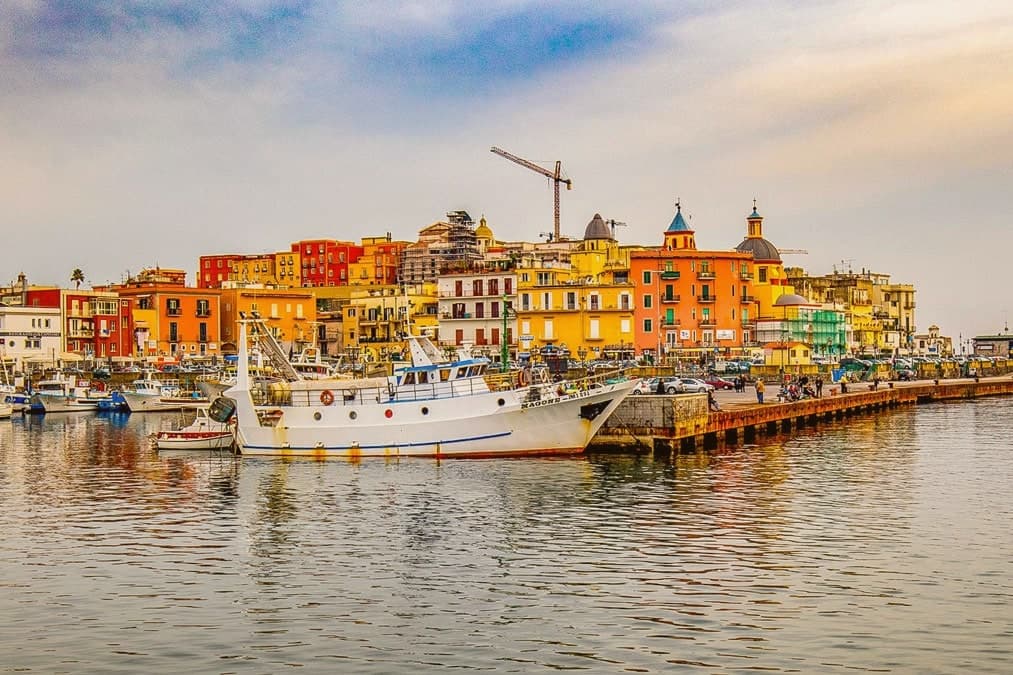
Pozzuoli sits at twenty-eight meters on the rim of the Campi Flegrei caldera, fifteen kilometers west of Napoli. Greek refugees from Samos founded the city in 531 BC as Dicearchia; Rome took it in 195 BC and renamed it Puteoli, a name the port kept through its centuries as Rome's busiest gateway by sea.
The old town and the working town are not the same ground. Rione Terra, the headland acropolis, was the city center for both the Greek and Roman settlements before it was evacuated in 1970 and reopened only piece by piece since.
The rest of Pozzuoli has grown around and below it, on a caldera that does not hold still: the crater above town still vents sulfur, and the crust beneath the whole area continues its slow rise and fall, watched closely enough that the alert level was raised again in 2023. A port city built its wealth on ground that was always going to move under it, and the town's oldest quarter has spent the last half century learning to live with that fact rather than escape it.
Abraxas, La Fattoria del Campiglione, Punto Nave and 1 more have been named by a guide.
What to see in Pozzuoli
- Anfiteatro Flavio. The cage chambers and lift machinery beneath the arena floor survive largely intact, giving a rare view of how the underground works of a Roman amphitheater actually functioned.
- Macellum (Tempio di Serapide). A market building long misread as a temple to Serapis. The three marked columns still stand at the center of the floor, close enough to touch.
- Rione Terra. The headland acropolis and original old town, evacuated in 1970 after a bradyseismic crisis and reopened only in stages since.
How to get to Pozzuoli
There is a railway station in the town, so you can arrive without a car and never need one while you are here. Napoli is roughly 25 minutes away by road.
Our tip
May through September is the working season for Pozzuoli, with June and September the easiest months. Sea temperatures rise into the mid-twenties, and the open-air sites stay accessible without afternoon heat closures. July and August are hot and crowded; the Anfiteatro and Macellum work best in the first morning slots.
More from Anywhere Italy
- The best towns you can reach by train within 45 minutes of Naples
 The best towns with a serious restaurant that eat well within 90 minutes of Napoli
 The 9 best towns you can reach by train in the province of Napoli
- The best towns inside a nature park that eat well in the province of Napoli
 The best towns with a serious restaurant that you can reach by train in Campania
 The best towns with a World Heritage site within an hour of Naples