
The best cheese towns within two hours of Perugia
Cheese in central Italy is a product of grass and altitude. On the high pastures of the Valnerina and the Monti Sibillini the flocks graze thin, herb-heavy turf, and the pecorino that comes off it is sharp, dry and faintly bitter in the finish. Down towards Lake Bolsena the volcanic soil gives sweeter milk and softer rounds, aged in cellars cut straight into tufa, the same stone the houses are built from. Spring, after the lambing, is when the fresh ricotta appears; autumn is when the aged wheels come out of the cellars and onto the tables alongside chestnuts and new oil.
Most visitors to Umbria eat their cheese in Perugia, on a board in the shadow of the Fontana Maggiore, or on a day trip out to Assisi where the coach parks fill by mid-morning and the shops along Via San Francesco stack identical tins of truffle cream. It is pleasant enough, and the cheese is often good, because the region's is. But the shops are retail, not production, and the queue moves past them all summer.
The production zones do not stop at the edge of the famous towns. They run south into the Valnerina, east over the passes towards Le Marche, and west across the Tiber into the tufa country above Lake Bolsena, and that is where the towns in this list are: smaller places, fewer people, with the dairy, the norcineria and the Saturday market within a few streets of each other. Each one sits inside the production zone of a protected cheese. Several are worth a detour on their own terms, cheese aside.
Of the 128 communes we have mapped in a 120-minute drive of Perugia, 9 qualify as cheese towns: each sits inside the production zone of a protected cheese. The smallest, Monteleone di Spoleto, has 555 residents.
Elsewhere in the catalogue: The best hidden towns on a walking route in the province of Perugia and The 6 best mountain towns within 90 minutes of Terni.
Monteleone di Spoleto
Why visit Monteleone di Spoleto
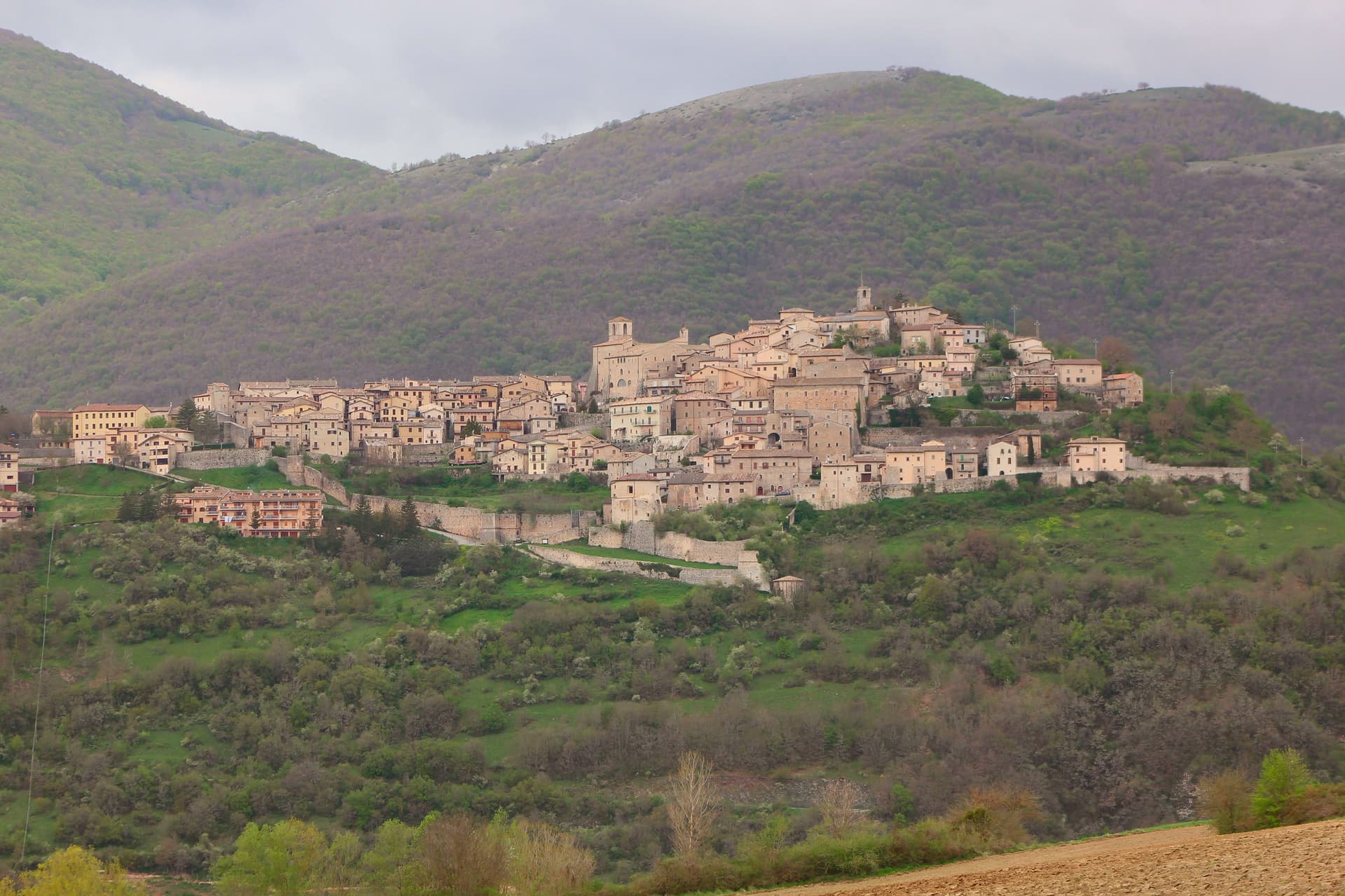
Monteleone sits at 978m on a hilltop in the upper Nera valley, the upper extension of the Valnerina, at the point where Umbria, Lazio and Marche converge. A castle anchors the summit and gives the borgo its defining silhouette, much-rebuilt over the centuries and again after the 2016 earthquake.
Below it sit the Chiesa and Convento di San Francesco, and the whole village is compact enough that the fortress organizes the view from almost anywhere within it. The find that put the town on archaeological maps happened by accident: a local farmer ploughing a field at the Colle del Capitano turned up an Etruscan bronze parade chariot in 1902, a complete biga from the 6th century BC.
His family sold it to French dealers for the equivalent of 950 lire, and it reached the Metropolitan Museum of Art in New York in 1903, where it is now displayed in Gallery 170 as the most complete pre-Roman parade chariot known to survive, its bronze panels depicting Achilles' birth, his combat with Memnon, and his apotheosis. Monteleone has pursued repatriation since 1990 through multiple legal proceedings, none successful, and the Met's title is now considered settled.
The village opened a museum in 2002 holding a full-scale replica alongside the original context of the find, and the town is also a marked stop on a 350-km pilgrim walk running from Norcia, Benedict's birthplace, through Monteleone to Subiaco and Montecassino, with pilgrim accommodation available locally. The 2016 Norcia and Cascia earthquake damaged several buildings in town; the castle and the Franciscan church have been restored, though reconstruction continues elsewhere.
Beyond the village, the Sibillini Mountains National Park lies to the east, the Cascia-Norcia route linking Benedict's and Rita's home towns runs to the north, and Lago di Piediluco is 30 km south. The food follows the Valnerina pattern: strangozzi with truffle, lentils from Castelluccio di Norcia, prosciutto and other Norcineria meats, pecorino, and Sagrantino di Montefalco from 60 km west.
Depopulation has been steep, from 1,800 residents in 1951 to 555 today, which leaves a village built for a much larger population now organized around a fortress, a church and a museum that all outsize the number of people currently living among them.
What to see in Monteleone di Spoleto
- Museo della Civiltà del Carro (replica chariot). Full-scale replica of the Monteleone Chariot, with the context of the 1902 find laid out around it. The panels on the original show Achilles' birth, his combat with Memnon, and his apotheosis. The museum also documents the village's repatriation campaign, active since 1990 and unsuccessful in every legal proceeding brought so far.
- Rocca dei Brancaleoni. The castle anchors the high point of the borgo, its rebuilt walls now standing again after 2016 earthquake repairs. From the top, the view runs across the whole upper Nera valley.
- Chiesa di San Francesco (Renaissance ceiling). 13th-century Franciscan church with later restorations and a carved wooden ceiling added in the 16th century. Also repaired after 2016 earthquake damage.
How to get to Monteleone di Spoleto
Terni is roughly 59 minutes away by road.
Our tip
Monteleone di Spoleto is mountain-seasonal — May through September is the high season. June-July brings the Cammino di San Benedetto pilgrim flow. Castelluccio di Norcia lentil bloom (late June-early July, 20 km east, the famous fiorita) is a major regional draw.
Preci
Why visit Preci
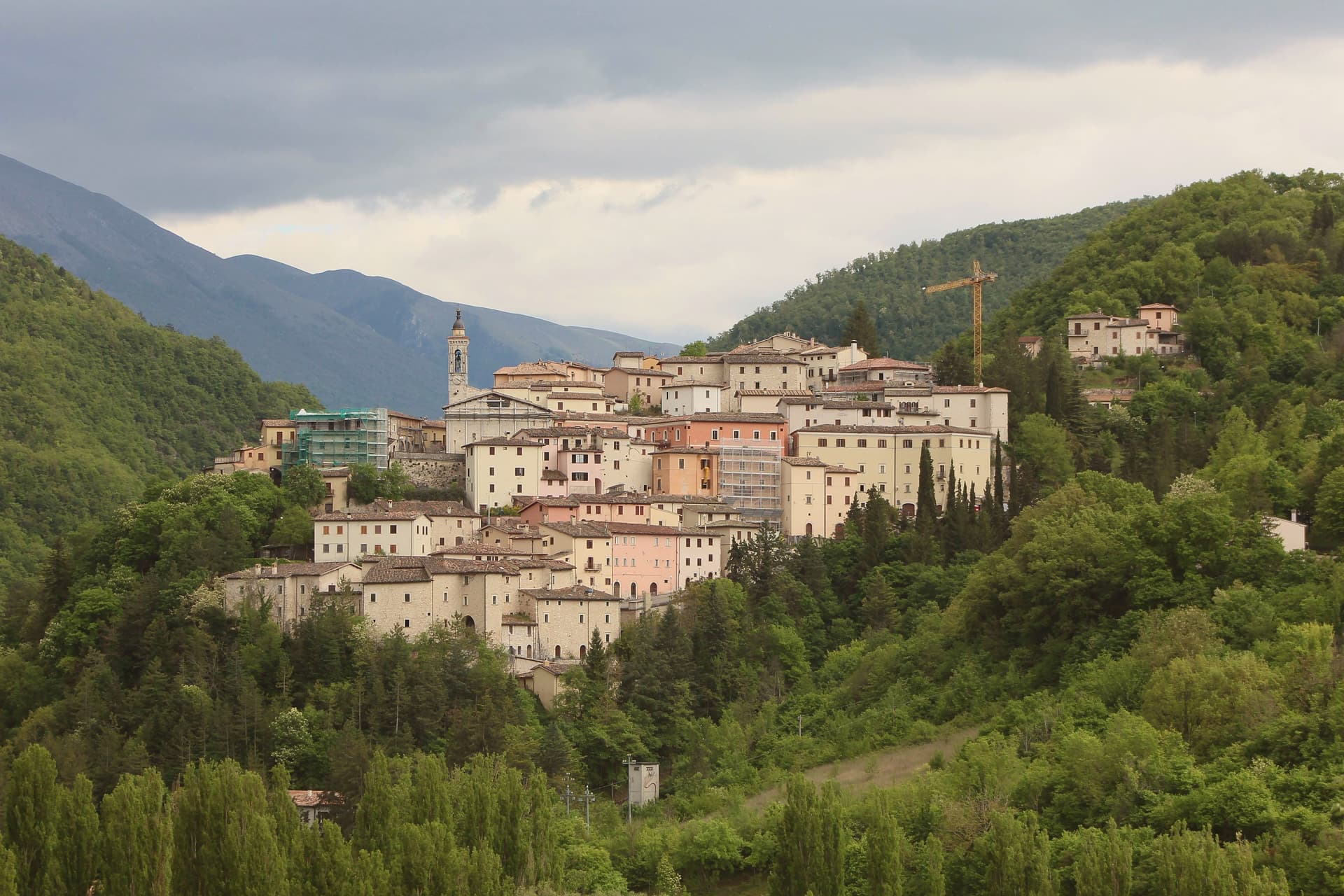
Preci sits at 596 meters in the Castoriana valley, inside the Monti Sibillini National Park and within driving distance of both Spoleto and Norcia. The walled borgo is crossed by the Campiano river and surrounded by mountain pasture.
The Abbazia di Sant'Eutizio, just outside the walls, is one of the oldest monasteries in Italy, founded by Syrian Benedictine monks in the fifth century. Their accumulated medical knowledge gave rise to the Preci school of surgery, which from the thirteenth to the eighteenth century supplied surgeons to royal courts across Europe; the local specialists worked in extraction of kidney stones, cataract surgery and hernia repair.
Noble palaces of the surgeon families still line the centro storico. The town was nearly destroyed by the 30 October 2016 earthquake, magnitude 6.5, which heavily damaged Sant'Eutizio; reconstruction is still in progress.
The Borghi più belli, Cittaslow and Parco Nazionale recognitions were retained through the rebuild.
Guaita Sant'Eutizio have been named by a guide.
What to see in Preci
- Abbazia di Sant'Eutizio. Benedictine monastery of 5th-century foundation, considered a place of origin for the Benedictine Order, heavily damaged in 2016 and under reconstruction.
- Centro storico fortificato. Walled medieval borgo on a hillside in the Castoriana valley, with noble palaces of the 16th-18th centuries built by the surgeon families.
- Museo della Scuola Chirurgica. Surgical school museum inside the Sant'Eutizio complex documenting the work of Preci surgeons from the 13th to 18th centuries.
How to get to Preci
Terni is roughly 90 minutes away by road.
Our tip
May through October is the working season at this elevation in the Valnerina. The Sibillini trails open in late spring and the Castoriana valley stays green through October. July and August are the months for the high trails to Piano Grande and Monte Vettore; the borgo itself stays cool in the upper twenties.
Allerona
Why visit Allerona
Allerona sits at 472 meters on a ridge between the Paglia valley and the Valdichiana, fifty kilometers southwest of Perugia and twenty north of Orvieto. The site was a Roman waystation called vicus Lerona, crossed by the Via Cassia and the Via Traiana Nova between Rome and Chiusi.
Paved sections and two milestones still surface in the surrounding fields. The medieval castle, built in 1275 by the Monaldeschi and Filippeschi families as Orvieto's northern bulwark, was destroyed at the end of the fifteenth century by Charles V and rebuilt afterward.
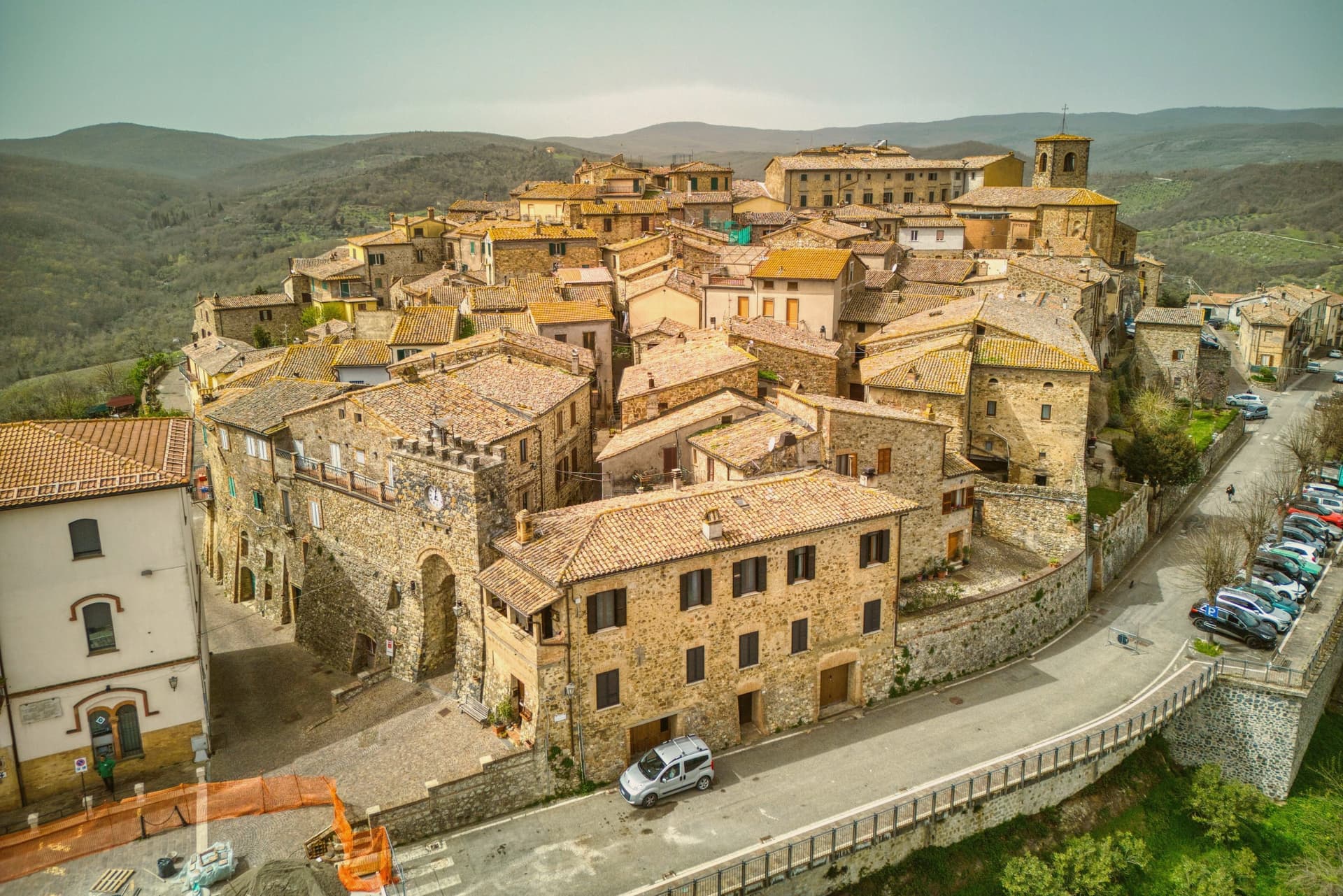
In 1595 the community freed itself from Orvieto and the Monaldeschi rule and wrote its own statutes. The centro storico keeps its original urban fabric: stone houses without plaster, two surviving gates called Porta del Sole and Porta della Luna, and a small grid of lanes that has not changed shape in five hundred years.
What to see in Allerona
- Chiesa di Santa Maria Assunta. Twelfth-century Romanesque church on the central square, renovated in neo-Gothic style 1892-1897 with terracotta pulpit and Viligiardi fresco cycle.
- Chiesa di San Michele Arcangelo. Twelfth-century church, the second pole of the medieval religious layout alongside Santa Maria Assunta.
- Borgo medievale. Unplastered stone houses, two surviving gates Porta del Sole and Porta della Luna, fragments of the 1275 Monaldeschi walls.
How to get to Allerona
Terni is roughly 75 minutes away by road.
Our tip
April through June brings the Paglia valley green and evenings cool enough to walk the ridge after dinner. September and October are the gold months. July and August reach into the mid-thirties in the lower valleys; the ridge at 472 meters stays a few degrees cooler, but the unplastered stone holds heat into the night and the centro storico empties between two and six.
Sant'Agata Feltria
Why visit Sant'Agata Feltria
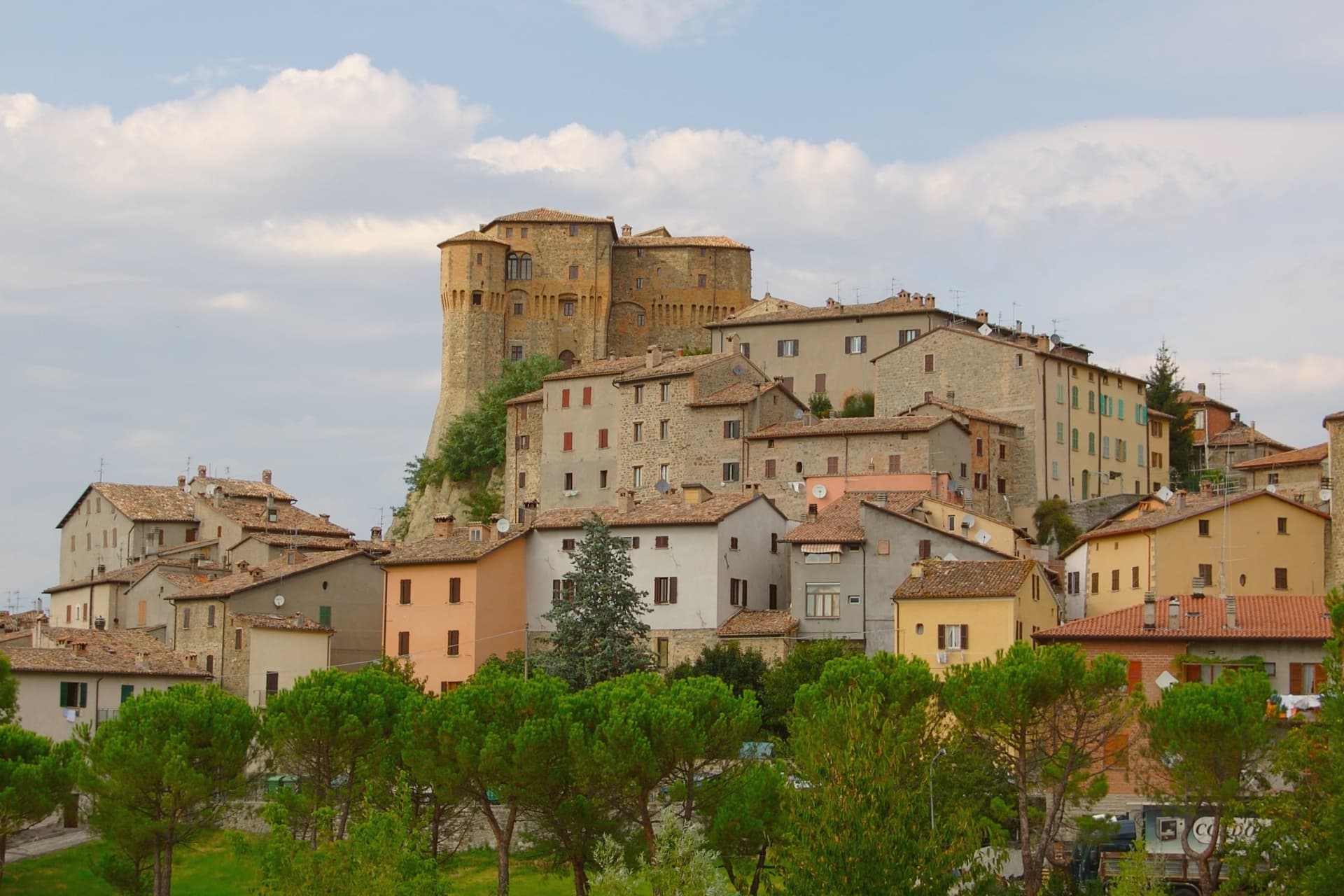
Sant'Agata Feltria sits at 607 meters in the upper Valmarecchia, in the historic Montefeltro region eighty-five kilometers north of Perugia and twenty inland from the Adriatic. The outcrop behind the centro carries overhanging walls on three quarters of its perimeter and a thirty-meter drop from summit to base, and its fortress is tenth-century in origin, rebuilt in the fifteenth century for the Fregoso family of Genoa, who gave it their name and held it until the seventeenth century.
Before them the town belonged in turn to the Malatesta of Rimini and the Montefeltro of Urbino, each leaving their mark on a settlement whose stone houses cluster below the fortress along the main street, past the convent of San Girolamo. Inside the borgo, the theater opened in 1605 is one of the oldest still-active theaters in Italy.
Every Sunday in October the centro hosts the white truffle fair, running since 1985, the reason the town carries the Città del Tartufo designation. A hill town this small, held by three ruling families and still staging theater in a four-century-old hall, has kept more of its layered past standing than its size would suggest.
What to see in Sant'Agata Feltria
- Rocca Fregoso. Sandstone fortress on the Sasso del Lupo, rebuilt by Francesco di Giorgio Martini in 1474, with overhanging walls on three sides and a thirty-meter drop.
- Teatro Angelo Mariani. Wooden theater opened in 1605 inside the medieval Palazzo Comunale, one of the oldest active theaters in Italy, named for the conductor born here in 1821.
- Chiesa Collegiata. Sixteenth-century collegiate church with a Baroque interior, housing relics of Sant'Agata and the venerated wooden image known as the Madonna del Soccorso.
How to get to Sant'Agata Feltria
Rimini is roughly 57 minutes away by road.
Our tip
April through June brings green hills and clear views over the Valmarecchia toward the San Marino ridge. July and August touch thirty-two degrees and the borgo empties between two and five, though evenings at six hundred meters cool quickly. September brings the porcini and the run-up to the truffle fair; the four Sundays in October are the busiest weekends of the year, with the centro full of stalls and trucks from the surrounding farms.
Cascia
Why visit Cascia
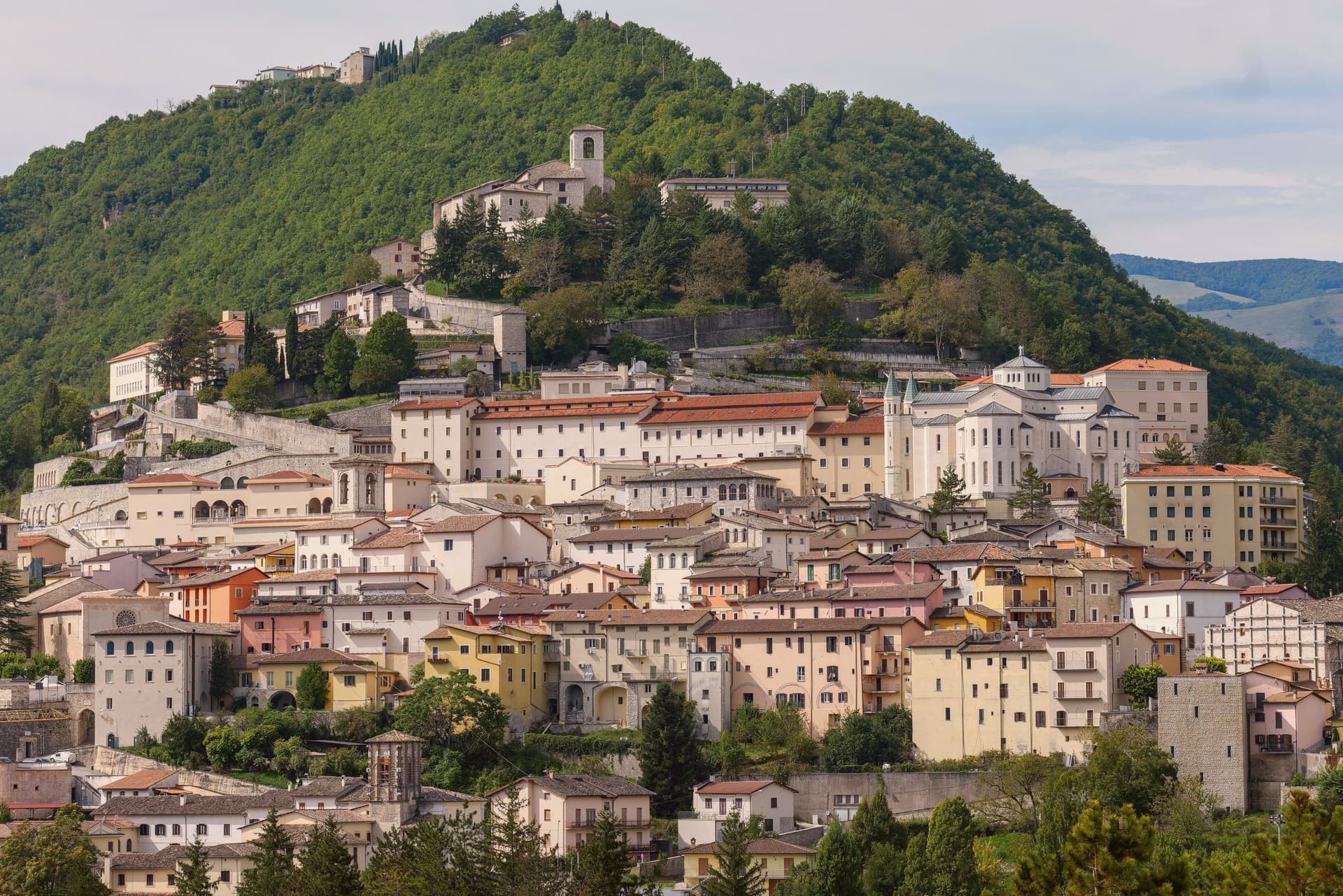
Cascia sits at 653 meters in the mountainous southeastern corner of Umbria, a remote pocket of the upper Valnerina near the Marche and Lazio borders. The commune carries the highest seismic activity in the region together with Norcia twelve kilometers away, and a long history of destructive earthquakes that culminated in the August 2016 sequence.
The town is built around Rita Lotti, who died in the Augustinian monastery here in 1457 and was canonized as Santa Rita in 1900. The Basilica di Santa Rita, built 1937-1947 in white Tivoli travertine on the site of the older church, draws pilgrims year-round and turns Cascia into a town that runs on faith and on truffle.
The Cammino di San Benedetto passes through, linking Norcia to Subiaco and Montecassino. Visitors not pilgrims tend to come for the black truffle, the lentils of nearby Castelluccio, and the silence of the high pastures above town.
What to see in Cascia
- Basilica di Santa Rita. Built 1937-1947 in white Tivoli travertine, Greek-cross plan, frescoes by Montanarini, Filocamo, Consadori, Ceracchini and Vicenzi.
- Monastero di Santa Rita. Augustinian monastery where Rita Lotti lived and died in 1457, attached to the basilica and still active as a religious community.
- Chiesa di San Francesco. Medieval Franciscan church in the lower centro storico, fourteenth and fifteenth-century frescoes inside.
How to get to Cascia
Terni is roughly 74 minutes away by road.
Our tip
May through October is the open season at 653 meters. The basilica is busiest around the May 22 feast of Santa Rita, when pilgrims fill the upper town and accommodation books out months ahead. June through September brings mild days and cool nights, the high pastures green, the truffle hunters working the woods above town.
Bolsena
Why visit Bolsena
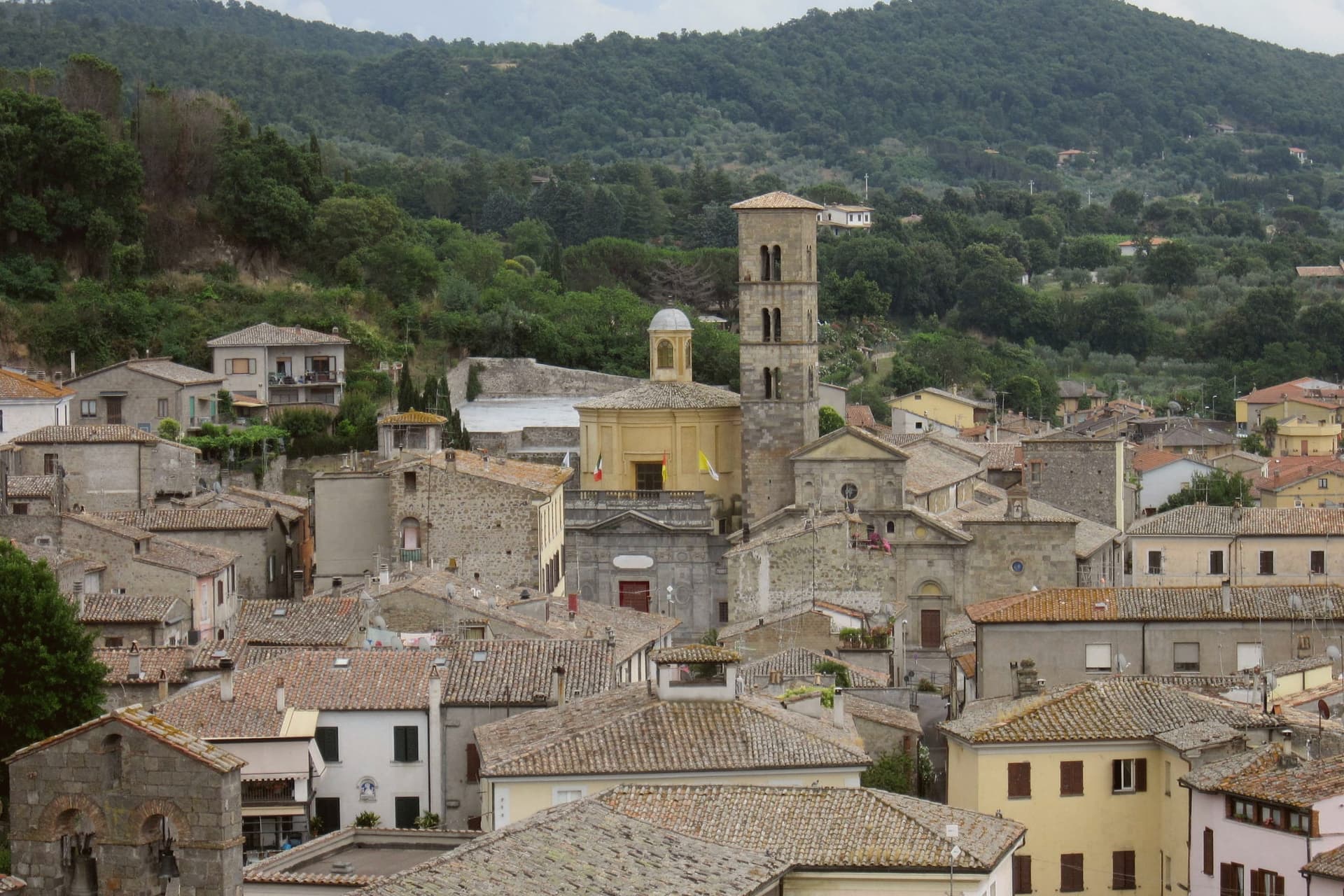
Bolsena stands at 350 meters on the eastern shore of Lake Bolsena, the largest volcanic lake in Europe at 114 square kilometers. The site sits on the old Etruscan town of Volsinii, razed by the Romans in 265 BC; the survivors were resettled here as Volsinii Novi.
In 1263 a Bohemian priest, doubting the doctrine of transubstantiation, was celebrating mass in the church when the host bled onto the corporal. The cloth was carried to Urbino, then to Orvieto, and Pope Urban IV extended the feast of Corpus Domini to the universal Church the following year.
The Basilica di Santa Cristina, where the miracle is said to have occurred, holds the original altar stone and an early Christian catacomb. The Rocca Monaldeschi della Cervara, a fourteenth-century fortress of the Orvietan family, dominates the upper town and houses the Museo Territoriale del Lago di Bolsena.
On Corpus Domini the streets fill with floral mosaics for the Infioritalia network.
What to see in Bolsena
- Basilica di Santa Cristina. Eleventh-century basilica with the altar stone of the 1263 Eucharistic miracle and an early Christian catacomb beneath the apse.
- Rocca Monaldeschi della Cervara. Fourteenth-century fortress of the Orvietan Monaldeschi, dominating the upper town and housing the Museo Territoriale.
- Lago di Bolsena. Largest volcanic lake in Europe at 114 square kilometers, with two small islands and a continuous swimming and fishing tradition.
How to get to Bolsena
Terni is roughly 81 minutes away by road.
Our tip
April through June and September into October are the months on the lake, when the water is clear, the chestnut woods on the volcanic slopes are full, and the swimming temperatures hold. The Infiorata for Corpus Domini, usually in late May or June, is the most photographed weekend. July and August push the basin into the low thirties; the lake stays cool enough to swim through the heat and the upper town keeps shade between the Rocca and Santa Cristina. Sagra delle Bontà falls in August.
Norcia
Why visit Norcia
Norcia sits at 604 meters on a high plateau on the Umbrian side of the Monti Sibillini, ancient Nursia of the Sabines, fortified in the 3rd century BC by Rome. Saints Benedict and his twin sister Scholastica were born here in 480; the Benedictine Order and the Ora et Labora motto that shaped Western monasticism began on this piazza.
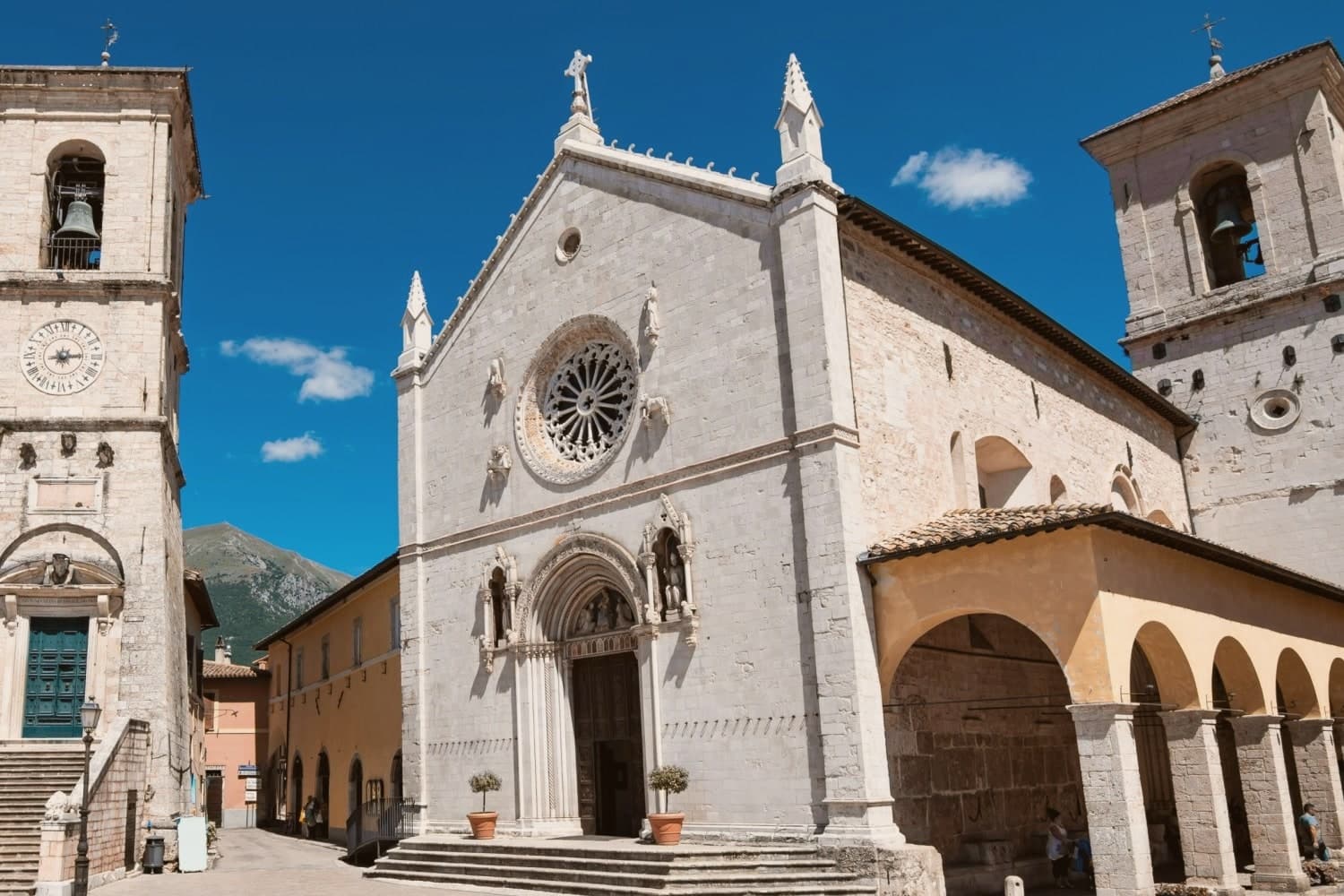
The Basilica di San Benedetto rises on the traditional birthplace, built between 1290 and 1338 over a pre-existing crypt. On 30 October 2016 a magnitude 6.5 earthquake destroyed the nave; only the façade was left standing.
Reconstruction completed on 30 October 2025, nine years to the day, with the original stones and earthquake-resistant technology. The town gave its name to norcineria, the Italian word for quality pork delicatessen, after centuries of Norcia butchers specializing in wild boar and pork.
Black truffle from the Valnerina, lentils from Castelluccio, and ricotta from the high pastures complete the table.
Vespasia, Granaro del Monte, Casale nel Parco have been named by a guide.
What to see in Norcia
- Basilica di San Benedetto. Built 1290-1338 over the traditional birthplace of Saints Benedict and Scholastica, rebuilt with original stones after 2016, reopened 30 October 2025.
- Castellina. Fortified papal stronghold designed by Jacopo Barozzi da Vignola in 1554, on Piazza San Benedetto, now the Museo Civico e Diocesano.
- Piazza San Benedetto. Civic and religious heart of the centro storico, with the Palazzo Comunale, the basilica, the Castellina and the statue of Benedict at the center.
How to get to Norcia
Terni is roughly 93 minutes away by road.
Our tip
April through June and September into October are the months for Norcia. The plateau holds its color, the lentil fields of Castelluccio bloom from mid-June into July, and the high pastures are open for hiking. July and August stay cooler than the Umbrian valleys at 604 meters, but the town fills with festival crowds for the Mostra Mercato del Tartufo Nero on the last weekend of February and again for sagras through the summer.
Acquapendente
Why visit Acquapendente
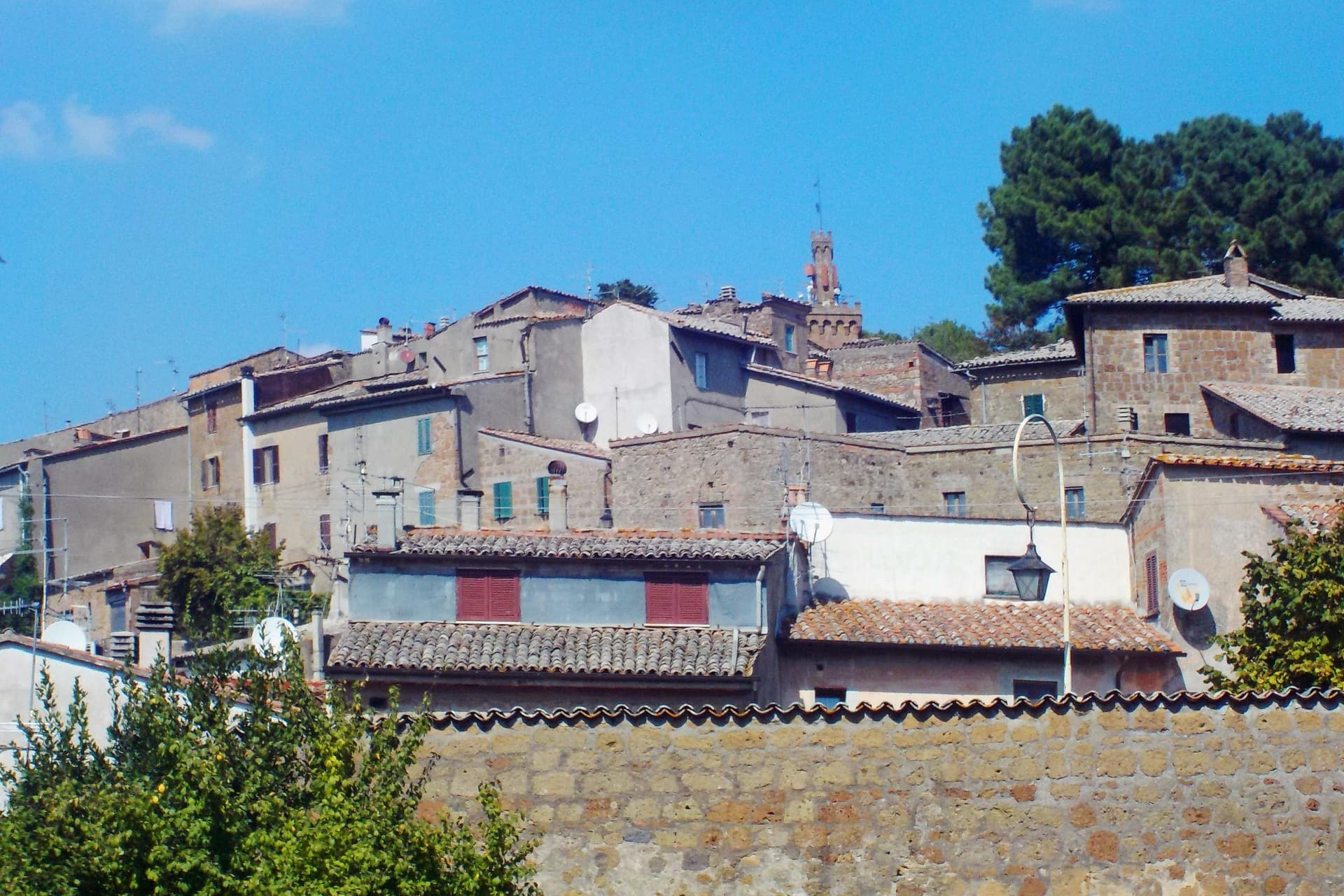
Acquapendente sits at the northern edge of Lazio, where the Paglia river marks the boundary with Tuscany. The name first appears in a document of Emperor Otto I dated 964, taken from the small waterfalls that drop the river toward the plain.
The town grew up along the pilgrim road that runs north to south through it, and the church at its center, with its Romanesque crypt and sacellum copying the tomb in Jerusalem, gave the settlement its old nickname, the Green Jerusalem. The built-up center holds the basilica and the streets that carry the floral mosaics each May, while outward from it the town's territory stretches to two very different edges: the frazione of Torre Alfina to the north, with its own restored castle and a listing among the country's most beautiful villages, and the forest of the Monte Rufeno reserve beyond that, nearly 3,000 hectares of oak and beech reached by marked trails.
A river border, a pilgrim route, and a nickname earned by a copied tomb: together they describe a town shaped less by what it produced than by what passed through it and what was built to receive those travelers.
La Parolina have been named by a guide.
What to see in Acquapendente
- Basilica Concattedrale del Santo Sepolcro. Twenty-four columns divide the crypt into nine naves. The sacellum sits carved into the rock at the center, a form pilgrims would have recognized as a copy of the tomb it names.
- Pugnaloni. Panels built from flower petals pressed into wooden frames, carried through the streets by each quarter of the town on the third Sunday of May.
- Castello di Torre Alfina. Neo-Gothic restored fortress in the frazione of Torre Alfina, itself listed among I Borghi più belli d'Italia.
How to get to Acquapendente
Terni is roughly 96 minutes away by road.
Our tip
April through June and September into October are the months for walking the Via Francigena and the trails of Monte Rufeno. The Pugnaloni festival fills the streets on the third Sunday of May and is the single best weekend in the calendar. July and August touch the mid-thirties in the Paglia valley; pilgrims start earlier and finish by mid-morning.
Montefiascone
Why visit Montefiascone
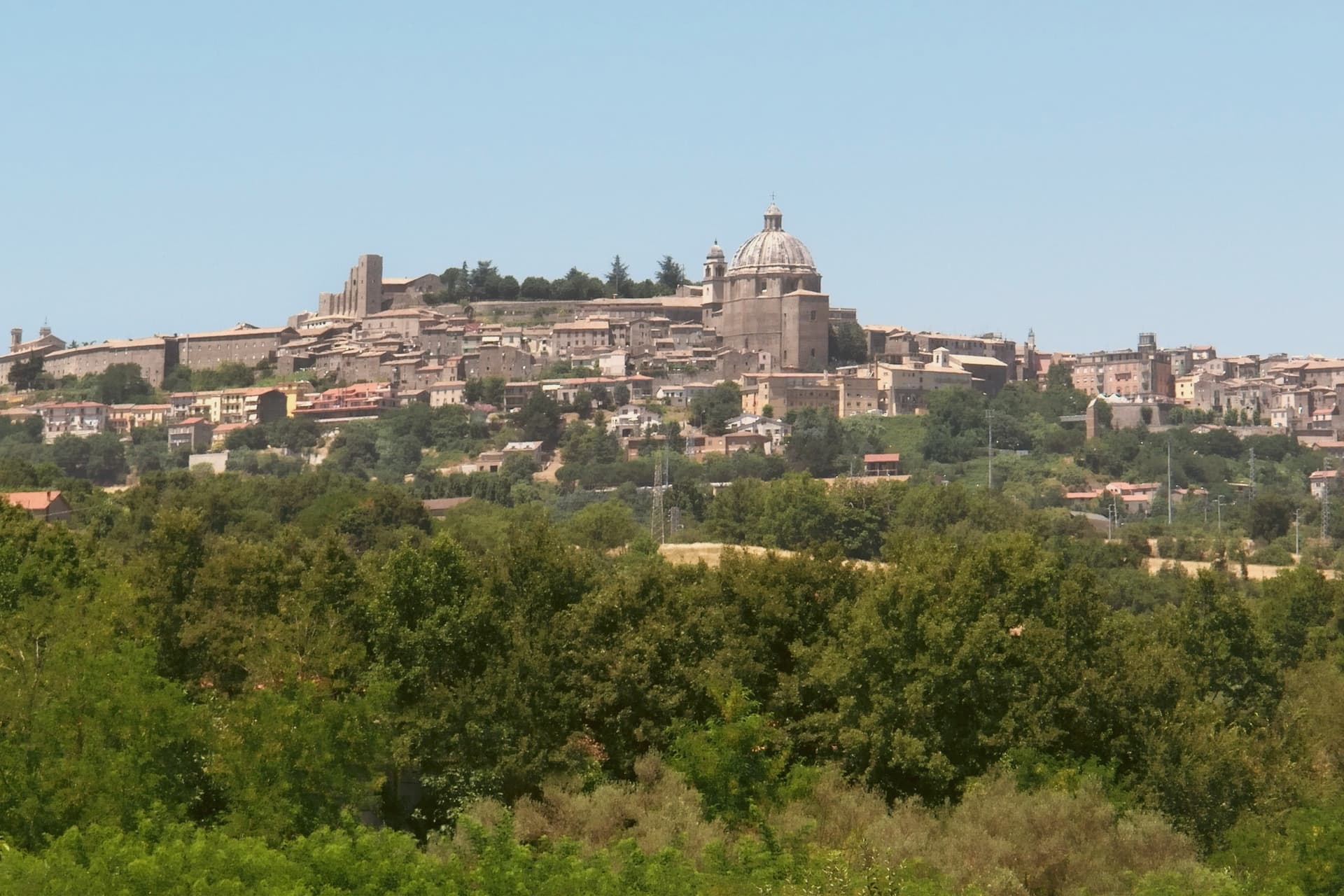
The town sits on the southeastern rim of a volcanic crater, about a hundred kilometers north of Rome, with the fortress at its highest point and the rest of the settlement built down the slope from there. The basilica stands just outside the walls at the lower end of that slope, separate enough from the fortress and the cathedral that the three read as three distinct centers of the town rather than one monument with satellites.
The wine takes its name from the same twelfth-century legend that put a German bishop's prelate on the road marking inn doors, and that bishop is the one buried in the basilica below, which ties the town's best-known export to a specific grave rather than to a floating story. The pilgrim route passes through on its way between Bolsena and Viterbo, so the hill that holds a papal summer residence and a wine legend was also, and still is, a stop on a much longer walk to Rome.
What the place adds up to is a small hill town where a fortress, a two-story church, and a road to somewhere else all sit within a short walk of one another, each one a different kind of stop on the same hill.
What to see in Montefiascone
- Rocca dei Papi. The fortress walls enclose the summit; the tower stair is narrow and gives out onto the panorama at once, the water filling the whole crater rim below.
- Basilica di San Flaviano. Two churches stacked on each other, the lower nave older and darker, the upper one built two centuries later and open to more light. The frescoes are original to the walls, not restored copies, and the German bishop Johannes Defuk is buried here.
- Cattedrale di Santa Margherita. The octagonal dome is 27 meters across, third largest in Italy by base diameter, finished in the late sixteenth century. It dominates the town's roofline the way the fortress dominates its summit.
How to get to Montefiascone
There is a railway station in the town, so you can arrive without a car and never need one while you are here. Terni is roughly 75 minutes away by road.
Our tip
April through June and September through October are the strong months. The hilltop position keeps Montefiascone cooler than Viterbo down the road, and the air over the lake is clearest in spring and autumn. July and August reach the low thirties; afternoons in the centro storico thin out between two and five. Fiera Del Vino falls in August.
More from Anywhere Italy
 The best hidden towns on a walking route in the province of Perugia
 The 6 best mountain towns within 90 minutes of Terni
- The best towns on a walking route in the province of Viterbo
 The 6 best hidden truffle towns in the province of Perugia
- The 6 best small towns that eat well in the province of Perugia
- The best towns that live slowly in the province of Perugia