The 9 best small towns to live in Liguria, by our own rules
Nine towns: what each is best for, what a home costs, and the catch. A square meter runs from €2,300 in Lavagna to €6,700 in Santa Margherita Ligure.
We've written about 1 of these 9. From the 1,000 towns picked by Peter Benei.
92 towns written about, 908 to go. Follow along, free: Subscribe on Substack
Where would you live in Liguria, if you wanted a town rather than a postcard? In our Where to Move in Italy series we wrote down our own rules: a town of 5,000 to 20,000 people, big enough to keep a life of its own and small enough to stay one community; a real city 30 minutes to an hour away by car, near enough for the hospital and the airport, far enough that the town is not its suburb; and, where we can, a station.
Of our 54 towns in Liguria, 9 pass every rule and have at least 7 of ten everyday services, from the grocer and the pharmacy to the doctor and the bar, within 500 meters of the center.
Every number comes from the town's own page. The drive is routed, not guessed. The services are OpenStreetMap's, read in November 2026, and the map misses things, so a shop it lacks is not proof there is none. None of it measures whether you will like the place: for that, go out of season, on a weekday.
Elsewhere in the catalogue: The 10 best small towns to live in Italy, by our own rules and The 9 best towns you can get around without steps in Liguria.
1. Andora
Best for olive oil. It belongs to the national association of olive oil towns.
1 h 23 min from Genoa · homes €2,900 to €4,800 a m² in the center · 7,239 people
Why visit Andora
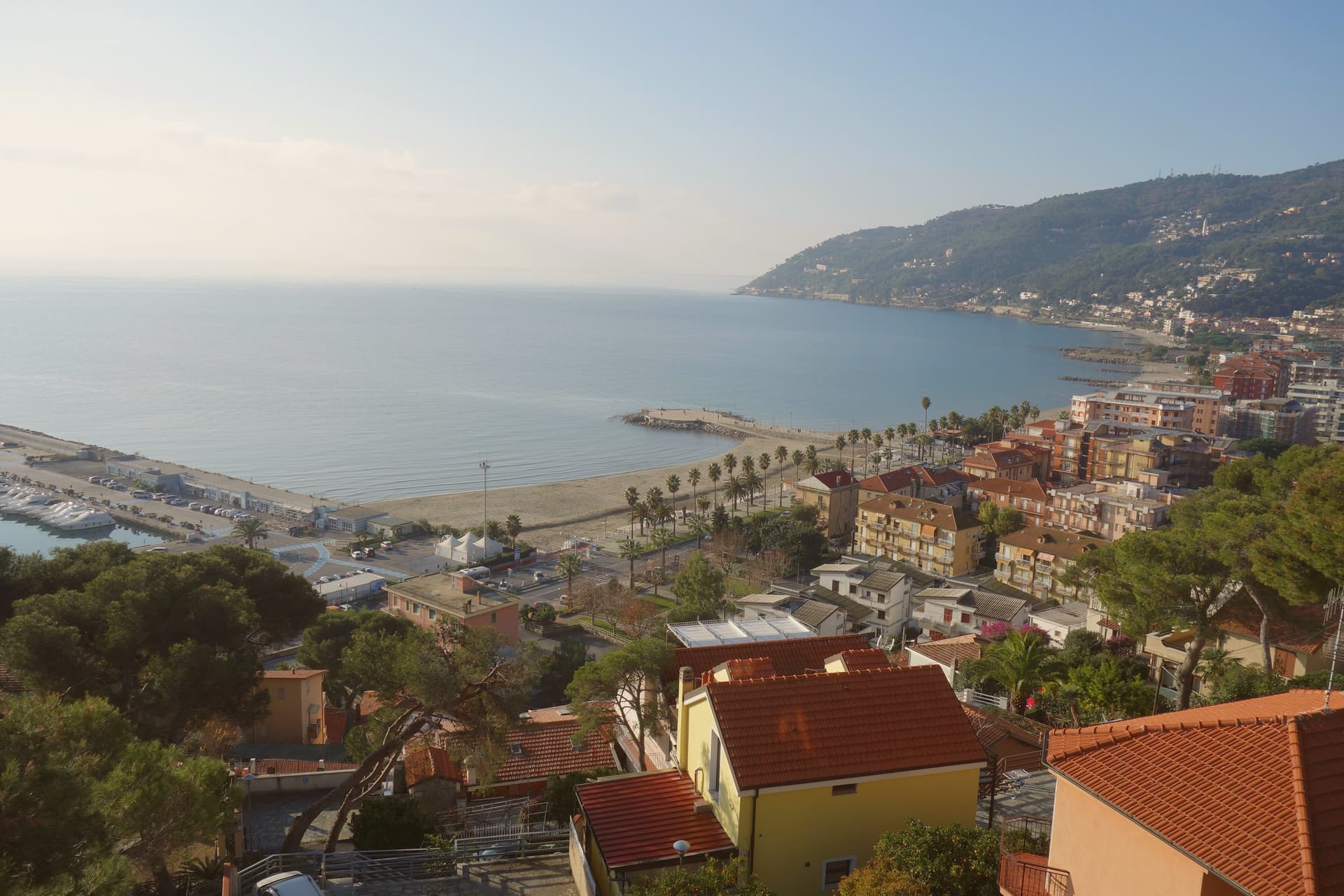
Andora sits on the Val Merula in the Riviera di Ponente, the westernmost coastal commune of the Province of Savona before crossing into Imperia. The original settlement was Borgata Castello, on the castle hill set back from the coast because Saracen raids made the shore unsafe.
The marquises of Clavesana made the castle, the Paraxo, their stronghold in the twelfth century, and beside it stands the late-thirteenth-century Romanesque-Gothic church of Saints Giacomo and Filippo, built like its bell tower in Capo Mele stone. Together they include one of the best-preserved Romanesque churches of the Riviera delle Palme.
The modern town moved to the Aurelia coast road after the raids stopped. Colla Micheri, the hilltop hamlet restored by Thor Heyerdahl of Kon-Tiki fame from the late 1950s, sits above the modern beachfront.
The Spighe Verdi recognition flags the green network running through the commune; the olive grove network covers the Val Merula slopes.
7,239 people, and Imperia is 31 min away by car, with a station in town. All ten everyday services we look for, from a grocer to a pharmacy, are on the map within 500 meters of the center.
What to see in Andora
- Castello dei Clavesana. Ruined castle known as the Paraxo, stronghold of the marquises of Clavesana from the twelfth century, the first nucleus of medieval Andora.
- Chiesa dei Santi Giacomo e Filippo. Late thirteenth-century Romanesque-Gothic church beside the castle in Borgata Castello, central polyphore and rose window in Capo Mele stone.
- Colla Micheri. Hilltop hamlet of old stone houses around the church of San Sebastiano, restored by Thor Heyerdahl from the late 1950s.
How to get to Andora
It has its own railway station. Genoa is about 1 h 23 min away by road. The full route from Genoa.
Our tip
April through June and September into October are the strongest months on Andora's coast. The olive groves come into harvest from late October into November. July and August fill the Aurelia beachfront and the Riviera dei Fiori traffic doubles.
2. Arenzano
Best for a walk through the old town. It is on the list of Italy's most beautiful villages.
31 min from Genoa · homes €2,400 to €4,100 a m² in the center · 11,156 people
Why visit Arenzano
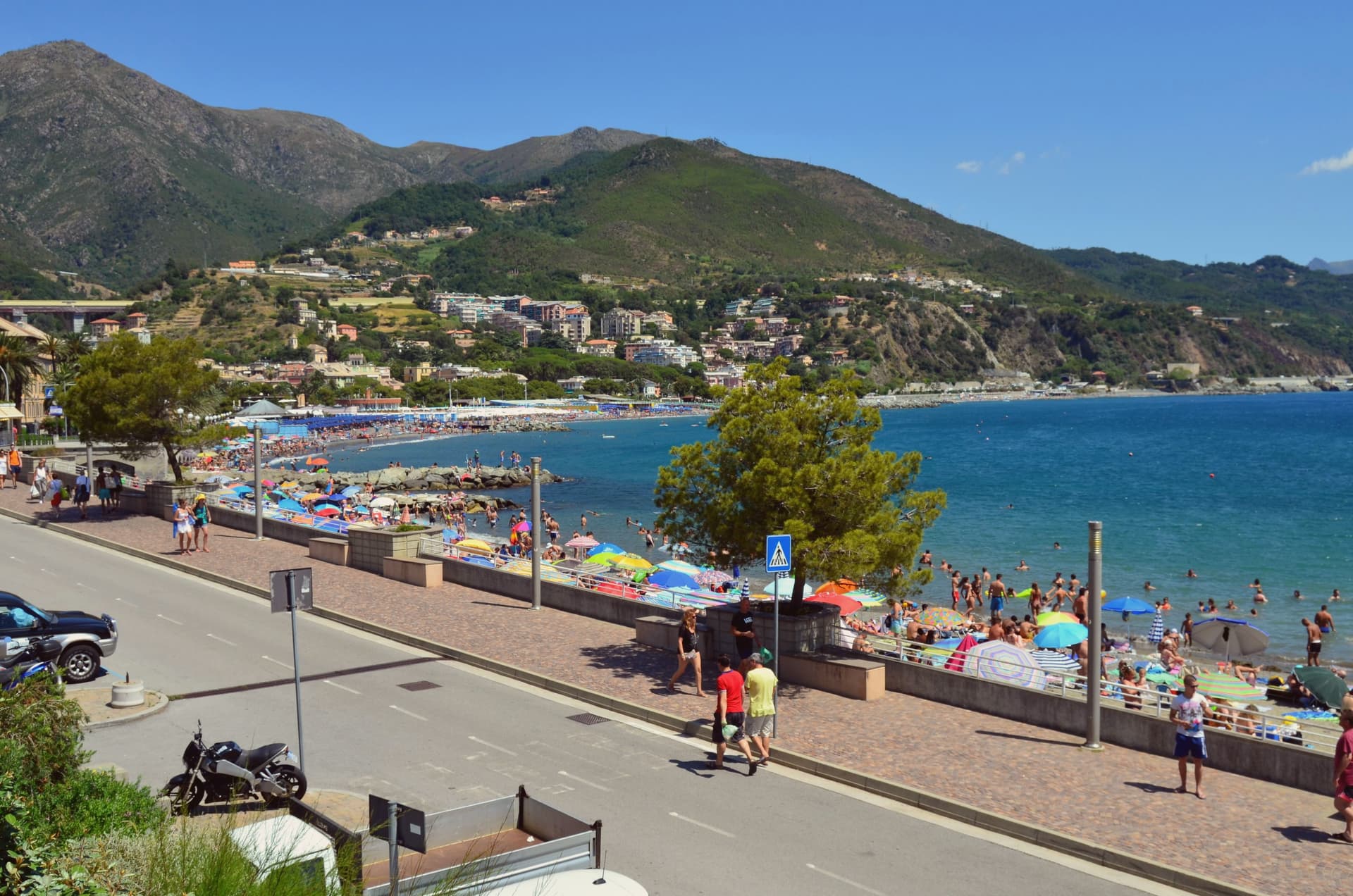
Arenzano sits in a bay at the foot of Capo San Martino on the Riviera di Ponente, twenty kilometers west of Genova. The name covers two different territories that share a boundary rather than a character: a strip of seafront and promenade at sea level, and behind it, rising fast, the two-thirds of the commune that belongs to the mountain park, climbing to peaks above a thousand meters within an hour of the shore.
The town itself gathers between the two, with the church and the villa a short walk apart near the water, and the trailhead sitting well above both, at 758 meters, as the point where the coastal town ends and the climb into the plateau begins. Arenzano reached the Borgo dei Borghi RAI final, which brought enough recognition to fill August weekends but not enough to make the rest of the year hard.
What holds the place together is that proximity: a pilgrimage site, a seat of government in a park, a sandy bay and an alpine plateau all sit within the same short walk of each other, so the town reads less as a single attraction than as a set of unrelated destinations that happen to share an address.
11,156 people, and Genoa is 31 min away by car, with a station in town. All ten everyday services we look for, from a grocer to a pharmacy, are on the map within 500 meters of the center.
What to see in Arenzano
- Santuario di Gesù Bambino di Praga. The sanctuary draws pilgrims year-round; the interior holds the statue of the Infant of Prague at the center of the devotion it gave the town.
- Villa Negrotto Cambiaso. The villa's park holds palm and cedar groves, a small aviary and a glasshouse, alongside the offices it now houses.
- Parco naturale regionale del Beigua. Monte Reixa rises to 1,183 meters within the park, reached by a network of trails that begin at sea level.
How to get to Arenzano
It has its own railway station. Genoa is about 31 min away by road. The full route from Genoa.
Our tip
April through June is the cleanest stretch for combining the Beigua trails with sea swimming, before the heat. July and August fill the bay with Genovesi day-trippers and weekend cars on the via Aurelia; the centro storico can be hard to park. September empties out and stays warm enough to swim into October.
3. Levanto
Best for walks in a national park. Part of the comune lies in a national park.
1 h 12 min from Genoa · homes €3,100 to €4,400 a m² in the center · 5,050 people
Why visit Levanto
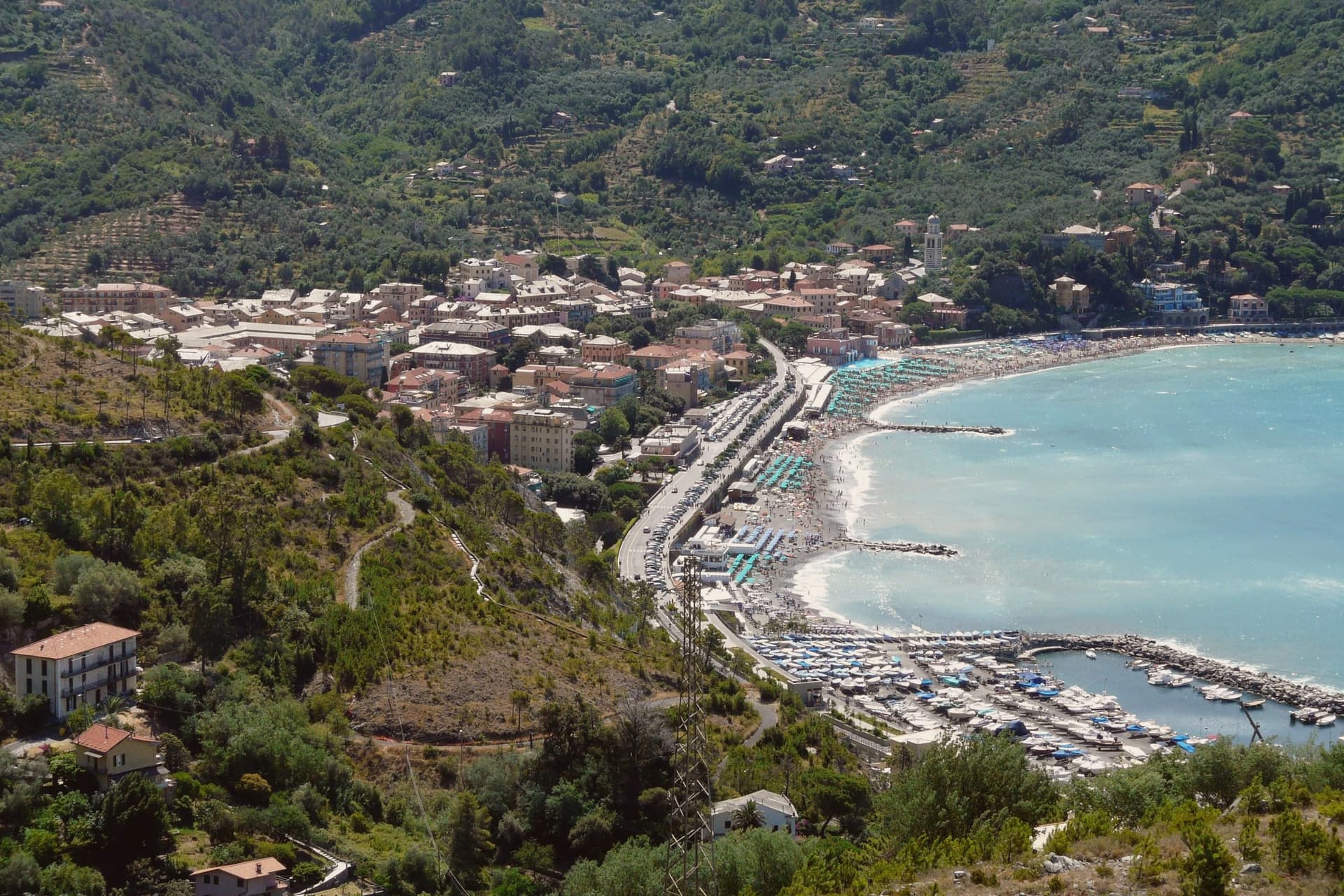
Levanto sits at sea level on the Ligurian coast, twenty kilometers northwest of La Spezia, on the western edge of the Cinque Terre National Park, which takes in part of its territory. The Cinque Terre Express train stops here every half hour on its way to the five villages, but Levanto has the things they do not: a long sand-and-gravel beach with Bandiera Blu status, a flat centro storico, and a surf break that local guides classify as one of the few big-wave spots in Italy.
The Chiesa di Sant'Andrea, built in 1222, fronts the old town with horizontal bands of white marble and dark green serpentine and a large rose window. Casa Restani, on Via Grillo, is a surviving medieval merchant house with the ground floor where goods from the harbor were stored.
Levanto holds Cittaslow, Bandiera Blu, Parco Nazionale, and Città dell'Olio at once.
5,050 people, and La Spezia is 43 min away by car, with a station in town. All ten everyday services we look for, from a grocer to a pharmacy, are on the map within 500 meters of the center.
What to see in Levanto
- Chiesa di Sant'Andrea. Parish church built in 1222 in Ligurian Gothic style, with horizontal bands of white marble and green serpentine and a large rose window over the main door.
- Castello di Levanto. Thirteenth-century defensive castle on the hillside, still intact but privately owned and closed to the public.
- Loggia Comunale. Thirteenth-century arcaded loggia on the main piazza, awarded a UNESCO title in 2007 as a monument of culture and peace.
How to get to Levanto
It has its own railway station. Genoa is about 1 h 12 min away by road. The full route from Genoa.
Our tip
April through June and September into October are the dry months. The sea warms enough for swimming by late May. The surf builds in autumn and winter when Atlantic systems push swell into the gulf.
4. Loano
Best for a long lunch. A food guide lists Bagatto here.
1 h 16 min from Genoa · homes €3,100 to €5,200 a m² in the center · 10,688 people
Why visit Loano
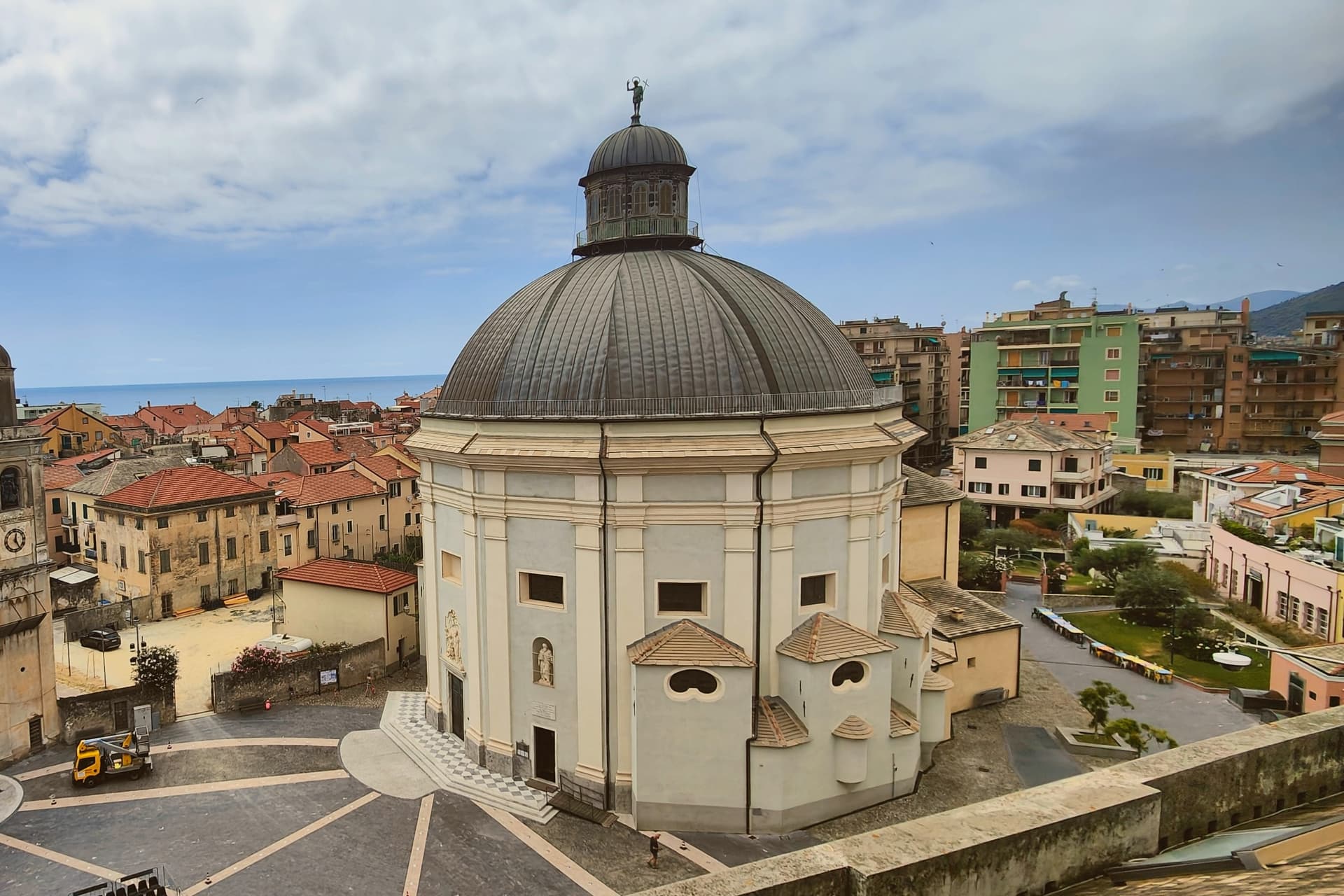
Loano lies sixty kilometers southwest of Genova, at the foot of the arc of mountains that shelters it from inland weather. The town was an imperial fief of the Doria family from the thirteenth century, and the family financed the major public buildings still in use today: the palace at the centro's heart, the loggia beside it where civic business was once conducted, and, indirectly, the church that stands nearer the harbor, built for the town's seafarers and still holding their votive offerings of brigantines and barques.
The old centro, with its palace, loggia and church, sits inland of the modern marina and the two kilometers of beach that run east from it. The mountain at Loano's back and the harbor at its front mark the two poles the town has always worked between: the Doria who governed from the hill and the sailors who prayed by the water.
10,688 people, and Savona is 50 min away by car, with a station in town. Nine of the ten everyday services we look for, from a grocer to a pharmacy, are on the map within 500 meters of the center.
The catch: Homes in the center cost up to €5,200 a m².
What to see in Loano
- Palazzo Doria. Considered one of the most representative civil Renaissance palaces in Liguria, its rooms now house the town's administrative offices, and the mosaic floor remains open to view on the main level.
- Chiesa di Sant'Agostino. Founded 1582 by Zenobia Del Carretto, rebuilt 1588-98; called the Madonnetta, the seafarers' church, with votive ship models inside.
- Marina di Loano. The Yachting Pages ranking sits alongside a working harbor east of the centro, with the beach running two kilometers of sand and gravel toward it.
How to get to Loano
It has its own railway station. Genoa is about 1 h 16 min away by road. The full route from Genoa.
Our tip
April through June and September into October are the strongest months on the Loano front, with the marina full of boats and the beach manageable. July and August are warm, often 28 to 31 degrees, and the population doubles with families on long stays from Milano and Torino. November through March is the calmest stretch but the town stays open because 10,700 residents keep daily services running; the Madonnetta opens for the seafarers' mass on 8 December.
5. Lavagna
Best for olive oil. It belongs to the national association of olive oil towns.
44 min from Genoa · homes €2,300 to €3,400 a m² in the center · 12,367 people
Why visit Lavagna
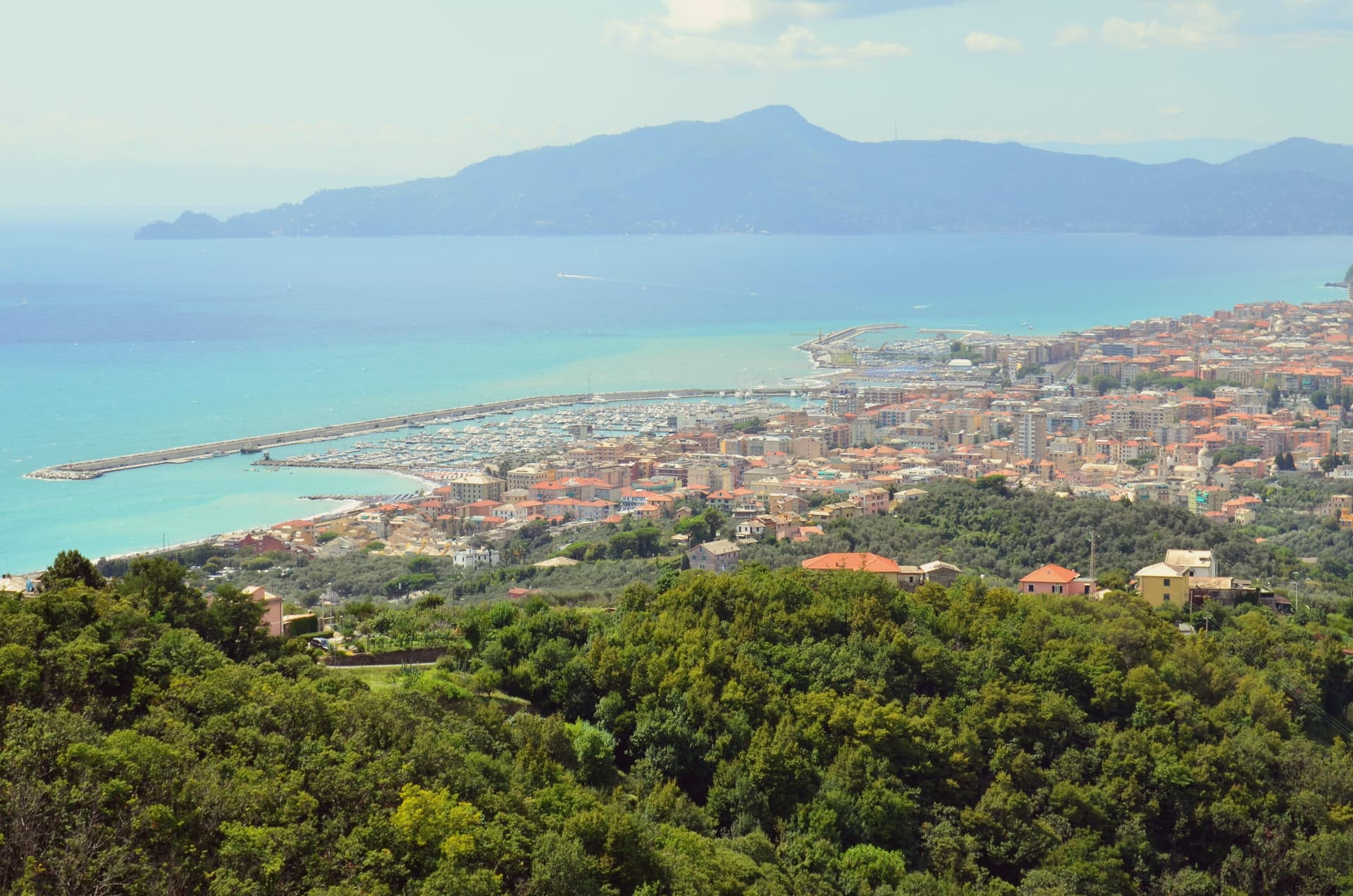
Lavagna sits at sea level on the eastern Tigullio, thirty-five kilometers southeast of Genova. The slate quarried from the San Giacomo mountains behind the town roofed the Genovese palazzi and lined the schoolrooms of half of Italy, which is why the Italian word for chalkboard is also lavagna.
Around the year 1000 the Counts of Lavagna held this territory, and the family that descended from them, the Fieschi, rose from it to produce two popes. The frazione of San Salvatore sits above the main town, holding the basilica that one of those popes ordered built in bands of white marble and slate.
Down at sea level, the old center folds around the staircase and square where, on 14 August, the town reenacts a thirteenth-century wedding with the Torta dei Fieschi, a giant cake carried out to the crowd. The beach holds Bandiera Blu at the opposite edge of town, near the port.
A town built on a stone that traveled far beyond it, and on a family that did the same.
12,367 people, and Genoa is 44 min away by car, with a station in town. Eight of the ten everyday services we look for, from a grocer to a pharmacy, are on the map within 500 meters of the center.
What to see in Lavagna
- Basilica di Santo Stefano. Parish church rebuilt over a sixth-century foundation, crowning the main square at the top of a wide staircase where the annual cake pageant begins its procession.
- Basilica di San Salvatore dei Fieschi. Thirteenth-century basilica in the frazione of San Salvatore, ordered by Pope Innocent IV in 1244, façade in alternating bands of white marble and local slate.
- Spiaggia di Lavagna. Long Bandiera Blu beach on the Tigullio, with one of the largest tourist ports in northern Italy at the western end.
How to get to Lavagna
It has its own railway station. Genoa is about 44 min away by road. The full route from Genoa.
Our tip
April through June and September into October are the dry months on the Tigullio. The beach water warms enough for swimming by late May. The 14 August Torta dei Fieschi is the central event of the summer: period costumes, procession from the Basilica di San Salvatore down to Piazza Marconi, and a giant cake distributed to anyone who matches a paired ticket.
6. Pietra Ligure
Best for everyday life on foot. Eight of the ten everyday services we look for are mapped within 500 meters of the center.
1 h 7 min from Genoa · homes €3,100 to €4,800 a m² in the center · 8,230 people
Why visit Pietra Ligure
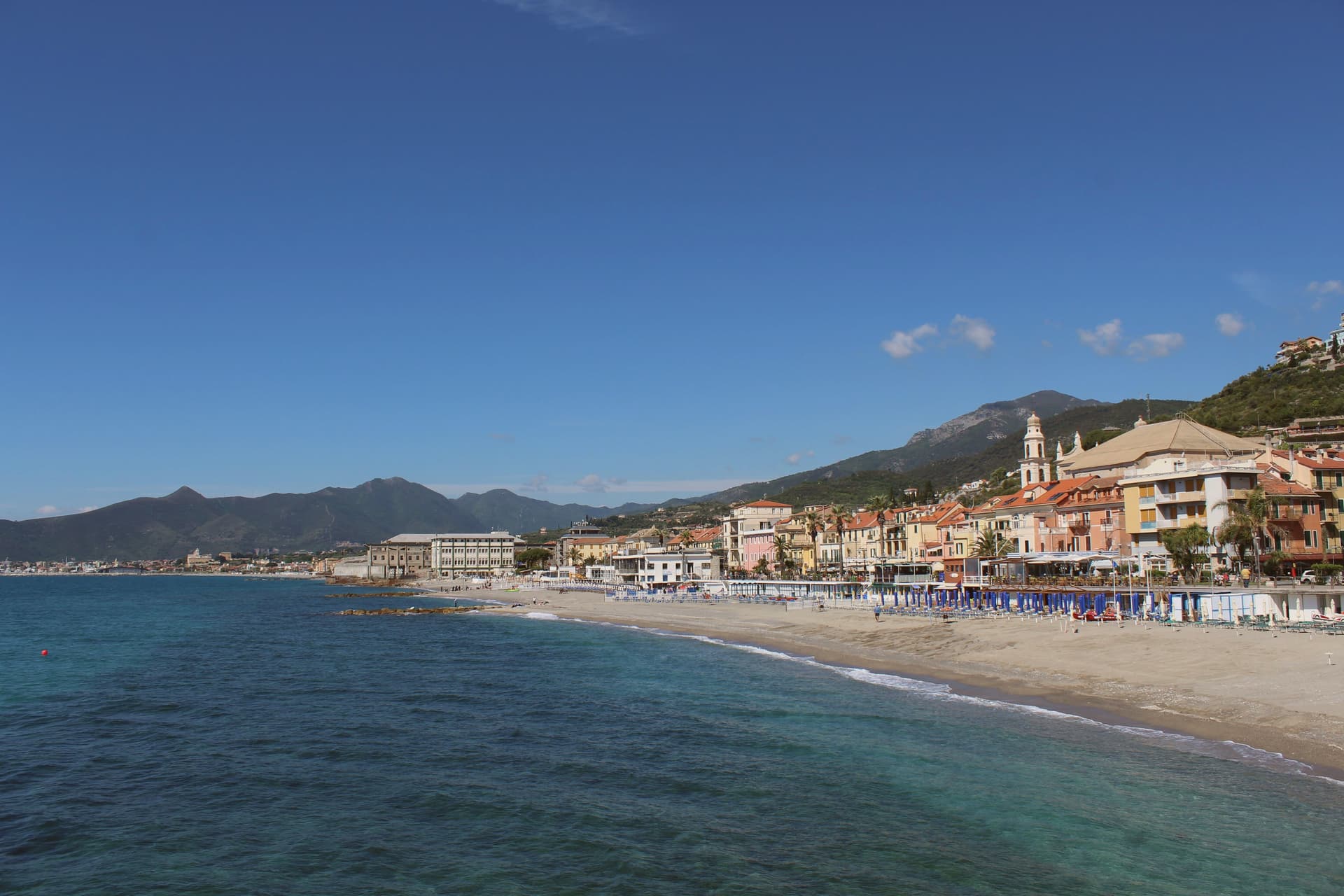
Pietra Ligure sits between Loano and Borgio Verezzi on the Riviera di Ponente, twenty kilometers southwest of Savona. Neolithic finds on Monte Trabocchetto and Roman artifacts in the centro storico place settlement here back across millennia, long before the town took its present name and shape.
That name comes from the Castrum et Oppidum Petrae, the fortress on the rock above the modern center, which became a summer residence from 1100 and was held until 1385, when it passed to the Republic of Genova. The old town has grown up around two poles: the rock with its castle at one end, and the Baroque basilica at the other, with the palazzi of the civic and religious elite filling the ground between.
The promenade now traces that same line at sea level, joining the historic center to a sandy beach that runs south toward Loano. Every three years the space between these poles, the central squares of the old town, fills with the floral carpets of the Infiorata, while a smaller annual version continues in the frazione of Ranzi.
What the town shows a visitor, in effect, is a small stretch of coast where a medieval fortress, a plague-vow church and a modern floral tradition all sit within walking distance of one another.
8,230 people, and Savona is 41 min away by car, with a station in town. Eight of the ten everyday services we look for, from a grocer to a pharmacy, are on the map within 500 meters of the center.
What to see in Pietra Ligure
- Basilica di San Nicolò. Mid-eighteenth-century Baroque parish basilica standing at one end of the historic center, its facade the anchor of the town's central squares during the flower festival.
- Castello di Pietra Ligure. Defensive castle on the rock behind the centro storico, long held by the Bishops of Albenga, its walls visible above the rooftops of the old town.
- Palazzo Golli. Historic palace on Piazza Martiri della Libertà, now the municipal building, the civic anchor of the centro storico.
How to get to Pietra Ligure
It has its own railway station. Genoa is about 1 h 7 min away by road. The full route from Genoa.
Our tip
April through June and September into October are the strongest months on this stretch of Riviera. Pietra Ligure in Fiore comes round every three years in May, drawing some forty delegations of flower artists from Italy and abroad into the squares of the centro storico. July and August fill the lungomare and the centro storico empties in the early afternoon.
7. Santa Margherita Ligure
Best for a day out from Genoa. It is 40 min by car.
40 min from Genoa · homes €3,200 to €6,700 a m² in the center · 8,323 people
Why visit Santa Margherita Ligure
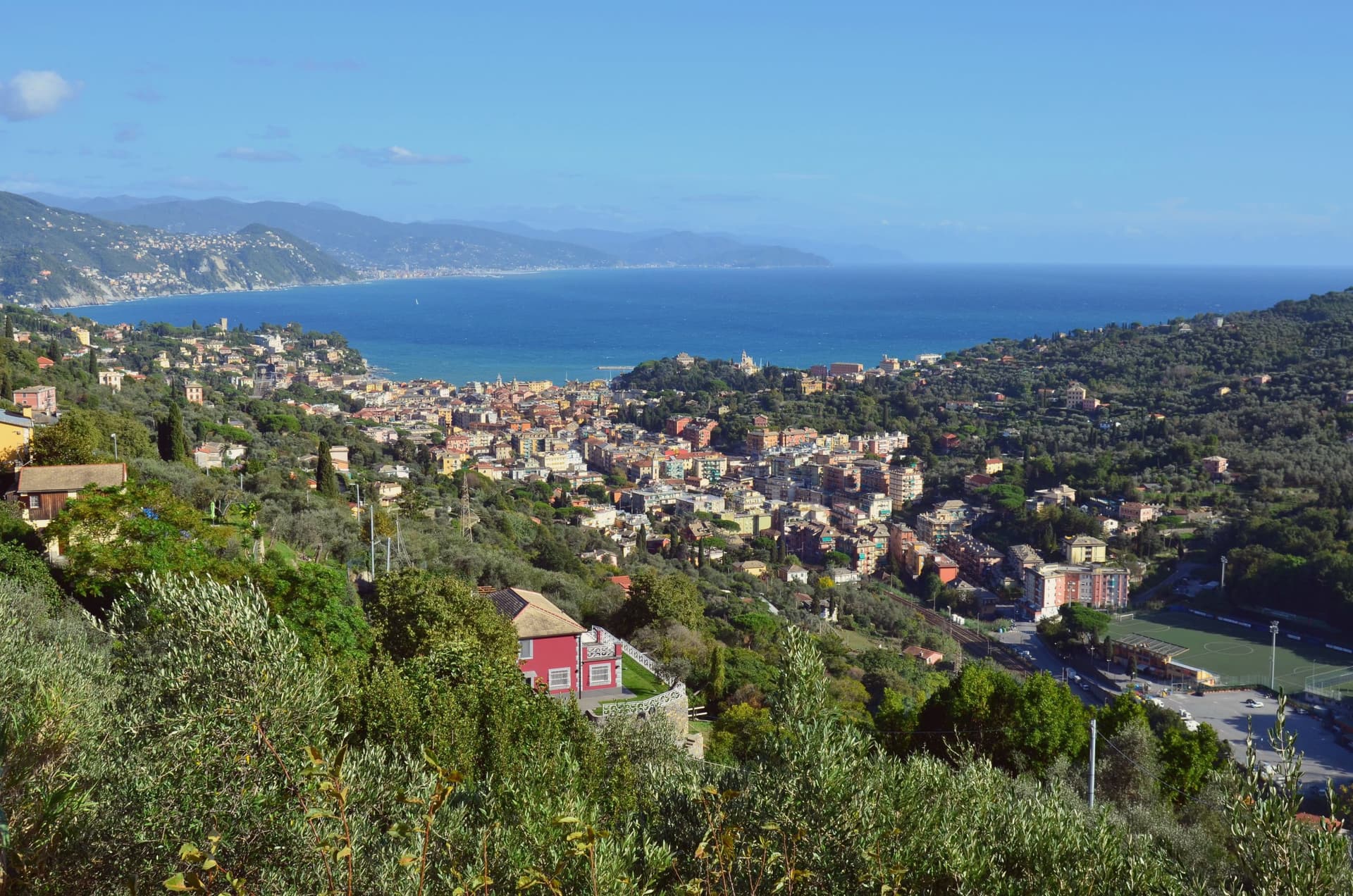
Santa Margherita Ligure sits on the inner curve of the Tigullio gulf, 35 kilometers southeast of Genova, between Rapallo and Portofino. The two medieval burghs of Pescino and Corte were unified by Napoleonic decree in 1812 as Porto Napoleone, then joined again in 1818 under the Kingdom of Sardinia as Santa Margherita di Rapallo.
Genoese architecture survived the merger: trompe-l'oeil facades on the seafront, the 1658 Basilica of Santa Margherita d'Antiochia with its baroque interior of marble and crystal, the 1550 castle built against North African corsair raids by the architect who built Rapallo's. Villa Durazzo, raised in 1678 as a Genoese summer residence, holds three hectares of terraced gardens above the harbor.
The port still works fishing boats alongside the yachts. Most day-trippers continue to Portofino.
The ones who stop find a town that uses its seafront rather than performing it.
8,323 people, and Genoa is 40 min away by car, with a station in town. Eight of the ten everyday services we look for, from a grocer to a pharmacy, are on the map within 500 meters of the center.
The catch: Homes in the center cost up to €6,700 a m².
What to see in Santa Margherita Ligure
- Basilica di Santa Margherita d'Antiochia. Baroque parish basilica from 1658, crystal chandeliers and gilded statuary, dominating Piazza Caprera in the centro storico.
- Villa Durazzo-Centurione. Genoese summer villa from 1678 with frescoed Piano Nobile apartments and a three-hectare terraced park above the Tigullio gulf.
- Castello di Santa Margherita Ligure. Coastal fort raised by the Republic of Genoa in 1550 against Saracen and Barbary raids, designed by the architect of Rapallo's castle.
How to get to Santa Margherita Ligure
It has its own railway station. Genoa is about 40 min away by road. The full route from Genoa.
Our tip
April through June and September into October are the strongest months. The sea is warm enough from late May, the Tigullio quiets after September, and Villa Durazzo's gardens are at their best in shoulder season. July and August fill the seafront, the Portofino ferries run packed, and the inland streets keep a few degrees of shade.
8. Sestri Levante
Best for a wine weekend. It belongs to the national association of wine towns.
44 min from Genoa · homes €3,800 to €6,200 a m² in the center · 17,240 people
Written about. No. 28. Read the letter →
Why visit Sestri Levante
Sestri Levante sits at the head of the Tigullio gulf, forty kilometers southeast of Genova, on a former island the Gromolo river silted into a peninsula by the eighteenth century. Roman Segesta Tigullorum was the predecessor; the town joined the Republic of Genova in 1133.
The peninsula splits the coast into two bays that face different ways and carry different names. To the north lies the long beach known as the Bay of Fables, named by a television host in a 1950s broadcast for the Danish writer who stayed here in 1833.
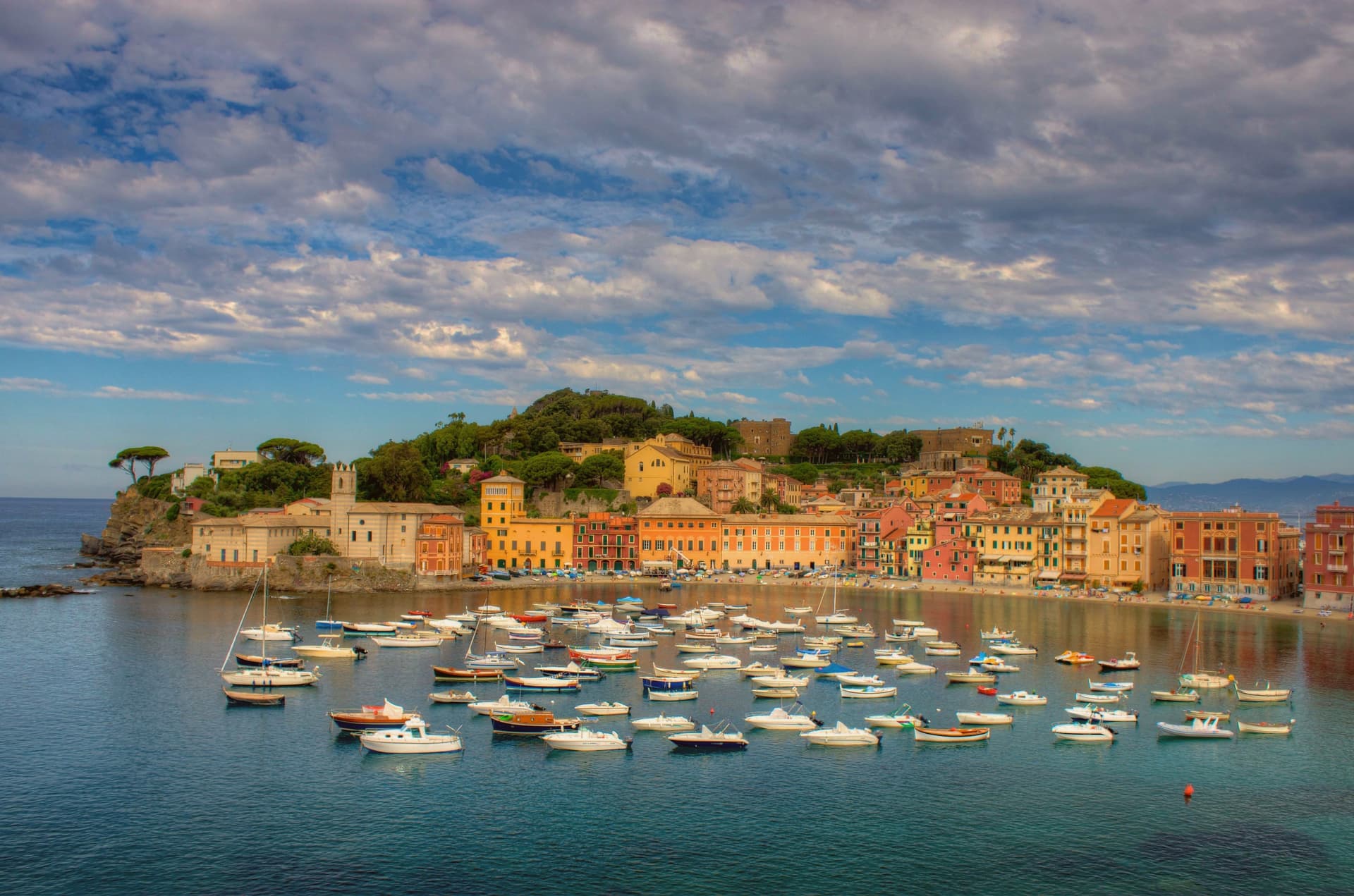
To the south lies the smaller, quieter bay, named by a Ligurian poet in 1919. Between them, on the high ground of the peninsula, stands the old watchtower where an inventor ran some of his most advanced shortwave radio work, work significant enough that the Navy renamed the gulf itself for him.
A town this small holds a beach with a literary name, a bay with a poet's name, and a headland with an engineer's name, three separate claims to attention pressed into one stretch of coast shaped by a silted river.
17,240 people, and Genoa is 44 min away by car, with a station in town. Eight of the ten everyday services we look for, from a grocer to a pharmacy, are on the map within 500 meters of the center.
The catch: Homes in the center cost up to €6,200 a m².
What to see in Sestri Levante
- Baia del Silenzio. Smaller southern bay enclosed by colorful seventeenth- and eighteenth-century houses, named by poet Giovanni Descalzo in 1919.
- Baia delle Favole. Long northern beach and the Bandiera Blu stretch of the town, its name recalling Hans Christian Andersen, who looked out over the water from his inn.
- Torre Marconi. Old watchtower on the heights of the peninsula where Guglielmo Marconi carried out shortwave radio experiments in 1933 and 1934.
How to get to Sestri Levante
It has its own railway station. Genoa is about 44 min away by road. The full route from Genoa.
✷ We have written about Sestri Levante
“A steep hill falls into the sea. The houses are crammed on the slope and painted in bright colors because they are old, packed tight, and need help. There is a small port if the cove allows it and a bigger port if the cove is generous. There is a small piazza around a small church, with maybe four restaurants, three bars, and a gelato place. There is no space for a grand square, because there is no space for grand anything in Liguria.”
Read our piece on Sestri Levante →Tigullio Roadtrip | Four Versions of the Same Liguria
Our tip
April through June and September into October are the dry months on the Tigullio. The sea warms enough for swimming by late May. The Premio Andersen children's literature festival runs in June with author events across the town.
9. Varazze
Best for a swim. The comune's beach holds a Blue Flag.
45 min from Genoa · homes €3,000 to €6,000 a m² in the center · 12,447 people
Why visit Varazze
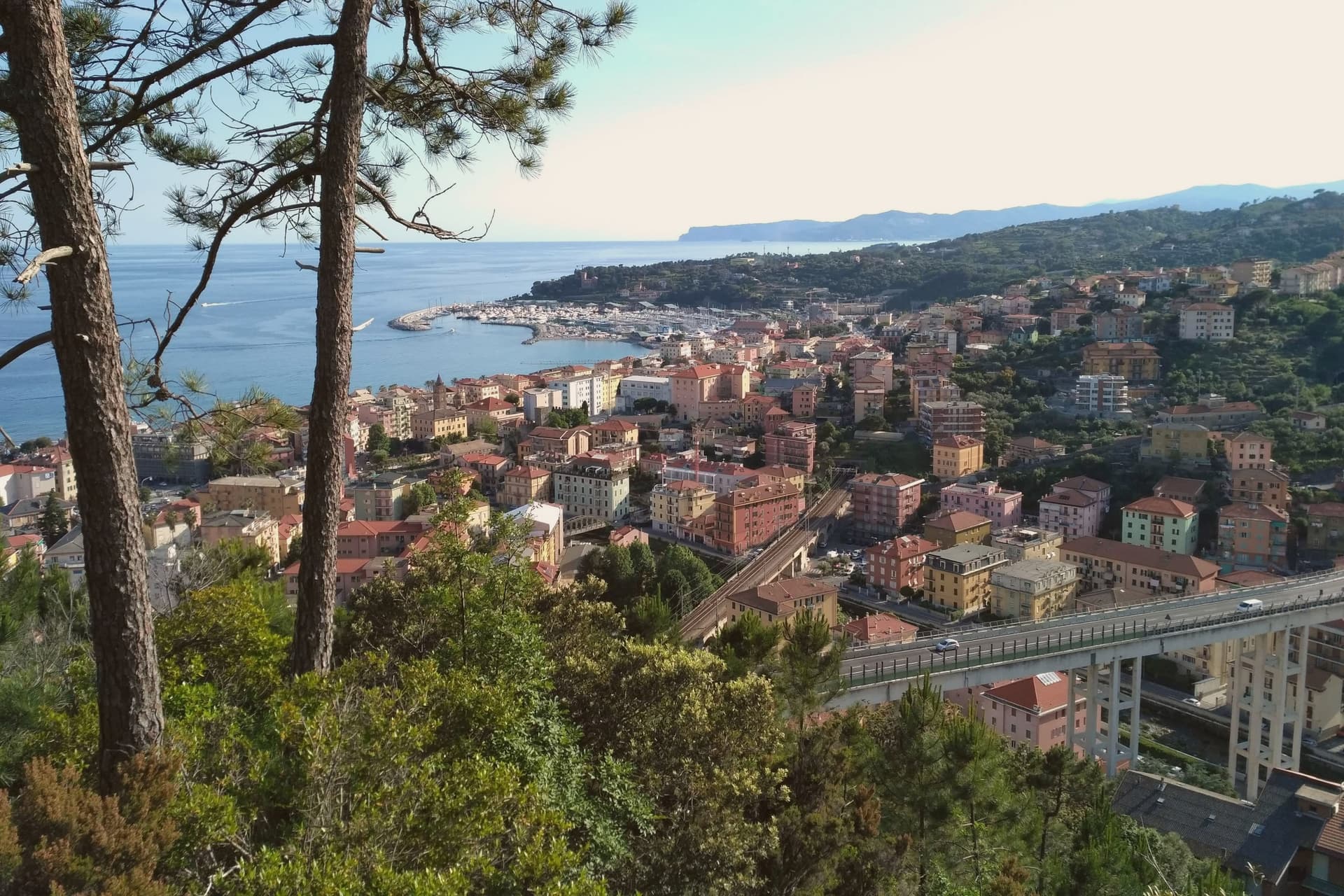
Varazze sits between Mount Beigua and the sea, 30 kilometers west of Genova in the Riviera di Ponente. The town grew around the Roman station of Ad Navalia and became the main port of the marquisate of Bosco, disputed for centuries between Savona and Genova because of its shipyards.
Jacopo da Varagine was born here around 1228 in the Casanova district. As a Dominican friar and later archbishop of Genova, he compiled the Legenda Aurea, a Latin collection of saint biographies that survived in roughly 1,400 manuscript codices through the Middle Ages, second only to the Bible in circulation.
The parish Collegiate Church of Sant'Ambrogio holds a panel by Luca Cambiaso, one of the greatest Ligurian painters of the sixteenth century. Mount Beigua rises to 1,287 meters at the town's back.
The economy still works shipyards, yachting and tourism in roughly that order.
12,447 people, and Savona is 37 min away by car, with a station in town. Seven of the ten everyday services we look for, from a grocer to a pharmacy, are on the map within 500 meters of the center.
The catch: Homes in the center cost up to €6,000 a m².
What to see in Varazze
- Chiesa Collegiata di Sant'Ambrogio. Parish collegiate church with Romanesque-Gothic three-mullioned bell tower, Baroque façade, polyptych by Giovanni Barbagelata and a panel by Luca Cambiaso.
- Parco Naturale del Beigua. UNESCO Geopark covering Mount Beigua at 1,287 meters, the highest peak in the range, with trails connecting the coast to the entroterra.
- Centro storico. Medieval grid behind the shipyards with surviving sections of the old town walls and the Casanova district where Jacopo da Varagine was born.
How to get to Varazze
It has its own railway station. Genoa is about 45 min away by road. The full route from Genoa.
Our tip
April through June and September into October are the best months on the Varazze coast. Mount Beigua shelters the town from north winds, so the climate stays mild well into autumn. July and August are warm and crowded, with the beaches filling and the Beigua trails busy.
If you only pick one
Which town is yours
One town for each kind of trip, and the reason in a line.
Without a car
Sestri Levante
The train stops in the commune, so you can arrive and leave without a car.
For everyday life on foot
Arenzano
All ten everyday services we look for, from a grocer to a pharmacy, are on the map within 500 meters of the center.
For a short trip
Santa Margherita Ligure
40 min by car from Genoa, the shortest drive from a city on this list.
For a small town
Levanto
5,050 people, the smallest town on this list.
Read a sample letter
Chioggia | Everyone is wrong about this town
It’s not an alternative to Venice
Letters from the towns we visit. Free.
More from Anywhere Italy
- The 9 best towns you can get around without steps in LiguriaLiguriastep-free9 towns · smallest 4,882 residents
- The best olive oil towns that eat well in LiguriaLiguriaolive oileats well8 towns · smallest 1,087 residents
- The best olive oil towns you can reach by train in LiguriaLiguriaolive oilby train7 towns · smallest 5,050 residents
- The best coastal towns within 45 minutes of GenoaNear Genoacoastalwithin 45 min10 towns · smallest 351 residents · closest 25 min away
- 10 small towns in Italy where everyday life is a walkLiguriaeveryday life on foot5,000 to 20,000 people10 towns · smallest 5,050 residents