The best wine towns within 90 minutes of Genoa
Cross the Apennines behind Genoa and the sea air gives way to something drier and more agricultural: rows of vines on chalky marl, hazelnut groves, brick farmhouses with dovecotes, hilltop towns wrapped around a castle or a bell tower. This is the Monferrato and the Alto Monferrato, where the white Cortese grape makes a wine sharp enough to drink with anchovies and the reds run from light Dolcetto to serious Barbera. Autumn is the season most people choose, with the grape harvest, white truffles appearing on the market stalls and fritto misto on the trattoria menus. Spring is quieter and the hills are green rather than gold, which is arguably the better trade.
The name that pulls almost everyone is the Langhe, an hour or so further south, where Barolo and Barbaresco have turned a cluster of villages into one of the most visited wine landscapes in Europe. The cellars there are excellent and the prices reflect it, and in October the roads between Alba and La Morra move slowly. Booking a table without weeks of notice has become difficult. It is worth going, and it is nobody's idea of a quiet lunch.
The same hills carry on north and east of the Langhe, and the vines do not stop at the famous boundary. The towns below sit inside the production zones of protected wines that are far less shouted about, in the Monferrato, the Ovadese and the Alto Monferrato around the thermal springs. They are close enough to Genoa for a day out and slow enough to justify staying the night.
Of the 46 communes we have mapped in a 90-minute drive of Genoa, 6 qualify as wine towns: each sits inside the production zone of a protected wine. The smallest, Mombaldone, has 197 residents.
Elsewhere in the catalogue: The best cheese towns within two hours of Genoa and The best wine towns within 90 minutes of Milan.
Mombaldone
Why visit Mombaldone
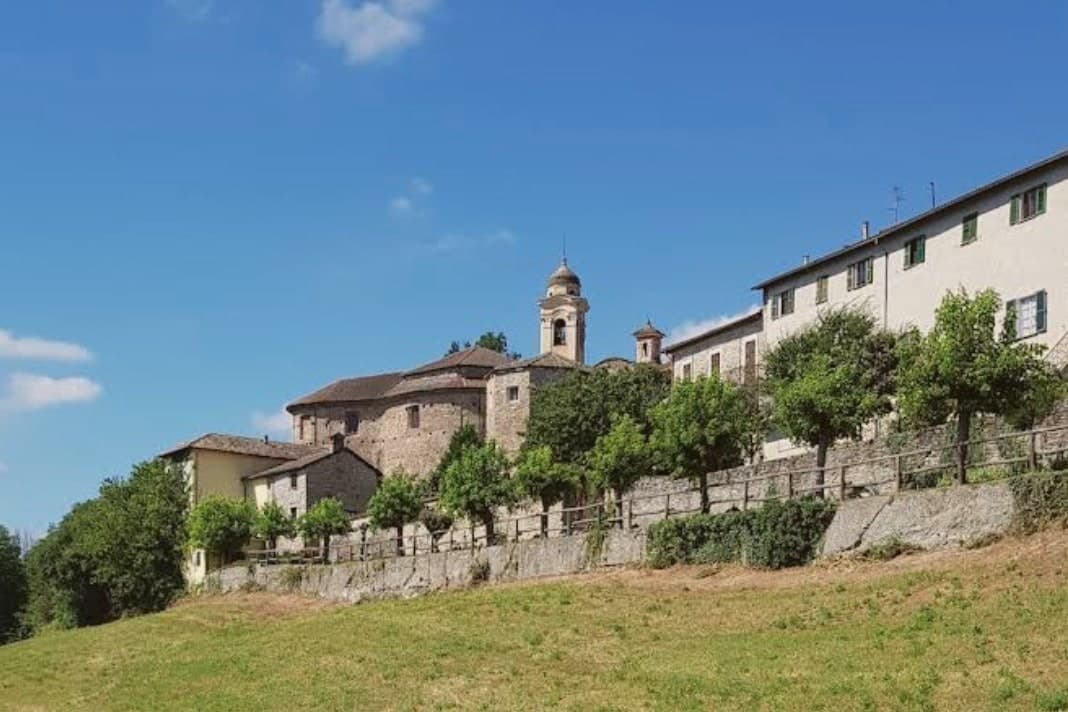
The village sits at 260 meters on a ridge, fifty kilometers north of Genova and well outside the Barolo and Barbaresco circuits. The Aleramici held the land from 991, when they founded the monastery of San Quintino di Spigno; in 1209 control passed to the Del Carretto, whose descendants still own property in the village.
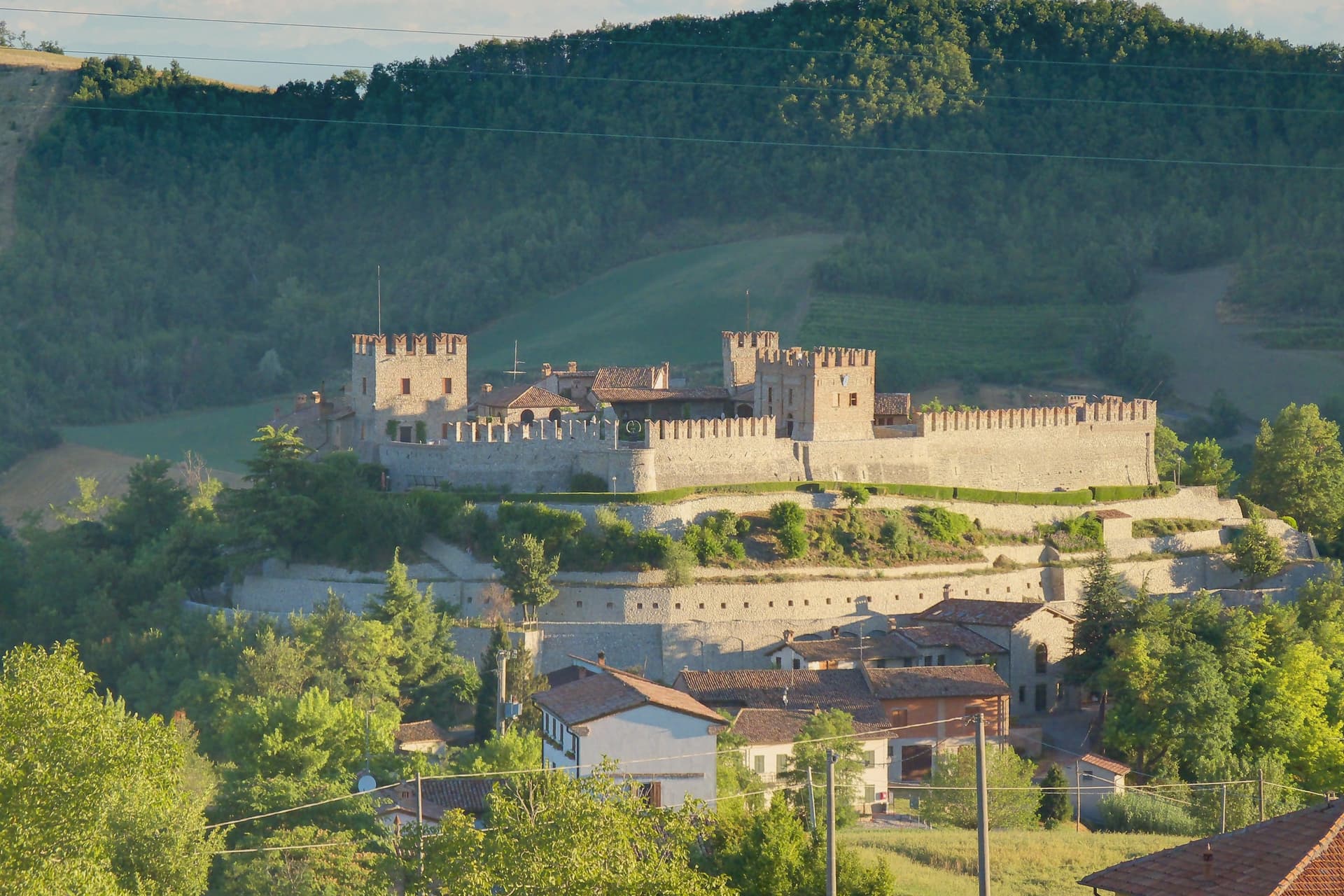
The castle on the high point fell in 1637 and stands in ruin, a square tower and a stretch of wall, while the walled center below has kept its ring intact around the resident population. The church built into the old moat carries canvases by the Monevi family of Acqui, a 17th-century addition to an 18th-century building.
Bormida-valley badlands open below the walls toward Liguria. The layout reads as a sequence: ruined high point, intact walled ring beneath it, open valley beyond.
What survives is not the seat of power but the perimeter that once served it, outlasting the family and the castle both.
What to see in Mombaldone
- Castello dei Del Carretto. 13th-century castle on the highest point of the ridge, partially demolished in 1637; a square tower and wall fragments survive.
- Chiesa di San Nicolao. 18th-century Baroque parish church by Matteo Zucchi on a hexagonal plan, built into the old castle moat.
- Centro storico murato. Complete medieval walled perimeter, the only one preserved in full in the Langa Astigiana, enclosing the small borgo intact.
How to get to Mombaldone
There is a railway station in the town, so you can arrive without a car and never need one while you are here. Genova is roughly 84 minutes away by road.
Our tip
April through June bring the hills back to green and the walls draw a few weekend walkers from Acqui and Asti. September and October are dry and gold, with truffle weeks in nearby communes pulling small crowds onto the ridge roads. July and August can push past thirty degrees and the centro stays empty between two and six.
Gavi
Why visit Gavi
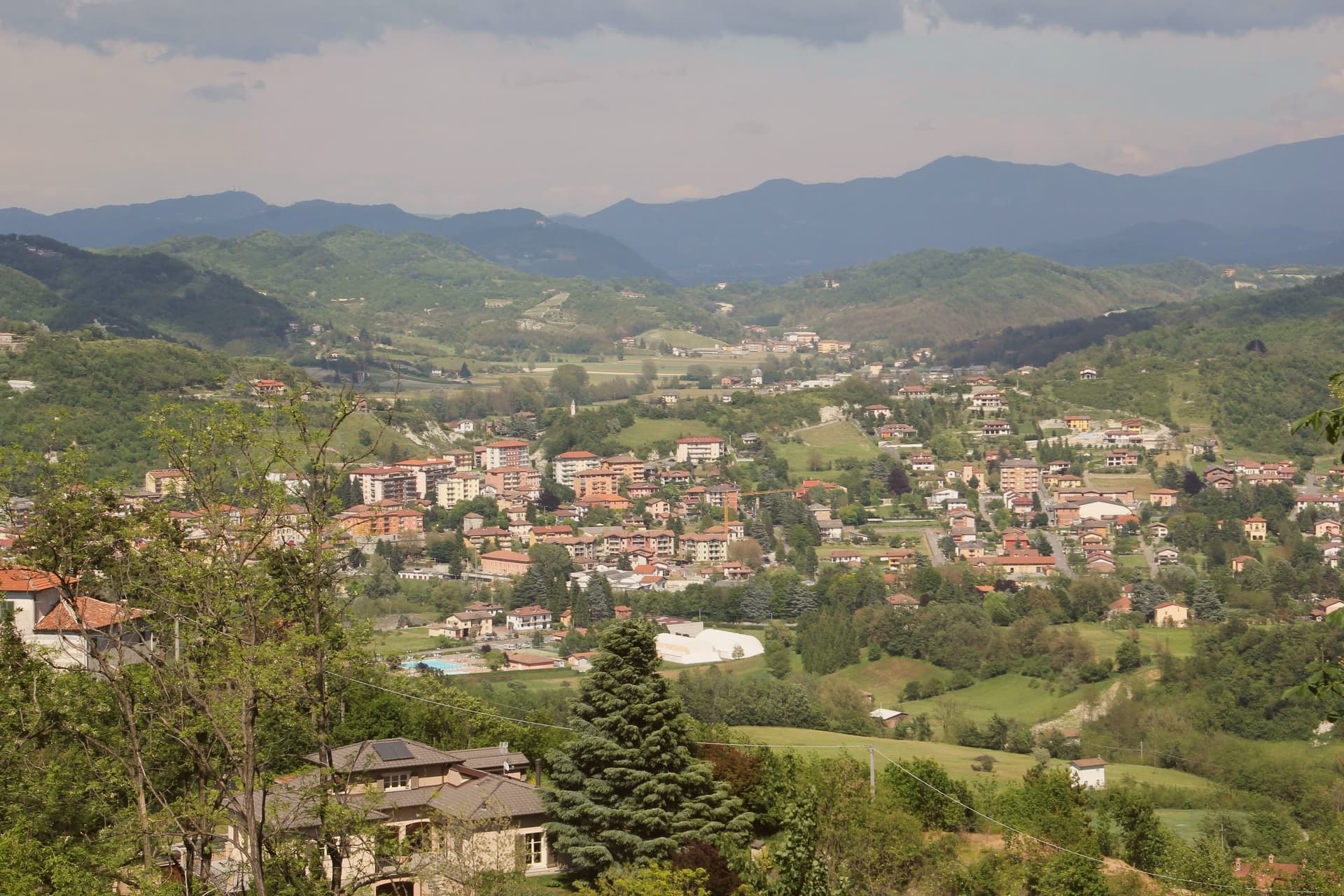
Gavi sits at 233 meters where the Lemme stream meets the Rio Neirone, the southern edge of Piemonte before the Apennines drop to Genova. The first record of vines here is a 972 tribute paid to the Republic of Genoa, three Genoese pounds of wine.
The medieval town clusters along the narrow valley below the Forte di Gavi, a polygonal star fortress built and expanded by the Genoese between 1540 and 1673 on the foundations of a tenth-century castle. The fort fell to French-Savoyard troops in 1625 and was retaken in twenty-one days; under the Savoy it became a prison, then a prisoner-of-war camp for Austro-Hungarian and later Allied soldiers in both world wars.
Cortese di Gavi was made DOC in 1974 and DOCG in 1998. Wine from vines inside the commune may be labeled Gavi di Gavi, and the consortium maintains a separate denomination for grapes grown in the historic center.
La Gallina, Locanda La Raia have been named by a guide.
What to see in Gavi
- Forte di Gavi. Polygonal star fortress on the hill above the town, built by the Genoese 1540 to 1673, later a Savoy prison and WWI/WWII POW camp.
- Chiesa di San Giacomo Maggiore. Romanesque parish church in the medieval center, with twelfth-century stonework and a baroque interior.
- Centro storico. Stone-house old town along the Lemme stream, arcaded streets and small piazzas framed by terraced vineyards.
How to get to Gavi
Genova is roughly 54 minutes away by road.
Our tip
April through October is the year. May and June bring green hills and the Lemme running clear; September and October are dry, with the harvest and the first cool nights. July and August touch the high twenties; the Forte di Gavi closes its tower walks in the afternoon heat. Gavi sotto il Forte falls in July.
Nizza Monferrato
Why visit Nizza Monferrato
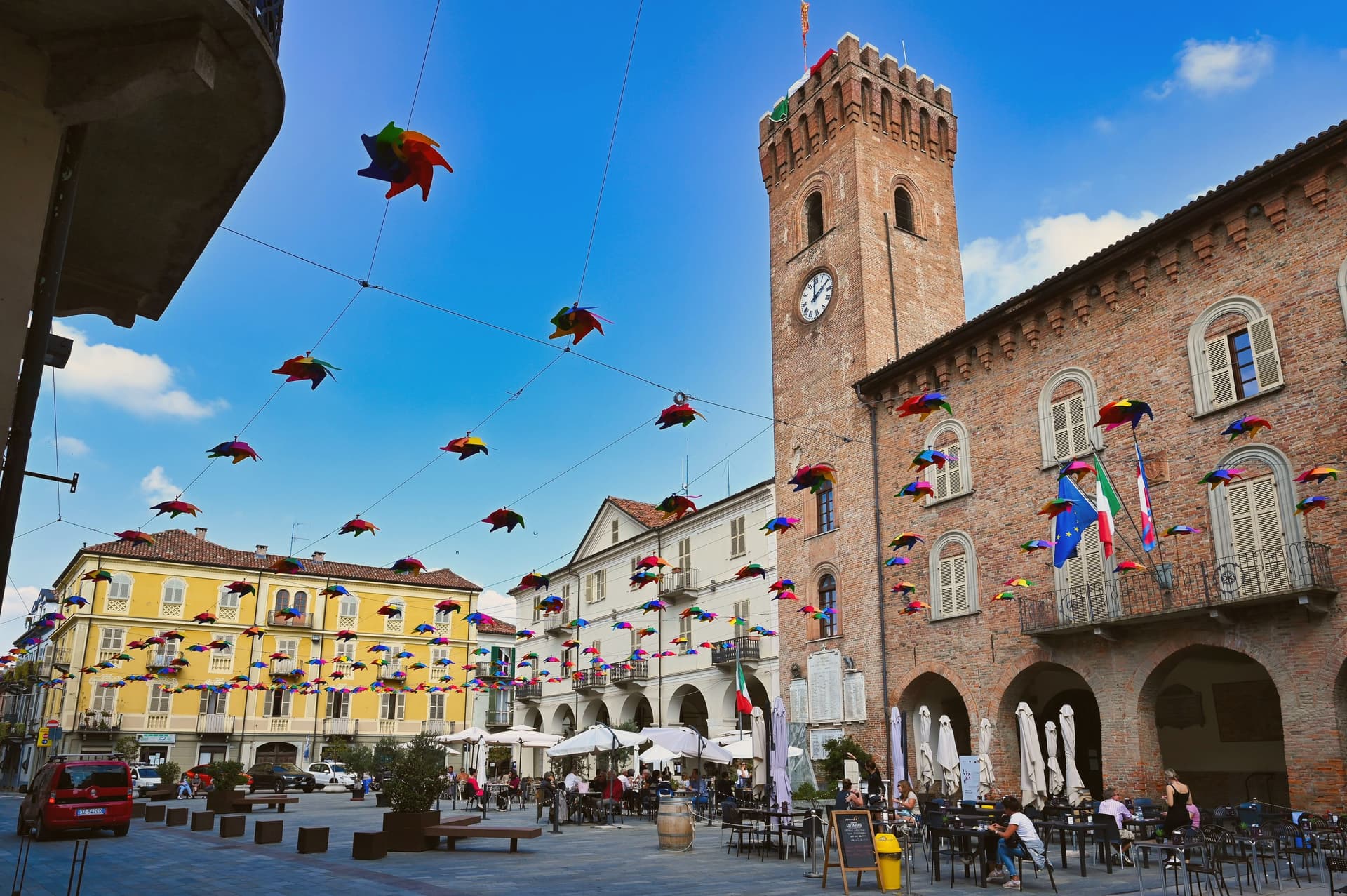
Nizza Monferrato sits at 267 meters in the south of the Asti province, thirty kilometers from Asti city. It was founded in 1225 by inhabitants displaced from castles in the Alessandria area, joined the Marquisate of Monferrato in 1264, and grew through the 19th century as the commercial center of the Barbera-growing hills around it.
The medieval grid from that 1225 founding still holds the centro storico together, with Renaissance and 18th-century palazzi lining Via Pio Corsi and Via Carlo Alberto, while the vineyards that made the town's fortune spread out beyond it at 200 to 400 meters. That agricultural hinterland and the market town at its center still explain each other: the Foro Boario, the old cattle market on Piazza Garibaldi, is the physical record of a town that existed to move what the hills produced, and it still does that job as a multipurpose hall for the antiques market and for the November weekend known as Nizza è Bagna Cauda.
At that gathering, long communal tables fill with the Cardo Gobbo, a hunchbacked cardoon grown only here and protected by a Slow Food presidium, alongside Barbera raised to DOCG status in 2014. A town built to trade a hillside's produce has ended up defined by two of that produce's most particular forms.
Le Due Lanterne, I Cugini di Torino have been named by a guide.
What to see in Nizza Monferrato
- Piazza Garibaldi and Foro Boario. Main square with the old covered cattle market, now a multipurpose hall used for antiques fairs and the November bagna cauda weekend.
- Chiesa di San Giovanni in Lanero. Baroque parish church on the centro storico, with a tall bell tower visible across the surrounding vineyards.
- Museo Bersano delle Contadinerie. Wine-and-farming museum in a former cellar, with one of the largest collections of historic Piemonte viticulture tools.
How to get to Nizza Monferrato
There is a railway station in the town, so you can arrive without a car and never need one while you are here. Torino is roughly 78 minutes away by road.
Our tip
April through June and September into October are the months the Monferrato hills work best. October is harvest, with the Barbera coming in late and the cellars open for visits. November is the Cardo Gobbo and bagna cauda weekend, the largest event of the year, when the Foro Boario fills with communal tables and the Cantina di Nizza pours through the night. Mercatino dell'antiquariato nicese falls in August.
Ovada
Why visit Ovada
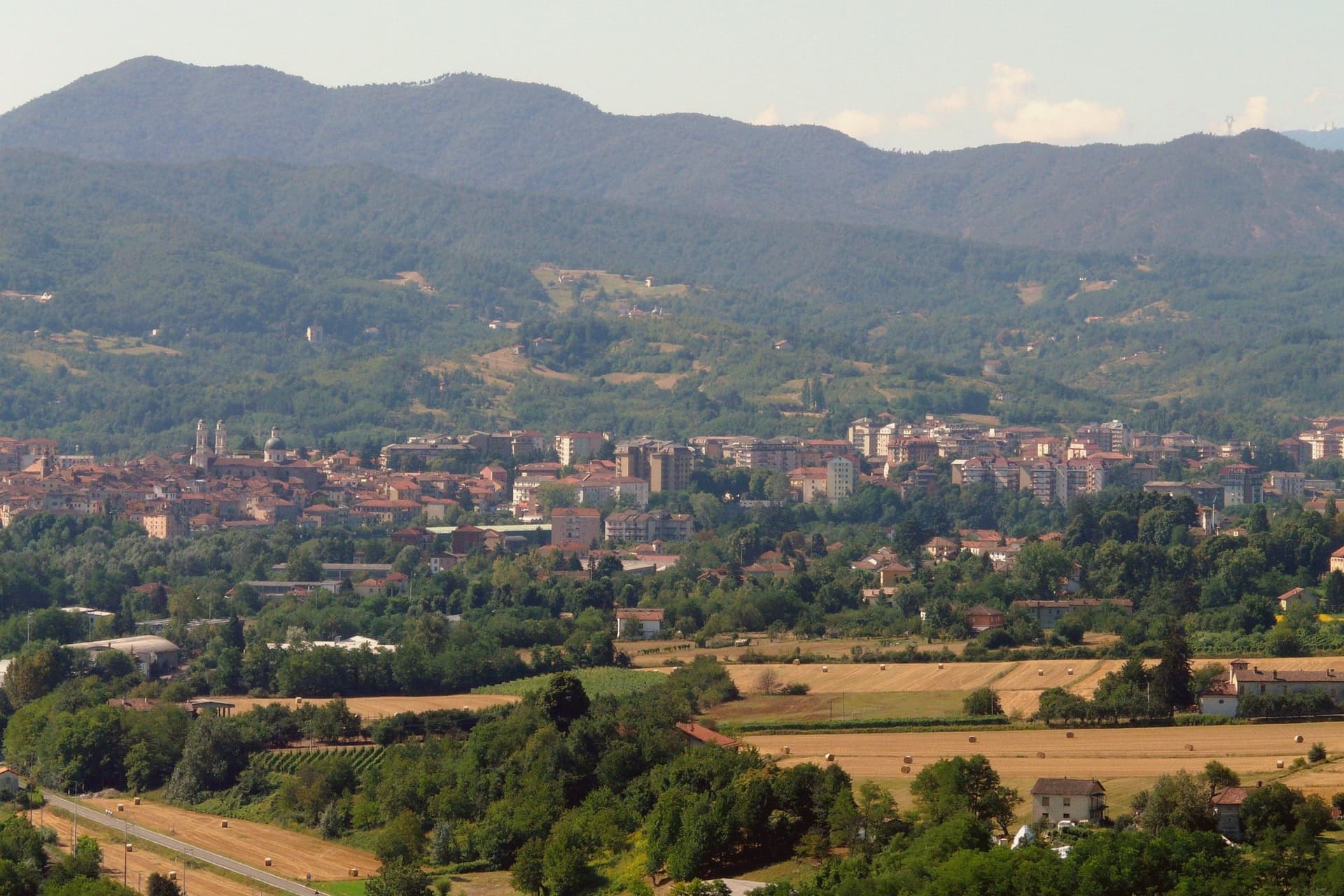
Ovada sits at 186 meters at the confluence of the Orba and the Stura, in the southern Monferrato hills, 35 kilometres north of Genova on the old salt road between the port and the Po plain. The painted façades and the tall narrow houses still show the imprint of the Republic of Genoa, which held the town through the Middle Ages alongside the Marquises of Monferrato.
Dolcetto from the Ovadese hills was already commercialised in the Lombard period (seventh and eighth century) and was the first Dolcetto in Piemonte to win DOC status, in 1972; the DOCG for Ovada Superiore came in 2008. The Chiesa Parrocchiale di Nostra Signora Assunta, with its two twin bell towers, was designed by Gio Antonio Delfrate after the Genoese Basilica di Santa Maria delle Vigne, built from 1772 to 1781 and consecrated in 1801.
The Capuchin church was built from 1640 after a plague vow of 1631 and suppressed under Napoleon in 1810. Ovada carries Città del Vino.
L'Archivolto - Osteria Nostrale have been named by a guide.
What to see in Ovada
- Chiesa Parrocchiale di Nostra Signora Assunta. Twin-bell-tower parish church built 1772–1781 by Gio Antonio Delfrate, modelled on Santa Maria delle Vigne in Genova, consecrated 1801.
- Loggia di San Sebastiano. Medieval loggia, the original parish church of Ovada dedicated to Santa Maria, now used as a venue for cultural events.
- Chiesa dell'Immacolata Concezione (Cappuccini). Capuchin church begun in 1640 after a 1631 plague vow, single nave with two side chapels, suppressed in 1810 under Napoleon's ecclesiastical decree.
How to get to Ovada
There is a railway station in the town, so you can arrive without a car and never need one while you are here. Genova is roughly 47 minutes away by road.
Our tip
April through June is the green window in the Ovadese hills, vines breaking bud and the rivers running off the Ligurian Apennines. July and August touch the mid-thirties; the centro storico thins after lunch and the Orba pools become bathing spots for residents. September and October are the harvest months, the entire Ovada DOCG zone working through vendemmia, and the cantine open for tasting.
Acqui Terme
Why visit Acqui Terme
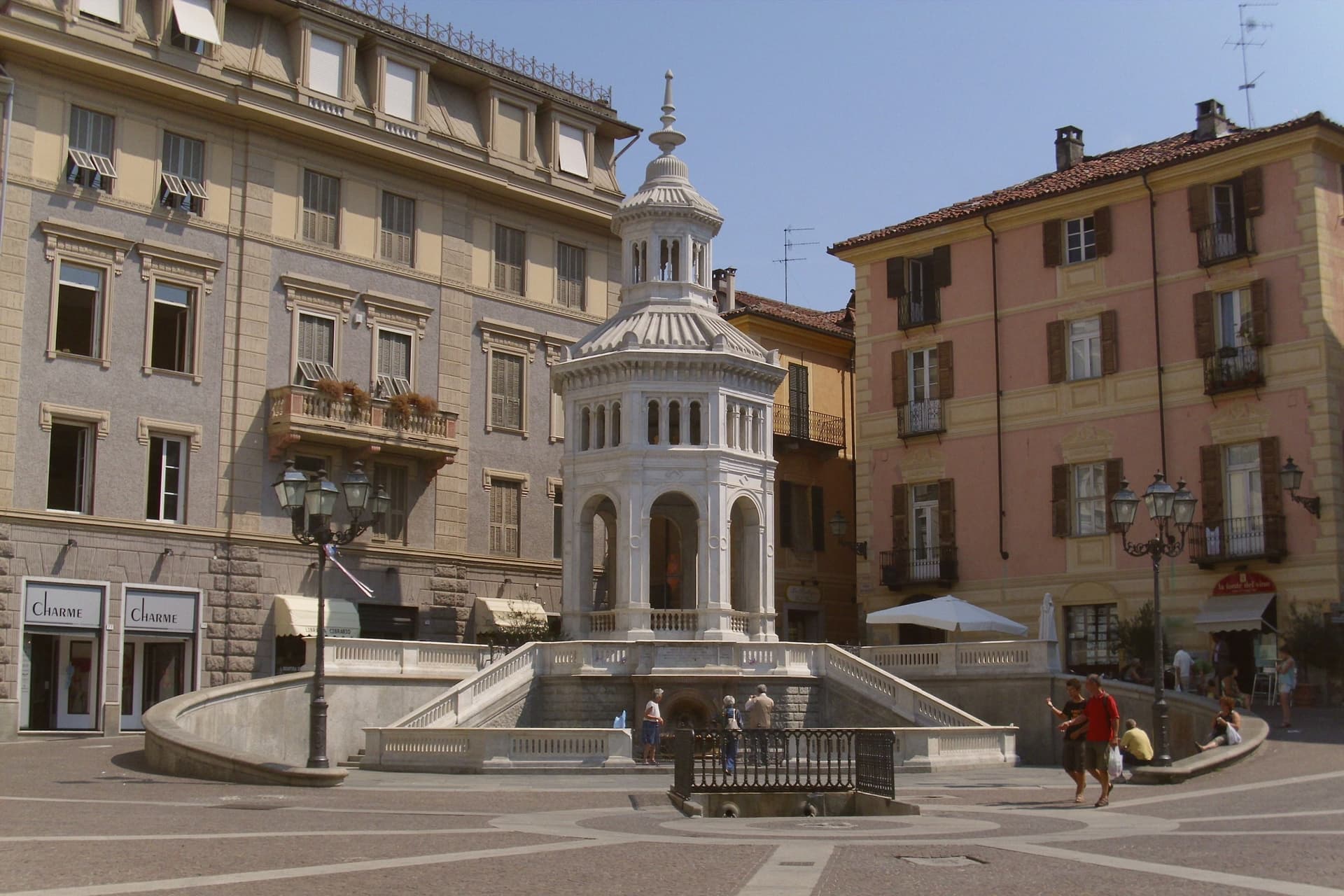
Acqui Terme sits fifty kilometers north of Genova, in the southern Monferrato hills, on the Bormida river. The Romans built their settlement here around hot sulphur springs that Pliny the Elder rated among the best in the empire, and the town's shape still follows that founding logic: baths and spring at the center, the aqueduct running out to the valley, the castle set above on higher ground where the Marquises of Monferrato later took the high point for defense.
The old town gathers close around the piazza where the water surfaces; the castle and its museum sit apart and above, holding what was dug up from the baths, theatre and amphitheatre below. The surrounding hills, meanwhile, grow the grapes for Brachetto d'Acqui DOCG, a low-alcohol sparkling red, and the town holds three separate designations at once: Spighe Verdi, Comuni Termali, Città del Vino.
The thermal trade runs year-round while the wine and the hills set the pace for everything else, so the town reads as two economies sharing one square: water pulled from the ground below, and wine brought down from the slopes above.
Il Moncalvo have been named by a guide.
What to see in Acqui Terme
- Acquedotto Romano. The structure originally carried water 13 km from the Erro stream to feed the baths of Aquae Statiellae, and still spans the valley floor intact.
- La Bollente. Octagonal marble pavilion designed by Giovanni Ceruti, its columns framing the steam that rises off the water even in the middle of the piazza.
- Duomo di Santa Maria Assunta. Romanesque cathedral built on the Latin cross plan over an earlier 10th-century church, consecrated by Bishop Guido.
How to get to Acqui Terme
There is a railway station in the town, so you can arrive without a car and never need one while you are here. Genova is roughly 68 minutes away by road.
Our tip
Acqui Terme runs on a thermal calendar, which means almost no closed season. The spa hotels operate through the cold months and the baths fill more reliably in November than in August. April through June is the gentle window: green Monferrato hills, mild evenings, the Bollente piazza busy without the August press. Mercatino degli Sgaientò falls in August.
Casale Monferrato
Why visit Casale Monferrato
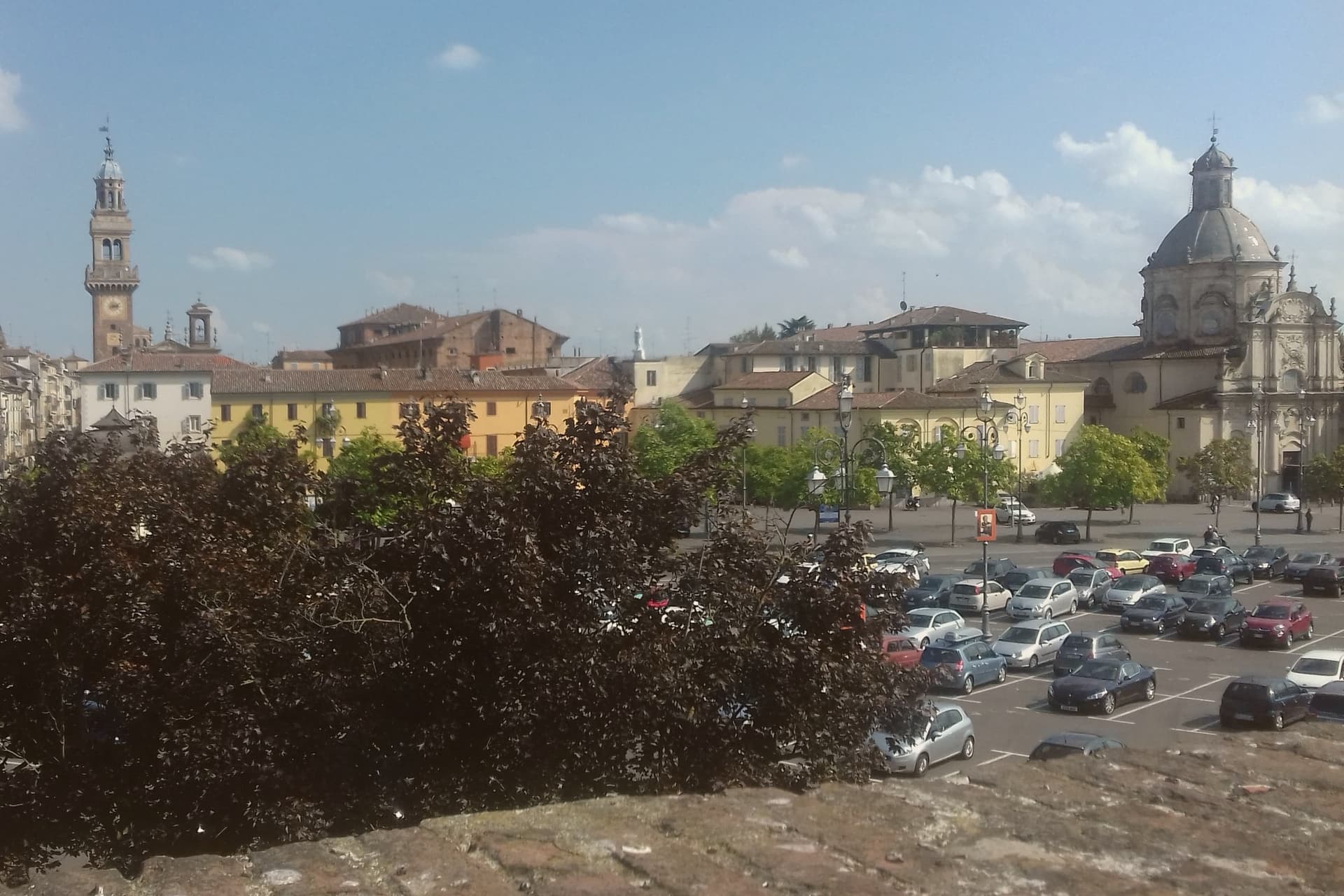
Casale Monferrato sits at 116 meters on the right bank of the Po, sixty kilometers east of Torino, at the foot of the Monferrato hills. Casale fell to the Marquess of Montferrat in 1292 and rose as capital of the Marchesato in the fifteenth and sixteenth centuries, on the strategic edge of the Po Valley.
The Duomo di Sant'Evasio is its oldest stone: consecrated on January 7, 1107 by Pope Paschal II on the site of a Roman temple to Jupiter and a Liutprandian-era church to Saint Lawrence, the basilica is one of the most important Romanesque-Lombard cathedrals in Piedmont, with five naves and a matroneum of trifore and quadrifore galleries. The Castello dei Paleologi, raised in 1352 by Giovanni II Paleologo, runs an asymmetric hexagonal plan with circular corner towers and a dry moat.
The Sinagoga, completed in 1595 in the old Jewish quarter, holds a gilded Piedmontese Baroque interior and a museum of Jewish history. The town is also the historic capital of Italian cement and Krumiri biscuits.
Osteria Bar Sport, Accademia Ristorante, Faletta 1881 and 1 more have been named by a guide.
What to see in Casale Monferrato
- Duomo di Sant'Evasio. Romanesque-Lombard cathedral consecrated 1107 by Pope Paschal II, with five naves, barrel and cross vaults, and a matroneum of trifore galleries.
- Castello dei Paleologi. 1352 castle by Giovanni II Paleologo, asymmetric hexagonal plan with circular corner towers and a dry moat, now used for exhibitions.
- Sinagoga di Casale Monferrato. 1595 synagogue in the old Jewish quarter, gilded Piedmontese Baroque interior, restored 1968 with a Jewish history museum on the upper floor.
How to get to Casale Monferrato
There is a railway station in the town, so you can arrive without a car and never need one while you are here. Novara is roughly 41 minutes away by road.
Our tip
April through June and September into October are the months Casale opens up. The Po valley clears of winter fog, the Monferrato vineyards leaf or harvest, and the Duomo's matroneum holds light it does not get in winter. July and August are hot and still on the river plain; the Paleologi castle's underground passages and the synagogue's gilded hall hold cool, but most days the town empties between two and five. Mercatino dell'antiquariato di Casale Monferrato falls in August.