
The 6 best towns worth staying overnight that hold a World Heritage site in Sicily
90 towns visited, 910 to go. Follow along, free: Subscribe on Substack
Sicilia builds in the color of whatever the island gave it: black lava stone in the shadow of Etna, warm honey limestone in the south-east, whitewash and pumice on the Aeolian rock. Late spring smells of orange blossom and grilled sardines, and by October the vineyards on the volcano's flank are being picked while the sea is still warm enough for swimming. Breakfast is granita with a brioche, almond or coffee or mulberry, eaten standing up. The baroque towns rebuilt after the great earthquake share a single architectural language, staircases, curved facades, balconies held up by carved grotesques, and they look best in the low light of early evening.
Most itineraries funnel through Taormina, which has the Greek theater, the sea view, the cruise passengers coming up from Giardini Naxos, and prices set accordingly. Agrigento's Valley of the Temples takes the rest, arriving by coach in the middle of a hot day and leaving before the light turns. Both are extraordinary and both are seen mostly between the hours a bus schedule allows.
The World Heritage listings run further than that. The baroque of the Val di Noto covers a string of towns inland and along the south-east coast, the Aeolian archipelago is listed for its volcanology, and Siracusa's Ortigia holds Greek, Norman and baroque layers within one small island. These are places with proper hotels, which means staying after the day visitors have gone, when the piazza belongs to the town again.
Of the 61 communes we have mapped in Sicilia, 6 qualify as towns worth staying overnight with a World Heritage site: each has a hotel a travel guide has vouched for, and each holds or sits inside a UNESCO World Heritage site. The smallest, Lipari, has 12,565 residents.
Two more lists worth reading alongside this one: The best towns worth staying overnight that have a serious restaurant in Sicily and The 9 best towns with a World Heritage site that have a serious restaurant in Sicily.
Why visit Lipari
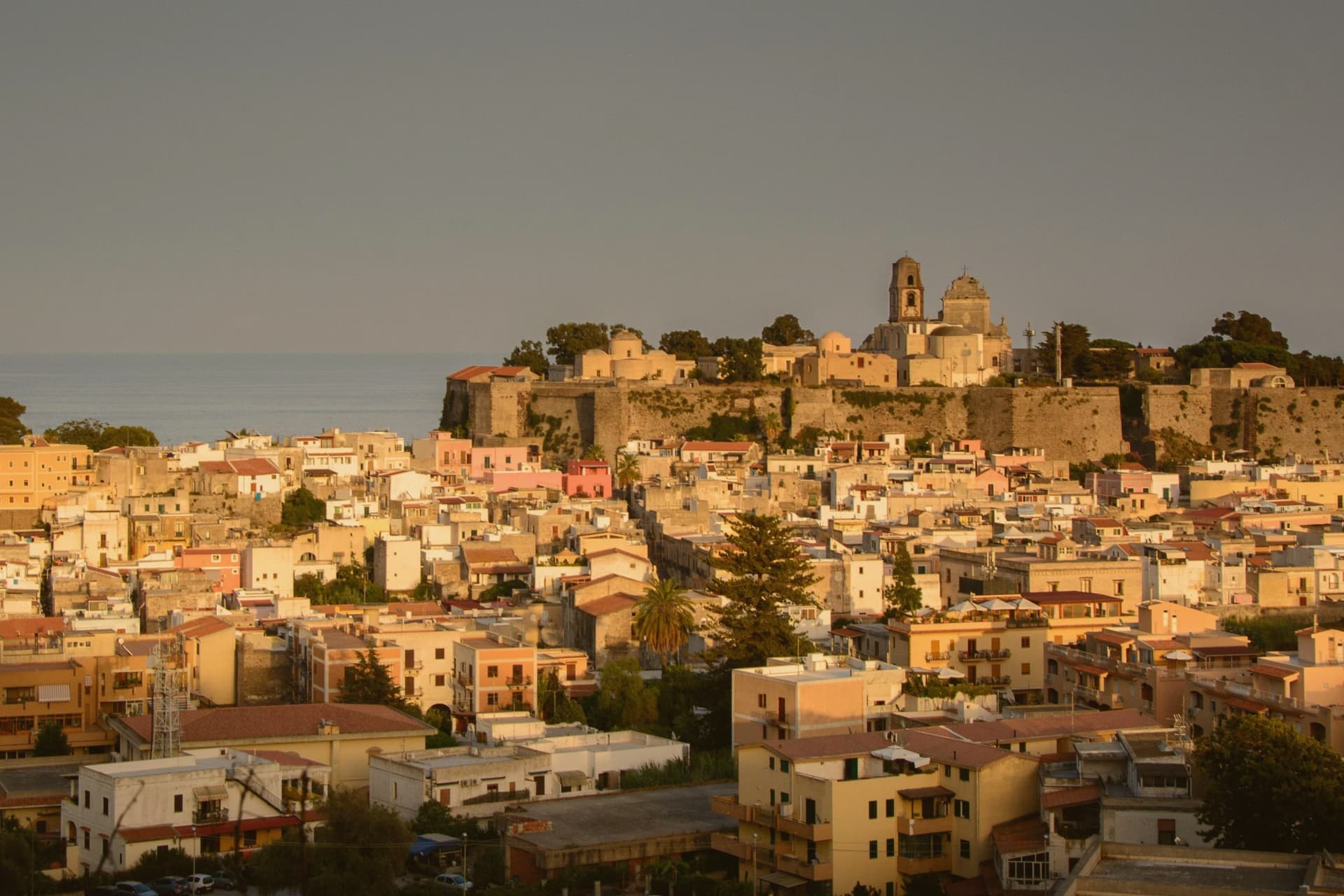
Lipari sits forty kilometers off Sicily's Tyrrhenian coast, the largest of the seven Aeolian islands and the only commune that administers six of them: Vulcano, Panarea, Stromboli, Filicudi, Alicudi and Lipari itself. Humans have lived here since 5000 BC, drawn by deposits of obsidian, the volcanic glass that made Neolithic Lipari a Mediterranean trading center.
The Rocche Rosse obsidian flow on the north of the island dates to the last eruption in 729 CE. The Spanish rebuilt the castle walls after Hayreddin Barbarossa sacked the town and enslaved the population in 1544; the citadel above Marina Corta now holds the Museo Archeologico Eoliano, one of the most important archaeological collections in the Mediterranean.
The archipelago joined the UNESCO World Heritage list in 2000 for its volcanism. Around 12,500 people live here year-round.
In summer the population doubles. Ferries from Milazzo arrive every two hours.
What to see in Lipari
- Castello di Lipari. Fortified citadel on a volcanic rock fifty meters above the sea, rebuilt by the Spanish under Charles V after the 1544 Barbarossa sack.
- Museo Archeologico Regionale Eoliano. Six-section museum founded by Bernabò Brea and Cavalier in the 1950s, with prehistoric, classical, epigraphic and volcanological collections from the archipelago.
- Cattedrale di San Bartolomeo. Cathedral on the castle plateau, ninth-century foundation rebuilt several times, dedicated to the patron saint whose relics were moved to Benevento in 839.
Our tip
May through June and September through early November are the months Lipari was made for. The sea is warm, the Stromboli boats run, and the ferries are not yet rationed by weather. July and August push toward thirty-five degrees and the population doubles with Italian holidaymakers.
Why visit Cefalù
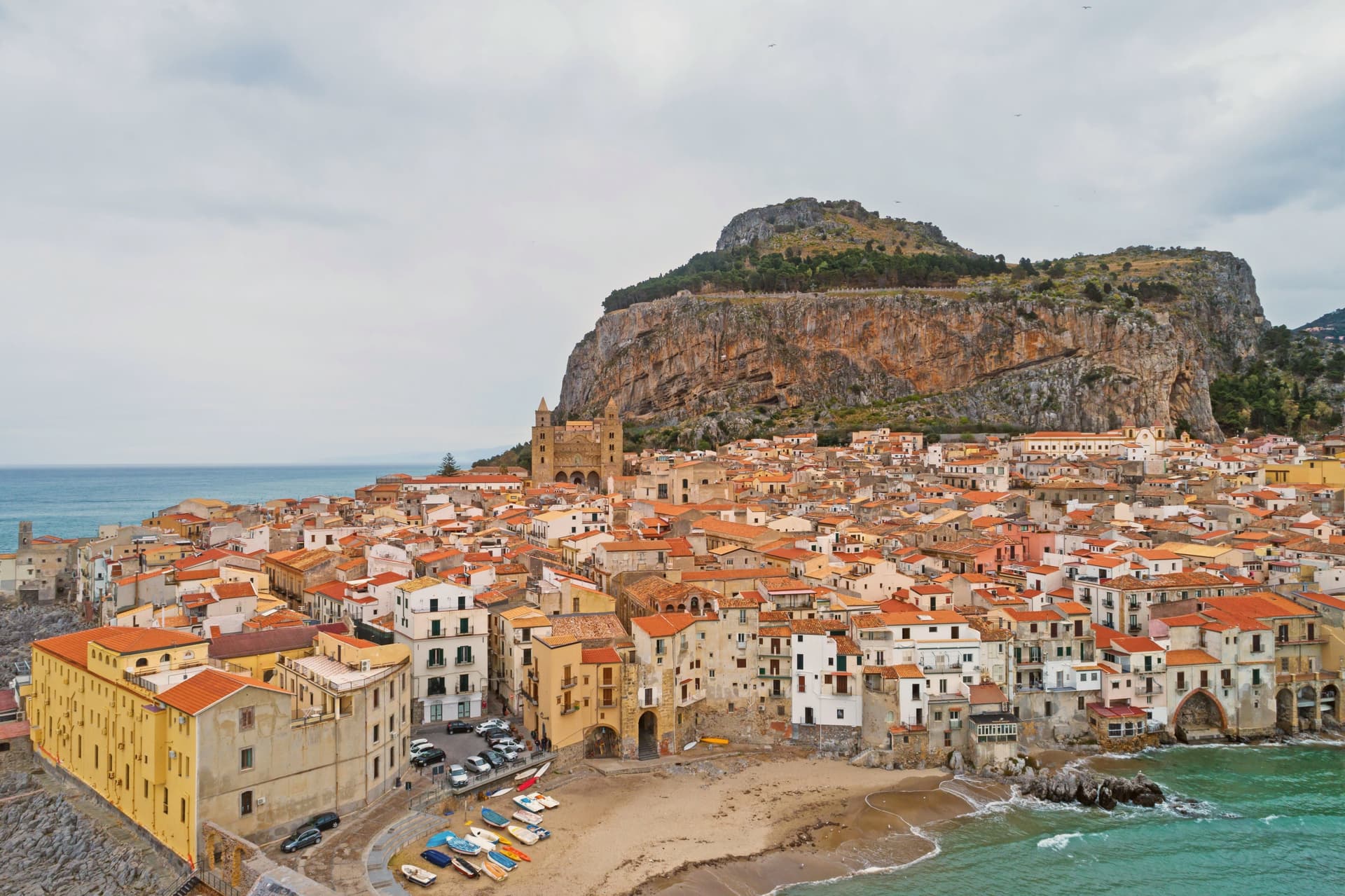
Cefalù sits 70 kilometers east of Palermo where the Madonie meet the Tyrrhenian, the old town built on a strip of land between the sea and the headland that gave the place its name. The Greeks called it Kephaloidion in the fourth century BC.
Roger II refounded the town at the foot of the rock in 1131 and began the cathedral the same year; tradition holds he vowed to build it after surviving a storm offshore. Its mosaics were executed by masters he brought from Constantinople.
The old town keeps the cathedral, the museum, and the working port within the same short walk, the stone lanes running straight down from the Duomo's square to the sea and the lavatoio fed by its own spring along the way. The beach runs below on one side, the rock rises behind on the other, and the harbor still works at the foot of it.
A small coastal town, built once by the Greeks and refounded by a Norman king against the same rock, still reads as one place rather than several eras stacked on top of each other.
What to see in Cefalù
- Duomo di Cefalù. Twin-towered cathedral built by Roger II, its west front facing a narrow square hemmed by the old town. Inside, the mosaic apse is reached down a nave still laid out to Norman proportions, the Arab-Norman UNESCO listing covering both the fabric and the decoration.
- La Rocca. The trail switchbacks up bare limestone above the roofs, past the megalithic sanctuary walls before reaching the castle ruins, where the town, the harbor, and the coastline in both directions open out below.
- Museo Mandralisca. Private nineteenth-century collection in an eighteenth-century palazzo, holding the Portrait of an Unknown Sailor and Greek vases from Lipari.
How to get to Cefalù
It has its own railway station. Palermo is about 1 h 3 min away by road. The full route from Palermo.
Our tip
May, June, September and October are the windows for Cefalù. The Tyrrhenian is warm enough to swim from mid-May, the cathedral and the climb up La Rocca are bearable in the morning, and the town isn't yet at full crowd. July and August fill the beach and the lungomare past capacity, with Palermo and northern European holidaymakers; the cathedral keeps its mosaics behind a steady queue.
Why visit Noto
Noto stands at 152 meters on a Hyblean foothill ten kilometers inland from the Ionian. The medieval town of Netum, on Monte Alveria eight kilometers north, was abandoned after the 1693 earthquake and rebuilt down the slope as Noto Nuova on a single orthogonal grid, the plan that anchors the Late Baroque Towns of the Val di Noto inscribed by UNESCO in 2002.
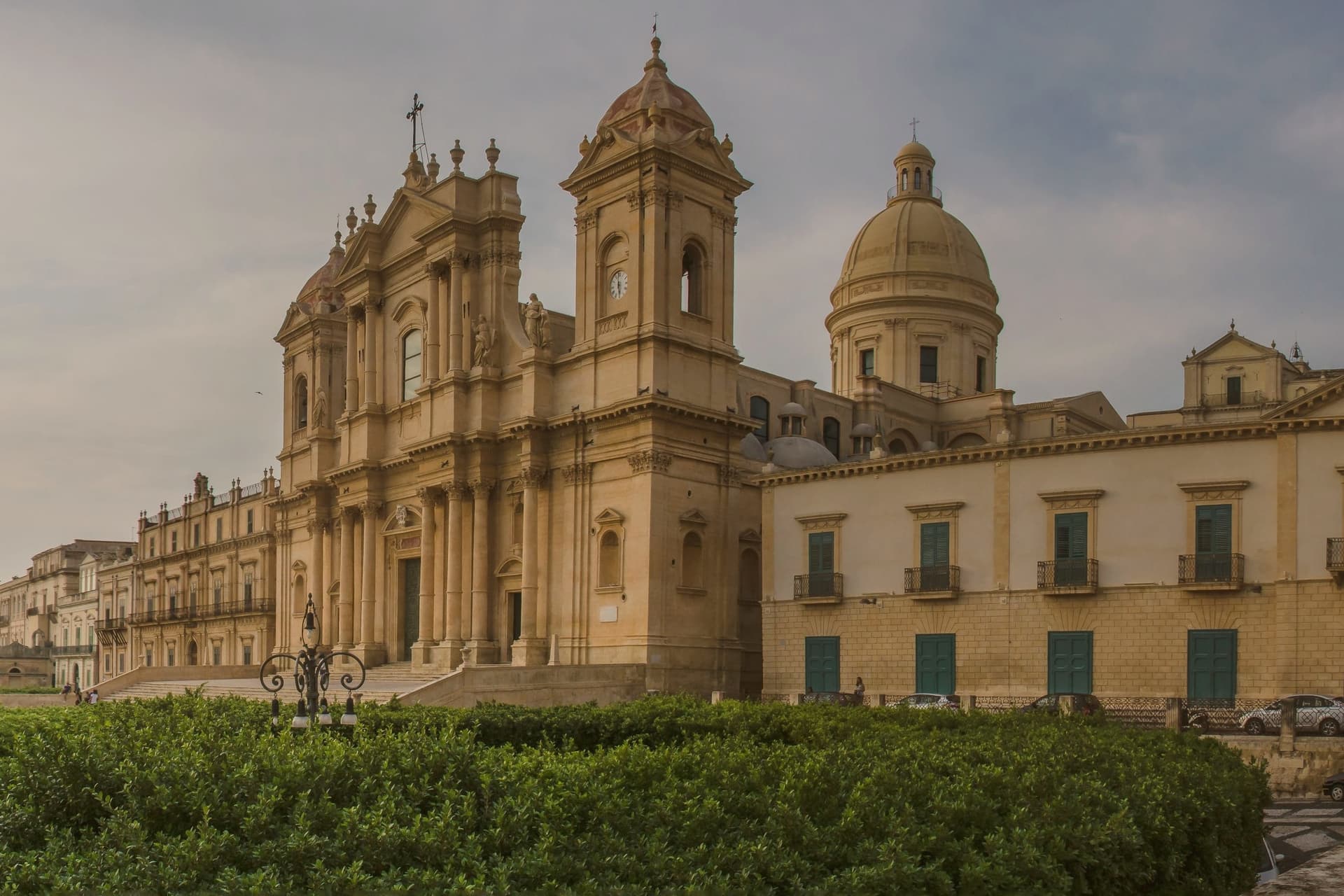
The cathedral sits at the top of its stairs on Piazza Municipio, facing the civic cluster of Palazzo Ducezio across the square. Behind it, the ground rises again into Via Nicolaci, defined by the palace built in 1731 and covered each May, since the early 1980s, in petal mosaics for three days.
Further along Corso Vittorio Emanuele the Jesuit church adds its own bell tower and a view back over the rooftops. Fifteen kilometers south the coast turns to salt marsh and reserve, a different register of the same limestone country.
The local stone itself, a soft tufaceous limestone, turns gold in late light, which is the thread running under the grid, the staircases and the carved balconies alike: a single rebuilding, in a single material, read at every scale from a town plan down to a corbel.
What to see in Noto
- Cattedrale di San Nicolò. The staircase it commands is wide enough to hold the whole width of Piazza Municipio in front of it, so the facade reads as the square's far wall as much as a building in its own right.
- Palazzo Nicolaci di Villadorata. The balconies along the street are carried on carved corbels of grotesques and animals, stone figures that project out over the passersby below.
- Piazza Municipio and Palazzo Ducezio. Civic square facing the cathedral, with Palazzo Ducezio, the eighteenth-century town hall designed by Vincenzo Sinatra after the rebuild.
How to get to Noto
It has its own railway station. Siracusa is about 42 min away by road.
Our tip
April through June and September through November are the right months for Noto. The Infiorata falls on the third weekend of May; Via Nicolaci is closed to traffic and the petal mosaics go down for three days, the largest single event in the calendar. July and August push past thirty-five degrees and the day-trippers from Catania and Siracusa fill the cathedral steps from mid-morning.
Why visit Ragusa
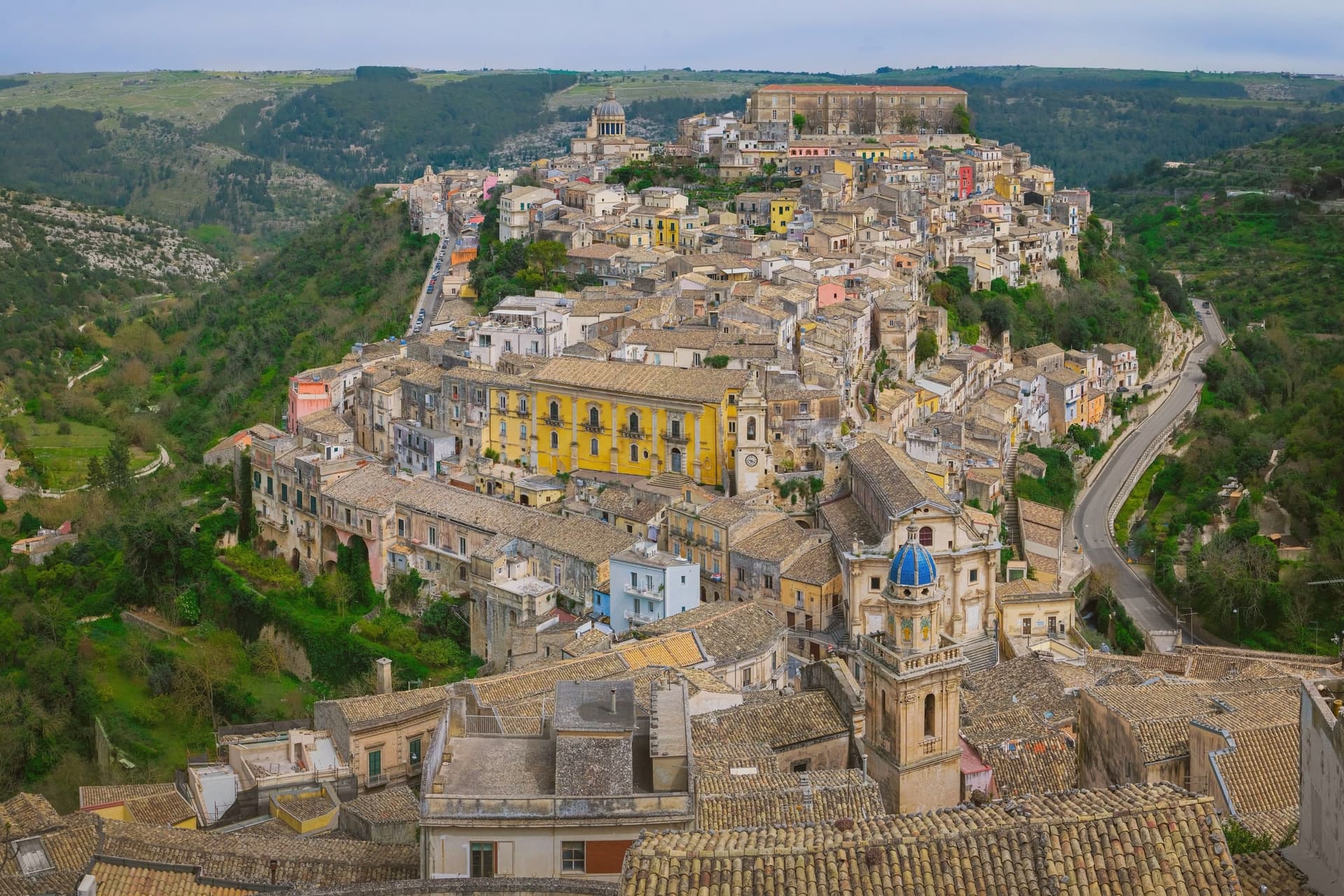
The town sits on a Hyblean plateau at 502 meters, sixty kilometers southwest of Siracusa, on a ridge cut by two deep ravines. The 1693 earthquake killed five thousand of its eleven thousand residents and erased the medieval town that stood there.
What followed split the place in two. One faction rebuilt on the old site and kept the ancient name attached to the lower town; the other built a new orthogonal grid on the higher ridge to the west and became Ragusa Superiore.
Both halves were inscribed together in 2002 as part of the Late Baroque Towns of the Val di Noto. The two cathedrals face each other across the divide, one anchoring each half, evidence that the split was never resolved so much as built into stone twice over.
What the earthquake broke, the rebuilding fixed into a permanent argument between two street plans on the same ridge: one curled and medieval in outline, the other laid out square.
What to see in Ragusa
- Duomo di San Giorgio. Built 1739-1775, three-tier convex façade above a wide staircase that formed the opening shot of the Montalbano titles.
- Cattedrale di San Giovanni Battista. Eighteenth-century Baroque cathedral on the principal piazza of Ragusa Superiore, balancing the other cathedral in Ragusa Ibla.
- Valle dei Ponti. Deep ravine south of the historic center of Ragusa Superiore, crossed by bridges including the 1843 Ponte dei Cappuccini and the modern Ponte Nuovo.
How to get to Ragusa
It has its own railway station. Siracusa is about 1 h 30 min away by road.
Our tip
April through June and September through November are the right months for the two halves of Ragusa. The Hyblean plateau holds the heat in July and August, often above thirty-five degrees, and the Ibla stairs empty between two and five every afternoon. The Ibla Buskers street festival arrives the first weekend of October and fills the lower town with musicians for three nights.
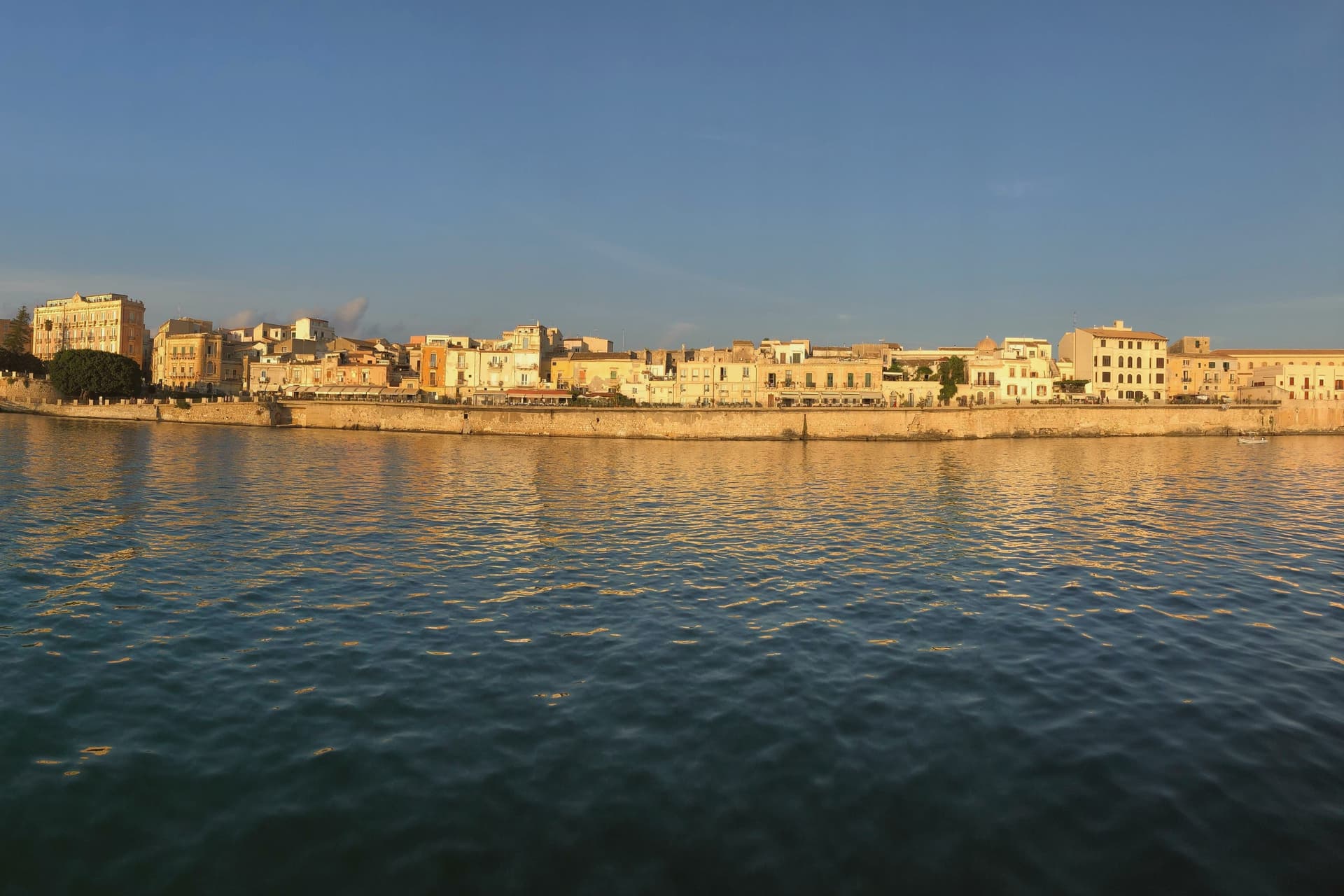
Why visit Siracusa
The city was founded in 734 BC by Corinthian Greeks and became the most populous Greek city in the Mediterranean under the tyrant Dionysius I in the 4th century BC. The historic center sits on Ortigia, the small island linked to the mainland by three bridges, where the Cathedral of Santa Maria delle Colonne, the freshwater spring, and the Piazza Duomo's late-Baroque palazzi, rebuilt after 1693, all stand on the same ground the Greeks first built on.
Across on the mainland, the Parco Archeologico della Neapolis preserves the theater, the limestone cave, a Roman amphitheatre, and the Ara di Ierone sacrificial altar, so the ancient city reads as two halves: an island core wrapped by the sea and a mainland quarry and theater district set into the hillside behind it. The Necropolis of Pantalica lies inland from both, joined to the city on the same UNESCO listing, and the city was later named a candidate for European Capital of Culture in 2019.
What Cicero praised as the greatest and most beautiful of Greek cities was in effect two settlements working as one, the island for living and worship, the mainland for spectacle and quarrying, a division still legible in how the ruins are separated by water and distance today.
What to see in Siracusa
- Ortigia + Duomo (Tempio di Atena). Island historic center with the cathedral built directly into a 5th-c. BC Doric temple of Athena, the original columns visible in the walls. Honey-coloured Baroque palazzi on Greek foundations.
- Teatro Greco (Parco della Neapolis). 5th-century BC Greek theater carved into the limestone hillside, still in use every summer for the INDA classical drama festival. The largest surviving Greek theater in Sicily.
- Fonte Aretusa. Freshwater spring at the western tip of Ortigia, the mythological setting of Arethusa's transformation. Pools at the seafront with papyrus growing.
How to get to Siracusa
It has its own railway station.
Our tip
Siracusa is year-round but with two clear peaks. The INDA classical drama festival runs from mid-May to early July at the Greek theater: the city's biggest cultural event. Book performances and accommodation months ahead.
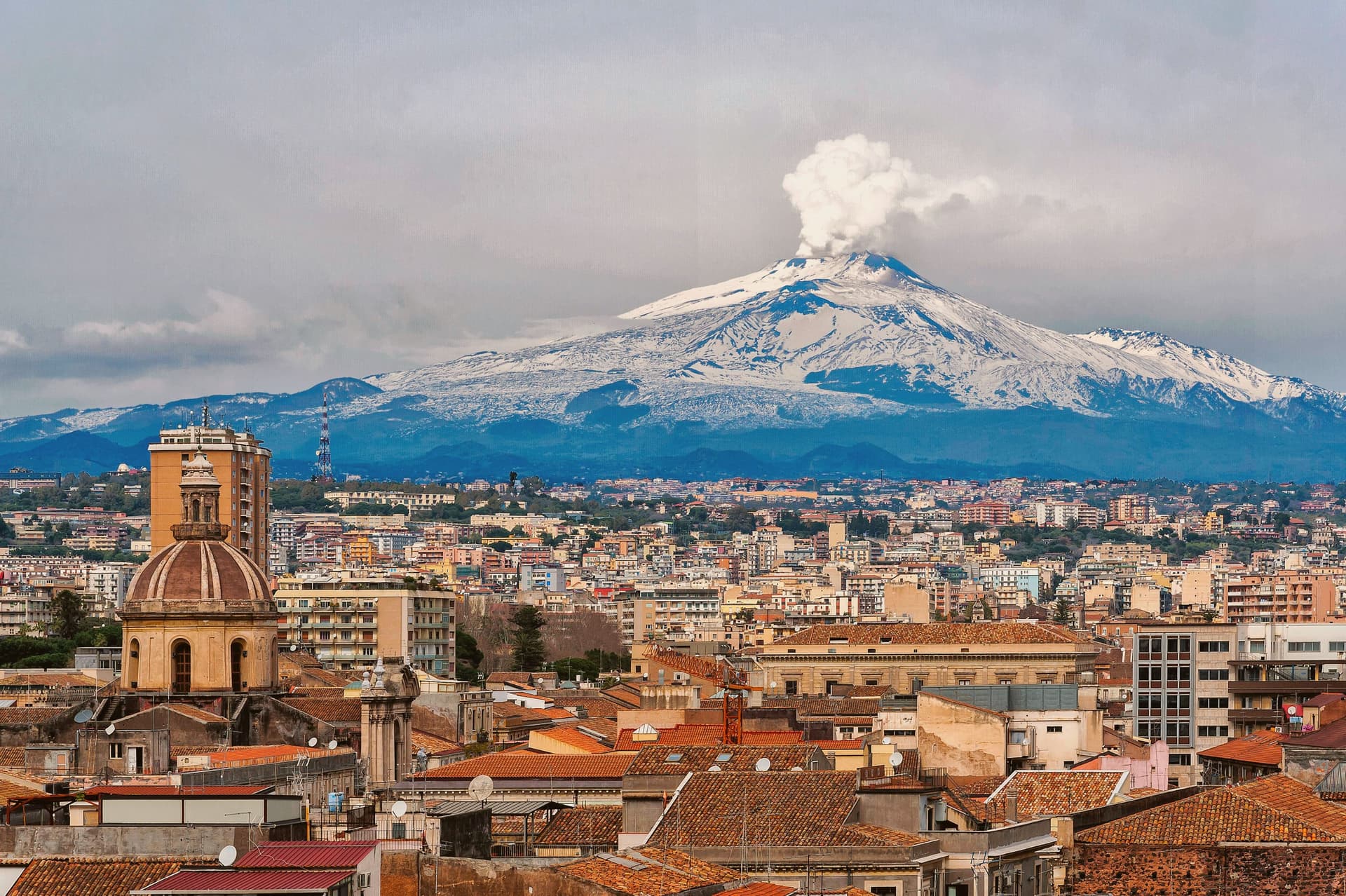
Why visit Catania
Catania is Sicily's second-largest city and the capital of the Ionian coast: 300,000 residents at the foot of Etna, with the volcano visible from every street that opens north. The current city is the third built on the same site: Greek Katánē (729 BC), Roman Catina, and the medieval town all in turn.
The version visible today was built almost entirely in the half-century after the 1693 Val di Noto earthquake destroyed 75% of the buildings and killed two-thirds of the population. The reconstruction was led by Giovanni Battista Vaccarini, who gave Catania its distinctive late-Baroque profile: wide regular streets paved with lava basalt, palazzi faced in the same black stone with white limestone trim, and the Piazza del Duomo at the center with Vaccarini's 1735 elephant fountain (U Liotru, a Roman-era basalt elephant supporting an Egyptian obelisk) as the city's symbol.
The historic center was inscribed on the UNESCO World Heritage list in 2002 as one of the Late Baroque Towns of the Val di Noto. Beyond the Baroque: Bellini was born here, the Roman amphitheatre is the second-largest in Sicily, the Pescheria fish market runs every weekday morning, and the Etna cable car from Rifugio Sapienza is reachable in an hour for the high-altitude lava fields.
What to see in Catania
- Piazza del Duomo + U Liotru. Vaccarini's 1735 elephant fountain in the central square: a Roman basalt elephant supporting an Egyptian obelisk. The cathedral of Sant'Agata anchors the south side. Both rebuilt post-1693 in lava-and-limestone Baroque.
- Via dei Crociferi. Pedestrian Baroque street with four churches in 200 meters, the densest stretch of post-1693 reconstruction. UNESCO World Heritage protected.
- Etna. Europe's largest active volcano (3,357 m), an hour from the city by cable car + jeep from Rifugio Sapienza. UNESCO World Heritage in its own right since 2013.
How to get to Catania
It has its own railway station.
Our tip
Catania is year-round. October through April is the value season: warm Mediterranean light, the centro storico navigable, the Pescheria at full output, Etna often snow-capped and stunning above the Baroque rooftops. May and June are the best months for the volcano and the coast: long warm days, Etna fully accessible, sea swimming starts.
More from Anywhere Italy
- The best towns worth staying overnight that have a serious restaurant in SicilySicilyserious restaurantworth staying overnight9 towns · smallest 10,471 residents
- The 9 best towns with a World Heritage site that have a serious restaurant in SicilySicilyserious restaurantWorld Heritage9 towns · smallest 8,101 residents
- The 7 best towns you can reach by train that are worth a night in SicilySicilyby trainworth staying overnight7 towns · smallest 10,471 residents
- The best hill towns with a World Heritage site in SicilySicilyhill townWorld Heritage7 towns · smallest 8,101 residents
- The best coastal towns you can reach by train in SicilySicilycoastalby train9 towns · smallest 10,471 residents
- The best hidden coastal towns that eat well in SicilySicilycoastaleats wellhidden8 towns · smallest 4,525 residents