
The best hill towns with a World Heritage site in Sicilia
The stone changes as you climb away from the Sicilian coast. Inland, the towns are built from soft golden limestone that holds the late light, sometimes set against the dark volcanic rock of the Iblei plateau, and the streets run in staircases because the ridge gave no other option. This is the country of cold-pressed chocolate worked without heat, of ricotta still warm in the morning, of almond granita eaten with brioche before the heat settles, and of wild oregano and thyme on the dry slopes in early summer. Spring and October are the good months, when the carob and olive terraces are green and the baroque facades are not blinding at midday.
Most visitors to eastern Sicilia base themselves in Siracusa and Ortigia, and it is easy to see why: the sea, the Greek theatre, the market, the ease of it all. Cruise arrivals and coach tours push the same lanes at the same hours, and by late morning in July the island quarter is slow going. Taormina, further north, has the same problem in a smaller space, with a hill view that everybody has already seen photographed.
The baroque of southeastern Sicilia does not stop at the coast. It was a regional rebuilding after the earthquake, and it climbed inland, up onto the Iblei and across into the ceramic hills, where whole towns were redrawn in stone and now carry World Heritage status for it. The towns here are those inland hill towns, with the same architects, the same limestone and considerably fewer people photographing it.
Of the 61 communes we have mapped in Sicilia, 7 qualify as hill towns with a World Heritage site: each is an inland hill settlement, and each holds or sits inside a UNESCO World Heritage site. The smallest, Palazzolo Acreide, has 8,101 residents.
If you are still choosing, we have also written The 6 best hill towns with a serious restaurant in Sicilia and The best hill towns within 90 minutes of Siracusa.
Palazzolo Acreide
Why visit Palazzolo Acreide
The Greek city was founded by Syracuse in 664 BC as an inland defensive outpost, set to guard the Iblei plateau on the route between Syracuse and Gela. That siting explains why the town carries a Greek substrate no other Val di Noto town has: the theatre, the quarries turned catacombs, and the rock sanctuary all belong to the outpost, not to the later town built above it.
The quarries themselves, the latomie, were cut for stone and only afterward pressed into service as Christian burial places, and the surrounding city walls and necropolis extend the ancient site well past the theatre alone. The 1693 earthquake destroyed the medieval settlement outright, collapsing three-quarters of its buildings and killing sixty percent of the population.
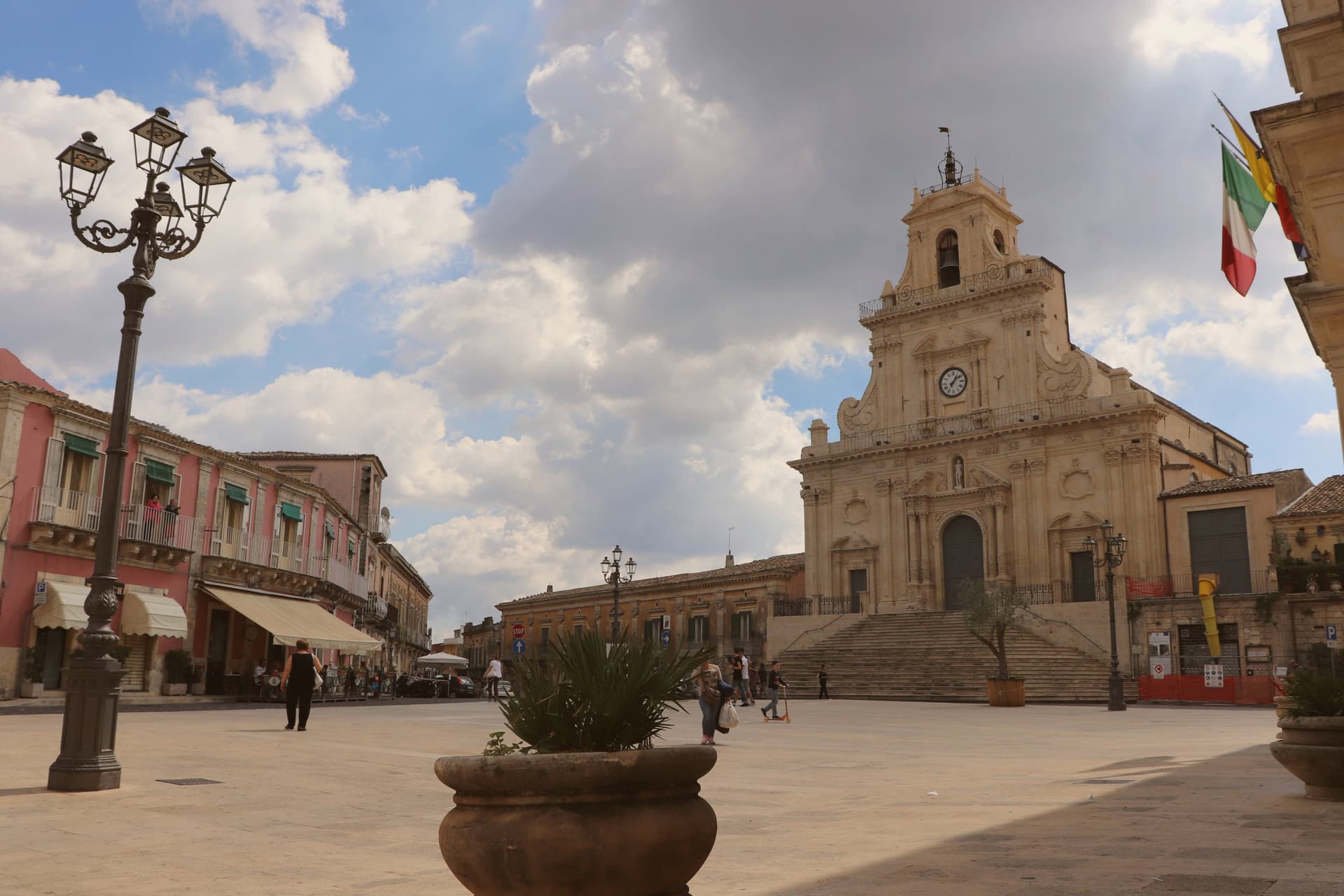
The rebuilding over the following fifty years laid out wide, regular streets and raised palazzi in honey-coloured limestone, with churches given concave façades and elaborate stairways. Beyond the two great set-pieces already named, the Basilica di San Pietro and the Palazzo Iudica-Cafici with its stone-carved balconies round out the Baroque core that UNESCO's inscription emphasizes, and together the two churches, the basilica, and the palazzo form the honey-coloured centre that sits directly above the buried Greek outpost.
Palazzolo also holds a place on the Borghi più belli d'Italia list, and its table carries the same plateau character noted above, extended by pasta with broccolo siciliano and ricotta salata alongside the sausage and truffle. The Festa di San Paolo in late June, with fireworks on the night of the 28th and 29th, is the year's main event.
What sits on the plateau today is a town built twice: once as a Greek outpost guarding a route, once by survivors rebuilding after the ground gave way, and the lower ancient layer and the upper Baroque layer have never fully merged into one story.
What to see in Palazzolo Acreide
- Teatro Greco di Akrai. 600 seats cut into the hillside, acoustics intact, the theatre is still used for summer Greek-drama festivals staged in its original setting rather than a reconstruction.
- I Santoni (Cybele rock sanctuary). The figures sit carved directly into the cliff face, cult images of Cybele set into rock rather than housed in a museum, just outside the modern centre.
- Chiesa di San Sebastiano + Chiesa di San Paolo (UNESCO). Concave façades, curved staircases climbing to the doors, organ-equipped twin towers. Built roughly a decade apart in the rebuilding years, they read as a matched pair from the street below.
How to get to Palazzolo Acreide
There is a railway station in the town, so you can arrive without a car and never need one while you are here. Siracusa is roughly 47 minutes away by road.
Our tip
Palazzolo Acreide is best April–June and September–October. The Iblei plateau at 670m stays much cooler than Sicily's coast — summer 28-30°C vs the coast's 35°C+. The Festa di San Paolo (28-29 June) with its fireworks is the year's headline. Agrimontana – I Sapori degli Iblei falls in October.
Sortino
Why visit Sortino
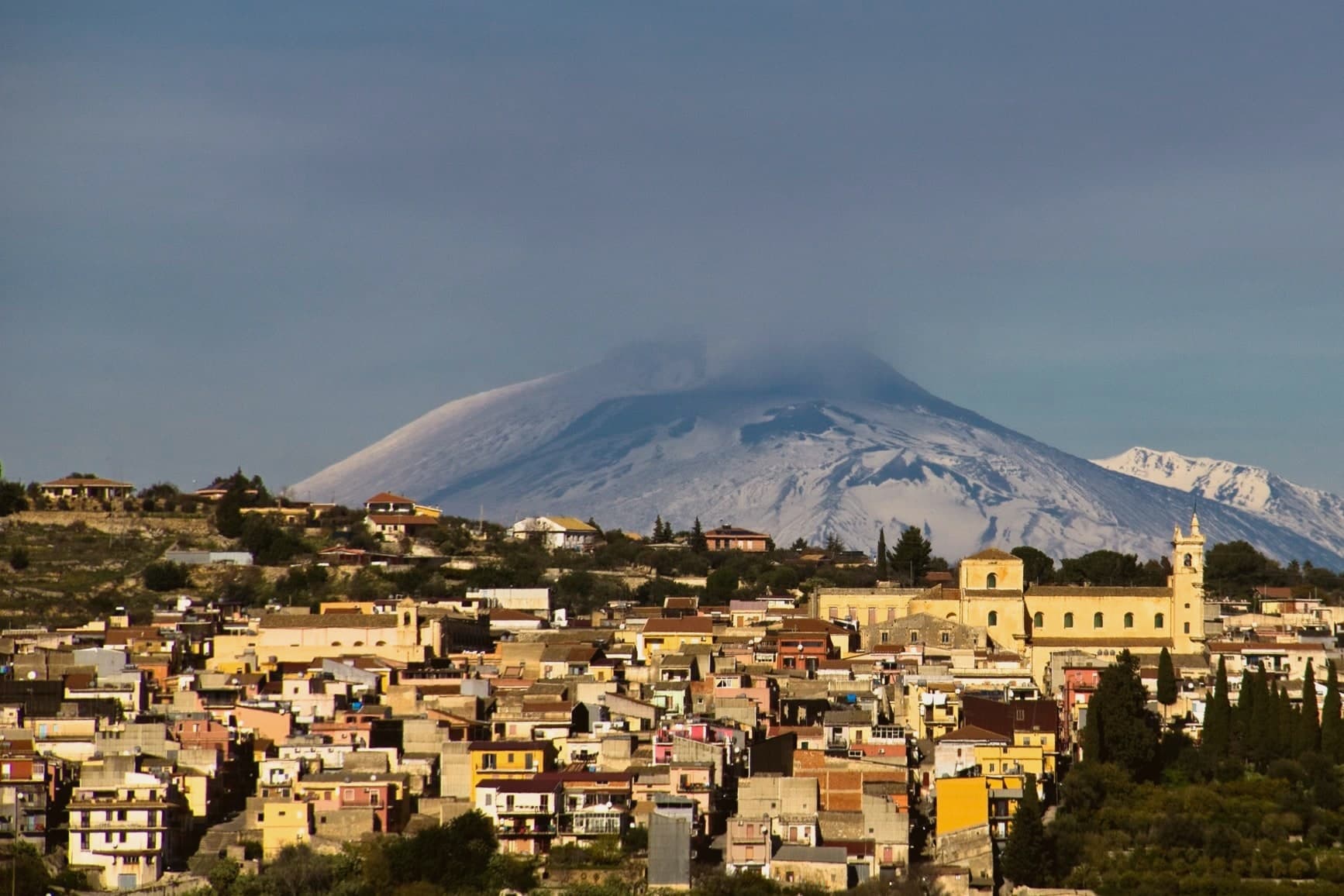
Sortino sits at 438 meters on the eastern Iblei, the other side of the Pantalica plateau from Ferla, sixteen kilometers from the Anapo gorge that holds the necropolis. The 1693 Val di Noto earthquake destroyed the medieval town on a different site; Peter Gaetani moved the rebuild to the current ridge and gave it the baroque grid still visible in the centro storico.
The Necropoli di Pantalica, around four thousand rock-cut chamber tombs from the thirteenth to the seventh centuries BC, sits between the two communes and joined the UNESCO inscription with Syracuse in 2005. Sortino is the official Sicilian Città del Miele, with a beekeeping tradition documented for a thousand years and a Slow Food presidium for the local thyme and orange-blossom honey.
The town's other signature is pizzolo, a 20-centimeter stuffed flatbread topped with olive oil, oregano and parmesan, served only in Sortino and a handful of nearby villages.
What to see in Sortino
- Necropoli di Pantalica. Around 4,000 rock-cut chamber tombs from the thirteenth to seventh centuries BC on the limestone plateau between Sortino and Ferla; UNESCO since 2005.
- Chiesa Madre (San Giovanni Evangelista). Eighteenth-century baroque mother church, rebuilt after the 1693 earthquake on the relocated ridge town under Peter Gaetani.
- Convento di San Francesco. Baroque convent complex with a richly decorated interior, part of the post-1693 rebuild commissioned by Peter Gaetani during the relocation of the town.
How to get to Sortino
Siracusa is roughly 54 minutes away by road.
Our tip
April through June and September through November are the windows for Sortino. The Anapo valley walking trail to Pantalica is open, the limestone tombs cool inside the rock, and the centro storico stays around twenty-two degrees. July and August push past thirty-three at 438 meters; the Pantalica trails close to vehicles and the village empties in the afternoons. Festa in onore di Santa Sofia falls in August.
Noto
Why visit Noto
Noto stands at 152 meters on a Hyblean foothill ten kilometers inland from the Ionian. The medieval town of Netum, on Monte Alveria eight kilometers north, was abandoned after the 1693 earthquake and rebuilt down the slope as Noto Nuova on a single orthogonal grid, the plan that anchors the Late Baroque Towns of the Val di Noto inscribed by UNESCO in 2002.
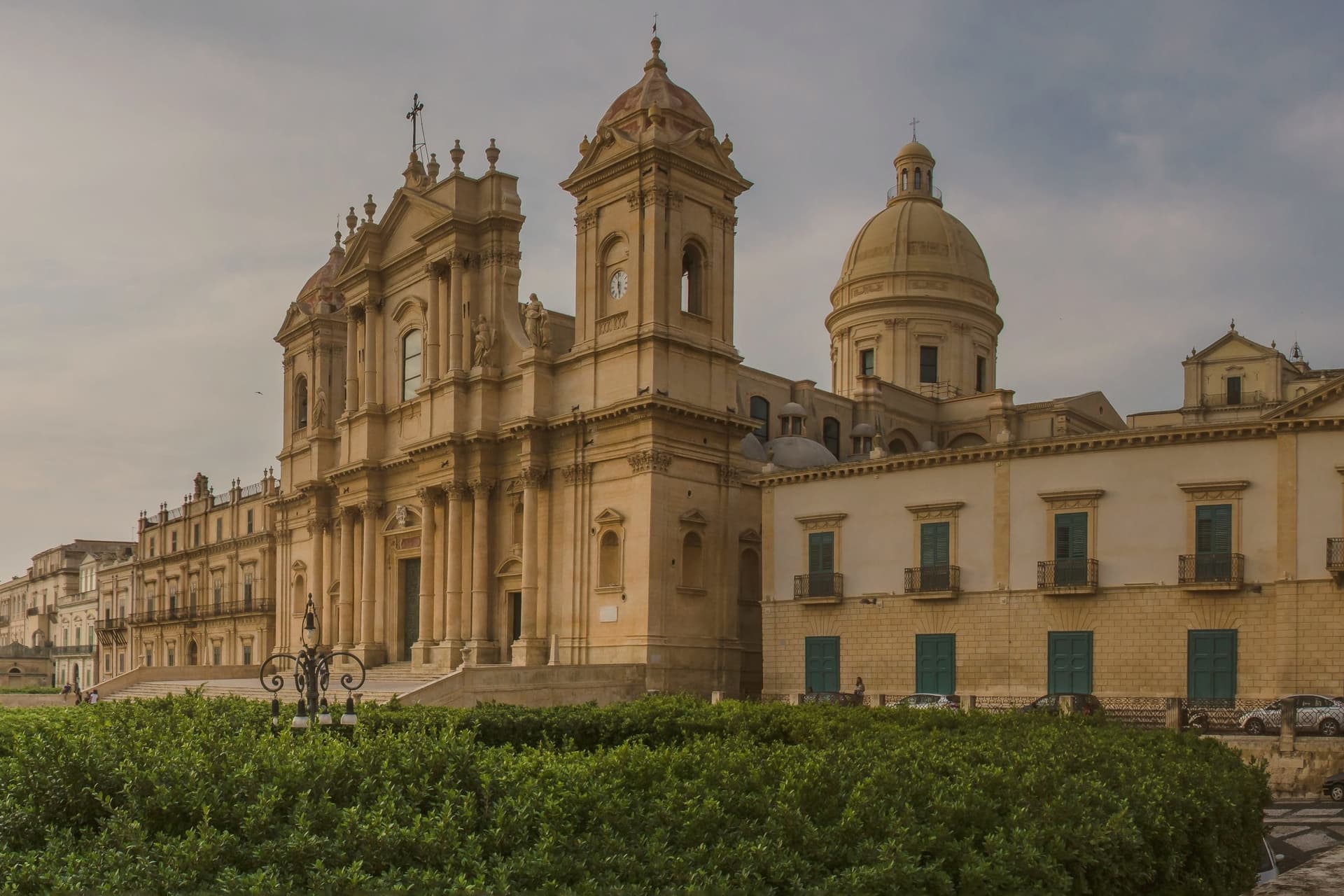
The cathedral sits at the top of its stairs on Piazza Municipio, facing the civic cluster of Palazzo Ducezio across the square. Behind it, the ground rises again into Via Nicolaci, defined by the palace built in 1731 and covered each May, since the early 1980s, in petal mosaics for three days.
Further along Corso Vittorio Emanuele the Jesuit church adds its own bell tower and a view back over the rooftops. Fifteen kilometers south the coast turns to salt marsh and reserve, a different register of the same limestone country.
The local stone itself, a soft tufaceous limestone, turns gold in late light, which is the thread running under the grid, the staircases and the carved balconies alike: a single rebuilding, in a single material, read at every scale from a town plan down to a corbel.
What to see in Noto
- Cattedrale di San Nicolò. The staircase it commands is wide enough to hold the whole width of Piazza Municipio in front of it, so the facade reads as the square's far wall as much as a building in its own right.
- Palazzo Nicolaci di Villadorata. The balconies along the street are carried on carved corbels of grotesques and animals, stone figures that project out over the passersby below.
- Piazza Municipio and Palazzo Ducezio. Civic square facing the cathedral, with Palazzo Ducezio, the eighteenth-century town hall designed by Vincenzo Sinatra after the rebuild.
How to get to Noto
There is a railway station in the town, so you can arrive without a car and never need one while you are here. Siracusa is roughly 42 minutes away by road.
Our tip
April through June and September through November are the right months for Noto. The Infiorata falls on the third weekend of May; Via Nicolaci is closed to traffic and the petal mosaics go down for three days, the largest single event in the calendar. July and August push past thirty-five degrees and the day-trippers from Catania and Siracusa fill the cathedral steps from mid-morning.
Caltagirone
Why visit Caltagirone
Caltagirone sits at 611 meters on the Monti Erei between the plains of Catania and Gela, sixty kilometers inland from the coast. The Arabs took the town in the tenth century and brought the glazing technique that turned local terracotta into majolica; Caltagirone became the first majolica center the North Africans established in Sicily, and the trade survived under Norman, Hohenstaufen and Aragonese rule.
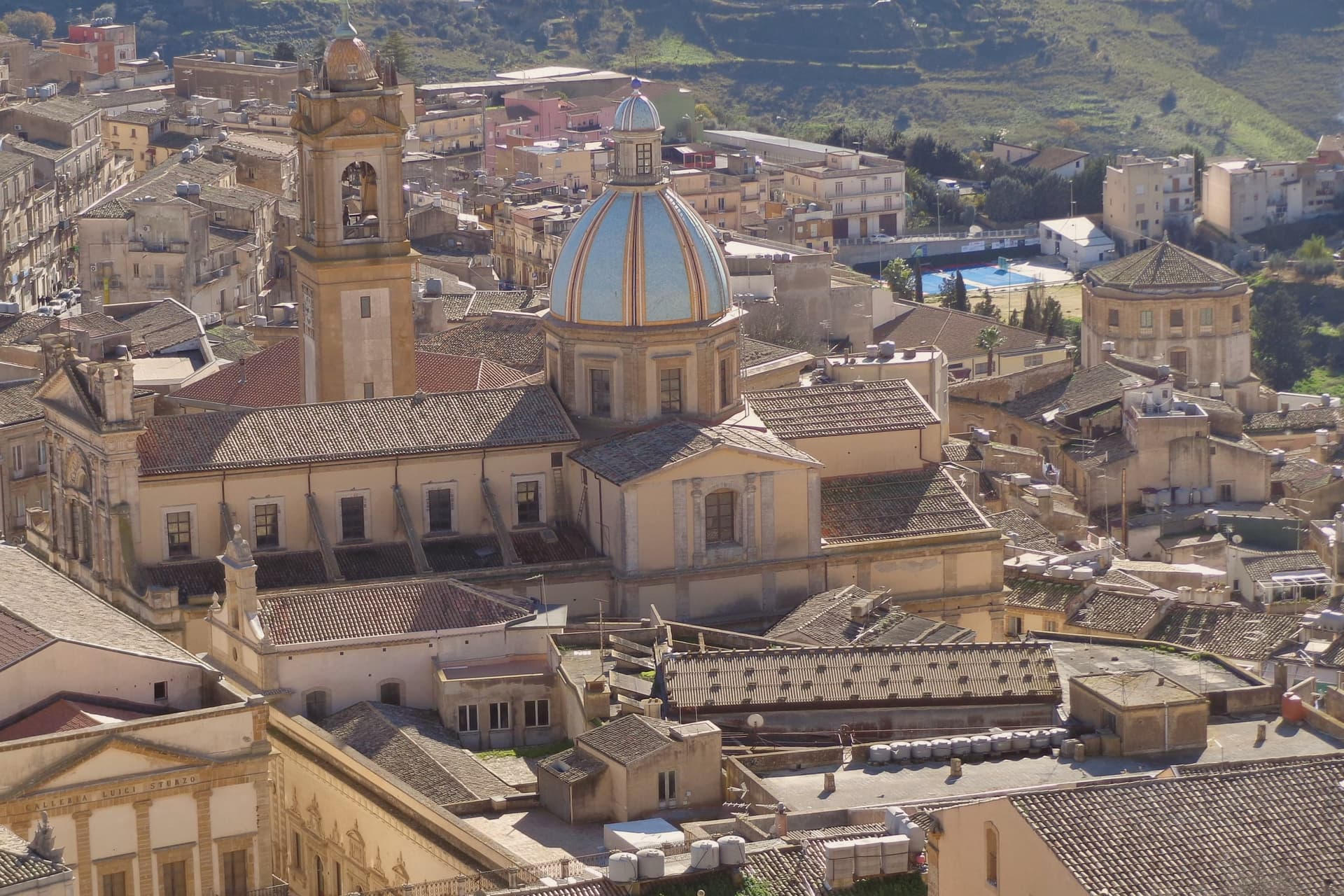
The 1693 Val di Noto earthquake destroyed the city. The rebuild produced the late-baroque centro storico that joined the UNESCO Val di Noto inscription in 2002, alongside Noto, Modica, Ragusa, Scicli and three others.
The 142-step Scala di Santa Maria del Monte, cut in 1606, was tiled in 1956 with majolica risers, each band a different pattern from Sicilian, Arab, Norman and Spanish design traditions. For three days every July, four thousand oil lamps line the steps for the patron San Giacomo.
Ceramic workshops still operate in the old town, the trade unbroken since the Arabs.
What to see in Caltagirone
- Scala di Santa Maria del Monte. 142 baroque steps cut in 1606 connecting lower and upper town, tiled in 1956 with majolica risers, each band a different pattern from the city's ceramic tradition.
- Cattedrale di San Giuliano. Eighteenth-century rebuild of the medieval cathedral destroyed in the 1693 earthquake; neo-baroque façade and bell tower added in the early twentieth century.
- Museo della Ceramica. Regional ceramics museum at the Giardino Pubblico, tracing Caltagirone production from the prehistoric era through medieval Arab glazes to twentieth-century studios.
How to get to Caltagirone
There is a railway station in the town, so you can arrive without a car and never need one while you are here. Catania is roughly 72 minutes away by road.
Our tip
April through June brings the green Erei hills and mild dry weather, the right window for the ceramic workshops and the long climb up the Scala. July and August are hot inland, often past thirty-five, but the four-thousand-lamp Luminaria on 24-25 July is the spectacle the city was built around. September through November is dry and golden, the second best window, with the Scala Infiorata flower display in late spring and the patron's feast already past. Festa Maria SS del Ponte a Caltagirone falls in August.
Monreale
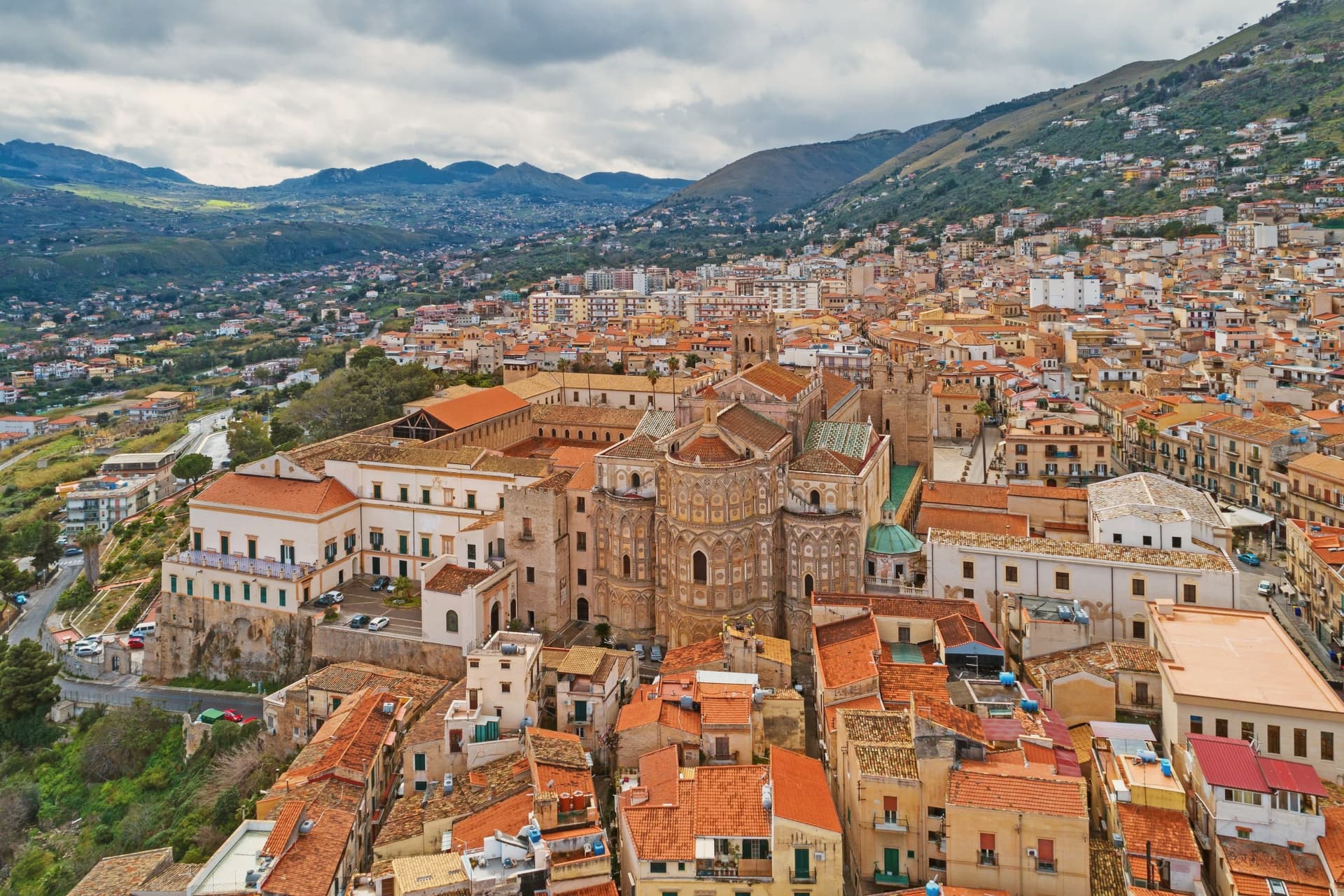
Why visit Monreale
Monreale sits at 310 meters on the southwestern slope of Monte Caputo, eight kilometers from Palermo, looking down across the Conca d'Oro toward the Tyrrhenian. William II of Sicily founded the Benedictine abbey here in 1174 and the cathedral, Santa Maria Nuova, was elevated to metropolitan rank in 1182.
The mosaics inside cover 6,340 square meters, the largest surviving Byzantine cycle in Italy, executed in coloured glass on a gold ground by masters William brought from Constantinople and Venice. The cloister, 2,200 square meters of pointed arches and 216 paired marble columns, is one of the most complete Romanesque cloisters in Europe, with no two capitals carved alike.
The cathedral and cloister joined the UNESCO Arab-Norman Palermo inscription in 2015. The town carries the Città della Ceramica title for the workshops that grew up around the cathedral.
Below the Duomo, the streets fall steeply toward the Conca d'Oro and back up to Palermo.
What to see in Monreale
- Duomo di Monreale (Santa Maria Nuova). Cathedral begun in 1174 under William II, 6,340 m² of Byzantine mosaics in coloured glass on gold ground, the largest surviving Norman mosaic cycle in Italy.
- Chiostro dei Benedettini. Romanesque cloister of 2,200 m² with 216 paired marble columns, each capital carved differently in foliage, biblical scenes and allegory; among Europe's finest.
- Palazzo Reale di Monreale. Twelfth-century Norman royal residence next to the cathedral, partly preserved within the seminary buildings; the rooms William II used during construction of the Duomo.
How to get to Monreale
There is a railway station in the town, so you can arrive without a car and never need one while you are here. Palermo is roughly 44 minutes away by road.
Our tip
April through June and September through November are the right windows. The cathedral is open all year, but the climb from Palermo and the walk down to the Conca d'Oro are easier outside the heat. July and August push past thirty-three in the lower town and fill the cloister queue past two hours; arrive at opening or wait until late afternoon. Grisi' in Festa falls in August.
Modica
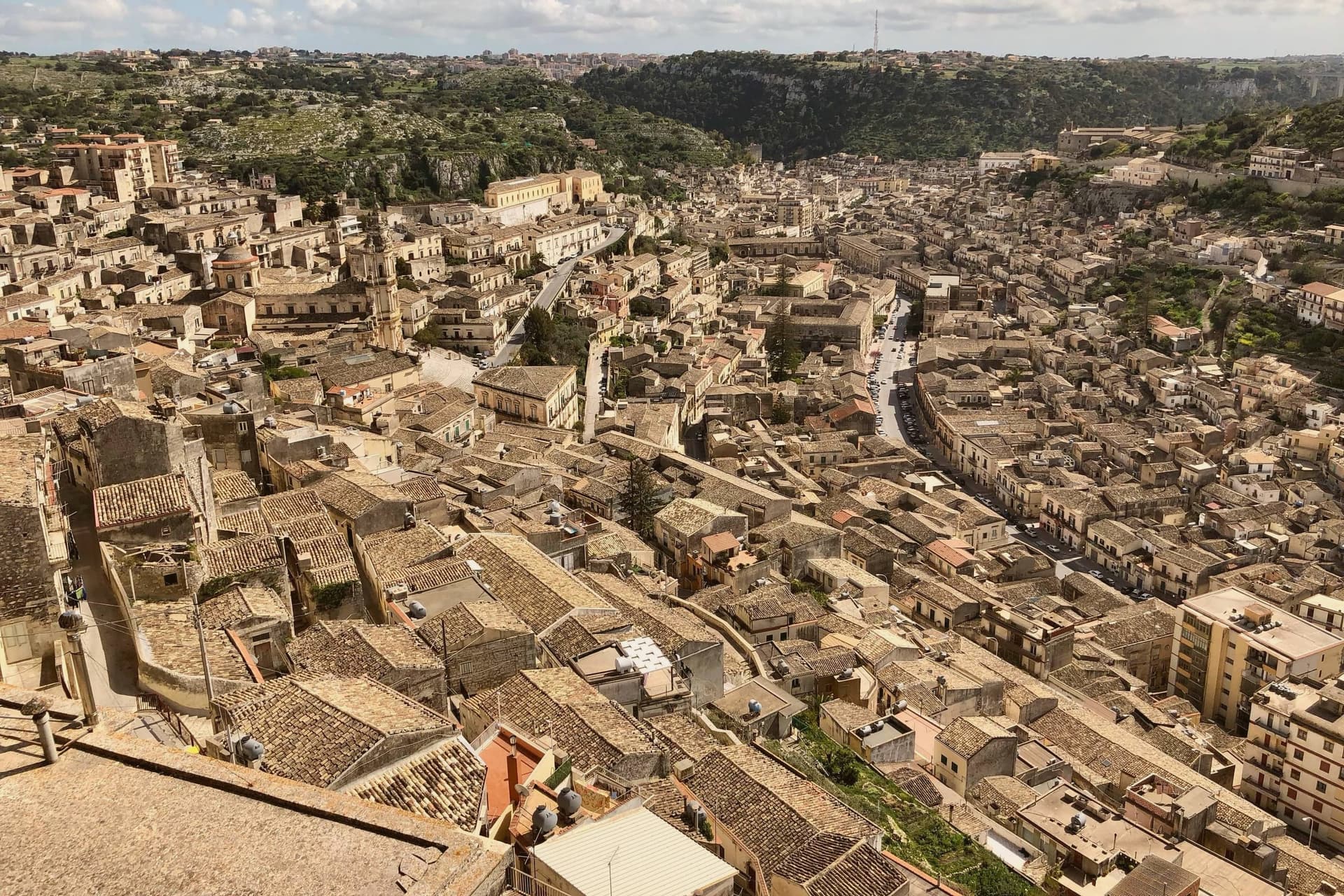
Why visit Modica
Modica sits at 296 meters on the southern flank of the Hyblean Mountains, threaded through two gorges that split the town into Modica Alta on the ridge and Modica Bassa in the valley below. The 1693 earthquake killed roughly three thousand people here and erased the medieval town.
What stands today was built across the eighteenth century by a generation of architects, Rosario Gagliardi above all, who designed the Duomo di San Giorgio at the top of its 250-step staircase. The Duomo di San Pietro answers it from the lower town.
Both are part of the Late Baroque Towns of the Val di Noto, listed by UNESCO in 2002. The other Modica export is older.
Cioccolato di Modica is still made by the cold-working method Spanish settlers learned from the Aztecs, the cocoa mass never melted past forty degrees, the sugar crystals left grainy. It is the only chocolate in Europe with a PGI mark.
What to see in Modica
- Duomo di San Giorgio. Rosario Gagliardi's Baroque cathedral in Modica Alta, three-tiered façade rising above a 250-step staircase, built between 1702 and 1738.
- Duomo di San Pietro. Mother church of Modica Bassa, fourteenth-century foundation rebuilt in Baroque after the 1693 earthquake, twelve statues of the Apostles on the entrance stair.
- Modica Alta and Modica Bassa. Two halves of the old town, upper ridge and lower valley, connected by stairways and the long Corso Umberto I that follows the former riverbed.
How to get to Modica
There is a railway station in the town, so you can arrive without a car and never need one while you are here. Siracusa is roughly 62 minutes away by road.
Our tip
April through June and September through November are the dry, walkable months in Modica, when the staircases of Modica Alta can be climbed without the July heat. The Hyblean inland sits hotter than the Ragusa coast; afternoons above thirty-five degrees are normal between mid-June and late August, and the chocolate shops on Corso Umberto run cooler than the streets. October pulls back the temperature and the cruise-ship day-trippers; the Duomo staircases empty. ChocoModica falls in October.
Ragusa
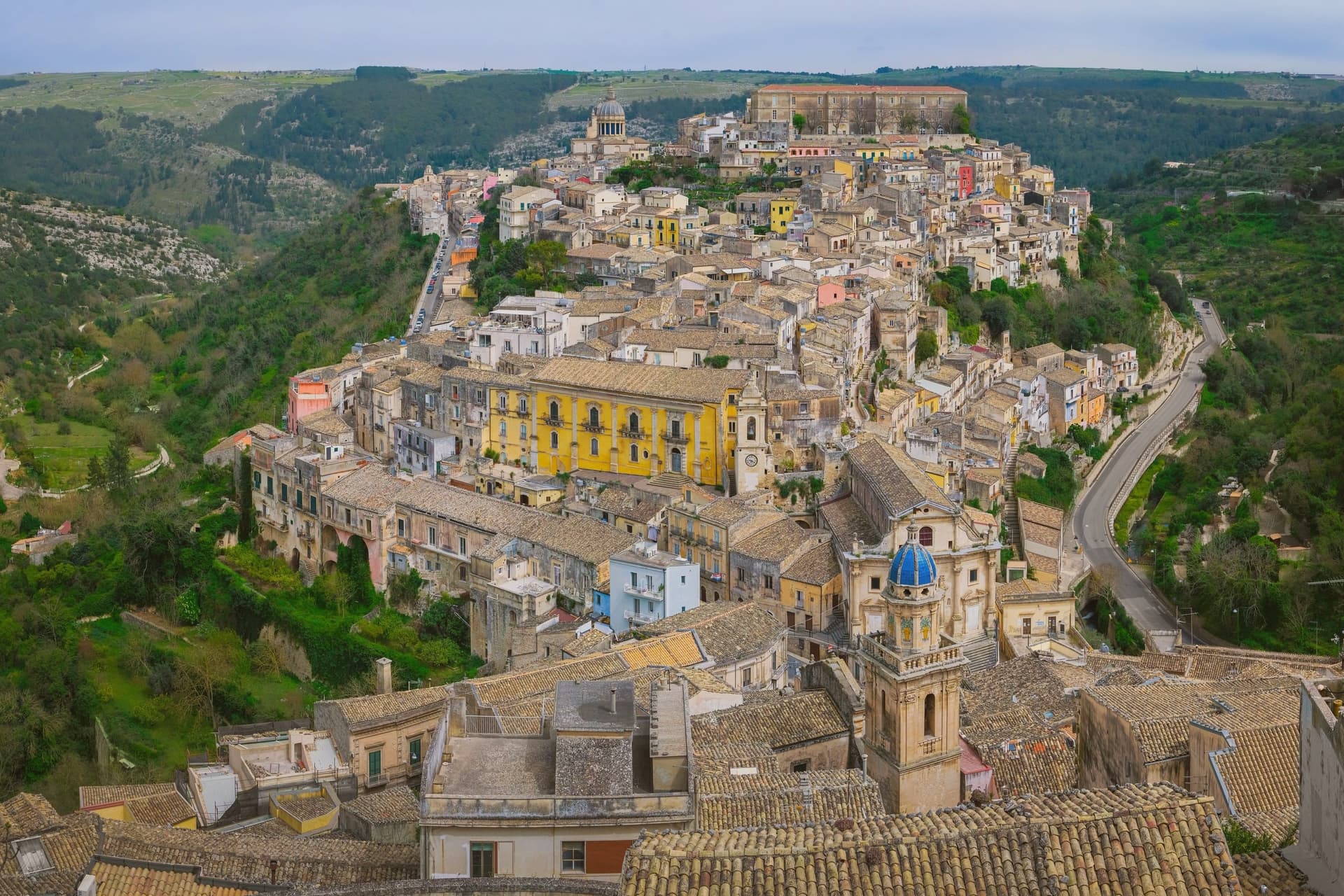
Why visit Ragusa
The town sits on a Hyblean plateau at 502 meters, sixty kilometers southwest of Siracusa, on a ridge cut by two deep ravines. The 1693 earthquake killed five thousand of its eleven thousand residents and erased the medieval town that stood there.
What followed split the place in two. One faction rebuilt on the old site and kept the ancient name attached to the lower town; the other built a new orthogonal grid on the higher ridge to the west and became Ragusa Superiore.
The Valle dei Ponti separates them, crossed by four bridges, and both halves were inscribed together in 2002 as part of the Late Baroque Towns of the Val di Noto. The two cathedrals face each other across the divide, one anchoring each half, evidence that the split was never resolved so much as built into stone twice over.
What the earthquake broke, the rebuilding fixed into a permanent argument between two street plans on the same ridge: one curled and medieval in outline, the other laid out square.
What to see in Ragusa
- Duomo di San Giorgio. Built 1739-1775, three-tier convex façade above a wide staircase that formed the opening shot of the Montalbano titles.
- Cattedrale di San Giovanni Battista. Eighteenth-century Baroque cathedral on the principal piazza of Ragusa Superiore, balancing the other cathedral across the ravine.
- Valle dei Ponti. Deep ravine separating the two halves of the town, crossed by four bridges including the eighteenth-century Ponte dei Cappuccini and the modern Ponte Nuovo.
How to get to Ragusa
There is a railway station in the town, so you can arrive without a car and never need one while you are here. Siracusa is roughly 90 minutes away by road.
Our tip
April through June and September through November are the right months for the two halves of Ragusa. The Hyblean plateau holds the heat in July and August, often above thirty-five degrees, and the Ibla stairs empty between two and five every afternoon. The Ibla Buskers street festival arrives the first weekend of October and fills the lower town with musicians for three nights.
More from Anywhere Italy
 The 6 best hill towns with a serious restaurant in Sicilia
 The best hill towns within 90 minutes of Siracusa
 The best hill towns within 90 minutes of Catania
 The best cheese towns within two hours of Catania
- The best towns with a food festival in Sicilia
 The 7 best towns you can reach by train that are worth a night in Sicilia