
The best towns worth staying overnight in Piemonte
Piemonte is a region best measured in evenings. The Langhe hills turn the colour of wet brick in late October, when the nebbiolo harvest is in and white truffle appears grated over tajarin in dining rooms that smell of butter and woodsmoke. Further north the light behaves differently, falling on Lake Maggiore and Lake Orta in long silver bands, on villas with iron balconies and on granite walls built by masons who worked the same quarries for generations. In the high valleys the houses are timber and stone under heavy slate roofs, the winters long, the food closer to Switzerland than to Turin: polenta concia, toma cheese, boiled meats with green sauce. All of it is better after dark, when the day visitors have gone back to their cars.
Most people see Piemonte from Turin, and Turin deserves the attention: the arcades, the Egyptian collection, the historic cafes serving bicerin. But the city fills its hotels with people who then drive out in the morning, reach a vineyard or a lakeshore by lunch, and return the same night. The result is a region experienced entirely between eleven and four, at the hours when the terraces are full, the cellar tours are booked out and the roads through the hills move at the pace of coaches. The wine villages in particular absorb an enormous amount of daylight traffic and then empty completely.
The hills and the lakes do not stop where the day trips turn around. The same nebbiolo slopes continue past the well known cellars into smaller villages with castles and one good restaurant; the same lake water laps against islands and quiet promenades further up the shore; the same valleys climb towards Monte Rosa and the French border, where towns run on skiers and walkers rather than tour buses. These are the places in this list, chosen because each has somewhere to sleep that a travel guide has vouched for, which means the evening is available to you. Fewer people stay here, which is most of the point.
Of the 65 communes we have mapped in Piemonte, 7 qualify as towns worth staying overnight: each has a hotel a travel guide has vouched for, so you can stay rather than day-trip. The smallest, Serralunga d'Alba, has 527 residents.
Two more lists worth reading alongside this one: The best small towns with a serious restaurant in the province of Cuneo and The best ski towns in Piemonte.
Serralunga d'Alba
Why visit Serralunga d'Alba
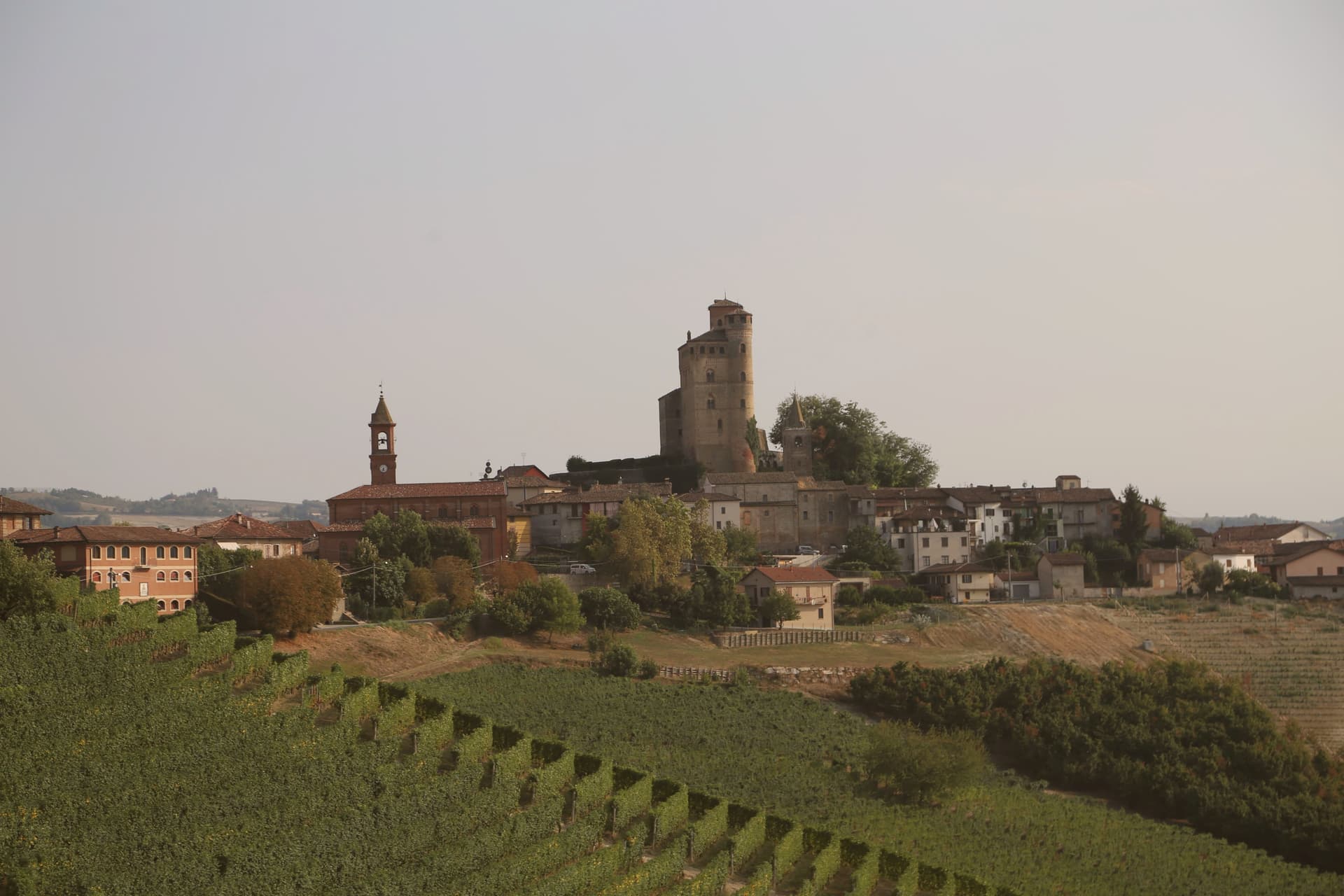
Serralunga d'Alba sits fifty-five kilometers southeast of Torino, in the centre of the Barolo DOCG, on a ridge so long and thin that the village is built as a single file along it. The Falletti family of Asti, merchants and bankers rather than warriors, acquired the territory and rebuilt the castle between 1340 and 1357 under Pietrino and his son Goffredo II, demolishing an earlier tower to put up the donjon in its place.
The choice of plan mattered: a French-style tower was unusual for Italy, and its narrowness was a statement of control over the productive land below rather than a defensive necessity. The layout of the borgo follows from this.
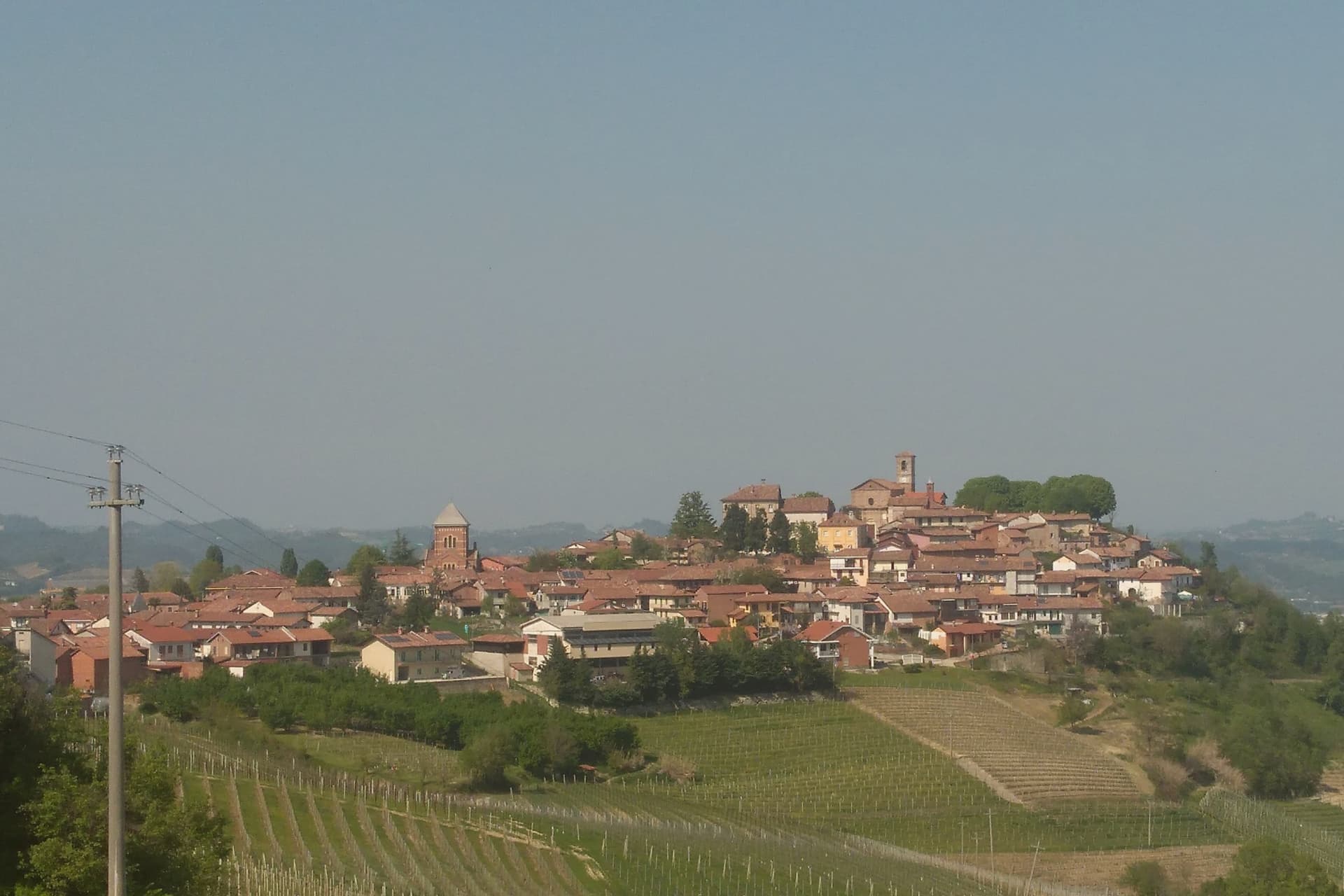
Houses run in a line along the crinale from the castle down to the parish church, so the two structures anchor the settlement at either end, administrative power at one point, religious life at the other, with the village strung between them. The vineyards that surround the ridge on all sides are what the castle was built to oversee, and what later brought international recognition to the same slopes.
A defensive tower repurposed as a counting house, a village laid out to serve it, and vineyards inscribed for the same landscape they were always part of: the place reads as one continuous arrangement rather than three separate attractions.
What to see in Serralunga d'Alba
- Castello di Serralunga d'Alba. Vertical and slim above the ridge, the donjon plan reads at a distance rather than up close, a design meant for administrative control of the land rather than for defense.
- Borgo lungo il crinale. Linear village of stone houses along the narrow Langhe ridge, with a single main street running from the castle to the parish church.
- Parrocchiale di San Sebastiano. Parish church on the ridge below the castle, with a baroque interior on a simpler medieval plan, the religious centre of the borgo.
How to get to Serralunga d'Alba
Torino is roughly 64 minutes away by road.
Our tip
April through June is the green window across the Barolo ridges: vines in leaf, mild evenings, the castle terrace open onto a clear line of cru. July and August touch the mid-thirties on the south-facing slopes; the borgo thins between two and five and the cantine close in the afternoon heat. September and October are the Nebbiolo harvest, when Serralunga's narrow main street fills with tractors and pickers and the wineries open their doors.
Alagna Valsesia
Why visit Alagna Valsesia
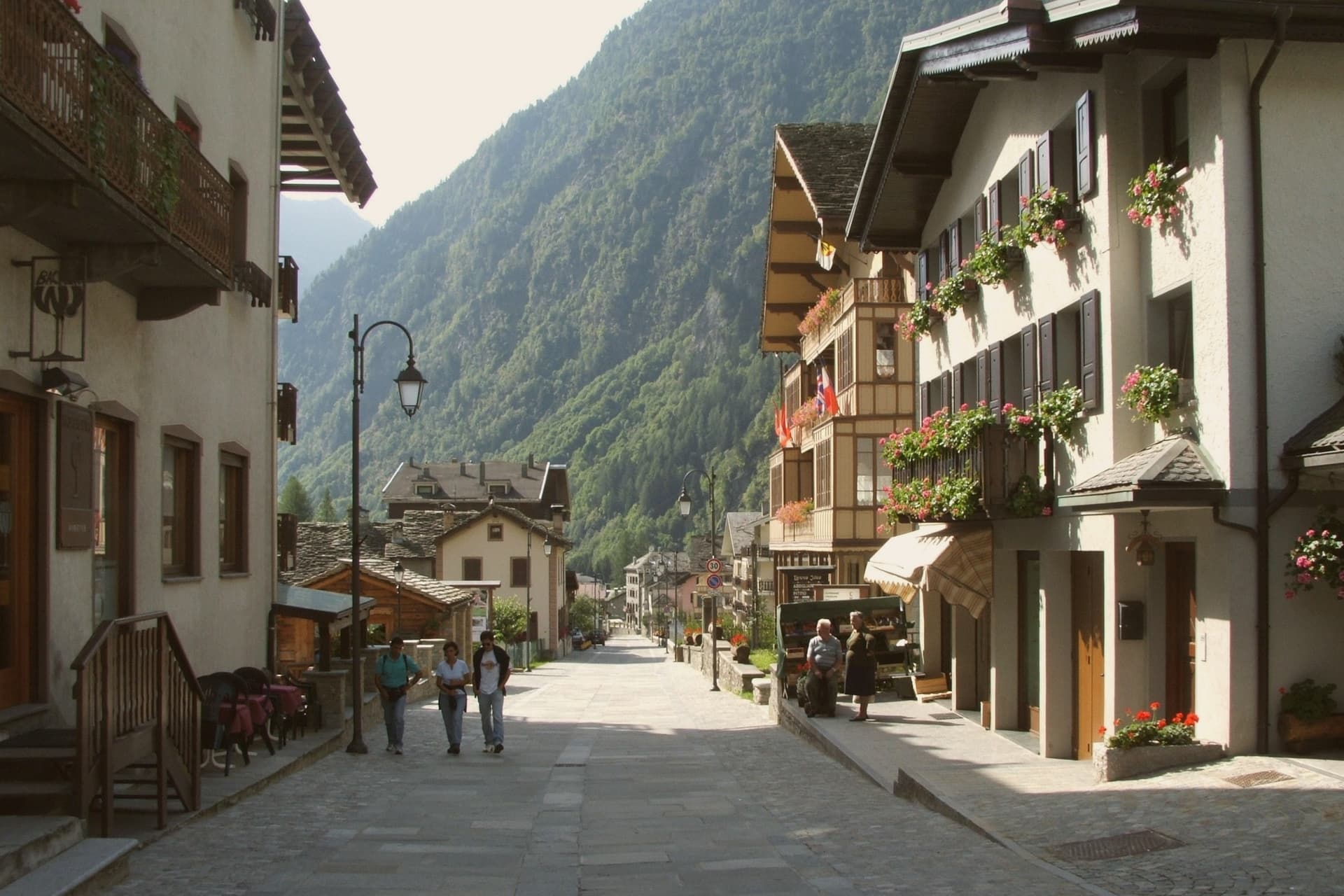
Alagna sits at the head of the Valsesia, at 1,191 meters, where the valley closes against the south face of Monte Rosa, the second-highest peak in the Alps. The commune covers 72.8 square kilometers, the largest by surface area in the province of Vercelli, and its territory reaches from the valley floor up to the glaciers, which is why a single village can hold both the wooden hamlets of the Walser settlers and the lift stations of a major ski domain.
Those settlers came from the Swiss Valais in the thirteenth century and stayed, building in wood and stone between 1500 and 1700; the hamlets of Pedemonte, Riale and Resiga carry that building tradition still. The Guides Association of Alagna, founded in 1872, is the second-oldest in Italy after Courmayeur, a marker of how early the peaks above the village drew climbers rather than skiers.
The lifts came later, opening in stages from the 1950s, and Alagna is now the eastern access to a domain that crosses into the Aosta Valley. Internationally the village is known less for groomed pistes than for the freeride terrain on the massif itself.
The Bandiera Arancione of the Touring Club fires here. The two identities, Walser hamlet and freeride terminus, sit on the same ground because the valley that sheltered thirteenth-century settlers is the same one that funnels skiers up toward the glaciers today.
What to see in Alagna Valsesia
- Frazione Pedemonte. Three-storey wooden houses still standing in their original form, the oldest a Walser hamlet built in the 1500s and 1600s.
- Museo Walser. Opened in 1976 in a 1628 Walser house in Pedemonte, reconstructing the interiors, tools and furnishings of a traditional German-Alpine household.
- Chiesa di San Giovanni Battista. Parish church built in 1511, holding sculptures by Giovanni d'Enrico, the Valsesian sculptor active around the Sacro Monte di Varallo.
How to get to Alagna Valsesia
Novara is roughly 97 minutes away by road.
Our tip
December through March is the ski season Alagna built around itself: lifts open, the Monterosa domain links to the Aosta Valley, and the freeride routes off Punta Indren run as long as the snow holds. June through September is the second season, when the same valleys become hiking and via ferrata country and the temperatures rarely break 22 degrees. April, May, October and November are quiet shoulder months.
Orta San Giulio
Why visit Orta San Giulio
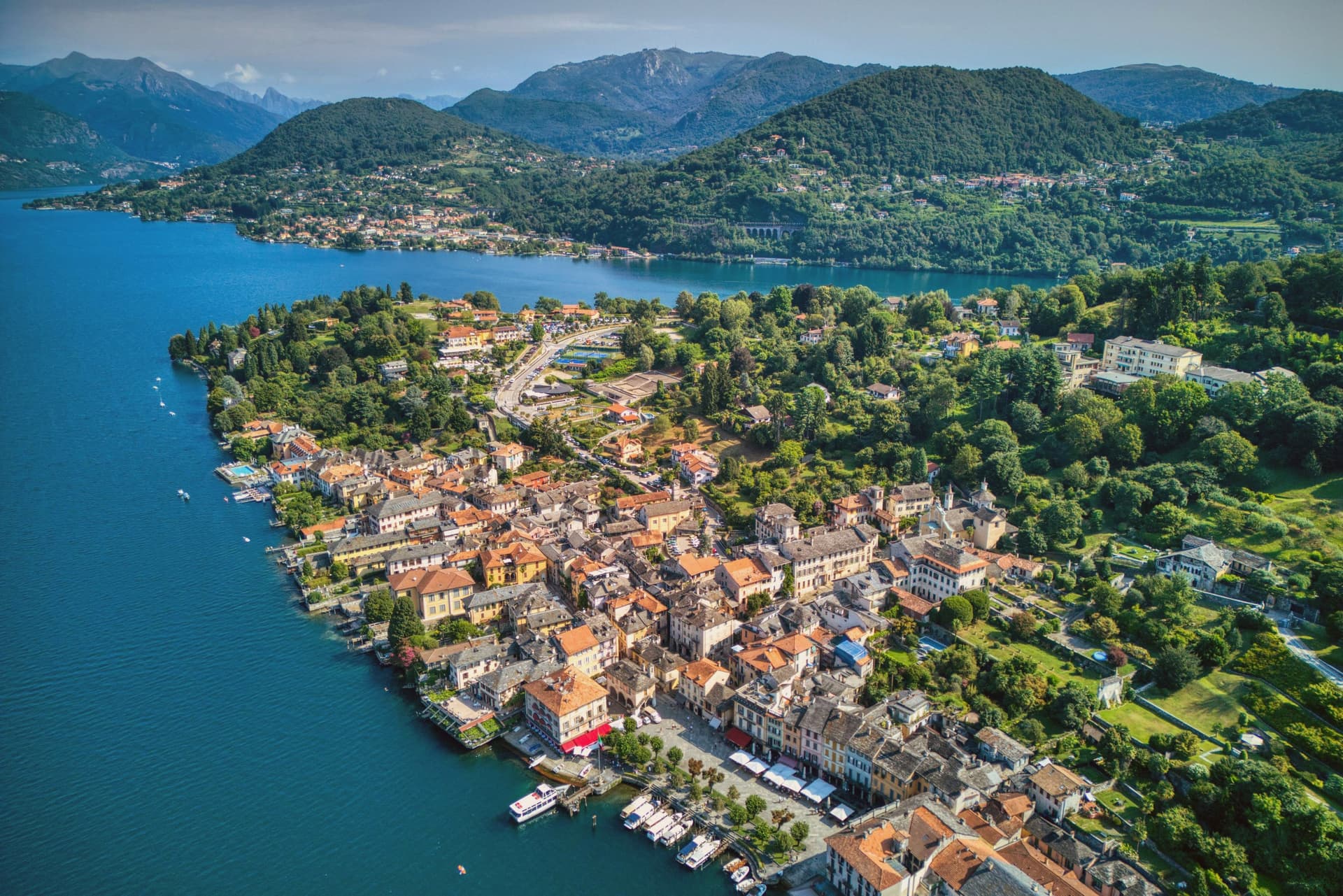
The town occupies a promontory pushed into the eastern shore of the lake, facing the small island 275 meters long and 140 meters wide. The two are close enough that the island reads as an extension of the town rather than a separate place, and a five-minute motorboat from the piazza is the only way across.
The old town holds three Tier-A signals at once: Borghi più belli, Bandiera Arancione, and the UNESCO inscription of 2003. The relationship between the three parts of the town explains how it works: the waterfront square and its lanes sit at lake level, facing the island directly across the water, while the hill above holds the devotional complex, reached by climbing away from the shore rather than along it.
Piazza Motta was also the seat of the Comunità della Riviera di San Giulio, an autonomous federation of lake towns that survived from the Middle Ages to the mid-eighteenth century, which is why the square, not the hill or the island, was built as a civic center. What results is a town in three registers at once: civic life at the water's edge, monastic life offshore, and devotional life on the hill above, each occupying its own ground and visible from the others.
What to see in Orta San Giulio
- Basilica di San Giulio. Serpentine ambo inside and a silver shrine dated 1697. Reached by boat, the basilica stands close to the water's edge, the focal point of the view from every point on the promontory.
- Piazza Motta and Palazzo della Comunità. The broletto's arcades face the water directly, and the square narrows toward the boat landing where the crossing to the island begins.
- Sacro Monte di Orta. The chapels climb the wooded hillside in sequence, each framing a scene, with the town and the lake opening up in views between them as the path gains height.
How to get to Orta San Giulio
There is a railway station in the town, so you can arrive without a car and never need one while you are here. Novara is roughly 46 minutes away by road.
Our tip
April through June brings the Sacro Monte chapels into the chestnut shade and the lake water warm enough for the open-air bars on Piazza Motta. July and August fill the ferry to the island and the piazza turns over by the hour; the centro pedestrian zone slows to a queue at lunch. September and October are the clearest window: low light on the basilica across the water, fewer day-trippers from Milano, and the Sacro Monte path almost empty after eleven.
Limone Piemonte
Why visit Limone Piemonte
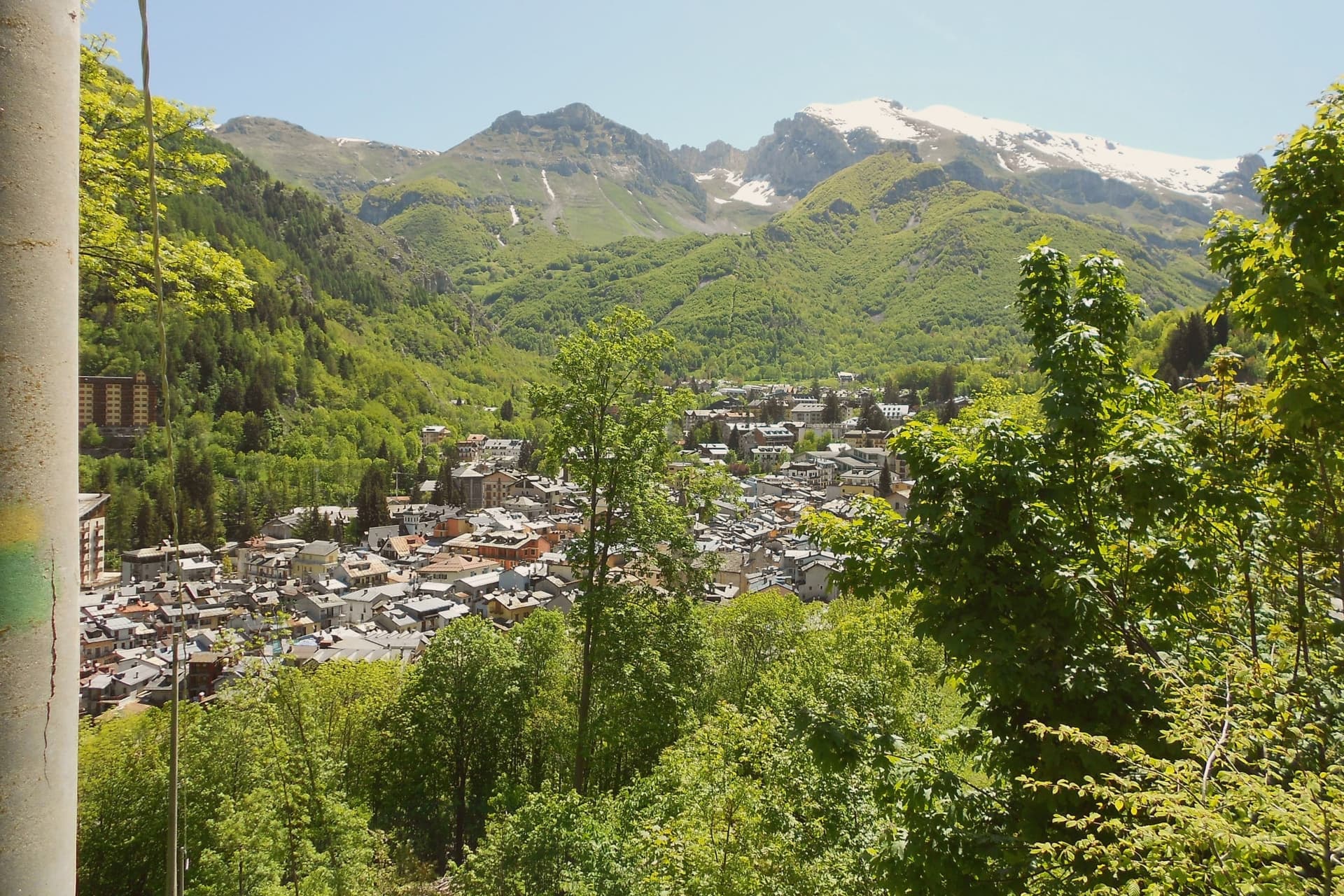
Limone Piemonte sits at 1,000 meters in the Vermenagna valley, twenty kilometers from Cuneo and fourteen from the Colle di Tenda, the historic pass into France. The Riserva Bianca ski domain rises behind the village from 1,050 to 2,085 meters, with eighty kilometers of pistes served by one gondola, ten chairlifts and three drag lifts.
The Cuneo-Ventimiglia railway, opened across this valley in 1900, runs ninety kilometers from the plain to the sea with thirty-three tunnels and twenty-seven bridges, one of the steepest mountain lines in Europe. In the village center, Piazza del Municipio holds a 16th-century stone fountain and the Gothic parish church of San Pietro in Vincoli, with elements of Romanesque and Gothic stonework from the 14th and 15th centuries.
The town empties between seasons and fills twice a year, for the ski months and for the alpine summer.
What to see in Limone Piemonte
- Chiesa di San Pietro in Vincoli. Gothic parish church on Piazza del Municipio, built between the 14th and 15th centuries on Romanesque foundations.
- Riserva Bianca. Ski domain rising from 1,050 to 2,085 meters with 80 km of pistes, the main winter draw of the southern Piemonte Alps.
- Centro storico. Stone village core around Piazza del Municipio, with a 16th-century fountain and a Gothic-Romanesque parish church.
How to get to Limone Piemonte
There is a railway station in the town, so you can arrive without a car and never need one while you are here. Torino is roughly 132 minutes away by road.
Our tip
December through March is the ski season the village was rebuilt for: the Riserva Bianca lifts open, the centro fills on weekends and the railway carries day-trippers up from the plain. June through September brings the second peak, when the same ridges become hiking, grazing and via ferrata country and the Tenda border roads draw cyclists. April, May, October and November are quiet between the two seasons.
Guarene
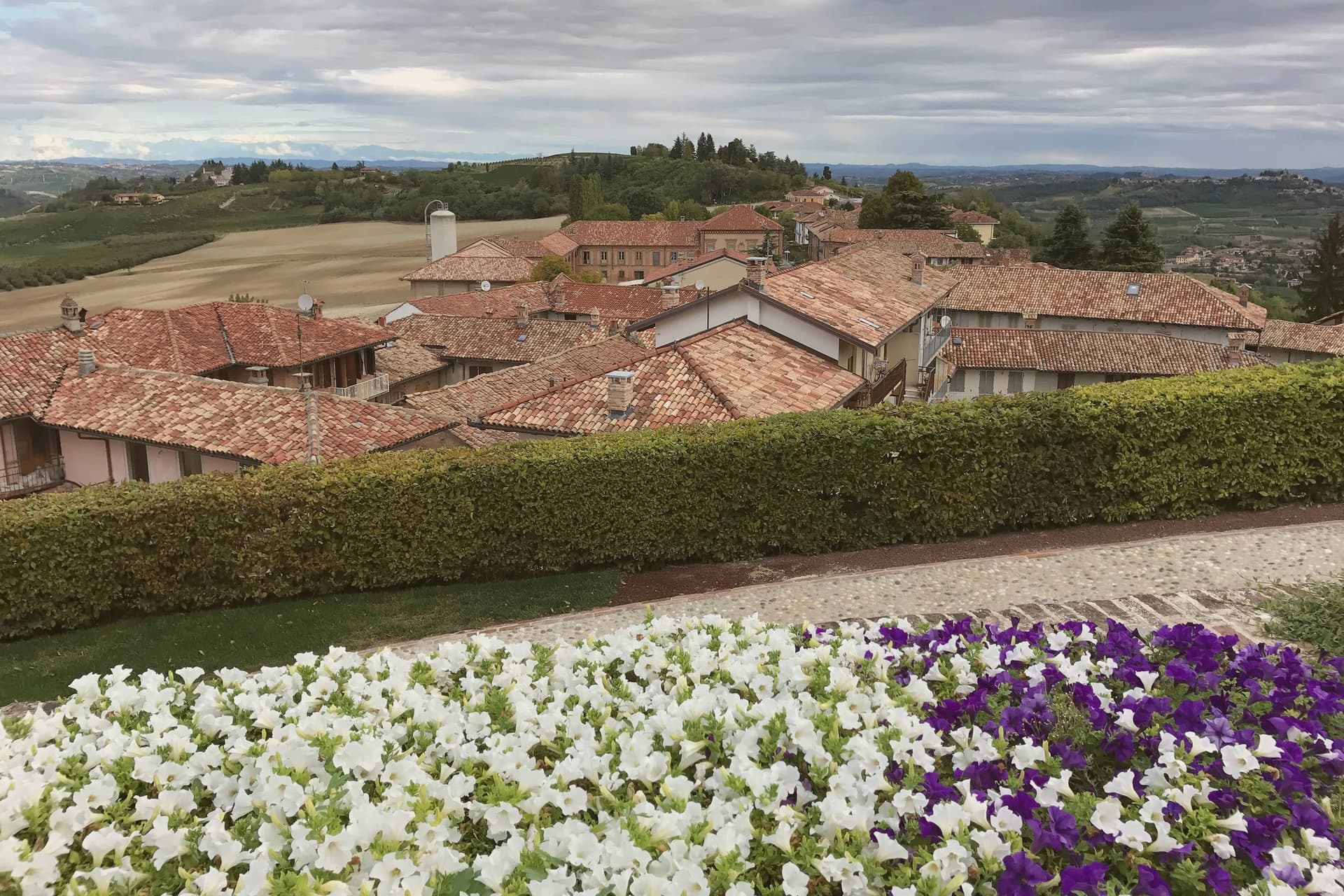
Why visit Guarene
Guarene sits at 360 meters on the left bank of the Tanaro, the last hill of the Roero before the river crosses to Alba and the Langhe. The Roero family, powerful Asti bankers, took the village in 1379 and held it until the line ended with Count Alessandro in 1899.
Count Carlo Giacinto Roero rebuilt the medieval fortress between 1726 and his death, turning it into a baroque summer residence; his sons completed the work and hosted the king and queen of Sardinia here in 1773. The castle is now a Relais & Châteaux hotel with a small museum.
On the slope below the village, the Fondazione Sandretto Re Rebaudengo opened Palazzo Re Rebaudengo in 1997 as its first contemporary art space; the foundation added an open-air sculpture park in 2019 with works by Carsten Höller, Marguerite Humeau, and Paul Kneale set among pear orchards and Nebbiolo rows. The hill carries four institutional signals at once, the highest density of any Roero commune.
What to see in Guarene
- Castello di Guarene. Eighteenth-century baroque castle rebuilt 1726 by Count Carlo Giacinto Roero from a medieval fortress, now a Relais & Châteaux hotel.
- Palazzo Re Rebaudengo. Fondazione Sandretto Re Rebaudengo's first contemporary art space, opened 1997 in an eighteenth-century palazzo in the village.
- Parco d'arte Sandretto Re Rebaudengo. Open-air sculpture park opened 2019 with works by Carsten Höller, Marguerite Humeau, and Paul Kneale among Nebbiolo rows and pear orchards.
How to get to Guarene
Torino is roughly 62 minutes away by road.
Our tip
April through October is the season. May and June green the Roero hills and the castle gardens open. September and October bring the harvest and Arneis bottling; the Tartufo Bianco d'Alba fair in October fills the surrounding villages.
Santo Stefano Belbo
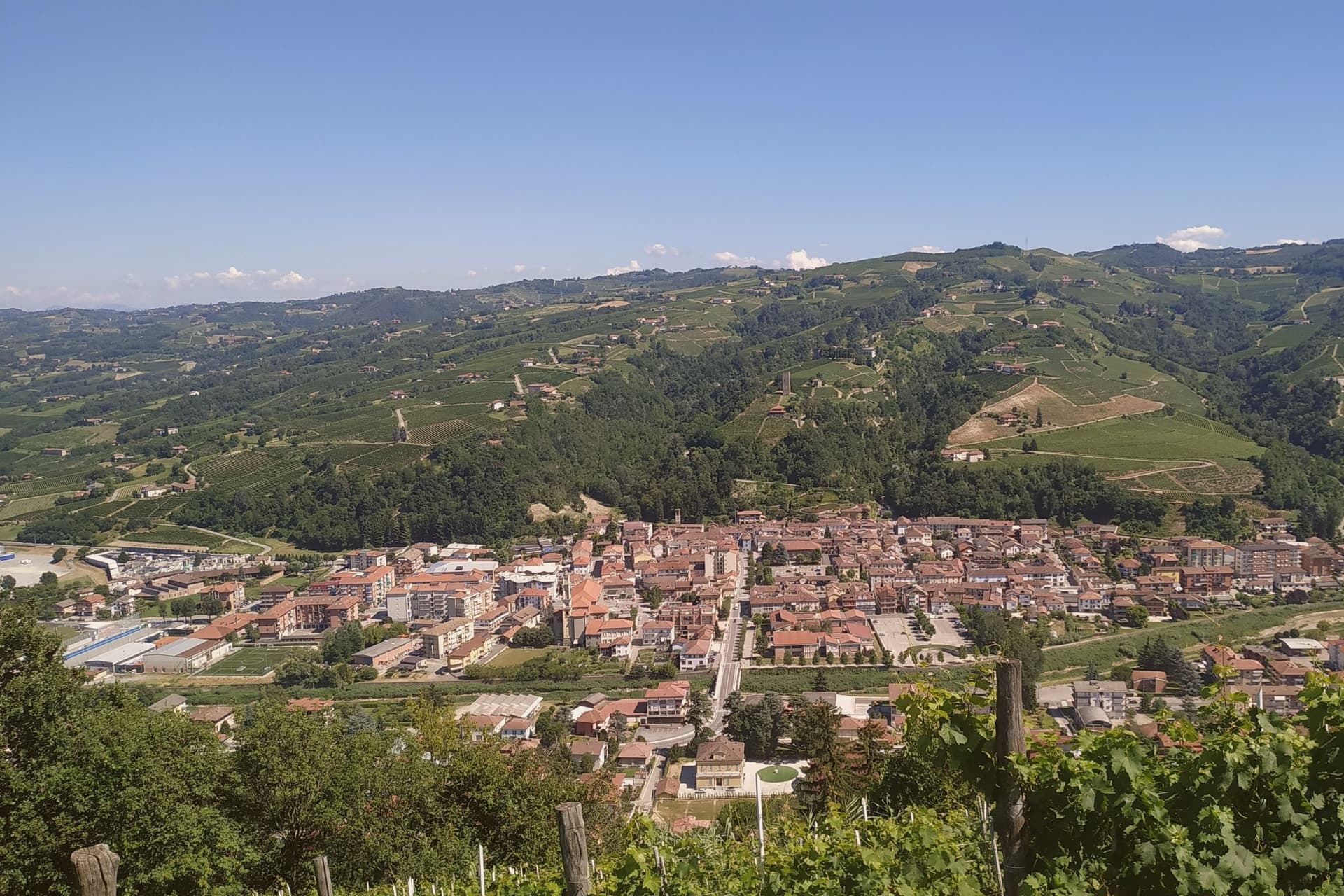
Why visit Santo Stefano Belbo
Santo Stefano Belbo sits at 175 meters on the Belbo, sixty kilometers southeast of Torino, on the seam between the Langhe and the Asti hills. Cesare Pavese was born here on 9 September 1908; his father came from the village and the family returned every summer.
The hills around the town gave him the setting for La luna e i falò and most of his late prose; his birthplace house and the Fondazione Cesare Pavese in the centre keep the manuscripts, photographs and the schoolroom of his early years. The commune is the largest producer of Moscato d'Asti and Asti Spumante in the DOCG, with close to 80,000 hectoliters of wine made each year, 93 percent of it Moscato.
A ruined medieval tower above the town once controlled the Belbo valley road. The recognitions stack up around what the commune actually does: Spighe Verdi for sustainable rural management, Città del Vino for Moscato, Città della Nocciola for the Tonda Gentile hazelnut of the surrounding slopes.
What to see in Santo Stefano Belbo
- Casa natale e Fondazione Cesare Pavese. Birthplace of the writer (1908) and the foundation in the centre, with manuscripts, photographs and audiovisual material on his life and work.
- Torre medievale. Ruined medieval watchtower above the village, the surviving fragment of the fortified core that once controlled the Belbo valley road.
- Convento dei Santi Giacomo e Cristoforo. Benedictine convent and church on the hill above town, traditionally said to stand on the foundations of a Roman temple of Jupiter.
How to get to Santo Stefano Belbo
Torino is roughly 81 minutes away by road.
Our tip
April through June is the green window between the Langhe and the Asti hills, with the Moscato vines coming into leaf and the Belbo valley cool in the mornings. July and August touch the mid-thirties; the village empties between two and five, and the cantine open for tastings only by appointment. September brings the Moscato harvest, the noisiest and most photographed month, with grape lorries on every road. Mercatino senza tempo falls in August.
Stresa
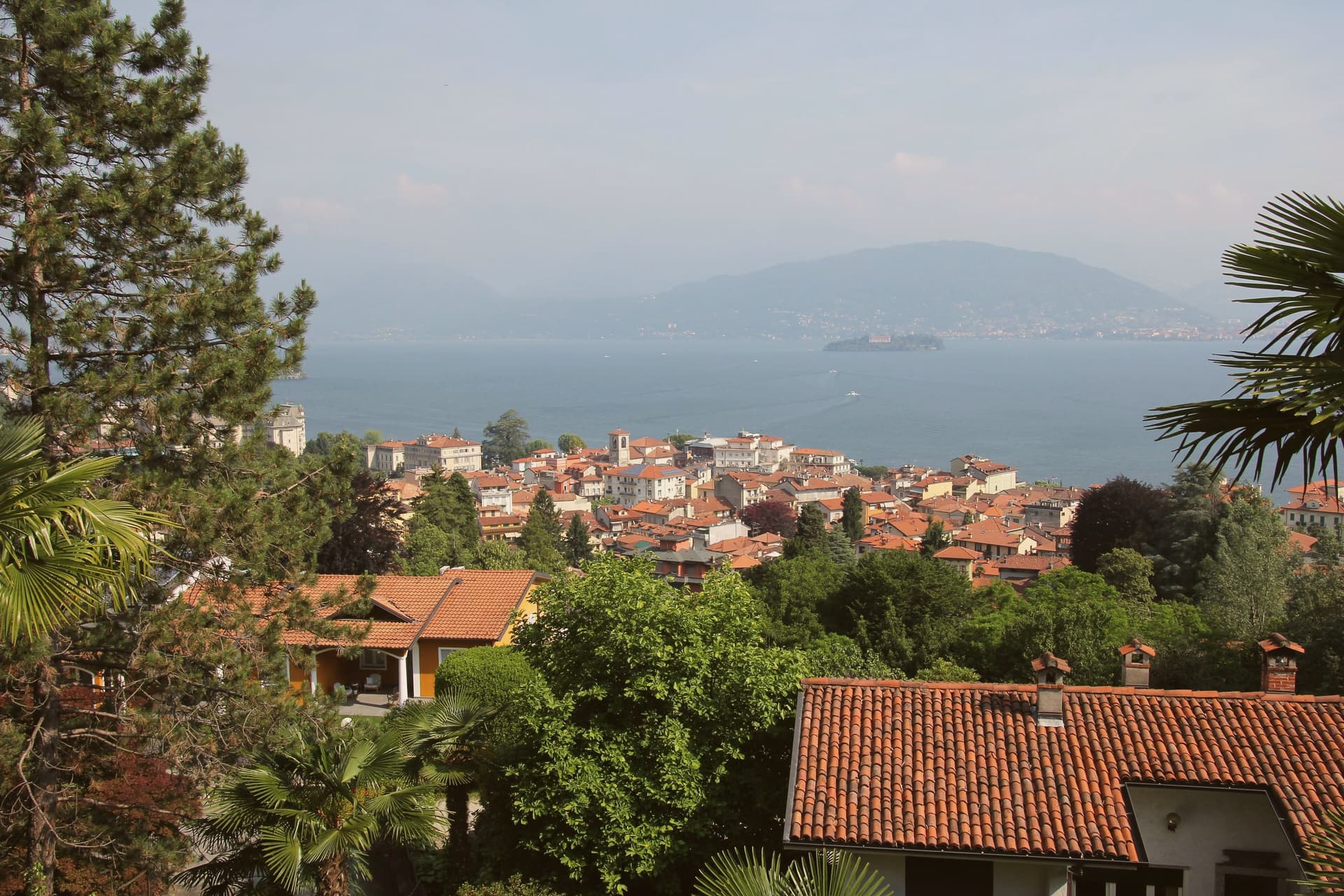
Why visit Stresa
Stresa sits at 200 meters on the western shore of Lake Maggiore, ninety kilometers north of Milano on the line of the Simplon railway. The town first appears in documents in 998, as Strixsya.
From the seventeenth century the lake stage here belonged to the Borromeo family: the palazzo on what had been called l'isola inferiore was begun in 1632, the island renamed after its patron's wife. The other two islands of the group lie 400 meters offshore alongside it, reached by regular ferry from the two town piers, one still inhabited, one given to its park.
Villa Pallavicino, established 1855, sits apart from this cluster on the southern edge of town, its own botanical and wildlife ground answering the islands' gardens without belonging to the same estate. The town's other identity, as a resort, dates to 1863 and the lakefront hotel building that opened international tourism here, later drawing the festival that has filled the town each late summer since 1962.
What Stresa amounts to is a small lake shore town organized almost entirely around water it faces rather than land it occupies: the islands offshore, the piers that reach them, and a lakefront built for arrival rather than settlement.
What to see in Stresa
- Isola Bella. The island sits close to the town piers, its terraced Baroque gardens rising in tiers above the water and the palazzo facing the lakefront directly.
- Isola Madre. The largest of the group, given over almost entirely to its park: paths through subtropical planting and glimpses of the villa between the trees.
- Isola dei Pescatori. The one island still lived in year-round, its lanes narrow between the houses and the trattorie facing the water where the fishing boats once worked.
How to get to Stresa
There is a railway station in the town, so you can arrive without a car and never need one while you are here. Novara is roughly 57 minutes away by road.
Our tip
April through June is the green window on Lake Maggiore: Isola Bella's terraced gardens in flower, the ferries running full timetable, and the lakefront promenade open without the August press. July and August are warm and crowded; the centro empties between two and four in the afternoon heat, and the islands fill on day trips from Milano. The Settimane Musicali run from late August into September, the busiest cultural weeks of the year.
More from Anywhere Italy
- The best small towns with a serious restaurant in the province of Cuneo
 The best ski towns in Piemonte
 The best small towns you can reach by train that have a serious restaurant in Piemonte
- The 7 best small wine towns with a serious restaurant in Piemonte
- The 10 best hidden wine towns that eat well within 90 minutes of Torino
- The best small wine towns within 90 minutes of Torino